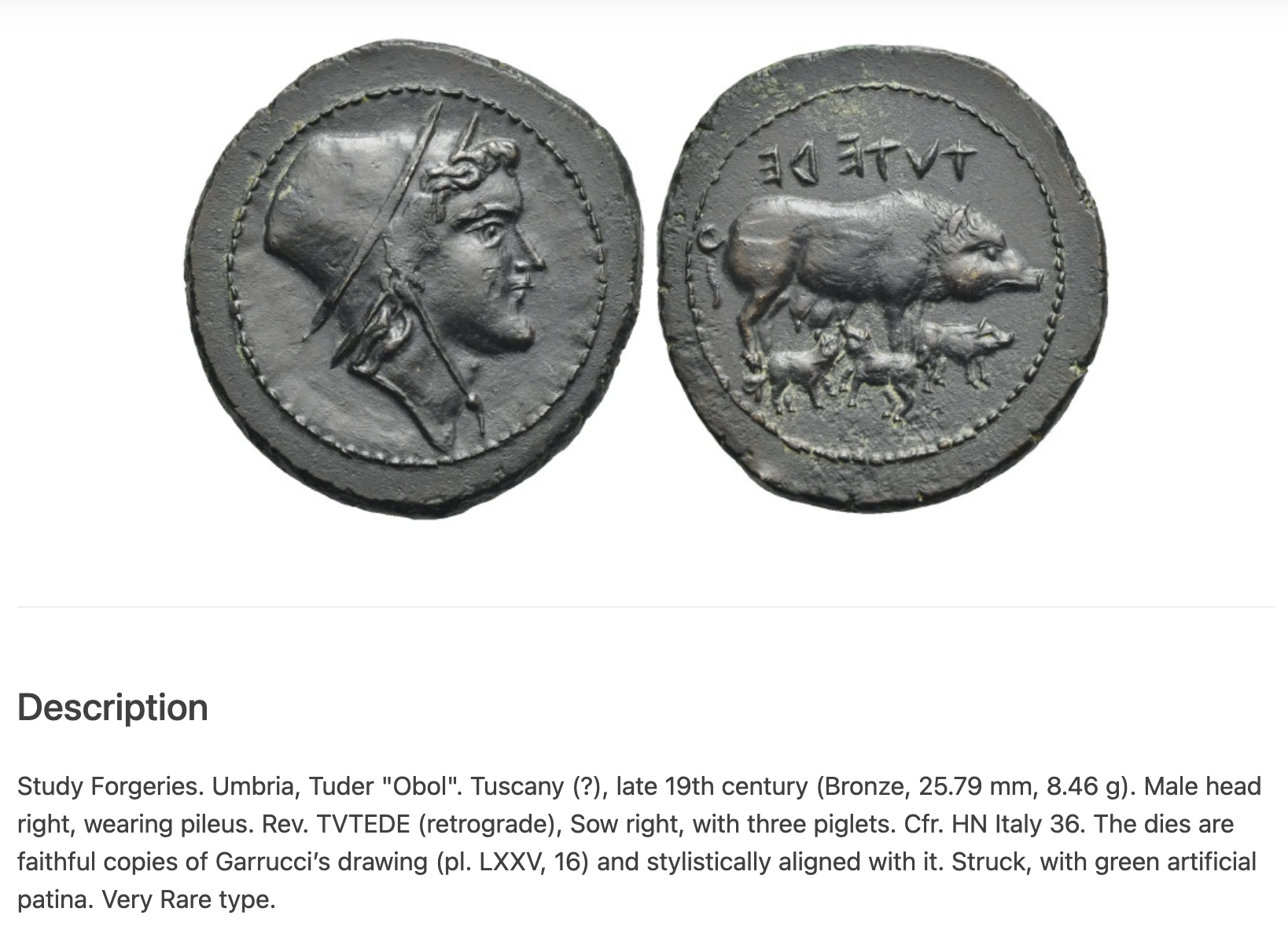
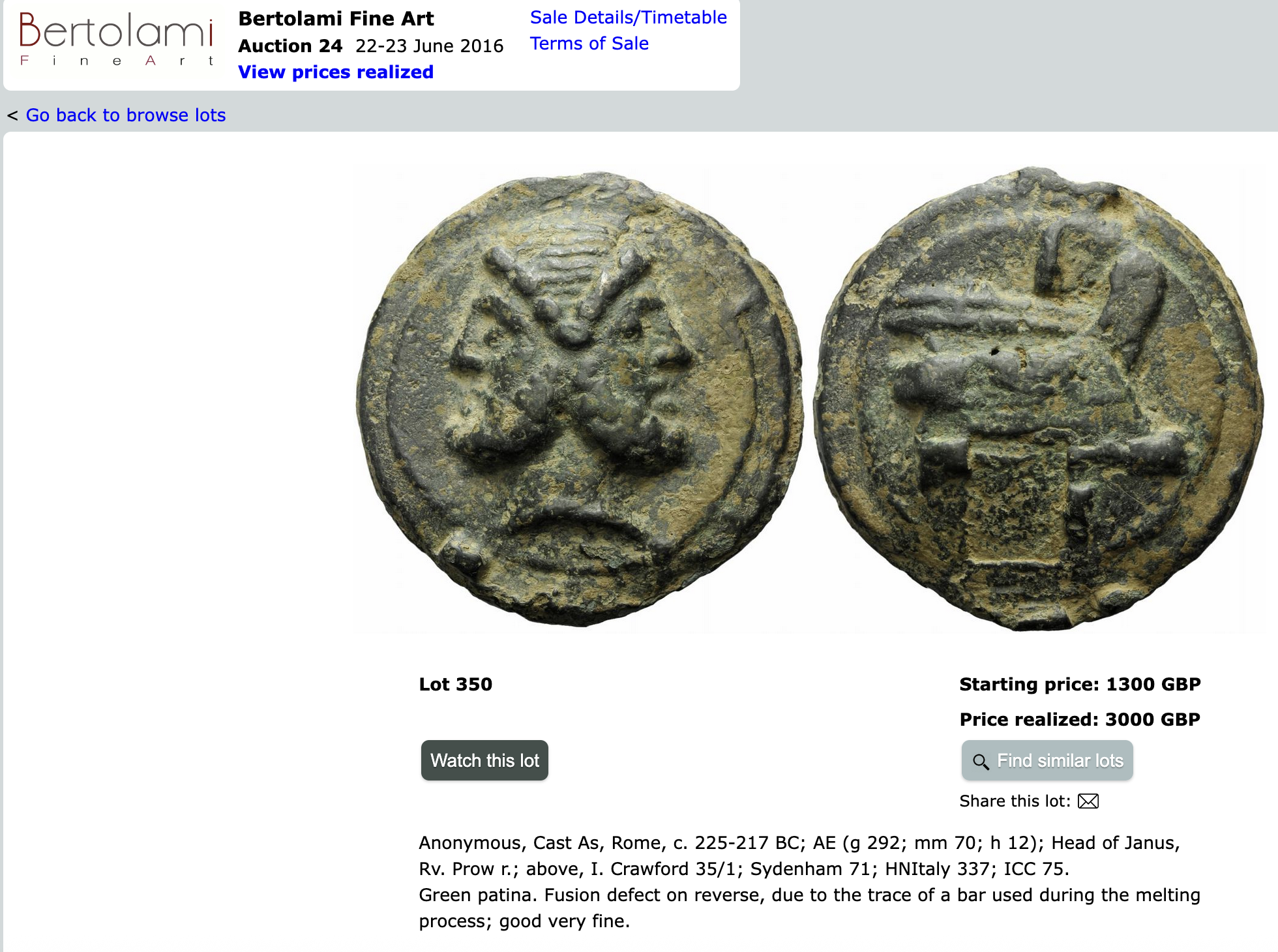
Thanks to a comment by John B. Van Sickle I had the opportunity to read this 2022 post. I find myself largely in agreement with your line of thought. Regarding the engraved plates in the early numismatic literature, which may have influenced certain forgers, there are indeed several documented examples of this phenomenon ( https://www.biddr.com/astarte/auction?a=6047&l=7450876 ). As for the structure and material of the moulds: some time ago I came across a cast as that showed a very peculiar mould trace on the reverse: it almost looked as if there had been a supporting strip, or more likely a repair patch in the mould matrix. This is a feature I had never encountered before and one that would be difficult to reconcile with stone moulds ( https://www.numisbids.com/sale/1573/lot/350 ).
Andrea Pancotti commenting on a January 2022 Post on this Blog
His comment is too valuable to be lost in the bowels of this blog. And frankly, I’d forgotten about that 2022 post and how much it captures my thinking before I started my metallurgical analyses. All these questions I was asking are still very much part of why I’ve been writing (and winning!) grants.
A correction. The coin from the Badian collection the one I was sure was a forgery, tested just fine under pXRF analysis. It fits comfortable in with a body of surface readings from specimens presumed to be genuine. Yes, I nearly fell out of my chair when those readings came in and re ran it again and again until I was certain. That doesn’t mean it is genuine. The only way to be sure a coin is real to for it to come out of a documented undisturbed archaeological context. However, what this did teach me is that style and stylistic variation are not reliable means alone of judging authentication. A good forger can emulate style. (Becker to name one of the greatest.) A good forger can melt down old coins to make a better fake. (I worry about this with disputed Brutus Aureii a great deal.).
I’ll want to think more about that above miscast more once we get to experimental archaeology and attempts to replicate the casting process of aes grave once we’re satisfied we know the original recipe. Maybe, hopefully, after this next set of experiments in May at Isis. Right now based on surface analyses and preliminary muonic xray results were pretty sure we know the approximate admixture and are confident it has almost the same if not more lead than tin. So much lead the admixture isn’t a true alloy and that it is very hard until we have more data to model how cooling will have effected readings at different depths. The other major question from experimental archaeology will be replicating the quelching process for the aes grave. In the air? with water? In the mold? Does the mold retain heat? It is even possible that heat was used to slow the cooling process in some way like is common now in modern glassblowing for large heavy pieces.
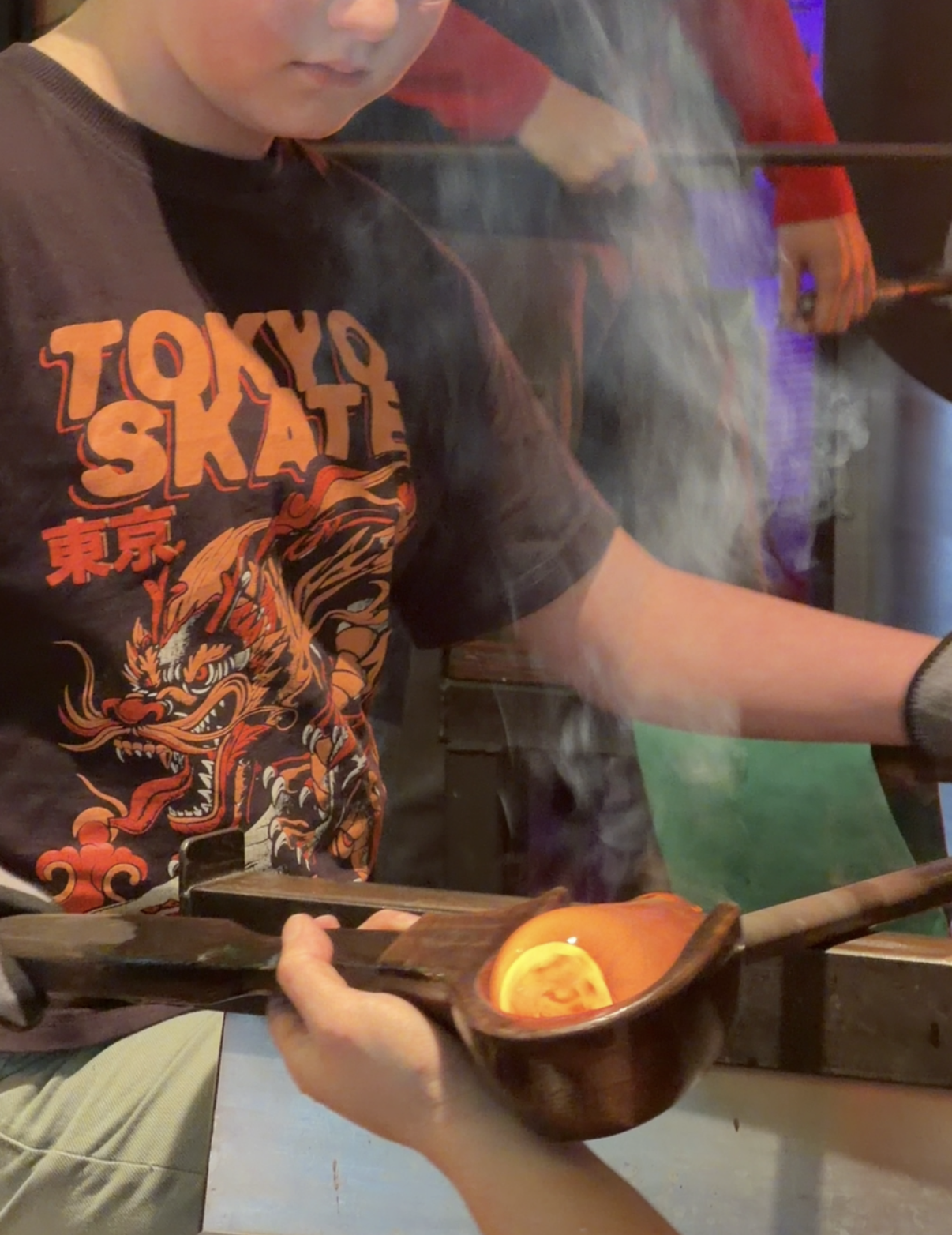
Why yes! My almost 11-year-old kiddos did just make glass paper weights yesterday and we cannot pick them up until Wednesday as they have to sit in the kiln to cool properly for the colors to form and cracking not to occur. And yes, the whole time I watched all I did was think about ancient manufacturing processes.
If there was a way to search replace my whole blog for spue to sprue, I would. It is one of my worst and most insidious typos. And yet, there ya go. I am a typo-queen.
Now one more pesky thought.
I’ve been worried for a while about an unusual RRC 25/1 sold in the Hirsch 1914 auction and illustrated by both Marchi and Garruccii in drawings. I’ve held what I believe to be this coin, now in a private collection.
The wing shape on. the helmet of Mercury is very very strange it has a single sweeping curve on the left rather than the more familiar S shape.
Now I’m wondering if the specimen might derived from a bad drawing in a catalogue!?!? Not a happy thought. But again no archaeological context no real way to authenticate anyway. We can just say unusual style.
I still want to know how the Hirsch sale ended up with so many coins that probably should be in the National collection at Rome…. There is 100+ year old mystery of how exactly stuff moved from Museo Kircheriano to new places… One day I’ll dig up answers. Or perhaps someone will save me the time and just clue me in!
Further key words: Tuder

 Liv Mariah Yarrow