
WARNING: This blog post contains SPOILERS about Greek myth and history, a little Shakespeare, and a 1991 SF novel.
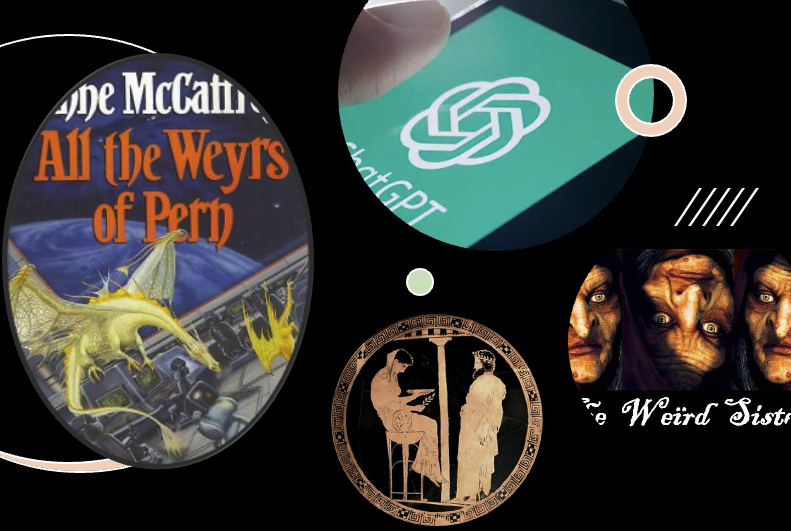
Yesterday and today I am struggling with how to address the use of what we’ve been calling AI — it’s just a large language model, for now. All educators are dealing with this these days and the answers have not been great. Some educators at both the HS level and the college level are simply not giving any assignments completed outside the classroom any weight in the assessment of student learning.
What’s the problem with that you ask?
First, Time. My time with my students is precious. According to our bulletin (most accredited institutions)students should dedicate twice the amount of time outside of class learning as in class. If I only assess work completed in the classroom, the time to complete that work comes out of my teaching time. Students get less instruction.
Second, Power Dynamics. When instructors obsess over policing academic integrity we lose sight of our relationship with students. We become primarily rule-enforcers rather than mentors, educators, and coaches. We lose the ability to reach our students across the gaping power differential. There are always ways to break the rules (and even get away with it). If a student doesn’t value the learning and respect integrity of the assessment process, more dystopian futures of enforcement won’t help. It only feeds a technological arms race with students consuming technology to enable ‘easy answers’ and educators and institutions will always be looking to buy better ‘detectors’ or ‘prevention methods’.
The solutions must be cultural and based on the relational rather than transactional aspects of education.
Why do I believe this? Why do I want to stay in relationship with students who have sought or may seek to deceive me? Why do I hope they may wish to stay in relationship with me?
Largely because humans have been struggling with these issues for millennia and telling stories about the risks they entail. My experiences with A.I. and my students and colleagues resonates with the fantastic narratives I read or watch for pleasure and the texts I have taught for more than 20 years.
Pithy Answers
Apollo slew the great Pytho* to win his shrine at Delphi. In honor of this his priestess, his voice on earth, his oracle, was named the Pythia. When something is said in a witty, concise manner we describe that as “pithy” to recall the nature of the responses given by the Pythia to those mortals who came to seek answers to difficult questions. The Pythia is always right but almost always misinterpreted. Oedipus’ parents are told their son will kill his father and marry his mother. They toss him away only to have him found and reared by other parents. He hears his own fate and trying to avoid it flees his adoptive parents and ends up killing his birth father and marrying his birth mother. Croesus wonders what will happen if invades Persia and is told “a great empire will fall”. Of course, being an optimist, he goes ahead only to have his own great empire of Lydia toppled by Cyrus the Great. If only they understood the ‘true’ answers and how to use that knowledge!
Or, maybe it is worse to have access to these questions and be tempted to use it? Socrates rebuked Xenophon for asking the wrong question before his ill-fated expedition with a much less great Cyrus. Xenophon tried to constrain the answer through the forming of his question: “What gods should I propitiate to have success in this endeavor?” Xenophon and a few of his comrades reached the sea and made it home to inspire others on their own ill-fated retreats. Many did not return. All were scarred. What if he’d asked a better question: “What will it cost me if I go?”
Weird Answers
I thought a great deal about the Delphic oracle while watching Macbeth with members of the BC Classical Society, a wonderful student club, which initiated a group viewing of campus production of “the Scottish play”.
Shakespeare reworked historical fiction to tell a story of the evils of “true” answers caused by the limits of human understanding. Macbeth was a real person, so Duncan, and so Malcolm, but none lived lives as we see on the stage or remember. Banquo and MacDuff were not purely Shakespeare’s own invention but may be considered shared fictional characters. Macbeth is tempted by seemly miraculous access to information. He asks again and again. And each ‘true’ statement brings him only deeper toward his own tragic end. Banquo tries to abide by his own moral code even as he asks and receives delicious answers. Macbeth is jealous of his access to this knowledge and Banquo’s own demise is the cost of knowing. We are also left to wonder if the answers given to Banquo are even correct. Shakespeare does not have them manifest on stage. Malcolm takes the crown. Sure the Stuarts claim Banquo’s equally fictional surviving son Fleance as an ancestor to legitimate their rule, but is it true? Did the audience believe it to be true? How can we verify the weird answers of the three sisters?
You can read those those better versed in these things to learn about how Shakespeare intersects with the classical tradition of riddles and prophecy.**
A Bird*** of a Different Feather?
I finished the last 20 minutes of my latest audiobook, All the Weyrs of Pern (1991), on the drive home from the dropping my children at school. I’d guessed from the foreshadowing how it would end and yet nonetheless it was poignant and I find myself writing now instead of addressing some most necessary piece of bureaucracy or service.
Pern is a world created by Anne McCaffery in the late nineteen-sixties and is still to some degree being created by her children and intellectual heirs. It was colonized by future Earthers looking to start afresh by using technology to escape the devastation of this world. (A dangerous SF trope influencing the minds of men with too much money today.). All goes well until unforeseen natural disaster on the new world returns the descendants of the original colonists to a pre-modern state. Fast forward more than two millennia and Pernese start excavating their past. The discoveries influence fashions and create social unrest. The best and worst of the discoveries is the A.I.V.A.S. or the Artificial Intelligence Voice Address System.
Let me tell you how disappointed I am to find no actual SF scholars have yet written about A.I.V.A.S. (as far as I can find)!
This character and how society reacts to it speak volumes to our present moment and has had me pause the playback on many occasions just to let the implications of this 1991 vision of today’s reality sink in fully. A.I.V.A.S. will remind readers of the computer in Star Trek and similar remarkable seemingly all-knowing data storage and computation tools from other SF worlds. A.I.V.A.S. holds necessary information for the Pernese to overcome the constant threat of natural disaster and thus have the material and temporal resources necessary for more than a subsistence living.
And, once the mission is accomplished, the machine destroys itself. Without the specific mission and focus of its energies, it will only disrupt society rather support it. The information it held is still accessible, but the ability to rely on the character of A.I.V.A.S., the interface that demands little or no comprehension of the mortal human accessing it must be removed.
What now?
I don’t think any of our AI will turn itself off. It has been programmed to capture our eyeballs and continually fascinate us, rather than to protect us and our intellectual autonomy. It is closer to Macbeth’s weird sisters than A.I.V.A.S. At best it might be pithy, a clever tool, of which we may if we dare ask questions and try to use the answers without (too much) risk. Futile attempts to smash AI, ignore it, or calling ‘the abomination’ will get us nowhere. Thoughtful, cautious engagement is where we must start.
I do know that thinking about the character of AI is something I want to do more and something I will invite my students to do alongside me.
* –
Python as we use the word today was imposed during the European taxonomy revolution and is only first attested in 1803. It is a borrowing of the classical to describe the ‘exotic’ without any inquiry of
** –
Davies, Malcolm. “‘All’and ‘Nothing’: Existential Riddles and Cosmic Pessimism in Ancient Greek Literature and Shakespeare.” GAIA. Revue interdisciplinaire sur la Grèce ancienne 18, no. 1 (2015): 455-469.
Fontenrose, Joseph. “The Oracular Response as a Traditional Narrative Theme.” Journal of Folklore Research (1983): 113-120.
*** –
Avis is Latin for bird. I’m playing with the homophone and wonder if the author may have intended this.

 Liv Mariah Yarrow
This is amazing. Wish I had time to comment more. I am doing an exercise in western civ that asks a traditional question, then asks what would I need to know to answer that (pushing toward imagining sources, breaking the question down), THEN asks, what is the prompt I’ll ask Chat gtp to help with this.
getting honest and vulnerable with them is great. Showing you want the relationship. Brilliant way around the broken transactional system. Great insights from classical world
Thanks!