

Serrated Timeline

Built off this but with an eye to HW/HBM/Holl. re-dating. I broke 50,000 words for the book manuscript. The press upper limit, they said. But Rowan took 60,000+ so I’m worried but not too worried. Still pics = 1000 words.
Meaningful Differences?
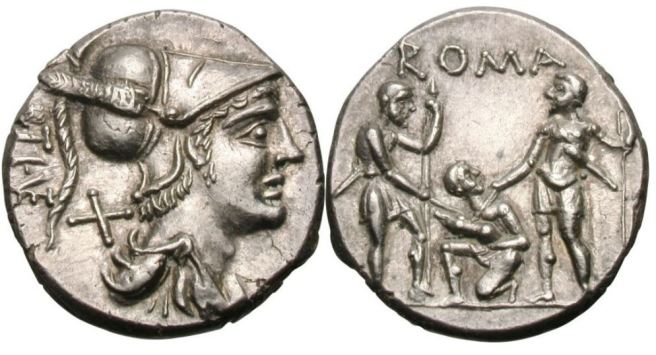
Perhaps not. I’m worrying about how RRC 234/1 differentiates its oath swearing scene from its prototype and whether those differences are meaningful or just ‘sloppy’. So for instance the two figures present less different on 234/1. Does the left hand figure have beard? Is he not wearing armor? Why was the right hand figure’s spear pointing down on the original? etc…

SPQR in the hands of Racists
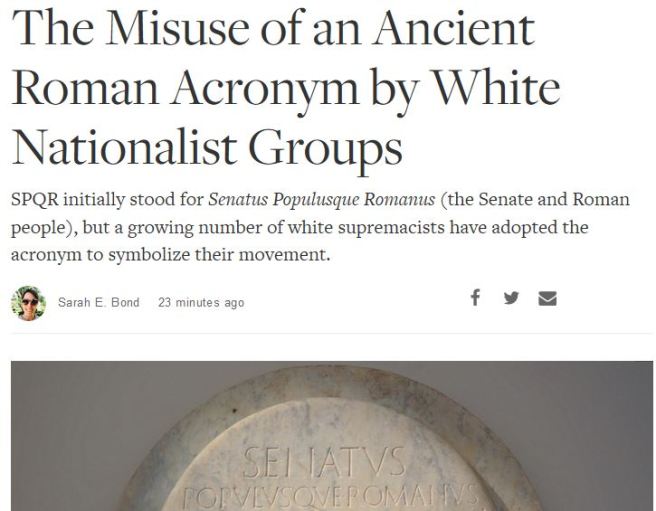
I’m pleased to have contributed to this piece of journalism written by the super smart Sarah Bond. Click image to read full article.
Advice from Others to Mentees
To be updated periodically
Advice to Those Starting Graduate School
Mostly targets at those at elite humanities programs in the US
CV vs Resume or Both?
How to Write a Conference Abstract
Consequences of Empire
Cato’s own words, as follows: “And I really think that the Rhodians did not wish us to end the war as we did, with a victory over king Perses. But it was not the Rhodians alone who had that feeling, but I believe that many peoples and many nations agreed with them. And I am inclined to think that some of them did not wish us success, not in order that we might be disgraced, but because they feared that if there were no one of whom we stood in dread, we would do whatever we chose. I think, then, that it was with an eye to their own freedom that they held that opinion, in order not to be under our sole dominion and enslaved to us. But for all that, the Rhodians never publicly aided Perses. Reflect how much more cautiously we deal with one another as individuals. For each one of us, if he thinks that anything is being done contrary to his interests, strives with might and main to prevent it; but they in spite of all permitted this very thing to happen.”
I want to think about this more in future as it relates Polybius’ project in extending his histories by 10 books and in the debates over the destruction of Carthage found in other authors…
Constitutional Forms: Mixed vs. Balanced
Derow taught not to talk of Rome (at least so far as Polybius’ Bk 6 goes) of a mixed constitution (a little of this, a little of that), but instead as balanced. He didn’t mean this so much as checks and balances but more the balancing act of not letting the anacyclosis (the cycle of constitutions) role on to the next form: monarchy to tyranny to aristocracy to oligarchy to democracy to ochlocracy. Rome was (precariously) balanced: the wheel wasn’t rolling (yet).
That’s background (and how I teach the republican government a la Polybius most semesters).
This blog post is because I just read again a sentence from the Cicero’s Republic (2.42):
For those elements which I have mentioned were combined (mixta) in our State as it was then, and in those of the Spartans and Carthaginians, in such a way that there was no balance (temperata) whatever.
I’ve never thought my views (via Derow’s) of aligned with those of Cicero’s…
Another Horned Helmet
Papius again. You might also notice I let my obsession run a little wild last night after the kids went to bed and got started on my typology.

Crucible and Furnace
Or would I say forge or kiln? I better look up some obscure Latin if I’m going to continue worrying about the identity of objects on the Papius series (j/k). Anyway this is relevant to ancient technologies around metal refinement and thus would be familiar to those engaged in mint operations.
If this is really Crawford symbol 24 like the catalogue suggests, than the drawings (or they specimens they were based on) were poor indeed.
Another Republican Die?!
Update 10-25-21:
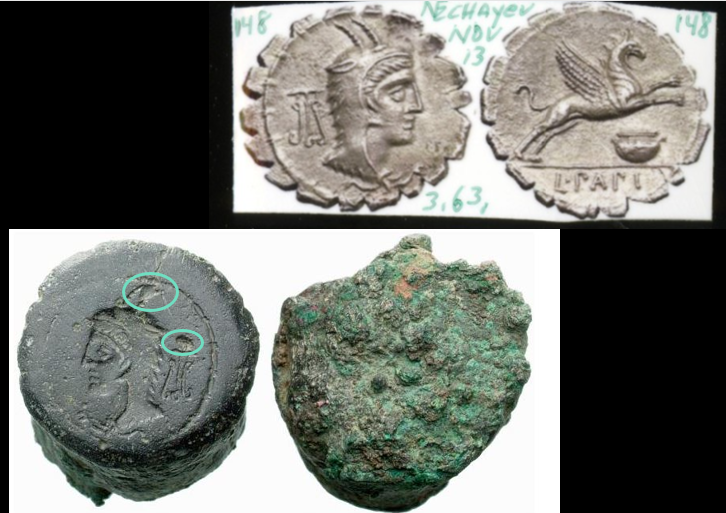
Definitely a forger’s die. (or a modern forgery of such an object) Most likely created using hubbing. This is made obvious by comparison with specimens in the Schaefer Archive. A huge shame current location and details of discovery of this unique object are not known.
Original Post:
The idea of a real republican die for the main mint surviving seems completely improbable. I just can’t make up a story whereby this would happen. This must be an imitation, but a nice one… Hubbed? There are imitations known but not this fine (and another example). Just reacting. But the control mark isn’t one detailed by Crawford 1974: p. LXVIII-LXIX (not that those sketches are perfect, but their usually pretty good). The rightly catalogue says: “Für das Symbol vgl. 148.” But this clearly isn’t Crawford’s 148 as that is a pair of animal heads. There is a small chance that it matches Crawford’s 86: a lamp hook and a lamp. Helps if I look at the right plates…. Strangely the odd symbol makes me think it is more genuine. Hmm.. Must think more: Papius is on my list of future projects.
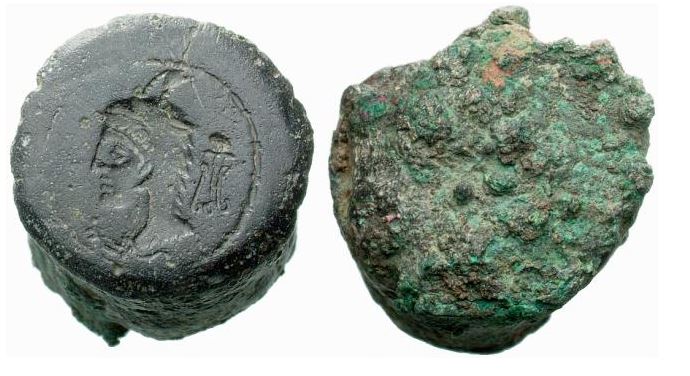

(in the Princeton museum)
The sort of object needed to hang up one of these (or as Crawford says, a cooking pot):

 Liv Mariah Yarrow