Iconography of the Dioscuri (note)

Elena Gagliano,  ‘Berreti de Dioscuri’ e campanelle spartane : Rfilessi di rapporti cultu(r)ali sugli episemata monetali. “ Rivista italiana di numismatica e scienze affini v.17, 2018, p.33-62.  Must ILL.

Focuses on the pilos and stars.  Discusses coin but also Skyphoi  including the Odysseus and Circe one.


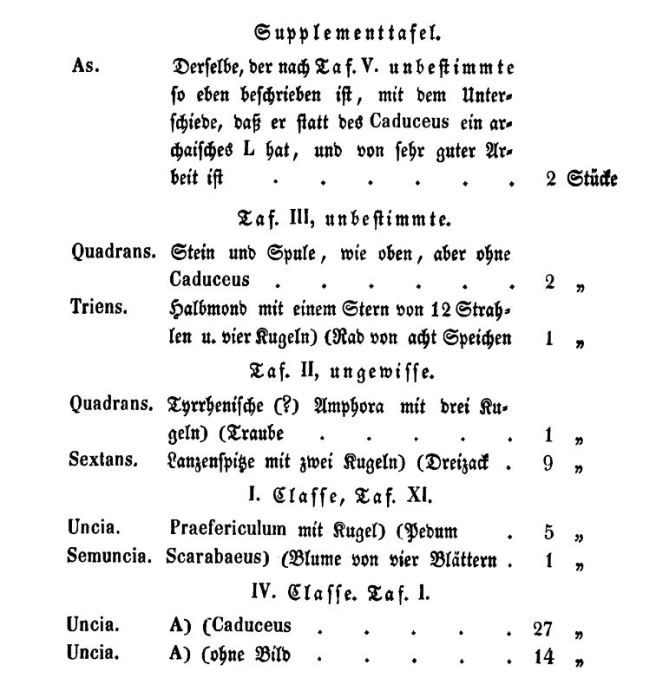
Data Dumping Blackletter Find List, Vicarello 1854

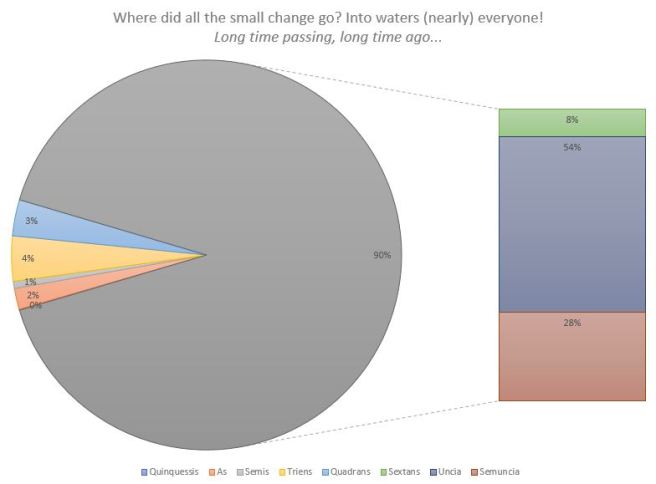
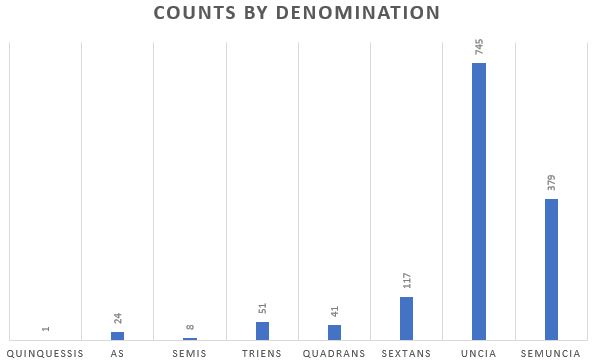
Of 1366 Cast Coins found at Vicarello:

Capture9.JPG

The chart just visualizes what you already know.  If you’re going to make a coin offering you’re most likely to leave a little coin.  However, as my joking chart title suggests, this habit could clearly have been a drain on Roman small change supplies.

Capture0.JPG

Does the lower count of semisses and quadrantes as compared to asses and trientes, suggest there were fewer of these denominations in people’s purses?  likewise fewer circulating semunciae than uncia? 

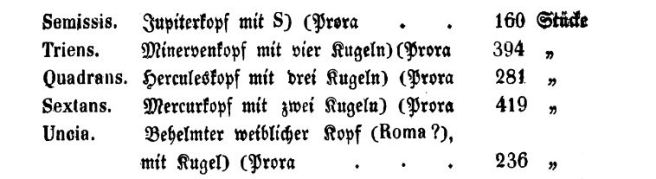
We might then also deduce a similar reflection of availability of struck bronzes: semisses slightly less common than asses, quadrans less common than triens, uncia less common than sextans.  However, all told struck coinage of all denominations looks like it mightbe more readily available in this latter period.

Capture11.JPG

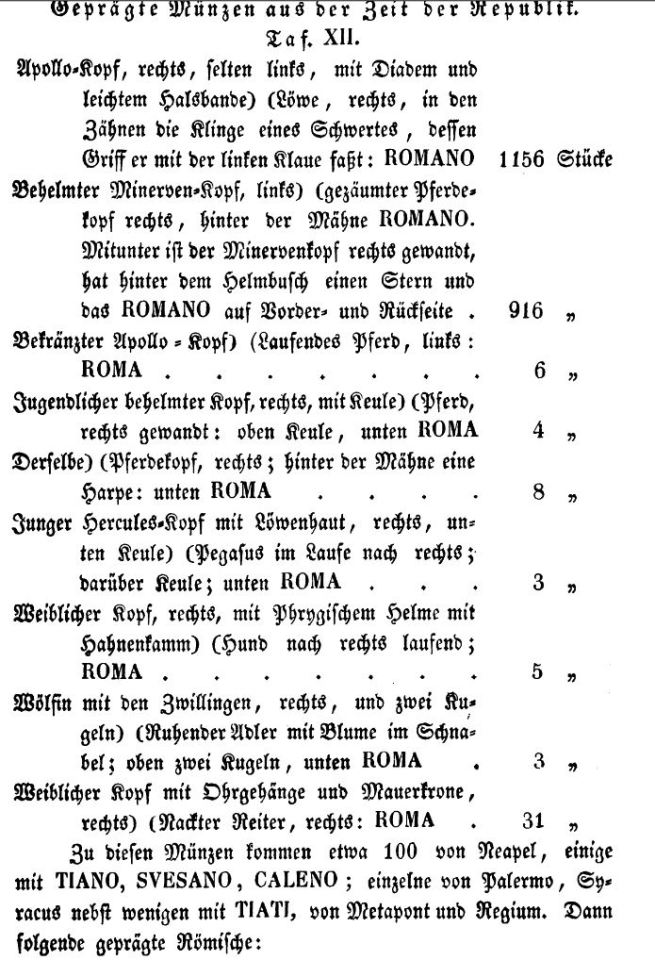
ROMANO Struck Bronzes

By far and away the most common find is RRC 16: 1156 specimens! followed closely by RRC 17 of which 916 were found!

That’s a LOT of small change AND suggests that both struck and cast were used by peoples heavily in the same cultural environment.  Roughly speaking a little over 25% of the bronze coin finds are cast, a little under 75% struck and the pattern suggests heavy use of the site in the mid 3rd century by Romans.  About 30% of the struck bronze is of the prow series which suggests continuity of practice at the site through late 3rd century at least.  I am particularly intrigued by the presence of Teanum, Suessa, and Cales bronzes of the early part of the First Punic War.


Public Domain: Henzen, W. “Alterthümer Von Vicarello.” Rheinisches Museum Für Philologie 9 (1854): 20-36. http://www.jstor.org/stable/41251528.

CaptureCapture1Capture2Capture3Capture4Capture5Capture6Capture7Capture8

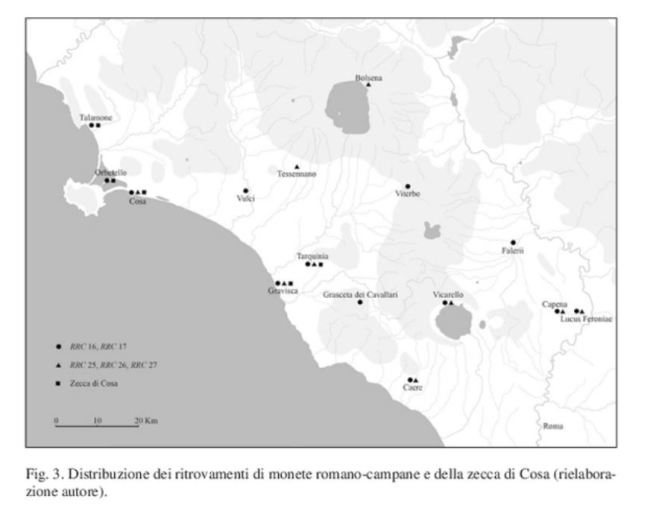
Maps of Coins Finds in Etruria (From Pulcinelli 2015)

From: Pulcinelli, Luca. “MONETE E CIRCOLAZIONE MONETARIA IN ETRURIA MERIDIONALE NEL III SECOLO A.C.” Archeologia Classica 66 (2015): 481-92. http://www.jstor.org/stable/26364293.

The author kindly made the paper available online, but the open access version does not have legible maps. These below are slightly more readable and are screenshots from Jstor.  [Don’t get eye strain!]

Stuff to note: Ceveteri (Caere) missing from maps 1-2.  Vulci missing from maps 1 and 4.  How Cosa coins hug the coast.  Rather frustrating (to my present work) that RRC 21 is lumped in with 14 and 18 on map 4…  Ghiaccio Forte Punic coin finds v interesting given high density of aes rude reported at the site.  Also that no Punic coins are identified in the HUGE Vicarello find.

CaptureCapture1Capture2

Capture3

Garrucci’s Testimony on Finds

Just some notes…

Bomarzo (CHRR 6)

single find

Capture.JPG

Haeberlin photo link.

Vulci (CHRR 10)

fragment of RRC 6/1 (not in CHRR, unlless recorded as fragment of ‘non Roman bars’)

Capture.JPG

Haeberlin photo:

Capture.JPG

Fragment – RRC 12/1

Capture.JPG

N. B. Garrucci labels the Paris RRC 12/1 whole bar as from Vulci.  This appears to be an error.

“Fragments of Non-Roman Bars” (I’d call this Ramo Secco)

Capture.JPG

Ariccia Hoard found 1848 (CHRR 13)

fragment – RRC 8/1

Capture.JPG

Crawford believes Shield Bar is in Berlin [but it is not (yet) in CRRO under RRC 7/1] and remainder of Hoard in Palazzo Massimo (i.e. this one too); he also lists as bibliography Annali 1871, 262[f.] and Haeberlin 1910, 20.

This drawing corresponds to the specimen shown on Haeberlin 1910 pl. 60.4

Vicarello, Aquae Apollinares

Votive deposit at source of thermal spring, +5000 bronze coins found along with a variety of other objects.

Capture.JPG

fragment – RRC 7/1

Capture.JPG

~16 – RRC 14/1 

Capture.JPG

“Of this as the waters of Vicarello have sent sixteen specimens, and there were four from the Cerveteri hoard, others from the deposits of Monte Mario, others from that of the Ostia. Mommsen states with P. Marchi (H. de la monn. I, 185) that around Ostia a deposit was found only of these “asses” and more abundant than that of Monte Mario (L ‘aes grave 48): and adds that 1109 of this series together with 13 of Roman series were taken from Vicarello. The truth is that P. Marchi counts only 13 “asses” with the two-faced on the obverse and the head of Mercury covered with winged petasus on the back, which were sent to him, I here and elsewhere I add to his calculations also those pieces then subtracted, which they came in my hand. In the place mentioned we note from Mommsen that in the vicinity of Trent the triens, the quadrans and the uncia of this series was were, per the testimony of Giovanelli (Dei Rezi, p. 81).”

4 – RRC 14/2

see under Genzano for testimony

Genzano  (CHRR 14)

2 – RRC 14/2

Capture.JPG

Capture.JPG

Capture1

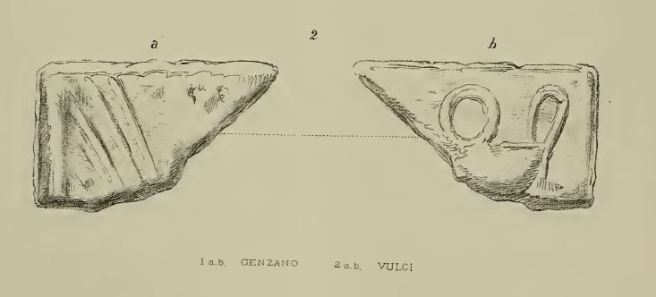
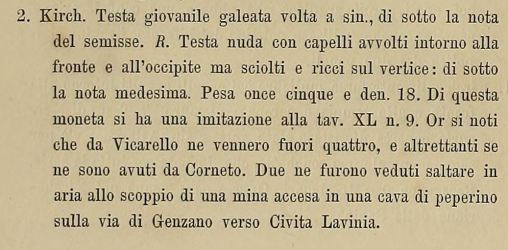
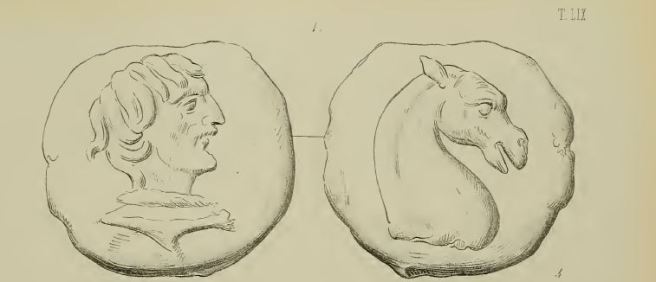
It should be noted that four came from Vicarello, and as many others from Corneto. Two were seen jumping into it air at the explosion of a mine lit in a peperino quarry on the way to Genzano towards Civita Lavinia.”

N.B. Garrucci also says RRC 10/1 (BM R1867,0101.1) was found at Genzano. Could it have been at the same time as these two semisses revealed though a mine explosion?!

Corneto (no CHRR #?)

~4 – RRC 14/2

see under Genzano for evidence

Ostia (CHRR 15)

unspecified number – RRC 14/1

See under Vicarello above for testimony

An Aes Grave Hoard from Praeneste

Vecchi 204: no. 276 = HNItaly 357

Capture.JPG

Capture.JPG

“…A second example was found in Palestrina together with the as representing the lion’s head with the dagger between the teeth, and on the reverse the horse protome with the sign of the caduceus.”

This is referring to Vecchi 2014: no. 254 = HNItaly 249.  I can’t tell from Vecchi’s list of finds if this is one he mentioned or in addition to his list.  He mentions none from Palestrina itself but two found ‘near’. One before 1910 (following Haeberlin I’m guessing and should check later) and the other 1884 at Artena.

I also can’t tell if this little hoard is the Praeneste find of this type I mentioned in my previous post, OR ‘new’ fourth find of the type at this locale.  (I got my information for that post from Vecchi 2014.)  Must sort this out later…


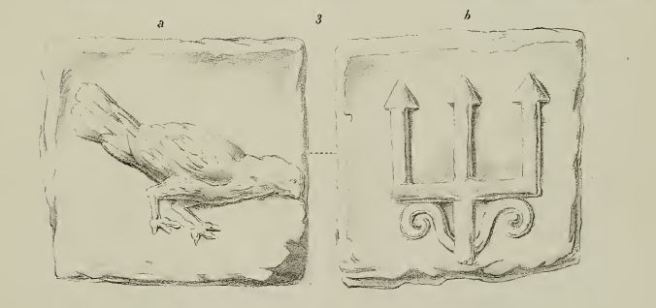
Source of the “Trident” Red Herring? (RRC 12/1)

I’m guessing the drawings on Carelli’s plates are just plain inaccurate and this fragment doesn’t exist at least not as shown, and thus we’ve all been led astray.

Capture.JPG“Dalle tavole del Carelli (XL, 2), non dall’originale che non si sa dove stia. Il Mommsen cita negli Annexes p. 330 questo bronzo fra quei che portano per tipo al dritto due polli e al riverso due creduti tridenti e due delfini, ma sbaglia anche perchè lo strumento che è al riverso è un vero tridente sempre così effigiato sui quadrilateri come lo è uesto.” – Garruccii p. 11

“From the plates of Carelli (XL, 2), not from the original that one does not know where it is. Mommsen cites in the Annexes p. 330 this bronze among those who carry two chickens and two dolphins on the obverse, but also wrong because the instrument that is on its back is a real trident always so portrayed on the quadrilaterals as it is.”

Garrucci on the Cerveteri Finds (CHRR 8, 53 and more?)

Clearly CHRR 8

Capture

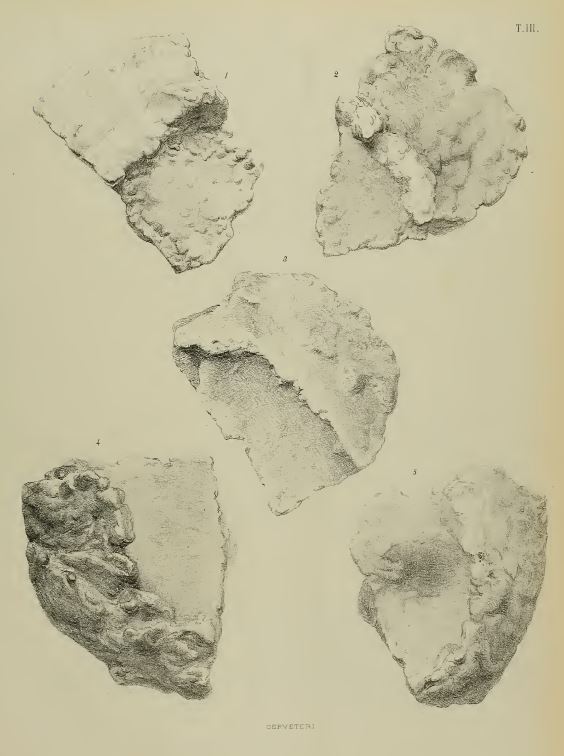
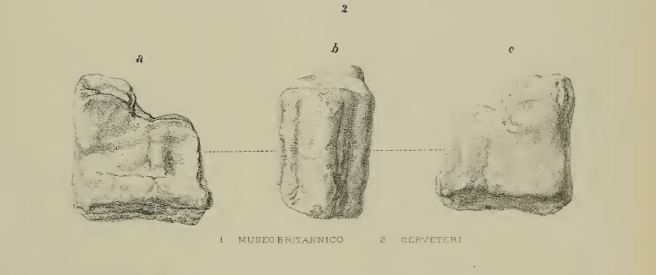
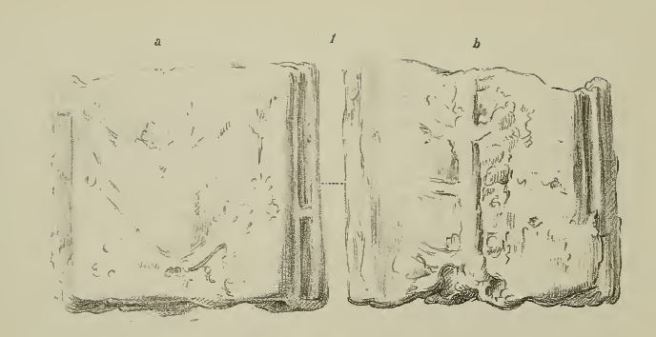
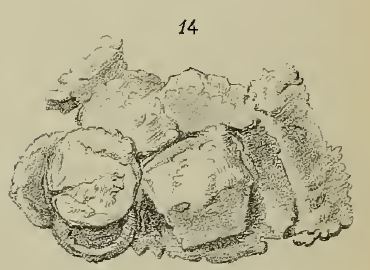
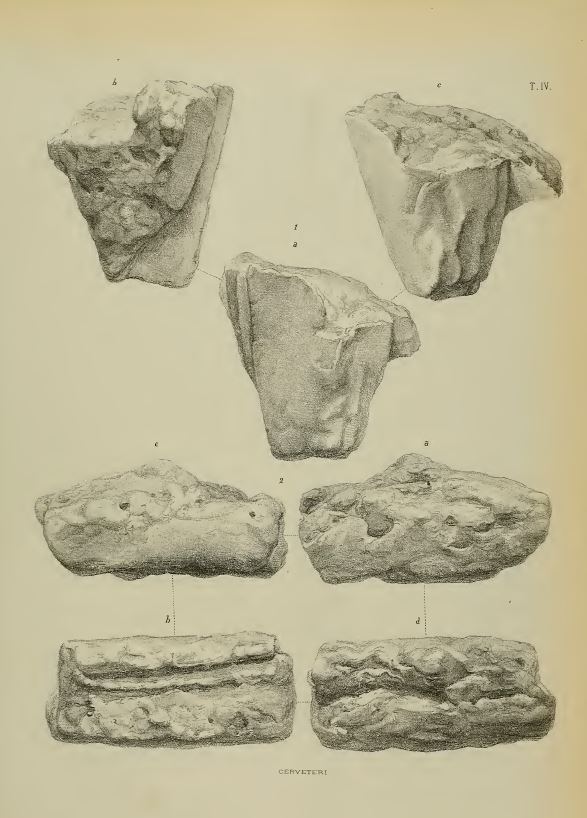
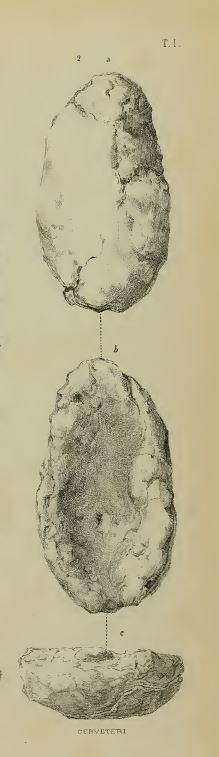
In the midst of the ancient Cere that today is called Cerveteri, Mr. Filippo Calabresi digging a ditch at great depth came across a beautiful deposit of aes rude and signatum mentioned above. There were a hundred and sixty-seven pieces of various sizes which all together totaled one hundred and fifty pounds of copper, fortunately saved in time from the furnace. A piece of it appeared of pure copper without a mixture of tin as in Villanova, nor of zinc as in Vicarello, or of lead as in Marzabotto. Among many small pieces there were large ones that guided my study, and I also found a whole one, though a little flawed on the one hand as the metal in the bracket stopped. Still it was clear that it tended to a round shape (see plate II a, b). This helped me as a guide, so that the other fragments were also studied (plate III, 1-5), and I deduced that the metal was placed in a bowl, with a slightly concave bottom, or in a wide bracket in the shape of a cone inverted and with a mobile bottom. This became obvious when I saw how, around the bottom of these loaves, a burr formed which took the form of a base (see the aforementioned plate III).”
Capture2.JPG

Capture.JPG

Capture.JPGCapture.JPG

Capture.JPG

Capture.JPG

Probably CHRR 8

Capture.JPG

Fragment of RRC 9/1, the elephant and sow bar.

  I find this identification hard to believe.

Clearly CHRR 53
Capture.JPG

Capture1.JPG

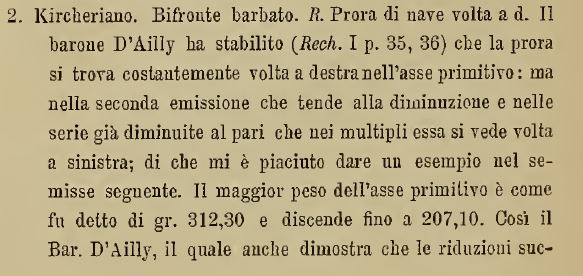
“… In the large deposit of primitive asses discovered at Cerveteri there were found three specimens weighing gr. 143,90; 147.80; 148, which seem to prove this deposit cannot have been made before the time of the semissal [e.g. semilibral] as.

Capture.JPG

“Of this as the waters of Vicarello have sent sixteen specimens, and there were four from the Cerveteri hoard, others from the deposits of Monte Mario, others from that of the Ostia. Mommsen states with P. Marchi (H. de la monn. I, 185) that around Ostia a deposit was found only of these “asses” and more abundant than that of Monte Mario (L ‘aes grave 48): and adds that 1109 of this series together with 13 of the Roman series were taken from Vicarello. The truth is that P. Marchi counts only 13 “asses” with the two-faced on the obverse and the head of Mercury covered with winged petasus on the back, which were sent to him, I here and elsewhere I add to his calculations also those pieces then subtracted, which they came in my hand. In the place mentioned we note from Mommsen that in the vicinity of Trent the triens, the quadrans and the uncia of this series was were, per the testimony of Giovanelli (Dei Rezi, p. 81).”

Capture.JPG

Three specimens of this bronze were found in the Cerveteri deposit and one was already from the excavations of Tarquinia.”

Likely CHRR 53

CaptureCapture1

“… To determine the region, it is worth noting that ten specimens of the as were found in the deposit of Cerveteri and that from Monte Mario hoard they had it with the club and without (Marchi, L’aes grave 46). In my experience, two other specimens but without the club have come from the necropolis of Cerveteri and this same city has now also given five semisses…”

RRC 21 and 27 are indicated.

CHRR 53 reads: “Roma/Roma series 15 pieces without symbol”

It would seem that Garrucci means 10 asses WITH the club (or with and without the club) were part of the 1852 discovery (CHRR 53), when the semisses were found is not specified and that 2 more asses of the RRC 21 type were found after 1852.

Capture.JPG