Cicero decries ‘lying’ Monuments

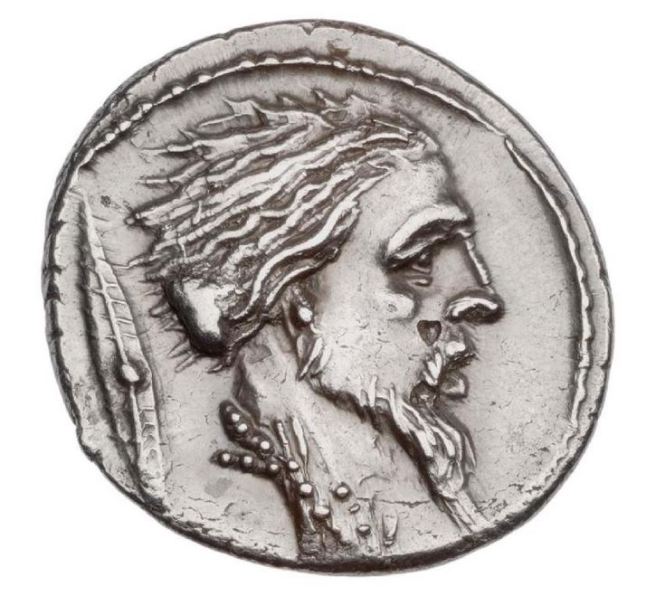
Ancestral inflation is nothing new, but the passage below is just a nice parallel for the fake “TER” (third triumph) claimed on RRC 415/1 (61 BCE).

N.B. Crawford tries to make this coin accurate by having it refer to times hailed imperator.  He says the (false) three triumph tradition is a ‘late’ but ILLRP 392 which he cites as support is dated to the c. 57-56 BCE and associated with the restoration of the Fornix Fabianus.

Capture.JPG
Boston MFA Specimen

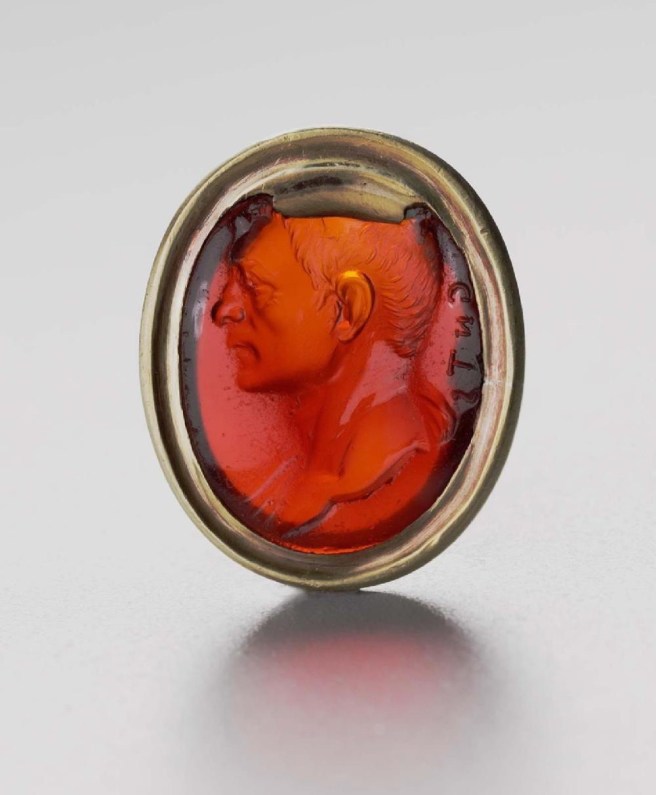
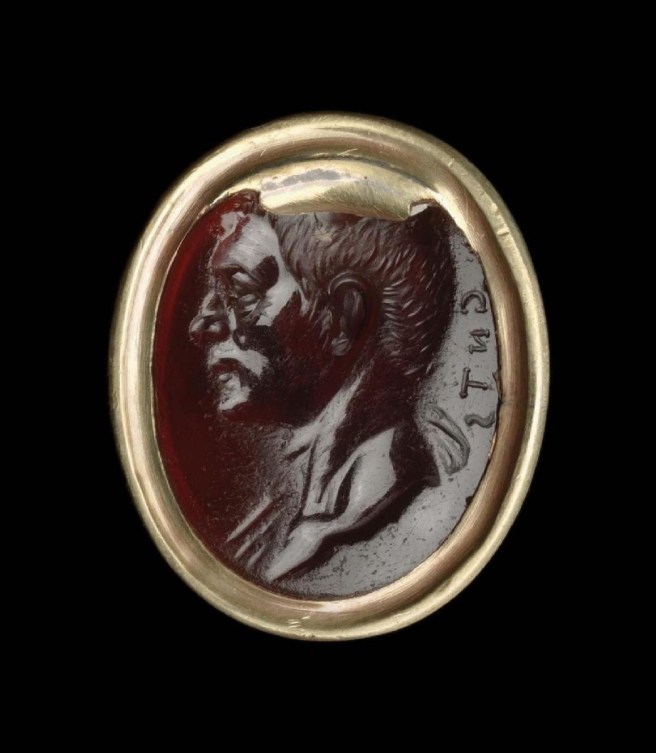
Cic. Att. 6.1.17:

“As to the statue of Africanus—what a mass of confusion! But that was just what interested me in your letter. Do you really mean it? Does the present Metellus Scipio [cf. RRC 459 and 460] not know that his great-grandfather was never censor? Why, the statue placed at a high elevation in the temple of Ops had no inscription except COS, while on the statue near the Hercules of Polycles there is also the inscription COS CENS, and that this is the statue of the same man is proved by attitude, dress, ring, and the likeness itself.

“But, by Hercules, when I observed in the group of gilded equestrian statues, placed by the present Metellus on the Capitol, a statue of Africanus with the name of Serapio inscribed under it, I thought it a mistake of the workman. I now see that it is an error of Metellus’s. What a shocking historical blunder!

“That statement of mine about Flavius and the Fasti, if it is a blunder, is common currency.  You were quite right to raise the question.

“I followed the opinion which runs through nearly all historians, as is often the case with Greek writers. For example, do they not all say that Eupolis, the poet of the old comedy, was thrown into the sea by Alcibiades on his voyage to Sicily? Eratosthenes disproves it: for he produces some plays exhibited by him after that date. Is that careful historian, Duris of Samos, laughed out of court because he, in common with many others, made this mistake? Has not, again, every writer affirmed that Zaleucus drew up a constitution for the Locrians? Are we on that account to regard Theophrastus as utterly discredited, because your favourite Timaeus attacked his statement?

But not to know that one’s own great-grandfather was never censor is discreditable, especially as since his consulship no Cornelius was censor in his lifetime.”

(I’ve tweaked the Public Domain translation to reflect Shackleton Bailey’s readings)


Cassius and Pompey’s Relationship

I was reading the Cicero’s letters from 50 BCE as he’s preparing to leaving his province (was looking for a reference on Credit systems I half remember, haven’t found it yet).

Now I’m worried I’ve misinterpreted Q. Cassius’ political position in 55 BCE in my forthcoming book and am wondering if it is too late to tweak it before it comes out: typescript is submitted and we should be in production soon.

I’ve read Cassius’ types (RRC 428/1-3) as a rejection of the (so-called) First Triumvirate…  BUT how the heck does that square with this (Cic. Att. 6.6.4):

“… Then there is this consideration: Pompey— so strong a man and in so secure a position—selected Q. Cassius without regard to the lot; Caesar did the same in the case of Antony: was I to put such a slight on one regularly assigned me by lot…”

Was his selection by Pompey a ‘gift’ to “win friends and influence people”?  Is this Pompey trying to bring Cassius over to his ‘side’?  OR, was Cassius already entangled with Pompey and I’m reading his types all wrong.  Then again by 49 50 he’s clearly a Caesarean….DPRR (below) doesn’t take into consideration Shakleton Bailey’s work in Cicero’s letters: 6.8 dates to 1 Oct 50 BCE and was written from Ephesus.

Batonius, however, brought news about Caesar that is really terrifying, and he enlarged still more on the subject in Conversation with Lepta. I hope what he said was false, but it is certainly alarming: that he would on no account dismiss his army; that Of the magistrates-elect the praetors, Cassius the tribune, Lentulus the consul, side with him; that Pompey is thinking of leaving the city.

I just don’t know what to make of this (yet) and it bothers me.

Here’s the DPRR entry:

Capture.JPG

Capture.JPG


Here’s the portion of the book as sent to the publisher already:

2.23. RRC 428/2, 55 BCE, denarius, 3.82 grams, ANS 1948.19.203; obverse: head of Libertas, Q·CASSIVS before, LIBERT behind; reverse: temple of Vesta with curule chair inside, flanked by urn and voting ballot with A C; moneyer: probably Q. Cassius Longinus, q. 52 BCE.

Other types of these two years [i.e. 56-55 BCE] that seem to be in opposition to the ascendancy of Pompey and the ‘triumvirate’ simultaneously memorialize the actions of the moneyer’s own ancestors, and promote alternate values which have a central position for both the state and the moneyer’s own family. Q. Cassius Longinus celebrates three major acts in the career of his ancestor L. Cassius Longinus Ravilla, consul of 127 BCE. As tribune in 137 BCE, he carried a law that extended the use of the secret ballot to public trials. Cicero sums up the controversy in 56 BCE around this historical act thus:

The people thought their liberty was at stake; the leading men (principes) dissented, and for the safety of the best men (optimatium), they feared the audacity of the multitude, and the license of the secret ballot. (Cicero, For Sestius 103; author’s translation)[1]

Just as in Cicero’s rhetoric, one of the coins explicitly juxtaposes the image of Libertas, the personification of liberty, with the images of the secret ballot (2.23).[2] The moneyer of 55 BCE is not the first to refer to the secret ballot on the Republican coin series: in fact there are numerous other references, including two by other members of his own gens (4.4.1).[3] The other ‘popular’ act of Ravilla was his service as chief judge against the delinquent Vestal Virgins in 113 BCE: he condemned two Vestals, Marcia and Licinia, previously exonerated by the pontifex maximus, L. Caecilius Metellus, who had only condemned Aemilia.[4] Cassius may have chosen to emphasize this trial partly because of how it disgraced the Licinii Crassi, the family of his pro-Pompeian fellow-moneyer and Pompey’s own co-consul. Their ancestor, the famous orator Crassus, failed to aid their other family member, the Vestal Licinia, even with his powerful, well-remembered defense.[5] Why was the condemnation of the Vestals ‘popular’? The well-being of the community was as a whole dependent on maintaining correct relations with the gods (cf. 4.2.1). To exonerate guilty Vestals because of pressures from their elite families endangered the whole community.

2.24. RRC 428/3, 55 BCE, denarius, 3.74 grams, ANS 1944.100.2636; obverse: youthful head of the Genius of the Roman People, scepter over shoulder; reverse: eagle on a thunderbolt, flanked by lituus (augur’s staff) and jug, Q·CASSIVS beneath; moneyer: same as last.  In Roman thought, anyone or almost anything could have a genius (male) or juno (female), an idea encompassing both the guardian spirit and the sacred essence or even soul of that thing or person.

Another coin type alludes to the sovereignty of the Roman people themselves through the image of the Genius of the Roman People with regal scepter and Jupiter’s eagle on a thunderbolt, a common representation of imperium (2.24).[6] In this reference to sovereignty, there may also be an allusion to the lex Cassia of 104 BCE, which removed from the Senate any one condemned by the people or who had their imperium revoked by the Roman people. The law, like the coin type, emphasizes that sovereignty at Rome rests not in the individual or the Senate, but with the people themselves.[7]

[1] He spoke more favorably of it in 65 BCE when defending Cornelius: “The Cassian Law under which the right and power inherent in the suffrage was restored to health and strength”. Preserved in Ascon. 78C. On liberty and the secret ballot, see also Cic. Planc. 16, 54 BCE.

[2] Cf. Feig Vishnia 2008.

[3] Arena 2012: 57; Bruce 1997.

[4] Ascon. 45-46.

[5] Rhet. Her. 4.47 and Cic. Brut. 159.

[6] On sovereignty of the people as a popular position, ANRW 5 (1981): 853 and Cic. Planc. 11, 54 BCE.

[7] Ascon. 78C.


Cato coin…

That Cato?!  really?! Why am I only learning about this now?

Capture.JPG

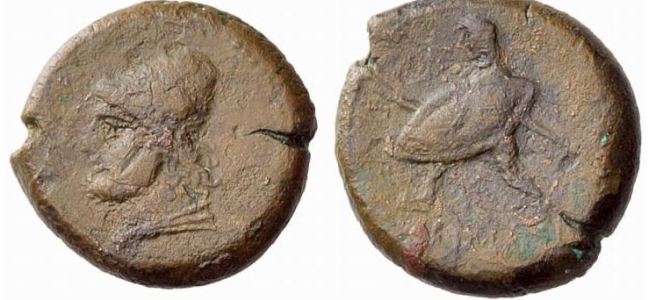
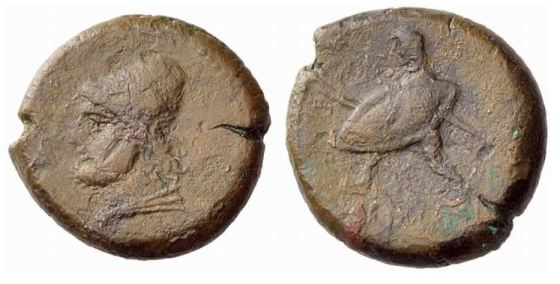
“SICILY, Panormos. Circa 208-180 BC. Æ (22mm, 5.40 g, 12h). Cato, quaestor. Laureate head of Zeus left / Warrior standing left, holding phiale and spear; CATO and monogram to left, shield to right. BAR Issue 12; CNS 129; HGC 2, 1071.”

Does the monogram resolve as PANORM… in Greek?  I’m not confident on this.

There just aren’t that many Catos and finding one doing something in Sicily really only leaves Cato the Elder:
Capture.JPG

From DPRR where you can check my research.

I’m just so excited to think Cato the Elder made a coin and stuck his name on it… Seems to good to be true.

The same type with same monogram and different Romans are also known:

Capture.JPG

Capture.JPG


Personification of Omonoia

[Concordia, Harmony, Concord, etc…]

Capture.JPG

Quoting from CNG catalogue:

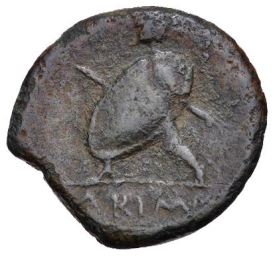
“SICILY, the Krimissan Alliance. Circa 320 BC. AR Hemidrachm (2.72 gm). OMONOIA, laureate female head (Homonoia or Concordia) right / KIMISS-AIWN, flaming horned altar, garlanded, with branches at sides. Jameson 559; Basel 346 (same dies); discussed by A.J. Evans, “On an Alliance Coin of Western Sicily, with the Altar of the Krimissos,” NumChron 1896, pg.140-143. … Evans suggests that this coin depicts an altar near the Krimissos river and the alliance (Homonoia) between two or more cities of the region, probably Segesta and Panormos.”

Mapping Oval Aes Grave

Sometimes when I map data it feels like I learn something radical and new.  Sometimes it feels like I spent a lot of time to see for myself what every catalogue entry summarizes…. This was a case of the latter.  Still, let no work be wasted so here it is.

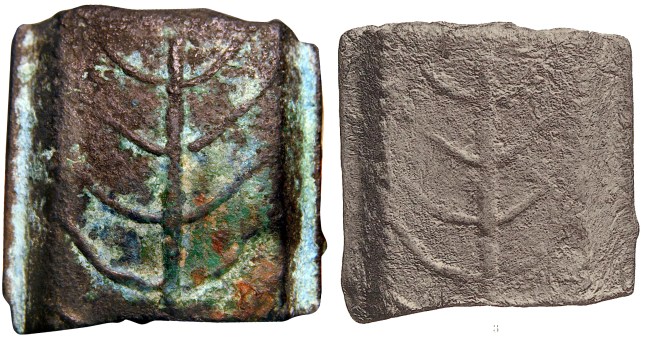
The first map shows all finds mentioned by Crawford 2002 in CH 9, p. 269-70.  Big dots represent 4+ specimens, medium dots ~2 specimens, little dots a solo specimen.

Capture

Crawford questions as others have before him an association with Tuder (Todi) and wonders if possibly the presence of one in a votive deposit at Orvieto means it the series might be better attributed to the Volsinii.  In his typical fashion Crawford is dismissive of other scholarship in this cases other finds reported in Ambrosini 1997 (must ILL).

Light blue circles Orvieto, orange Todi.  I can’t say one really fits the distribution better than the other…  Vecchi 2014 doesn’t commit, but nods in Crawford’s line of thought.

InkedCapture1_LI.jpg

GPS Points used:

Orvieto 2 42.718333, 12.110278
Tolfa 1 42.149722, 11.936667
Vicarello 1 43.613611, 10.464444
Tarquinia 1 42.249167, 11.756111
Vulci 3+ 42.418889, 11.631667
Talamone 1 42.555056, 11.132755
Vetulonia 2 42.859444, 10.971111
Siena 4+ 43.318611, 11.330556
Castilglione del Lago 2 43.138611, 12.047778
Perugia 1 43.112222, 12.388889
Spoleto 1 42.756479, 12.68547
Cecanibbi 1 42.778889, 12.414167
Ripabianca 1 42.940278, 12.404167 ?
Campo La Piana, Nocera Umbra 1 43.116667, 12.783333 ?
Montignano 1 42.677778, 11.756944 ?
Valle Fuino 1 42.731667, 13.016667 Cascia
Ancarano 1 42.833333, 13.733333
Sabina 1 41.616667, 13.8 Altina
Carsóli 4 42.1, 13.083333
Trento 1 46.066667, 11.116667
Comacchio 1 44.7, 12.183333
Termoli 1 42, 14.983333
Morgantina 1 37.430833, 14.479444

Denomination Markers

Obviously thinking about parallels to Roman or otherwise aes grave.

Selinus

Largely CAST!, typically dated to 450-415 period.  3-pellet type most common= Trionkion or Tetras.  4-pellet also known = Trias or tetronkion.  2-pellet = HexasCapture.JPG

Capture.JPG

There also silver fractions with five pellets usually dated to the early 5th century

Capture.JPG

Akragas

also has cast bronze denominations with 1, 2, 3, 4 pellets.  6 pellets are known in struck coinage.

The “Onkia” doesn’t have a denomination mark, but it’s fab design is clearly intended to flag its place in the denomination system:

Capture.JPG

2 – pellet:

Capture

3-pellet:

Capture.JPG

4-pellet:

Capture.JPG

Struck variations also exist:

CaptureCapture

Capture.JPG


Kamarina

3-pellet typically dated 420-405 BCE seems most common

Capture.JPG

1-pellets are also known

Capture.JPG

Himera

1643311.m.jpg

Himera, last quarter of the fifth century onwards (links to ANS specimens)

Base-12 system, six-pellet, three pellet seem most common, some four pellets

Gela

Capture.JPG

Gela, last quarter  of the fifth century – links to specimens in trade

3-pellet and 1-pellet seem most common,  assume this means a base-12 system too

Syracuse

Capture.JPG

Syracuse, last quarter  of the fifth century – links to specimens in trade

3-pellet and 1-pellet seem most common,  again I assume this means a base-12 system

Some mints producing struck Hemilitrons with pellets

Lipara, Syracuse (many AR with four spoked wheel), Akragas, Piakos, Mytistratos (mid 4th cent?), Panormos (fine rooster! and some with Punic script), Himera, Mamar, Solus (Solos, Soloi), Kamarina (?), Naxos (also silver version), Entella, Leontini, Kentoripai

4-pellet piece from Segesta misidentified as hemilitron, also Motya AR piece,

Some Bibliography on Denomination systems

La valeur des monnaies grecques en bronze / Olivier Picard. Revue Numismatique Vol. 153, 1998, p. [7]-18.

Thracian Silver


RRC 365 and 366, Hoard Evidence

Thinking about the possible relationship of these two issues (RRC 365 and 366) as hypothesized by Crawford to both be struck to support Sulla’s move against Sertorius…

Hoards containing both closing before 70 BCE (excluding Romania)

capture.jpg

those containing Flaccus’ issue (again excluding Romania and closing by 70 BCE):

capture.jpg

Those containing Annius’ issue (again excluding Eastern finds and closing by 70 BCE):

capture.jpg

Will want to come back to this and plot using dots that symbolize no. of Coins of each issue.  And check hoard lists etc.

Just another preliminary thought-experiment in my planning about how to make use of RRDP data.

When I think more about Sertorius I want to return also to this specific hoard.

Vilaret I Monfort, Joan. “Una troballa numismàtica de l’època sertoriana a l’Empordà.” Acta Numismática 6 (1976): 47-60.


Aedilician Issues

I’m considering possible next case studies for the RRDP material.  Trying to think about what issues would be most useful to compare die counts.  This set is in the running…

likely 86 BCE, RRC 351/1 – Both Plebeian Aediles (imitates RRC 300/1 in design!) – under Cinna’s regime – Ceres/subsellium

likely 84 BCE, RRC 356/1 – one curule aedile – under Cinna’s regimeCybele/curule chair

likely 69 BCE, RRC 406/1 – one curule aedile, SC – Vesta/sacrificial implements

likely 67 BCE, RRC 409/1-2 –both curule aediles, SC – composite deity/eagle and Cybele/curule chair

certain in 58 BCE, RRC 422/1–both curule aediles, SCcamel and supplicant / Jupiter, scorpion, historic legend RE Privernum


certain in 55 BCE, RRC 431/1 – one curule aedile – Cybele/camel and supplicant

certain in 55 BCE, RRC 432/1 – one curule aedile – Diana/goat

Bibliography on the Mint of Massilia

I will need to think more about the context of RRC 365 soon.  Creating this prelimary list is part of that prep.

A [forger’s?] die of this type as show on Andrew MacCabe’s photostreamCapture1.JPG

capture.jpg

Monographs

**Depeyrot, Georges. Les monnaies hellénistiques de Marseille. Collection Moneta; 16. Wetteren: Moneta, 1999.

Barrandon, Jean-Noël and Picard, Olivier. Monnaies de bronze de Marseille: analyse, classement, politique monétaire. Cahiers Ernest-Babelon; 10. Paris: CNRS Éd., 2007.

Brenot, Claude and Scheers, Simone. Catalogue des monnaies massaliètes et monnaies celtiques du Musée des Beaux-Arts de Lyon. Leuven: Peeters, 1996.

Articles

*Brenot, Claude. “Des drachmes de Marseille aux drachmes de Cisalpine: nouvelles remarques.” Rivista di Studi Liguri 61 (1995): 15-32.

Richard, Jean-Claude. “La diffusion des monnayages massaliètes au-delà du territoire de Marseille.” In Marseille grecque et la Gaule : actes du colloque d’histoire et d’archéologie et du Vᵉ congrés archéologique de Gaule méridionale : (Marseille, 18-23 novembre 1990), Edited by Bats, Michel. Travaux du Centre Camille Jullian; 11 – Études massaliètes; 3, 255-260. Lattes (Hérault): A.D.A.M., 1992; Paris: Éd. Errance, 1992.

Beyneix, Alain. “Des estampilles sur dolia dans le sud-ouest de la Gaule à la fin de l’Âge du Fer.” Archäologisches Korrespondenzblatt 30, no. 1 (2000): 85-96.  ” The 1st century BC Stamps attached to storage vessels bear certain similarities with both massiotic amphora stamps and Roman coins. Their use is linked to the trade in which Gallic grain was exchanged for Italian wine.

most too early or late in focus for my period

Chevillon, Jean-Albert and Lillamand, Anthony. “Marseille grecque : une série inédite d’oboles classiques à légende ionienne ΜΑΣΣΑΛΙΗΩΤΕΩΝ.” Revue Numismatique 174 (2017): 141-149.

Py, Michel. “Un pécule d’oboles de Marseille du milieu du Ve siècle avant notre ère sur l’oppidum du Marduel à Saint-Bonnet-du-Gard.” Revue Numismatique 174 (2017): 119-140.

Gentric, Gisèle and Richard Ralite, Jean-Claude. “Le triobole de Marseille, une émission d’époque classique sans lendemain ?.” Numisma 62, no. 256 (2012): 225-228.

Chevillon, Jean-Albert. “La phase postarchaïque du monnayage de Massalia.” Revue Numismatique 169 (2012): 135-158. Doi: 10.3406/numi.2012.3178

Chevillon, Jean-Albert, Bertaud, Olivier and Guernier, Roland. “Nouvelles données relatives au monnayage archaïque massaliète.” Revue Numismatique 164 (2008): 209-244. Doi: 10.3406/numi.2008.2852

Amela Valverde, Luis. “De nuevo sobre la serie de Q. Nasidius (RRC 483).” Revue Numismatique 161 (2005): 79-92.  – on narrowing down date of issue and attribution to mint of Massilia

Cahn, Herbert A.. “Artémis à Phocée.” In Ἀγαθος δαίμων: mythes et cultes : études d’iconographie en l’honneur de Lilly Kahil, Edited by Linant de Bellefonds, Pascale. Bulletin de Correspondance Hellénique. Supplément; 38, 73-75. Athènes: École Française d’Athènes, 2000.  – on early iconography

Villaronga, Leandre. “À propos de monnaies massaliotes inédites trouvées en Catalogne.” Cahiers Numismatiques 33, no. 129 (1996): 7-10.

Larozas, Christian. “Les petits bronzes à légendes ΚΥΙΞΞΟΣ ou ΚΡΙΞΞΟΣ.” Cahiers Numismatiques 33, no. 127 (1996): 19-24.

Chevillon, Jean-Albert. “Monnayage archaïque de Massalia: un type inédit à la tête de lion de face.” Cahiers Numismatiques 33, no. 129 (1996): 11-16.

Brenot, Claude. “Une étape du monnayage de Marseille: les émissions du Ve s. av. J.-C.” In Marseille grecque et la Gaule : actes du colloque d’histoire et d’archéologie et du Vᵉ congrés archéologique de Gaule méridionale : (Marseille, 18-23 novembre 1990), Edited by Bats, Michel. Travaux du Centre Camille Jullian; 11 – Études massaliètes; 3, 245-253. Lattes (Hérault): A.D.A.M., 1992; Paris: Éd. Errance, 1992.