This is a great article particularly for thinking about shifts in arms and armor in the Republic. I’m sure I’ll come back to it many times. Three initial thoughts below.
Michael J. Taylor. “Etruscan Identity and Service in the Roman Army: 300–100 B.C.E.” American Journal of Archaeology 121, no. 2 (2017): 275-92. doi:10.3764/aja.121.2.0275.
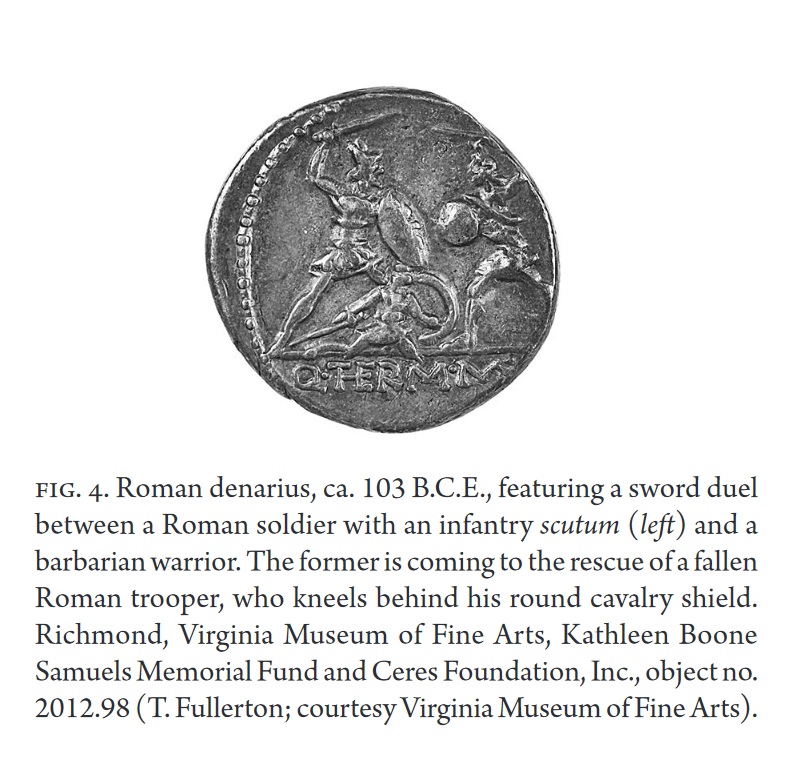
P. 282-3: “The kneeling fighter on the Minucius Thermus denarius (see fig. 4) carries a round shield and thus seems to be a fallen cavalryman awaiting rescue from the infantryman with the scutum.”
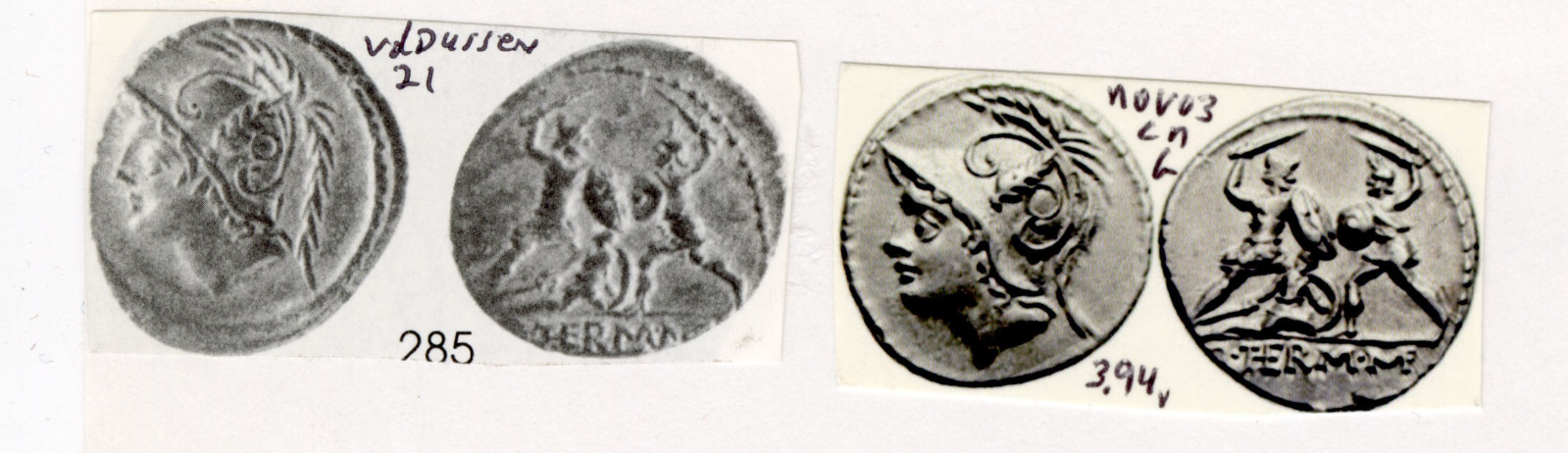
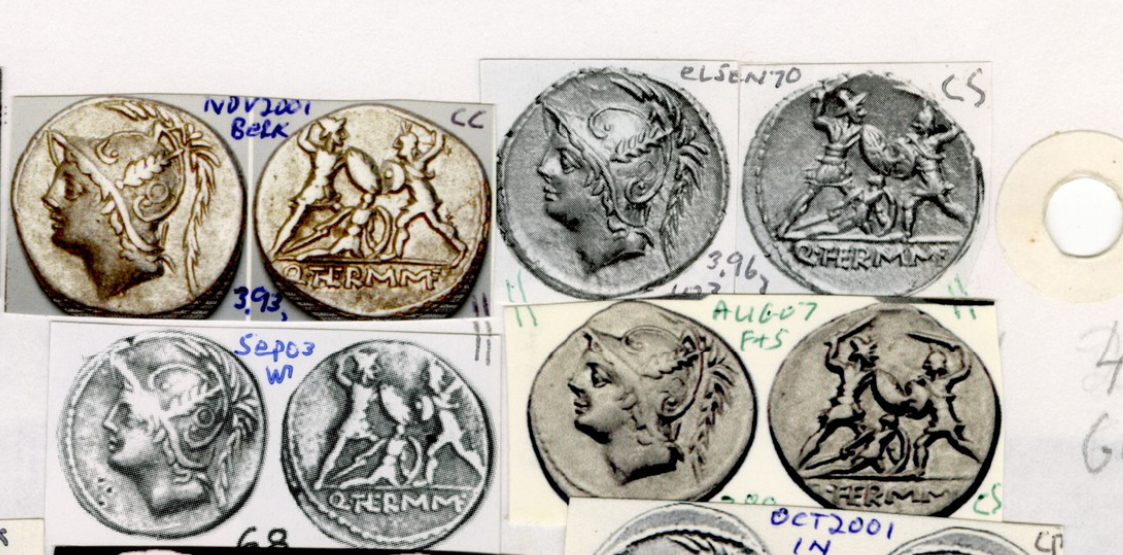
I want the figure on the ground to have a round shield and on many dies it looks that way but I’m not so sure its consistent enough cross the known dies to really be an intentional distinction to help us identify the figures and their ranks:
From Schaefer Archive left could be oval where as right specimen clearly round.
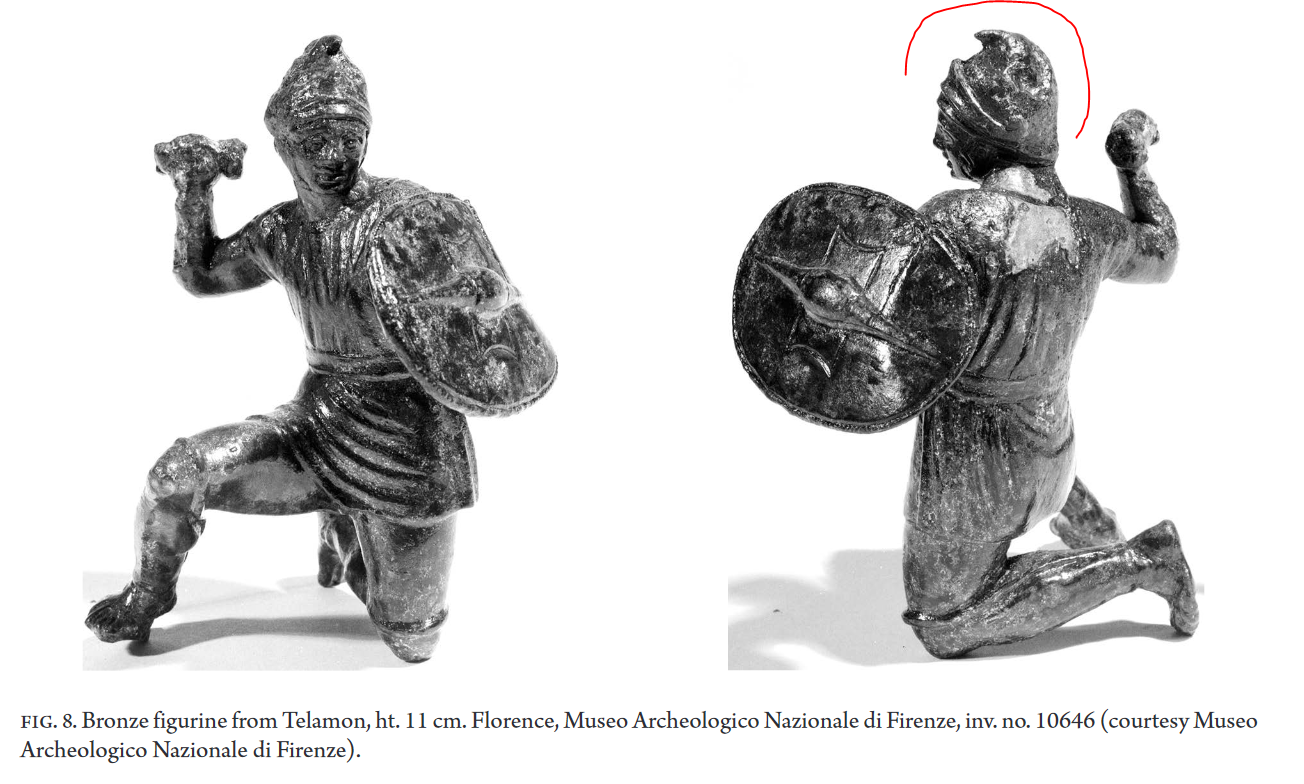
P. 285: “Otherwise equipped as a Roman soldier, the Telamon soldier wears a hellenizing Attic-Phrygian helmet (characterized by the prominent brow protector and low hemispherical dome that rises to a Phrygian peak).71 Similar helmets, a common enough Greek style, are well attested in pre-Roman Etruscan art.72“
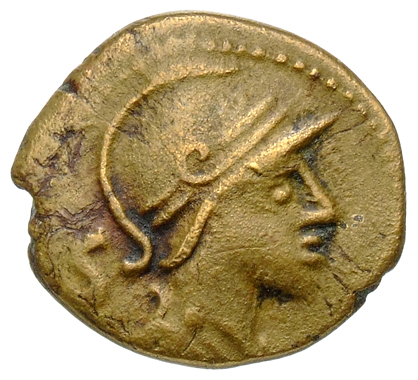
The Phrygian helmet (often with wings) of course is common on numismatic depictions of Roma (youthful Mars) but one type is VERY close to this figurine’s helmet.
p. 290: “The use of Greek myth on the urn is confident, even playful, with the front of the urn featuring centaurs and nymphs in apposition to the cavalryman, his warhorse, and his wife, proof of the wealthy patron’s studied Hellenism. The inscriptions are in Etruscan. A Volterran noble at the end of the Roman Republic could serve (and perhaps die) as a Roman eques and still go to the afterlife as an Etruscan aristocrat.”
This is a twitter convo that started because of one of Dr. Crom’s #ACOTD posts, morphed into consensus over obverse Muses (i.e. not Apollo on 410/2-10) and then turned to letter formation–weird long stroke on the first line of the V of MVSA on the reverses. There was also some discussion over the prevalence of banker’s marks (test punch marks) on the series. Anyway good bibliographical suggestions (Borghesi Ouevres and possible unpublished dissertation) and images so wanted to archive thread here. RRC 410
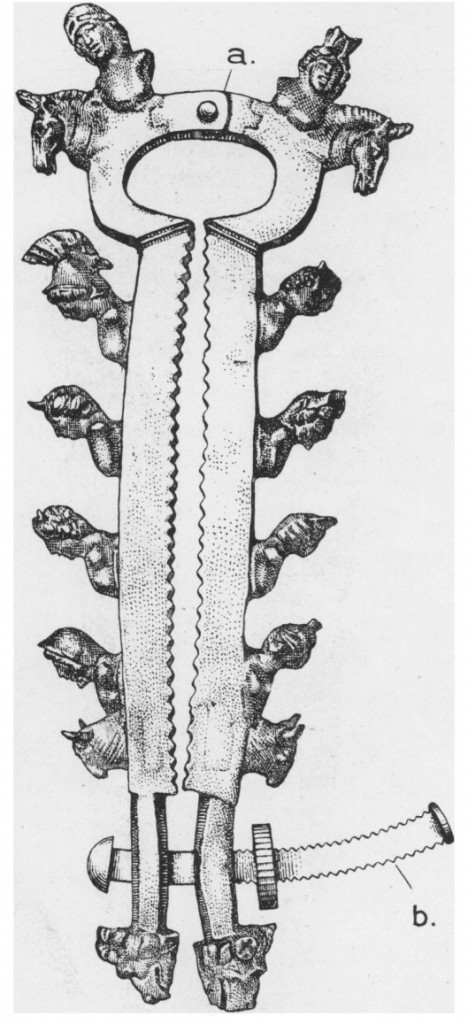
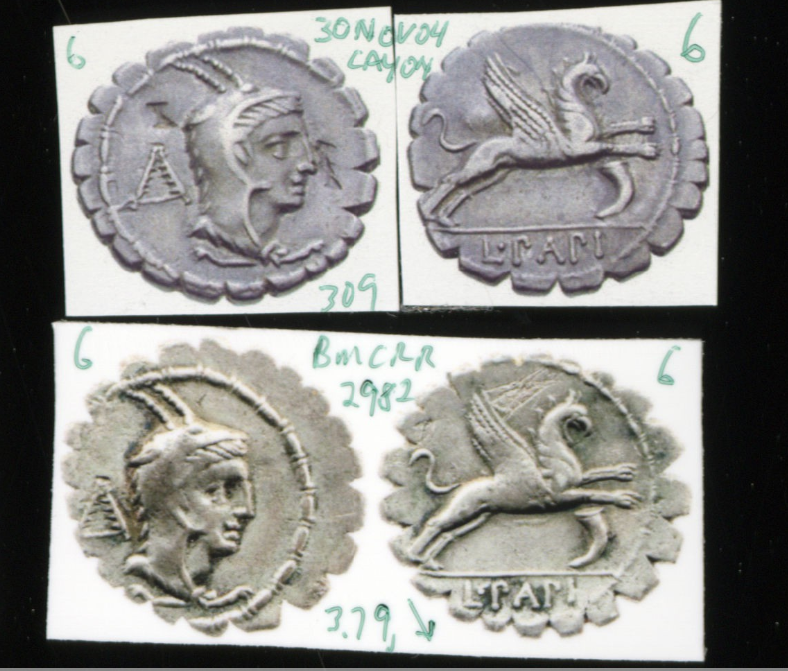
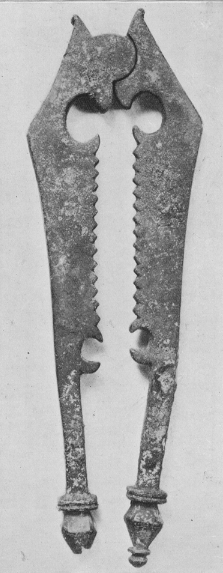
I didn’t know about this object until yesterday, when it was brought into a twitter convo. Needless to say I’ve been thinking about it ever since. The keen eyed Clare Rowan noticed a potential connection to a Cr. no. 6 obv symbol of the Papius series (images below) and I was deeply skeptical at first. Part of my skepticism in the knee jerk reaction came from how shiny the object looked in discussion on Roger Pearse’s blog. I thought they were gilt and thus I was like that can’t be real–must be a forgery for the titillation of some 19th century collector. But we must consider all options.
The BM description leaves some thing to be desired.
Do you know of a fuller publication not (yet) known to me the BM or Pearse?
To start, why couldn’t the left hand topper not be Attis (castrated consort of Cybele)?
Also why are there flame/horn like spiky hair protrusions from the horse heads?
I also worry that the deities down the sides haven’t been well identified
Mars (youthful), Luna, Helios, Saturn seem the best description down this side. Mercury, Jupiter, ?Venus?, ??? someone else???
The order seems possibly cosmological. Both sides terminate with bull heads.
The deities if read up the left hand side and down the right hand side are the days of the planetary week in order, plus one extra female goddess.
Notice a similar cosmological theme in this plate:
The Parabiago plate – La patera di Parabiago [2nd to 4th cent CE] Ancient Roman cemetery at Parabiago near Milano Milano Archaeological Museum (image from Flickr)
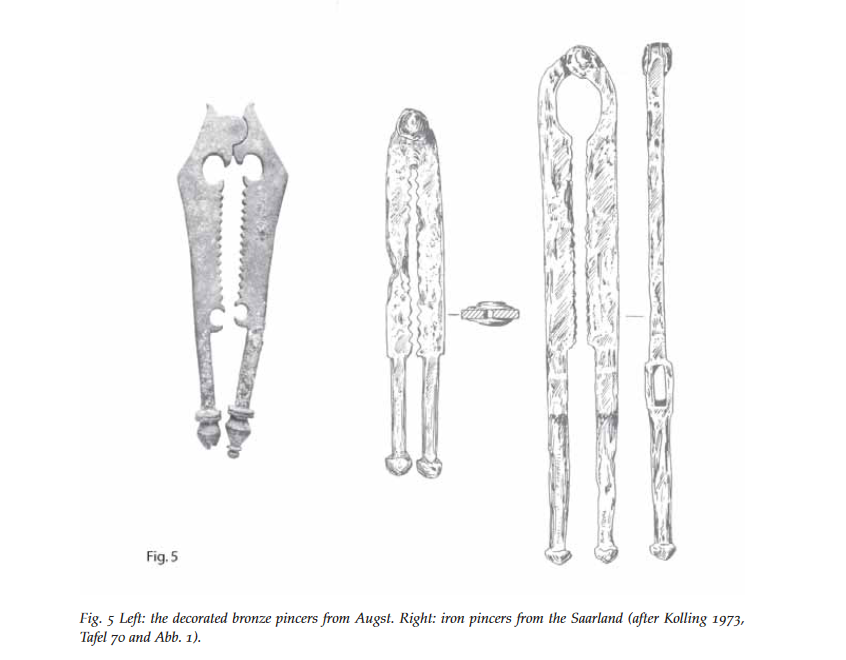
Notice that the whole where the missing bottom pin or screw would be placed
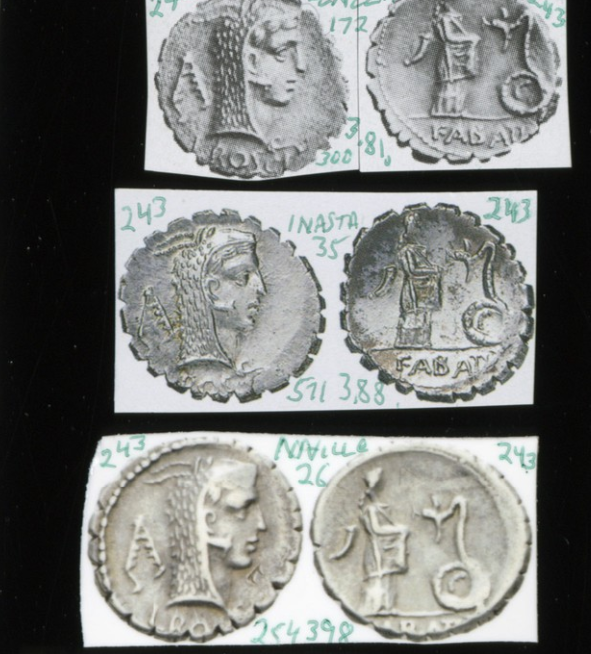
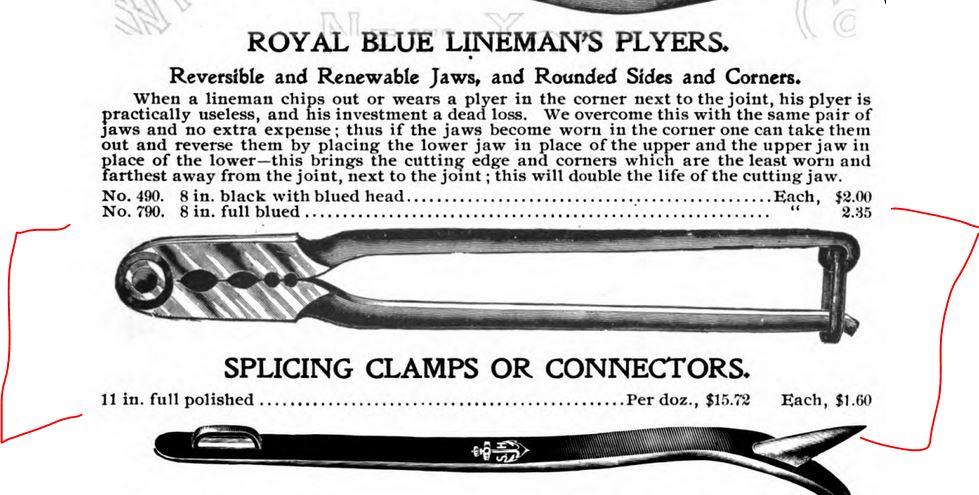
So why do I care? Well the Papius series has this thing that I though might be a musical instrumentBut now I see this from the Fabatus series and a clamp seems almost indisputable…Schaefer Archive Image of RRC 412
So now the question is now not what is the funny triangle but rather what do horns have to do with clamps? I don’t know enough about animal husbandry….
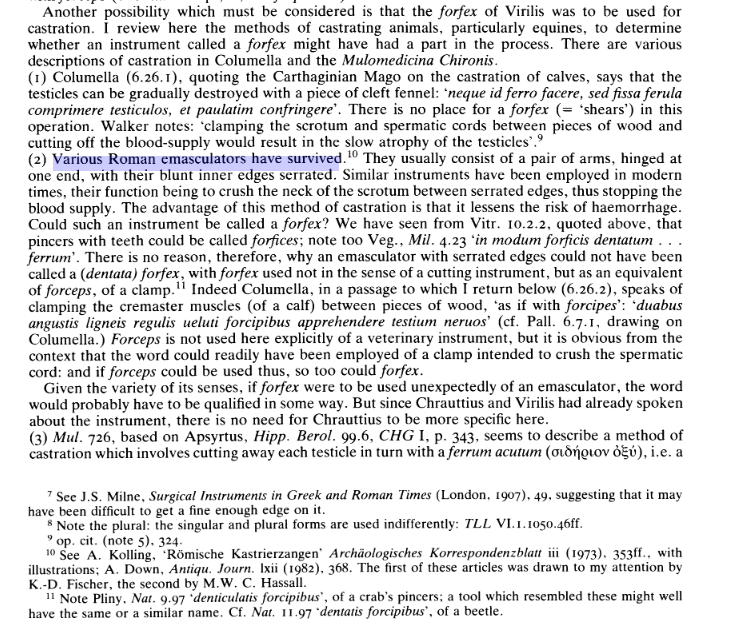
I’m now reading Heeren 2009 who is not so fixated on the castration explanation of the tools. He suggests these items might be a twitch used in horse care. He brings up the incredibly weight of the metal clamps that survive that would make them less functional for either castration or twitching a horse as the weight of the object would cause more pain than if a lighter wooden tool was used.
So maybe its a clamp but not for twitching or castrating? What else do we do to animals with a clamp?
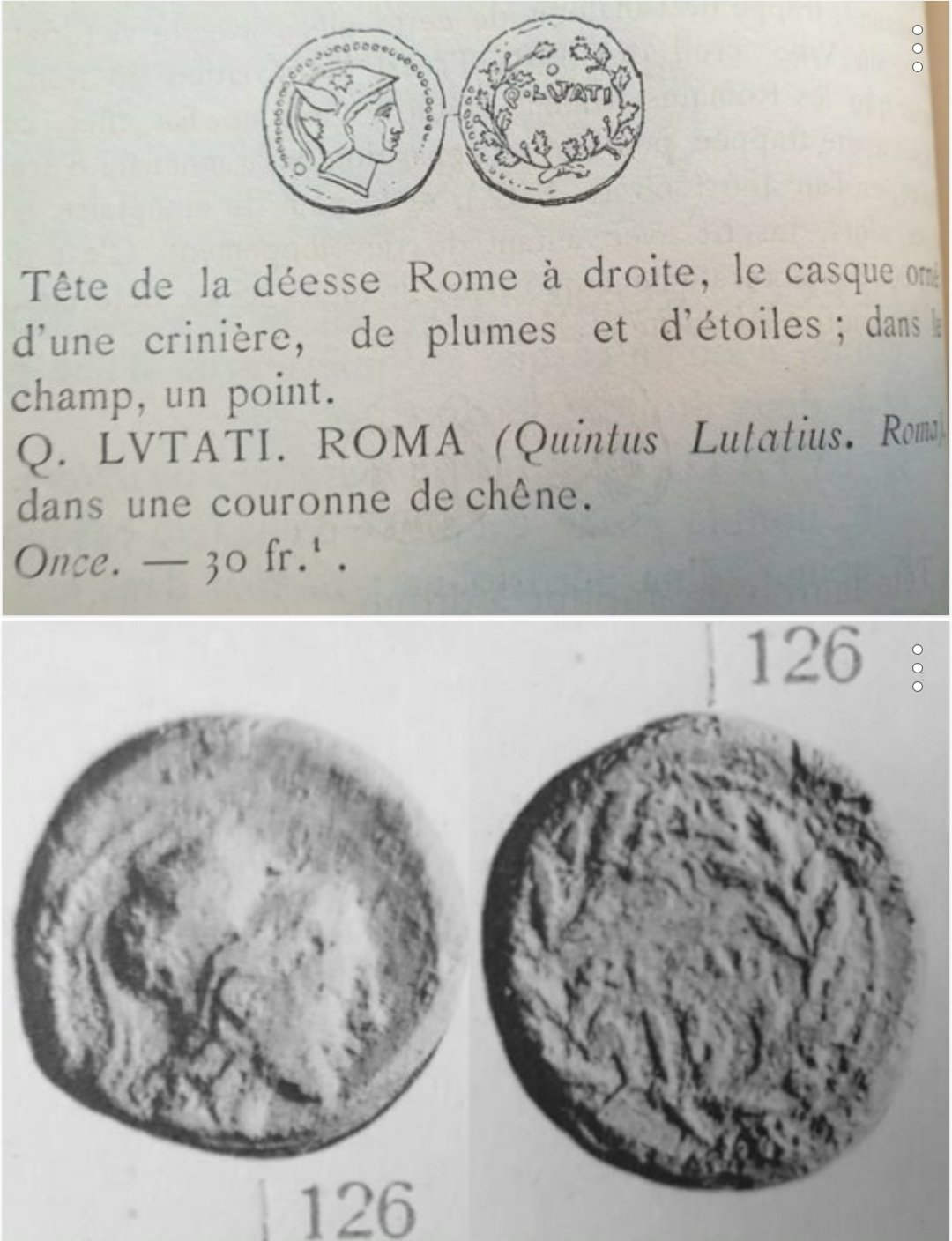
This little coin (RRC 305/2) is so irritating I managed to wipe it from my memory and thus from the first draft of the uncia paper. That cannot be left that way (I know, I know: it is also full of typos– I’ll get to those too… at some point).
Bahrfeldt also seems to have found it a wee bit irritating.
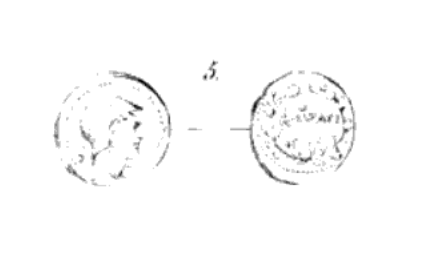
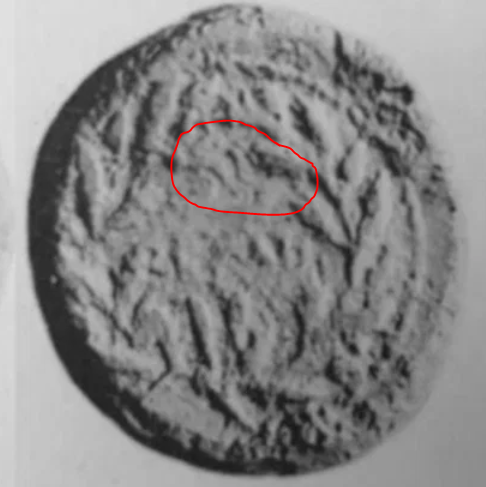
I have not been able to determine the whereabouts of the uncia that was once in Capranesi’s possession, weighing 4.15 g, and published by him in Diamilla’s Memorie numismatiche I 56, part IV 5. It did not find its way into the Vatican Coin Cabinet, as might have been suspected. I discussed the second known specimen, Supplements II 17. It is in Copenhagen, weighs 4.38gs and is only moderately preserved. Nevertheless, in order to show the correspondence between the head and the denarius, I give a picture here on plate V 126. The inscription did not come out well, but Q LVATI till legible, as well as the denomination mark • but of the ROMA there is nothing to be seen.
Bahrfeldt vol. 3 p. 69
Crawford cites this as D.D. Müller, did he miss read his handwritten notes perhaps for Diamilla?
All descriptions and images of this uncia go back to the 4.15g specimen published by Diamilla in Memorie numismatiche I, p. 56, plate V, no. 5, whose whereabouts cannot be traced. I found a second specimen in Copenhagen, it weighs 4.38 grams and is moderately preserved. I could not determine anything about the origin, but judging from the illustration it is not identical to that published by Diamilla.
I was so excited by the mention of a plate. I shouldn’t have been. I mean its a terrible scan but I don’t think the drawing is going to inspire confidence even if I get a better image of the place
Update from the next morning:McCabe kindly supplied a better drawing from Babelon deriving from this Capranesi plate he also supplied a photo from Bahrfeldt’s plate of the Copenhagen specimen. Both are very helpful.
In style and character this uncia–which I regard as unique–has on the obverse a perfect resemblance to that of the money belonging to Lutatius himself, but the title of quaestor and the inscription ROMA are missing. The beautiful preservation, with which it is provided, excludes at all that anyone thinks this coin is defective or missing the legend. The quadrans published by Riccio (1) was also coined without the title of Quaestor; we regret that in publishing it the weight of this quadrans was not given, which is so useful for the monetary system, but I hope that it fits perfectly with this uncia, and then it would be very desirable to have completed all the fractions of the rarest of consular bronzes. Quintus Lutatius also had the uncia struck in memory of the famous victory obtained by the Romans over the Carthaginians in 512, through the heroism of his ancestor C. Lutatius Catulus; which victory, among other honors, procured him the Civic Crown, which is seen impressed on the silver coin, and on this uncia, in favor of so many citizens saved and returned to their homeland.
Capranesi, p. 56
So Capranesi has convinced me. If his specimen has an obverse that looked JUST like the denarius obverse and the Copenhagen also looks to me to be modeled on the denarius obverse, I say that Capranesi’s coin probably existed and probably looked very much like the Copenhagen. I also am relieved that it doesn’t say Q or Roma as I can’t see either on the Copenhagen.
Update from the next morning: After seeing the images supplied by McCabe (see above) I’m further convinced that there are two specimens. I think they are best accepted as official products of the the Roman mint. I wonder a little if there might be a Q at the top where in the drawing Capranesi’s specimen has denomination mark.
Update for the evening of the next day: Schaefer still urges me to caution on Copenhagen specimen as possibly altered without condemning it. I agree that confirmation bias is always a danger; we see what we WANT to see.
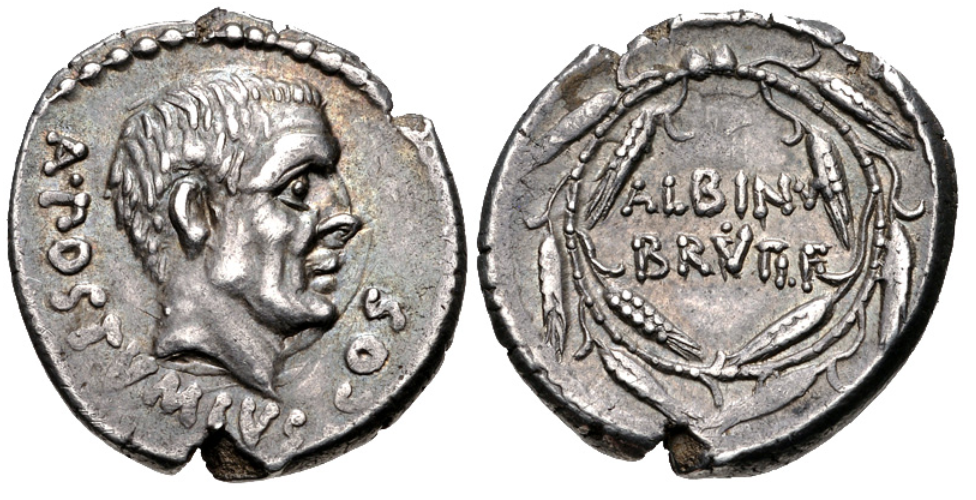
I still wonder if it was made by a pseudo mint from dies hubbed from a denarius and then the reverse re-carved a bit. My one sticking point for this pet theory is that after looking at all the 305/1 reverse dies that all only have ONE leaf about the TI of the name where as the uncia has two.
The drawing of the second specimen is so terrible even this cannot be compared. Boo.
François de Callataÿ discussed clash dies in his keynote for RBW conference.
There was some discussion if this was Roman or not. Andrew McCabe assured attendees that indeed it appears on Roman Republican Coinage. As this is new to me, I thought I’d collect here to train my future eye.
“The features before the face on the obverse suggest this is an overstrike, but if one compares Münzen und Medaillen Basel XXVIII, 19 June 1964, lot 232, which has the same obverse die, the same features appear; hence, the anomaly must be from this die rather than from an undertype. The feature is incuse and seems to follow the circle of the reverse corn ear, and around the point of the truncation one can see leaves. Hence, this is a result of a die clash. A die clash between two incuse-engraved dies produces a raised feature on the damaged die and thus an incuse and reversed image on the as-struck coin. Compare also to lot (my number 63) [Andrew McCabe]”
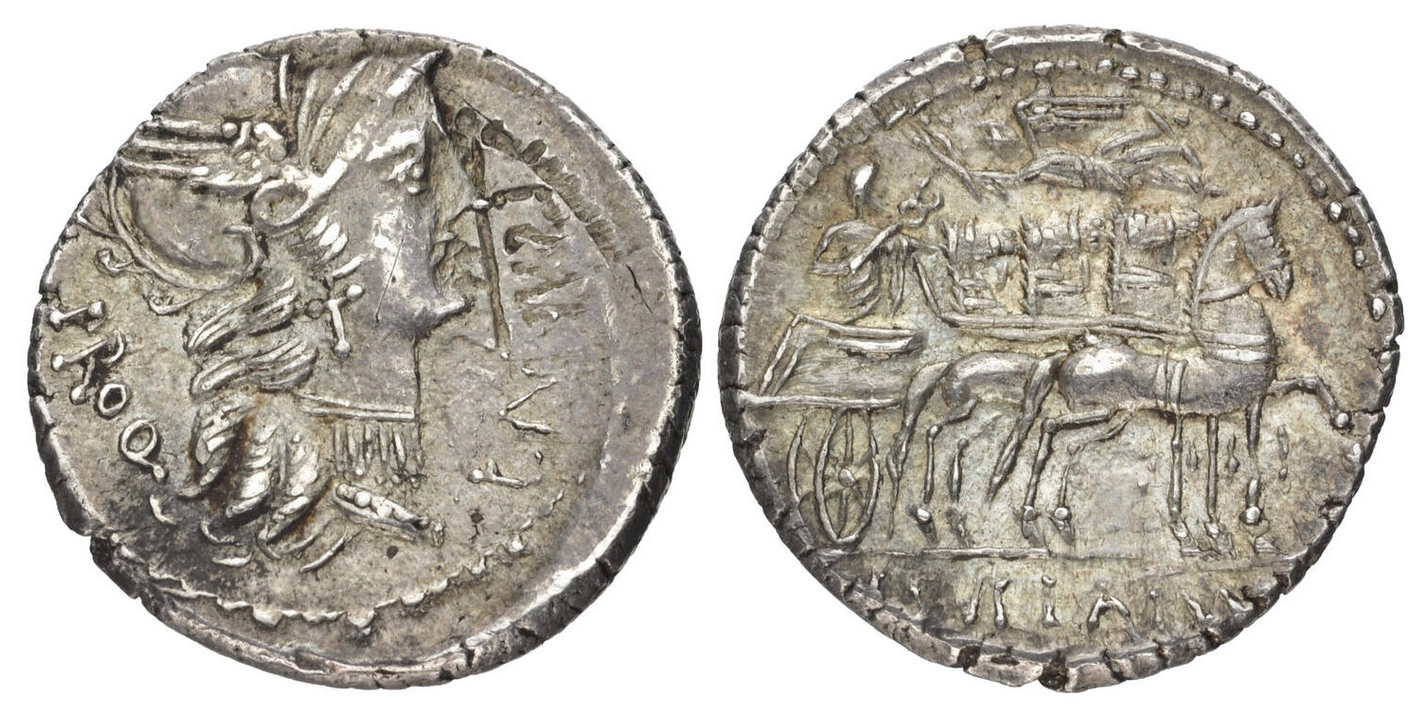
“Clear die clash is visible on the obverse where the reverse exergual line and the letters L.SVL[LA] can be seen incuse before Roma’s head. A die clash between two incuse-engraved dies produces a raised feature on the damaged die and thus an incuse and reversed image on the as-struck coin. They are quite scarce to find so clear, and I have collected examples over the years, see CNG E-408, lots 423 and 431. Note also the scarcer reverse on a typically larger flan where the horse to the right on the coin is also to the right of the quadriga group. Crawford’s arrangement per obverse legend ignores the much bigger difference in the two reverse horse arrangements. The type with this quadriga sometimes come with faintly visible control marks scratched into the die that wear off over time, see Phillip Davis’ article “Control marks: Tiny letters, numbers or symbols on Roman Republican denarii offer collectors a brain-teasing challenge” in The Numismatist (Vol. 126, No. 8, August 2013), pp. 65-7. These numbers are above the horses or before or under the horses’ legs. Very close examination on this coin shows no confirmable trace, but they were so lightly engraved that they quickly wore off during die use, as indeed was likely the intention. From time to time I buy examples of this quadriga variety in order to examine the field for these elusive numbers. [Andrew McCabe]”
“This is an excellent example of a die clash, with the reversed and incuse letters AED C before the chin being a clear reflection of AED CVR on the reverse. Rarely do die clashes come so clear. A die clash between two incuse-engraved dies produces a raised feature on the damaged die and thus an incuse and reversed image on the as-struck coin. Compare also to lot [my number 70]. [Andrew McCabe]”
The obverse of this die shows either the results of a broken die, an overstrike, a double strike (direct or flipped), or a die clash. Die clash requires a negative incuse impression. There’s a tantalizing impression of a possible exergue line with lettering before the chin of Roma. It looks in relief, which would make it a flipover double strike, but I cannot see a match to the reverse exergue. At the time of consigning, I had not yet worked out which option is most likely. [Andrew McCabe]
It’s so rough and so full of typos, but I must let it go as I’ve got students who I can ignore not a minute longer. Feel free to tell me how wrong I am and what I’ve not read but obviously should have.
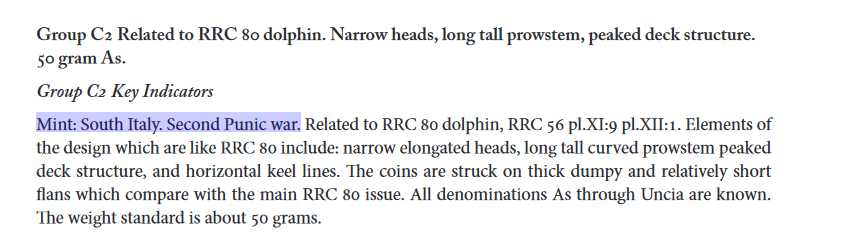
Mmmm. I wonder what if the Tubuli were active in the 2nd Punic War…
Can I prove that the dolphin series was made by C. Hostilius Tubulus Pr. 209 during his S. Italy campaigns? Nope. Do I think its highly likely that his descendant went and found an ancestors’ coin to emulate as he tried to resurrect the fortune of the family? ABSOLUTELY
Ah well it was fun speculation while it lasted.
So can I keep my creativity? Maybe.
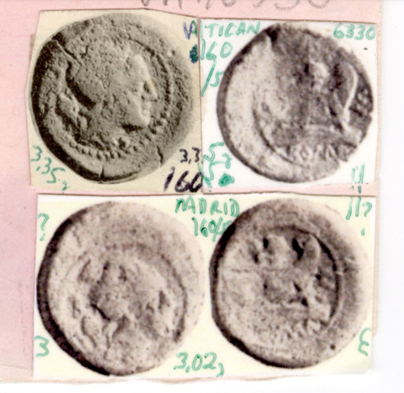
If RRC 80 Dolphin was C. Hostilius Tubulus Pr. 209 at Capua …
perhaps RRC 160 Dolphin was struck by a descendant?
Maybe L. Hostilius Tubulus pr. 142 or his father?
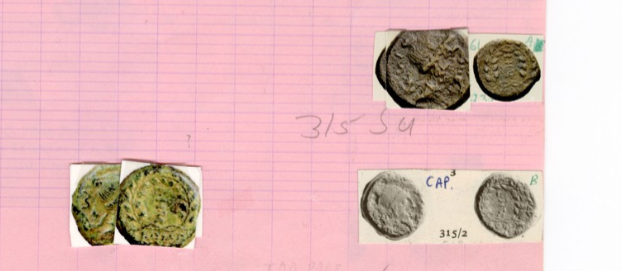
Then thus a connection down to RRC 315?
More speculative.
I mean we do have the Mamilii using the same numismatic symbols over even longer spans of history so cannot be completely ridiculous.
RRC 160/5 was clearly known Herennius and Tubulus but how is now a bigger question.
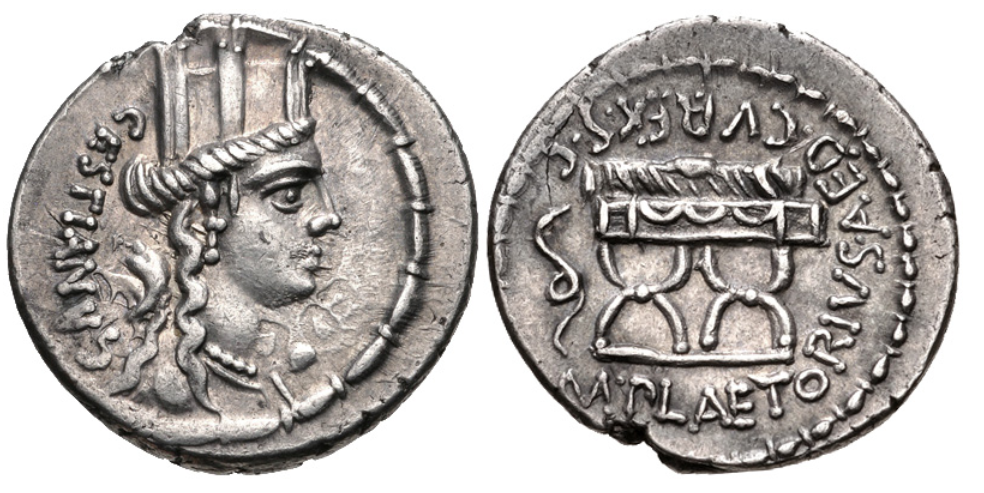
I’ll admit the style of the Roma head on this unique uncia of Thorius (RRC 316) has been bothering me. Like what’s up with that bulbous up turned nose and huge eyes?
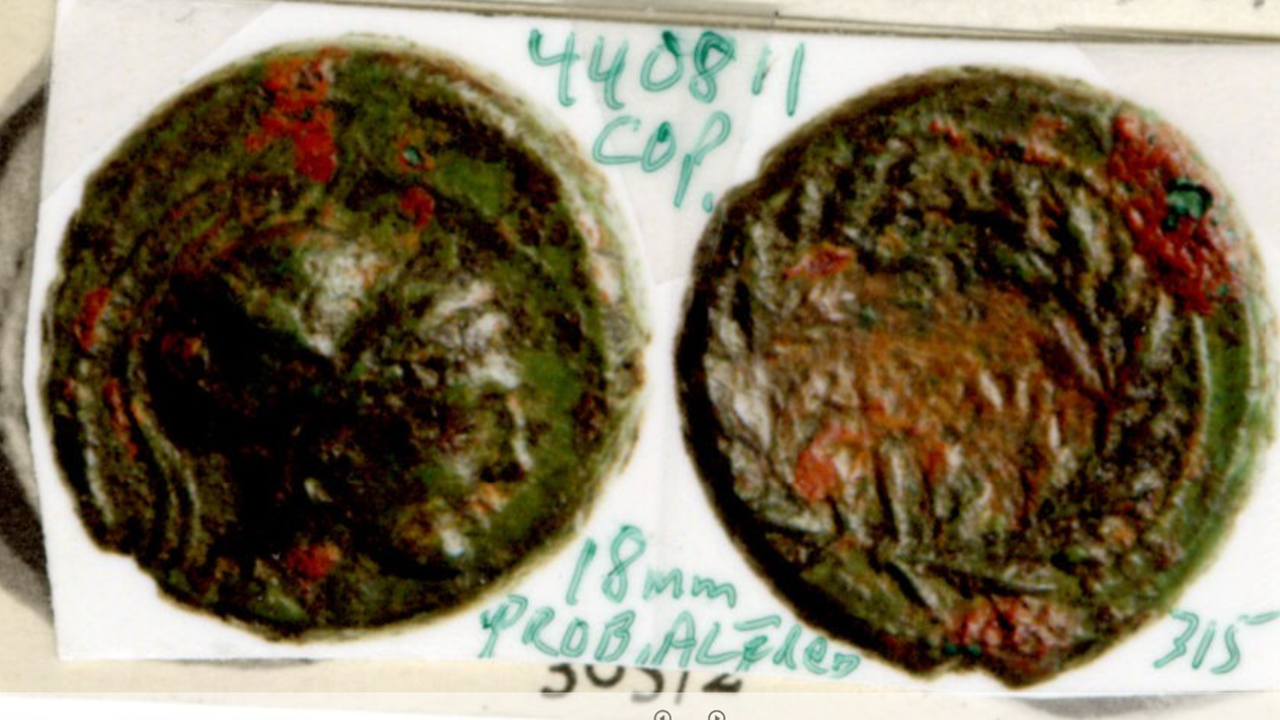
But this specimen of RRC 315/1 has made me feel better about it. Plausibly by the same hand even if the Thorius specimen still seems more exaggerated and cartoonish.