Re-blogging Abstract Guidance
This is an excellent post from Cora Beth Knowles. I’m copying in full to create an archival copy of this materials but this her work, not mine! PLEASE FOLLOW HER both here on wordpress and on twitter!
—
What is an abstract and how do I write one?
Posted on by Cora Beth
I’ve been reading a lot of abstracts lately, and thinking about what makes a good one. So here are my thoughts, for those times when you’re unexpectedly in need of an abstract!
This year I’m a judge on the Classics and Archaeology Panel for the Undergraduate Awards. As part of the judging process we look at the abstracts that people have written to accompany their essays. Now, I’ve seen some great abstracts over the last couple of weeks, but in general it’s apparent that people don’t know what to do with an abstract. They write a few lines as an afterthought, or more often they simply copy and paste their introduction. So let me address both of those mistakes, to show you why an abstract is important, and why it’s not an introduction.
You should always make good use of the opportunity to provide an abstract. The abstract is the public face of your work – your advert, if you like, for your own research. It’s the first bit of your writing that your readers will see: and if it’s not good enough, it will be the only bit they’ll see, because they won’t bother with the rest! Essentially it’s rhetoric: you’re persuading people to read on.
So what are you supposed to do, and how can you do it well enough to hook a reader?
One crucial element of the answer is that the abstract is different from an introduction. It should be catchier: just ask yourself, ‘What would Cicero write?’. It should be a standalone piece of writing. It’s the classic ‘elevator pitch’: the way you’d sum up your research to someone if you were sharing a lift with them for thirty seconds. An abstract should usually be between 100 and 300 words, and doesn’t usually contain references: so it can be more powerful than normal academic writing.
It should also go further than your introduction. These are the things you’re usually advised to include:
Background information
Focus
Gap
Purpose
Methodology/ Approach
Conclusion
In other words you’re telling the story of your developing research; you set out the context of your main interest and (crucially) the gap that it is going to fill; and you cover the purpose of the work (what does it set out to achieve?). These are all things that you might do in your introduction. But in your abstract you also need to outline your methods: what approach have you chosen? This is important: people might choose to read your work because they want to use similar methods in a different context, so you need to see your methodology as a selling point in your elevator pitch.
You also need to anticipate your conclusion. Many people don’t do that, because it’s not something you would usually do in an introduction – but of course (as I may have mentioned!) this isn’t an introduction. Don’t worry about giving away the ending: frankly, your research is unlikely to contain a great deal of dramatic tension anyway! Tell the reader what you’ve found out: if they find it interesting, they’ll read the full article to see how your research justifies your conclusion.
There aren’t a lot of occasions at undergraduate level when you need to write an abstract. You’re likely to need one if you pursue undergraduate publication or submit an essay to the Undergraduate Awards; but apart from those, it tends to be seen as a higher-level requirement, for MA study and beyond. However, if you can get into the habit of writing a rough abstract, for your eyes only, for every essay (yes, I know, it’s a crazy idea!), you’ll see how the act of writing an abstract forces you to sharpen up your thinking about how your goals, methods and conclusions connect.
Abstracts are a big part of academic life; but for the most part, writing an abstract is a skill that is not taught. Scholars even at the top levels of academia are often dreadful at writing abstracts. It’s a startling omission in research and skills training, but it’s one that you can exploit by developing the ‘elevator pitch’ as a skill that sets your work apart. Keep in mind that when people get out of that metaphorical lift, they should be interested in finding out more about you. If they’re bored or confused when the doors open, you’ve lost that audience forever.
Abstracts: the art of being fun in a lift. Remember that definition and you won’t go far wrong!

(And here’s a detailed discussion of the ideal [arguably!] composition of an abstract, from the LSE Blog.)
Cora Beth Knowles
“Indian” Rhetoric
While preparing for my graduate seminar last night I found references to the importance of Bingham’s Columbian Orator to classical reception particularly the reception of Cato and Addison’s Cato. All things of deep interest to me.
This morning as I was cleaning up my open tabs I couldn’t help but browse the table of contents and noticed an ‘anonymous’ speech:

This is bizarre and also not unexpected. It so well typifies beliefs about the ‘Noble Savage’ and ‘right’ relations with indigenous peoples. I wondered if anyone had written on it, but then I remembered how much I had to do so I am throwing up this blog post. When I return to it I want to start here:
Stockbridge Indian papers, 1739-1915.
Collection Number: 9185
Division of Rare and Manuscript Collections
Cornell University Library
BUT I also want to think about the possible influence of the Bingham version of the speech on the Lewis speech to the Yankton Sioux! Note especially the use of the FAMILIAL VOCATIVE!

Notes to Self on Running Charitable Auction
- Paypal was a nightmare to set up, allow time and multiple people to work on this.
- Compressed is best to conserved your own energy and enthusiasm and also of the bidders. This was shorter but in someways still too long.
- This is in tension with the fact that everyone want to bid immediately when they see stuff and also wants to donate items even when they are learning about auction at the last moment
- Line up data entry volunteers or paid help, people solely responsible for keeping track of donations and uploading them into website.
- You never know what will appeal to others. Accept the wacky as long as on theme and trust it will find its fan base.
- People are motivated by the personal, make it ALL personal
- Promote matching from the start BUT don’t make matches too big, use twice retail as a good bench mark for a successful possible match target. Suggest big matchers sponsor instead.
- Recruit sponsors, but set a minimum for sponsorship and make clear to differentiate levels (bronze, silver, gold are boring but the I now see why fundraisers use these!)
- Research and PAY for a better site. Time = money. A clunky site costs time.
- People like to the donate items during auction. Let this happen but have data entry support lined up to handle it.
- Social media alliances are key. Get people to volunteer as designated re-tweeters. Formalizing this will validate it as work.
- Never under estimate who will complain about what. Keep to a NO DRAMA policy, but pre establish what will be grounds for removing posted items.
- Mail Merge is your best friend. That and spreadsheets. Make sure donation form has fields that can be directly uploaded to action site.
- The raffle worked great earning 4/5s as much as auction itself. Some legal issues should be talked through and we also need to cognizant in future of religious prohibitions in some communities.
- Go Live works but use Youtube not FB. FB requires an account.
- Don’t forget to set minimum bid increment
- Don’t set buy it now too low.
- Closing time matters!
- If working in a team have a pre scheduled set of check in meetings on the calendar.
- The pool of bidders and donors has huge overlap. A core group uses the momentum of the event to encourage themselves to engage further and extend giving. Much of it is about community.
- Too much work and too much risk of becoming ritualized if run annually. Should be random-ish and at least 14 plus months since last similar event.
Tower of Babel

What’s up with portrayal of race on this mosaic?!
A different type of fraud
“…He then attributed his conjecture … to one of his imaginary sources…”

Charity Auction Alert

Hellenistic Royal Portrait Mosaic

This isn’t a real post. I’m too busy for a real post. Everything I’m doing feels a little neglected as I’m doing too much. HAPPY SEPTEMBER! but I don’t want to lose this image or refs.
For #MosaicMonday, my second favorite Hellenistic mosaic: the stunning portrait of Berenike II, Queen of Kyrenaika and later Ptolemaic Egypt. She sports a crown made of warship prows and a fibula (brooch) with an anchor, a possible hint at her Seleukid lineage. Naval couture.
From Eduardo García-Molina
Dr. Blouin argues this is Arsinoe II
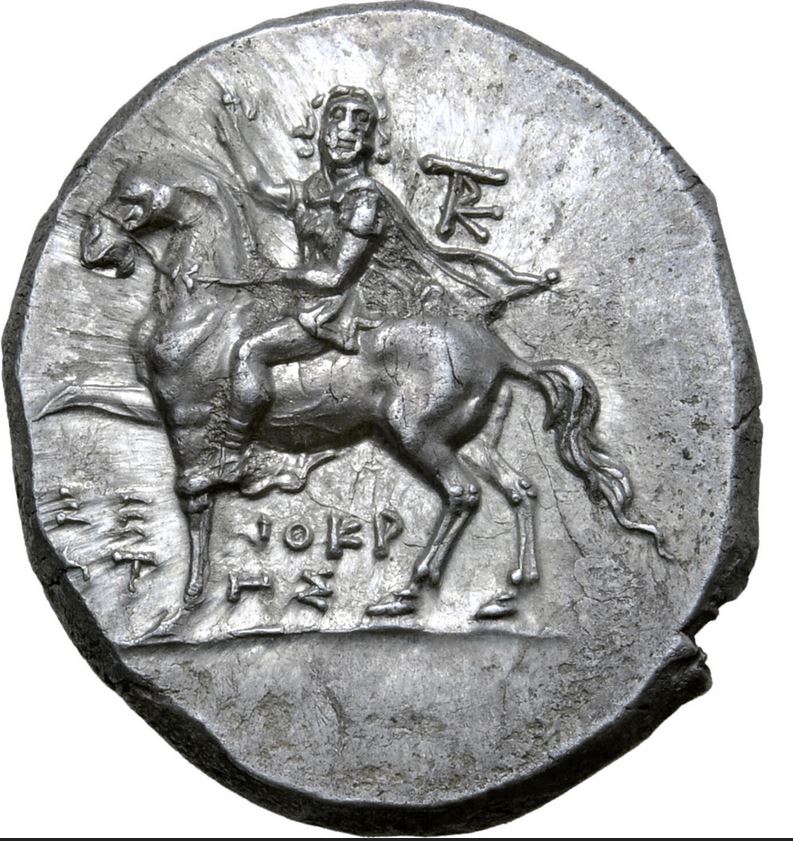
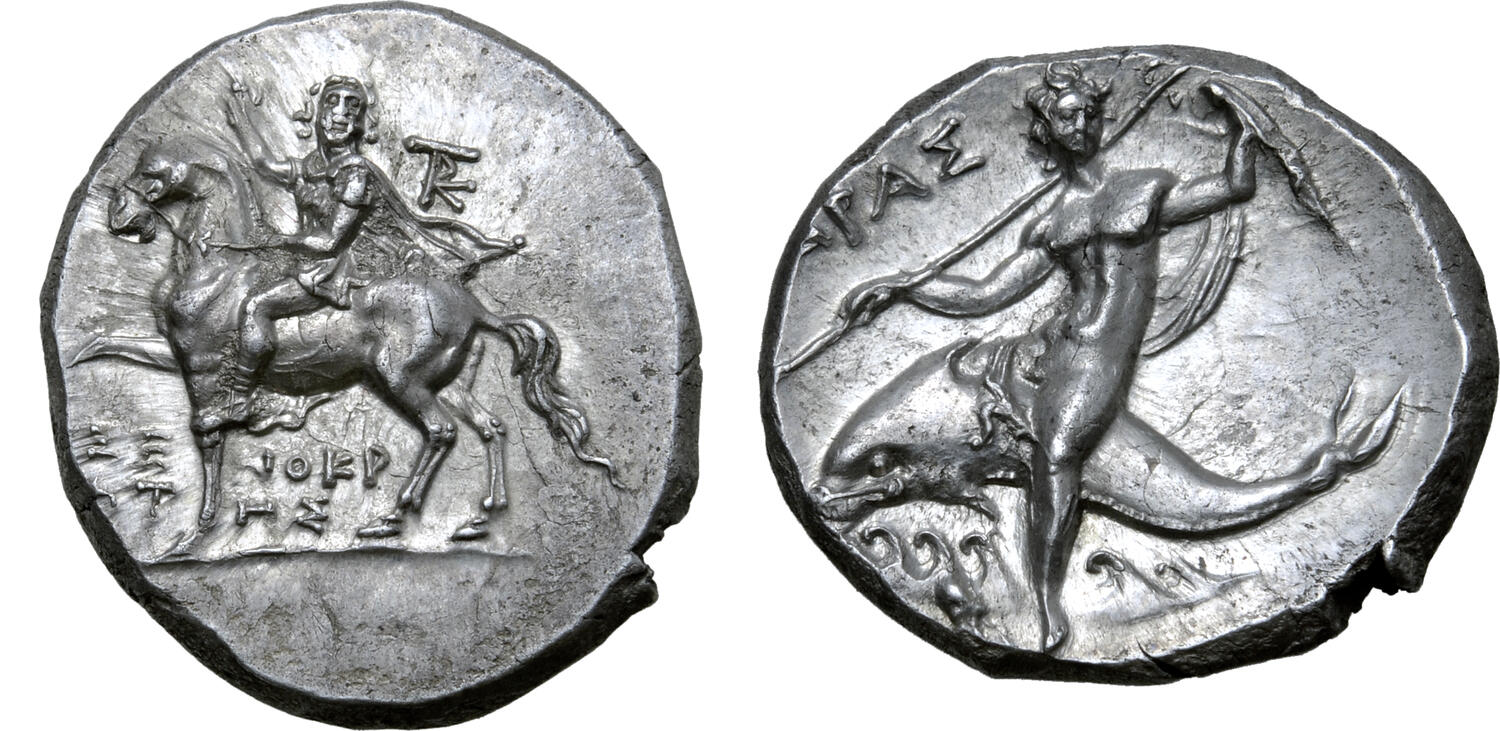
Those horses DO look alike!
This post is to archive the observation made by the keen eyed Andrew McCabe on Twitter celebrating the re-opening of the BM; I think he may well be right.


Hercules and the Muses

John Ma on twitter offered a translation of this newly discovered inscription:
“I am Maternus, new Herakles, who was best in the Muses and unconquered in the gladiatorial schools. I killed Pasinikos, and myself descended to the underworld with him”
-Tweet from Aug 26

I just wanted to file this away for another example of Hercules association with the Muses for juxtaposition with coin above.