So I like the sense of completion of hitting publish on a blog post, its a trivial little boost to mark a bit of work and the end of a thought unit. So I’m breaking my previous long post and starting a new one. There is no logic to my breaking spot maybe even some illogic, but it’s a rough January morning in a pandemic when my republic is in turmoil and my colleagues are catching Covid, and I need all the little morale boostsI can get to keep myself working away…
I love the Philippus series. I realize that lots of my writing on it hasn’t appeared in print and only some on the blog (collection one, collection two) as I’m ‘saving’ it for my kings project that might or might not be a monograph one day. Anyway. If you are interested in the denarius for scholarly reasons, ask me to send you my essay on it and other kings with coins, but there is also a good chunk in chapter 2 of the coin book, riffing on the work of Hölkeskamp who has revisited the Marcii in many valuable publications.
No as, semis, triens, or sextans or semuncia is known, just quadrantes and unciae. I’m inclined to think these might have been the only denominations made or at least the only ones prioritized. This is interesting as it suggests that these might the ‘in demand’ denominations. I want to think more about that and also think if there is an argument to be made about RR unofficial AE issues about which denominations were most likely to be made and then of course WHY.
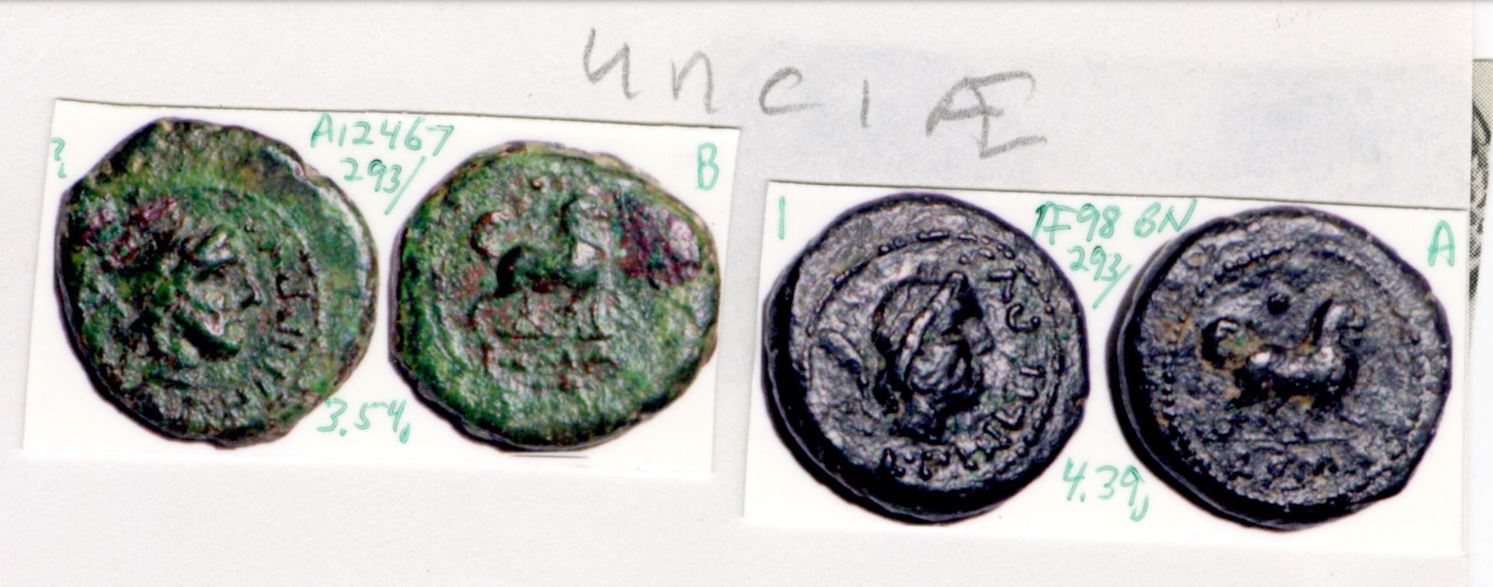
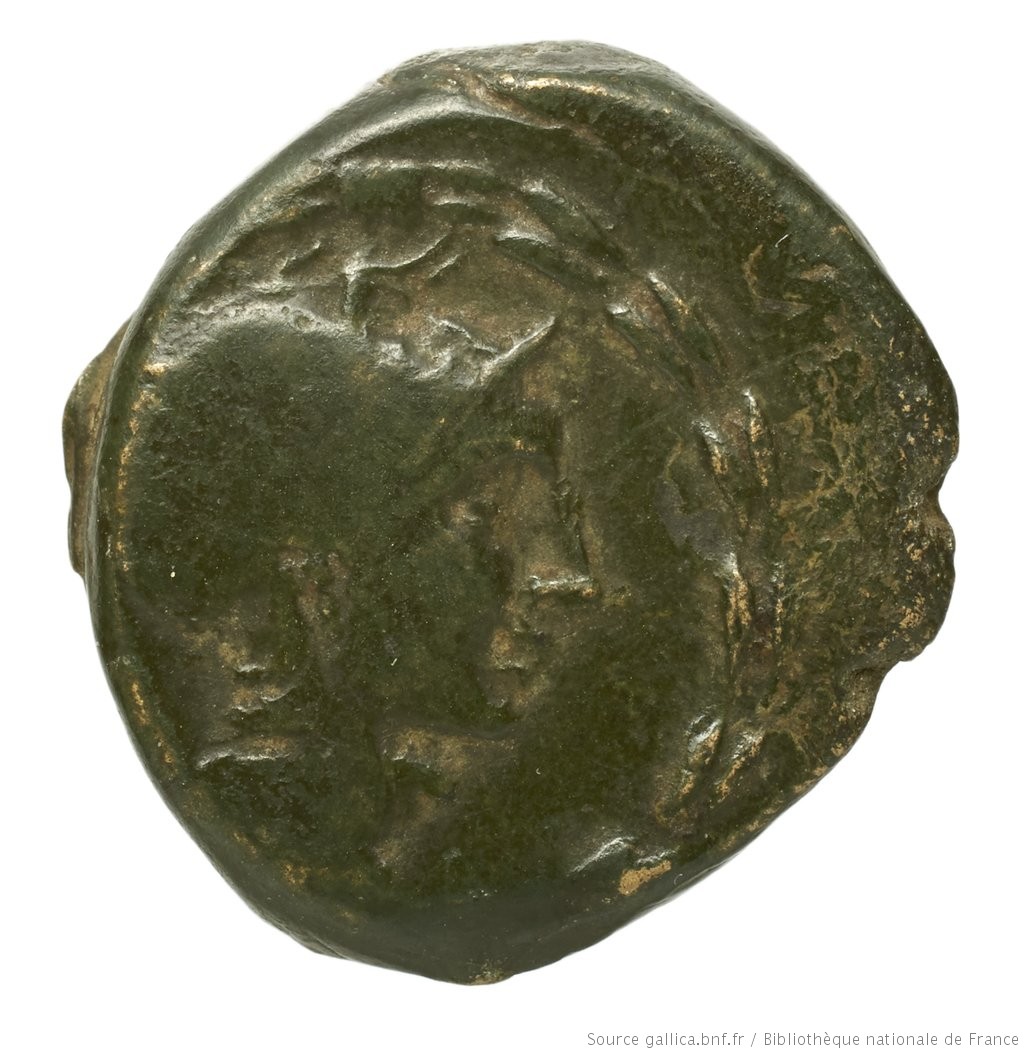
Only two unicae are known and both in Paris (again).
The photos of ?-B and 1-A in the Schaefer binder are actually better lit for seeing details than the official Gallica images.
Where did these come from? Was a wishing well or other votive deposit discovered perhaps in ye olden days and the nicest unciae ended up in Paris source collections…? Could archival work here help? I should go look at Nemi find and other similar sacred water coin toss finds.
Why Saturn? maybe the logic went that if no semis was made the god of the treasury would get offended if not on the coins if bronze were made? Or could there have been a little fashion for Saturn and this marks the start of it? Saturn gets some love on the denarii shortly after this , but that love for the most part seems explained in each individual case. The Memmii love Saturn for family reasons (we can assume), Saturninus for canting pun reasons, Caepio for his quaestorship….
Update: the identification as Saturn is based on the falx behind his head. See much earlier post.
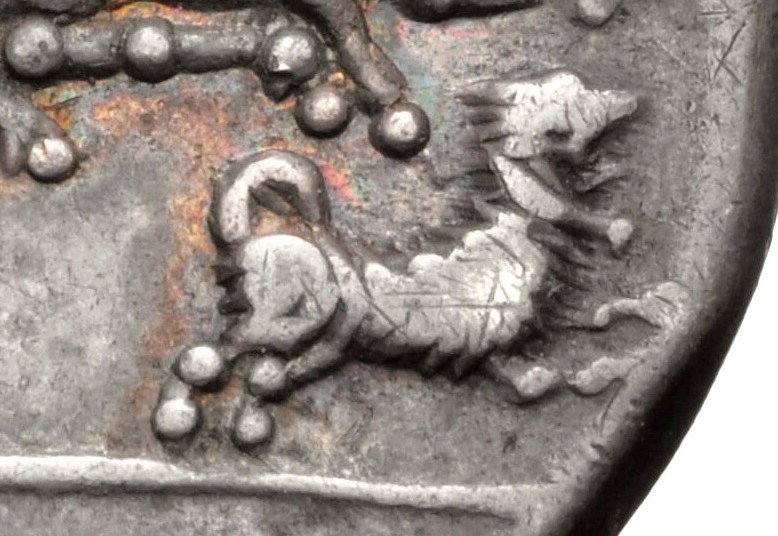
And why a dog? I’m going to go with loyalty-fides resonance; see me on Ulysses and dogs and Fides. This particular dog type is some times called a Maltese or Proto-Maltese and will be familiar to many numismatists from a wide variety of coins.
But there are earlier dogs on the Roman series of a similar breed cf. RRC 122. The dogs of RRC 26 have some similarity in body pose but are leaner and read more like a hound to me. This is, of course, all a little subjective.
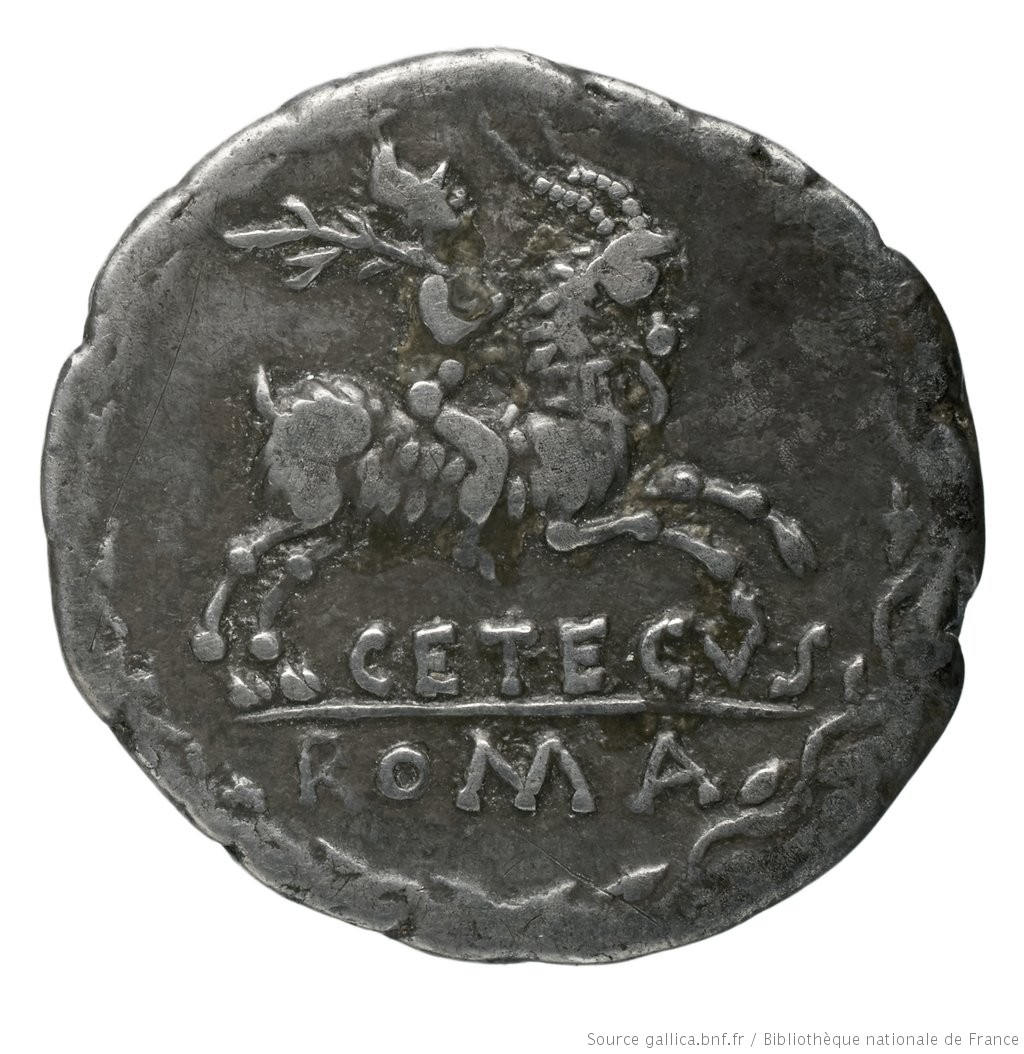
The quadrans has a lovely bellicose rooter. I’ve written (too much perhaps) about cocks on this blog and in a forthcoming article. I’m guessing the the two types the dog and cock were chosen for their recall of manly Roman virtues: fierce and loyal, perhaps characteristics they would associate with Tremulus who is honored on the denarius.
So I’m thinking about the uncia RRC 290/6 but that makes me of course think about other Mars-in-quadriga types and I ended up at that old puzzle about that figure next to Mars on RRC 232/1:
I need to let it go. I’ve been through Schaefer’s collection of die images and I still am not sure what I’m seeing but I’m leaning towards a female figure. We could do with some comparative iconography…
Next up in our small change investigation is RRC 289/5. To understand this choice you’ll have to accept Lockyear 2018‘s methods for rearranging the relative chronology. Crawford had put this in 115-114 BCE and HBM has even nudged it down towards 112 BCE, but Lockyear tells us that 289 is in the wrong place so it needs to be earlier, we’ll ball park it at 119 BCE. The could be too early but at very least its the next uncia after those of the 130s BCE and earlier than the unciae of RRC 285, which Lockyear has also shown to be later in the relative chronology. We’ll call it 111 BCE but we must leave it fuzzy and accept we just don’t know precise dates on these YET.
These late unciae are also “weird” in the degree to which they shake up our expectations regarding design. 256/5 in 132 BCE might have kicked off this playfulness with the small change.
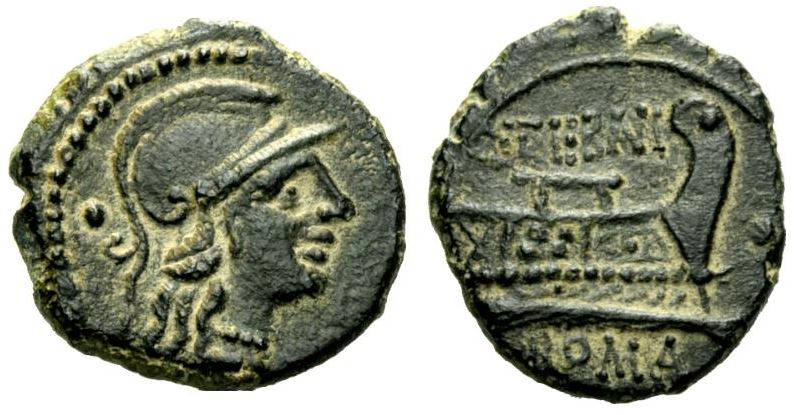
Normally I might say the rudder was an attribute of Fortuna and leave it at that, but the weird thing is that’s not really how it seems to be used on the republican coin series. Most instances where we can tell what its doing suggest that we should see it as a claim to dominion over the seas. Given that the same symbol appears on the reverse as a secondary symbol of the denarius of this issue, we should probably assume that the symbol has meaning to the moneyer and his family, ditto probably Hercules. The main take away is that the uncia is the place the moneyer feels comfortable breaking with tradition even as he chooses as super conservative denarius type (Roma/Victory). This is his little bit of difference.
So my children have discovered that if they come into my office and look at the plates of Crawford and then ask me to show them a better picture of what ever type they are pointing to I will pretty much always play along forever. This is sneaky of them and bad for my productivity but cute as all get out. Anyway. I’m going to go do family stuff more on unciae tomorrow.
285/7a-b
This series, or at least the bronze is much more playful. Unlike the preceding series where the moneyer only really messed with the uncia the whole of the bronze of 285 has creative alternative reverses. Issue is made by the whole college of moneyers in collaboration (How convenient! How rare!). The denarii are pretty boring, just Roma-Quadriga
Examples from trade of 285/1 and 285/2 respectively: notice Domi’s is a slow quadriga and Jupiter has a laurel branch and fulmen (thunderbolt)–this is Jupiter on ceremonial parade, like a triumphator; by contrast Sila and Curt’s Jupiter is in a fast chariot reminiscent of the quadrigatus didrachms of more than a century earlier. He hold a scepter and hurls his thunderbolt. A little lituus has snuck into the field above showing us a minor personal statement: “hey I got an augur in my lineage; my family safe guards Rome’s religious traditions and the favor of the gods (like Jupiter).”
The bronze is where the college is shown functioning as a whole college and leaving behind the extremely entrenched prow reverse and instead choosing a standard attribute from the traditional iconography of each obverse god for the reverse. Semis through uncia are well known. If an as or semuncia showed up tomorrow I wouldn’t be that surprised (but I’d love to see it!!). To get a sense of the series look at this page and the next in Schaefer’s binders. They are beautiful. I in particular admire the Minerva-Aegis on esthetic grounds.
Update: Jeremy Haag wrote me about this post, pointing out how important it is for the identification of the god of the Semis as Saturn not Jupiter. Mattingly’s “A Guide to the Exhibition of Roman Coins in the British Museum” written in 1927 describes the Roman Republican bronze semis as depicting Jupiter, not Saturn, whereas Sydenham’s “The Coinage of the Roman Republic” in 1952 is happy to call the god Saturn. 285/3 has a curved agricultural implement as the reverse attribute thus confirming that later identity is most likely the right ID on all semisses. This led me back to an old post I forgot I’d written on harpa versus falx!
But besides noting the overall pattern in the issue as a whole, I’m going to stay focused on the unciae.
Detail of same Schaefer page linked above. Do you see what I see? The flans of the two specimens I”ve drawn a blue arrow between have suspiciously similar shapes? What’s up with that?
Ok so I can only assume that these are the same coin and that some one did a hell of a a cleaning job on it and turned a fantastic profit. While removing a good .1 grams of material from the specimen. I grant you the cleaned up one is prettier… If I’m wrong, do tell me! Now what weight do I put on my spreadsheet?! grrr…. decisions. I’ll put 3.96 and call it done. Apollo shows up more and more on coins in the late republic and perhaps was taking on greater significance for the state or even being favored by those elite with a particular view of how Rome should work. (There are some earlier blog posts about this: one, another, yet another ) I’ll have to talk about this in what ever comes of this survey of the small change.
This unciae is clearly playing with the fact that it has approximately the same dimension as the denarius and thus can imitated the denarius design. Mars driving a quadriga isn’t so common on the denarius reverse and neither is a laurel wreath border. Crawford says that the obverse of this is borrowed from 289/1; I won’t argue that they are clearly carved in the same style and likely by the same hand, but it seems to me that the moneyer is thinking about 232/1 for his overall inspiration. I wonder if this connection of obverses is what influenced Crawford’s arrangement of the series which seems a little off here according to Lockyear 2018? Or if Crawford’s logic holds maybe 290 also needs to move earlier in the series… but that doesn’t seem right. Another moving piece of the puzzle… I’m not sure if this issue goes before or after the previous one.
I also really want to go hold this Paris specimen and see if it is an overstrike. The flan is so strange….
Upper right corner seems to has traces of … something? Or my eyes and the light are just playing tricks on me. Link
Oh and now I type their weights into my spreadsheet and these unciae are SO HEAVY! More on that data below. They seem however on average a good full gram more than earlier unciae.
Note: RBW thought that his specimen might be unique and that that from the Fénelon-Farezcollection might be a forgery BUT that specimen is shown by Schaefer to die link with a Verona specimen.
Schaefer has long noted the wide variety of renderings of the quadruped on these quadrans and has identified at least 11 different reverse dies, 12 if we count the strange ‘bird’ from the Capitoline museum. BUT I think we probably shouldn’t. It seems more likely that 292/4b is in fact a mint error and a 293/2 Philippus triens reverse was combined with a Nerva triens obverse, and we should take this as evidence that the two moneyers likely belong to the same college. The struck out idea is made more complicated now that Manfred Fischer has kindly drawn my attention to a second specimen of 292/4b.
Uncia – quadruped, same creature as on the quadrans.
What is it? Part of me thinks a horse many look like a horse and engraving can be sloppy. Part of me is leaning toward goat. The goat part of me is thinking about the funny looking goat on RRC 288/1 and more generally about dionysiac imagery and that maybe that dancer could be called a Maenad and we could have a connecting theme?
So I got to play around with Neapolitan weight conversions to figure out what Riccio thought this little coin weighed. The various reportings of the Naples libbra in the 19th century all are between 320-321gs. So that puts the trapeso (1/360th of an libbra) at c. 0.89 g. and this specimen as having a reported weight of c. 3.55g.
Rough translation of Riccio’s commentary: “It has not been possible to assign a mint to coin with a different style of engraving. In terms of weight, it almost corresponds to the half-ounce of this series, although it lacks the mint mark of Luceria. Could the ball, about half the size of that typically found on this series, be the symbol of semuncia? We have had two beautiful ones from the surroundings of Luceria. Others better informed will pass judgement on this conjecture, since it has hitherto been impossible to situate the fractional denominations of the as corresponding to this type, sometimes attributed to Campania, and sometimes to Apulia.” (corrections welcome as always)
Some names seems so familiar to the numismatist, others not all… But also the form of truncation and ligature and letter forms and punctuation feels v very familiar.
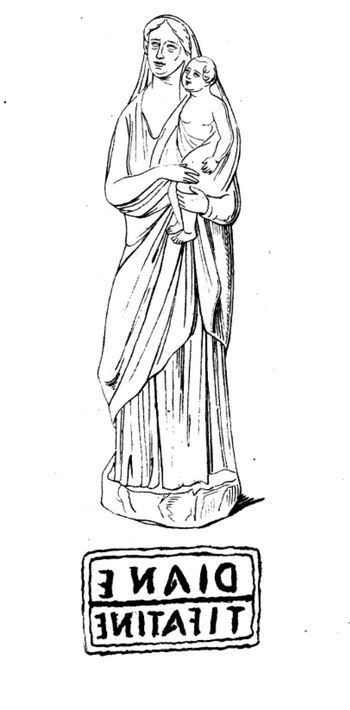
I’m struggling to find Riccio 1855 digitized to follow up on that Bahrfeld note in the previous post about a possible uncia of RRC 238. BUT that does mean I’m leafing through a lot of other digitized works by Riccio. This is so fun. I assume its a votive offering but does it represent the goddess or the petitioner, probable the later!? I’m not going to let me self be distracted but Diana Tifatina is so important in the Sullan era I wanted to record this.
I thank M. Fischer for kindly sending me the following additional 241/6 specimens!The generosity of those working on RR coins never fails to astound me and warm my heart.
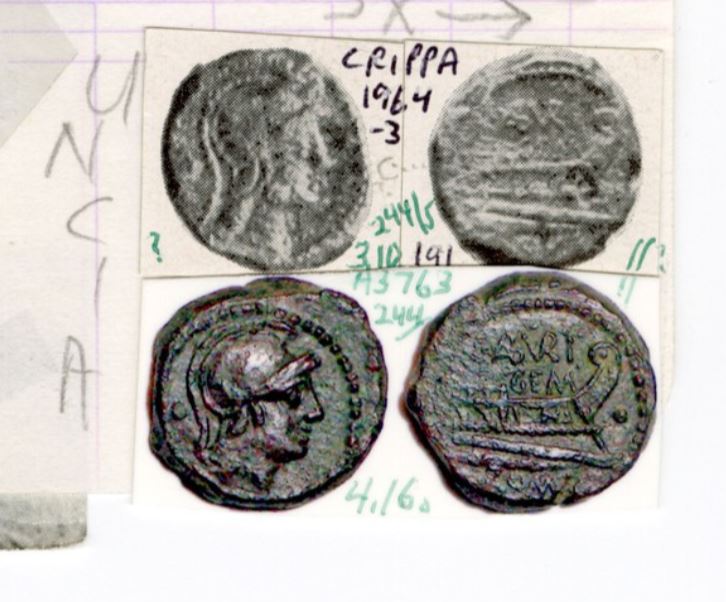
Only third known specimen of RRC 244/5: 3.87 g.; the first known is in Paris (it’s always Paris isn’t it?!): 4.17 g, 17 mm, 7 die axis. Do you have a better photo of this coin? I’d love one, if you did! The second known specimen, is only known to ME because of the Schaefer archive (wow I love them so much); the bottom image is an alternate image of the Paris specimen. What is CRIPPA you ask?! Answer in the unofficial Schaefer guide. 3.10 g. Again, if you have a better photo…?
We finally get a mess of specimens (still pretty measly, but beggars cannot be choosers) with RRC 249/4.
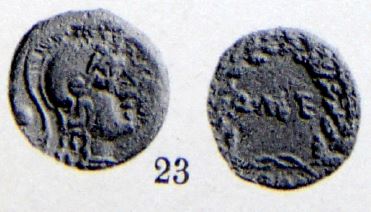
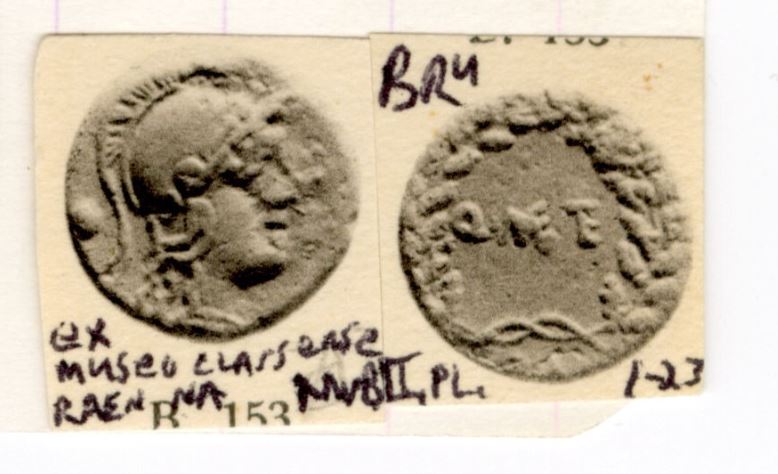
Fischer has sent me a specimen known to Bahrfeld in Ravenna but not included by Crawford that would be 256/5:
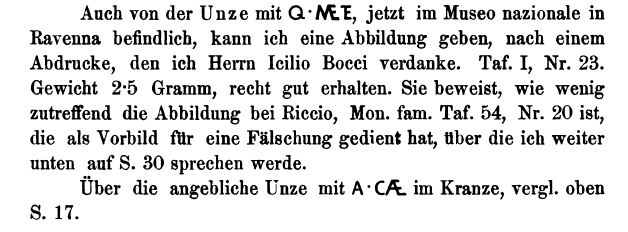
Cleaned up machine translation:
“I can also give a picture of the uncia with Q · METE now in the Museo nazionale in Ravenna, based on a print I owe to Mr Icilio Bocci. Plate I, no. 23. Weight 2.5 grams, in very good condition. It proves how poorly the illustration in Riccio, Mon. fam. Plate 54, No. 20, which served as a model for a forgery, which I will talk about further below on p. 30. About the alleged uncia with A · CA in the wreath, see above, p. 17.”
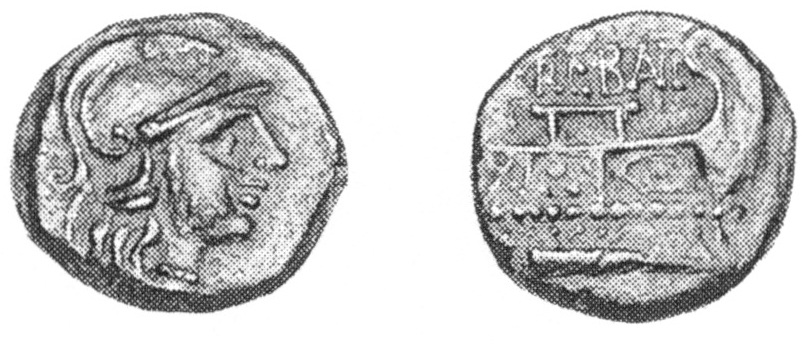
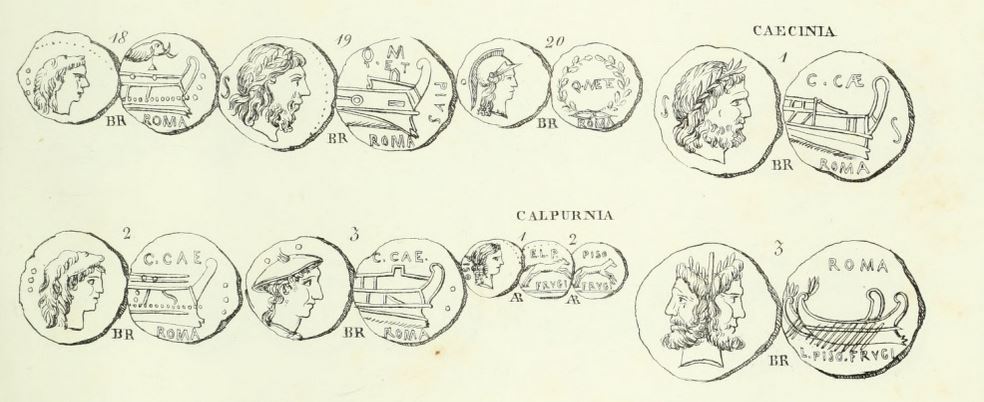
Riccio Pl. 54 is pretty poorly drawn but I do just love that it exists as confirmation at all. Notice also the ELP coin type below! Another rare favorite.
AND sure enough Schaefer already knew this specimen as well, BUT given than it was sold in 1958 (BRU = Count Luigi Brunacci Collection = P&P Santamaria Auction (Rome), 24 February 1958), I don’t think I bother looking for it in Ravenna post pandemic:
Molinari 2016 would (like HB Mattingly new) put this issue in 132 BCE and I follow her judgement on dates in this period. I would note that it clearly displays an OAK wreath like some later issues. This specimen seems like it belongs more to the subsequent period of uncia because of its design, but the moneyer is quite clear no later date seems quite feasible.
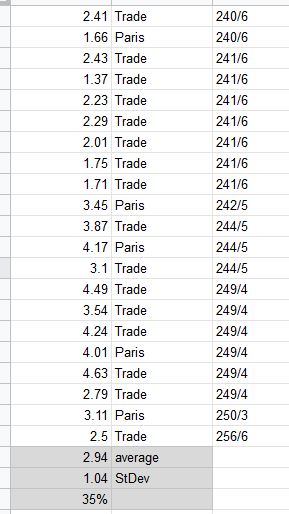
21 specimens over 7 different issues is pretty bad for doing any meaningful quantitative analysis, but we can say that the while the specimens are visually very consistent their weights very significantly. I’m pretty happy to say that the weight of these coins was not a major concern in minting operations and thus not particularly tightly controlled in any way.
Do you know of other uncia of this decade that are not listed here? Do let me know!
So why start here? Well it looks like there has been about a 10 to 15 year gap in the making of the uncia before these issues and there seems to be another gap of about 20 years after. Of course another specimen could show up in a few hours and mess my gaps, but we’ll keep chatting. Dates are a big issue here in the hazy late 2nd century. If we presume that relative chronology is ok then the previous uncia was RRC 217/7 (not in Crawford, but Russo 1998, 147, for illustration bottom left specimen on this Schaefer binder page).
Hint: to find a type that isn’t in CRRO but likely known to Schaefer, go to nearest denomination in the issue in CRRO and start from the binder pages listed for that type and you’ll usually find what you need.
RRC 217 matters for dating a whole heck of a lot. A denarius of this issue was over struck by Andriscus as Philip IV meaning that 217 needs to be c. 149-150 BCE NOT 144 BCE as HB Mattingly would have it or 147 BC as Crawford gave us. However both agree on general relative chronology so we probably need to move not just this but surrounding issues earlier.
***
Fischer also kindly shared with me this note from M.v.Bahrfeld in his “Nachträge und Berichtigungen zur Münzkunde der römischen Republik Bd I S.20” on a uncia from L. Antestius Gragulus (Cr.238)
A slightly cleaned up machine translation (if I’ve made a meaningful error, do let me know!):
“We only know the uncia from the description by Riccio Catalogo p. 34, No. 28, sales catalog p. 13, No. 194; the coin’s whereabouts is not known. I think they are very problematic, by the way. Babelon describes the uncia on p. 148, no. 15, according to Riccio Catalogo p. 34, no. 28. But since he says “helmeted head of the goddess Roma facing right”, while Riccio says “Head of a veiled woman facing left” which suggests he did not consult Riccio, but simply asked Cohen to transcribe it.”
I started this morning by making myself a spreadsheet by dumping csv data out of CRRO and then cleaning it up and adding new info. Dump was post 146 BCE to 82 BCE and the new info was thanks to my various marginalia in my physical copy of Crawford and also also to searches of trade databases and OF COURSE Schaefer’s binders in Archer as linked from CRRO (hence earlier random posts of today).
Do you see a type I missed that’s not in Crawford? Send me a photo or citation! I’m very curious.
So I thought at first I might take a chronological approach, but I’m now thinking I might take a denominational approach to exploring what’s going with small change and the Roman mint.
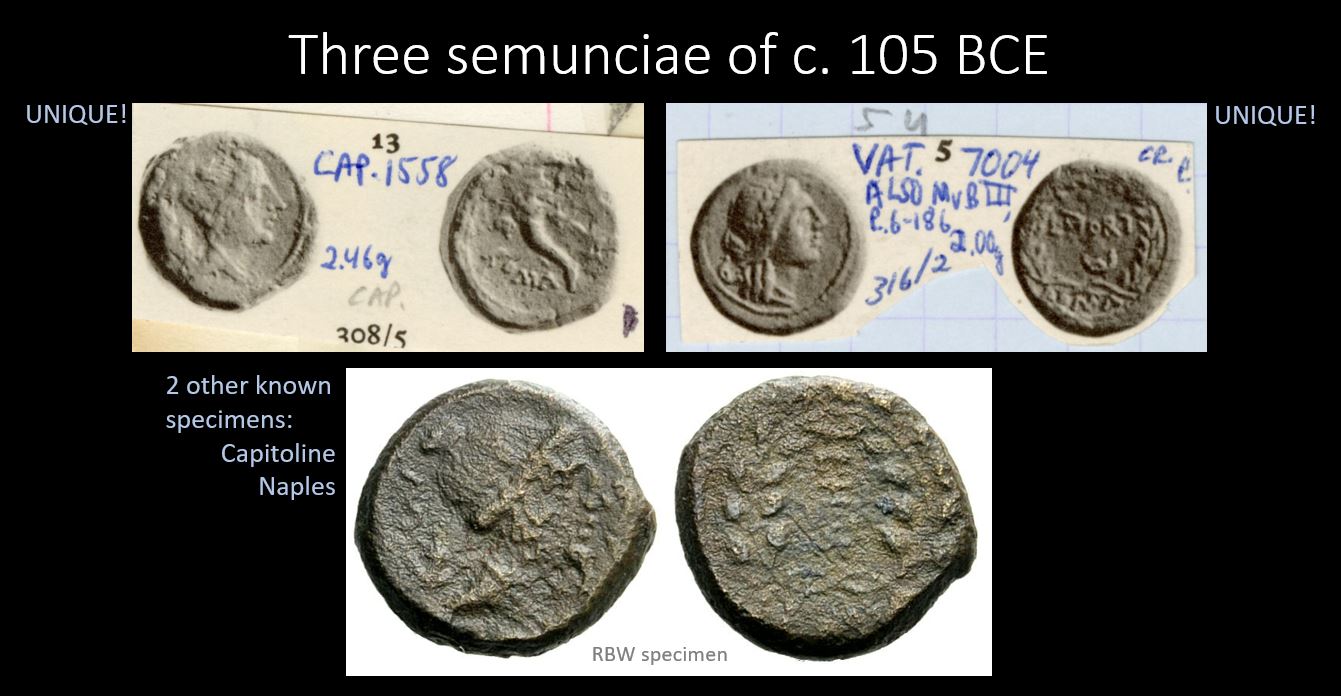
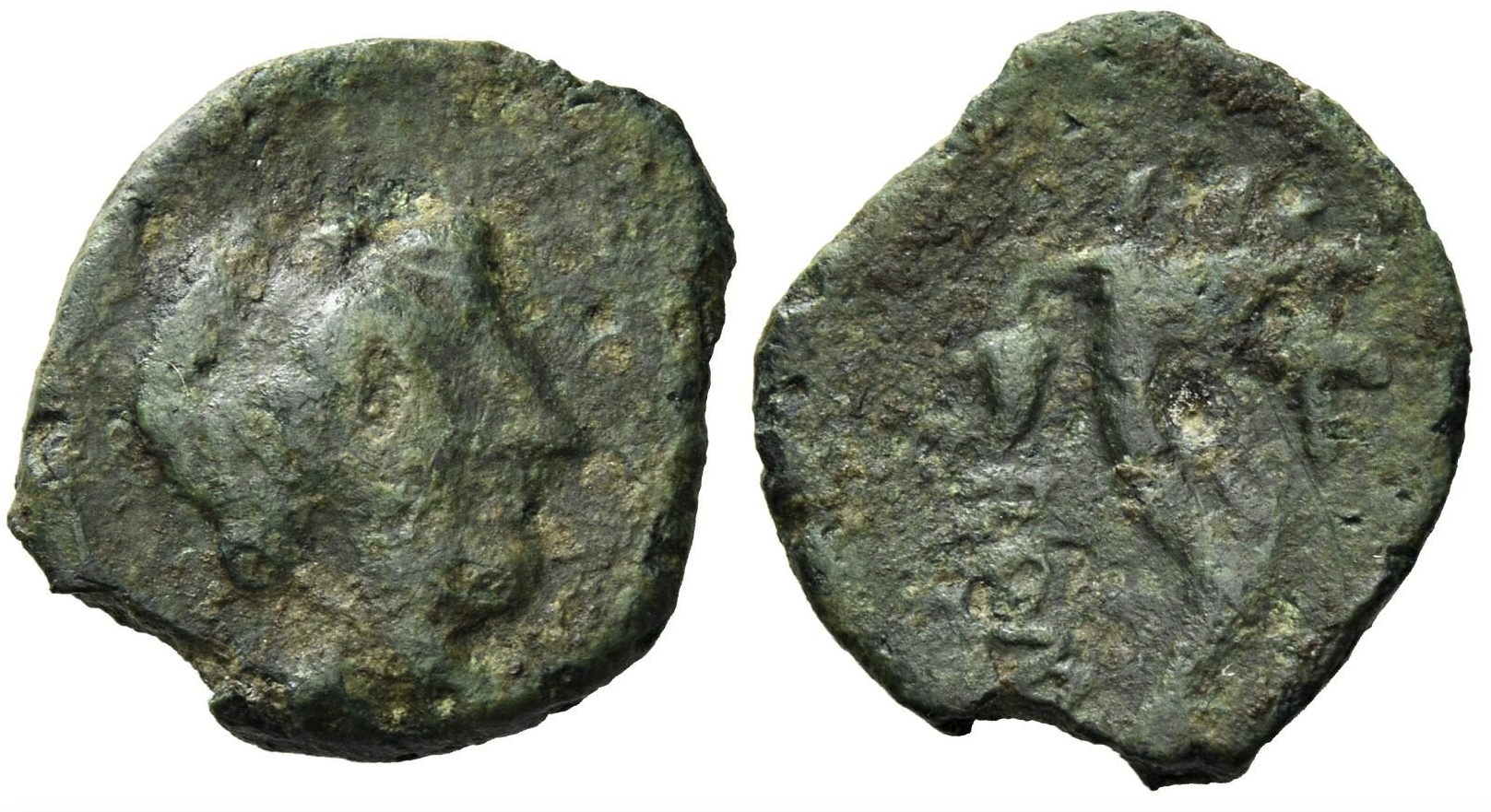
The three semuncia of c. 105 BCE seem to be a strange and wonderful revival of a tiny denomination that seems not to have been regularly by the Roman mint in some fifty years, the previous issue containing this denomination being RRC 177 (PT or TP; uncia and semuncia of this issue not known to Crawford but documented by Russo 1998, 146, see Schaefer Binder 7, p. 136, bottom row of images, image second from left hand edge).
The semuncia was never that common of a denomination (or at least we can say has a very poor survival rate). There are only 22 total examples as far as I can tell. Of course, there are lots of semunciae in Italic coinage, but they don’t really come into this discussion.
Again correct me, if I’m missing some.
RRC 308/5 and RRC 315/2 both seem to harken back to RRC 160, not RRC 177 in that they have Diana as well. The vast majority of the struck semunciae of the earlier period have Mercury as their primary obverse type. The exceptions being RRC 39/5 (part of an atypical series) which may have Cybele or a turreted personification of Roma or Fortuna Romanorum, and the Dioscuri on RRC 98A/8 (but how someone decided this unique specimen in Naples belonged to this bronze series is not yet clear to me), and the Roma on RRC 177.
The other thing these coins make me think of are the wreathed AE coinages of Sicily under Roman rule. … I feel a book purchase coming on: I need something for reference on Sicilian coinage…
I should also mention that RRC 308, Herennius, is not likely to be 108 BCE like Crawford would have it. Here I’m not just relying on HB Mattingly’s pref for 104 BCE based on his alternate sequence of moneyers, but rather Lockyear 2018 which says that RRC 308 denarii are probably later in the overall sequence than Crawford suggested (PDF). This suggests that these semunciae are likely all made within a one to two year period.
Otherwise for dating in this 130s to 82 BCE Molinari 2016 is also critical (PDF).
Tomorrow if all goes well I’ll give you a post on unicae.



















 Liv Mariah Yarrow