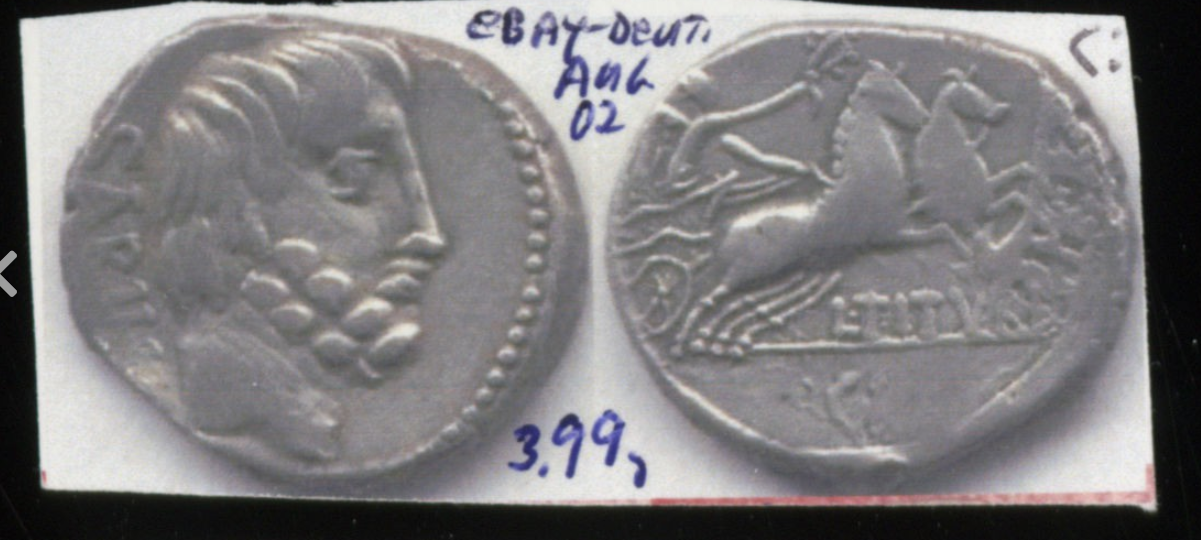
Subsellium

ANS specimen
Another ANS Specimen

I want to think about how RIC Augustus 407 intersects with Republican types of Caepio Piso and also the Plebeian Aedile issue of the Cinnan regime, not to mention the Libertas issue of 45….!

Also cool rostra on the rostra!!!


Update 11-25-25:

Specimen in trade
Berlin Specimen

I ended up on this old post this AM and stopped to fix the broken images and then started noticing not the similarity but the difference. Besides the clear indication the scene is on the rostra (itself significant for creating as setting) we also have a the staff next to only one of the figures. WHAT is the staff!?! The subsellium is for magistrates without imperium (quaestors, aediles, tribunes of the plebs). BUT the staff has a bulge it that seems no die engraving accident. That made me wonder if it was supposed to be a bundle of fasces, but I don’t like that interpretation. Too narrow (very unlike other iconography), magistrates don’t hold their own fasces. It isn’t a scepter there is not decorative top. So what is it?!

Also un related notice the attempt as creating depth through angling the bench seat edges but the engraver did not get the angles right for the desired effect.

Sulpicius’ Uncia (312)

Now you’re thinking to yourself: why, why did she skip Herennius? Cast your mind back, dear reader, to the semunciae post. As detailed there, Herennius likely comes later in the series, so we have to treat Sulpicius first! RRC 312

Ex RBW, of course

Are you reminded of the dog (who was a very good boy, of course!)? I am reminded of that dog too (RRC 293/3)! And that goatish, horsish quadruped?! Yes! exactly! That too (RRC 292/5 new)! But wait. Those were reverses, here its an obverse. The reverse is our moneyer’s name in a wreath! We’ve seen that too in just the last post for 305/2 and also on two of the three semunciae and will see it on later unciae (links to come).

So what’s with this? It feels like no one can decide what small change SHOULD look like or at least the idea of what it should look like is in flux. As I mentioned in the semunciae post, the wreaths with inscription in it are well known on various regional coins (including those of Cossura!).

A round of the sort of coins I’m thinking of (ignoring Augustan era ones):

The Kampanoi. Mercenaries in the Aitna area. Ae (ca. 344-336). In trade.
PANORMOS, before 135 BCE. In trade.
HIMERA, c. 413-408 BCE. In trade.
Time of Pyrrhus? Note oak leaves. In trade. Also just a stunning coin. Cf. this specimen.
overstrike! In trade.
Himera, c. 400-380 BCE. In trade.
Melita, 3rd cent? In trade.
oak leaves again. Fourth Democracy, 289-287. In trade.

Pegasus is rare on the republican series, but not so rare we should make too much of it. I suppose it had some significance to the moneyer… No particular relation as far as I can make out to symbols on rest of RRC 312 series.

Coins of Cossura

In trade, late 3rd early 2nd cent BCE?
In trade, 2nd cent. BCE?
mint location

Some literature. Some types also spelt Kossura. Modern Panterellia.

I want to learn more!!!

NOTICE REG counter marker and sign of Tanit on reverse, specimen in trade another great example
Example of RRC 56/3 with same counter mark. In trade.

Alföldy, Géza. “Ein römischer Ritter aus Cossura (Pantelleria).” Zeitschrift für Papyrologie und Epigraphik, no. 151 (2005): 193-213.

APh has about 25 more relevant records but one must search Pantelleria to find them.

Also think about in light of coins of Melita (Malta), e.g.

CHECK OUT THE SPECIMENS IN BERLIN!! Go here. Then enter Cossura as your search term. Also this twitter thread.

Late Unciae (305)

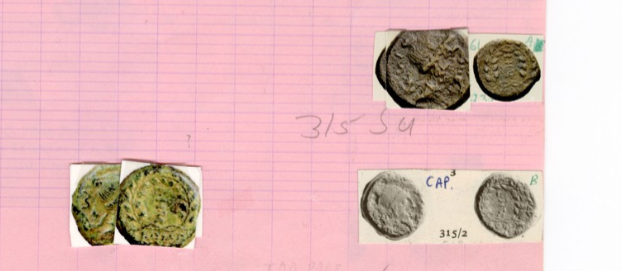
Schaefer binder image detail (image of coin)
from same but image of cast from Crawford’s plates

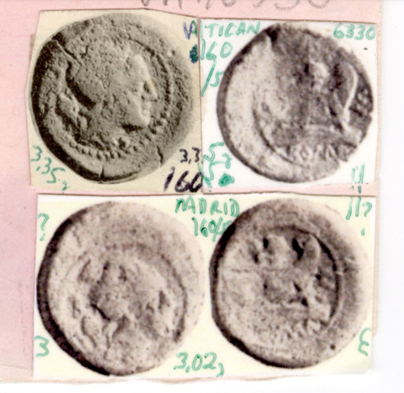
Crawford knew two specimens of RRC 305/2: Copenhagen illustrated above and in Crawford’s own plates and F. Capranesi in D. D. Müller, Memorie, 56. Tracking down the latter is on the to do list. Irritatingly, no weight for either specimen.

Schaefer was concerned that this Copenhagen specimen might be an altered RRC 315/1. I don’t think so but that is primarily based on the obverse. The obverse of this Copenhagen specimen has a bump on its nose, a recessed chin and and a helmet with a side feather and maybe some stars. The rendering of the Roma on the obverse of 315/1 is far more traditional and stylized.

These CRRO specimen of 305/1 show similar features. The reverse of the denarius has an oak wreath as does the uncia. There is also a passing similarity to the obverse of RRC 296/1.

This post is part of a small change series.

Unciae, post 1, post 2, post 3

Semunciae

More to come!

More late unciae (293/3)

So I like the sense of completion of hitting publish on a blog post, its a trivial little boost to mark a bit of work and the end of a thought unit. So I’m breaking my previous long post and starting a new one. There is no logic to my breaking spot maybe even some illogic, but it’s a rough January morning in a pandemic when my republic is in turmoil and my colleagues are catching Covid, and I need all the little morale boosts I can get to keep myself working away…

I love the Philippus series. I realize that lots of my writing on it hasn’t appeared in print and only some on the blog (collection one, collection two) as I’m ‘saving’ it for my kings project that might or might not be a monograph one day. Anyway. If you are interested in the denarius for scholarly reasons, ask me to send you my essay on it and other kings with coins, but there is also a good chunk in chapter 2 of the coin book, riffing on the work of Hölkeskamp who has revisited the Marcii in many valuable publications.

No as, semis, triens, or sextans or semuncia is known, just quadrantes and unciae. I’m inclined to think these might have been the only denominations made or at least the only ones prioritized. This is interesting as it suggests that these might the ‘in demand’ denominations. I want to think more about that and also think if there is an argument to be made about RR unofficial AE issues about which denominations were most likely to be made and then of course WHY.

Only two unicae are known and both in Paris (again).

The photos of ?-B and 1-A in the Schaefer binder are actually better lit for seeing details than the official Gallica images.

Where did these come from? Was a wishing well or other votive deposit discovered perhaps in ye olden days and the nicest unciae ended up in Paris source collections…? Could archival work here help? I should go look at Nemi find and other similar sacred water coin toss finds.

Why Saturn? maybe the logic went that if no semis was made the god of the treasury would get offended if not on the coins if bronze were made? Or could there have been a little fashion for Saturn and this marks the start of it? Saturn gets some love on the denarii shortly after this , but that love for the most part seems explained in each individual case. The Memmii love Saturn for family reasons (we can assume), Saturninus for canting pun reasons, Caepio for his quaestorship….

Update: the identification as Saturn is based on the falx behind his head. See much earlier post.

And why a dog? I’m going to go with loyalty-fides resonance; see me on Ulysses and dogs and Fides. This particular dog type is some times called a Maltese or Proto-Maltese and will be familiar to many numismatists from a wide variety of coins.

A stellar specimen included here for esthetic purposes and because the auction catalogue gives good chat about the history of the breed.

The best parallel is probably from the RRC 219 series.

specimen in trade

Some dies let you see the collar in a lovely fashion:

detail of specimen in trade, cf. another mis-identified in trade.

But there are earlier dogs on the Roman series of a similar breed cf. RRC 122. The dogs of RRC 26 have some similarity in body pose but are leaner and read more like a hound to me. This is, of course, all a little subjective.

The quadrans has a lovely bellicose rooter. I’ve written (too much perhaps) about cocks on this blog and in a forthcoming article. I’m guessing the the two types the dog and cock were chosen for their recall of manly Roman virtues: fierce and loyal, perhaps characteristics they would associate with Tremulus who is honored on the denarius.

Ex Goodman Ex RBW

Mars in a Quadriga

So I’m thinking about the uncia RRC 290/6 but that makes me of course think about other Mars-in-quadriga types and I ended up at that old puzzle about that figure next to Mars on RRC 232/1:

Detail of specimen in trade

I’ve blogged about it before.

Another specimen in trade.
specimen in trade

I need to let it go. I’ve been through Schaefer’s collection of die images and I still am not sure what I’m seeing but I’m leaning towards a female figure. We could do with some comparative iconography…