
The function of this post is to get my head screwed on straight about career and connections of the moneyer of 88 (RRC 346). It goes without saying that there is a great deal of recent scholarly work on the gens Marcia: I’ve collected bibliography below. That said, I like to start from the primary evidence and then read secondary literature to refine and critique my first impressions.
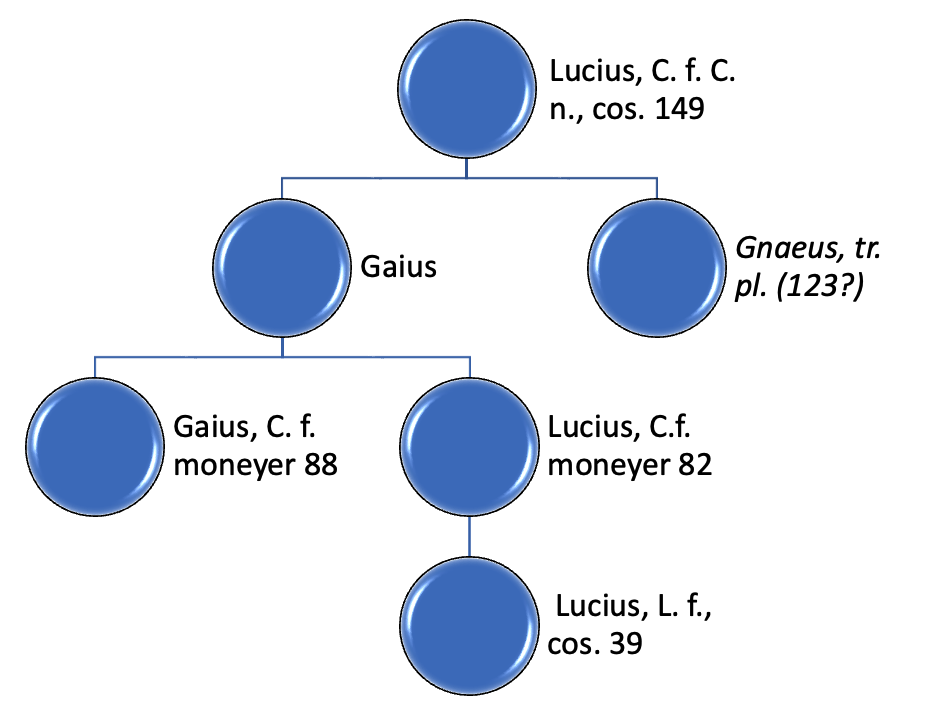
The family cognomen derives from a Gaius, cos. 310, Censor 295 AND 265, and Princeps Senatus c. 269 (primary evidence on this last role not clear to me: check Ryan 1998). This man was also either a priest or augur, the evidence is inconclusive (cf. Vaahtera 2002: 105ff.). This man himself may have been the son of the cos. 357, cognomen Rutilius. [I may come back to him, but not just yet.] We also think that in 311, just one year before his consulship he was tribune of the plebs and proposed a piece of legislation relating to the election of military tribunes:
“in that year, also, two commands —both military —began to be conferred by the people; for it was enacted, first, that sixteen tribunes of the soldiers should be chosen by popular vote for the four legions, whereas previously these places had been for the most part in the gift of dictators and consuls, very few being left to popular suffrage; secondly, that the people should likewise elect two naval commissioners to have charge of equipping and refitting the fleet. [4] The former of these measures was proposed by the tribunes of the plebs Lucius Atilius and Gaius Marcius; the latter by Marcus Decius, another tribune of the plebs.” (Liv. 9.30.3)
I mention this because it reminds me of fragment from which we assume the existence of our moneyer’s uncle a Cnaeus, who is thought by MMR and Thommen 1989 to have been tribune of the plebs some time before 121 based on a fragment assigned to C. Gracchus from Char. GL 1.208k:
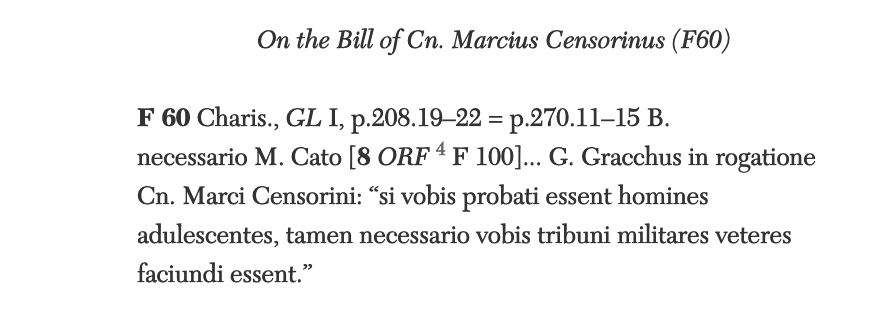
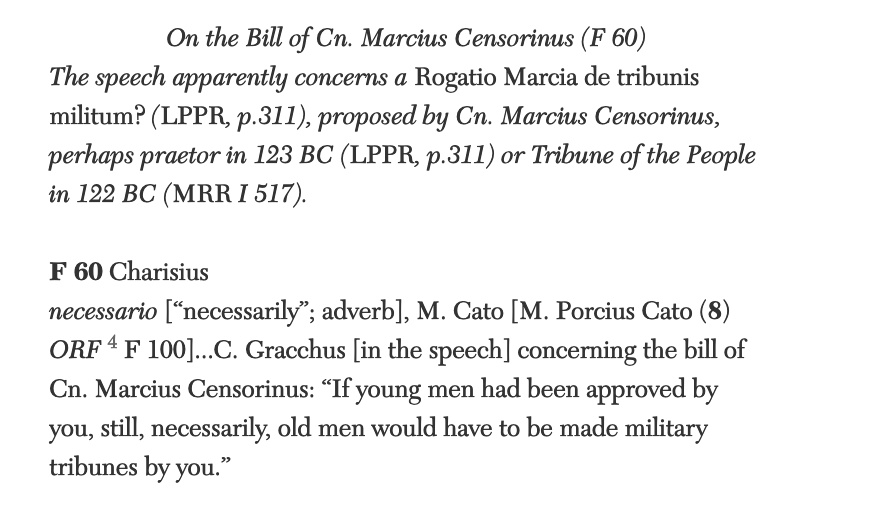
I think LPPR stands for G. Rotondi’s Leges Publicae Populi Romani: Elenco Cronologico con una Introduzione Sull’Attività Legislativa dei Comizi Romani (1912).
Assuming the Cn. could be C., then why couldn’t C. Gracchus be talking about the law of 311?! Or, I guess we could say if the uncle Gnaeus exists he might have been trying to build on the success of the cos. 310 by proposing related legislation… Still not a lot to go on.
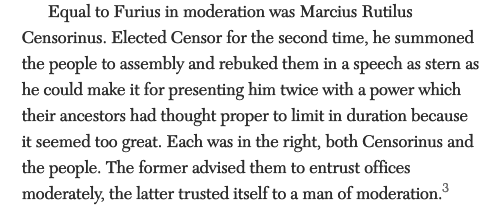
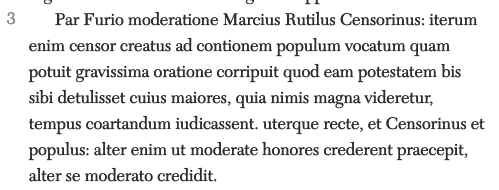
MRR is perhaps misleading to suggest he passed legislation to limit times one could hold the censorship. The below passage describes a speech in a contio, not a legislative assembly. Plut. Cor. 1.1 does say it was legislation, not just the rebuke, but perhaps it is Plut. who is overstating rather than Val. Max. understating?
If they become check sources on military exploits and triumph in DPRR.
We hear nothing of his descendants until the cos. 149, assumed to be his great grandson.
Our first glimpse at his career is with his choice of the Hecyra by Terence for the Roman Games as curule aedile, where this play, ‘the mother-in-law’, was a huge hit after disruptions at its first two stagings (Knorr 2013, cf. Parker 1996; Did. Ter. Her.). We know nothing of his other offices until his consulship where he had a very lack luster career in charge of the fleet at the start of the 3rd Carthaginian War, barely escaping disaster. Nevertheless he was elected Censor for 147. (Did the name help?!) We also know he took some interest in Academic philosophy and Clitomachus of Carthage (died 110 BCE) addressed a treatise on the subject to him at some point (Cic. Acad. 2.102). Perhaps he introduced in grandsons to such philosophy? My colleague Philip Thibodeau pointed out to me that Terence and Clitomachus are near contemporaries and are both said to be of Africa origin, as well as appearing to share the cos. 149’s patronage.
On to his grandsons, the moneyers, as we have no knowledge of their father.
In 92 BCE we assume Gaius (mon. 87) was the Censorinus who thought about prosecuting Sulla and then chickened out (cf. Reams 1993 who argues this does not prove he was a Marian):
When Sulla came back to Rome, however, Censorinus brought suit against him for bribery, alleging that he had collected large sums of money illegally from a friendly and allied kingdom. However, Censorinus did not put in an appearance at the trial, but dropped his impeachment.
Plut. Sulla 5.6
One Gaius Censorinus, likely our moneyer was known to have been an orator, and we might connect Cicero’s testimony in the Brutus with what we know of his grandfather’s connections to Greek literature, esp. academic philosophy.
C. Censorinus had a good stock of Greek literature, explained whatever he advanced with great neatness and perspicuity, and had a graceful action, but was too cold and unanimated for the Forum.
Cic. Brut. 237 cf. 311
In 87 he was certainly deep into the dirty work of the regime. He is credited with the murder (execution?!) of the consul! His official capacity this year is uncertain. Broughton (MRR) thought he was a military tribune; Suolahti 1955 thought he might be better described as a legatus or praefectus equitum. I’m not sure it matters really. The world had turned upside down and he set some dangerous precedents.
Cinna and Marius had sworn to Octavius (cos. 87), and the augurs and soothsayers had predicted, that he would suffer no harm, yet his friends advised him to fly. He replied that he would never desert the city while he was consul. So he withdrew from the forum to the Janiculum with the nobility and what was left of his army, where he occupied the curule chair and wore the robes of office, attended as consul by lictors. Here he was attacked by Censorinus with a body of horse, and again his friends and the soldiers who stood by him urged him to fly and brought him his horse, but he disdained even to arise, and awaited death. Censorinus cut off his head and carried it to Cinna, and it was suspended in the forum in front of the rostra, the first head of a consul that was so exposed. After him the heads of others who were slain were suspended there; and this shocking custom, which began with Octavius, was not discontinued, but was handed down to subsequent massacres.
The execution of a consul was widely remembered, but Censorinus’ role was not always deemed crucial in how the incident was recall in our sources. Besides Appian none of the numerous sources on Octavius’ death mention Censorinus (see list below).
Later in Appian we hear of a Marcius apparently in command of Cinnan faction troops, where he seems to be on par with Carbo and Marius at least in the narrative.
About the same time Metellus gained a victory over another army of Carbo, and here again five cohorts, for safety’s sake, deserted to Metellus during the battle. Pompey overcame Marcius near Senae and plundered the town. Sulla, having shut Marius up in Praeneste…
BC 1.88
Yet we can’t be sure this is Gaius and not his brother Lucius! Or even another member of the gens… Appian again discusses Marcius’ defeat by Pompey a little later on. Within his narrative it seems to be a separate episode, but perhaps Appian is confused and Marcius only met Pompey once? Or perhaps both brothers were defeated by Pompey on two different occasions. I can’t see any easy way of resolving the mystery.
Carbo sent Marcius with eight legions to the relief of his colleague, Marius, at Praeneste, having heard that he was suffering from hunger. Pompey fell upon them from ambush in a defile, defeated them, killed a large number, and surrounded the remainder on a hill. Marcius indeed made his escape, leaving his fires burning, but the army blamed him for being caught in an ambush and there was a serious mutiny. One whole legion marched off under their standards to Ariminum without orders. The rest separated and went home in driblets, so that only seven cohorts remained with their general. Marcius, having made a failure of it in this way, returned to Carbo.
BC 1.90
We have no direct testimony of how Gaius the moneyer died but that it was violent can be inferred by Cic. Brut. 311 where he is counted among the losses of civil unrest.
His brother, Lucius, left no certain trace in our literary records only his coin issues (RRC 360, RRC 363). We can perhaps assume he is the younger brother because he held office later. Hinard 1985 assumes he was a senator and proscribed. He, however, seems to have been survived by a young son, thought by Rüpke 2005 to have been borne c. 89. He was another Lucius, cos. 39 in what year he also triumphed over Macedonia. He was in 43 a supporter of Antony whom he had joined at Mutina. He seems to have benefited by the proscriptions even getting for a time Cicero’s Palatine residence (Vell. 2.14.3).
Sources on Octavius’ death excepting Appian quoted above
Cic. Tusc. 5.55: decapitation on orders of Cinna
Augustan era Fasti seem to recall his death in office (note to self: check Latin text at some point)
Liv. Per. 79-80 gives a summary, death recorded, no particular agency ascribed but Cinna and Marius by implication
IG 14.1297 records death and lays agency on Marius
Vell. Pat. 2.22 slain on command of Cinna
Val. Max. 1.6.10 omen of beheading: no ascribing of agency but Cinna by implication
Ascon. Scaur. 23 Cinna agent of Octavius’ death as well as that of Crassus
Plut. Sull. 12.8: Cinna kills Octavius
Plut. Mar. 42.5: dragged down from the rostra and butchered by men sent to do the job
Flor. 2.9.14: head displayed on rostra, general massacre at predesignated symbol.
Vir. Ill. 69: Cinna kills Octavius
Aug. Civ. 3.27: head displayed on rostra
Morelli, Davide. “The family traditions of the « Gens Marcia » between the fourth and third centuries B.C.” Classical Quarterly N. S. 71, no. 1 (2021): 189-199. Doi: 10.1017/S0009838821000495
Syme, Ronald. “The politics of the Marcii.” In Approaching the Roman revolution : papers on Republican history, Edited by Syme, Ronald and Santangelo, Federico., 44-55. Oxford: Oxford University Pr., 2016.
Russo, Federico. “I « Carmina Marciana » e le tradizioni sui Marcii.” La Parola del Passato 60, no. 340 (2005): 5-32.
Zanin, Manfredi. “Zur fraglichen Identität des Münzmeisters Q. Marcius (RRC 283).” Museum Helveticum 77, no. 2 (2020): 216-220.
Briquel, Dominique. “Les guerres d’Ancus Marcius: comment mener les guerres en accord avec la religion.” Bulletin de l’Association Guillaume Budé, no. 2 (2018): 63-81.
Hölkeskamp, K.-J.. “In the web of (hi-)stories : « memoria », monuments, and their myth-historical « interconnectedness ».” In Memory in ancient Rome and early Christianity, Edited by Galinsky, Karl., 169-213. Oxford: Oxford University Pr., 2016.
Hölkeskamp, Karl-Joachim. “Im Gewebe der Geschichte(n): « memoria », Monumente und ihre mythhistorische Vernetzung.” Klio 94, no. 2 (2012): 380-414.
Rohr Vio, Francesca. “« Clari monimenta Philippi »: poesia e politica nei « Fasti » di Ovidio.” Paideia 72 (2017): 279-291.
Tansey, Patrick. “Marcia Catonis and the « fulmen clarum ».” Classical Quarterly N. S. 63, no. 1 (2013): 423-426. Doi: 10.1017/S000983881200081X
Jyri Vaahtera. (2002). Livy and the Priestly Records: À Propos ILS 9338. Hermes, 130(1), 100–108. http://www.jstor.org/stable/4477486
Thommen, L. (1989) Das Volkstribunat der späten römischen Republik. Stuttgart.
Ryan, F. X. (1998) Rank and Participation in the Republican Senate. Stuttgart.
Reams, Lee E. “CENSORINUS, SULLA, AND MARIUS.” Rheinisches Museum Für Philologie 136, no. 3/4 (1993): 281–88. http://www.jstor.org/stable/41233915.
Knorr, Ortwin. “Hecyra.” In A Companion to Terence, 295–317. Oxford: Blackwell Publishing Ltd, 2013.
Parker, Holt N. “Plautus vs. Terence: Audience and Popularity Re-Examined.” The American Journal of Philology 117, no. 4 (1996): 585–617. http://www.jstor.org/stable/1561950.
Suolahti, J. (1955) The junior officers of the Roman army in the Republican period : a study on social structure. Helsinki.
Hinard, F. (1985) Les Proscriptions de la Rome Républicaine. Rome & Paris.
Rüpke, J. (2005) Fasti sacerdotum : die Mitglieder der Priesterschaften und das sakrale Funktionspersonal römischer, griechischer, orientalischer und jüdisch-christlicher Kulte in der Stadt Rom von 300 v. Chr. bis 499 n. Chr. (3 vols.). Wiesbaden.















 Liv Mariah Yarrow