The blog and social media continues to give. One colleague saw a post and sent it to another and that resulted in a thought provoking email in my inbox this AM that led to me to grab a few neglected books of my shelf and to finally really notice the following passages. So if you wonder why I am so open about my work it is because I get to learn more this way. It pays to be brave enough to be wrong, or just throw stuff against the wall to see what sticks.
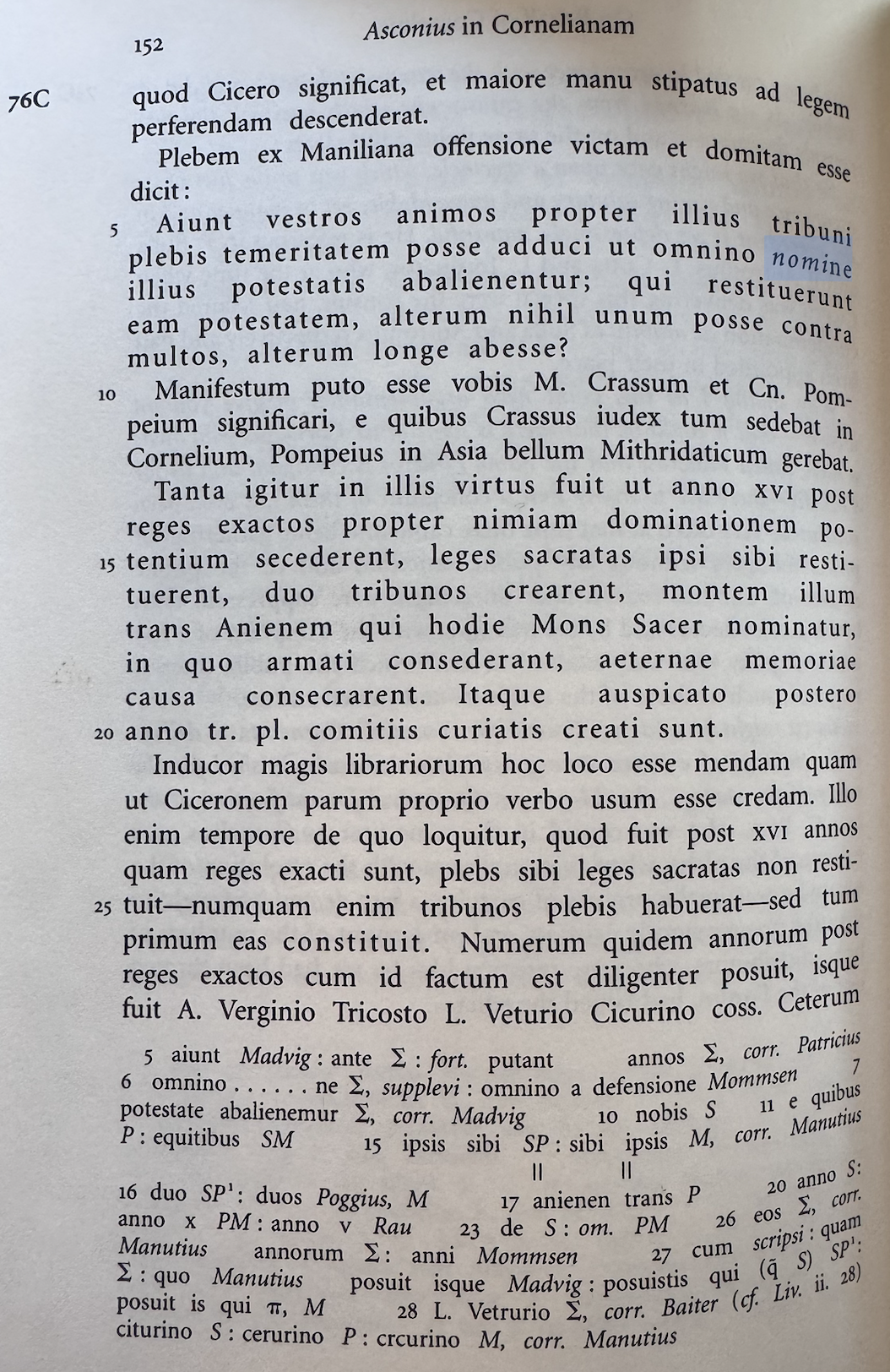
In the below passage I’m most interested in the name [of power] rhetoric and how it is combined with the verb abalienare in the passive rather than some version of odi. That is Cicero is playing around with the idea of the hatred of the name of kings seems implied by how the passage continues with a reference to the explusion of the reges shortly there after. All of this is super relevant for the revising of the first chapter of book three. A project I need to take off the back burner soon. I said I’d wait until I was done being chair but a colleague called to task for this at the book fair at the SCS this year and it hit home. I’d rather see it out sooner rather than later.
I’d give a great deal to have the whole of Cicero’s account from this speech on the historical origins of the tribunes of plebs. I want to cross reference these surviving fragments of the speech with passages from the Republic and Laws of Cicero. I’d also like to think if these views are influencing Dionysius of Halicarnassus’ comments on the tribunate and its history. I suspect there may be some shared perspectives on the institution and its constitutional strengths, weaknesses, and (ab)uses.
Ok. This should be enough for me to find all this again.
Further key words for future me: Lex Porcia, libertas, Lex Cassia, decemvirate, Verginia, Asconius, In Corneliam,
I”m trying to get out ahead on some of my commitments, I have three new papers for delivery to write (all eventually needing to be published) and two PR publications to draft, revise and submit by the end of the semester. Will I do it? Maybe maybe not. Something may have to give.
Must be cited
Konrad, Christoph F. “Some friends of Sertorius.” The American Journal of Philology 108, no. 3 (1987): 519-527. (Jstor)
Very solid straight forward prosopographical/career overview of Annius’ quaestors who struck RRC and defected to Sertorius.
Antela-Bernárdez, Ignacio Borja. “Anio, Fanio y Tarquitio en las Guerras Sertorianas.” Latomus 76, no. 3 (2017): 575-593. Doi: 10.2143/LAT.76.3.3275127 [Jstor – extensive notes below]
This is a much more detailed treatment of an earlier article on the same topic by the same author: Antela Bernárdez, Ignacio Borja. “Los cuestores de C. Annio y el gobierno provincial en Hispania.” L’Antiquité Classique 82 (2013): 263-265. Doi: 10.3406/antiq.2013.3838
Possibly relevant
Woytek, B. “Ein frühneuzeitlicher Aureus des Nerva mit PAX AVGVSTI und ein überprägter Victoriat im Namen des Sertorius.” NZ 125 (2019): 73-87. [ILL requested – excited to see if this connects with my current interest in fantasy pieces.]
Konrad, Christoph F, and Plutarch. Plutarch’s Sertorius : A Historical Commentary. Chapel Hill: University of North Carolina Press, 1994. [on my shelf]
Gaggero, G. “Aspetti monetari della rivolta sertoriana in Spagna.” Rivista Italiana di Numismatica 78 (1976): 55-75. [ILL requested]
García Cardiel, Jorge. “La cierva de Sertorio en su contexto (ibérico): poder, adivinación e integración en la Hispania tardorrepublicana.” Latomus 79, no. 2 (2020): 317-339. Doi: 10.2143/LAT.79.2.3288653
Arrayás Morales, Isaías. “Conectividad mediterránea en el marco del conflicto mitridático.” Klio 98, no. 1 (2016): 158-183.
Syme, Ronald. “« Rex Leptasta »: (Hist. II, 20).” In Approaching the Roman revolution : papers on Republican history, Edited by Syme, Ronald and Santangelo, Federico., 122-127. Oxford: Oxford University Pr., 2016.
García González, Juan. “« Quintus Sertorius pro consule » : connotaciones de la magistratura proconsular afirmada en las « glandes inscriptae Sertorianae ».” Anas 25-26 (2012-2013): 189-206.
Domínguez Arranz, Almudena and Aguilera Hernández, Alberto. “Del « oppidum » de Sertorio al « municipium » de Augusto : la historia reflejada en el espejo de las monedas.” Bolskan 25 (2014): 91-109.
Manchón Zorrilla, Alejandro. “« Pietas erga patriam » : la propaganda política de Quinto Sertorio y su trascendencia en las fuentes literarias clásicas.” Bolskan 25 (2014): 153-172.
Mederos Martín, Alfredo. “El periplo insular y continental norteafricano de Sertorio (81-80 a.C.).” In « Libyae lustrare extrema »: realidad y literatura en la visión grecorromana de África : homenaje al prof. Jehan Desanges, Edited by Candau Morón, José María, González Ponce, Francisco José and Chávez Reino, Antonio Luis. Literatura; 98, 99-116. Sevilla: Ed. Universidad de Sevilla, 2008 (impr. 2009).
Not particularly relevant to my work now but worth remembering
Bennett, William H. “The death of Sertorius and the coin.” Historia: Zeitschrift für Alte Geschichte H. 4 (1961): 459-472. [JStor]
This is a fascinating look at a passage of Appian and the era years on the coins of the kingdom of Bithynia to make a case for Sertorius dying in Spring of 73. It has been cited relatively widely but not as I can see widely adopted (cf. DPRR). Honestly, I just loved reading it for how it drew history and coins together without apologizing or soft pedalling the analysis of either. I don’t know or have time at this moment to comment on accuracy of conclusions. Do you know? Let me know!
Scherr, Jonas. “Die Jünglinge von Osca.” Antike Lebenswelten: Althistorische und papyrologische Studien (2015): 282. [on Academia.edu]
Concludes that Plutarch, Sertorius 14,1–4 must be read in a primarily cultural/literary method and that it cannot be taken as evidence of Sertorius’ actual policies or practices.
Iberian Numismatics
I should probably ILL all of these I cannot access online, but my mandate is to talk about iconography and the Roman mint so I’m just leaving the refs hear for now.
Medrano Marqués, Manuel. “El campamento de Quintus Sertorius en el valle del río Alhama (Fitero-Cintruénigo, Navarra).” Cahiers Numismatiques 159 (2004): 15-32.
Bruni V., La moneta provinciale in Spagna durante la guerra sertoriana (82-72 a.C.) INC XV Proceedings, p. 656-660.
Alonso, Carmen Marcos. “La moneda en tiempos de guerra: el conflicto de Sertorio.” In Moneda y exèrcits: III Curs d’Historia monetaria d’Hispania, pp. 83-106. Museu Nacional d’Art de Catalunya, 1999.
Doménech-Belda, Carolina, and Feliciana Sala-Sellés. “Two lead coins with the legend N· CALECI from Sertorian forts of the Roman civil wars in Hispania.” (2021).[link to full text]
Salinas Romo, Miguel. “Apuntes en torno a las guerras sertorianas : evolución e impacto sobre el poblamiento y la ordenación territorial del valle del Ebro.” Espacio, Tiempo y Forma : Revista de la Facultad de Geografía e Historia. Serie 2, Historia Antigua 27 (2014): 15-53. Doi: 10.5944/etfii.27.2014; 10.5944/etfii.27.2014.14163
Abstract of last: The division between horseman reverses with a palm (“domi”) and armed horseman (“militiae”) in Iberian coinage allows us to affirm that some Iberian mints correspond to military camps. Thus, the denarii of “Ikale(n)sken” should be associated with the troops sent by the city of Kese to Córdoba in support of Sertorius (97-93 BCE). The denarii of “Sekobirikes,” on the other hand, are the coins of Sekaisa’s troops in the territory of the Arevaci under T. Didius and V. Flaccus (98-92 BCE). The Catalan bronze series all correspond to the beginning of the Bellum Sociale (90 BCE). Rome fought in Hispania during the 2nd century BCE at the invitation of cities such as Segeda-Sekaisa, which were threatened by overly powerful enemies. Iberian armies fought in the Roman manner in the time of Marius. Classical Iberian coinage was minted between 107 and 90 BCE. It reflects not the Roman conquest of Hispania, but the formation of a Hispano-Roman branch of the Roman army.
Chaves Tristán, Francisca, García Vargas, Enrique and Ferrer Albelda, Eduardo. “Sertorio: de África a Hispania.” In L’ Africa romana. Atti del XIII convegno di studio: Djerba, 10-13 dicembre 1998, Edited by Khanoussi, Mustapha, Ruggeri, Paola and Vismara, Cinzia. Collana del Dipartimento di Storia dell’Università degli Studi di Sassari. Nuova serie; 6, 1463-1486. Roma: Carocci, 2000.
“Ricostruzione dell’itinerario percorso da Sertorio, sulla base di ritrovamenti di monete africane nella zona di Cadice e grazie al contributo delle fonti letterarie (soprattutto Plutarco, Strabone e Sallustio)”
Arévalo González, Alicia and Marcos Alonso, Carmen. “Dos reacuñaciones romano-republicanas sobre moneda hispánica.” Madrider Mitteilungen / Deutsches Archäologisches Institut, Abteilung Madrid 38 (1997): 67-74.
“Models of two coins from Cáceres el Viejo (Provincial Museum of Cáceres) and Torelló d’en Cintes (Museum of Fine Arts of Mahón, Menorca), which not only document the first known Roman republican overstrikes on Hispano-Iberian coins but also provide evidence for mintings before the emissions of the Pompeian party. The mintings likely took place during the Sertorian Wars to pay the Roman troops.”
Best thing thus far
Noguera, Jaume, Pau Valdés, and Eduard Ble. “New perspectives on the Sertorian War in northeastern Hispania: archaeological surveys of the Roman camps of the lower River Ebro.” Journal of Roman Archaeology 35, no. 1 (2022): 1-32. [on file; full text available through Google scholar]
I’m in love with this article. You should read it for so many methodological reasons, and of course the sling bullets (glandes). I’m not surprised by the presence of Fides or Pietas for legitimating messaging, but Veritas and Ius really do feel like a slightly different rhetoric. I want to think much more about them. The fasces also surprise in this context. Not because the imagery is unknown but because the ‘audience’ for these messages seems to be a lower social order and I want to think more about how they would have received this iconography. I suspect in the first instance we should connect it to the use of PRO COS for Sertorius himself and be a statement that HE is the real Roman not the Sullan party.
On Pietas:
Lloris, Francisco Beltrán. “La «pietas» de Sertório.” Gerión 8 (1990): 211-226. [full text available via google scholar]
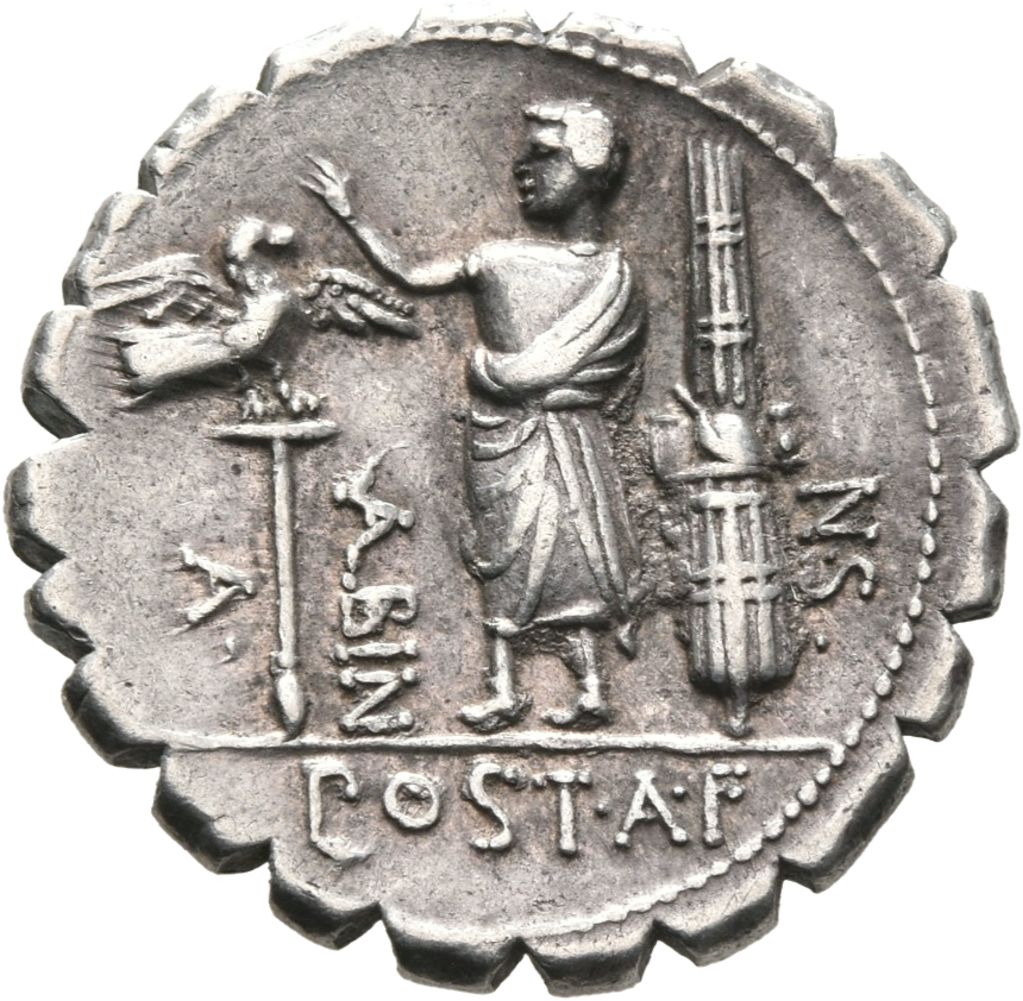
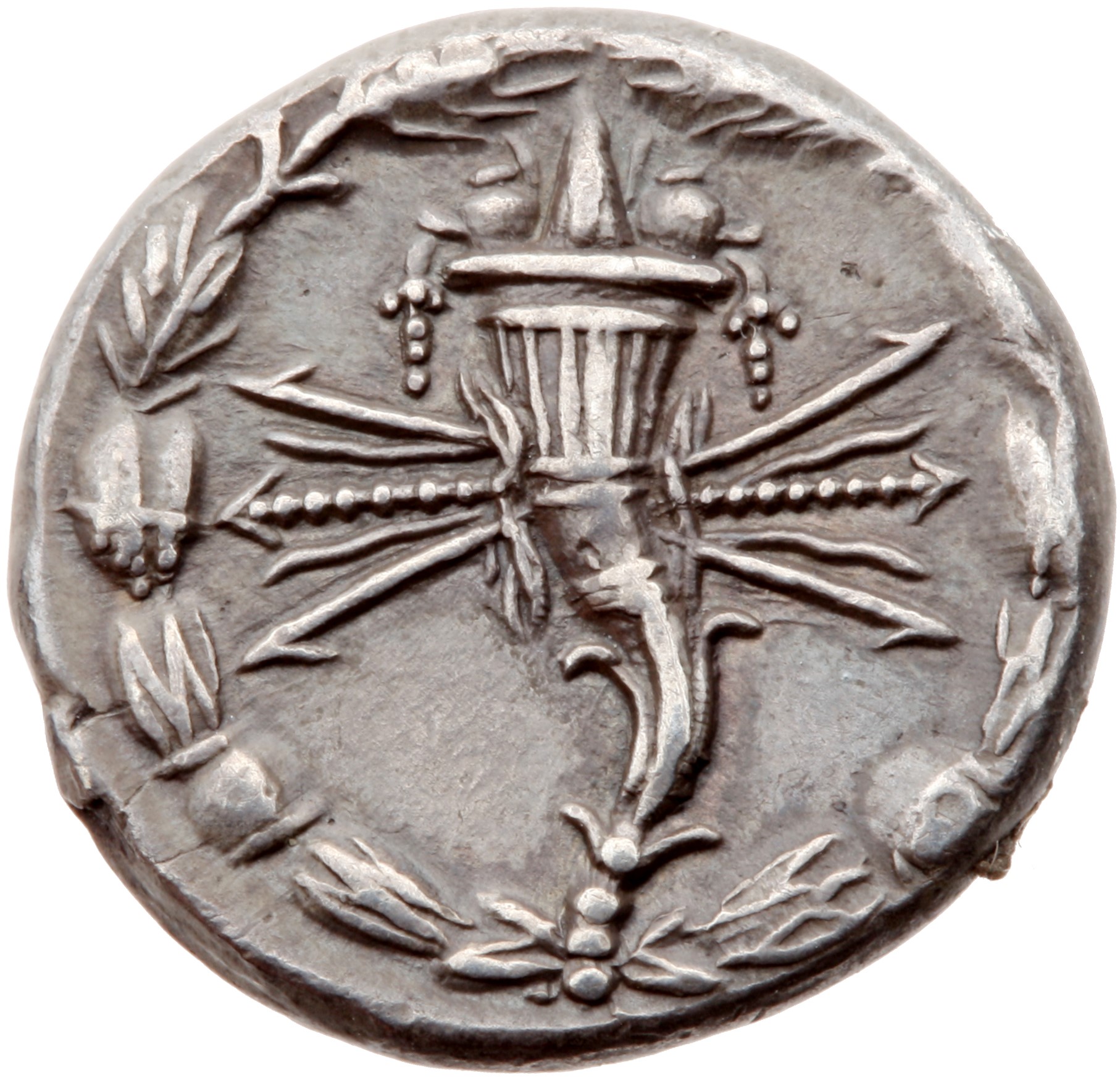
I bet I can work these fasces into my talk by way of this coin of c. 82 BCE (RRC 372/2; Mainz specimen). Perhaps a stretch but I may do it for fun and contextualization.
Röm. Republik: A. Postumius AlbinusRöm. Republik: A. Postumius Albinus
Glandes illustrations
from the Les Aixalelles archaeological siteFrom Les Tres Cales archaeological siteFrom Les Tres Cales archaeological site
So now I’m obsessed with Noguera’s scholarship and getting a little off track, but I’m going to run with it a little longer….
NOGUERA, JAUME, P. Valdés, EDUARD BLE, and JORDI LÓPEZ VILAR. “Tracing the Roman Republican Army. Military Archaeology in the Northeast of the Iberian Peninsula.” In Limes XXIII. Proceedings of the 23rd International Limes Congress, Ingolstadt, vol. 2, pp. 277-90. 2015.
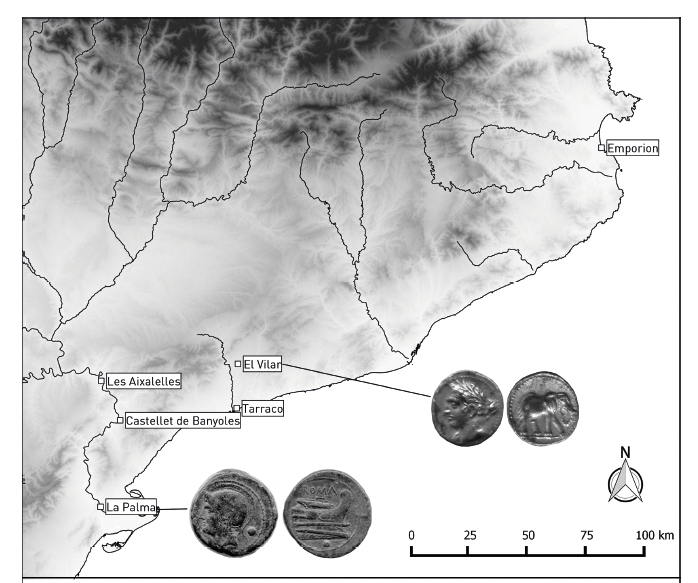
Fig.1: Map of the archaeological sites dating from the first phase of war stress with related finds including a quarter-shekel from El Vilar deValls and an uncia RRC 38/6 from La Palma
Look at that glorious Punic shekel with an elephant and young Hercules/Heracles/Melkart with ARCHAEOLOGICAL context. I’d love more of that.
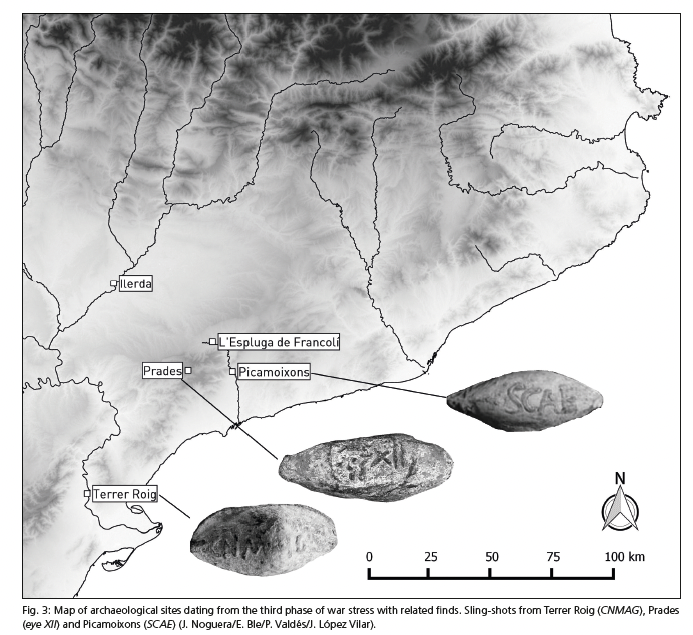
I really like the idea that this glans may have an eye on it. V fitting from an apotropaic perspective. Incredible that there are 82 glandes from Picamoixons with SCAE. I’m curious how we are confident that the CN MAG bullet is from a 49 context not an earlier one, say from the Sertorian war. I’m guessing topography of the war and/or find context. I must pull the original publication to see how firm the dating is.
López 2013 · J. López, César contra Pompeyo. Glandes inscriptae de la batalla de Ilerda (49 aC). Chiron 43, 2013, 431–457.
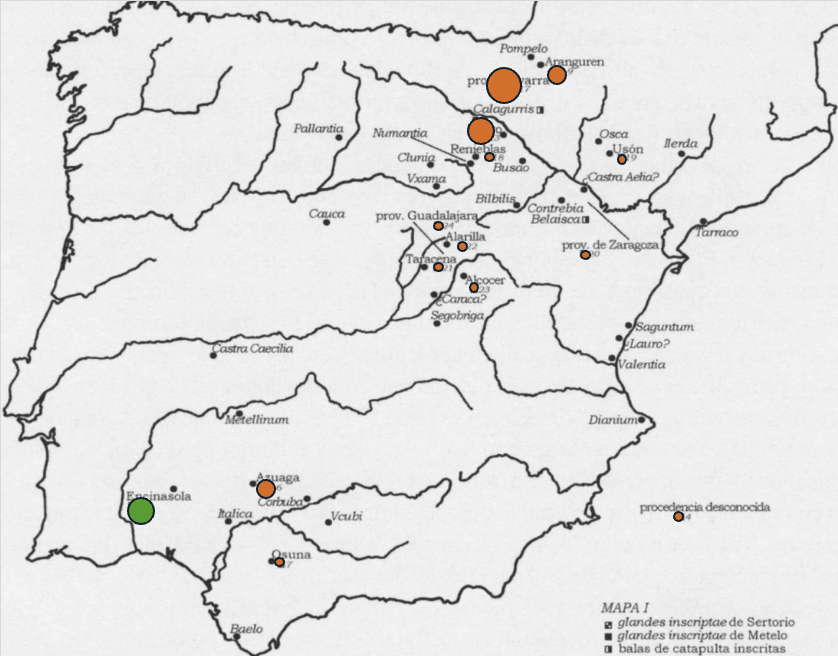
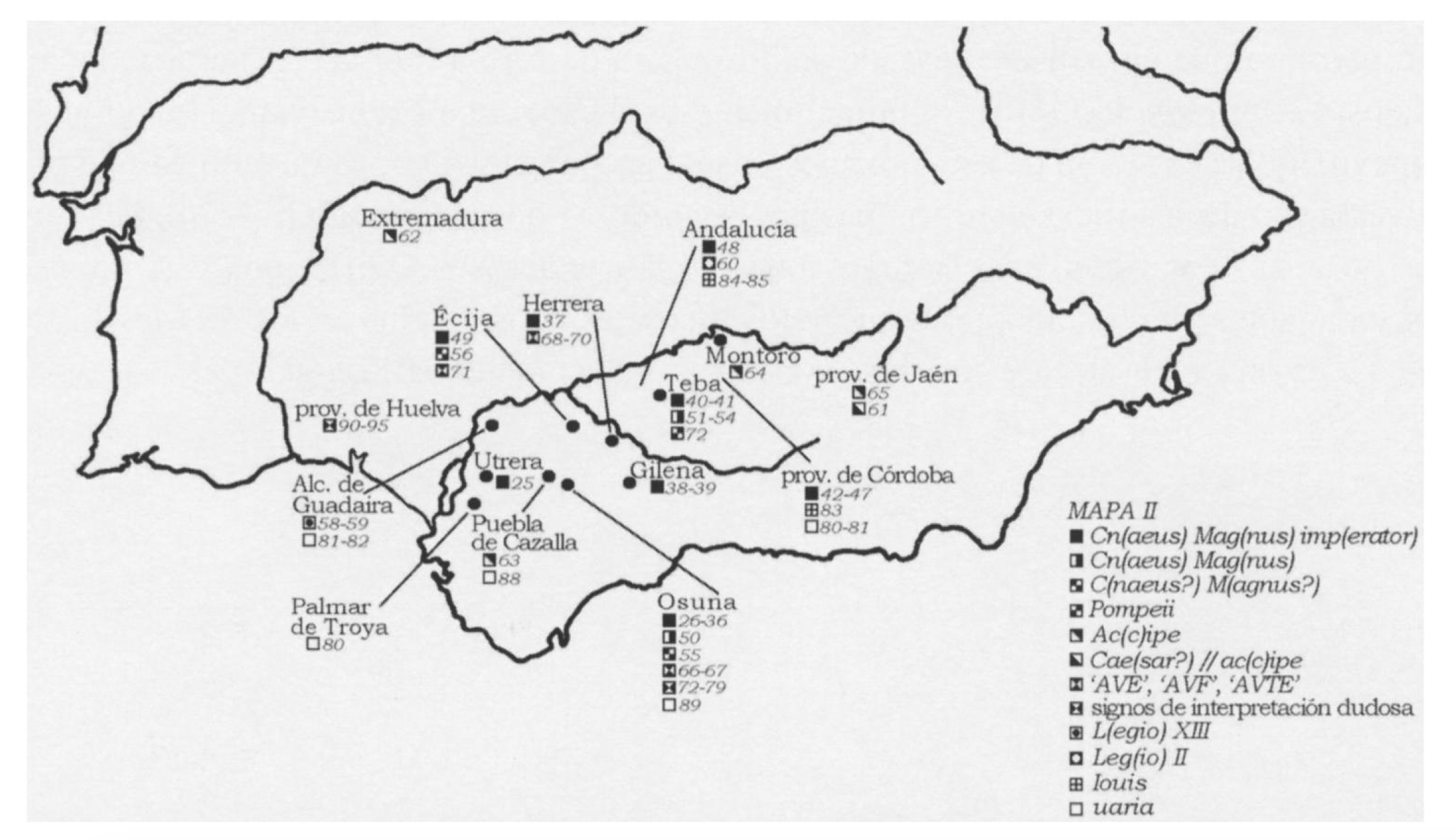
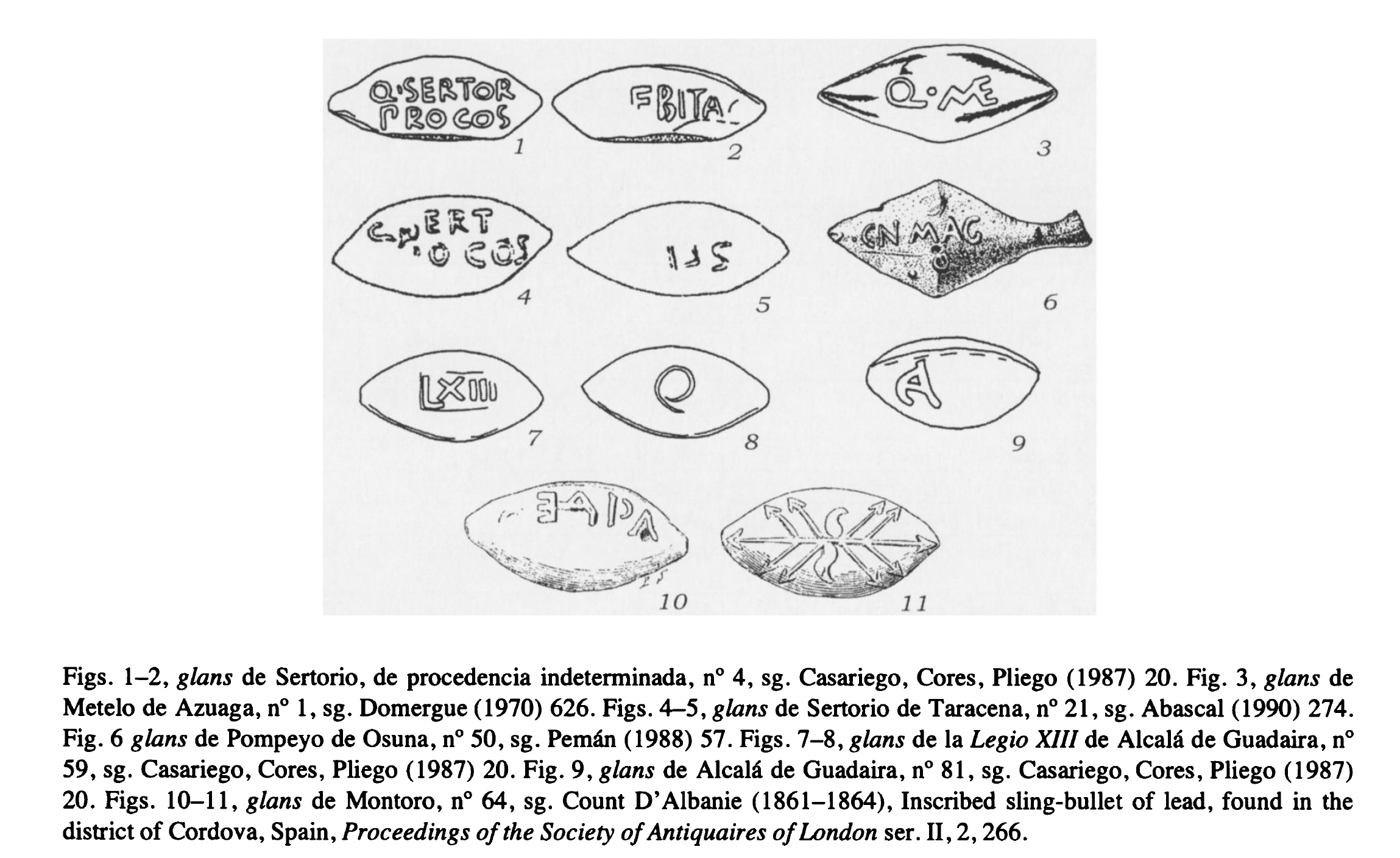
This older publication takes a wider geographical area as its focus and thus remains still useful, esp. the appendix of all the glandes he knew at time of publication from the Iberian peninsula:
Ariño, Borja Díaz. “Glandes inscriptae de la Península Ibérica.” Zeitschrift für Papyrologie und Epigraphik (2005): 219-236.
I’ve modified here his map to use orange for Sertorius, green for Metellus. Dots are also scaled to number of finds in general area.
No. 2 below sould probably be re read as [Ve]ritas
likewise no. 4 below should probably also be corrected to Veritas, instead of liberitas.
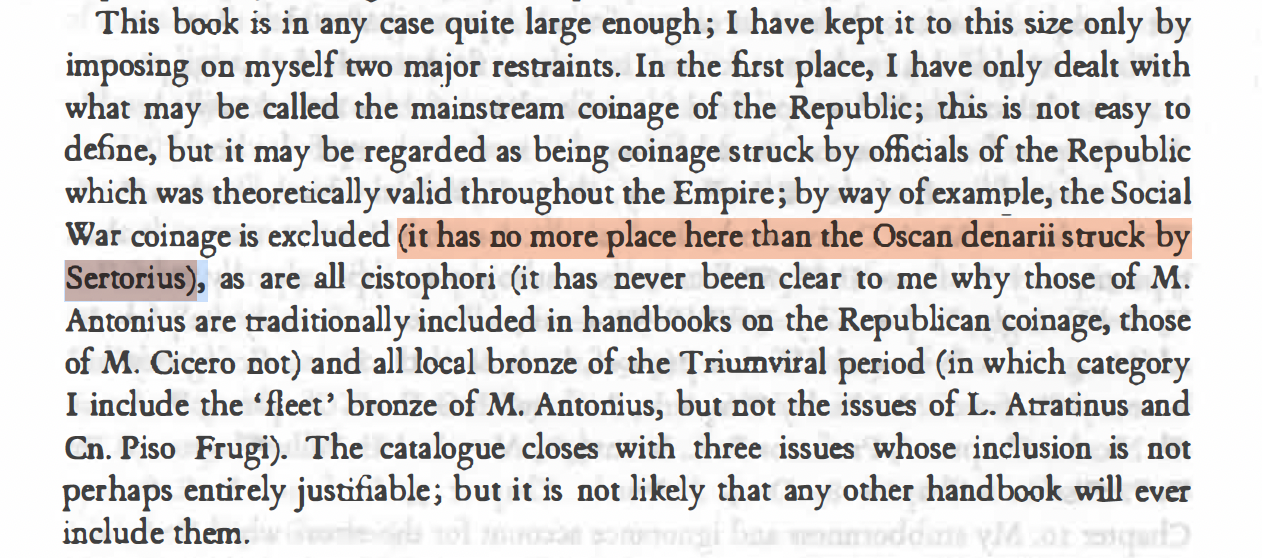
Crawford on Sertorius
Two points of interest in this second paragraph of his preface (p. xiii). 1) Crawford seems in no doubt that the Iberian Oscan coins are both denarii and made by Sertorius, and 2) he does not see them as ‘real’ Roman coins, thus de legitimating Sertorius’ own claims.
p. 82
Lockyear says this issue is somewhat later in the series (2007: 97). Crawford in connecting this issue to Sertorius seems to have been following Grueber in BMCRR which has these as Spain 52, 57, 58. This is the distribution map from CRRO for 393/1a (Mattingly dated 1b to 58 BCE cf. 2004: 285, but this is not yet proved in my mind).
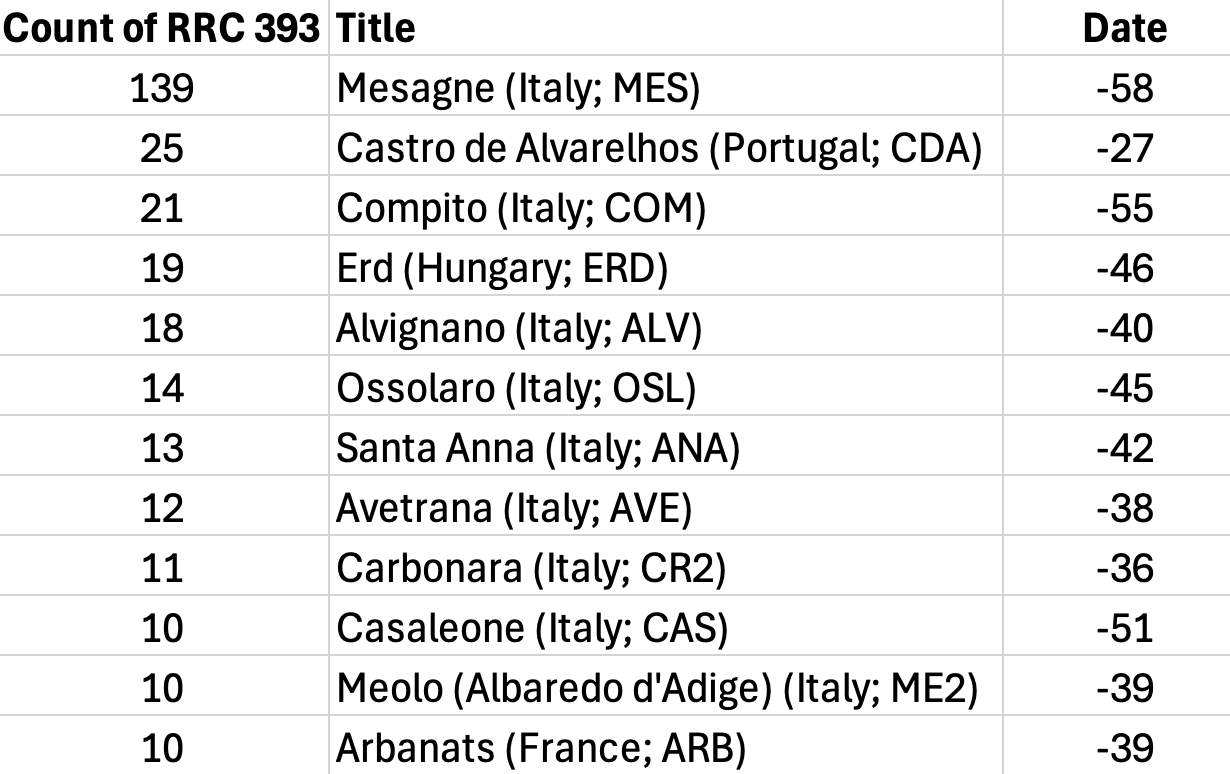
To get a better idea of the likelihood of such a connection. I only plotted hoard with more the four specimens, removing all the hoards from the visualization that have 3 or less coins of this moneyer. Bigger dots been more coins found at that site (extra-large >100 (only Mesange), large > 10, medium > 4, <10).
Most of those with more than 10 specimens don’t close anywhere in near the dates of Sertorian War:
I think the Pontecorvo hoard is something of a red herring. And I’d point out the complete absence of finds from the Ebro region. So I’m going to disagree with Crawford on this one.
P. 89 & 92:
I agree with Crawford that these coinages are likely from the later civil war and have nothing to do with Spain, but the place of minting might have clues in the new RACOM data. I wonder about the footnote comment about double headed coins associated with unpeaceful times of production. Stannard is now the go to guy on this topic (first article, second article)
P. 370-371
Under discussion of bronze series RRC 355 (c. 84 BCE) Crawford comments that “Salinator reappears as Legate of Sertorius in 81 BCE.” The Prow of these Cinnan Era asses are marked DSS, similar to SC. Meaning they were struck according to the wishes of the Senate.
P. 381
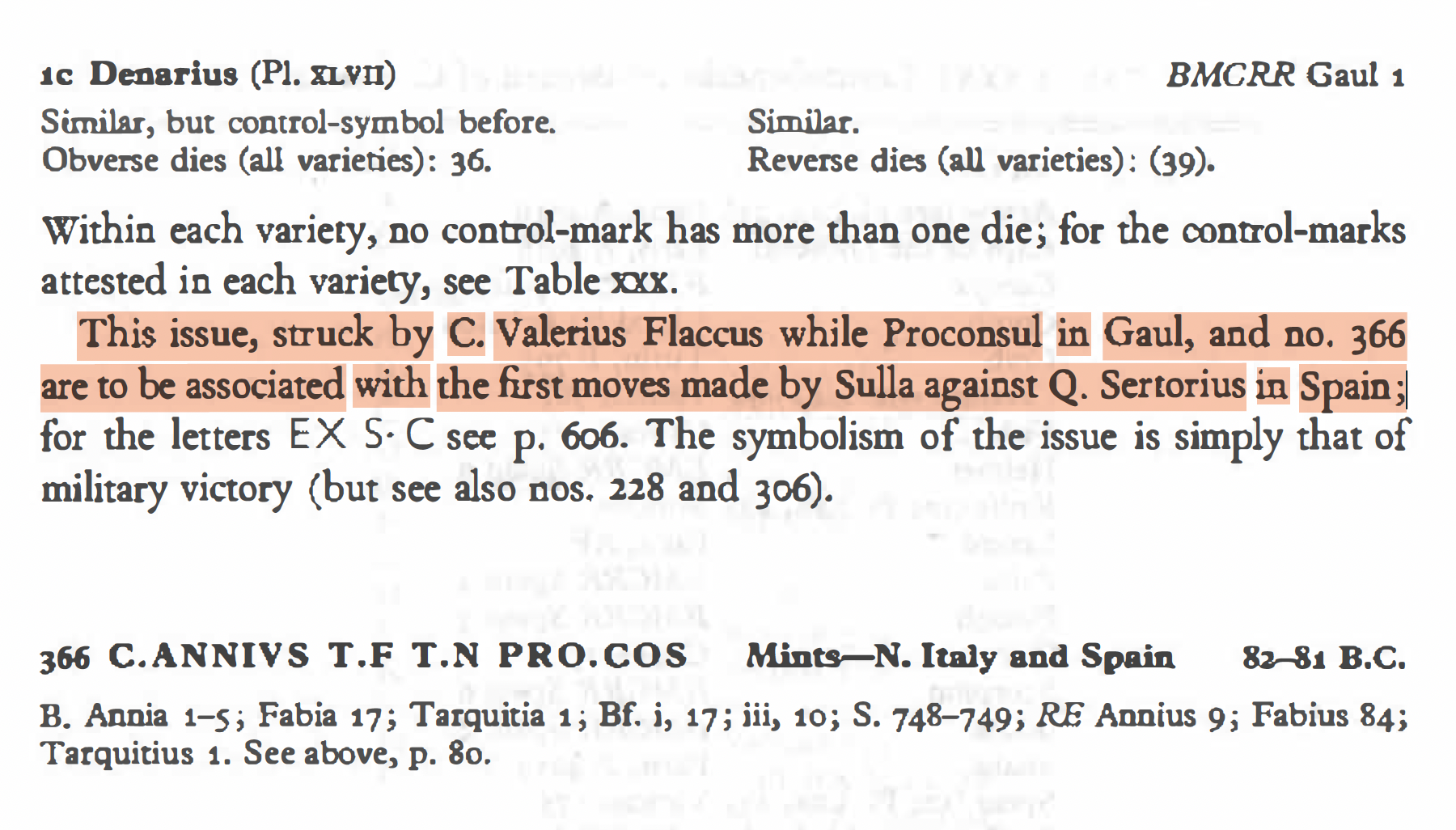
RRC 366 is certainly to be associated with the efforts against Sertorius, but I’m less convinced about RRC 365. I see no specific evidence to support this conclusion. I’m inclined to see C. Valerius Flaccus as a more independent actor at this point, but I’m open changing my mind on this.
I looked at the hoard data for 365 focusing just on the Iberian Peninsula and the south of France. It certainly supports minting near Massilia, but we don’t know where the so called Spain hoard (SP2) was found (hence it is just plotted in the center). To associate it with the Sertorian War I’d hope to find many examples in local regional museums of Ebro river region. I’d say jury is still out.
By contrast even without my putting dates on the map you can see that RRC 366 has a much broader representation in Iberian hoards, such that I’m not sure I’d connect them so closely as Crawford suggested:
P. 386
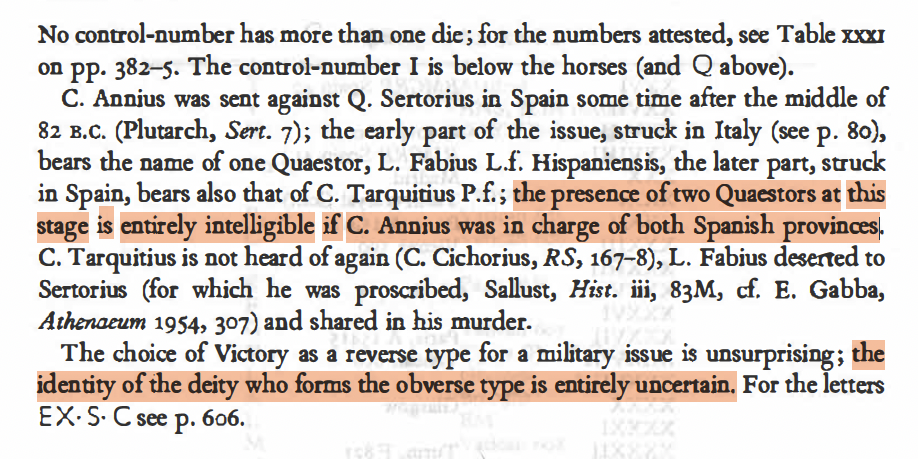
The Konrad article mentioned at the top of this far too long post is an important intervention to these traditional views. There are clearly many different hands carving this complex issue. See new post for more on the deity of the obverse (Aequitas).
I don’t think RRC 393 has anything to do with Sertorius. The interest in the Genius of the Roman People in the early, mid first century BCE still needs explanation. I’m not always one to go in with looking for family connections but I would not rule it out. I wrote about these types in a 2010 publication but should come back to them (PDF link).
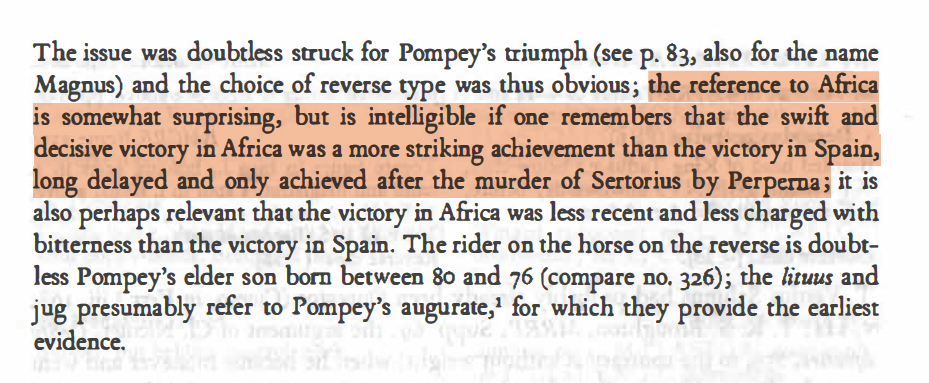
P. 413 revisiting the RRC 402/1 aureus:
Here’s my previous writing on this topic in response to Kopij NAC 2016, 106-127. I’m still on the fence on the dating of this issue. I’ve checked Suspene et al AVREVS and they don’t seem to have tested it. A great shame but understandable given no specimens to my knowledge are available in French public collections. It might be possible to test the BM specimen if i wrote a grant. Maybe in the fullness of time I’ll put this baby to bed that way (I have aspirations to do the same with the XXX oath scene gold of which I personally question the authenticity…). I also am longing for a better picture of the Bologna specimen (That on the website is so low res). The better picture is necessary to confirm whether or not the obverse head is wearing an earring as it appears on the BM specimen. Bologna is die linked to the RBW specimen in private hands (Schaefer archive link). I’m a little surprised I don’t have Woytek’s 2015 chapter on file as PDF nor do I own the RBW Fides volume to which I contributed but at 275 bucks, I just decided to ILL request the chapter. More after I read that chapter. I assume Woytek still holds to his 2015 views as he cites himself in AVREVS but I may need to double check that…
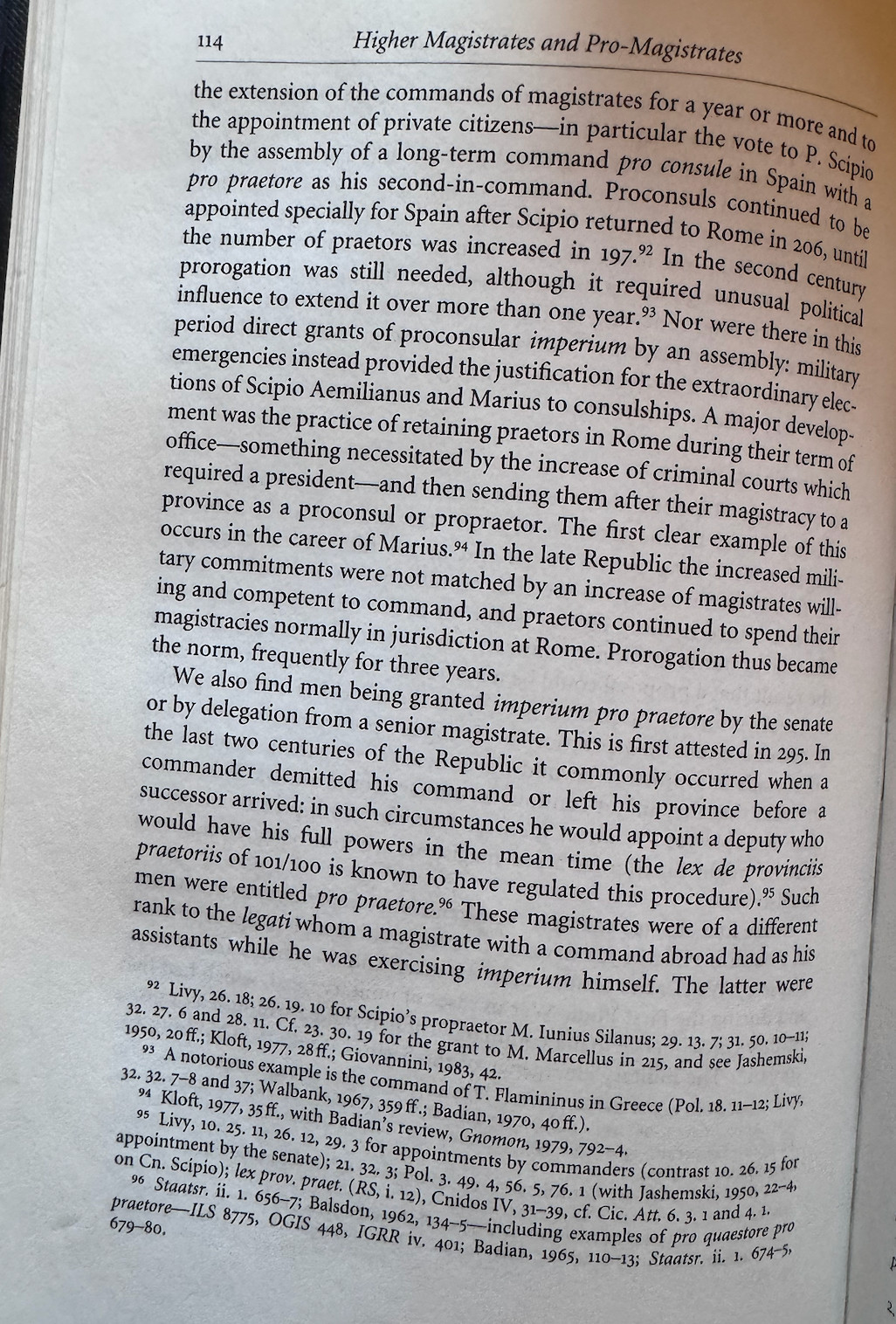
Much Kopij’s argument rests on later epigraphic parallels cf. RRC 446 and RRC 447 and the MAGN PRO·COS legend. I think I may need to review the use of PRO COS for this conference paper. We have the Sertorian Sling Bullets above, we have RRC 402, AND the earliest (I think) use of PRO COS on coins is for Annius (again never elected consul) RRC 366. This is a constitutional moment of crisis and this new power structures different from previous pro rogations is coming out. There must be something newer and more satisfying than Lintott 1999 on this:
My forthcoming RACOM paper with Sharpless and Lockyear will help flesh this out a bit, but we know that the amount of striking in the Social War/Civil Wars 91-79 ish was so intense that these coinages dominate the hoards down to the crossing of the Rubicon. This intersects with my paper I was delivering all over the place last fall (ANS long table version).
So I disagree with the GPR stuff as mentioned above. I’m not at all sure reconcilation was a big priority but perhaps footnote 3 needs chasing (see below). RRC 403 is read best in my mind as explain the correct hierarchical relationships of Rome and Italy. Again discussed in my 2010 piece (PDF link).
So that gets us through Crawford’s RRC comments. This leave his more discursive treatment in 1983. As this is less widely available I provide a PDF.
This is so strange I think we all assumed Crawford knew RRC 366 (Annius coins is FOR the Sertorian war not BEFORE). I wish he elaborated on this dating. I’ve also written to Clive Stannard to ask about the coinage struck by L. Appuleius Decianus, Q. and whether he agrees they have anything to do with the Sertorian War.
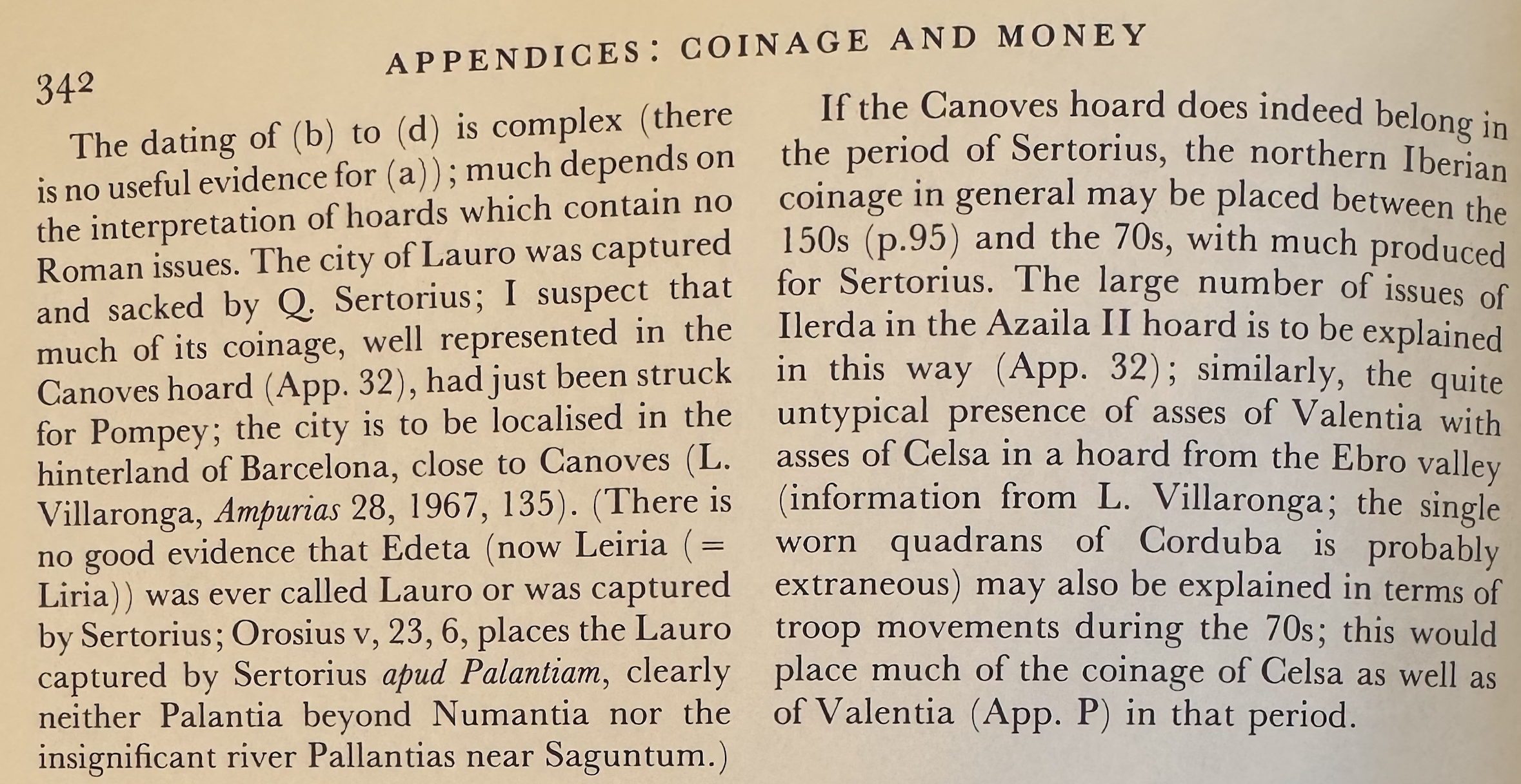
I’ve also asked about the the Cn.Iulius issue of quandrantes from Corduba. Recent sales catalogues give a date of 49-45 BCE. Crawford wants it struck for Metellus in the Sertorian War, and new RBW ANS catalogue lists the type as second half of the second century BCE, but the older ANS specimens are listed with a date of 100-40BCE. I think I like the late dates (Caesarian) best on stylistic grounds but that is just a hunch. Total the ANS has 46 of these!14 in the BM. 13 in Paris. Surely there must be a systemaic study of these coins there are so many!!
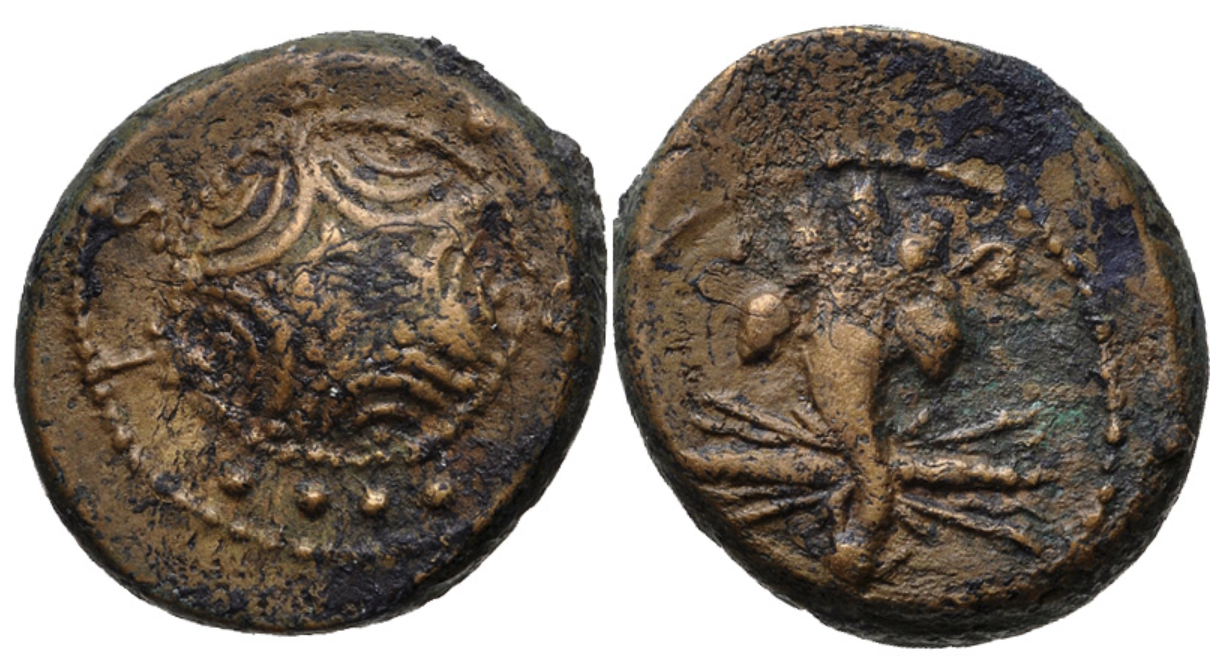
Crawford also suggests that the coins of Valentia can be associated with Sertorius (at least in part).
The inspiration of these is RRC 265/1 (early 120s?), but the type was revived under Sulla (Cf. RRC 371/1) and in an unpublished paper of Acton 2013 deriving from the ANS summer seminar it has been shown through die links that at some Roma types are linked to Apollo reverses.
Römische Republik: Q. Fabius MaximusRömische Republik: Q. Fabius Maximus
The design was also copied at Paestum. I ‘ve a little in my 2021 book on this.
Crawford concludes that Iberian silver coinage ends with the Sertorian War and an assumption this was Roman policy because of the association with Sertorius.
Antela Bernárdez, Ignacio Borja. “Anio, Fanio y Tarquitio en las Guerras Sertorianas.” Latomus 76, no. 3 (2017): 575-593. Doi: 10.2143/LAT.76.3.3275127 [Jstor]
P. 575
…probablemente autorizado con poder proconsular. La autoridad con la que Sertorio se presenta en la Península ha merecido una intensa discusión…
Ok. This is interesting. The implication is that although Sertorius was never Consul it was the Cinnan Senate in Rome that authorized him as ex praetor to serve in this capacity in this region. This may tweak how I see the sling bullets.
The authors start from Badian’s arguement that Sertorius was ‘offiical’ governor of both provinces and that Annius was his designated successor in both. A tidy picture, but can it be proved?
E. Badian (1964), Notes on the Provincial Governors from the Social War down to Sulla’s victory, in E. Badian (ed.), Studies in Greek and Roman History, New York, p. 71-104.
P. 576
… y siguiendo a Brennan, podemos considerar a Anio también propretor, a pesar de que en sus monedas se designe como proconsul …
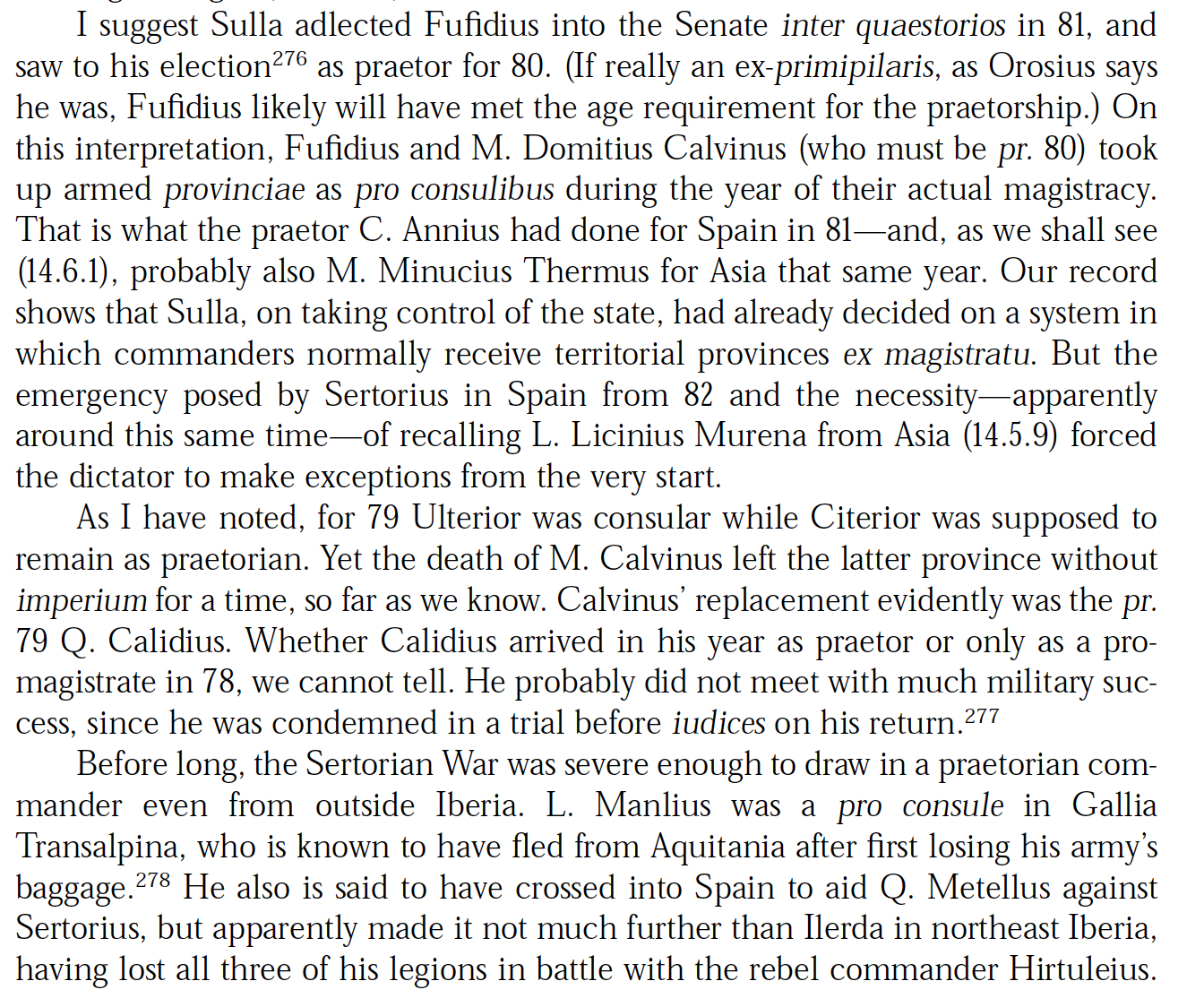
I don’t see Brennan making this claim of Annius, but perhaps my reading hammered by the language barriers. What I do notice in Brennan’s text is the consistent legal framework under both Cinnan and Sullan regimes of sending ex-praetors out as proconsuls, not just Annius and Sertorius but also Fufidius and Calvinus (cf. Thermus too!). I These all help contextualize Pompey’s extra ordinary grants of imperium.
I’m also note of how Sertorius and the Marians are associated with Africa and wonder if this is party of the reason for the Elephant headdress on RRC 402.
Here’s Brennan 2000: 505-507.
From here Brennan continues talking about Pompey being sent to Spain, but I’m going to continue with my reading of Antela-Bernárdez 2017 instead.
… si bien la primera serie de la acuñación tuvo lugar en Roma, probablemente por parte de Fabio, la segunda debió emitirse en Hispania, quizás después de la expulsión de Sertorio de la Península y con el objetivo de financiar un nuevo reclutamiento de tropas que permitiese a Anio asegurar la posición ganada. Por ello, no es estrictamente necesario interpretar que ambos hayan ejercido el cargo de forma simultánea, y quizás en un momento dado uno de ellos fue reemplazado por el otro …
For one quaestor to succeed the other Annius would have had to be prorogated and the quaestor replaced in the new year. Brennan’s re construction doesn’t allow this as it only has Annius there for 81 and two new commanders there for 80, Calvinus and Fufidius.
P. 577
…No obstante, algunos autores han querido considerar a Anio como un representante de la corriente política moderada, intermedia entre los dos bandos enfrentados…
Was Annius a moderate or a middle ground? I’m not so sure. Sulla needed to accomplish two things. 1) ensure no more defections, 2) ensure no oppportunistic power grabs. My guess is that Annius was loyal and just good enough not to mess up the campaign or take too much independent action. (I didn’t type “mess” the first time).
Esta hipótesis explicaría la iniciativa sertoriana de visitar otros focos de posible soporte marianista, y relativiza la versión que argumenta la huida de Sertorio ante la presión militar de Anio
I like this revisionist idea that Sertorius was looking to broaden his base rather than cede territory, but I’m not sure we can prove it either way.
P. 578
Continues same speculation
… y añade Plutarco que este grado de confianza era posible “por aquellos que habían estado con él”. La referencia puede hacer mención de una relación anterior entre Sertorio y algunos Lusitanos que hubiesen estado enrolados como auxiliares en el ejército de Tito Didio…
The text goes on to say this is an unlikely reading of Plut. Sert. 6.9.
P. 579
Turns the question the problem of the quaestors saying Konrad and Hinard reached the same conclusions: Fabius is the Sertorian, but Tarquitius is not the same as the Tarquinius Priscus from the texts.
F. Hinard (1991), Philologie, Prosopographie et Histoire à propos de Lucius Fabius Hispaniensis, in Historia 40, p. 113-119.
Says next pages will lay out Hinard and Konrad’s arguments.
P. 580
…Fabio Hispaniensis debería haber obtenido el cargo de pretor monetal bajo la aceptación de Sila….
What does pretor monetal mean? He’s a quaestor, just as it says on the coins…. Maybe a language/terminology issue on my side.
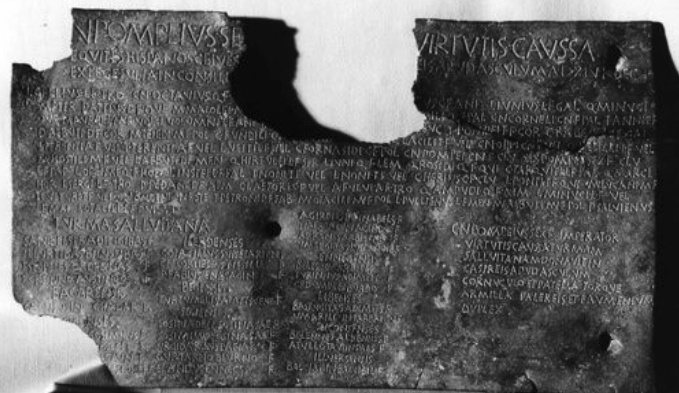
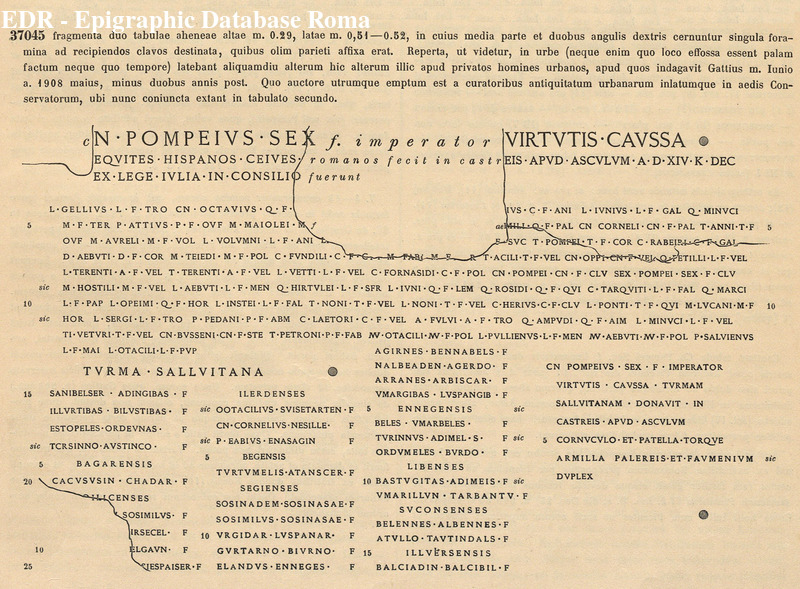
Critiques Konrad’s differentiation of Tarquitius from Tarquinius as these may be variations of the same name. Reminds reader that Konrad draws support from the Tarquitius spelling on the Ascoli Bronze (line 9 near right hand side).
I agree spelling variations are not definitive proof. Including bronze just so I remember it.
… Konrad acepta la posibilidad de que Fabio hubiese sido primero elegido como pretor en Noviembre 82…
Now I’m really confused by the term pretor for quaestor.
Hinard no considera aceptable tal hipótesis, a la luz de las implicaciones de la proscripción de Fabio, que imposibilitaría que un individuo susceptible de ser considerado enemigo de la República tan sólo unos meses antes hubiese sido elegido antes para un cargo como el de pretor
I don’t share Hinard’s concerns the proscription lists could be arbitrary and cruel. And I don’t find the arguement that their were two Fabii Hisp. likely at all. DPRR keeps them as one individual. The date of his election is must have been 82 for 81. That said Hinard is correct that some families tried to have members on both sides of civil wars not just in the Sullan age but also later under Caesar.
P. 581
Y sin duda es esta situación la que nos hace pensar que, efectivamente, en ambos casos estamos ante los mismos personajes.
Now we come to the authors’ own view that both men known from the coins are the same two men known from the texts. I’m open to this idea. And convinced on Fabius and Tarquitius is possible… The speculative arguement that because no Fabii held the consulship between 116-45 means the family was Marian seems weak. I’m curious for the evidence of Fabian engagement with the found of Valentia. Is the arguement based on the borrowing of a coin design from Q. Fabius Maximus? (see above.)
P. 582
Sabemos, ante esto, el papel destacado de Valentia en el bando Sertoriano, según atestigua la epigrafía. Por otra parte, los vínculos de la gens Fabia con Lusitania parecen también evidentes a la luz de la numismática y de la participación de éstos en la lucha contra Viriato.
The footnote to the sentence is:
H. Gallego franco (2000), Los Sertorii: Una Gens de origen republicano en Hispania romana, in Iberia 3, p. 243-252.
I many need to check for epigraphy. Odd the footnote for the second is only to Florus 1.32.17 [sic], nothing about coins as mentined in text.
At last Fabius Maximus had overcome him also; but his victory was spoilt by the conduct of his successor Popilius, who, in his eagerness to finish the campaign, assailed the enemy leader, when he was already defeated and was contemplating the final step of surrender, by craft and stratagem and private assassins, and so gave him the credit of seeming to have been invincible by any other method. [Florus 1.33.17]
The authors suggest that Tarquitius’ name may indicate an Etruscan ethnicity. I was sceptical but the six epigraphic attestations of the gens pre 1 BCE make this seem possible.
I also ran the gens Tarquinius and got two results, one from Ceveteri and one from Rome.
I”m less sure I believe in the Etruscan-Iberian connection pre existing. I don’t believe connection between Tarquitius and Sertorius can be easily traced to the Social Wars. Sertorius was in Cisalpine Gaul, Tarquitius was at Asculum and with Pompeius Sextus’ army.
P. 583
Speculates on Annius’ disappearance after the Ebusus incident and a power vacuum into which Pacciecus steps. I need to go back to the primary sources here to refresh my memory.
P. 584
Annius is not among the four generals whom Plutach mentions Seritorius facing: the authors suggest Annius perished in the course of his campaign. Argument from silence. The question they say is not why where they elected (Hinard’s question) but why did they defect?
P. 585
Did Sulla really control all elections in 82 BCE the authors ask or just the consular ones?
P.586
The authors question whether we can trust Sallust’s testimony regarding proscriptions of Fabius. I think we can.
[And this raises in my mind when Fabius entered the Senate…]
P. 587
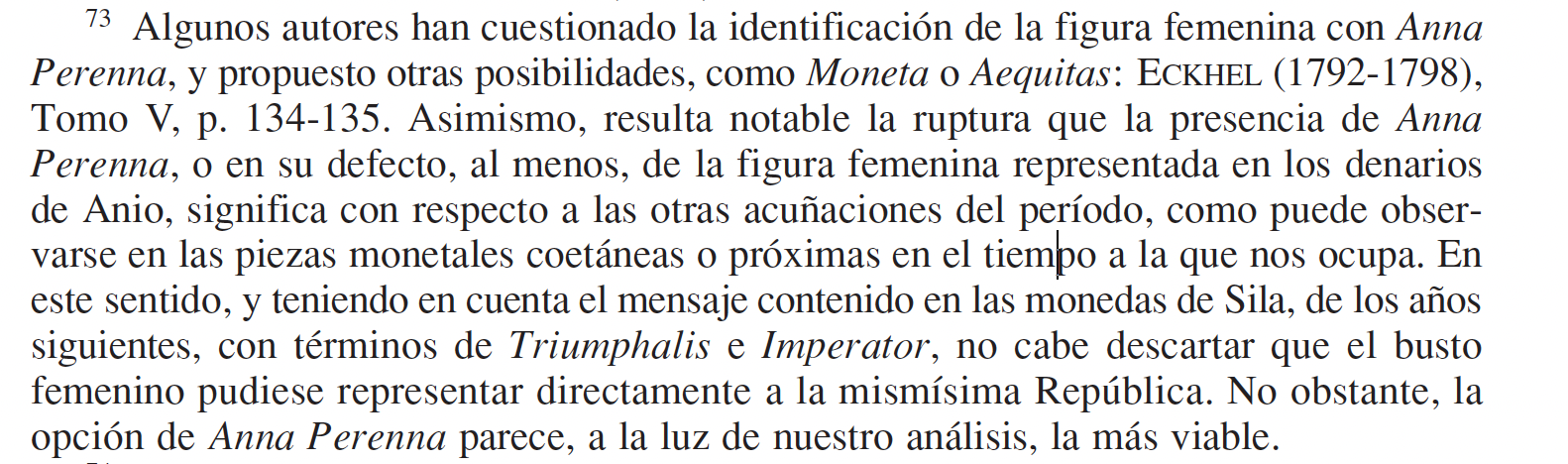
Accepts identity of obverse as Anna Perenna. I don’t.
The authors cite:
R.D. Woodard (2002), The Disruption of Time in Myth and Epic, in Arethusa 35, p. 83-98.
I’m not convinced by Woodard’s methodology to support his (Indo-Aryan origin) theories. On Anna Perenna, I’ve created a new post.
P. 588.
Suggests the coin is pointing to Annius setting out for Spain in March 82 BCE (!) (because of the date of Anna Perenna’s festival in that month!). The authors propose a series of events where Sulla takes Rome in November 82 BCE and is read as written Annius sets out before this. OR, if I am charitable and allow my reading of the Spanish might be wrong that Annius sets out just after Sulla takes Rome but before the Ides of 81 BCE and evokes Anna Perenna to legimate leaving before the campaign season’s traditional start. I don’t find either logical.
Habitualmente, sin embargo, se ha presupuesto que la acuñación de Anio tiene lugar con posterioridad a su enfrentamiento con Sertorio, y que la iconografía de la misma haría referencia a su victoria sobre los sertorianos en los Pirineos
I don’t think I or those I read have assumed that only that victory (even anticipated) is appropriate for any War issue. RRC 366 is minted in multiple mints that seems clear precisely when and where remains to be seen.
P. 589
Suggests that caduceus and scales refer to commercial trade and how recent war events may have effected trade and commerce. Also suggests that land seizures by Sulla for his troops in Etruria might have been reason for Fabius and Tarquitius’ defections presuming these negatively impacted their families.
De este modo, podemos contraponer a los supuestos “piratas” sertorianos, en realidad comerciantes, que apoyan a Sertorio, con aquellos comerciantes a los que la acuñación de Anio parece hacer referencia. Por lo tanto, la lucha entre Anio y Sertorio por el dominio del Mediterraneo occidental puede entenderse en suma como una muestra más de la existencia de un conflicto de competencia entre dos grupos de comerciantes, resultado de los destacados intereses mercantiles (como los de la isla de Ebusus), estando cada uno de ellos vinculado a uno u otro de los bandos contendientes durante el conflicto sertoriano.
So this came up in my search results for other things and footnote 37 caught my eye.
Torelli, Mario. Studies in the Romanization of Italy. University of Alberta, 1995. [Why I don’t own this I don’t know. I’ve now ordered but will take some weeks to arrive.]
Crawford, Michael. “Coins from a Cemetery at Malignano.” American Journal of Archaeology 72, no. 3 (1968): 281-283. (jstor)
Crawford is correct to emphasize that the Teanum coin is important as is the semi-libral. What I really want is images and associated finds to better understand context AND maybe think again about dating of these series and the use of coins in burials.
Some of this has been done by this v recent v important article that take Crawford’s work as a starting point, but I’ve put in a request to the library for help getting a scan of the original excavation reports. Fingers crossed more to say after that.
Naiman, M. G., and M. K. Termeer. “Roman and Campanian bronze coinage in Etruria in the 3rd c. BC.” (2021). [pdf available through google scholar]
Opening of the Moldovan Pimp, by Edgardo Cozarinsky
Ok. I lied. I have at least one more conference inspired post to write. The enslavement panel had a paper by Gaia Gianni who is experimenting with Critical Fabulations and epigraphic traces of enslaved women in Rome. I had a number of side bar conversations with colleagues about this paper and the methodology. The biggest questions still in my mind are for whom are these narratives. Do they make us feel better? Why and how? Do we want to be made comfortable or uncomfortable? Why? I know I might enjoy writing these speculative fictions, but I also know they are not for me to write. I would also note that the application of critical fabulation to female enslaved persons of the ancient world has already been discussed by other scholars.
Kamen, Deborah, and Sarah Levin-Richardson. “Epigraphy and critical fabulation: imagining narratives of Greco-Roman sexual slavery.” Dynamic Epigraphy: New Approaches to Inscriptions (2022): 201-221.
What is “critical fabulation”, you ask. Well, it started here.
Hartman is one of the great minds and literary scholars (artists) of the 21st century. We should be hesitant to trust our talents to walk the same path. We should also question whether it is possible or appropriate to apply a technique from the aftermath of the Atlantic slave trade (still very much shaping our present!) to the ancient material. Perhaps the most accessible way to get a sense of the Hartman’s approach and its impact is this 2020 New Yorker article.
The phrase ‘critical fabulations’ has now become a bit of a cultural and academic buzz word for everything from art exhibits to books about design. There is LOTS of results in the scholarly literature and lots of arguing over its limits and utility. I am just watching from the sidelines with some reservations but equally deep interest and curiosity.
So this is not a post using critical fabulation but rather about the name Venus and naming customs among US enslavers. One of my favorite databases is
And a project I’d v much like to do with students one day is analyse these reports of enslavers trying to recapture the self liberated to say something about when and why US enslavers used classically inspired names for those they claimed to own. Renaming, something also practices by Roman enslavers, is a critical means of control and articulation of natal alienation.
To this end, I decided to allow myself to read all the ads with Venus as an enslaved name. 17 Venuses set themselves free. And it is only in the rage of their former enslavers that we can know them.
RUN AWAY from the subscriber, about eight days past, A NEGROE WENCH, named Venus, speaks but little English, has many country marks on her face, and on one arm a white spot or (?) occasioned by a scald or burn of the fire. Whoever returns her to the owner in Savannah shall receive ten shillings and all reasonable charges. WILLIAM OLDS N.B. If harboured by any white person, thirty shillings will be given; she had on a white negroe cloth petticoat and an oznabrig jacket. [August 29, 1775. Georgia Gazette.]
Country marks is a reference her scarification as a beauty and/or ritual practice of many African peoples. This and the reference to her lack of English language, suggest she had recently endured transport and there is no particular chance Venus was her own name for herself or that of her communities. Was Venus applied to her as a euphemism? Even a mocking joke?
RAN away the 26th instant, the following NEGROES, viz. Paris, Venus his wife, and three children, named Elsey, Luna, and James. Paris has an impediment in his speech; his wife, a likely sensible wench, about 25 years old, formerly belonged to Mrs. Murray. Any person delivering said negroes to the subscriber shall receive ten dollars; if they return home of their own accord they will be forgiven. JN°. HENDERSON. 29th Nov. 1781. [Georgia Royal Gazette]
Notice here that Venus is married to Paris. Was the enslaver was ‘playing’ with classical mythology in the match or the naming? Was Venus named Venus when in the control of Mrs. Murray? Their children break the pattern (with the possible exception of Luna). Did they get to name them themselves? To what degree would such a choice be controlled by the immediate enslaver? It is interesting ages of the children not given, but the strength of the family unit and desire to protect said children can be strongly inferred.
Broke out of the Trenton Gaol, on Monday night, the Fourth of this Instant October, a Negroe Wench, named Venus, formerly the Property of Samuel Stout, junior, in Amwell: Had on when she went away, a Lincey Jacket and Petticoat; she is likely to have round her Head two or three Handkerchiefs. Whoever takes up said Wench, or secures her so that she may be delivered to John Allen, High Sherrif at Trenton, or the Gaol Keeper, shall have Three Pounds Reward, and reasonable charges paid by me, John Allen, High Sherrif, N.B. All Masters of Vessels are forbid to carry her off at their Peril. [October 14, 1762; Pennsylvania Gazette]
I’ve nothing to say of the name but I am reminded that it was in Philadelphia that Ona Judge liberated herself from George Washington and I am at once again reminded of northern complacency and enforcement of enslavement. Here we have a state official acting to apprehend Venus.
Eight Dollars Reward. RUN-away on Sunday morning the 3d instant, a tall, stout negro wench and her child; the wench is named LUCY, the child VENUS. The wench is very much pitted with the small pox, and her feet is so large that she is obliged to ware mens shoes. She took with her two short gowns, and two petticoats, one striped bottom short gown and a yellow ground callicoe one; one black petticoat and one other supposed green, either of which she wears. The child had on a tow cloth frock, has a scar on her shoulder, and is about 5 or 6 years old. Her mother is about 28 years. Whoever gives information to the printer so as the owner may have them again, shall receive the above reward. All persons are forewarned not to conceal, harbour or carry off the said wench and her child, as they will have to answer for it at their peril. [August 18, 1783; The New-York Gazette; and the Weekly Mercury.]
Did Lucy name Venus? Why would she pick such a name? I can’t help cheering on this mother who sought to give her young daughter a better future and dared to take a change of clothes. Part of me wants to speculate that the mother wanted to protect her child from sexual violence, but now I’m straying from my stated methods.
RAN-AWAY on the 4th ultimo, a negro woman named Venus, formerly the property of Mrs. Berwicke, deceased. She is a stout likely young wench, of a very black complexion; she is well known in Charleston, and as she was enticed away by a wench named Liena, belonging to Mr. Rudly, near Hasel & Church street, it is supposed she is harbored by her. Whoever will deliver the said wench to Mr. Samuel Baker, No. 18, Tradd-street, or to the master of the work-house, or to the subscriber, on John’s Island, shall receive three pounds reward ; and a further reward of ten shillings if harbored by a black, and one pound if by a white person.Thomas Legare, jun. John’ s Island. [December 2, 1794; The City Gazette; St. George’s Dorchester, Charleston, South Carolina, US]
What does ‘likely’ imply here? Does this mean attractive? Was Venus friends with Liena? Was the flight inspired by Legare’s treatment upon her presumed recent acquisition upon the death of her former female enslaver?
RUN AWAY from the subscriber a Negro wench named Venus, about 26 years old, this is to warn all masters of vessels and others from harbouring or carrying off the said Wench, as they shall answer for it as the law directs. Whoever will apprehend the said Wench, shall be handsomely rewarded by bringing her to No. 27, Roosevelt Street. Charles Boardwi[ne]. [July 3, 1782; The Royal Gazette, NYC, NY]
How could there be any hope of recovery with so little detail, what was the motivation for posting the ad?
Ran away from me the Subscriber, on the 4th Day of May Instant, a Negro Girl named VENUS, in the 19th Year of her Age. All Persons are hereby cautioned and forbid against harbouring, concealing or employing said Negro, as they would avoid the Penalty of the Law. EPHRAIM FULLER.Middleton, May 28,1778. [June 11, 1778; New-England Chronicle, Boston, Mass.]
At least Venus had more than a month’s head start before this meager ad without specified reward was published.
Ten Dollars Reward. RAN-AWAY from the subscriber on the 22d ult. two negroes, viz. MARK, and VENUS his wife ; Mark, a fellow about five feet six or seven inches high, and about 22 or 23 years of age, has a blemish in one of his eyes and commonly keeps it shut when spoke to. He is very artful and sensible, and of a blackish complexion ; formerly the property of Gabriel Manigault, Esq. of Charleston. The fellow formerly lived near or at Goose-creek, and it may be supposed he will make for that place, as his relations are all living about there ; had on when he went away, a negro cloth coat and and oznaburgh overalls. Venus (Mark’s wife) a wench about the same age of himself, and of a yellowish complexion, about five feet two or three inches high, both of this country. A reward of six dollars will be given for Mark, and four for Venus, to any person or persons that will deliver them to the goal of Charleston, or Coosawhatchie, or to the subscriber on the Saltketcher. Andrew Zahler. August 6. [August 6, 1793; The City Gazette; St. George’s Dorchester, Charleston, South Carolina, US]
Here we see the presumption that the separation from family maybe the motivation for the disappearance. The focus is on Mark not Venus. She chose to leave with him even though there is not suggestion she was also enslaved by Manigault. Did she fear punishment for his escape? Did she genuinely love him? Both were born in this country and knew no life but enslavement. Venus knew she was likely her enslaver’s daughter or the product of white male sexual violence. Yet her enslaver values her 2 dollars less than her husband.
Ten Dollars Reward. RAN-AWAY from the Subscriber, the 22d July last, a NEGRO WENCH, named VENUS, of a yellowish complexion, lusty, well made and a bushy head of hair ; chief of her upper fore teeth are out; her clothes are mostly of homespun, one gown that is yellow striped. Whoever will deliver her to the Master of the Work House, or the Subscriber, on Orangeburgh Road, near the Cypress, shall receive the above Reward. ELYGERCRUM. October 20. [October 20, 1796; The City Gazette; St. George’s Dorchester, Charleston, South Carolina, US]
Why the three month delay in advertising? The missing front teeth speak to likely violence. No age is given. Again the mention of complexion speaks to mother’s trauma. What does lusty imply here? What about well made? Are these implying sexual desirability?
25 DOLLARS REWARD, RANAWAY from the Subscriber on the 25th Feb. last, a Negro Man by the Name of EPHRAIM, and his wife by the name of VENUS–EPHRAIM is about five feet high, thick sett, black complexion, has a large scar on his right foot, 38 years of age, and can read and write.–Venus is of a yellow complexion, thin visage and about 39 years of age.–I will give the above reward to any person that will secure them in any Jail in this state so that I get them again, and all reasonable expences paid, or fifteen Dollars for the fellow and ten for his wife. Masters of Vessels and all others are hereby forwarned from harbouring, employing, or carrying away said Slaves, under the penalty of the law. SAMUEL WILLIS. Swift Creek, March 7th, 1813. [March 13, 1813; Carolina Federal Republican; New Bern, North Carolina]
Note Ephraim’s literacy. These are one of the oldest couples thus far. Why now? Again we have price differential between husband and wife. Women just aren’t worth as much.
RUN AWAY from the subscriber’s plantation in Prince William’s parish, South Carolina, on the first of this month, the following NEGROES, viz. Will, Kitty; Liddy, about eight years old, Chance, Sabina; and Tom, about 18 months old; Pope, (a carpenter) and his daughter, three years old; John, Lucy, Venus, Granville, Monteith, Mahomedy, Philip, and Henny. As these Negroes formerly belonged to John Graham, Esq. it is more than probable they will attempt to conceal themselves on or near Savannah river. A reward of two dollars per head will be paid to any person who will lodge them in the Work-House at Savannah, or three dollars a head on their delivery at the plantation of the subscriber near Combahee. GODIN GUERARD May 8, 1785. [May 12, 1785; Gazette of the State of Georgia; Savannah]
16 left together. Sale even as family units was just too much. Three young children among them. The only other classical name in the group is Sabina.
ABSENTED himself from the Subscriber, on Saturday se’nnight, a NEGRO FELLOW, of a very black complexion, 6 feet high, stoops a little in his walk, about 25 years old, and formerly belonged to Dr. Kezelburgh. He had on a brown coat, green jacket lined with white, and blue trowsers, but may have changed his dress. He says he is free, and that his name is Venus, of New- York, and will probably try to get there : masters of vessels are therefore cautioned against carrying him off. If he returns of his own accord, he will be forgiven. Whoever will apprehend him, shall be handsomely rewarded. John D. Thomas, HAZELL-STREET. [Venus/Jack escaped again on May 10, 1796; see ad number 722.] [January 4, 1796; The City Gazette; St. George’s Dorchester, Charleston, South Carolina, US]
Who turned in Jack? Did he believe the lie of being forgiven and ended up with an iron around his neck?!
Twenty Dollars Reward, A NEGRO FELLOW named JACK, belonging to the Subscriber, was taken off Sullivan’s Island on the 1st instant; he is of a very black complexion, 6 feet high, stoops a little in his walk, about 28 years old ; and formerly belonged to doctor Kezelburgh; has a sore leg and an iron about his neck ; he had on when he was taken off, a blue jacket and trowsers, but may have changed his dress ; he says he is free, and calls himself Venus of New-York, and will probably try to get there. Whoever will take him up and deliver him to me on Sullivan’s Island, or to the master of the Work House in Charleston, shall receive the above Reward and all reasonable expences. Masters of vessels are cautioned against carrying him off the state. John David Thomas. May 10. [Venus/Jack’s earlier escape was advertised on January 4, 1796; see ad number 670.] [May 10, 1796; The City Gazette; St. George’s Dorchester, Charleston, South Carolina, US]
A man who knows his name an rejects the one he is given. I’m curious about other attestations of Venus as a male name.
RUN AWAY, FROM the Subscriber, on the 27th of March last, in Robeson County, Two NEGROES, a Man and a Woman. The Fellow is betwixt 25 and 30 Years of Age, named Cato, and a handsome Negro, the inside of one of his Ancles[sic] has been cut with an axe, which occasions him to walk a little lamely. The Woman is betwixt 35 and 40, named Venus, a low Wench and a Complete Cook. Whoever shall apprehend the said Negroes, and lodge them in any Goal, and give Notice to the Subscriber, shall be paid Ten Dollars Reward, or Five Dollars for either of them. ARCH. M’NEILL. April 15. [April 18, 1803; Raleigh Register And North Carolina Weekly Advertiser]
What does low mean? The classical tastes of the enslaver seem also reflected in the name Cato.
RAN away on or about the 20th of June, 1779, from the subscriber, on Edisto Island, the following Negroes, viz. Titus, Sampson, Prince, Isaac, Marquis, John, Taass, Cyrus, Hercules, Quamina, Sarah, Venus, Hagar, Rose, Cudjoe, Jethro, Abraham, London, Jack, Sam, Harry, Bristol, Caesar,Polydore, Stephen, Lymus, Bob, Amey, Catherina, Doll, Sabrina, Dido, Sarah, Maria, Phoebe, and Jenny. Whoever takes up any of the said Negroes, and delivers them to Mr. David Duncan in Savannah, the Warden of the Workhouse in Charlestown, or the subscriber on South Edisto Island, shall receive a reward of Three Guineas for each, with every reasonable expence; and a like reward will be paid on such information being given as will convict any person harbouring any of the said Negroes. BENJAMIN EDINGS. N.B. Any of the above Negroes returning home of their own accord will be forgiven. [January 25, 1781; Georgia Royal Gazette; Savannah]
You can just hear the desperation of this enslaver who lost in one act of self liberation 35 captives. It is incredible to me that he would think they would voluntarily return after 18 months of liberation. What this large group does is give us an idea of name variation under this enslaver’s judgement:
(4) Other Objects/Titles: Doll, Prince, Marquis, Rose
(2) Other European names: Catherina, Stephen
(2)Place names: Bristol, London
RUN AWAY from the subscriber, THREE NEGROES, viz. Carolina, a short well made fellow, much pitted with the smallpox, about 25 years of age, is well known in this and the province of South Carolina, had on when he went away a blue negroe cloth coat with white metal buttons, and purple pair of breeches with silver buttons. Venus, a wench about 5 feet 6 inches high, about 35 years of age, has her fore teeth filed. And Nanny, a girl about 12 years of age, born in this province. They had both on blue negroe cloth habits; and all speak very good English. Any person that will deliver the said negroes to the Warden of the Work House shall receive a reward of Ten Shillings each, and all reasonable Charges; and whoever will discover any person or persons who shall harbour or entertain the said negroes, or any of them, such person shall, upon conviction of the offender, receive a reward of Forty Shillings if a white person, and Twenty Shillings if a slave. And as perhaps some ill disposed person may intend the carrying the said slaves off this province, they will do well to consider that such offence is, by the laws of this province, felony without benefit of clergy, and they may be assured that whoever shall so offend will be prosecuted with the utmost rigour of the law. CHARLES PRYCE. 12th January, 1768. [January 20, 1768; Georgia Gazette; Savannah]
Were Carolina and Venus borne abroad and survived the passage? This seems the implication of Nanny being said to be borne ‘in this province’. How did they learn their English? Why are Venus’ teeth filed? Was this a pre enslavement body modification?
RUN AWAY, From Mrs. Elbert’s plantation, on Argyle Island, Monday last, The following Negroes, viz. CHARLES, of a yellow complexion, from the Angola country, about 5 feet 4 inches high, speaks a little broken English, about 25 years of age. BREETCHIE, about 6 feet high, stout made, speaks good English, from the Ebo country, about 30 years of age, of a yellow complexion. VENUS, his wife, about the same age, and from the same country, of a deep black complexion. PEGGY, Charles wife, of a black complexion, about 25 years of age, of the Angola country. Its supposed they are gone towards Augusta. Whoever will apprehend them shall be handsomely rewarded, on their delivery to Speirs, Macleod, and Co. at Savannah, or to Mrs. Elbert, at White Oak plantation, on Ogechee. Savannah, February 4, 1790.
Here we show enslaver knowledge of original cultural origin of those he enslaves. I’m confused by the meaning of yellow complexion. I’d been taking it to mean biracial but these make me wonder.
TEN DOLLARS REWARD. RAN away from the Subscriber, last Night, a Negro Man, named FREEMAN, about 38 Years of Age, about 5 Feet 6 Inches high, stout and well made; had on a dark great Coat, with Horn Buttons, a grey Kersey Jacket, and took with him a Variety of other Cloathing.—Also a Negro Wench, his Wife, named VENUS, about 32 Years of Age, tall and likely; took with her a red short Cloak, a black Bonnet, a Cloth coloured Worsted Gown, and Plenty of other Cloathing. Whoever will take up and return said NEGROES to their Master, shall have TEN DOLLARS Reward, and all reasonable Charges, paid by SAMUEL TOMKINS. Cranston, Oct. 24,1783. Reprint: The Providence Gazette, 11-01-1783.
I find naming an enslaved person Freeman pretty awful. Glad they took more Clothes.
This was a long post. I wanted to stop. I almost did. But I really wanted to see Venus a little clearer. I wanted to know as much of their stories as I can and celebrate their radical actions to honor their own humanity and that of their fellow enslaved.
Skip to the second half of this post if you just want notes on actual scholarly stuff. Most of this at the top is about the meta-experience of conferencing, but it does contain links to earlier posts on conference papers.
—
For reasons that are boring and practical and completely unexpected, I’m on a crappy bus without any wifi or electrical plugs winding my way home the long way. No this is not great for my mood. I’m writing to try to cheer myself up and of course as always to consolidate some of my learning and reflect on how to do better next time.
I want to refine my conferencing strategy to meet my relatively well-defined conference goals.
Goals.
Connect people.
Basically, I love ensuring I introduce those at different career stages to one another and myself being introduced to new people and hearing updates on their career and lives from those I’ve met before in these transient academic spaces. This was an especially good year for this, I got to connect both UGs and Grads with a wide range of colleagues at other institutions and at different career stages. The reward was myself feeling like I made great connections with early career Italian scholars all three of whom I think will be important to my work going forward. The other rewarding moments were hearing about how my funding list has been used by both institutions and individuals. I also learned a great deal about how MMUF works on private campuses.
I guess also in this category is where I would put being accessible myself to those who want to connect with me.
Learn about newly excavated evidence.
Later in this post I’ll allow myself to vent about the impossibility of attending everything of value at the SCS/AIA and how this is demoralizing and even toxic for the field. But since one has to choose what to attend in all the concurrent sessions, I put my attention primarily on hearing papers where I will see unpublished archaeological evidence with a primary focus on Italy, ideally pre Augustan Italy. My logic is that here I am most likely to learn something transformative for my own scholarship that I cannot learn from just reading on my own. You might have already deduced this from my earlier conference inspired posts (divination, Capitoline, phalloi, and natal alienation). But not all such papers I attend actually lead to a post. Likewise the evolution of Pompeii I.14 was fascinating from the shifting use of space (is indoor or outdoor space more needed in any given moment? time to dig a new cess pit!) to the impressions found of originally woven reed mats in herring bone pattern with borders. There was also the stunningly good paper by Krupali Krusche on the Temple of Vesta, comparing digital scans to archival drawings (22 columns are now certain! as is a wider opening with engaged columns). Some more notes can be found in the second half of this post.
Learning about new trends in scholarship and the field.
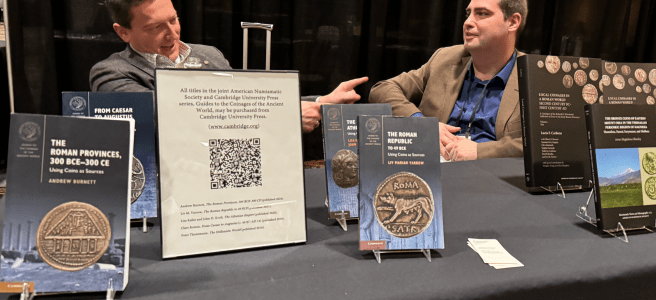
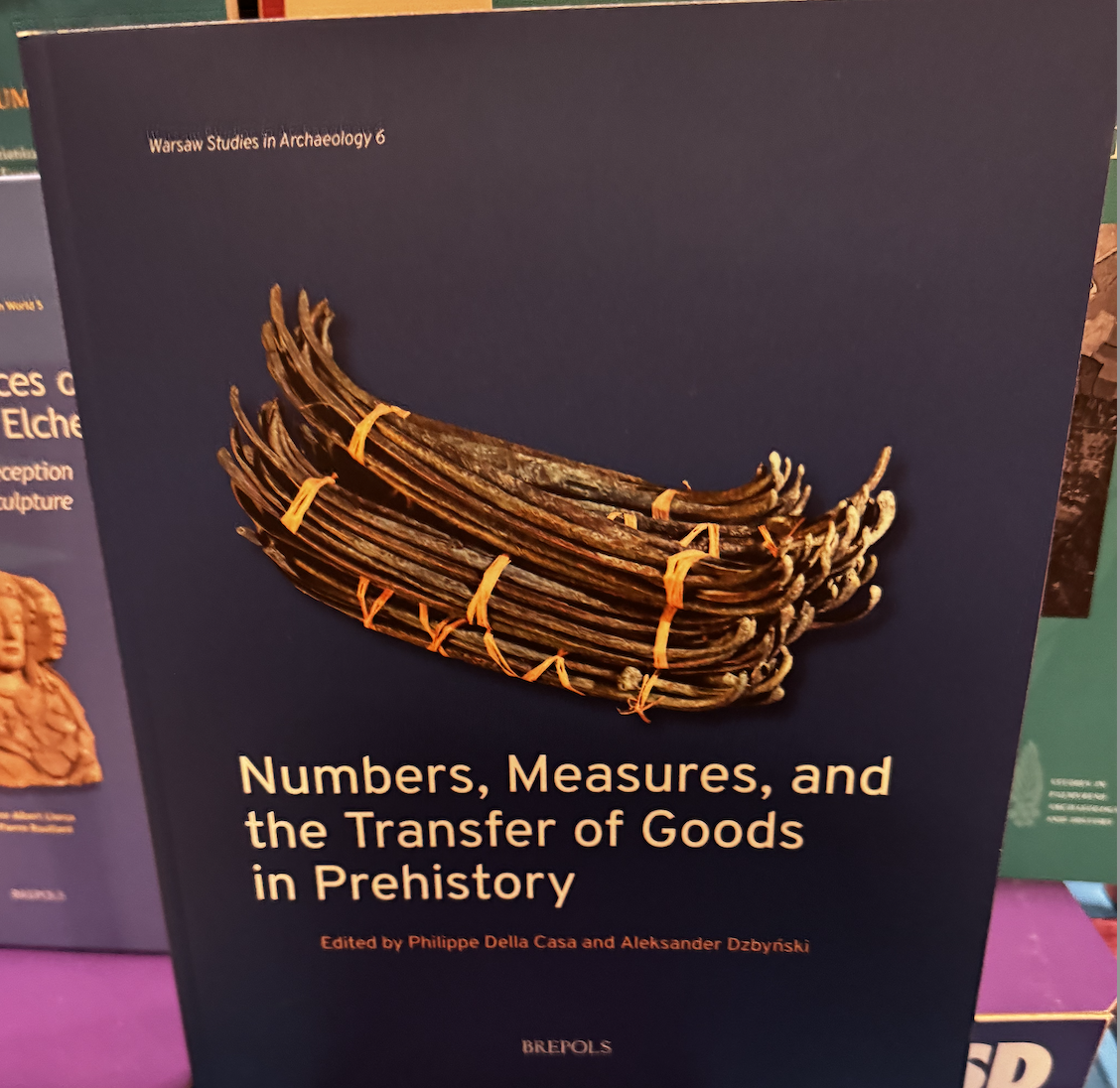
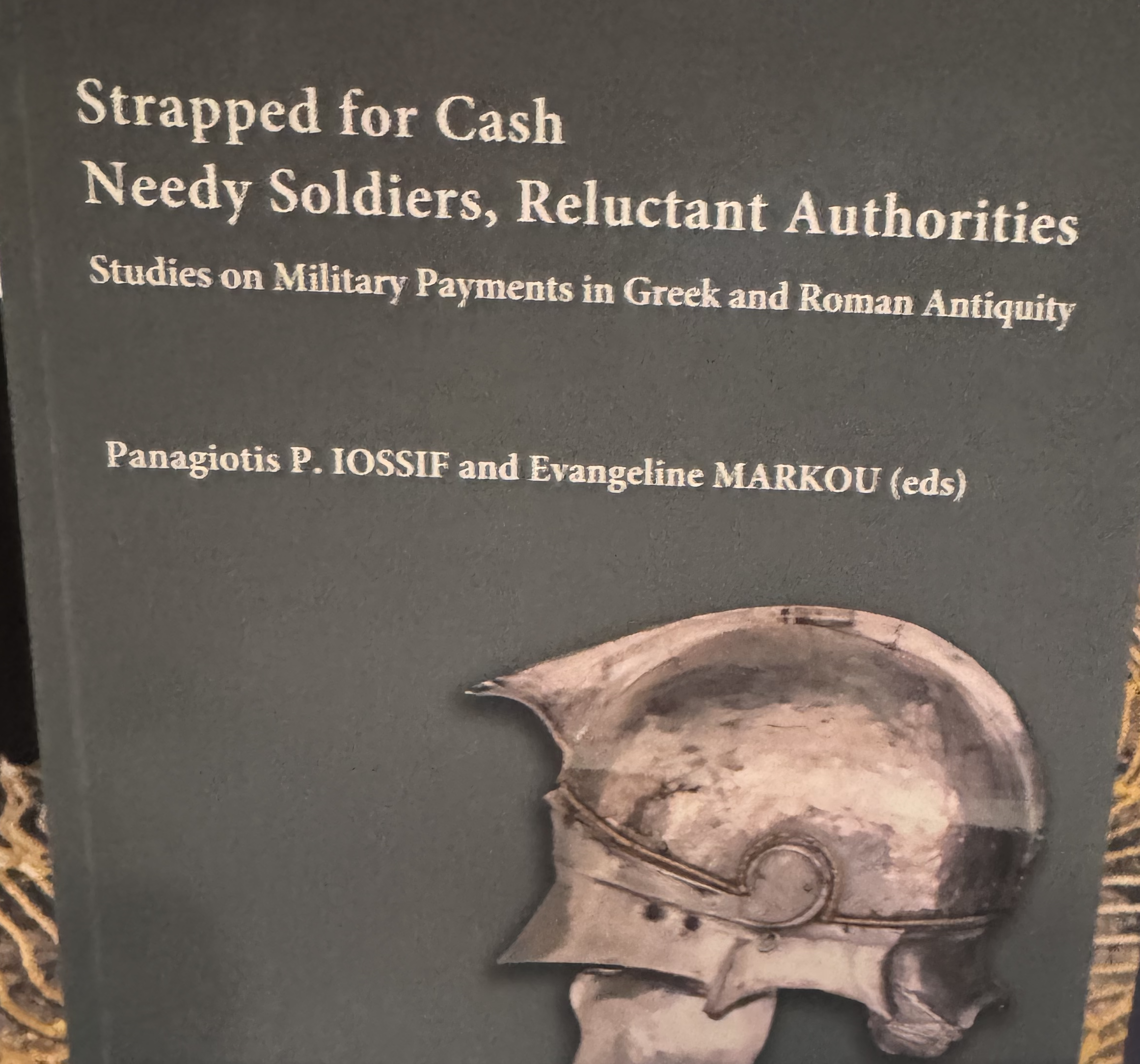
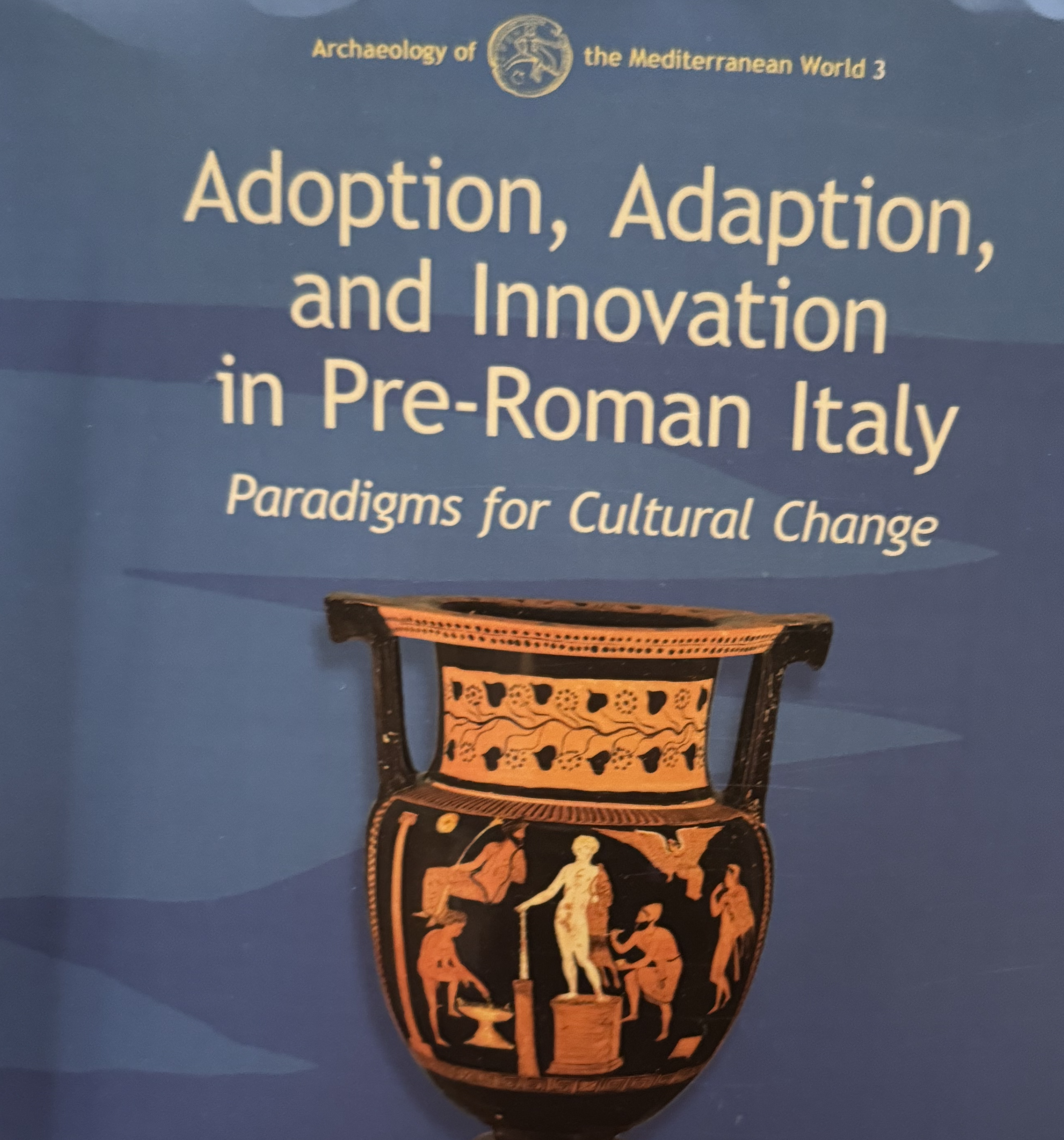
So this should happen in the panels but frankly the best that usually happens is just reading titles of sessions and papers I’d like to hear but conflict with something else I’m going to prioritize because of the previous goal. Instead, the main place I meet this goal is in the book exhibition hall. Yes, it is a great place to bump into people (esp. if the bar isn’t your thing), but really I like to work through the whole hall table by table and photograph each title of interest. You might remember my round up from last year. The photos act as notes as well as a pause before purchase. This year I wanted to attend so many sessions I didn’t give the hall the attention it deserved. I did get Tabolli on Veii at a steal and I’ll drop some images of other books below. There were good conversations with one exhibitor about pricing structures of digital products and another about image permissions.
[This bus is so hot I feel a little faint and my nose is rather offended. Only an hour to go, but my laptop battery won’t last…]
Seeing friends.
I think I’ve prioritized this too much in the past. I know this seems strange, but all of us at the conference have such a range of demands on our time, I am coming to see, especially after this year, that the social can be deeply unsatisfying. I long to have meaningful convos and catch ups and feel connected to my besties in the field and those more senior scholars I consider role models and mentors of a sort. Yet, the venue is only ever a taster or a tease. I’d have to give up all the goals above to meet this one well and even then how can I ask others to prioritize the personal over the professional. This is not a dig at anyone but only a mild wistfulness of those I missed completely and those to whom I did not give my fullest attention. I need a mild mental re calibration of personal expectations. I don’t want to conflate my goal of connecting people with my personal desires for re-connection. And, I need I think more opportunities to see those I care about throughout the year. Luckily this spring holds many such travel commitments.
Serendipity.
I want to be open to unexpected and the spontaneous. This is always my goal in life generally, but especially I do not wish to be rigid in the conference space. This year serendipity connected me with the Low Income and First Gen advocacy group (you can sign up for their mailing list here, website to come). It also led me to reflect on my commitment to reproductive healthcare access and a desire to forthcoming WCC initiatives. These conversations helped me articulate for myself that I want to contribute in fixed one-off gifts of time and talents, but that I’m not in a position to take on standing roles with job descriptions. It helped me feel better about turning down a leadership position.
Strategic Tweaks.
Session attendance planning.
This year I did better about planning my session attendance than in past years and the app helped. BUT I was still doing it partly on the fly and at the conference. In an ideal world I’d do all that planning before arriving, or given that isn’t always possible perhaps next year I should fly in a day early or just arrive much earlier on day one to give myself time to read it all and plan and discern about that plan in light of above goals. I think doing this will help me pace myself and anticipate the rest and personal care necessary in order to keep going for the duration of the conference.
Tend to the body.
The schedule of the AIA/SCS is beyond grueling. The program requires the you chose to forego key professional activities to eat and sleep. Parts of the program start as early as 7 am and official programming goes as late as 10 pm. There is no officially empty slots for any meals. There is not even the crappy coffee and dry pastries as one might expect at other conferences. There is no culture of providing food at drinks parties. And there is a culture of many such back to back receptions, some with v generous open bars, others where a bottle of water is eight dollars. Can we learn nothing from our Italian and Greek colleagues who would never dream of giving you a glass of wine without at minimum salty nibbles?! Even today, airlines still give you a micro packet of wee crackers with your non-alcoholic beverage. Most of us struggle to sleep in a strange bed or to fall asleep without at least a little decompression time. I learned (again) the hard way that I cannot run on empty indefinitely. Two major changes for next year I think. I’m not to be trusted to chose self care when I have a list of professional opportunities in front of me.
1) I will need to be blocking out meal times and pre gaming a strategy of where the food will be sourced. The hotel is often not an option given crazy lines and up-charges. At minimum I need a case of bars and a case of seltzer for my room and maybe even something caffeinated.
2) Discern clearly which goal is being met by various evening ‘receptions’ or even just bar time. Serendipity is great but it is low on the list and one can predict where one might be most likely to have a meaningful interaction.
Packing.
It isn’t over packing to have a variety of outfits and shoes. I found myself refreshing before evening events by showering and changing. It really helped. I want to intentionally pack double in future years. I also want two bags. The backpack is perfect for day time with the laptop and all, but come evening a smaller shoulder bag to make up for a lack of pockets is highly necessary. Both bags will help with having water, bars, and crochet to ready hand. Being able to switch between heels and flats was also great.
[I made it off the bus and into the bosom of family.]
More notes (and photos).
It’s the morning after and I’ve got 20 minutes now before I have to strategize the spring schedule with my dean.
SCU.
Catherine Steel delivered a masterful re evaluation of the senatus consultum ultimum which I may never again refer to as ‘so called’. Caesar gives us the ultimus shorthand in BCiv 1.5.3, but the decree from 121 BCE onwards is recognizable by the use of the phrase: “ne quid res publica detrimenti capiat“. I’m sure she’s going to publish this and when that happens I’ll try to come back and add notes. I also have photos of many of her slides on file. Key questions that emerged were: what does detrimenti imply and is the concern primarily about property damage? Is this decree descriptive of crises rather than proscriptive of specific actions? Why is it used as compared to other crisis actions like the appointment of a dictator? How do we understand 77 BCE use and how does it related to the ambiguous citizenship status of individual in greater Italy in this this period? What differentiates this type of SC from other SCs and what is the evolution of the quasi legal status of SCs any way?
This section had glorious discussion. And I blushed as Cynthia Bannon described Zach Herz, Carlos Noreña and I as a power trio as we praise Steel and engaged in the convo. Yes this is just (no so humble) bragging. But I like to remember these little asides.
Glandes.
Elizabeth Heintges blew me away with her paper on sling bullets. Surely once published this paper will become the definitive citation on the subject. This is another perennial interest on this blog. She used new finds from Spain and a review of literary evidence and the historical corpus of such material to review the communicative functions of such objects and the words upon them. One distinction is bullets that are etched upon after casting (graffiti) vs. those cast with a message. She convinced me that bullets may have been much different that arrows or javelins with messages attached. It also got me thinking a great deal of reuse of such objects. Would a labeled object be less likely to be reused or at least melted and re cast before being slung back? She also drew my attention to the fact that different size bullets existed some quite large as much as 70gms!
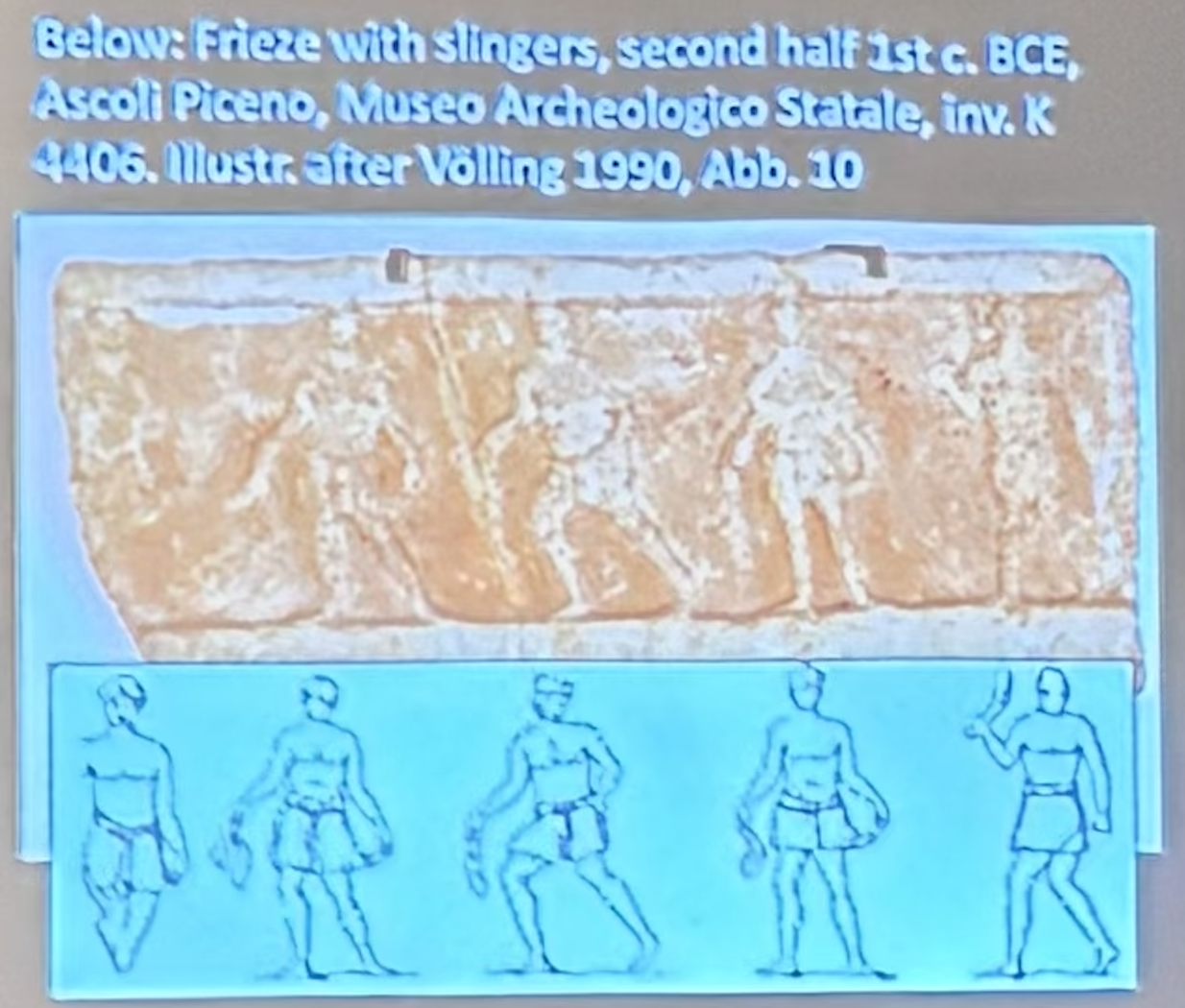
Looking for an image she showed led me to this great digital resource on Trajan’s column and images of all scenes in incredible detail. But my republican loyalty makes me love the relief with slingers from Ascoli Piceno more.
Note that the stacks of ammunition in this relief are probably for the ballista also shown in the same scene not sling bullets. The extra bullets are in the slingers cloak
Do you have a better image of this? I’d love it. I’m also struck by the relative nudity of these slingers vs. that on the column relief
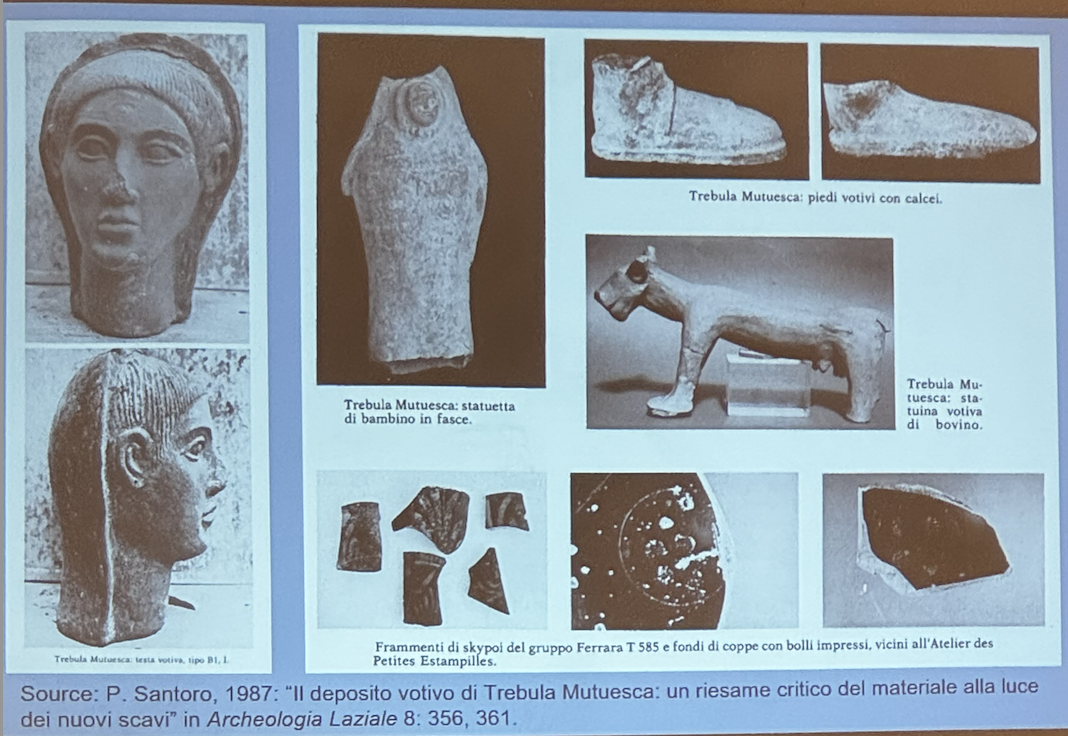
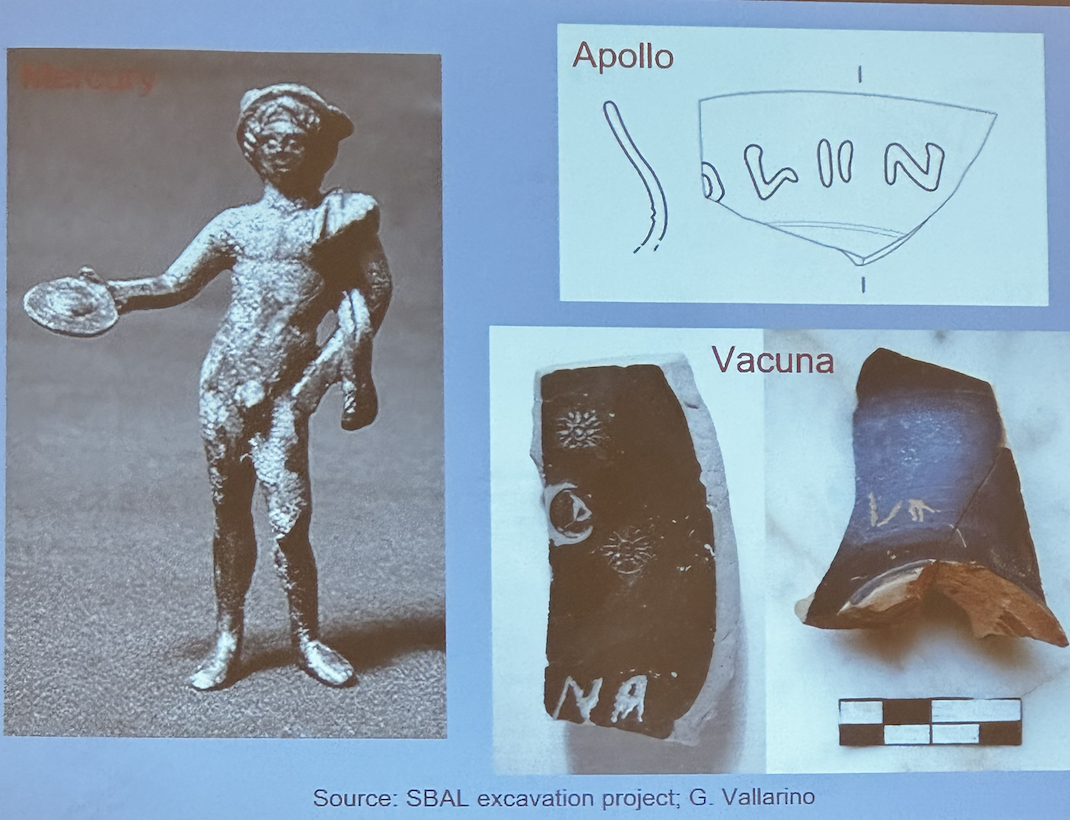
Again notice the stamps on the black glaze, the speaker was emphasizing here that other gods besides Feronia were honored here
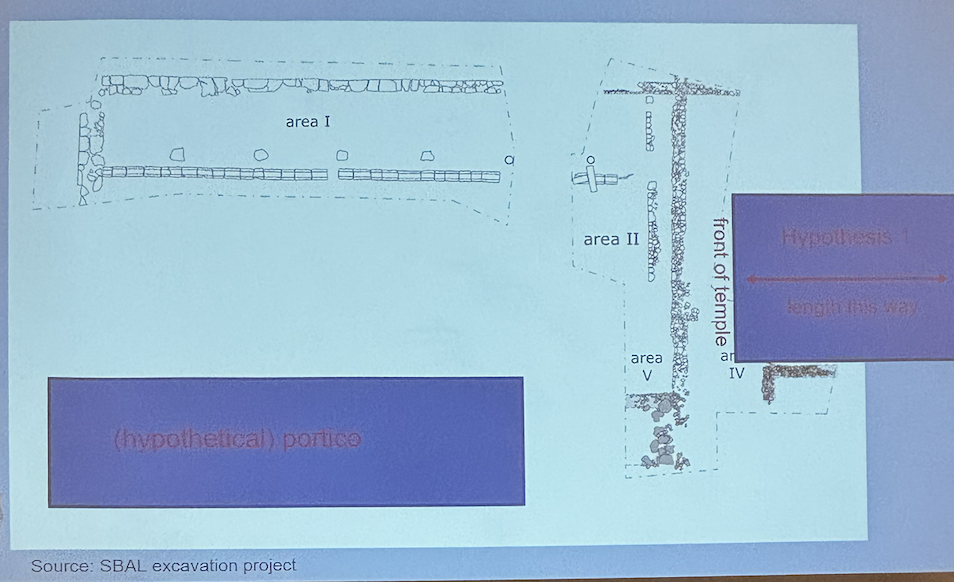
Another hypothesis perhaps stronger is that the temple orientation should be rotated 90 degrees
I’d v much like to find the details of coin finds and compare to find locations of black glaze
Enslavement.
The panel on Slavery was fabulous. Chance Bonar’s paper started to think about how enslavers construed and constrained and feared the religious knowledge of the enslaved, and how the enslaved utilized this knowledge. Perhaps most striking to me what how different his examples were from those that immediately come to my mind. These are mine: Eunus using religion to unify Sicilian uprisings, enslaved used for the most brutal jobs in animal sacrifice, the baccanalia SC, the worship of the enslavers genii and iunones, the enslaved deaconesses of Pliny’s letters, general concern over foriegn cults. He instead talked about Cato’s agricultural treatises and ambushes of former enslavers by the self liberated at festivals. Lots of potential.
Javal Colman and Dan-el Padilla Peralta challenged assumptions of any growing concern for humane treatement of the enslaved in the later empire (antonine onwards). Instead of seeing legislation as concerned with humanity of enslaved rather the texts can be read as controlling mismanagement of property and how such mismanagement potentially threatens the rights of ‘good’ enslavers to be able to control their own property. Handout on file.
Grateful to Joe Howley for asking a question on Diodorus that led to Muntz crediting my work and the importance of questions of Roman imperialism to ancient perceptions of the consequences of mass enslavement. I got to credit Tristan Husby for helping my thinking on this evolve from 2006 to 2021. (Both my books talk about the theme).
This seems relevant to my work on aes rude and the transition to aes grave
I wonder if Michael Taylor has reviewed this
must find ToC
Perhaps useful enough to buy?
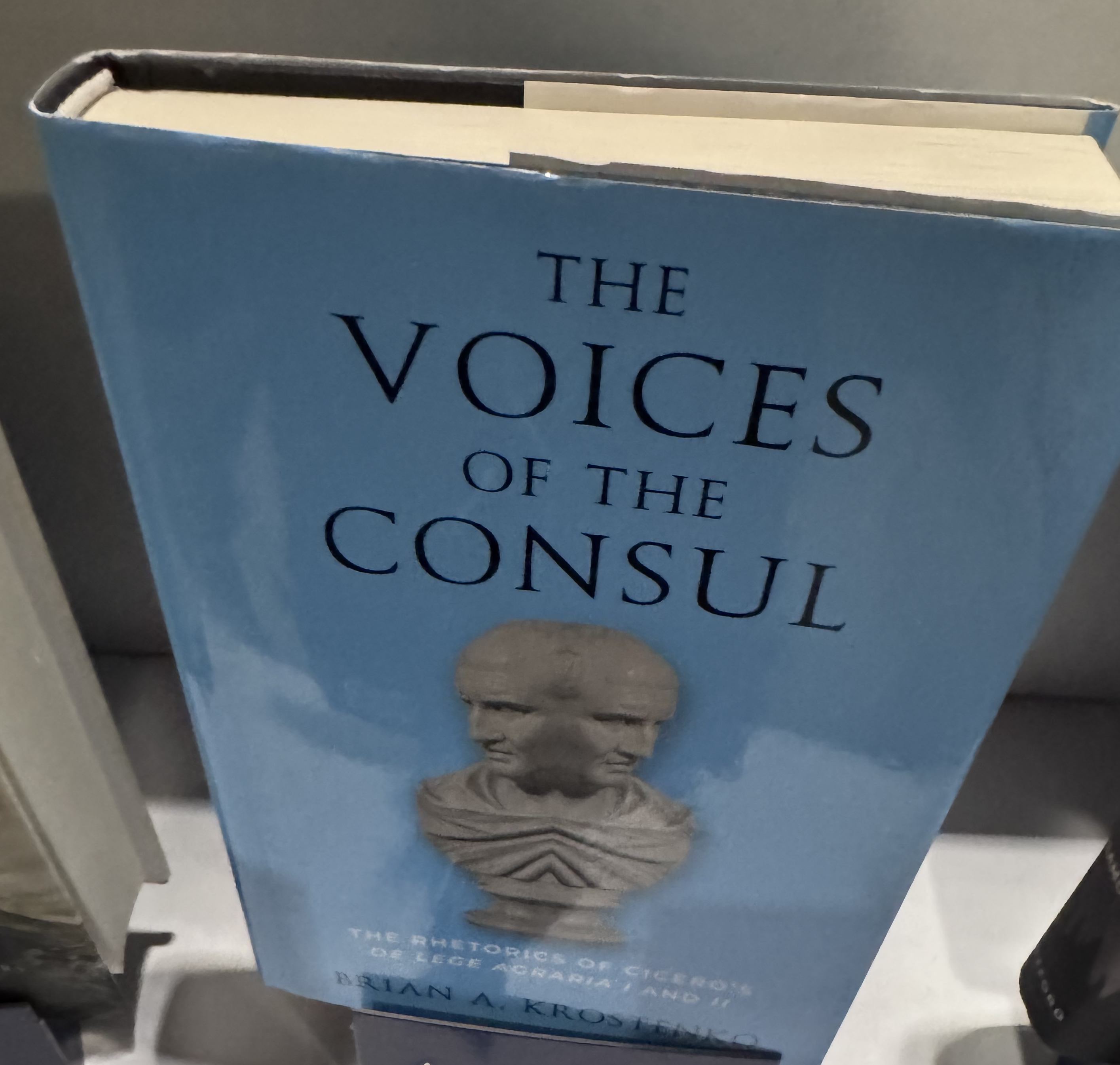
Specifically on the lex agraria speeches
Archival Archaeology is growning — given my work with Archival Numismatics through the Hersh archive I want to think more about how others are approaching this work
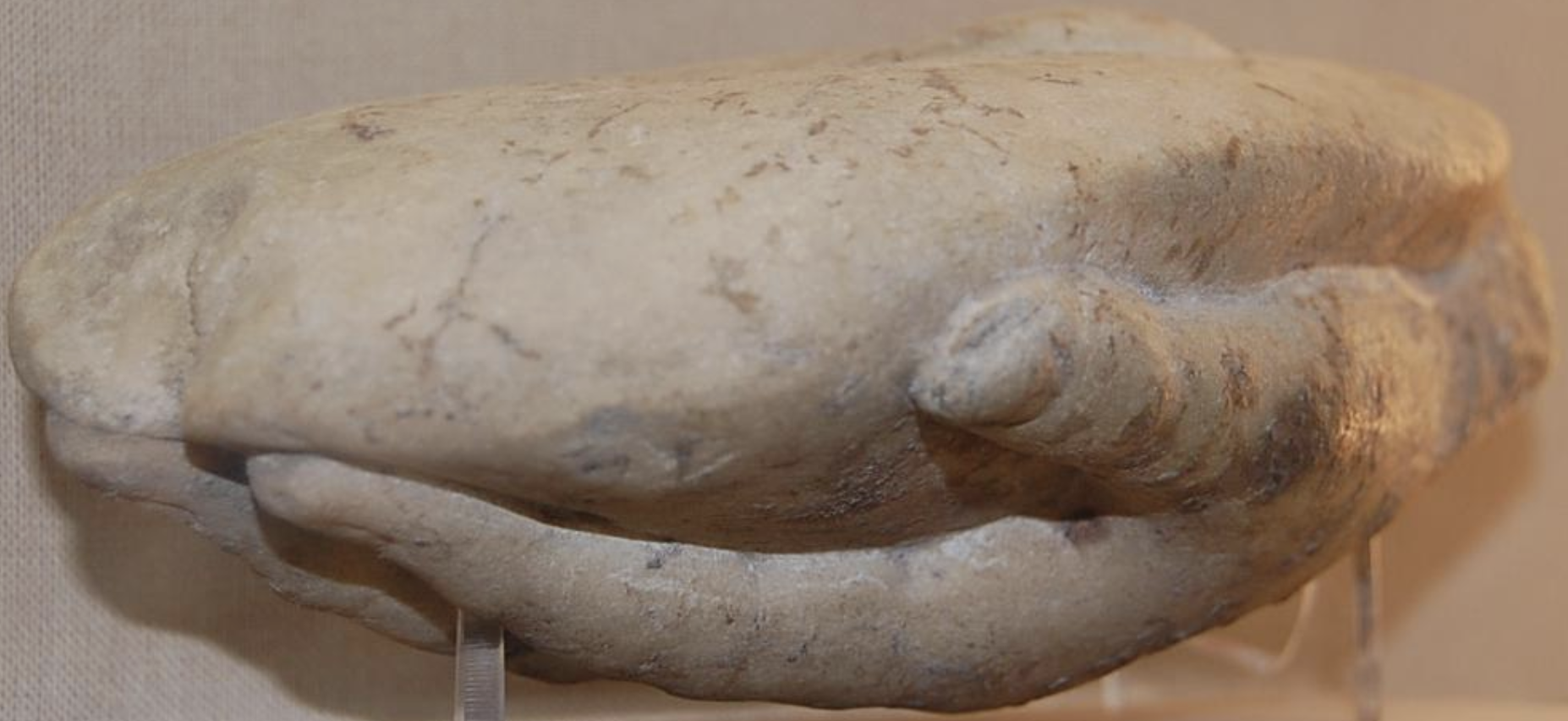
Listening to Jean Turfa talk about the logics of Etruscan observations of natural phenomenon. Fascinating stuff. She’s been drawing parallels with much earlier middle eastern texts and practices. One tantalizing example was a Faliscan vessel (perhaps from a Celle tomb, but J. Tabolli suggests perhaps another site) with a horse motif (typical) but where the equid has the teeth of a predator. The object is now in the Penn museum along with extensive archaeological archives and finds. In Middle Eastern tests an anomaly such as this was interpreted as a positive omen predicting the strength of the prince or king. {Wishing I’d photographed that slide}
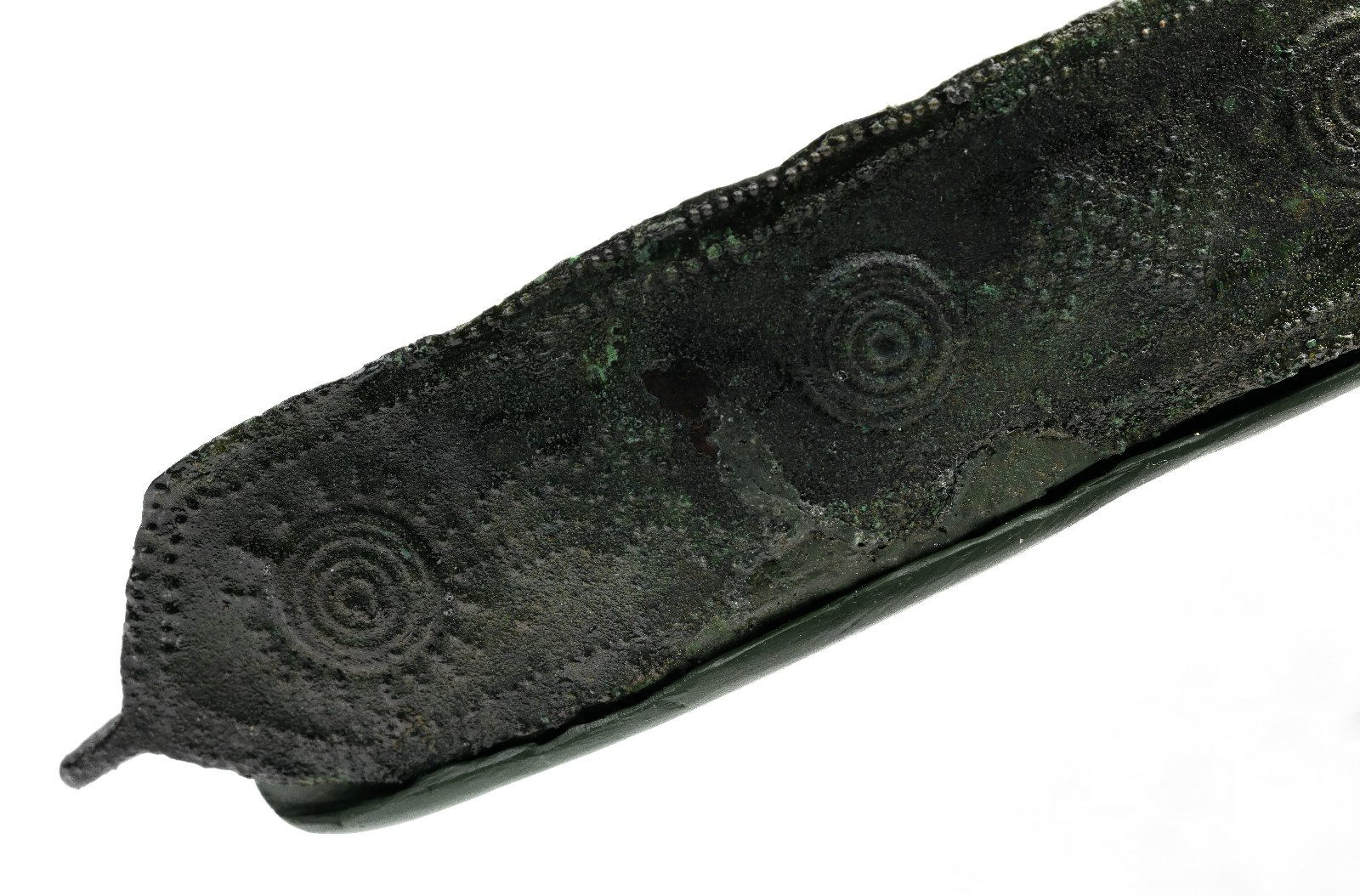
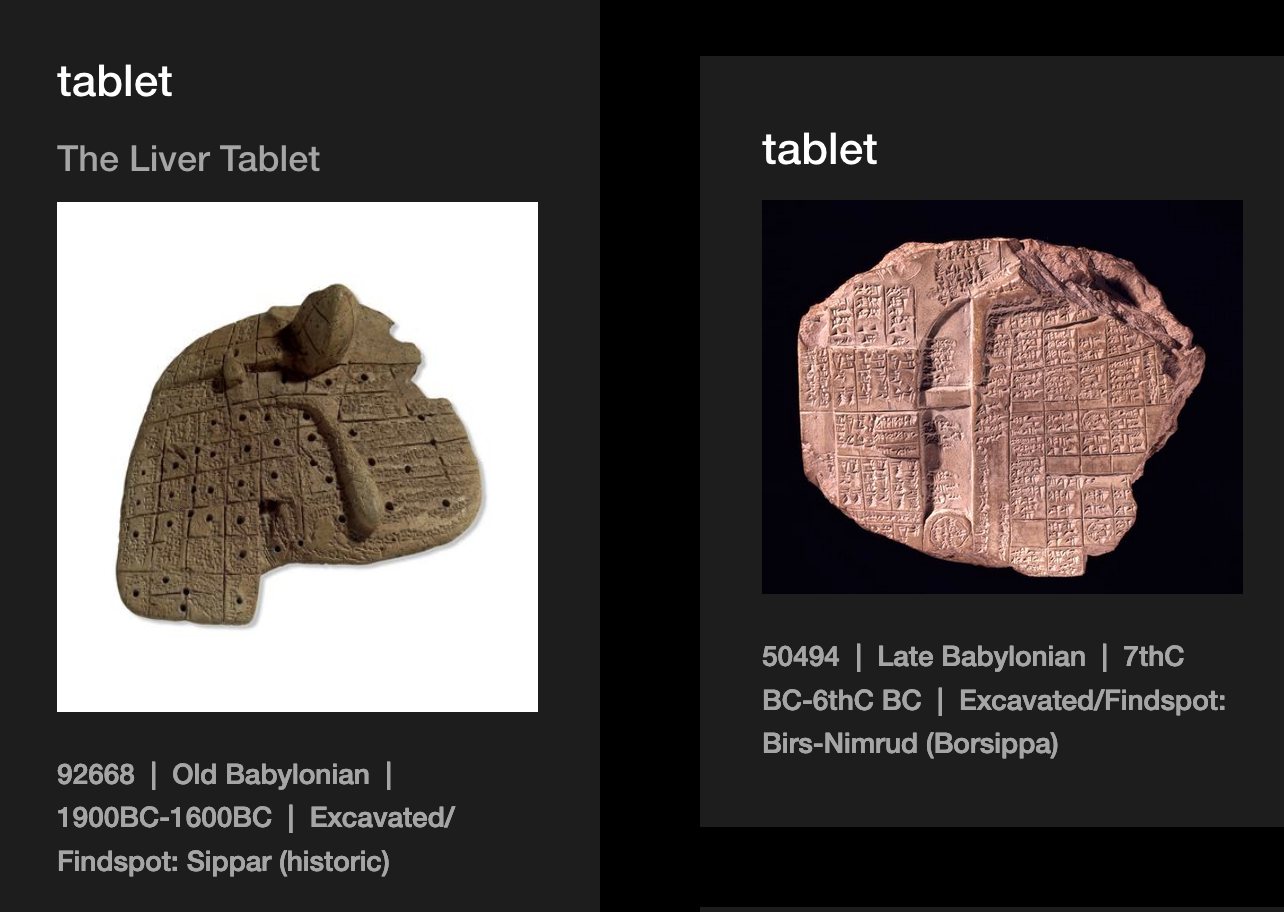
She emphasizes that certain observations may have been based on really predictive qualities. Flukes attack sheep livers where the Picenza Liver marks the underworld gods. These same parasites then about 3 months later wreck havoc on the human population. The Brontoscopic calendar in February may note the connection between the cycle of mumps in the human community and a disease that fatally strikes birds at the same time. And, she suggests this belt may show Haley’s Comet from 695BCE.
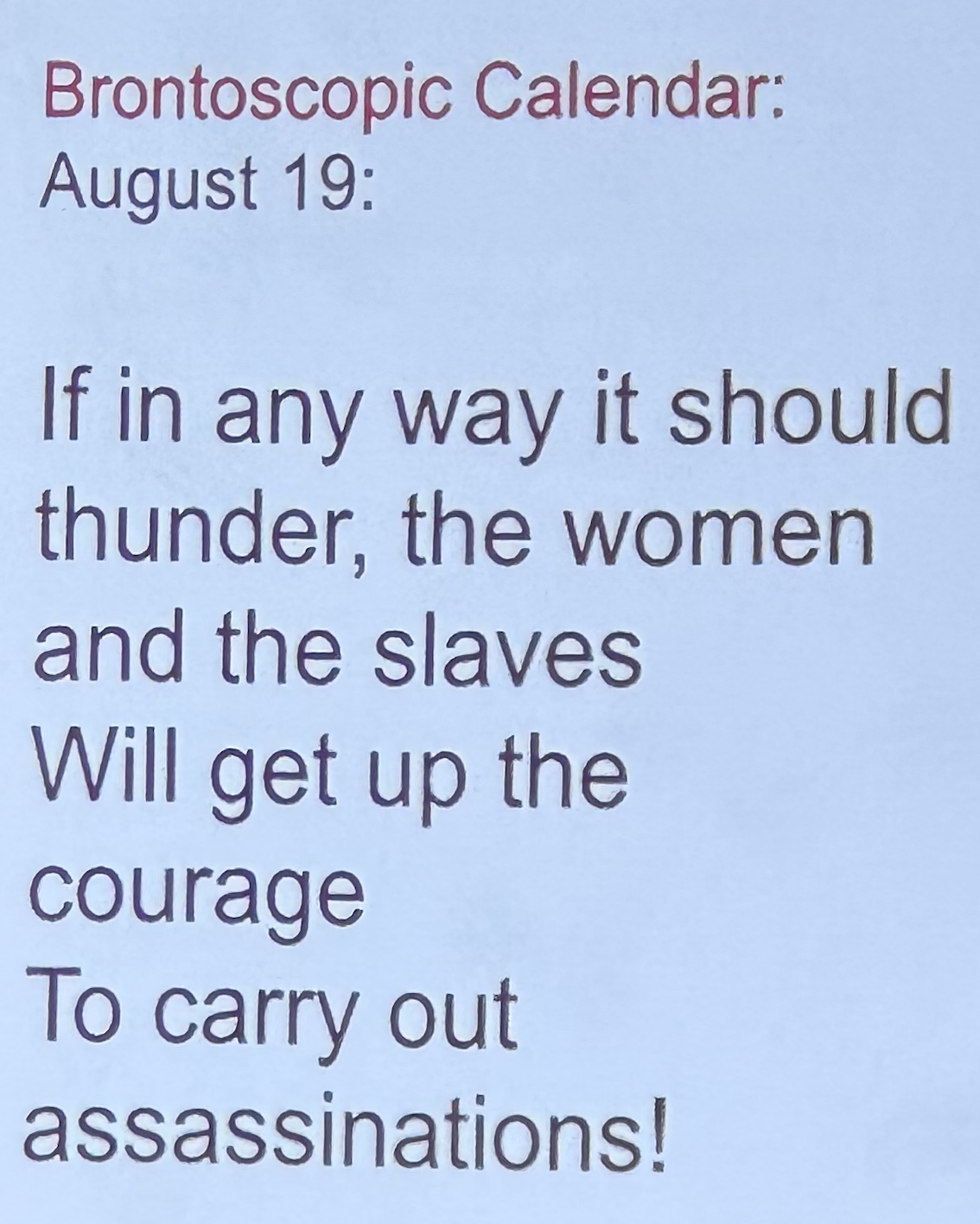
On a lighter note she observed the Bronoscopic calendar has thunder on March 12 predicting the downfall of a great leader and speculated a connection the ides of march! Did the assassins choose the date as propitious for their plans? But hands down this was my favorite calendar extract she shared:
Similar calendars like the Enuma Anu Enil exist in our survivng cuniform tablets.
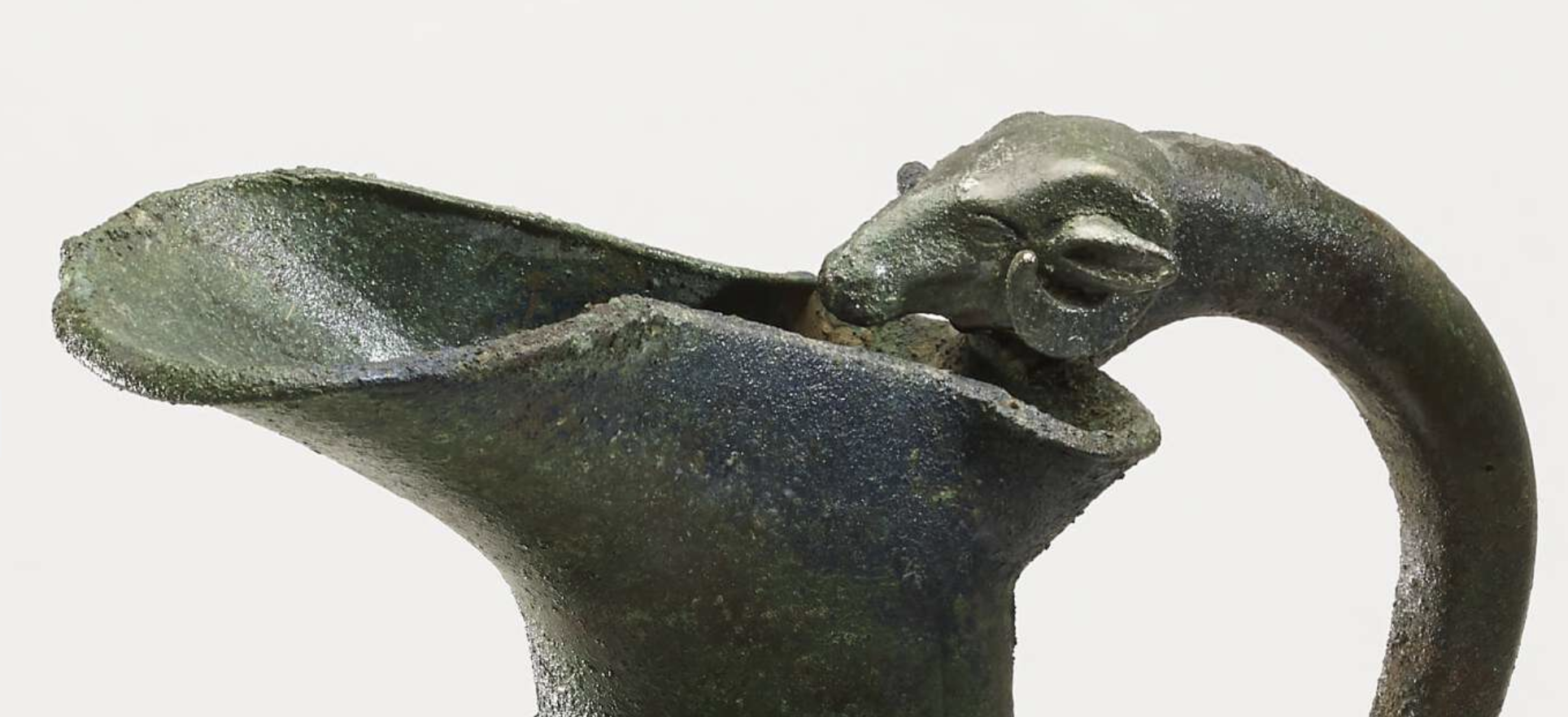
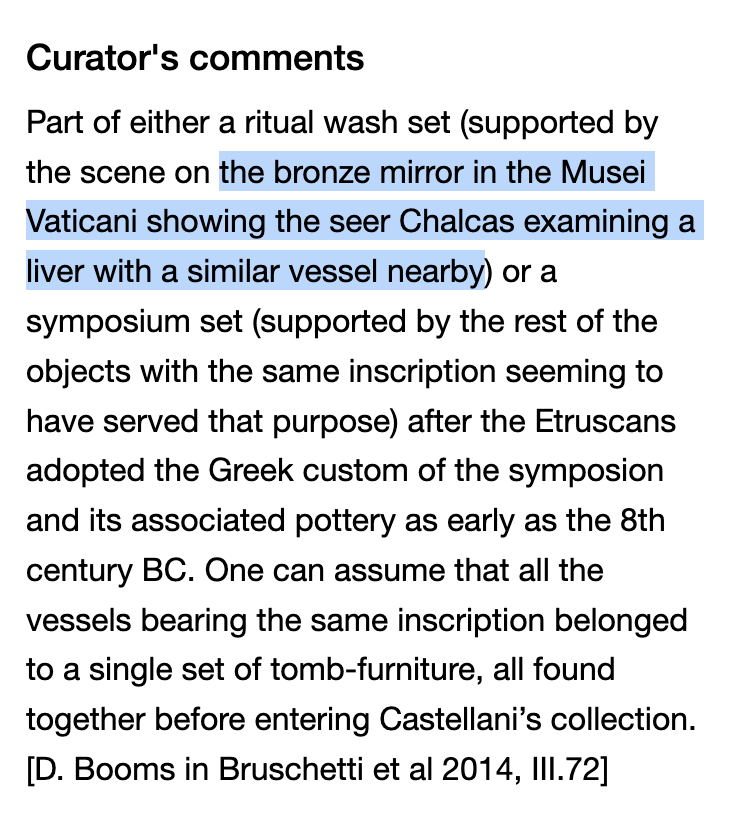
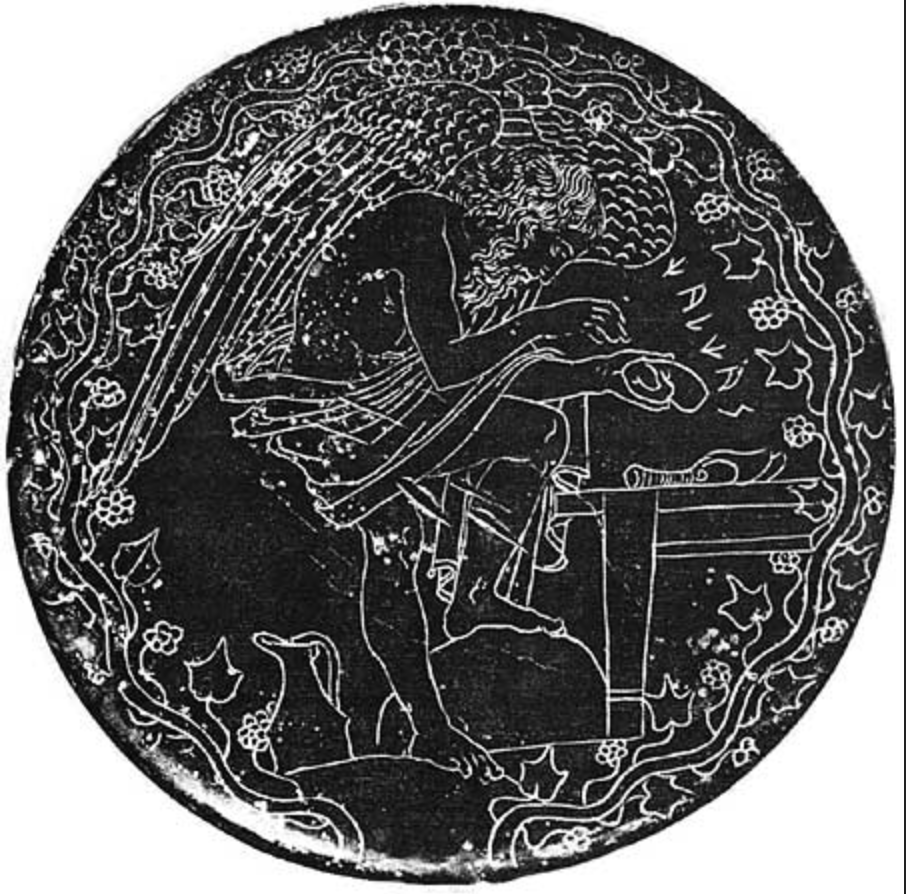
I also particularly like this sheep detail and the curator’s note on this pitcher.
Now a paper on San Casciano dei Bagni by Mattia Bischeri!! This was so rich and fast and I can barely hold it all in my head.
In the Tiberian age when the pool underwent a major monumentalize the earlier votives were closed in with not only a major deposit of roof tiles but also ritual objects of a fulmen (bronze) and knapped flint (slide photographed)
Latin divinity name: Fons Caldus Etruscan divinity name: Flere Havens; Bilingual inscription
Post Tiberian 9,000 coins, all fresh from the mint (slide photographed with summary of dates) BUT as yet no aes grave or aes rude, but excavation ongoing and may yet emerge.
ex votos showing boys engaged in divination, birds, ball – connected to other similar representations through out Etruria (slide with summary photographed)
new from 2024 campaign ,an orphic statue with orphic tablet, connected to orphic representations on mirrors [other new finds, I snapped a few images–all still under investigation]
two bronze votive anatomical plaque of internal organs, not just one. Slightly different but both deeply
psychoimmunotherapy (sp?) – discussion of anthropological view of medical practices, rituals heal the mental/social origins/effects of disease
WEIGHTS of statues corresponding to bronze monetary system!!! 3-1st cent BCE. Inscriptions even discuss weight [see slide photo]. Coins replace statues as monetary gift to divinity in the post Tiberian period.
HEIGHTS correspond to height mentioned in Pliny as appropriate for statues in the forum!!
Points out how icongraphy in christian art derives from the typology seen in the statues. The open handed praying and. infant Jesus gestures and association with bird and ball.
I’ll try to come back and fill this in later with more…
we can see evidence of translating from different weight and measures
The following are a few items to remind me of Tina Bekkali-Poio.’s paper.
Listening to fascinating panel on new excavations on the Capitoline highlighting work especially in collaboration with the DAI in Rome with La Sovrintendenza Capitolina.
They may have found a whole complex of roof tiles from including decorated mold made elements and also post holes potentially associated with wooden equipment used in building (think cranes for lifting blocks). (7th to 3rd BCE is the date of the times)
The tiles seem to have been deposited in a phase of later construction. Perhaps in the post Pydna era when monumentalization takes off in the city. Parallels might be drawn with better understood phases on the Palatine in the sanctuary area of Victory and Magna Mater temples.
There is also clear documentation now of the temple podium that was incorporated/covered by the Prussian hospital.
non-sequitur.
I love the term ‘fiddle drill’!
I asked for clarification of the opening remarks that briefly highlighted of the importance of archival work, specifically comparing older drawings of the hill and Severan map to identify the temple of fides on the Capitoline. Ortwin Dally praised the book of Rousse [sp? – must find reference and link], while also pointing out that the temple is at the foot of the hill, perhaps better associated with the sanctuary area of San Omobono. He wondered how we disentangle the surviving fragments to confirm they really come from a single temple rather than multiple structures. He also pointed to the literary testimony, particularly Livy. Fides was attested to be one of the earliest temples, before Ops and Mens. Livy also discusses the removal of statues. Yet matching names of temples attested literature as ‘on the Capitoline” to archaeological structures remains difficult. On avenue for future exploration is the attested finds of military diplomas found on Capitoline [I must learn more on these!].
I did not hear the whole paper on the roof tiles to catch Carbone and Sharpless speaking on archaeological finds of coins at the villa of Hadrian. They did such an amazing job. I hate these parallel sessions and dashing between different panels to catch individual papers, but this is how we conference….
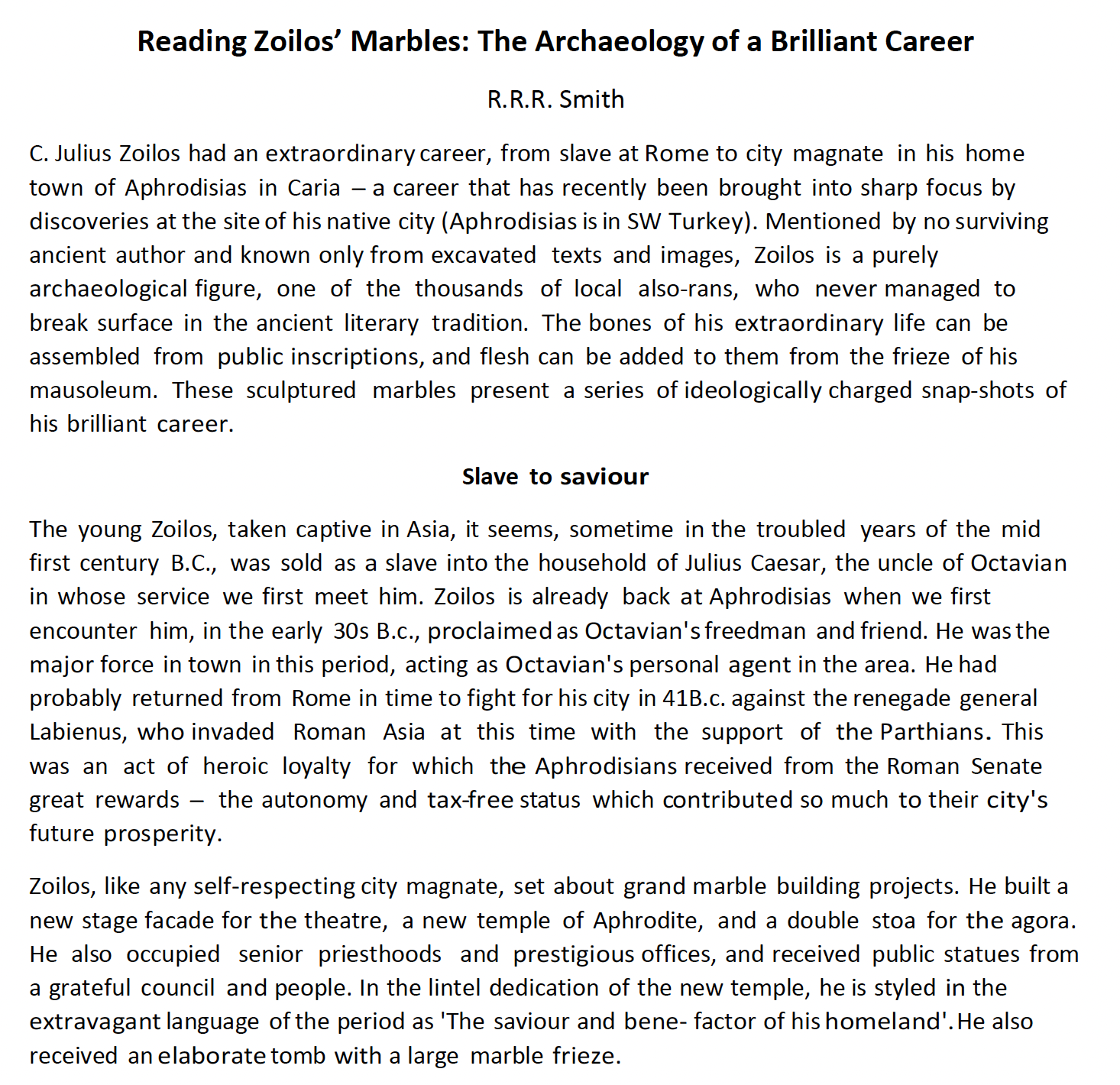
Listening to Max Meyer (Brown) talk about the trees at Aphrodisias and of course Zoilos got a shout out. Listening to a brief summary of his career, I immediately thought about Orlando Patterson’s concepts of enslavement and the key role of natal alienation. I often teach manumission in the Roman context as perpetuating natal alienation by perpetuating the enslaved person’s structure in the Roman familia. I often teach this through naming customs.
BUT Zoilos managed to use his manumission to in fact elevate his status in his community of origin and seems to have retained his original name at least in part. An exception that proves the rule… I want to think more.
For context.
non sequitur.
The trees discussed were date palms. Speaker connected to Ishtar, fertility, and economic display of imported plants needing special call. No particular mention of date palm association with Phoenicia. I am thinking also of Nicolaus of Damascus being the name-sake of Augustus’ favorite dates. It also provides a great precedent for the trees of the Flavian templum pacis and might just possibly take some influence from the plantings in the theatre of Pompey at Rome. I wonder about other precedents.
Listening to a stunningly good paper by Abigail Straub (UMich) on her work on Pompeii Bakeries and their religious protections. (Well worth making it to this 8am session and even skipping a coin session — I feel guilty about the latter!)
The points I want remember are the representations of Vesta with donkeys, the Vestalia, but most importantly the placing images of phalloi at the hearth/oven mouth. This made me think immediately of one of the narratives of Servius Tullius’ conception:
They say that from the hearth in the palace, on which the Romans offer various other sacrifices and also consecrate the first portion of their meals, there rose up above the fire a man’s privy member, and that Ocrisia was the first to see it as she was carrying the customary cakes to the fire, and immediately informed the king and queen of it. Tarquinius, they add, upon hearing this and left beholding the prodigy, was astonished; but Tanaquil, who was not only wise in other matters but also inferior to none of the Tyrrhenians in her knowledge of divination, told him it was ordained by fate that from the royal hearth should issue a scion superior to the race of mortals, to be born of the woman who should conceive by that phantom. (Dion. Hal. RA 4.2.1-2)
Can’t wait to see Straub’s final dissertation. A real shame this paper was scheduled at exactly the same time as Sinead Brennan-McMahon (Stanford), “Queer Spaces in Pompeii? Phallic Aesthetics and Shared Communities”. I’d have loved to seen both and be able to think about how the two papers might be in dialogue with each other.
Let me start by saying this was the best class I’ve ever taught and the students were extra ordinarily dedicated. Many are education majors destined to teach in NYC public schools. I’m deeply impress with them all and I’m also realizing that teaching Roman art (material culture) gives me even more joy than teaching history courses (and let me tell you I love teaching Roman history!!).
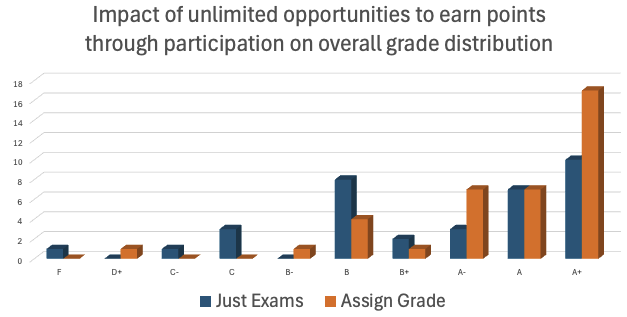
As an educator, I’m deeply committed to treating my students fairly and sticking to my word, especially about something so meaningful as grades. This semester was a new prep and thus I had to imagine a new grading structure appropriate to goals of the course and its content. I decided on 54% examination (proof of learning, command of information), and 46% participatory assignment (low and high stakes activities that took meaningful effort and were graded on degree of engagement). I also have a policy of accepting a wide variety of activities and assignments submissions as means of earning additional points or making up missed work. No late penalties.
Yes I’m a big softy. BUT are these policies distorting student grades. I was worried perhaps I’d shifted too far away from grades being a meaningful reflection of learning. So….
As a proxy for ‘what if’ I calculated each student’s grades based on exams alone and then compared that with the real grades they earned according the rules set out in the syllabus.
For exactly 50% of the students the participation gave them no advantage or disadvantage over the grade they would have gotten if I’d just awarded grades based on exams. 95% of these students who experienced no GPA change would have gotten an A or A+ in the course on exams alone. 32% of that 50% (so 16% of the class) did shift from A to A+, an honorary distinction with no effect on GPA. Two students who did A+ work on the exams only earned A- grades because their scores on (lack of engagement with) participation assignments, but I can live with that.
My takeaway is that perhaps for the needs of the top half of the class I may need to refine my exam writing to better differentiate levels of learning.
What my policy did do is shift weaker test-takers into a higher grade position. The average change was .7 GPA points. (when there was a change) That’s a B to an A- for instance. If you take the class average, my policies overall averaged about a .3 GPA point increase, that’s a B to a B+.
estimated GPA “increase”
% of Students
.3
11%
.4
3%
.7
11%
1
16%
1.3
3%
1.7
3%
Generally speaking, I feel good about rewarding students for active learning be it in class activities or museum visits. They teach how to look at images, how to take notes, and that it is not enough to ‘know’ — one also has to engage with the material.
So yeah. I gave a LOT of As and may refine my points structure slightly, esp. on exams, but I think I’ll keep my approach to open ended points. Why close the door on learning when it is helping lift up the students who struggle most?










































 Liv Mariah Yarrow