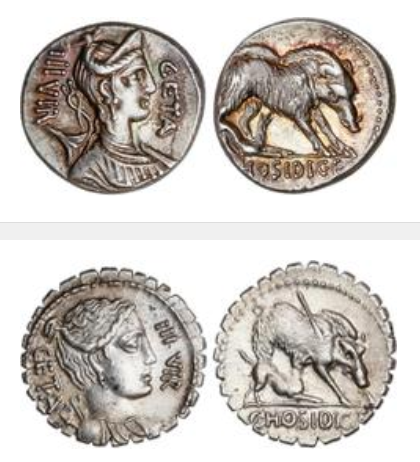
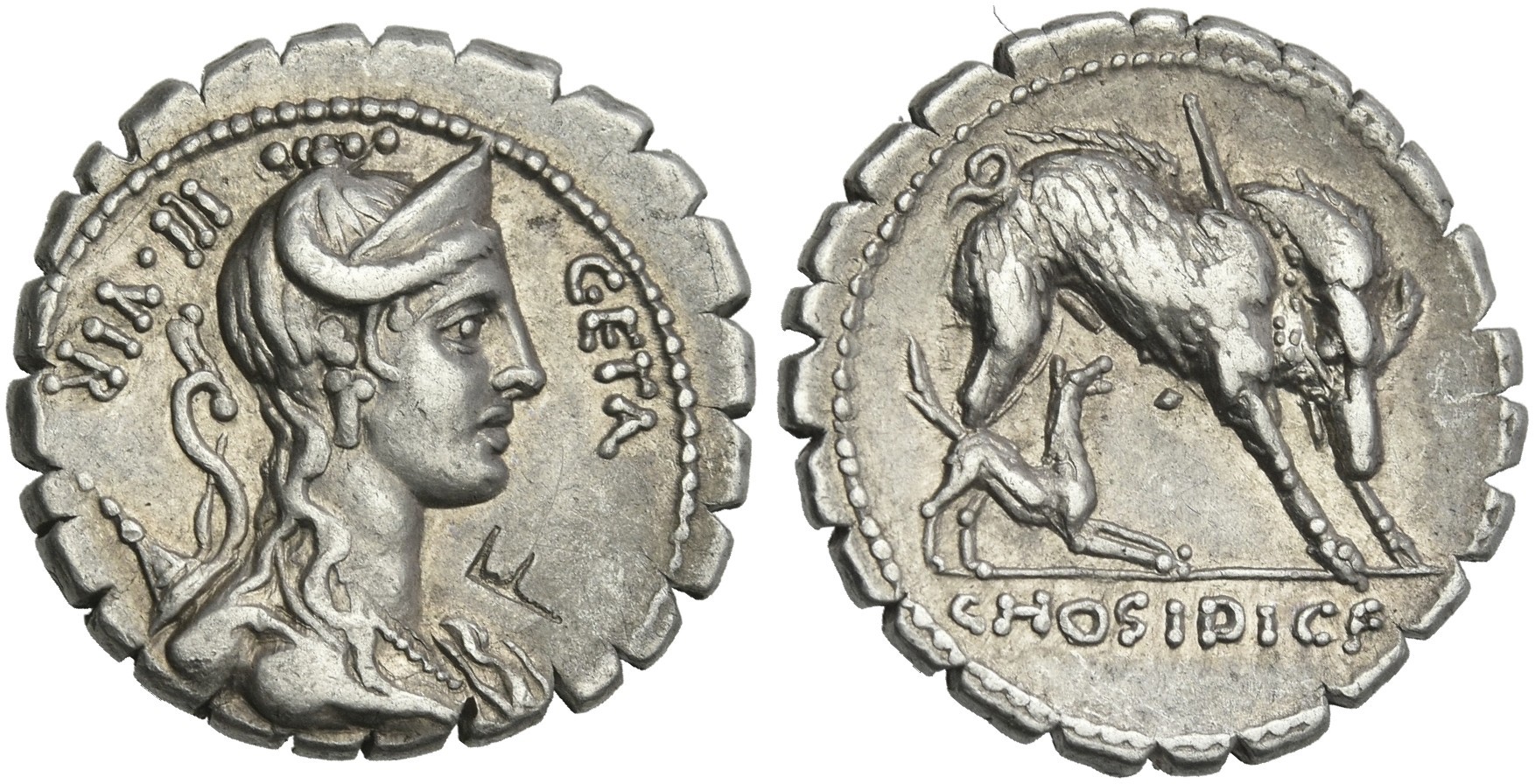
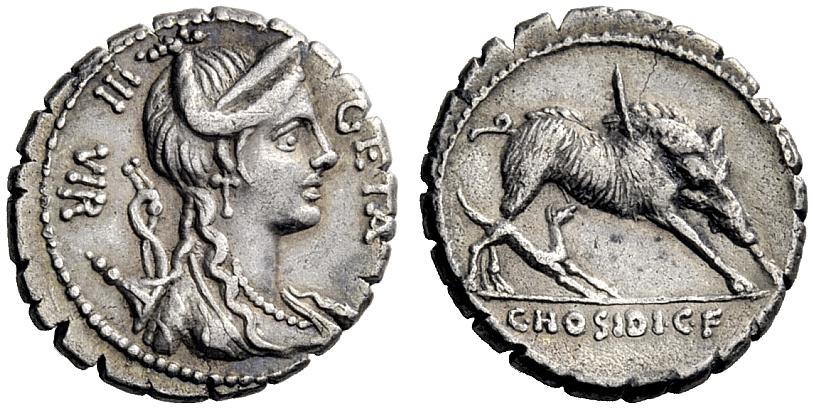
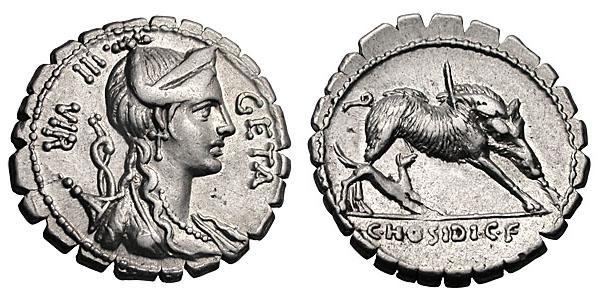
No serrations and small head with stephane (407/2) and large head, no stephane, serrated (407/1).
Were they produced at the same mint at the same time?!
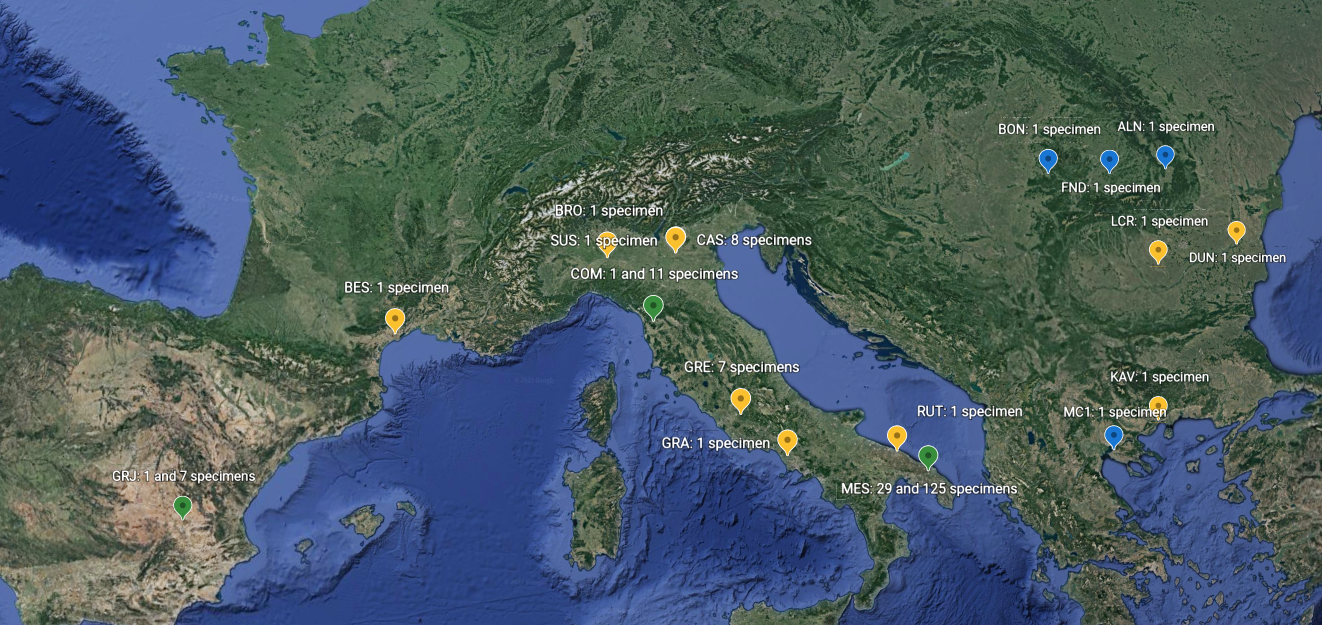
The above map was my first stab at seeing if they might have had different distributions in antiquity. One explanation is that the serrated issue was just taking too long to produce and at one point in the production process the serrations were abandoned. But… I’m still suspicious.
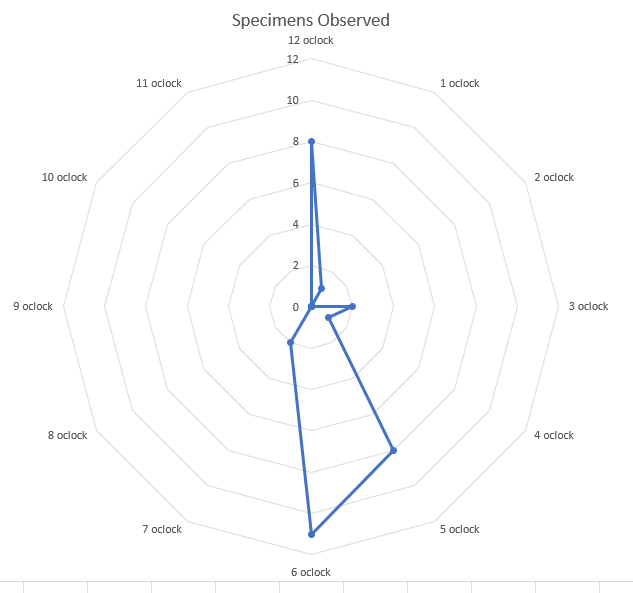
If I graph CRRO specimens with reported die axis above you see the strong 6/12 tendency of 407/1, the serrated issue. I’m not 100% sure I trust this data though. All but one of the specimens with a 12 oclock axis are in the Fitzwilliam. I worry a data entry person wasn’t checking the coins, but simply filling 12 automatically. Stuff happens.
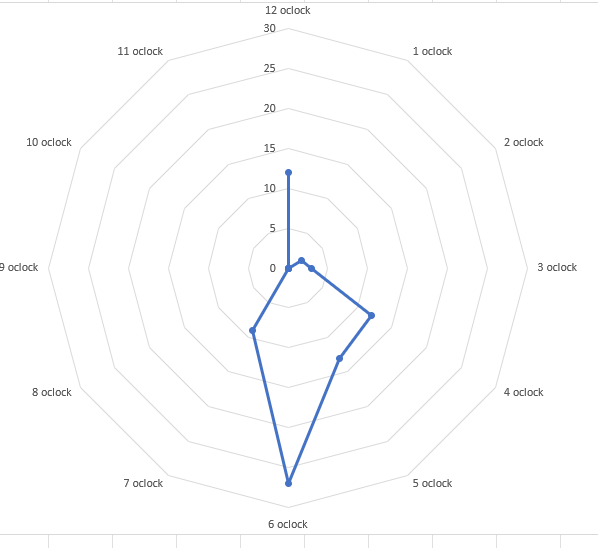
I’m more convinced we need to throw out the Fitzwilliam die axis data after graphing 407/1 (no serrations, small head). See below. Here there is not a single 12 oclock die axis reported by another collection.
What do I make of this? The fact that both have a strong 6 oclock die access might be a point in favor of their actually being produced at the same mint, but we all know the Roman mint wasn’t so keen on controlling die axes. To do this properly I’d have to also do all the specimens in the Schaefer archive.
I don’t have a theory yet but it is odd…
P.S. While you’re here note that the date for these two types is likely c. 64 BCE (So Hollstein endorsing Hersh and Walker based on Mesange hoard), not 68 BCE as in Crawford.
A colleague reminds me of this rare type published by P. Debernardi, “Some Unlisted Varieties and Rare Dies in Roman Republican Coinage”, NC 2010 and that this type suggests all were produced at the same mint. There are two obverse dies of small head, crown, serrated.
Seeing these coins juxtaposed next to each other in a catalogue organized alphabetically by gens, makes the overlapping reverse iconography so obvious. It never occurred to me the curule chair as the reverse type might be familial or familial inspired. Perhaps not but must be considered.
The gens Furia has 62 members listed in the prosopographical database; of which five have the cognomen Crassipes. Brocchus from the coin is the only known Brocchus. Other gens use this later cognomen as well, but we have no epigraphic record of any Furius Brocchus (as far as I can tell relying on Clauss-Slaby database) .
Brocchus is cognomen based on a physical attribute like so many of them, meaning bucktoothed (very old blog post from near the start of my blogging).Valerius Maximus (6.1.13) did know of one Gnaeus Furius Brocchus, perhaps this man’s father or son?, who was was accused of adultery and when caught it is said in the act, turned over to be raped by the slaves of the wronged husband/father (?).
Good morning and (may it be a) happy New Year (for us all).I’m not on holiday as I had expected and am trying to ease myself into work and remember what I love about it. When I need to do that I often look at pictures to see what I see. I decided to look at aes grave in recent trade and this specimen caught my eye.
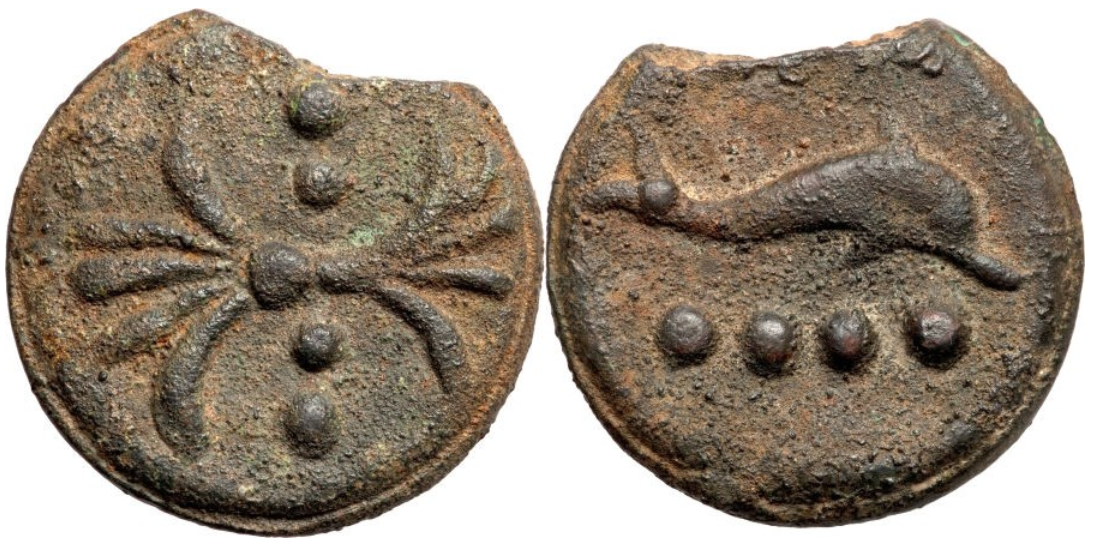
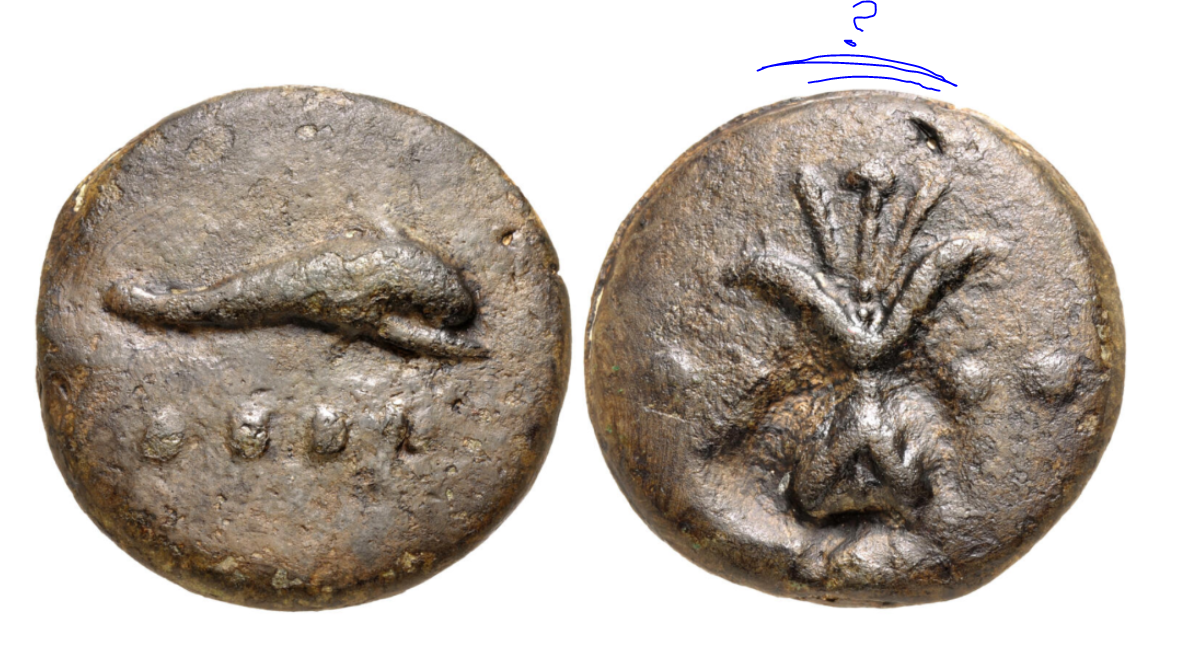
What specifically caught my eye was the apparent indentations surrounding the lower (in this image) part of of the fulmen (thunderbolt). It’s a curious hollow such as I don’t seem to remember seeing. It seems it must be a feature of the casting process, but how? its sits directly above where we commonly find the spue on this type.
As I’ve said elsewhere (here? certainly in my forthcoming metrology chapter…), cast coins have innies and outies just like bellybuttons. This is how the bronze flowed through the mould via these channels. When the coin is taken out of the mould in most cases either a little of the coin is removed (innie) or a little of the spue remains (outie). Among other things this means that the spues tell us very clearly the alignment of the two halves of the mould were aligned. Given this it seems really silly that we almost always photograph the fulmen in a vertical rather than horizontal position. The creators of these coins meant the fulmen to be on the same axis as the dolphin. Interestingly, when museums record the so-called die access for these specimens in their databases, the belief that the fulmen should be either horizontal or vertical effects how the axis is recorded. Some call it 12, some three, but in all cases the same alignment is being described. (I downloaded the CRRO data and when viewed as a spreadsheet this leaps right off the screen. More on this data set below.)
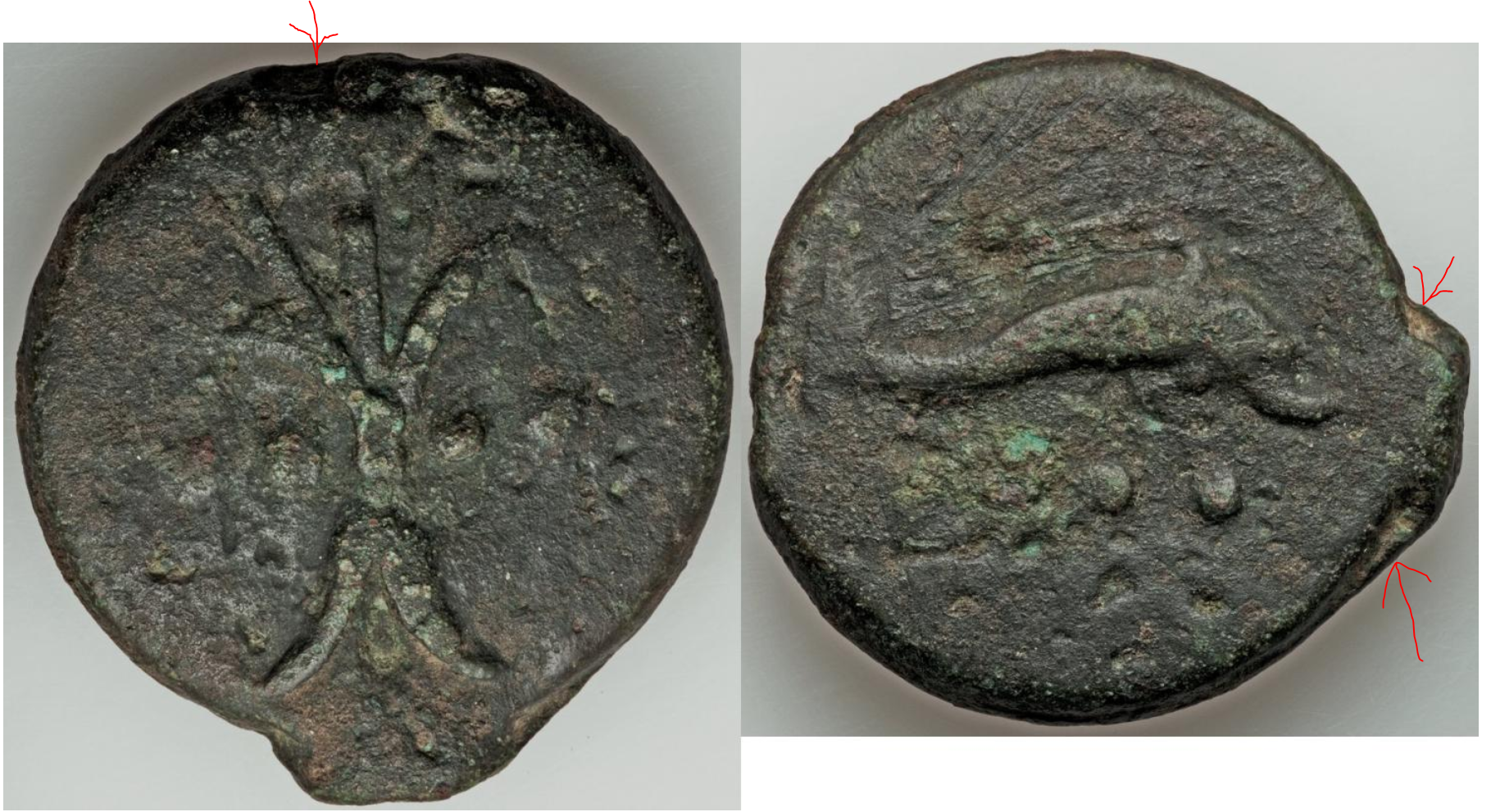
This spue pattern is so consistent on this type that when it is absent or significantly misplaced, I start to get suspicious. See the below specimen. Notice that the break (innie) is on the top and that there is no exit channel opposite. Notice also have the specimen has a strong join rim all the way around which is highly unusual for specimen of this type. The fulmen is also rendered in a radically different style (the center of the five spikes on each end is distinctively thinner and ends in an arrow in most cases). The fashion for imitations in the 19th century was very strong indeed and their manufacture is a personal point of interest. I have a hunch or inkling (not yet a theory or hypothesis) that engraved illustrations from early numismatic literature often influenced how imitators carved their molds.
My interest in spues isn’t really about authentication of specimens though. Authentication comes through well documented archaeological provenance (but we can talk about that at length). It started because the significant size of the spue, be it positive or negative, can significantly skew the weight of the individual specimen, especially in the very small denominations (unciae, semunciae). The Roman seem to have been remarkably tolerant of weight variations for coins from these earliest series right through to their batch control of the denarius in the late republic (cf. Stannard on gouging). This tolerance is at variance with an understanding of the face value reflecting an intrinsic value of the coin. And I find this apparent double think with Roman’s relationship to money absolutely fascinating. They seem to care about the purity of silver and the heft of a piece of bronze, but only up to a point. Specimens of different weights clearly circulated together. We don’t have evidence of clipping or shaving. Face value seems for all practical purposes far more significant than fabric.
The other thing I really like about spues is that they are a very obvious artifact of manufacture and thus offer us some clues about the creation process and I think they hint at aspects of the likely metallurgical composition of the bronze.
One fact that I can’t get out of my brain is the high lead content (~20-30%) of the Roman currency bars tested by the BM in the 1980s (see Burnett, Craddock, and Meeks). I am on record as being intrigued by the possible parallel metallurgical ratios seen in the Egadi rams (from only preliminary testing). I’m also on record as suggesting that those five pound bars are best associated with the 1st Punic War: This makes them later than RRC 14, 18, and 19. Lead makes the bronze more brittle once cool, but more viscous in the casting process. Specimens invariably show both an entrance and exit channel for the molten bronze (the spues). The Roman valued the ability of the bronze to flow both in and out of the moulds filling the whole cavity. They tolerated the brittleness that left the innies and outies on each specimen as they broke the coins free of the moulds. Heck, maybe the brittleness was even a feature rather than a flaw for this particular operation. Of course, I’m just speculating RRC 14, etc… have a lead content similar to the currency bars. I’ve not YET been able to test any specimens, but that is high up on my wish list.
In private conversation with someone who has spent many many more years than I looking at cast coinage, I’ve heard it speculated that the moulds might have been single use and clay because of how one does not find mould links like one finds die links for struck coinage. The question of materials used for the mould is fascinating. I don’t even know if it is possible to cast this type of bronze in clay. I also wonder if they were made out of clay why we couldn’t find stamp links. This is the age of petite estampilles on fine blackware, so the advantage of a reusable stamp would have been obvious those creating clay moulds. Tufa would be too soft, surely (?!). Travertine? But so often that has a texture of its own. I have questions. FAR too many questions.
Where does that leave me with this first specimen and the funny cavity… Worried. There is no exit spue opposite the cavity, only a smooth edge with a distinctive join. Also that’s a heck of a lot of negative space between the edge of the mold and the central arrow of the fulmen. Definitely funny. Could it be the last specimen in a line of specimens being cast in sequence? I guess. Maybe… But would that work if you were pouring molten bronze into the top channel how would you be confident that the bottom mould filled properly? wouldn’t you need an air hole at least? I’ve got stuff to learn.
What to make of this?
…
At this point I decided to get a little more serious about these questions so I reviewed all the RRC 14/3 specimens in CRRO and took notes on the spues visible in the available photographs and also any unusual features.
When I’m confident in what I’m seeing on the specimen only 16% have one spue, rather than two, or to be more literal, I found four specimens out of 25 where I am am certain the specimen only has one spue.
The last causes even more concern as the alignment of the spues is atypical. On the dolphin side instead of aligning with tail or head, the spue is at about four o’clock.
The other fun point of note is the Badian collection specimen (Rutgers) has the dots above the dolphin rather than below and seems likely to be an imitation.
Unfortunately most imitations are not this easy to spot. (And, of course it is even just possible this is an engraving error at the mint).
Ideally the analysis would be restricted to specimens from well documented hoards and excavations, and yet that reduces the pool to an unmeaningful sample size.
I’m grateful to Prof. Irene Soto Marín for access to Kelsey coins during the digitization process.
Who is the female figure on the reverse of the coins with legend PONTIF MAXIM?
The above reverse design with a seated female figure holding a scepter and an branch and a legend referring to the emperor in the role of Pontifex Maximus repeats on the coins of Augustus, Tiberius, and then revived under Vitellius, and Vespasian. The Vitellius aureus differs only slightly, with a shorter legend and a patera instead of a branch. RIC identifies the Vitellius reverse as Vesta and that was my first throught for the others, but Vesta is always (?) veiled. So perhaps we’d be safer reading this as a personification? Perhaps Pietas?
This is not the Papius specimen or control-mark I’m supposed to be thinking about this very moment, but I don’t want to lose this thought:
The cataloger for MZ 194 describes the reverse control mark as crossed shields and a helmet and thus as attributes of the Salii, armed priests who dance for Mars. This seems plausible but not certain. I’d like to see more crossed shields. I’m also interested if this is the cataloger’s original proposal or if it has been proposed else where. Other possibly Salii related images on the Blog.
This is a lovely specimen in the Kelsey Museum (T2009-0053; Thx Prof. Soto Marín!), but it looks funny. How am I 98.88% confident it is a 19th century imitation? Largely through comparison with images collected by Schaefer. This was made easier by the fact that Satrienus numbered his dies and thus told me exactly which dies I should be checking. A selection is given below.
My working hypothesis is that the imitation was made from casting a (relatively) well preserved specimen and then cleaning up that mold before using it for making imitations. Hubbing is also possible, but less likely.
Obverse:
The set of the eye is wrong, esp. the upper lid
There is too little detail in the hair
Lack of spiral on the helmet
Reverse:
The shape of the upper portion of the rear far leg is wrong
The fourth teat has been removed
There is too much fur on the underside of the raised front leg
There is too much fur in spikes beneath the tail
The hair at the neck has a different pattern
Fabric:
Funny Patina
Flan is much larger than most used for this series, allowing more detail than typical
Combination of soapy indistinct features suggesting wear and then very legible feature elsewhere (contrast letters and border dots).
Should the Kelsey de-accession this piece? Absolutely not.
It remains a key historical artifact; it just requires we ask different questions.. It came into the collection in a well documented fashion in the late 19th century (more on that history of the collection another time). Given that it is (near) replica of a likely genuine specimen it gives us evidence of that specimen’s existence. It also can teach us about the historical trade, manufacture, and marketing of fakes. I’m particularly interested in the metallurgy that produced this patina and whether it is distinctive enough to confirm other imitations where die comparison is inconclusive.
In this case I suspect the earnest buyer who was selecting specimens for the university while in Florence in the 1880s was an easy mark, as non-expert, with a very particular goal: selecting specimens to educate the young men of Ann Arbor.
And, in its own way it is beautiful, in fact too beautiful.
We all know emperors on Roman coins are laureate. Why? What does it mean?
I’m trying to consider the republican evidence
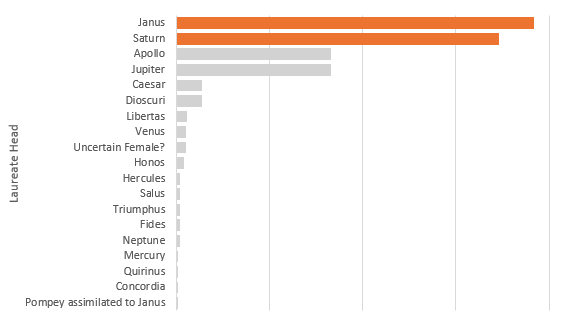
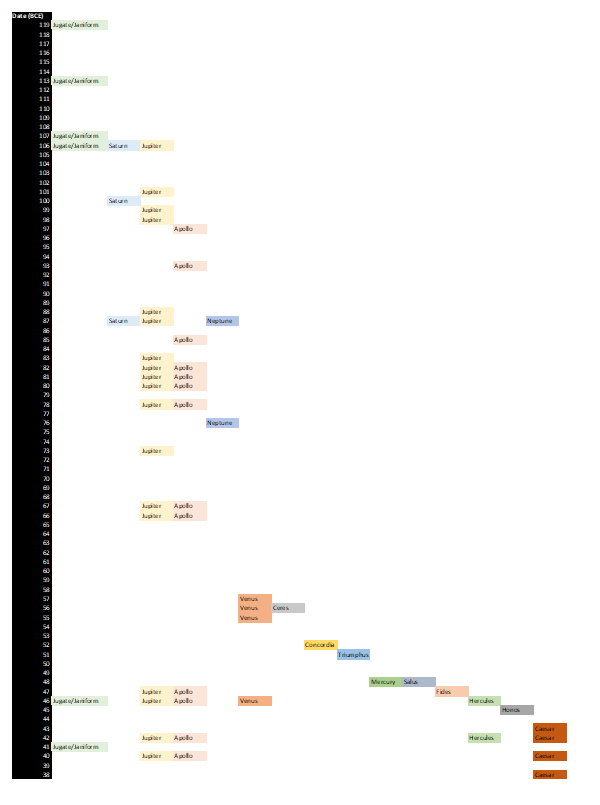
These are all the individual types counted. A bad graph. It makes no difference of change over time and does not take into account differences between silver and the much more conservative bronze. Also Crawford’s numerous sub types can inflate representation.
In this next Graph I removed all bronze and planned to restrict coin types to those at 146 BCE, but there are no silver or gold issues with laureate heads between 170 BCE and 119 BCE.
But I still want better data visualization. This doesn’t say anything very meaningful.
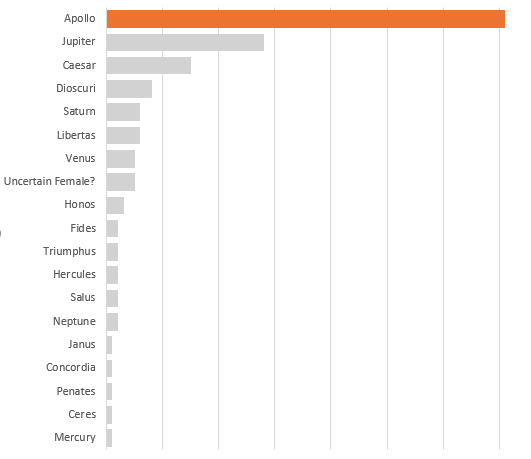
This next graph below is hard to read at this scale. But it does a better job of showing change over time. Traditional senior male gods are laureate through out the period and going back to the very start of the republic. Neptune gets to be laureate when he appears, unsurprising giving his divine status. Things only get interesting with the introduction of the laureate Venus in the mid 50s to represent Pompey’s Venus Victrix. After this minor gods or divine personification are made laureate on specific issues for reasons we may not fully understand. Caesar is only laureate after death and we should probably take it as a Roman symbol of his divine status. None of the many other living Romans who put their own portraits on the coins are depicted laureate, nor are their ancestors.
Anyway. Not earth shattering but there it is. Post Actium the future Augustus shows up on the coins laureate… I sure someone has written about that. Just wanted to see how the run up shook out.
This tweet thread on RRC 205 generated good conversation and supplementary images. I’m archiving on the blog to ensure I can find it when I next go looking.
This is a close up of the AS of Sulla's ancestor (c.151 BCE) showing a goddess in the prow stem. While one specimen doesn't define a type this one is extra clear … 1/ https://t.co/JTvZdQTU1cpic.twitter.com/ndv75UMBbL
Perhaps to me the most interesting is this fitting said to be from the area of Actium in the British Museum. It measures Height: 47.50 centimetres Length: 58.42 centimetres Width: 44.45 centimetres.
The other key observation on twitter is that there are more decorated prow stems on the Roman Republican Bronzes than have been noted in the major catalogues, a point well made by Michael Davis ( @Michael24441229)