120 and 121 out of 410 days: Very Punny Names

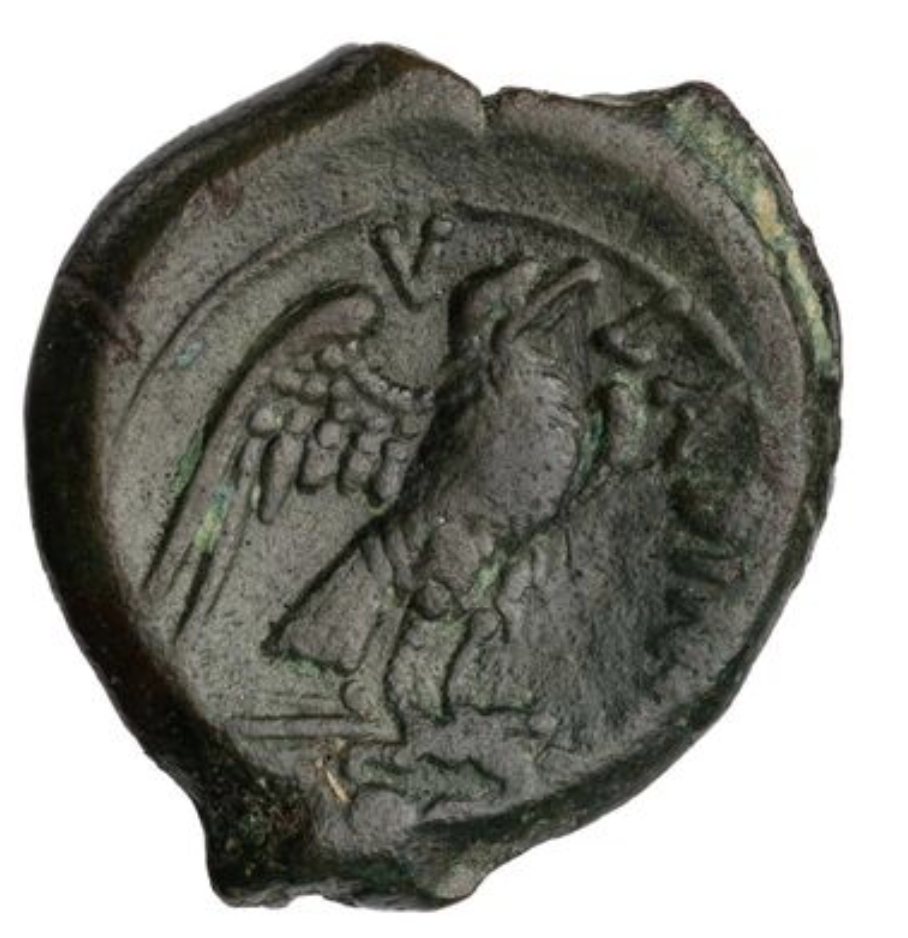
Reverse of RRC 141/1. 1944.100.235


Crawford says of this coin:

Image


This type of logic permeates RRC.  Given enough time with the series one starts to think that this type of symbolic language must have been pervasive at Rome.  But is this actually how people thought?  Are the name plays obscure or obvious to their audience? Is it a Roman phenomenon or something much wider?

Yesterday (because of the book review I’m diligently working at), I was thinking about the legacy of Pythagoras.  Not a figure I can say I’ve cared much about in the past, beside mentioning the legendary connection to Numa in some of my classes or this rather fun video. Of course, he shows up on some provincial coins of Samos.  But I was surprised to learn that May thought there might be a fifth century portrait on a coin from Abdera.

Here is what Burkert, Lore and Science in Ancient Pythagoreanism, 1972, p. 110 says:


Image


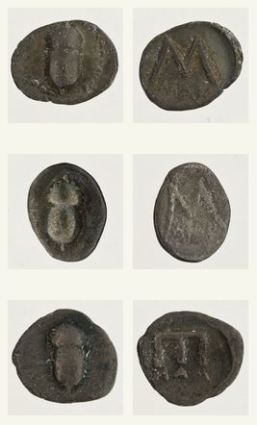
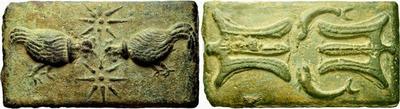
I’ve singularly failed to find you an image of this coin.  And after ‘wasting’ a hour and a half plus looking for it (and in the mean time getting rather visually acquainted with the mint of Abdera — what a great series!), I decided that it had nothing to do with the review or the book and so I’d better drop it.  The only tangential connection is this use of visual puns on the moneyer’s name.  Take for instance this beauty:

The moneyer, Dionysas, has the head of Dionysus.  And here’s Python and his tripod:

Silver coin.The British Museum has their whole (?) collection of Abdera coins up with photos.  It’s a great shame its not searchable by inscription and May number.  [The ANS has the May numbers, but few images and the legends are not transcribed.]  A look through the BM collection suggests straight off that not all images are naming puns, even if some certainly are.

Did real people think like this or was this a coin designers’ game?  Enter, Timeaus (via the anonymous author of On the Sublime):

Observe, too, his language on the Athenians taken in Sicily. “They paid the penalty for their impious outrage on Hermes in mutilating his statues; and the chief agent in their destruction was one who was descended on his father’s side from the injured deity—Hermocrates, son of Hermon.”

Or Timeaus via Plutarch:

Indeed, he often lapses unawares into the manner of Xenarchus, as, for instance, when he says he thinks it was a bad omen for the Athenians that Nicias, whose name was derived from victory, declined at first to head their expedition; also that, by the mutilation of the “Hermae,” Heaven indicated to them in advance that by the hands of Hermocrates the son of Hermon they were to suffer most of their reverses during the war; 

This is prophetic, symbolic thinking, not iconography, but nonetheless I detect a similar type of name=symbol association as we find on the coins.  Perhaps we could marshal Timeaus as part of an argument for decode-ability of the logic behind our numismatic symbols.   And perhaps Abdera + Timeaus = some background to just what exactly the Roman moneyers thought they were communicating with their symbolic language.

Update 5/19/14:  An old piece of scholarship that does a fine job of surveying the use of visual puns in media other than coins.


112 thru 117: A “Loyal” Return

Image

The ‘intensive’ Turkish language class and bureaucracy have occupied much of the last week, but now as the Kurban Bayrami festivities begin our lives are settling down a bit.  The language class is certainly part of my professional goals for this sabbatical, but as it doesn’t touch on my research and writing directly I don’t find I have much to say about it. I set a simple goal of reading two chapters a day of a book I’m reviewing and writing notes there on in order to have a draft of the review by next Sunday.  This should allow plenty of time for flash cards and grammar exercises and perhaps even some more bureaucracy, if any offices are open.  It should also let me blog here a bit about the material, like the inscription above.  Here’s a recent translation:

ImageImage


Here’s the link to the translation source and here’s an even more recent discussion.  There is controversy over the date: Late Empire? Late Republic? The latter is more favored at the moment.  The passage is often discussed regarding the role of the historian in society and how histories would have been experienced by contemporary audiences, i.e. reception in antiquity.  What caught my eye was the list of things that cause problems in societies, the understanding of which will be beneficial to the audience of the history:

  • popular politics
  • greed
  • infighting
  • AND loss of trust (pistis)

It’s the last rhetorical point that resonates with numismatic imagery and more.  In the passage infighting (staties emphulioi), i.e. conflict between kinsmen, those who should be ‘natural allies’, is juxtaposed against the idea of a loosening loyalties (pistion katalusies), implying, perhaps, that the latter refers to external treaties or agreements, interstate affairs.  The first pair similarly contrasts poor and rich.  The poor should be stirred up to want undo societal influence, but equally the rich should not seek to become richer still. Harmony within a community, perhaps, depends on these two precepts (homonoia, the rhetorical opposite of statis).  

This started me thinking about how Homonoia (= concordia) and Fides (= pistis) have a strong overlapping iconography, most obviously the joined right hands. 


The joining of the right hand is so much a part of the iconography of each abstract ideal that when unlabelled we should perhaps read both ideas instead of just one alone:


The question of course becomes how far back should we read the development of this overlapping and sophisticated icongraphic rhetoric:


102 thru 111: The Great Hiatus

Image

In preparing to relocate continents it seems sensible to do the rounds of one’s healthcare providers.  It is NOT sensible to let your dentist drill into your teeth 24 hours before your flight.  A school girl error really.  I’m not that experienced with matters of the teeth having never needed any serious prior work.  A week on we’re settling into Turkey but my jaw still aches.

The jet lag is the worst that I’ve experienced, but the house is lovely and I sent off the chapter to my editor yesterday.  It was basically no different than the draft as it stood before the drilling but I didn’t trust myself to let it go.   We began intensive Turkish Friday.  Four hours every afternoon for 20 sessions.  Being an elementary student again will certain inform my teaching next fall.

More anon.

A travel blog by both of us is in the works.  This will remain primarily about work.

99, 100, 101 out of 410 days: The first Imperator, or ‘EMBRATUR’

Obverse Image

Back on 14 August 2013 I was rambling on about Sulla’s numismatic peers especially in relation to the use of the self-identifier IMPERATOR.  I’ve always been a little uncomfortable with the first instance of this honorific on coins being attributed to Fimbria.  Not that after murdering his commander and taking his army and sacking Troy I thought he wasn’t an arrogant enough @$$hole to do so.  [I really dislike Fimbria: he’s my least favorite Roman and they were generally a bad lot.]  It’s just he didn’t strike me as very creative or trend-setting.  Why would Sulla be copying him?  Did they really come up with it each independently?  Well, turns out we have C. Papius C. f. Mutilus to thank for this innovation.  Yup.  That’s right.  One of the most notable of the Social War generals.   A Samnite enemy of Rome eventually defeated by Sulla.  His coinage is pretty famous too:

So it doesn’t really say Imperator as that’s Latin.  It says, reading right to left, EMBRATUR, in Oscan, but the title has the same meaning in a  very closely related language and cultural milieu.

The coins struck in Mutilus’ name use the same types as those used by the Marsic confederation and are clearly part of the same series, but Mutilus’ ability to use the coinage for the promotion of his own standing and especially his honorific title clearly had a lasting impact.

[A. Burnett raises the possibility of Mutilus inspiring Sulla briefly in general terms on p. 170 of his ‘The coinage of the Social War’ In Coins of Macedonia and Rome: Essays in Honor of Charles Hersh, edited by A. Burnett, U. Wartenberg, and R. Witschonke, 165-172. London: Spink)]

***

I’m rushing to finish a chapter prior to leaving for Turkey and am generally frantic, but this observation was so fun I couldn’t not share!

95, 96 out of 410 days: Divine Abstractions

There is a good deal of concern and attention paid to the divine honors given to the personification of abstract concepts.   The habit has it origins in the Hellenistic period.  Think of the Nikes we’ve seen, not to mention much more famous examples:

Victory of Samothrace

All of these turn the idea of ‘winning’ into a goddess who can not only be represented in art but also given cult honors, from temples to sacrifices to prayers and hymns.  The Romans took this practice to great heights.  Click on that link “care and attention” above for discussion.   Of course they did not have a monopoly, but we usually think of them influencing their neighbors.  We’ve seen the Locrians representing Pistis (= Fides = Loyalty) crowning Roma before.  Strangely that coin isn’t usually discussed in context of the coin above also minted at Locri.  It represents (and labels as such) the goddess Eirene (= Peace).  The style of the reverse is modified from the coin of a neighboring town:

Reverse Image

Yes that’s a Nike on this AR Stater, Terina, Bruttium, 400 BC-356 BC.  The bird is a rather different attribute. Something to chase up another time…

What the Eirene coin does is contextualize the Pistos / Roma coin by letting us know that the Locrians are already well versed in thinking about abstract divinities: they don’t need the Romans to help with that.

Pax won’t show up on Roman coins until 82/81 BC at the earliest:

The identification of the obverse here is far from certain.  The first secure appearance isn’t until 44 BC and the is a very rare coin indeed:

Pax may not have had a cult site in Rome until the Ara Pacis!

92, 93, 94 out of 410 days: Fight or Flight

I’m trying to tamp down the panic of leaving the country for ten months.  I no longer wake up with coins in my mind: its all logistics and I’ve not slept straight through the night for days.  I wake up with the ‘what ifs’ and ‘must remembers’ and cold sweats.  

Monday I finished section two of the current chapter by moving two large epigraphic-ish topics (1,200 words plus) into an appendix to keep my narrative flow smooth.  

Tuesday morning I realized I really should have ordered images of gems for section three from other museum collections, oh say two months ago.  They both went out Wednesday. No word back.

Yesterday, I fought with HSBC over my lost 720 dollar wire transfer and tried two other wire transfer services both of which went better than HSBC but resulted in prohibitive fees on the Turkish bank end.

I when to the doctors (at long last, I hate doctors, not unlike Cato) and scheduled even more check-up, preventive medicine type things.  I researched the cost of out of pocket medical care in Turkey.  (Totally affordable from an American perspective, no surprise.)

I finalized a going away party.  I went running.  I cooked.  Apparently, I cook when stressed.  

I dealt with messy little bits of college matters that reared their hydra-like heads even on sabbatical.

I felt guilty for ignoring my blog.

Bad Neighborhoods

Today I’m worrying over the Turris Mamilia, or the Tower of the Mamilii.  Really there are only three pieces of evidence.

1) Passages in Festus.  The reference is under the entry for the October Horse:

“October Horse” is the name of the horse which is annually sacrificed to Mars on the Campus Martius in the month of October. It is the right- hand horse of the winning pair in a chariot race. There used to be an  intense struggle for its head between the inhabitants of the Subura and those of the Sacra Via: the latter hoping to affix it to the wall of the Regia, the former to the Mamilian Tower. And the tail of the same animal is conveyed to the Regia, with speed enough for the blood to drip from it to the hearth, for partaking in a divine service.

(Here’s a  French translation.)

2) The fact that some members of the gens in the third century had the cognomen ‘Turrinus’.   Refs can be found here and here.

3) An inscription, CIL 6.33837 = ILS 7242:  “M. Octavius M. l. Attalus centurar[ius] a t. M.”  where the t.M. is taken to be a reference to the Turris Mamilia as a topographical marker.

This is not a lot of evidence. Frankly its not absolutely clear that all three pieces of evidence refer to the same ‘tower’.  What we make of it all pretty much depends on how one wants to think about the Festus passage.  Is this tower an ancient and embedded part of the religious ritual? Is this proof of the Mamilii being part of the archaic Roman landscape on par with the ancient kings?  Is some ancient power struggle between two claimants to the throne crystalized in this annual rite?   Or was the tower just any old third-century landmark in an otherwise squalled, hot and dirty neighborhood?   A point of focus in the district that was co-opted into the ritual contest for convenience sometime after its building presumably well after the origins of the religious festival itself?

None of the other sources on the October horse and the battle for its head emphasized the Mamilii in anyway, although we do hear about the Subura participants in this contest from Plutarch.

89, 90, 91 out of 410 days: a Sea of Sukkot

My neighbors have finished the High Holidays and booths (sukkah singular, sukkot plural) have been appearing in every spare space that is open to the sky in preparation for the beginning of Sukkot this coming Wednesday.  The singing will go on long into the evening from inside the booths.  There will be large citron fruits and palm branches and myrtle and willow too.   I can see just one remaining unconstructed sukkah in a neighbor’s yard.  In just a few hours the hammering is sure to begin.  

It’s a good time of year to be outside, to be with family and friends.

The weekend SDA’s family came into the borough Saturday, a lovely time.  Sunday I had a little freak out about moving to Turkey for 10 months.  An attack of the what-ifs.  I find answering the question ‘Why are you going?’ exhausting.  Even to myself.  Also the question ‘aren’t you nervous about Syria…’  I am nervous about many things.  Money, my ability to write efficiently there, the stress of everyday activities, and isolation.  But not about Syria.  

So I made Foccacia.  

The most academic things I did was haggle with a street vendor for eight Loebs.  He threw in the ninth (Horace) for free.  And, wrote a sentence or two about the turris Mamilia more on that here later perhaps.

***

Sukkot always reminds me of the line in 2 Maccabees 1:9.  This book has a few letters from Jews in Judea writing to Jews in Egypt appended to the beginning.  The book as a whole is a testament to the Divine assistance to the Maccabean restoration of the temple (i.e. in contrast with 1 Maccabees which is more a history of the new dynasty).   The one line urges the Jews in Egypt to celebrate the feast of Booths in Chislev.  The ‘real’ feast of booths is the one now in Tishri.  The letter seems to be drawing a parallel between the establishment of the new holiday Chanukah and the activities and traditions of Sukkot. Borrowing the Torah-endorsed legitimacy of the latter for the former.

88 out of 410 days: Seeing Too Much

Reverse Image

This reverse type has been the victim of too much speculation.  Crawford in RRC wants the type to be visual representation of the moneyer’s name.  The other type made at the same time by the same moneyer seems to pun on the constellation the Triones (a.k.a. the seven stars of the Plough a.k.a. the Big Dipper a.k.a. the Great Bear) and the moneyer’s cognomen:

To make a pun out of the winged boy on a dolphin Crawford had to speculate that it might represent Melicertes (a.k.a. Palaemon) and thus by extension his mother Leucothea whose name sounds like Lucretius.  This has then been spun into a legendary genealogy connecting the family to this goddess and tying the moneyer to Odysseus via a connection with Antium. [Hence how I found this in my notes today and thought I’d write it up as it’s unlikely to ever really make it into the book.]

The problem is that is that Melicertes is never represented with wings.  So says the LIMC (not just the website, I promise I checked the books as well on this).   That is just a regular little cupid (eros) on a dolphin.  A perfectly normal, completely common representation on gems, lamps, and dozens of other decorative art forms. One that appears on many coins as well:


And even on Roman coins:


The main problem with the tentative suggestion of Melicertes is not the speculative reconstructions above, but that by saying “winged boy” in the catalog entries of every major database it never returns in searches for “eros and dolphin”  or “cupid and dolphin” thus virtually erasing an important link in the history of the iconography.

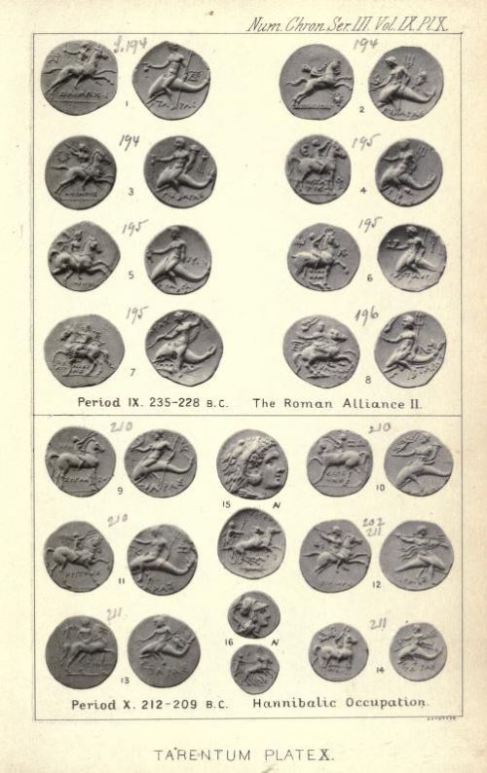
Of course, Melicertes can be represented riding a dophin.  And there are lots of boys on dolphins, most famously at Tarentum.  But the wings rather make a difference!

As a fun aside:

Image


Yep that’s George Washington!


Acrostolium (again)

RRC 213

I lied.  I wasn’t ready to move on.  I kept poking around and my eyes caught this specimen from Andrew McCabe’s collection:

Image

And I was surprised to see a head in the acrostolium because I thought I knew all the Roman republican types with this sort of head.  All two of them.  We discussed them at length earlier.  So I checked Crawford.  No such note.  Then the ANS and BM specimens.  Possible but nothing that really looked conclusively similar.  The auction catalogs gave slightly better results and I turned that uncia above.  The neck of the head seems really clear.  I assume that even when it isn’t clear, it is meant to be there:

Link