302 out of 410 days: Lycophron and Rome’s Foundations

Image
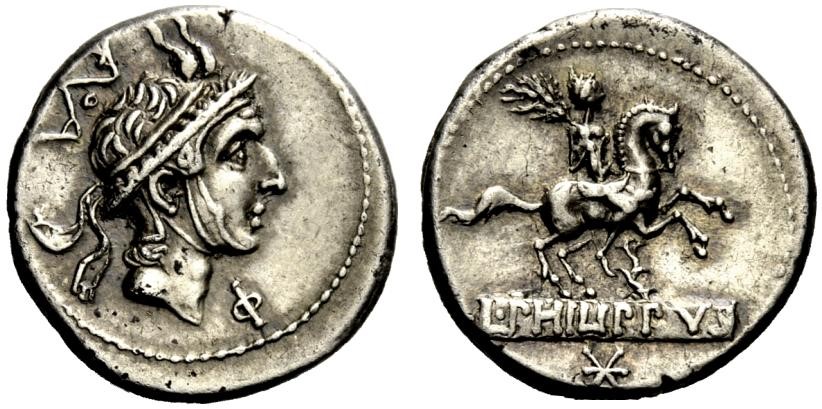
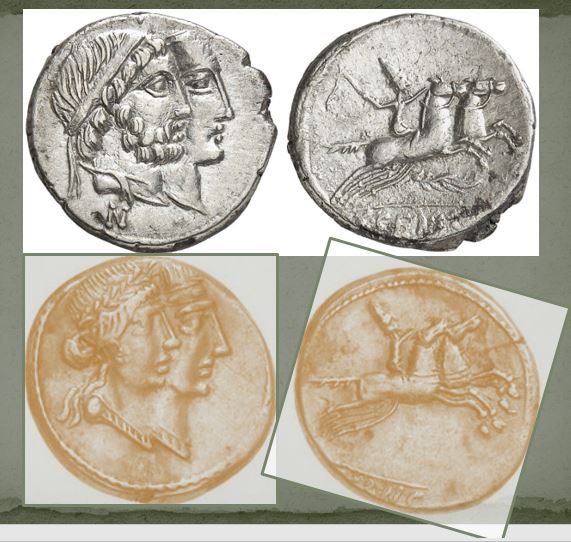
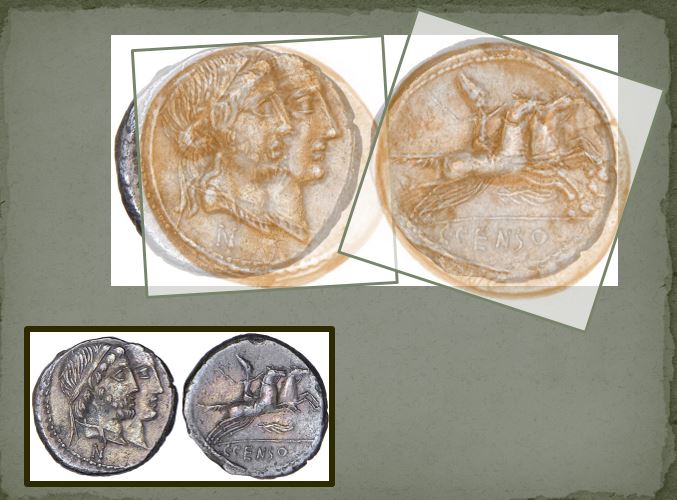
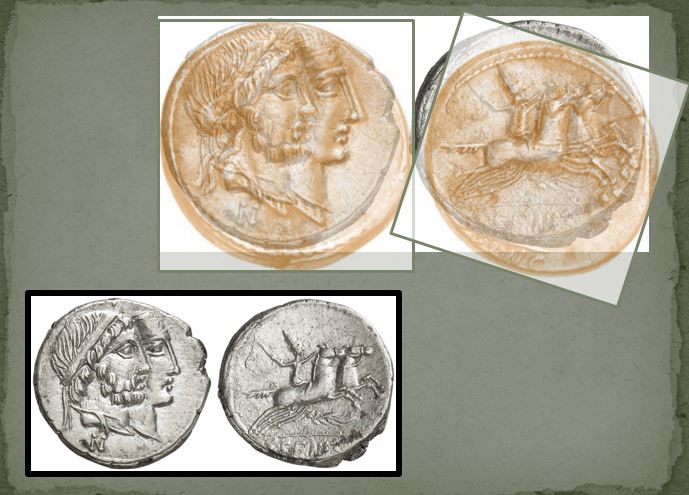
RRC 16/1a. ANS 1969.83.7. Image links to all ANS specimens of this type.

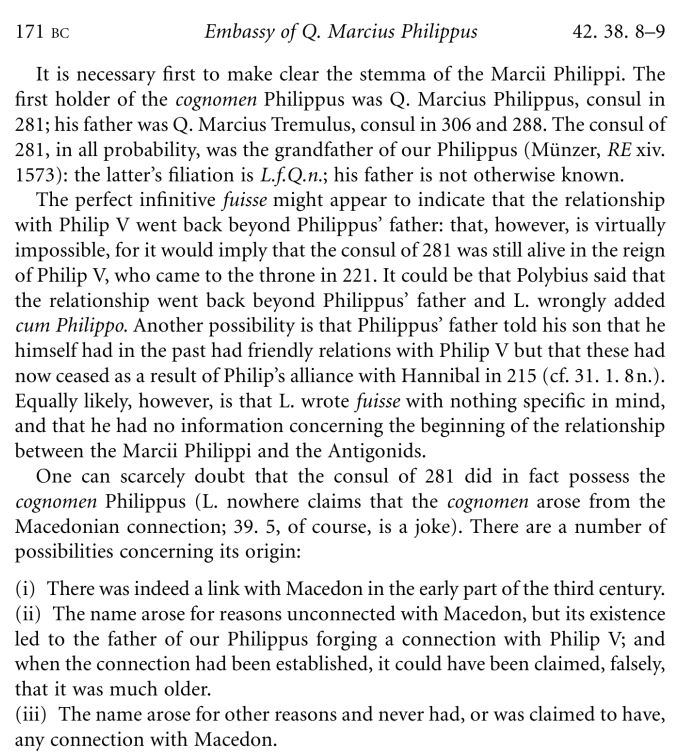
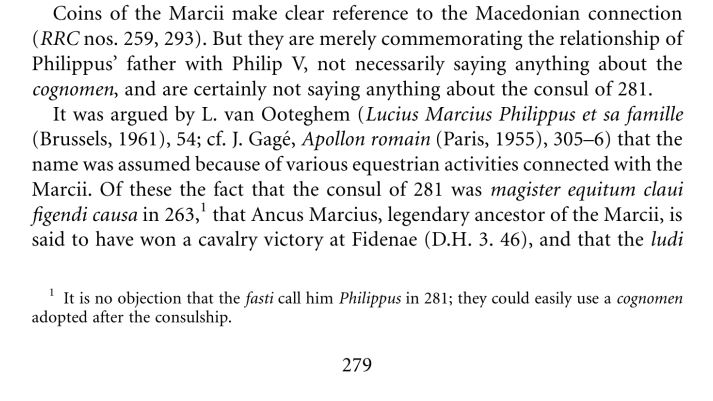
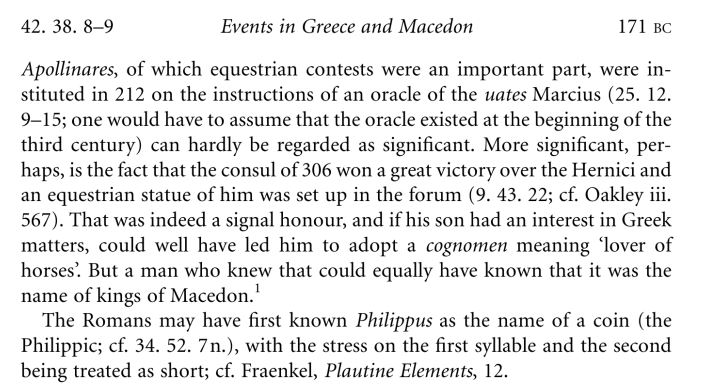
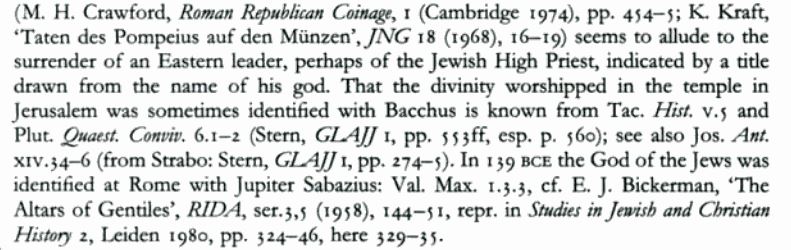
I came across the passage of Crawford below and decided I might kick the main discussion of the type above out of the chapter I’m working on at the moment (Rome and Italy) and put it in the previous one (The Legendary Past).  

Image

Image

Since Crawford wrote this passage (RRC II.714) thinking about Lycophron and Roman foundation legends has developed. Here’s Wiseman’s translation of the relevant passage from his Remus:

Image

Coin geeks will know Aphrodite Castnia from the coins of Metropolis in Thessaly [links to an example with a side story from the collector illuminating acquisition practices].  Literary buffs will be more likely to reference Callimachus Iambus 10; Kerkhecker 1999: 207:

Image


[Other relevant bibliography on Callimachus includes Clayman 1980 and Acosta-Hughes 2002.]

Wiseman 1995 has shown many ways lions may be present in the now lost myths of the foundation of Rome before the establishment of the Romulus and Remus tradition (p. 63ff) and has endorsed Stephanie West’s dating of the above passage and others to the second century (181 n. 5).

The lion and goddess seem to me very much in the South Italian and Sicilian repertoire of iconography (cf. Velia and Syracuse for Lions among other mints), evoking power and divine protection, but not necessarily an intersection with a specific foundation narrative.  

And I’m still moving away from Russo’s suggestion that RRC 16, 17, and 23 form a series, amongst other reasons already discussed, because of Crawford’s comments about the different circulation patterns of RRC 16 and 17 in CMRR, p. 38 with App. 9 (p. 285) listing hoards. 

301 out of 410 days: Pistis again

οἱ δ᾽ εἰσελθόντες χρόνον μέν τινα διετήρουν τὴν πόλιν καὶ τὴν ἑαυτῶν πστιν

… διορθοῦσθαι παρὰ τοῖς συμμάχοις τὴν αὑτῶν πστιν.  (Polybius 1.7.6 and 10)

The very first episode actually narrated in Polybius’ Histories doesn’t really let the Romans come off that well.  The garrison they sent to Rhegium seizes the city for themselves rather than protecting it.  This episode is set by Polybius in the back drop of the Pyrrhic War and he says after the war, as soon as they could, the Romans laid siege to the town and punished mercilessly their own garrison.    The episode begins and ends with references to pistis (= fides = [good] faith).   Now, Polybius is probably hazy on the details.  See Walbank’s commentary (follow link above) for the nitty gritty details, but key points therefrom include:

” Dion. Hal. xx. 4 records that the garrison was against Bruttians, Lucanians, and Tarentines, and was sent in the consulship of C. Fabricius (282).”

“The Roman reduction of Rhegium (cf. 6. 8) is in 270; Dionysius (xx. 16) and Orosius (iv. 3. 3–6) attribute it to the consul C. Genucius, but his colleague Cn. Cornelius Blasio triumphed de Regineis (act. tr.).”

So 12 years is an awful long time to leave this rogue garrison hanging out in S. Italy…  I also find the triumphal fasti entry interesting.  We usually talk about funny business with the triumph in the civil wars and allied rebellions of the Late Republic but this appears to be a really early case of a Roman claiming to have defeated a foreign enemy when fighting other Roman, or former Roman, soldiers. And of course it made me think about this coin and its broadly Pyrrhic context and Locri’s status as a neighbor of Rhegium.  The whole episode was quite an object lesson for the Locrians…:

Reverse of Silver stater, Locri Epizephyrii. 1944.100.7030
Reverse of Silver stater, Locri Epizephyrii. Pistis (= fides = fidelity) crowns Roma. ANS 1944.100.7030

Related earlier posts on Locri, on Pistis.

Dolphins at Cosa and Signia

Image
HN Italy 210. First Cosan bronze issue. Image from Buttrey’s classic 1980 publication, to which it links.

This issue of Cosa imitates Rome’s first didrachm (RRC 13/1).  It’s date post 273BC (the founding date of Cosa) has sometimes been used to try to draw down the date of Rome’s first didrachm, the idea being that iconographic borrow would be unlikely over a gap of some 40-50 years.  The gap doesn’t bother me.

I was just intrigued by the dolphin addition to the design. Buttery says its there “bronze to identify Cosa as a port” (p. 22).  Need this be true?  I’m just recalling the dolphin neck terminus we find on the obverse of the coins of Signia:

Latium, Signia. Obol circa 280-275, AR 0.69 g. Head of Mercury r., wearing petasus; below neck, dolphin r. and below chin, caduceus. Rev. Mask composed of Silenus head l., and boar’s head r.; below, SEIC. Sambon 164. SNG ANS 115. Campana CNAI 1a. Historia Numorum Italy 343.

Segni is most certainly not on the sea.  And as I mentioned in passing in another post, Mercury isn’t particularly associated with nautical imagery and dolphins.  I’m wondering it is not a design element considered aesthetically pleasing at the bottom of a protome to ease the transition. Two examples an argument does not make.  I’ll keep my eye out for more.

Nuceria Didrachms

HN Italy 608, In Trade

So I’d been revising my thinking on the Cora didrachm a bit of late and that made me wonder if I needed to also think again about Nuceria issues.  Crawford lumps them together, speculating it was a means of distributing booty.   I was pleased to see Nuceria specimens next to Suessa specimens in this hoard even if they will be much earlier than its deposition date:

Image

The original 1912 publication is much more detailed.

Update 4/16/2014:  When thinking about Nuceria and Cora and how their striking relates to that Teanum, Suessa, and Cales, don’t forget the silver didrachms of Paestum, again very rare and the jury is still out on dating (HN Italy 1180).   Image here.

Update 8-29-25:

The 1843 Thomas Thomas Sales Catalogue


296 out of 410 days: Revival Reverses?

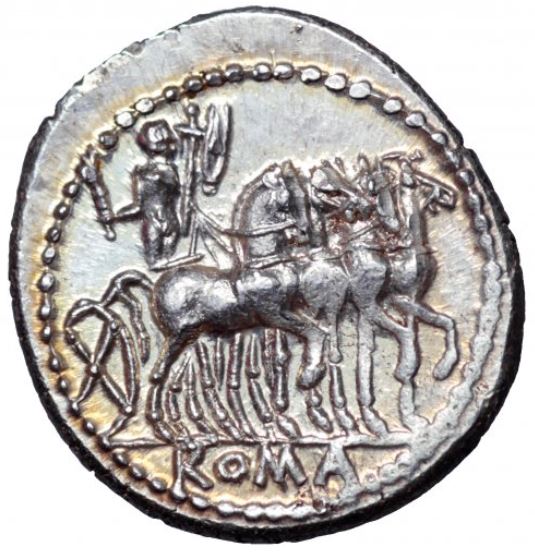
Appius Claudius Pulcher, T Manlius Mancinus and Q. Urbinius; Denarius 111 or 110, AR 3.98 g. Helmeted head of Roma r.; behind, quadrangular device. Rev. Victory in triga r.; in exergue, T.MANL.AP·CL·Q·VR. Babelon Manlia 2 and Claudia 3. Sydenham 570a. Crawford 299/1b.

T. Quinctius. Denarius 112 or 111, AR 3.92 g. Bust of Hercules seem from behind, head l., club above r. shoulder. Rev. Desultor to l.; behind, B. Below horses, TI – Q on sides of rat l.; in exergue, D·S·S incuse on tablet. Babelon Quinctia 6. Sydenham 563. Crawford 297/1a

So this is a pretty left field thought.  But as I’m thinking about the coins of Teanum I can’t help but think how weird it is to have a triga, a three-horse chariot.  It’s not really a well known or convenient hitching configuration.   One could speculate that it comes from copying a quadriga type like that found at Selinus or other Sicilian mints where the front horse rather obscures the next one so that it almost looks like a three horse configuration.

And then it occurred to me that we do get a few trigae on the republican series.  The first (above) is within a year or so of the first desultor type as well. You’ll remember we discussed desultores in relation to Suessa’s didrachms that parallel Teanum.  And those two coins above are also with in a year of the type of Torquatus that looks so much like the bronzes of Larinum.   Is there a Cales parallel? Cales just used the victory in a biga, a type all over the republican series so calling one specific issue an echo of Cales would be non-sense.  Or just more non-sense than my other non-sense in this post!

Could there have been a little fad for drawing inspiration from old allied coins of the Punic Wars at the end of the second century?  Probably not.  Let’s call it a fun coincidence.

Update 4/18/14: I came back to this post briefly when I read this passage in Woytek’s chapter in Metcalf’s Handbook (p. 326):

Capture

Ritter, H. W. (1982). Zur römischen Münzprägung im 3. Jh. v. Chr. Marburg.

Update 4/30/14:  On die engravers making errors in the number of horses they carve when copying a prototype, see:

Hollstein, Wilhelm. – Ein kurioser Quadrigatus im Kestner-Museum Hannover. NNB 1996 45 (9) : 8. AP Abstract: Among the Quadrigati the museum (=> 60-10031) is a specimen (No. 107), in which the Quadriga has five horses with ten front, but eight hind legs.


Left to Right, Right to Left

Image
Bronze Coin, Frentani. ANS 1957.172.36. SNG ANS 1.129. HN Italy 621.

Check out the legends on each side of this coin.  They are both FRENTREI, but with the Rs looking for all the world like Ds and the F like an 8.  Oscan isn’t really that far off the Latin or Greek alphabet:

It’s main difference is that its written right to left (like Hebrew and Arabic), rather than left to right (like English and kin).  I like the above specimen because it has the same name written in different directions on each side.  L>R on the obverse; R>L on the reverse.  It’s as if we get a little window into the moment of evolution of the language among the Frentani.

It uses a locative ending like the first coin of Larinum to show a Roman influence.  The coins of Larinum during the Hannibalic War period continue to be of influence for the swap between Oscan and Latin and the D/R letter forms (see Rutter in HN Italy, no. 624).

post script.  Doesn’t the little beanie hat style of Mercury’s wings remind you a little of how they were rendered on Suessa’s bronzes… or at Teanum ?

Two Hints about Mint Output at Roman Allied Communities during the First Punic War

Looking again at the coins of Suessa, Cales, and Teanum, especially specimens which have been on the market, it occurred to me how heavily used the obverse dies seem to be, especially at Teanum:

Even after the obverse die break in ways to mar the face of the god portrayed they keep on being used.  Such intensity is not consistent with a ‘vanity project’ but instead with a more rushed economically driven agenda.  Not a bad die study opportunity here.  [The last two are the same obverse die as this Fitzwilliam Specimen; interesting specimen with a prow mint symbol at CNG site].

The other curiosity that might hint at wide circulation (and by extension striking in some significant volume) is the fact that the Boii of the Po river valley (aka Cisalpine/Transpadine Gaul)  borrowed the type of Cales’ bronzes for an obol silver issue:

The specimen above is called a ‘drachm’ and the catalogue notes the assignment to the Boii is provisional.  (We need a few good hoards or excavation finds…)

This last one is listed as possibly from the Danube region.


295 out 410 days: Third Century Quaestors and The Fleet

[If you click on the title of a post it will take you to a full page view of that post making it easier to read the images of text clippings.]

Image

This is again from the Tusa and Royal article I keep coming back to (p. 44).  Prag is Jonathan Prag of Merton College, Oxford.  I came back to this passage after reading this portion of Walbank’s Commentary:

Image

The Livy Epitome (15.8)  is really so short as to be down right useless:

Quaestorum numerus ampliatus est, ut essent octo.

The number of quaestors was doubled so that there were eight.

But Lydus, On Magistrates (1.27) is more interesting:

Image

Image

Modern critical edition, translation, and commentary available here (p. 41-45).

Relevant bibliography:

Le Bohec, Yann. – La marine romaine et la première guerre punique. Klio 2003 85 (1) : 57-69 carte.

Harris W. V. – The development of the quaestorship, 267-81 B.C. Classical Quarterly 1976 XXVI : 92-106. Abstract: There were two new quaestorships in 267, not four, as usually supposed, and they probably shared some of the duties of the quaestores urbani. Two more quaestorships were added for Sicily and Sardinia, and in 197 the total was probably raised to ten, a figure maintained until Sulla. The quaestores classici of 267 probably represented a tightening of Roman control in Italy.

With Bells On

Capture.JPG

RRC 262/1.  I had a little itch in my brain that elephants wearing bells were some how familiar to me when I included the coin below in my previous post.


Capture1.JPGETRURIA. Val di Chiana. Ca. 208–207 BC. SNG ANS 36. SNG Morcom 44. HN Italy 69.

I realize it must have been because of the bell on the elephant head on RRC 262/1.  The bell must have been a prominent feature on war elephants to make it onto the coin iconography…

addendum.  HN Italy 2666 is an AE coin of ~18mm diameter with a bust of Nike on the obverse and an elephant with a bell on the reverse.  Trunk curves outwards, not inward.  The mint and date is unknown.  Two more specimens are in Copenhagen.

Update 6/6/2014:  Elephants with Bells also seems to be a Bacrian motif:


8/22/16:  and Indo-Greek

Capture9.JPG

Update 4/11/18: So funny to learn while I was observing all this some one else what writing an article on it!

Sylvain Perrot. “Elephants and Bells in the Greco-Roman World: A Link between the West and the East?” Music in Art 38, no. 1-2 (2013): 27-35. http://www.jstor.org/stable/musicinart.38.1-2.27.

Jupiter Libertas beyond Rome

Image


Image from this webpage.  Here’s a little background from Italian Dialects (image links to an open access copy):

Image


Findspot:

Image

Here’s an earlier post about (Jupiter) Libertas at Rome.

Here’s an image of the Furfo inscription.  Some academic discussion thereof. And the text:

L(ucius) Aienus L(uci) f(ilius) Q(uintus) Baebatius Sex(ti) f(ilius) aedem dedicarunt /

Iovis Liberi Furfone a(nte) d(iem) III Idus Quinctileis L(ucio) Pisone A(ulo) Gabinio co(n)s(ulibus) mense Flusare /

comulateis olleis legibus illeis regionibus utei extremae [f]unda(m)e(nta) <sunt=OVAE> lapide /

facta hoiusque aedis ergo uteique ad eam aede(m) scalasque lapide st<r=A>u(ctas) <st=CT>(r)uend(as)<q=O>(ue) /

columnae stant citra scalas ad aedem versus stipitesque aedis hu<i=M>us tabula/

mentaque utei tangere sarcire tegere devehere defigere (e)m<e=A>ndare ferro oeti /

promovere referre [liceat] fasque esto sei quod ad eam aedem donum datum donatum dedicatum/

que erit utei liceat oeti venum dare ubei venum datum erit id profanum esto venditio /

locatio aedilis esto quemquomque veicus Furfens(is) fecerit quod se sentiunt eam rem /

sine scelere sine piaculo [vendere] alis ne potesto quae pequnia recepta erit ea pequnia emere /

conducere locare dare quo id templum melius honestius seit liceto quae pequnia ad eas /

res data erit profana esto quod d(olo) m(alo) non erit factum quod emptum erit aere aut argento /

ea pequnia quae pequnia ad id {T}em<end=PL>um data erit quod emptum erit eis rebus eadem /

lex esto quasei sei dedicatum sit sei qui h{e}ic sacrum surupuerit aedilis multatio esto /

quanti volet idque veicus Furf(ensis) mai(or) pars FIFELTARES sei a<b=P>solvere volent sive condemnare /

liceto sei quei ad huc templum rem deivinam fecerit Iovi Libero aut Iovis Genio pelleis /

coria fanei sunto