
Author: Liv Yarrow
First Sketch

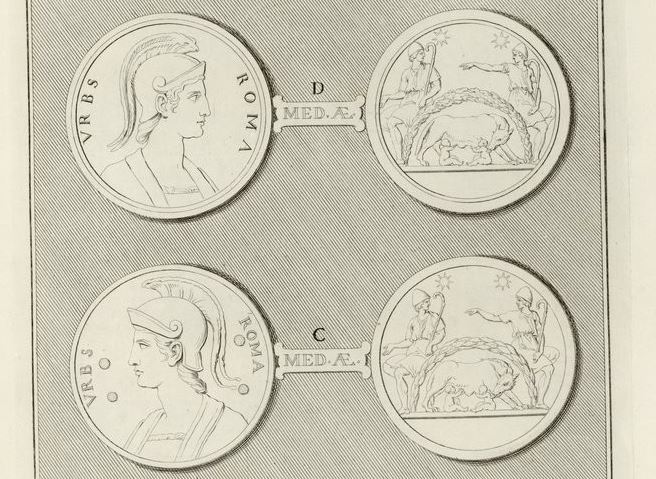
I’m in the last stages of getting ready to send an article out. This is my first ever pencil sketch of a coin (well part of a coin). Of course I used a light box and high quality image to produce it (I wanted it to be accurate after all!), but nonetheless I’m exceptionally pleased with how it turned out and how is emphasizes details I’m discussing in the publication.
Why can a candidate win the popular vote and lose the presidency? An Op-Ed from a Roman Historian
The “Founding Fathers” are often treated as a sainted lot. They like, all politicians, were engaged at their best moments in a grand compromise. A horse-trading of privileges, rights, and duties that leaves no-one happy, but, if successful, staves off civil war. At their worst, again like all politicians, they were engaged in the protection of their own self-interests and the interests of their kith and kin.
I’m not a U.S. historian, but I am an American and I do know quite a bit about the models on which our founding fathers drew. As our country faces again our deep divisions, I offer a question, a history lesson, and more questions for introspection.
Why can a candidate win the popular vote and lose the presidency?
In the grand compromise negotiated by the founding fathers at its heart was a struggle over balancing the rights of individual communities to be self-governing and the rights of individuals to be treated equally under the law. You may remember this from Social Studies, Civics Class, or American History 101 as the question of “States’ Rights” or the Federalists and the Anti-Federalists. Because the 13 original colonies already had independent political structures in place, there was no will among the elite to dismantle the existing entities and start anew, only a desire to unite these states into a more perfect union. “More perfect” meaning better able to assert itself on an international stage as a viable, powerful nation state.
This comprise is the same compromise that gave us a slave counting as 3/5s of a human being and the same compromise that was designed to keep a power balance between states with large slave populations and those with smaller or unacknowledged slave populations. This is also why you will hear some claim that the Civil War was not about slavery, but “States’ Rights”.
We may be in motto ‘one nation under god’ or e pluribus unum (out of many, one), but we are not under one law. We have the right to move freely between states (if we are privileged enough to have this economic mobility), but we must live under the different laws of each state while resident therein. These laws can be very different indeed. What power does the federal government have to unify individual rights? Only those constitutionally guaranteed. Which is, of course, highly dependent on how the constitution is interpreted (= why everyone is freakin’ out about the Supreme Court).
In the grand compromise of our founding, the restriction of the powers of the federal government was not only limited to the written constitution, but also by how we as citizens are allowed to participate in that central government. The electoral college is intentionally designed to restrict our ability to effect change by a simple popular majority. The design worked. Hillary will not be president.
Whaaaa?
Back to Civics class. The number of members of the electoral college, the people who actually choose our next president, is equivalent to the number of members of Congress. Each state gets 2 votes, one for each senator, and one vote for each member of the house of representatives. (DC get three, Puerto Rico and other territories get none; all further later political compromises.) Thus, no state has less than three, no matter its population. The distribution of representatives to the House between the states, and thus electoral votes, changes each census to reflect population shifts.
The media often talks about the importance of winning big states with large numbers of electoral college votes, but in fact the system is set up so as to privilege regions with low population densities. Your vote counts more in the electoral college if you live in a state with a smaller population:
The Texas voter has the least say and the Wyoming voter the most. This type of block voting intentionally suppresses the interests of the individual and prioritizes State identity. It is more important that the state gets its say than the individual.
To really drive this point home, consider this: states are allowed to choose by their own means who serves as delegates to the electoral college and those mysterious individuals are not by federal law constrained to follow the popular vote, although some 35 individual states do regulate how they vote. Theoretically, the electoral college could meet and elect whomever they chose and no constitutional crisis would follow. (Update: SCOTUS has moved us away from this as of 7/6/2020.)
The means by which we choose our president is not intended to be democratic in any pure sense of the term (demos = people, kratos = power, authority), but instead an expression of the States’ choice of leadership informed by a popular poll.
In our nation’s history we’ve been moving away from the compromises of our founding fathers towards more democratic institutions. We’ve tended towards a widening of the enfranchisement, incorporating women, former slaves and their descendants, and those between the ages of 18-21. Before 1913 US senators were chosen by the governments of individual states, not through direct popular election.
The question I put to you now, is this: is it more important to allow individual communities to be self-governing, or should we as one big, messy, divided nation, live by majority rule?
I myself am a Federalist. One Country. One People. One Law. This is largely informed by my reading of Roman republican history and the ways in which it demonstrates both the power and the disenfranchisement inherent in systems of block voting.
Our founding fathers were not enamored by the chaos of classical Athens’ radical democracy and its eventual, painful fall beneath the sway of the Spartans. They worried about how to unite and govern vast tracts of land and they took comfort in the successes of the Roman republic in the centuries before Julius Caesar, Augustus, and the rest of the Emperors featured in B movies. Our main sources on this form of government are Polybius, a Greek political detainee in Rome, who asked the question: How and by what constitution did Rome come to dominate the known world in just fifty-three years, and Cicero, a man from greater Italy who broke into Rome’s political scene by playing the arch-conservative. They gave us and our founding fathers an idealized vision of Roman government, both in their own way from an outside perspective.
One ideal they both communicate is still one of our most cherished values: the checks and balances between different branches of government. However, for Polybius and Cicero, the checks and balances were not exactly between branches of government, but instead between types of government: monarchical, aristocratic, and democratic. Ancient wisdom said you needed some of each, but not too much.
The ‘genius’ of the Roman system of block voting was that it appeared each individual had a say, but not all of those ‘says’ were in fact relevant. Another Greek historian commenting on Rome’s government, Dionysius of Halicarnassus, claimed that the true power of Rome rested in this appearance of democracy through its system of voting, without in fact having popular rule. In one Roman system of block voting, citizens voted in groups determined by wealth and age, with the groups of wealthier older citizens having fewer members than those with less property and fewer years. Fewer members meant more power because the individual votes carried more weight toward the block vote. Other Roman block voting systems were ostensibly tied to geographical origins and by extension family origin, but really meant that if you came from a poor urban background your vote would probably count much less than that of a leisured country dweller who decided to come to the city to cast a vote.
Block voting allowed the Romans to perpetuate the inequalities of their society. Block voting allowed our founding fathers to give significant concessions to the anti-Federalists and slave owners. Let us re-negotiate their grand compromise, as we have already done many times before. And, in doing so, strive once again to create a more perfect union.
Male God with Covered Head

This is a representation of the genius of the Roman people. The attributes are indisputable: foot on a globe, scepter, cornucopia, curule chair, crowned by victory. But what the heck is he wearing? Notice the drapery over and around the head. This is just not typical. Is it supposed to be a toga over the head for piety? I can’t think of another similarly dressed seated figure. Also notice below that the fabric comes around the arm and billows outward. I’d originally thought of this as fillets tided to the scepter, but I think not now. It seems to all be meant as one single garment.

We can compare the earlier full body representation of the genius of the Roman people on a rather poorly carved type:

CRRO Links 329/1 and 397/1. Links to illustrated specimens (here and here).
The closest seated bare chested figure with drapery over the head I can find is the Tiberius in the Vatican (if it has not been overly restored, that is):

Ptolemy XII’s Parentage
Below is a half finished post. Maybe it will be of interest to me again sometime in future. I rather wish before I started writing it I knew about this website:
http://www.tyndalehouse.com/Egypt/ptolemies/genealogy.htm
______
PXII is known by the pejorative epithet, Auletes, but ascended the throne originally as: Theos Philopator Philadelphos Neos Dionysos.
Whether PXII was born to a Ptolemaic queen or a Egyptian Concubine is a point of dispute in the ancient sources and among modern scholars. Here’s a use full footnote of references (Siani-Davies 1997):


It would be more useful if the references were accurate. The prologues to Trogus (not Justin) say nothing about the PXII’s parentage.
It would have appeared some where in these lines of Prol. 40:
How at Alexandria, after the death of Ptolemy Lathyrus, he was replaced on his death by his sons: one was given Cyprus, which the Romans took from him following the proposal of P. Clodius; the other fled to Rome when his arrest was called for during an uprising in Alexandria, and he later regained his imperium thanks to the war fought by Gabinius. On his death his son succeeded who, quarreling with his sister, Cleopatra, murdered Pompey the Great and also went to war with Caesar at Alexandria.
Justin’s epitome of Book 39.4 is the most promising source:
In Egypt, Cleopatra, being dissatisfied at having her son Ptolemy to share her throne, excited the people against him, and taking from him his wife Selene (the more ignominiously, as he had now two children by her), obliged him to go into exile, sending, at the same time, for her younger son Alexander, and making him king in his brother’s room.
The assumption seems to be that the Latin, indignius quod ex Selene iam duos filios habebat, refers to Auletes and the future king of Cyrene. But it was Cleopatra IV, not Selene who was driven into exile…
Justin’s epitome of Book 40 ignores Ptolemaic history. There is a similar reference at 39.5.2:
During the course of these proceedings, his natural brother, to whom his father had left the kingdom of Cyrene by will, died, appointing the Roman people his heir;
That’s Watson’s translation from 1853. Yardley gives it as:
Meanwhile, Ptolemy’s brother died. The son of a concubine, this brother had been left…
The Latin reads:
Dum haec aguntur, frater eius ex paelice susceptus, cui pater Cyrenarum regnum testamento reliquerat, herede populo Romano instituto decedit.
The Ptolemy under discussion here is PIX Lathyros, brother and rival of PX Alexander I. So this doesn’t help us get closer to PXII’s lineage. His father is clearly PIX Lathyros; the mother is in doubt. What this might help us with is proof that the son of concubine could ascend a throne in the Ptolemaic world at this time.
Pausanias 1.9.3 is a bit clearer
…Shortly after this Ptolemy met with his appointed fate, and the Athenians, who had been benefited by him in many ways which I need not stop to relate, set up a bronze likeness of him and of Berenice, his only legitimate child.
The relevant bit of the Greek is pretty clear: ἣ μόνη γνησία οἱ τῶν παίδων ἦν. Although this could at a stretch mean his only legitimate female off-spring… Pausanias seems to be seeking an explanation of why there is a statue of Berenice and legitimacy offers one possible explanation. She was also a very beloved figure unlike many other later Ptolemies.
Josephus Jewish Antiquities 13.349 has no direct comment on the matter:
but she immediately marched against him, with a fleet at sea and an army of foot on land, and made Chelcias and Ananias the Jews generals of her whole army, while she sent the greatest part of her riches, her grandchildren, and her testament, to the people of Cos.
We could only question whether Cleopatra, Mother of PIX, would describe the children of concubines as τοὺς υἱωνοὺς.
Appian, Civil War 1.102 is the most clear by implication, but does not actually speak to the issue directly:
Sulla decreed that Alexander (the son of Alexander the former sovereign of Egypt), who had been reared in Cos and given to Mithridates by the inhabitants of that island, and had fled to Sulla and become intimate with him, should be king of Alexandria. He did this because the government of Alexandria was destitute of a sovereign in the male line, and the women of the royal house wanted a man of the same lineage, and because he (Sulla) expected to reap a large reward from the rich kingdom. As Alexander behaved himself in a very offensive manner toward them, relying upon Sulla, the Alexandrians, on the nineteenth day of his reign, dragged him from the palace to the gymnasium and put him to death; so little fear had they of foreigners, either by reason of the magnitude of their own government or their inexperience as yet of external dangers.
The key language in the Greek seems like Appian’s speculation as to motivation: ἐρήμου τῆς Ἀλεξανδρέων ἀρχῆς ἀνδρὸς οὔσης καὶ τῶν γυναικῶν, ὅσαι βασιλείου γένους
The implication could be that neither Alexander or Auletes was borne from wedlock, but equally it could only mean that no other male candidate was in Egypt claiming the throne. Or, it could be that γένους refers to PXI Alexander II’s Greekness not his familial connection.
Appian Mith. 29.93 doesn’t make any sense as a reference. I think maybe this was supposed to be 23:
In the meantime Mithridates crossed over to the island of Cos, where he was welcomed by the inhabitants and where he received, and afterward brought up in a royal way, a son of Alexander, the reigning sovereign of Egypt, who had been left there by his grandmother, Cleopatra, together with a large sum of money
This is confused as there is only one son of Alexander mentioned and no other grandchildren. We know from other sources it was plural.
This footnote and set of sources I’m working through is all supporting this one sentence (Siani-Davies 1997: 308):
and when the new king ascended to the throne his right to rule was contested even by his own (probable) mother, Cleopatra Selene, who in 75 journeyed to Rome as the advocate of her two other sons who were said to be of ‘undoubted’ Ptolemaic provenance and hence prospective claimants to the throne of Egypt
This may be the context of the sarcastic context of Cicero’s comment in the Verrines about the importance of Verres potential future input on foreign affairs if acquitted (2.2.76).
However, let him come; let him vote war against the Cretans, liberty to the Byzantines; let him call Ptolemy king; let him say and think everything which Hortensius wishes him. These things do not so immediately concern us—have not such immediate reference to the risk of our lives, or to the peril of our fortunes.
The discussion later in the Verrines mentions the the two Syrian kings’ petition for Syria on behalf of themselves and their mother BUT not the presence of Selene in Rome.
Jos. AJ 13.419ff is not relevant only mentioning that Cleopatra Selene ruled over Syria (Ditto BJ 1.116 and Strabo 16.2.3).
—
That pattern of confusion over Ptolemaic genealogy is not limited to to PXII:


Notice how thin on the ground the actual source material is. So much of this depends on inference. Bennett continues to argue that there were ideological/religious reasons for Egyptian source to lie and thus the classical (Greek/Roman) are to be preferred. I find this not wholly convinciny. It is, however, fair to say from any perspective that Ptolemaic female lineage is malleable in its public presentation.
Sayings of and about Sulla
This paragraph of Appian (BC 1.101) reads very much like an excerpt from a collection of ‘wittisms’ or ‘memorable sayings’
So terrible was he and so uncontrollable in anger that he slew in the middle of the forum Q. Lucretius Ofella, the one who had besieged and captured Præneste and the consul Marius, and had won the final victory for him. He did this because, in spite of the new law, Lucretius persisted, though Sulla opposed and forbade, in being a candidate for the consulship while he was still in the equestrian order and before he had been quæstor and prætor, presuming on the greatness of his services, according to the former custom, and captivating the populace. Then Sulla assembled the people and said to them, “Know, citizens, and learn from me, that I caused the death of Lucretius because he disobeyed me.” And then he told the following story: “A husbandman was bitten by fleas while ploughing. He stopped his ploughing twice in order to clear them out of his shirt. When they bit him. again he burned his shirt, so that he might not be so often interrupted in his work. And I tell you, who have felt my hand twice, to take warning lest the third time fire be brought in requisition.” With these words he terrified them and thereafter ruled as he pleased. He had a triumph on account of the Mithridatic war, during which some of the scoffers called his government ” the royalty disavowed” because only the name of king was concealed. Others took the contrary view, judging from his acts, and called it “the tyranny confessed.”
The flea parable is particularly interesting in the tradition of parables. The triumphal jokes should be read in light of the tradition of Roman ribald songs as part of the ritual, particularly ones that poke fun of the commander. Cf. comments about Caesar and Nicomedes at the former’s triumph.
Numa in 88 BCE?

RRC 346 features both Numa and Ancus Marcius. Most of the plausible explanations for the series and its types relate to Ancus, Rome’s 4th king. Numa is typically explained as Ancus’ grandfather and thus the source of his elevated status and authority. BUT… I just came across this passage in Appian (Mith. 22) and it got me thinking:
When the consuls cast lots, the government of Asia and the Mithridatic war fell to [Lucius] Cornelius Sulla. As they had no money to defray his expenses they voted to sell the treasures that king Numa Pompilius had set apart for sacrifices to the gods; so great was their want of means at that time and so great their ambition for the commonwealth. A part of these treasures, sold hastily, brought 90,000 pounds’ weight of gold and this was all they had to spend on so great a war. Moreover Sulla was detained a long time by the civil wars, as I have stated in my history of the same.
Two (Fanciful?) Naval Monuments
RRC 438/1 and this fresco now in Palazzo Massimo, Rome:
Notice the similar hat on the figure on the left of the coin monument and the figure on right of the fresco monument. Not the same monument in any way, but perhaps good to think with in the context of each down the road…
Sacrificial Implements on Cast Coinage
This anonymous Etruscan series (based on an as of c. 177g) seems to demonstrate a continuity of symbolism between 3rd century inland Etruria and 1st century Rome regarding symbols of the priesthood. HN Italy 68a-e, Haeberlin pp 273-5, Vicari 219-23.
[Why can’t I find a digitized copy of Haeberlin’s Aes Grave? He died in 1925. Even allowing the full 80 years post the author’s death (German pre 1965 law), this would still have put it out of copyright more than a decade ago!]
Paestum’s Female Benefactor
I don’t really need to blog about the Mineia coinage because the excellent Warwick blog already did so!
My general gut feeling is not that she is issuing this coinage, but that the coinage of the city is honoring her for her generosity, a monument in miniature to say ‘thank you’ for her gift of a monument in… maximum?!