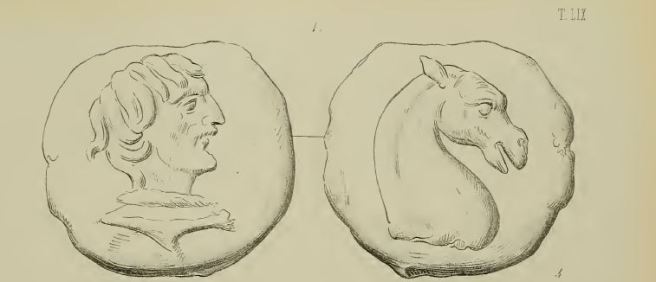
Garrucci says its in Pesaro! But Gorini 2010 clearly consulted the Pesaro collection… The plot thickens.


adventures in my head
Garrucci says its in Pesaro! But Gorini 2010 clearly consulted the Pesaro collection… The plot thickens.
I’m guessing the drawings on Carelli’s plates are just plain inaccurate and this fragment doesn’t exist at least not as shown, and thus we’ve all been led astray.
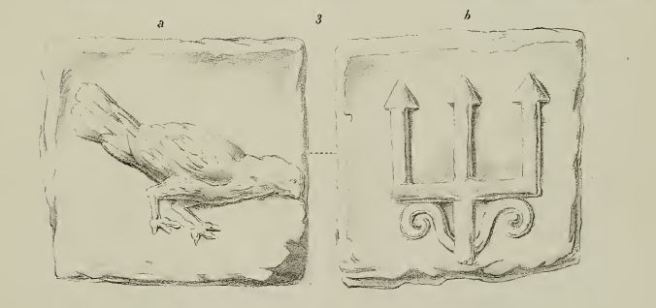 “Dalle tavole del Carelli (XL, 2), non dall’originale che non si sa dove stia. Il Mommsen cita negli Annexes p. 330 questo bronzo fra quei che portano per tipo al dritto due polli e al riverso due creduti tridenti e due delfini, ma sbaglia anche perchè lo strumento che è al riverso è un vero tridente sempre così effigiato sui quadrilateri come lo è uesto.” – Garruccii p. 11


I find it pretty odd that the Paris specimen is the only one with its fillet tied left, not right. I also note that spues are typically found at top of the caduceus not the bottom.
Food for thought….
Typical Spue direction also applies to one fragmentary specimen in trade.
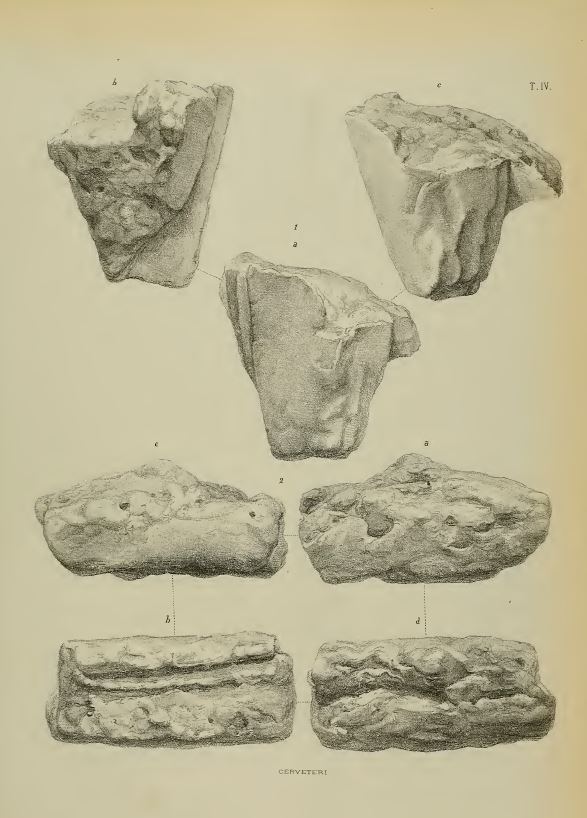
Garrucci, Plate IV ‘aes rude’ from Praeneste…


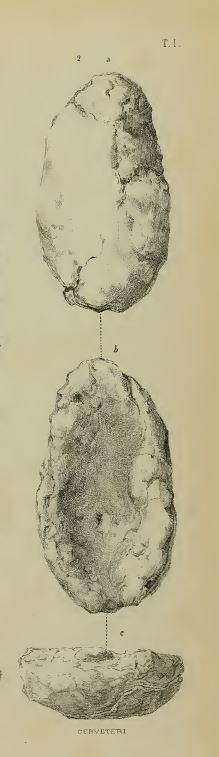
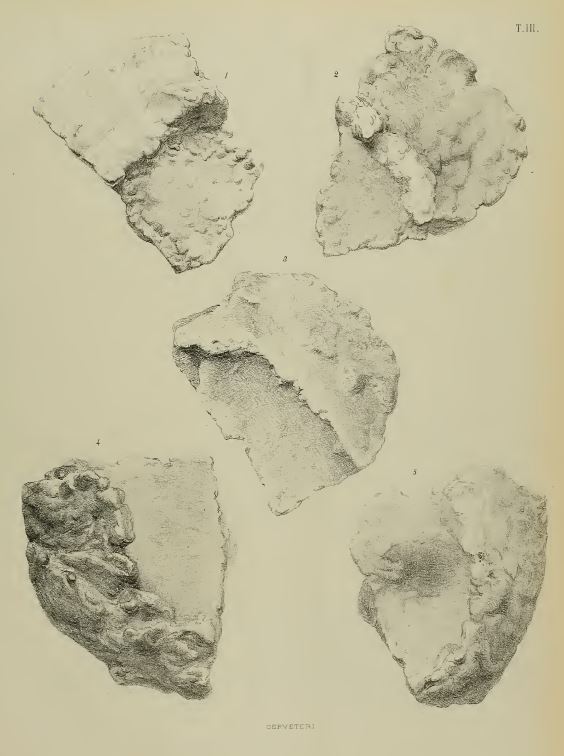
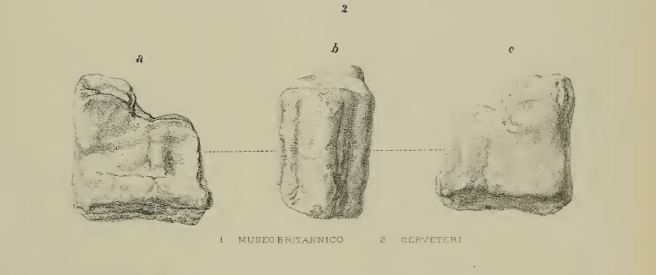
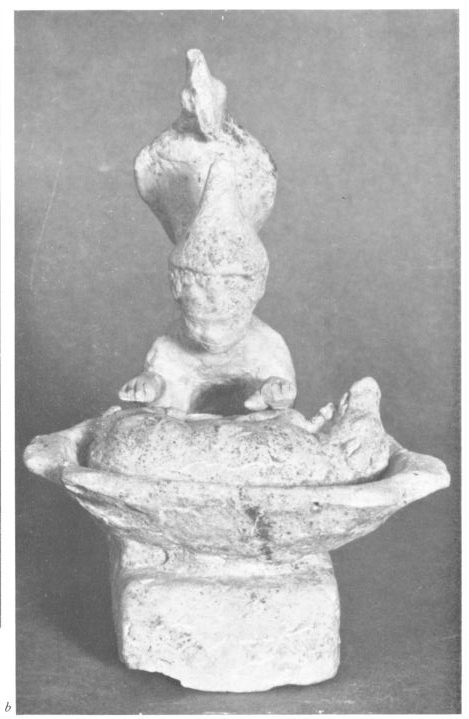
“In the midst of the ancient Cere that today is called Cerveteri, Mr. Filippo Calabresi digging a ditch at great depth came across a beautiful deposit of aes rude and signatum mentioned above. There were a hundred and sixty-seven pieces of various sizes which all together totaled one hundred and fifty pounds of copper, fortunately saved in time from the furnace. A piece of it appeared of pure copper without a mixture of tin as in Villanova, nor of zinc as in Vicarello, or of lead as in Marzabotto. Among many small pieces there were large ones that guided my study, and I also found a whole one, though a little flawed on the one hand as the metal in the bracket stopped. Still it was clear that it tended to a round shape (see plate II a, b). This helped me as a guide, so that the other fragments were also studied (plate III, 1-5), and I deduced that the metal was placed in a bowl, with a slightly concave bottom, or in a wide bracket in the shape of a cone inverted and with a mobile bottom. This became obvious when I saw how, around the bottom of these loaves, a burr formed which took the form of a base (see the aforementioned plate III).”


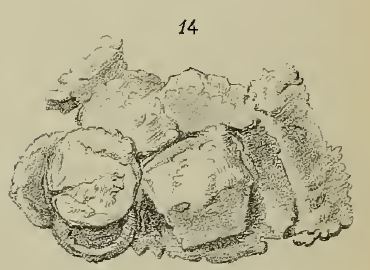
Fragment of RRC 9/1, the elephant and sow bar.
I find this identification hard to believe.
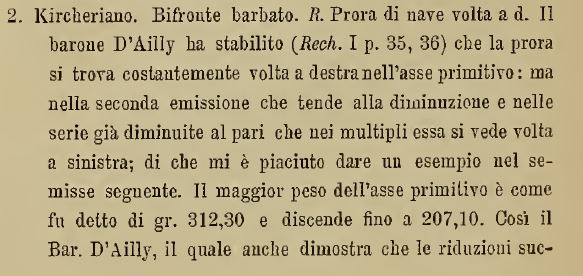

“… In the large deposit of primitive asses discovered at Cerveteri there were found three specimens weighing gr. 143,90; 147.80; 148, which seem to prove this deposit cannot have been made before the time of the semissal [e.g. semilibral] as.”

“Of this as the waters of Vicarello have sent sixteen specimens, and there were four from the Cerveteri hoard, others from the deposits of Monte Mario, others from that of the Ostia. Mommsen states with P. Marchi (H. de la monn. I, 185) that around Ostia a deposit was found only of these “asses” and more abundant than that of Monte Mario (L ‘aes grave 48): and adds that 1109 of this series together with 13 of the Roman series were taken from Vicarello. The truth is that P. Marchi counts only 13 “asses” with the two-faced on the obverse and the head of Mercury covered with winged petasus on the back, which were sent to him, I here and elsewhere I add to his calculations also those pieces then subtracted, which they came in my hand. In the place mentioned we note from Mommsen that in the vicinity of Trent the triens, the quadrans and the uncia of this series was were, per the testimony of Giovanelli (Dei Rezi, p. 81).”

“Three specimens of this bronze were found in the Cerveteri deposit and one was already from the excavations of Tarquinia.”


“… To determine the region, it is worth noting that ten specimens of the as were found in the deposit of Cerveteri and that from Monte Mario hoard they had it with the club and without (Marchi, L’aes grave 46). In my experience, two other specimens but without the club have come from the necropolis of Cerveteri and this same city has now also given five semisses…”
RRC 21 and 27 are indicated.
CHRR 53 reads: “Roma/Roma series 15 pieces without symbol”
It would seem that Garrucci means 10 asses WITH the club (or with and without the club) were part of the 1852 discovery (CHRR 53), when the semisses were found is not specified and that 2 more asses of the RRC 21 type were found after 1852.

Notes on

“Un ulteriore motivo di interesse è la provenienza, sia dal “deposito delle coppette” che in generale dall’area dell’edificio β, di vasi con sigle probabilmente latine33, indizio, seppure labile e sporadico, di una nuova frequentazione dell’area sacra, testimoniata forse anche dal rinvenimento nella zona di monete e di alcuni frammenti di votivi a stampo. Tra le monete, di particolare interesse un aes grave (Fig. 6a) quadrante della serie Bifronte/Mercurio34, D/mano aperta R/ due spighe di grano, rinvenuto in connessione con un’olla d’impasto che forse lo conteneva, secondo una modalità di offerta attestata anche altrove nel Santuario Meridionale (v. infra). ” – p. 130
“A further point of interest is the origin of a new utilization of this sacred area, as shown by both the “deposit of the cups” and vases with probably Latin inscriptions in general from the area of the β building33; albeit this is unstable and sporadic evidence. The same phenomenon is perhaps also evinced by the discovery in the area of coins and some fragments of mold votives. Among the coins, of particular interest is an aes grave (Fig. 6a) quadrans of the janiform head/Mercury series (O / open hand R / two ears of wheat) found in connection with an impasto olla that perhaps contained it, according to one offering modality attested also elsewhere in the Southern Sanctuary (see below).”
This language seems to suggest to me that there is more unpublished material and that the full context of the discovery of this RRC 14/4 specimen is not given here. I especially note that the olla which might have contain it (and other coins? a hoard?) does not seem to be among the pottery illustrated in this article.
“Anche l’altare ν (Fig. 1.3), a disco monolitico fungente, secondo la proposta di G. Colonna, da tavola per i sacrifici41, è stato forse fatto oggetto di offerte in una fase recente di frequenta zione come si desume dal rinvenimento, insieme a ceramica a vernice nera e tegole di II e III fase, di un’oncia della serie Apollo/Apollo con grano d’orzo (Fig. 6b), degli inizi del secondoquarto del III secolo, attribuita a zecca romana42, attestata anche nel pozzo S del Santuario Monumentale43. Come già anticipato, due once di questo tipo sono state rinvenute nell’olla deposta nelle fondazioni della torre meridionale delle mura del Santuario di Sol Indiges a Torvaianica, associate con altro aes grave44.” – p. 131-133
“Also the altar ν (Fig. 1.3), with a monolithic disc acting, according to the proposal of G. Colonna, as a table for sacrifices41, has perhaps been the object of offering in a recent phase as can be seen from the discovery, together with black-glazed ceramics and II and III phase [roof?] tiles, of an uncia of the Apollo / Apollo series with barley grain (Fig. 6b), from the beginning of the second quarter of the third century, attributed to Roman mint42, also attested in the well S of the Monumental Sanctuary43. As already mentioned, two uncia of this type have been found in the olla deposited in the foundations of the southern tower of the walls of the Sanctuary of Sol Indiges in Torvaianica, associated with other aes grave44.”
“n. 43 – Baglione 1988-89, pp. 127, fig. 101.3, 129, n. 3, fig. 101.”
Bibliography: Baglione 1988-89: M.P. Baglione, «Le monete», in Pyrgi 1988-89, pp. 126-131, 322-324.
“Alcune di esse sono provviste di iscrizioni23: si segnala in particolare un esemplare dell’atelier des petites estampilles24 con, all’interno della vasca, l’iscrizione vei[-]is (Fig. 5b) interpretata da D.F. Maras come la resa etrusca del teonimo latino Veiovis 25. Tale dato potrebbe confermare l’ipotesi fatta in precedenza da G. Colonna dell’esistenza di un rapporto tra la divinità latina e il dio Śur/Śuri del Santuario Meridionale26, sulle cui valenze cultuali lo studioso si è soffermato anche di recente27.” – p. 129
” Some of them are provided with inscriptions23: we note in particular an example of the atelier des petites estampilles24 with, inside the bowl, the inscription vei [-] is (Fig. 5b) interpreted by D.F. Maras as the Etruscan rendering of the Latin theonym Veiovis 25. This datum could confirm the hypothesis made previously by G. Colonna of the existence of a relationship between the Latin divinity and the god Śur / Śuri of the Southern Sanctuary26, on whose cultic aspects he has recently published 27.”

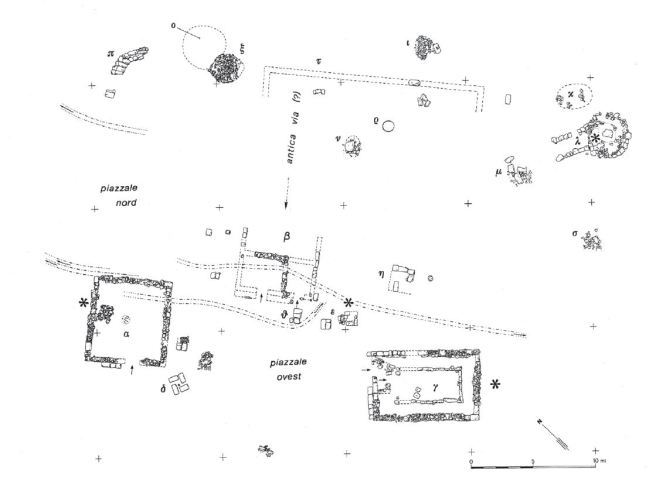
“2. Le azioni rituali relative al settore orientale (fossa ο, struttura π, muro τ), al sacello α e al piazzale nord.
Particolarmente significativo è il rinvenimento nella fossa o di 23 reperti numismatici 88, tra i quali un frammento di aes signatum riferibile, con ogni probabilità, al tipo con àncora e tripode (Fig. 13a) 89, attestato nella stipe votiva di Vicarello, a Castelgandolfo, da una località tra Roma e Napoli90, a La Bruna presso Spoleto91, sulla Via Tiberina presso Roma ed a Mazin in Croazia. I quadrilateri interi finora rinvenuti, di questo tipo, hanno un peso compreso tra gr. 1495 e 183092; il nostro frammento pesa gr. 55,30, pesoche potrebbe corrispondere a quello di un asse estantario. Tra gli esemplari meglio conservati, si segnalano quello di Berlino93 da La Bruna (presso Spoleto) del peso di gr. 999,99 (cm 18,7 × 8,7) e di Londra94 dai dintorni di Castelgandolfo del peso di gr. 1495,06 (cm 18,3 × 8,9)95.
Il Nenci96, sulla base di uno studio dell’Alföldi, ritiene che anche l’aes signatum con i tipi dell’àncora e tripode possa essere ricollegato a determinati eventi bellici che con tali simboli Roma intese commemorare. Nello specifico, il simbolo dell’àncora “riconduce ad un momento della progressiva affermazione di Roma sul mare”, mentre il tripode andrebbe ricondotto alla simbologia monetale di una ben determinata città della Magna Grecia conquistata da Roma, Crotone (277 a.C.) o, secondo A.G. Fusi-Rossetti, Taranto (272 a.C.)97. Secondo il Crawford, questo tipo di aes signatum è stato prodotto durante la guerra contro Pirro98 ed il ripostiglio de La Bruna, con la presenza di tre varietà di aes signatum (tra le quali, come abbiamo visto, anche la nostra), assume un simbolismo navale, difficile da immaginare prima che Roma fosse divenuta una potenza navale durante la Prima Guerra Punica99. Recentemente anche C. Steinby ha sostenuto che, pur non potendo mettere in connessione queste “bars” con alcun evento (bellico) certo, le raffigurazioni poste su di esse hanno un chiaro messaggio e fanno riferimento all’espansione romana e all’accresciuta importanza della flotta romana100. Il Milani aveva collegato il tripode al culto di Apollo Delfico101 e l’àncora con una spedizione oltremarina; il quadrilatero pertanto doveva essere collegato con “qualcuna delle solenni circostanze in cui i Romani furono consigliati di rivolgersi a Delfi ed al culto di Apollo αjλεξίκακος (Medicus, Salutaris, Conservator)102. L’offerta di un quadrilatero che reca su un lato la raffigurazione di un tripode delfico e sull’altro, com’è lecito supporre, un’àncora, in un santuario sul mare dove si venera Apollo/Śuri, nel porto principale della città di Caere, sembra, forse, non casuale.” – p. 141-142
“2. The ritual actions related to the eastern sector (pit ο, π structure, wall τ), to the α sacellum and to the northern square.
Particularly significant is the discovery in the pit O of 23 numismatic artifacts 88, among which a fragment of aes signatum referable, in all probability, to the type with anchor and tripod (Fig. 13a) 89, attested in the votive deposit of Vicarello, in Castelgandolfo, a place between Rome and Naples 90, in La Bruna near Spoleto 91, on the Via Tiberina near Rome and in Mazin in Croatia. The entire quadrilaterals so far found, of this type, have a weight included between gr. 1495 and 183092; our fragment weighs gr. 55.30, pesoche could correspond to that of an extraneous axis. Among the best preserved examples, we note that in Berlin 93 from La Bruna (near Spoleto) weighing gr. 999.99 (cm 18.7 × 8.7) and in London 94 from the surroundings of Castelgandolfo weighing gr. 1495.06 (cm 18.3 × 8.9) 95.
Nenci 96, based on a study by the Alföldi, believes that also the aes signatum with the types of the anchor and tripod can be connected to certain war events that with such symbols Rome intended to commemorate. Specifically, the symbol of the anchor “leads back to a time of the progressive affirmation of Rome on the sea”, while the tripod should be traced back to the symbolism of a well-defined city of Magna Graecia conquered by Rome, Crotone (277 BC) or, according to AG Fusi-Rossetti, Taranto (272 BC) 97. According to Crawford, this type of aes signatum was produced during the war against Pyrrhus 98 and the La Bruna hoard, with the presence of three varieties of aes signatum (among which, as we have seen, also ours), takes on a naval symbolism, difficult to imagine before Rome became a naval power during the First Punic War99. Recently also C. Steinby has argued that, although they cannot connect these “bars” with any certain (war) event, the representations placed on them have a clear message and refer to the Roman expansion and to the increased importance of the Roman fleet100. The Milani had linked the tripod to the cult of Apollo Delfico 101 and the anchor with an overseas expedition; the quadrilateral therefore had to be connected with “some of the solemn circumstances in which the Romans were advised to turn to Delphi and the cult of Apollo αjλεξίκακος (Medicus, Salutaris, Conservator) 102. The offer of a quadrilateral which bears on one side a depiction of a Delphic tripod and on the other, as one might suppose, an anchor, in a sanctuary on the sea where Apollo / Śuri is venerated, in the main port of the city of Caere seems, perhaps, not accidental.”
“n. 90 – Gorini 2004, p. 162, con bibl. cit. L’esemplare pesa gr. 1645.”
“n. 95 – Il Milani per l’esemplare del British Museum fornisce come provenienza Genzano ed il peso di gr. 1494,53.”
“n. 95 – For the BM example, Milani gives Genzano as provenance and the weight of gr. 1494.53.”
N.B. Milani (p. 35) is relying on Garrucci for find location. Gezano has a connection to the Gandolfo family but is 6.5 km south of Castel Gandolfo. I notice that Crawford lists as CHRR 14 a Gezano before 1885 hoard with 2 semisses of the RRC 14 series which he gets from Garrucci, p. 20. Should CHRR 14 and CHRR 2, possibly be combined!? Link to BM Specimen.


Bibliography: Gorini 2004: G. Gorini, «Le monete del santuario di Gravisca», in F. Colivicchi, Gravisca. Scavi nel santuario greco. I materiali minori, Bari 2004, pp. 159-171.


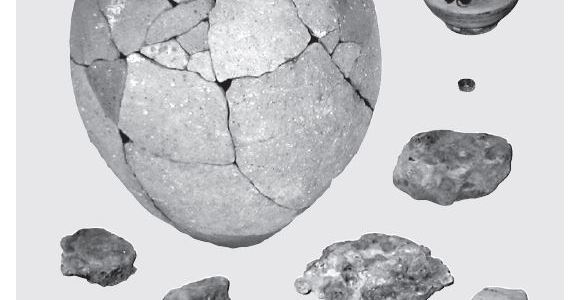
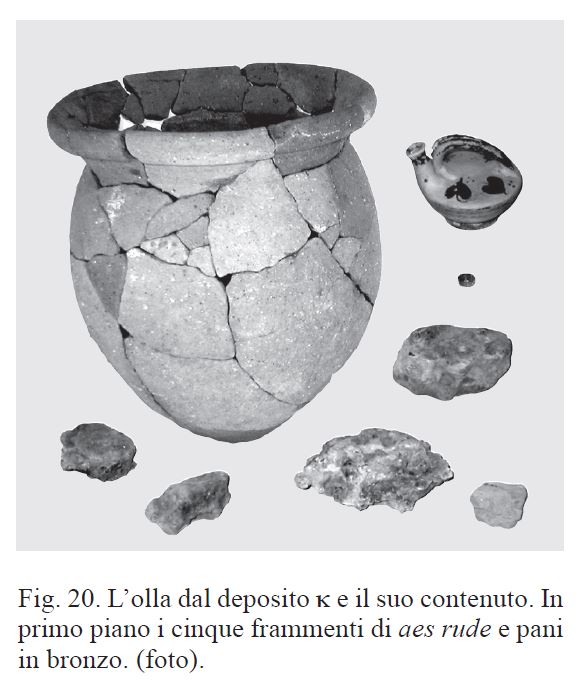


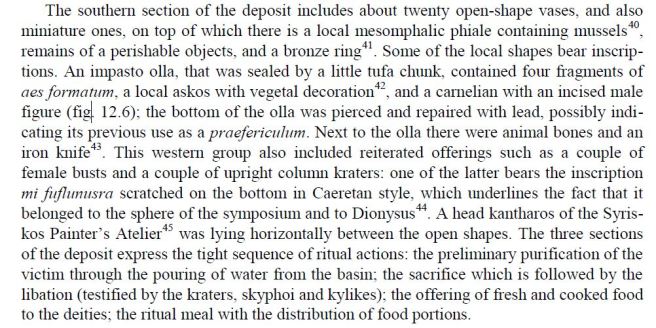
An English Language Paper on the Sanctuary in General and also discussing Aes rude Olla hoard:
[Part Human (me), Part Machine (google) Translation]
“The discovery of this hoard took place by chance in the spring of 1890 at La Bruna[1] in the municipality of Castel Ritaldi, a few steps from the Tatarena ditch, almost in the center between Spoleto, Trevi and Todi, in the heart of Umbria.
“A farmer, hoeing the earth, first came upon the bar shown on plates 4-5, which in fact presents the trace of the hoe on the basin of the tripod, then found four asses of the type shown on plate 14 [Apollo/Apollo]. He immediately took them to his patron, a certain Mr. Francesco Venturi, and the latter, on the next day, that man found himself at the find spot, poking the ground and looking more closely. He picked up all the other pieces that make up the treasure: that is, four other whole bars of aes signatum, two broken bars, plates 12-13, the piece of aes rude, plate 1, and four other libral asses, together with a few fragments of clay pots and some animal remains.
“The said Mr. Francesco Venturi brought the precious deposit to Rome, and showed it to the General Directorate of Antiquities and Fine Arts. There those pieces were believed to be false, and a hoax; and the same erroneous judgment having been confirmed to Venturi also by a well-known Roman antiquarian, he returned dejected and turned back to his own country.
“Venturi retained the discredited objects until the end of November, when, having come into contact with the expert antiques dealer Mr. Giuseppe Pacini of Florence, could soon, and to his no small satisfaction, conclude the sale of the entire treasure. The merchant Pacini paid a large sum for it (about L. 9000 [equivalent to more than $18k today]), and he was not wrong to judge the find above suspicion. When he came to show it to me, I did not believe my eyes, seeing pieces of such extraordinary rarity, in such preservation, and with patina and such characters, as to leave no doubt about their authenticity.
“I was able to study this illustrious deposit in the short time it remained in the hands of the merchant Pacini; I took the photographs, slightly reduced, which served to the annexed photo-etchings, and had the casts of every single piece executed in the workshop of the R. Etruscan Central Museum, in anticipation of the further dispersion of the originals. Our Museum, due to lack of funds and the natural claims of Pacini, could no longer aspire to such a purchase. No later than early January, Mr. Pacini had found the buyer of the entire closet in the person of Dr. Tommaso Capo, a well-known lover of Rome, who has already begun the dispersion too, putting a part of it for sale in a public auction.
This is the true story of the discovery, and the ups and downs so far suffered by this hoard.
The fragments of the vase and the animal remains collected together with the pieces of aes grave were recovered by Mr. Giuseppe Pacini, following my expression of interest and sold by him to me. Shortly, I will exhibit them in the Central Etruscan Museum, together with the aforementioned casts; meanwhile I offer here the detailed description:
a) Two fragments of a large and robust dolio of primitive dish. The thickness varies from 0.027 to 0.035; the largest piece measures 0.09 X 0.21. The clay is almost black on the inside (soul) and reddish on the outside.
b) Band amphora loop (0.05 wide), attached to its mouth. It can be assumed that the mouth of the vessel had a centimeter diameter. 15 to 20. The clay is of an ashen-like fine mixture with a brick red outer coating.
e) Fragment of an ordinary black bucchero bowl, externally brownish, perhaps lid of the vase b; presumable diameter 0.15.
d) Fragment of the mouth of a midsized olla in ordinary red earth (thickness 0.07).
e) Bottom of a very fine yellowish earthenware vase, likely coming from a small olla or an Italo-Pelasgic cup.
f) Fragmentary femur of a horse.
g) Other leftovers of animal skeleton, and horse tooth.
“Here is the description of the seventeen monetary pieces that make up the actual treasure: …”
[1] La Bruna, about 11 kilometers from Spoleto, is a small place, with a church and an inn, which is marked on the military topographic map.
Interestingly Capo sent a catalogue of his collection this year to the Royal Numismatic Society:
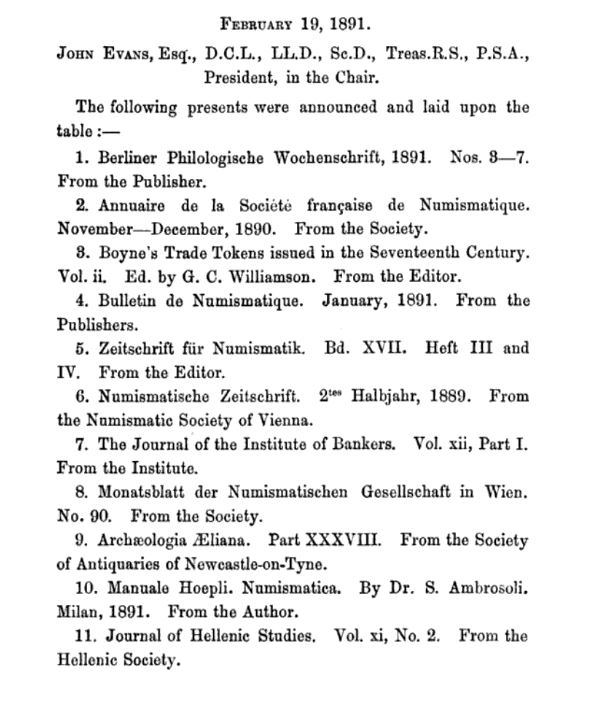
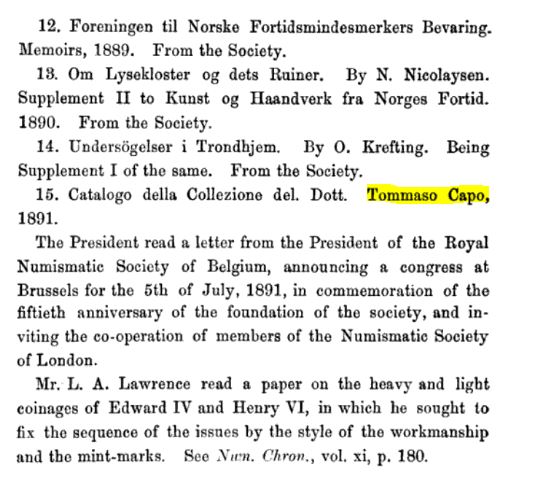
BECAUSE…
It was a sales catalogue and he wanted buyers:
Capo, Tommaso. 1891. Catalogo delle monete greche, romane, primitive, consolari, imperiali, italiane medievali, moderne possedute dal Dott. Tommaso Capo, che si venderanno al pubblico incanto per cura del Cav. Ortensio Vitalini, numismatico in Roma, a principiare dal 9 marzo. Roma: Tipografia A. Befani.
(Links to WorldCat entry) And, thank goodness, the ANS has a copy and I will get to see that Tuesday. More then I’m sure.
And of course he found them as Crawford in CHRR (16) reports that most of La Bruna is now in the Staatliche Museen zu Berlin… BUT, Berlin is supposed to be in CRRO and at least some of these pieces aren’t there (Eagle/Pegasus for example). Perhaps Berlin collection is not fully digitized? One of the Anchor/Tripod type is online and it was acquired in 1940 from Haeberlin. So perhaps Haeberlin was the primary buyer at the Capo auction?
Needs checking.
The report of Capo’s sale is in the same volume of RIN as Milani’s hoard report above!
Capo’s status/reputation as a dealer seems confirmed by this footnote.
But here he is described as a passionate numismatist and medical doctor. But the context suggests pieces that passed through his hands may have been ‘improved’.

The BM online collection search is really buggy right now. I’ve been using a google advance search as an alternative.
—
A place for me to hold images.

BM 2005,0927.101 (see curator notes!)



Addition 19 Jan 2021:


La Bruna
The closest parallel for this ‘fancy’ terminus for the scabbard is Haberlin 1910: pl. 32.2
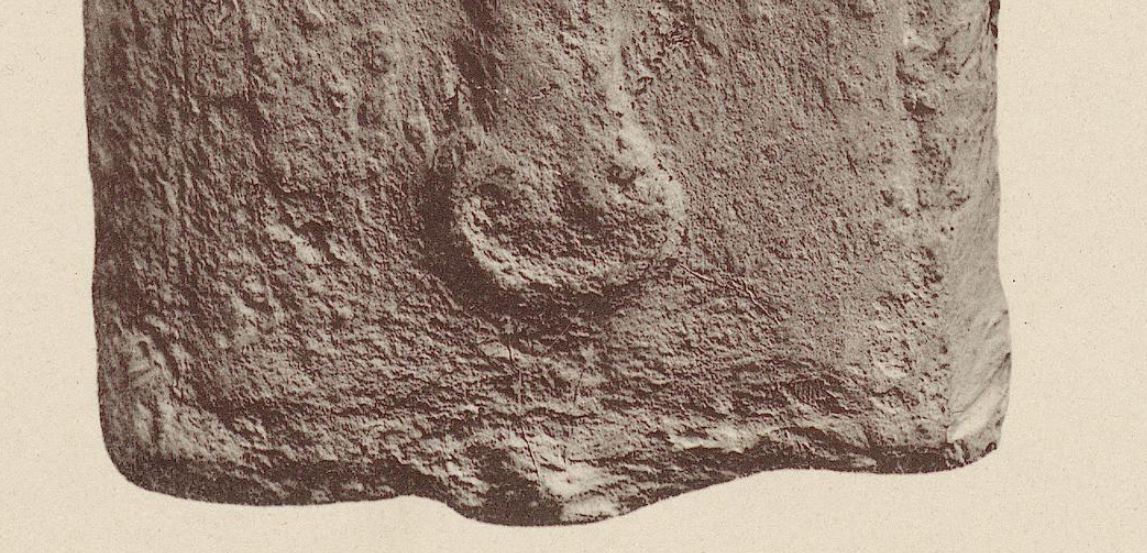
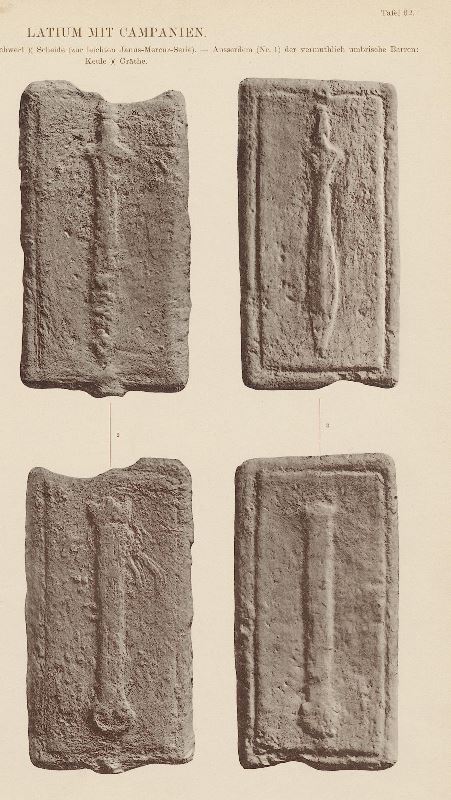
Haberlin 1910: 62
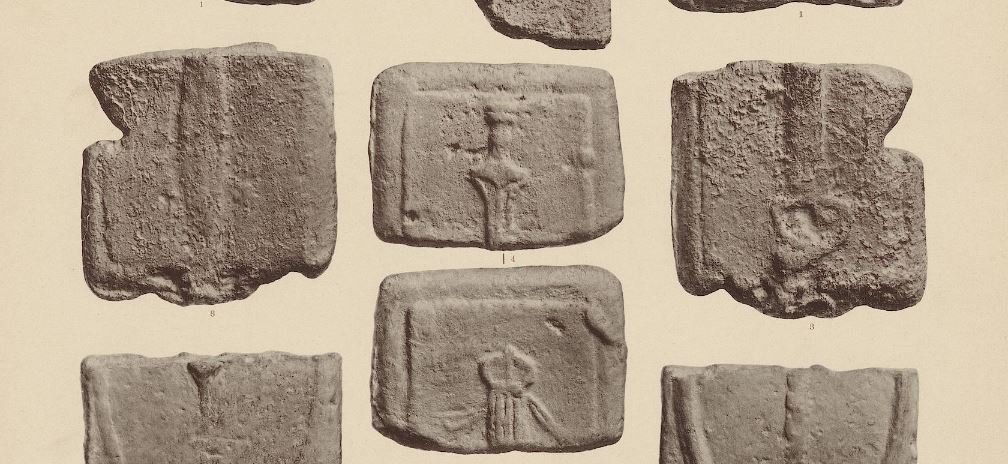
Haeberlin 1910: pl. 60
The Vienna and BM specimens are close to each other in rendering. (Too close?!)


British Museum 1867,0212.7


Vienna FA 4170
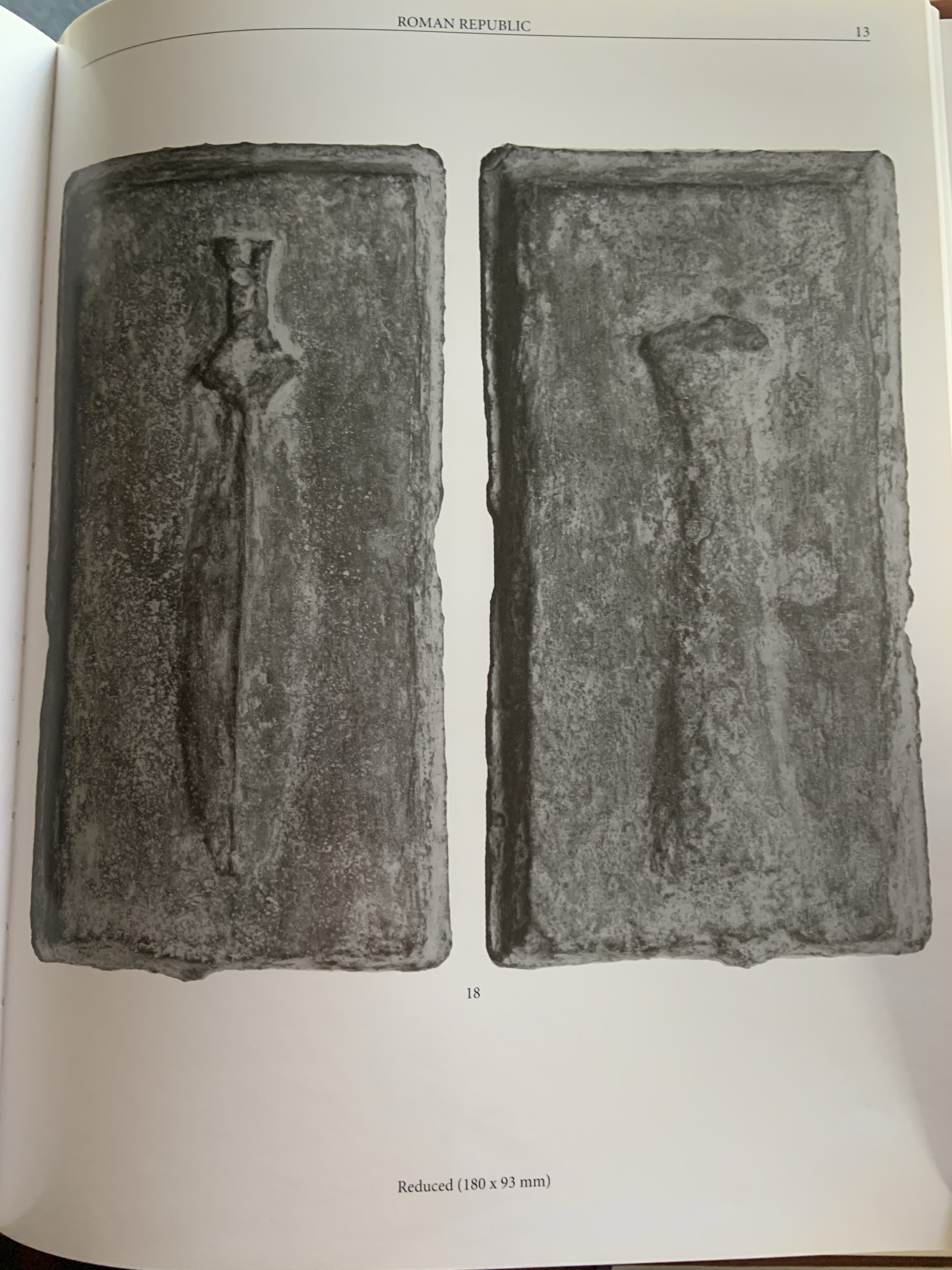
The bar of this type illustrated by Vecchi 2014 is very different in style indeed:
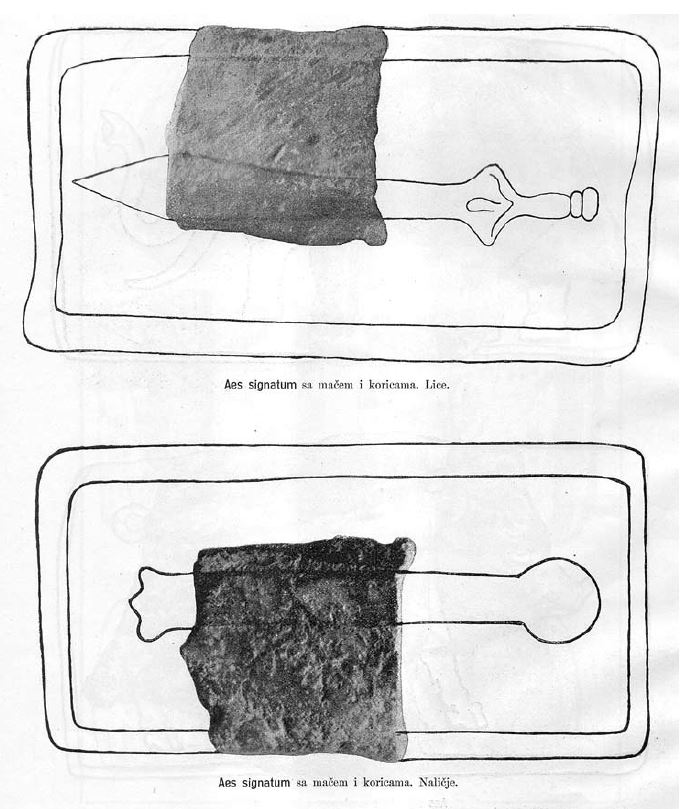
The Mazin find is so small the drawings don’t add much:
Still to be tracked down and checked: Ariccia 1848 and Velletri 1784
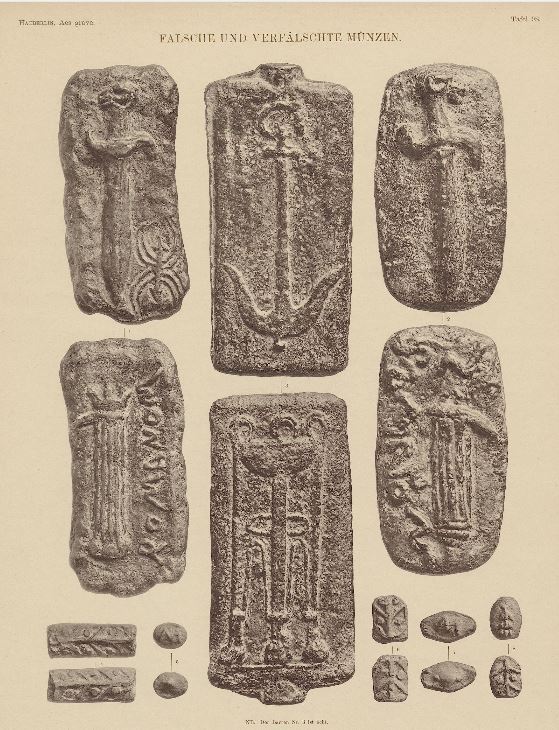
Fakes known in 1910