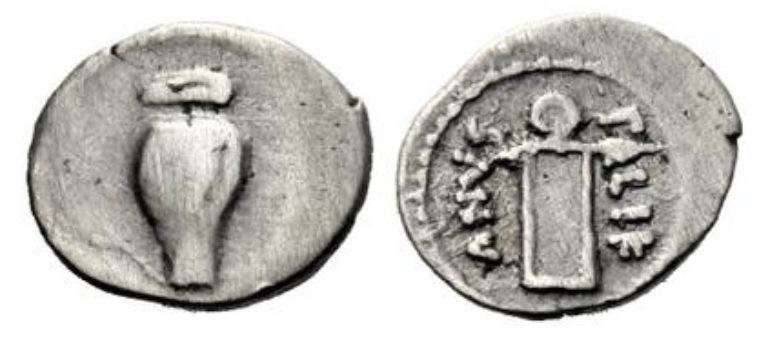
If you happen to follow me on social media you will already know I got some awesome news today. My colleagues and I won a grant to non-invasively analyze the interior composition of a handful of Aes Grave specimens excavated from Nemi in the late 19th century. This technique lets us take multiple targeted readings at different depths and then compare different specimen. A huge advance over the pXRF surface reading and shallow drilling, this data will contextualize my other data and also allow us to ask better questions of the material. I hope we will also know more about the relationship of RRC 14 and 18.
I know many of you will have questions about the nature of the work. Below is the narrative from our grant proposal.
The Cu:Pb:Sn Alloy at the Heart of Rome’s Earliest Cast Coinage
L.M. Yarrow (CUNY), W. Powell (CUNY), A. Hillier (STFC), A. Inscker (Nottingham)
Background and Context
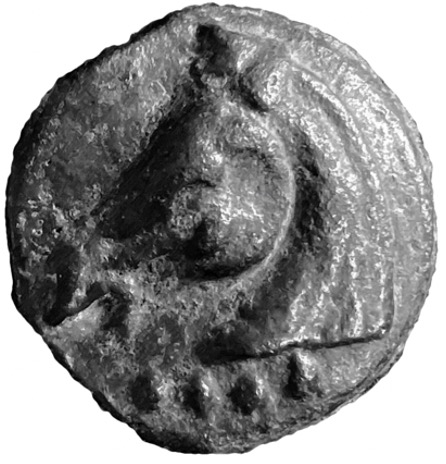
This cultural heritage proposal seeks to determine the composition of Rome’s earliest cast coinage, called aes grave, ‘heavy bronze’. The results of our experiments will produce a more accurate picture of early monetization in the Roman economy and may confirm a new hypothesis that these unusual coins had little intrinsic value, being more akin to bitcoin than bars of bullion. This key historical case raises questions of the very nature of money itself. The standard reasoning to explain the heaviness of earliest Roman coins is that such mass was required to achieve sufficient intrinsic metal value. It has been hypothesized that the Romans adopted the tradition of northern and central Italic peoples of using crudely shaped copper alloy ingots as money and married this tradition to the design habits of the silver coins used by Greek inhabitants of southern Italy. This resulted in a heavy copper alloy coinage with fixed denominations and intrinsic value that was recognizable as money to all peoples in the Italic peninsula.
Underlying this assumption is that the Italic copper alloy ingots also had intrinsic metal value as a commodity, and so were used widely as bullion and money. This has been called into question by metallurgical testing of archaeological finds. (1,2) My recent re-analysis of metrological data of these coins also suggests they are unlikely to have any significant intrinsic metal value.(3) Accurate analysis of the bulk composition of these coins would serve to test this new hypothesis. The material from Lord Saville’s 1880s excavations at the sanctuary of Diana at Nemi is curated by Nottingham City Museums & Galleries. As a securely provenanced collection of aes grave, they will serve as the ideal specimens for such analysis. The findings from our experiments will be contextualized with previously published data and our own data collection for specimens without archaeological provenance in other major museum collections. Besides work-to-date detailed in section III below, I have a fellowship for March 2024 to study related artifacts in Staatliche Museen zu Berlin. All this analysis seeks to define the role of bronze in the third century BCE Roman and wider Italic economy which in turn will help us better understand the socio-economic role of all bronze objects from this period, from their military applications to their status as religious offerings, including but not limited to those headline grabbing discoveries from the Etruscan site at San Casciano dei Bagni.
Proposed Experiment
Two forms of corrosion may develop on leaded tin bronze: 1) a thin and even two-layer structure (noble patina); 2) a thicker uneven and pitted three-layer structure.(4,5,6) In either case, weathering in the absence of Cl results in loss of Cu and an increase in Sn within the corrosion layer, and so the patina masks the true original composition from any form of surface analysis. Of even greater importance, Pb does not alloy with either Cu or Sn. Molten leaded bronze will separate into two immiscible liquids at the onset of cooling. The composition of both will evolve during crystallization, with the Pb-Sn-rich component compositionally fractionating over a greater temperature range(7). Thus, it is expected that significant compositional variations and heterogeneities will be present in sizable artifacts that were not quenched upon casting. Given such compositional variation between surface and interior, neither surface analysis (e.g., pXRF) nor near-surface sampling (e.g., shallow drilling) will yield the true bulk composition of the object (8,9). The unique cultural heritage value means destructive techniques such as deep drilling would be unethical. Therefore, analysis of sizable Pb-Sn-bronze artifacts such as aes grave requires a non-destructive, deep-penetrating method that can document variation in composition with depth, and position. Negative muon spectrometry is ideal for this purpose.
The proposed experiment seeks to characterize the patterns of internal compositional variations within a set of the earliest aes grave (RRC 18) of varying size (denominations: 1, 1/3, 1/6). And for comparison, one 1/6 denomination from RRC 14, considered to be of the same approximate date. Compositional variation with distance from the outer surface of the coin is expected based on the results of the negative muon experiment of Cataldo et al. (2022)(4); interior metal would have crystallized later from a more compositionally fractionated molten residuum. Additionally, gravity-driven segregation of the Cu-rich and Pb-rich melt would likely cause a gradient of increasing Pb-content of the alloy from the bottom to the top of the mold (sprue to sprue). It is also expected that compositional heterogeneities will decrease from larger to smaller objects.
The data will then be used to model the Cu-Pb-Sn ratios of the bulk recipe used to manufacture each coin, and the validity of the result will be tested with mass calculations based on the ratio of Cu:Pb:Sn, elemental densities, the mass of the coin, and its volume. Results from this test will be used to iteratively improve the composition model. Ultimately, the results from these first experiments, and the method for modelling bulk composition from depth profile data will form the basis for the design of future experiments that will investigate patterns in aes grave composition over time and value in order to determine whether the Romans had a relative consistent ‘recipe’ and allow us to assess the economic value of the raw materials used as money in this period.
Summary of Previous Beamtime or Characterization
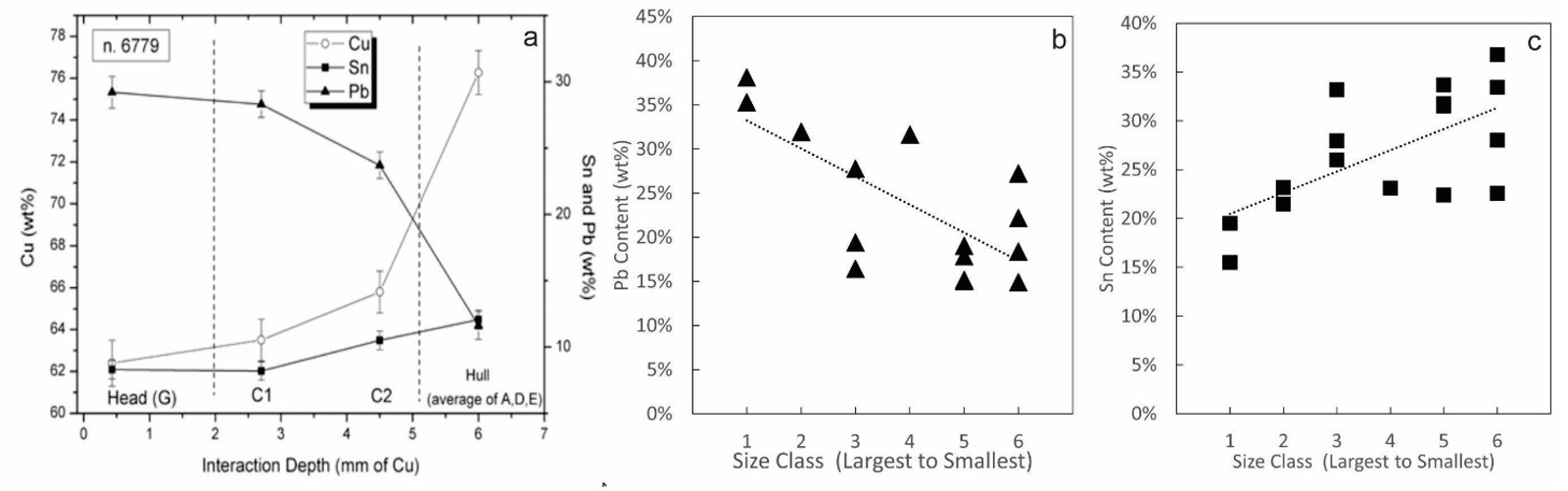
Compositional depth profiling of a leaded-bronze artifact using muonic X-ray spectroscopy documented a gradual 17wt% decrease in Pb and a 14wt% increase in Sn from the surface to a depth of 6mm (10) (Fig. 1a). This clearly demonstrates the contrasting surface and interior compositions that are inherent to high-Pb bronze. In addition, we conducted pXRF analyses on aes grave from curated collections at Yale, Princeton, and Rutgers University. Subsequently, we analyzed the 56 specimens of the Nemi collection at Nottingham. The 145 analyses of corrosion-free objects (i.e., O, C, S, or Cl) indicate that surface Pb concentration decreases while Sn increases as the size of the artifact decreases (diameter and thickness) (Fig. 2a and b). It is illogical to conclude that the manufacturers of these coins chose to enrich the smallest denominations of their coins in the more valuable of the metals (Cu, Sn) and debase their largest denominations with lead. More likely, these patterns in the pXRF reflect compositional variations resulting from greater segregation of immiscible melts in larger castings with slower cooling rates.
Justification of Beamtime Request
The UKRI ISIS Muon and Neutron Facility has experience with depth profile analysis of Pb- bronze, and the artifacts that will be analyzed are curated by a UK cultural institution (Nottingham City Museums & Galleries) facilitating transport. Thus, the ISIS facility is the ideal site to undertake the work. 112 hours of beam time would allow for initial analysis of 1 in-house Pb-bronze alloy (4 analyses; c. 16 hours), as well as 24 analyses to test for compositional zoning due to gravitational settling as well as edge-to-center cooling in 4 cultural heritage objects. Given a maximum depth of 10mm, the approximately 20mm-thick 1/3 denomination will be used for the most detailed and complete interior characterization: 8 evenly spaced analyses through the maximum thickness at the center of the coin, beginning at a depth of 0.5mm (flip specimen half-way), and one central analysis at each of the sprue ends (10 analyses; c. 40 hours). Analysis of a 1 denomination coin (c. 20 mm thick) will investigate the maximum potential internal composition al variation: at thickest point, 1 mm and 1cm depth on each side, as well as ¼, ½ of the way through at each of the sprue ends (8 analyses; c. 32 hours). Analysis of a 1/6 denomination coin (c. 10 mm thick) will investigate possible homogeneity of composition in the smallest denominations: at thickest point, three analyses at depths of 1mm, ¼ depth, and at the core (3 analyses; c. 12 hours). This will be repeated on a second 1/6 denomination, this one from RRC 14 to compare composition of coins thought to be of similar age (3 analyses; c. 12 hours).
1 Baldassarri, et al. (2006). Analisi LIBS di esemplari di AES Rude… Cong. Naz. di Archeometria IV, 561-573.
2 Ingo et al. (2005). Microchemical investigation of archaeological copper… . Microchimica Acta 144, 87-95.
3 Yarrow. (2023). Strangeness of Rome’s Early Heavy Bronze Coinage. In Making the Middle Republic, 103-31.
4 Robbiola, et al. (1998). Morphology and mechanisms … archaeological Cu-Sn alloys. Corr. Sci., 40(12), 2083-2111
5 Constantinides et al. (2002). Surface characterization of artificial corrosion layers … . App. Surf. Sci, 189, 90-101.
6 Nørgaard, H. (2017). Portable XRF on prehistoric bronze artefacts… . Open Arch., 3, 101-122.
7 NIST Material Measurement Laboratory. https://www.metallurgy.nist.gov/phase/solder/cupbsn.html
8 Burnett, et al. (1986). “Early Italian currency bars.” Italian Iron Age Artefacts in the British Museum.
9 Westner, et al. (2020). “…compositional and Pb isotope data of (leaded) copper-based alloys…” JAS 121, 105-204.
10 Cataldo et al. (2022). A novel non-destructive technique for cultural heritage … negative muons. App. Sci., 12, 4237.


























 Liv Mariah Yarrow