
Ideally, one dates coins by the hoard evidence. People squirrel away pots of money and for whatever reason never come back for their savings. These groups of coins help numismatists figure out which coins were minted in what sequence. The numismatist takes all the hoards and tries to arrange them into a sequence of newest to oldest based on the contents. They end up with a much more complicated version of a chart like this one with the coin makers down one side and hoards down the other with the number of attested specimens of each specimen listed:

The wear of the coins — a subjective judgment up to a point — can be used to bolster support for such a relative chronology. So in our fictitious chart it would be reassuring if the coin of Bob was really worn and crummy looking in the Greece hoard, but the specimens in the Bahamas and Cayman hoards were nice and shiny. So far so good for accuracy. But what about Gigi and Heidi? Did they make coins at the same time? Or, did one come before the other? Would wear help in such a case? Would we trust that kind of assumption? What would we say if their coins looked really, really similar in all the fine details? What would we say if the looked totally different, not just different subject, but as if artists with two totally polarized styles did the carving? Would that make them less likely to have been made at the same time? What criteria would we use to make the judgment? Observation of stylistic similarities and differences often influences how coins are grouped in our relative chronologies. The similarities or differences are not themselves wholly subjective, but the interpretation of their meaning is. Even once one has a fairly decent relative chronology, it needs to be hung on an absolute dateline.
Look at the chart again. Notice three hoards all close with coins by Frank: Exeter, Easton, and Edmonton. And there sure are a lot of Frank’s coins left around, even in the Greece hoard. Here the numismatist might assume that Imaginaria (the hypothetical state whose hypothetical coins we’re studying) was at war. Wars are expensive. Lots of coins get made to pay troops and suppliers, etc. Lots of people also get scared and hide their coins. And, lots of people also die, making it harder for them to come back and find their pots of coins. Not great for them. Very useful for the numismatist. But can we be sure? What would be really useful is if it turned out we had an exact date from some literary text that said that Eastalia (ancient Easton) was burned to the ground on 14 February 530 AND that a professional archaeologist found the Easton hoard under the layer of destruction firmly associated with this known historical event. But that rarely happens. Usually hoards are found by metal detector hobbyists in areas never likely to be professionally excavated let alone tied to a literary record. More commonly we take stray finds of coins from controlled excavations in areas associated with major historical events to help establish a terminus ante quem for specific coin types and then tie that back into the relative chronology of the hoard evidence (e.g. Morgantina vel Numantia).
But that’s not all! The Roman republican numismatist has many more tricks up his sleeve. Meet our comrade: Prosopography. It is the subtle art of constructing an Ancient Who’s Who. It tries to figure out the inter-generational and marital relationships and career path of each known historical figure. To do this it uses inscriptions and literary testimony and combines those with assumptions about typical naming customs in specific families, regulations governing the holding of public office and more. Why would this help the numismatist date coins? Well, if we know an Edgar was elected to a magistracy that had a minimum age requirement of 45 in 542 and we think the typical age for a moneyership was thirty, then maybe we can assume that the coins of Edgar were made about 527. If it is the same Edgar and the time separating his magistracy and his moneyship were at the standard interval and if our assumptions about what that interval is are all correct. Still, it’s better than outright guessing. Ancient historians use the evidence they have. We might also use this type of evidence to help our relative sequencing. The order in which Isaac, Justin, and Kira held some later office might provide a clue to the order in which they held the moneyership.
There are also times when specific issues are tied to known historical events and that information is then tied back into our relative chronology. Sometimes the coins are absolutely associated with an event but the historians and coins geeks like to fight about when the event really happened base on a wide range of evidence (e.g. founding of Narbo). Other times the association of coins with a well dated historical event is based on assumptions about what the image meant to the original viewer (e.g. the oath scene on the coins TI.VETVR). These historical arguments become relevant to the whole series as the relative chronology from the hoards is hung onto these apparently fixed points.
Surely it’s not so shaky as all this? No, not completely. We know there were three moneyers each year and so for the Roman Republic (not Imaginaria discussed above) we also get to divide our group of moneyers into ‘colleges’ and if we feel confident (on stylistic grounds?!) about those colleges then we can sequence our relative chronology into years more easily. And, every once in a while we get a new big hoard with a useful closing date and it confirms and/or updates our preexisting arrangements (e.g. The Mesagne Hoard). Good archaeological evidence also comes along periodically. And, scholars with bigger brains than mine have been working on the arrangement and refining the details for a very, very long time. The relative chronology is likely to shift but not drastically so. The absolute chronology is probably good within at least five years (so Crawford himself, RRC I p. 74 speaking about the 2nd century in particular).
The problem comes in how both numismatists and historians (and archaeologists too?) treat the years given to coins. Certitude is a dangerous thing. RRC for most types affixes a specific year. Modern databases are great things but most aren’t programmed to accept the input of anything but a specific year or range of years. None of the major coin databases I use have included data about post-Crawford dates. This creates a default to Crawford. However, updating the dates to new scholarship doesn’t really fix the intellectual problem. The dating of any one coin in the series is usually based on dozens of assumptions about the plausibility of its place in the sequence and the relationship of that sequence to real time. There is no one place any scholar, let alone student, can go to have all thought assumptions spelled out for the individual coin type. The discussion and charts are condensed and focused on portions of sequence and their interrelationship. It’s not a house of cards, but it is not bedrock either. There is no open invitation to inspect the foundations in the minutia.
And the minutia is often what interests historians.
A few precious coins once in a rare while get their own independent date based on other criteria. When the historian opens a coin catalog or database each type has a specific year or year range attached to it. This then informs how the type is discussed along side literary accounts. The archaeologist may even use these dates to determine the deposition dates of certain related finds. Dates are one of the things that makes coins relevant to other discussions. Change the date of a coin by a few years or even just change the sequence of two coins and the whole picture changes.
Crawford dates this coin to 134 BC. Mattingly to 133 BC. Not that big of a difference. Both use this hoard as the basis of their arguments.

However, this very similar coin showing the same monument is put five years later in 128 BC by Mattingly, but one year earlier, 135 BC, by Crawford. Mattingly has the advantage of the “New Italy Hoard” to reverse the relative position of the two coins and suggest a gap between their issue. [Hersh, NC 1977: 24-27 with Crawford, Survey Num. Research 1979: 172f. and which for some reason I can’t find in the Hoard Database. Grr.]

Thus we now think the representation of the monument became more elaborate not less in the second representation and that it was revived rather than continued. (I find a a satisfying logic in the fact that the earlier coin with its radical departure from traditional Roman coin iconography would say ROMA on it.) Moreover, where do we fit this celebration of the Minucius who suppress the populist Maelius and then distributed his grain to the people at a low price for which he was honored with said monument. (I link here to Livy, but there are also relevant references in Dion. Hal. 9.4, Pliny NH 18.15 and 34.21.) Obviously there is some link between this narrative, the coin image used at this time, and the political circumstance surrounding Tiberius Gracchus’ famous tribunate of 133 BC. But what? We used to think it was the image used the year before Gracchus now we need to consider what it means for the imaged to be deployed in the same year and for the image to be revived five years later. And then what about this coin of M. MARCI MN.F?
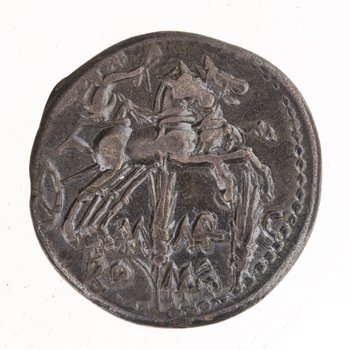
Everyone is pretty sure those big ears of grain popping up under victory recall an ancestor (even his father perhaps?!) who distributed grain at a cheap price as aedile (Pliny, NH 18, 15). But as far as I can tell the hoards help us not a lick on the relative chronology between this assertion and the similar one made by the first Minucius coin above. Mattingly fits it in the year before and sees the Minucius as an elaborate rebuttal to Marcius’ claim. Crawford has it coming after. The historian worried about the political climate at the time of the Gracchi would sorely like to know which.
Enough. For now.
















 Liv Mariah Yarrow