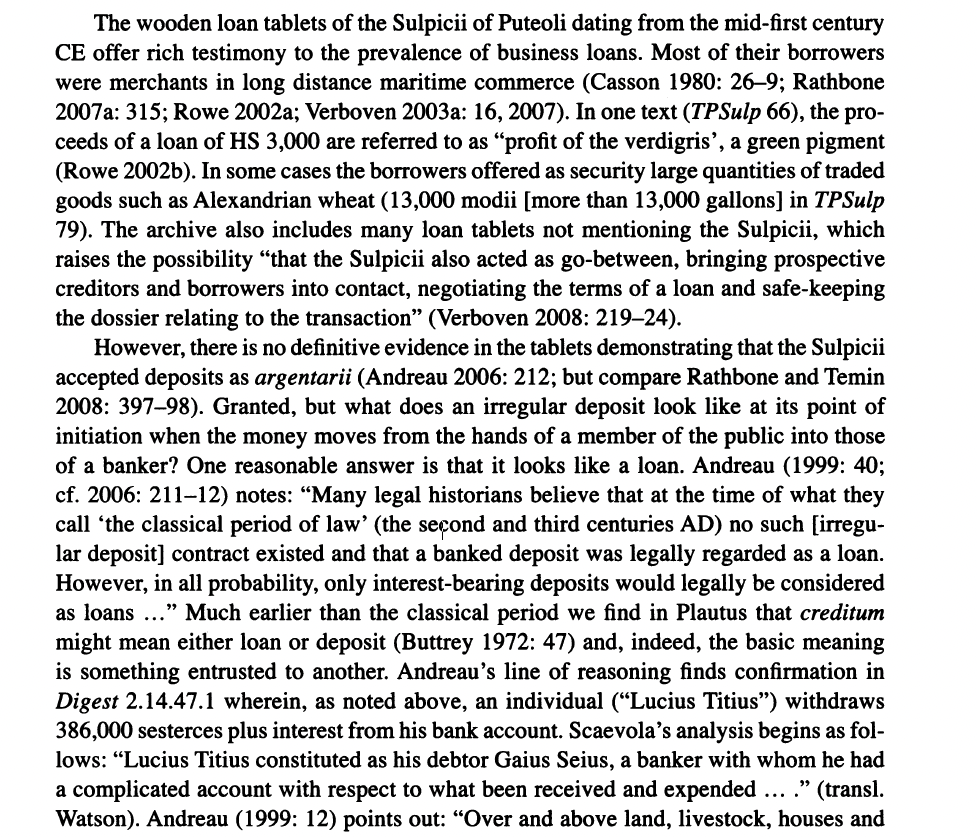
Post started yesterday. I read this:
Camodeca, Giuseppe. “Il credito negli archivi campani: il caso di Puteoli e di Herculaneum.” In Credito e moneta nel mondo romano, pp. 69-98. Edipuglia, Bari, 2003.
(It gets good about p. 76) I realize that maybe I’m jumping into the material at the wrong point.
Let’s start with some basics. Overview of the documents known at The Archive of the Sulpicii.
Camodeca, Giuseppe, Tabulae Pompeianae Sulpiciorum, 1999 is the primary reference.
It can no longer be had as a physical book for love or money and does not seem digitized (at least not legally), but is in most major research libraries.
I found this review article a good entry point overview:
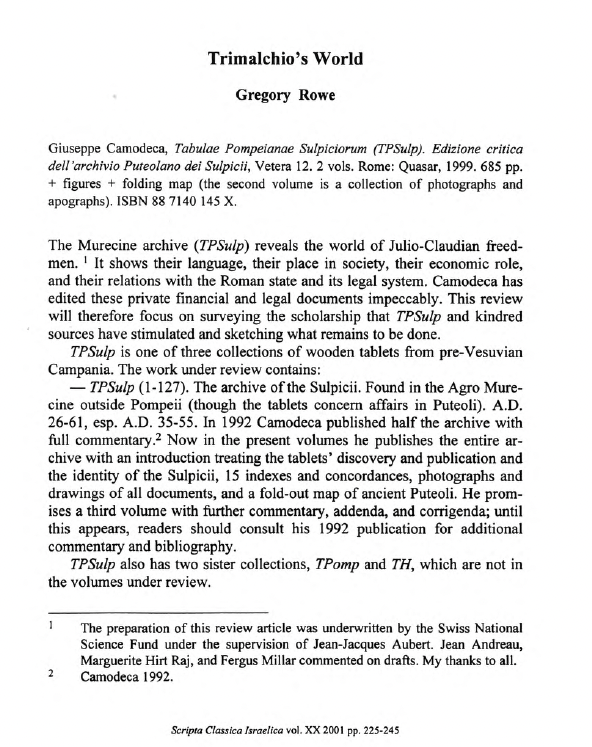
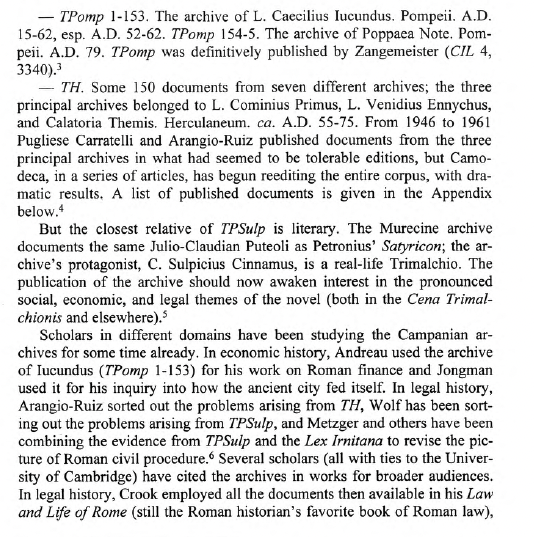
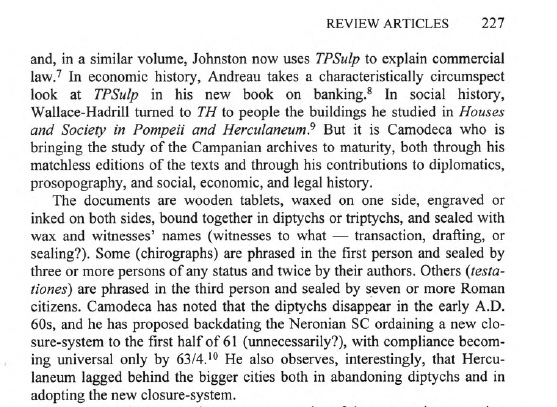
So I go to APh and sadly this Italian conference proceedings volume was never catalogued there (plenty of Camodeca’s other publication), then I go to google scholar, viola!, lots of newer stuff citing this piece. No surprise it had a big influence on how Harris thought and wrote about the Roman economy as well as Lo Cascio and Scheidel and others. This led me to take note of all sorts of interesting citations, but those are being stored in another post (currently in drafts). I’m going to come back to these and some are in the next post, but her I stick with the Camodeca and TPSulp stuff for this post.
Then I read these two pieces:
Jakab, Éva. “Loans and securities: Tracing Maritime Trade in the archive of the Sulpicii.” Roman law and maritime commerce 137 (2022).
Candy, Peter. “Credit for Carriage: TPSulp. 78 and P. Oxy. XLV 3250.” Roman Law and Maritime Commerce 175 (2022).
Both in
PETER CANDY and EMILIA MATAIX FERRÁNDIZ (EDS), ROMAN LAW AND MARITIME COMMERCE. Edinburgh: Edinburgh University Press, 2022. Pp. x+ 204, illus. isbn 9781474478144.
Like in my reading of Camodeca above my impression is that the sums are so much smaller than those in the Ciceronian archive. A different order of magnitude that makes me re calibrate my reading.
Also I hate endnotes. Not always but wow they are harder to utilize as a scholar looking to extract and check information than just leisurely digest.
To read something more recent by Camodeca I went here as it gives incite both into acknowledgement of a debt but also Camodeca’s methodologies in reading these texts:
Camodeca, Giuseppe. “Il Senatore Q. Cassius Gratus e Un Suo Affare a Puteoli. Ricomposizione Di Una Tabula Herculanensis Del Gennaio 53 (TH2 A 32).” Zeitschrift Für Papyrologie Und Epigraphik 217 (2021): 261–65.
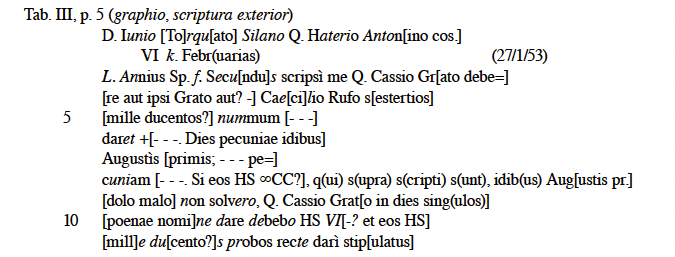
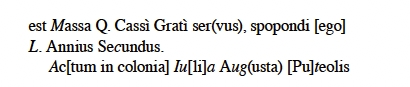
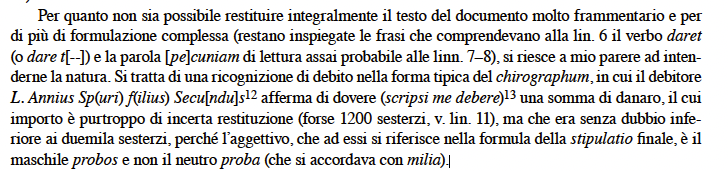
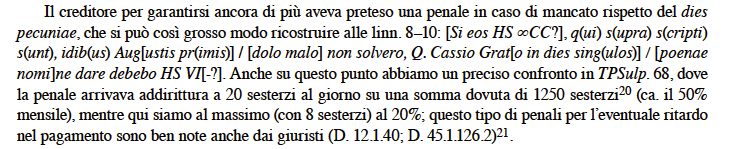
Obviously I love the vocabulary of probare (another post). But the central point of interest is that the creditor is a praetorian ranking senator making a loan through his enslaved agent to a third party. The document sets a deadline for the repayment of an outstanding balance, forces the debtor to acknowledge that balance, the timeline, and sets a penalty:
Visual for context:
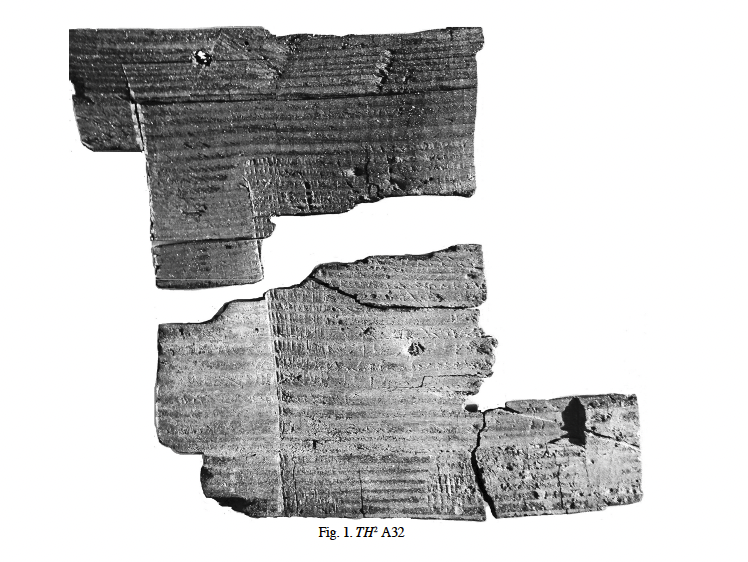
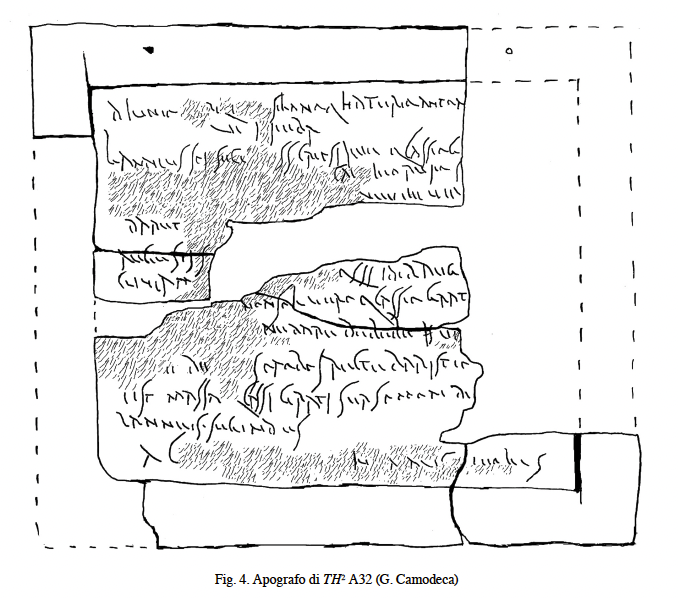
I love an article that deep dives one piece of evidence, but I also realize that how I feel about this type of material culture is how others feel about coins, a specialized field where one struggles to understand how to check the validity of the claims.
Silver, Morris. “Finding the Roman Empire’s disappeared deposit bankers.” Historia: Zeitschrift für Alte Geschichte (2011): 301-327.
more notes from this article in next post, keeping this one focused on Sulpicii material or trying to.