I’ve been writing only emails and texts and other pieces of non-sense. This isn’t the first blog post I’ve written since April 15 but hopefully on this one I’ll hit the publish button, rather than the draft button. I did the school run and then stole some time to take a walk and talk to a bestie, now I’m stealing time to write just to stay in the habit. You almost got a gender studies deconstruction of “Honey, I’m Good” a catchy song my kids keep playing on which I have many thoughts on how it constructs male sexuality and female agency. Short answer I think it is problematic, but that sort of writing isn’t really what I tend to do publicly so I’ll save it for tomorrow and another convo with another bestie over beers.
As I have been mentoring students on research and writing, I ‘ve been talking more about my own practices. One of which I’m not sure I’ve articulated (but you will certainly have noticed if you read this blog regularly) are these chatty diary-esque paragraphs in italics at the beginning of posts. The italics is how I signal that it isn’t the real post, but rather the warm up exercise where I loosen my mind and my fingers by just typing the running commentary that is always in my head. Connecting my internal voice to the words that appear on the screen is key to letting me write freely on more ‘serious’ topics. In some ways it is all the same. I have to be able to articulate my thoughts and experiences and observations and starting with the this type of “here’s where I’m at” scene setting works a treat to get me writing and the words and ideas flowing.
—
Comfort reading for me is often adjacent to my work but never on my work. I tend to reject any historical fiction that is set in Rome, ditto movies, shows. They feel like work. Sometimes I can read actual scholarly literature in my field for leisure if it is different from my primary research. So for example I can read on Republican theatre or Imperial Architecture if my main focus is on the coins. This runs the risk of being too distracting though with the potential to pull me into a new line of research.
I find the late antique and medieval much safer recreation. In fiction I don’t know enough to worry about ‘accuracy’ and instead enjoy the plot and tidbits of historical window dressing. Fiction these days I almost exclusively enjoy via audiobooks. The Company of Liars pulled me in and left me hungry for more of a similar vein. I thought of returning to Umberto Eco or Orhan Pamuk; for both their medieval historical fiction is my absolutely favorite. Yet, the world is burning and I wanted something lighter with more guardrails (genre conventions). I’ve started on the Sister Fidelma series which I was surprised and pleased to learn was written by the same author as the Cadfael series, just under a pseudonym. They are very much in the old fashioned Agatha Christie style of mystery. Still as the world is burning, narrative is often too much. I prefer non-fiction to dip in and dip out. And occasionally poetry but that is another post.
Get to the point, LIV!
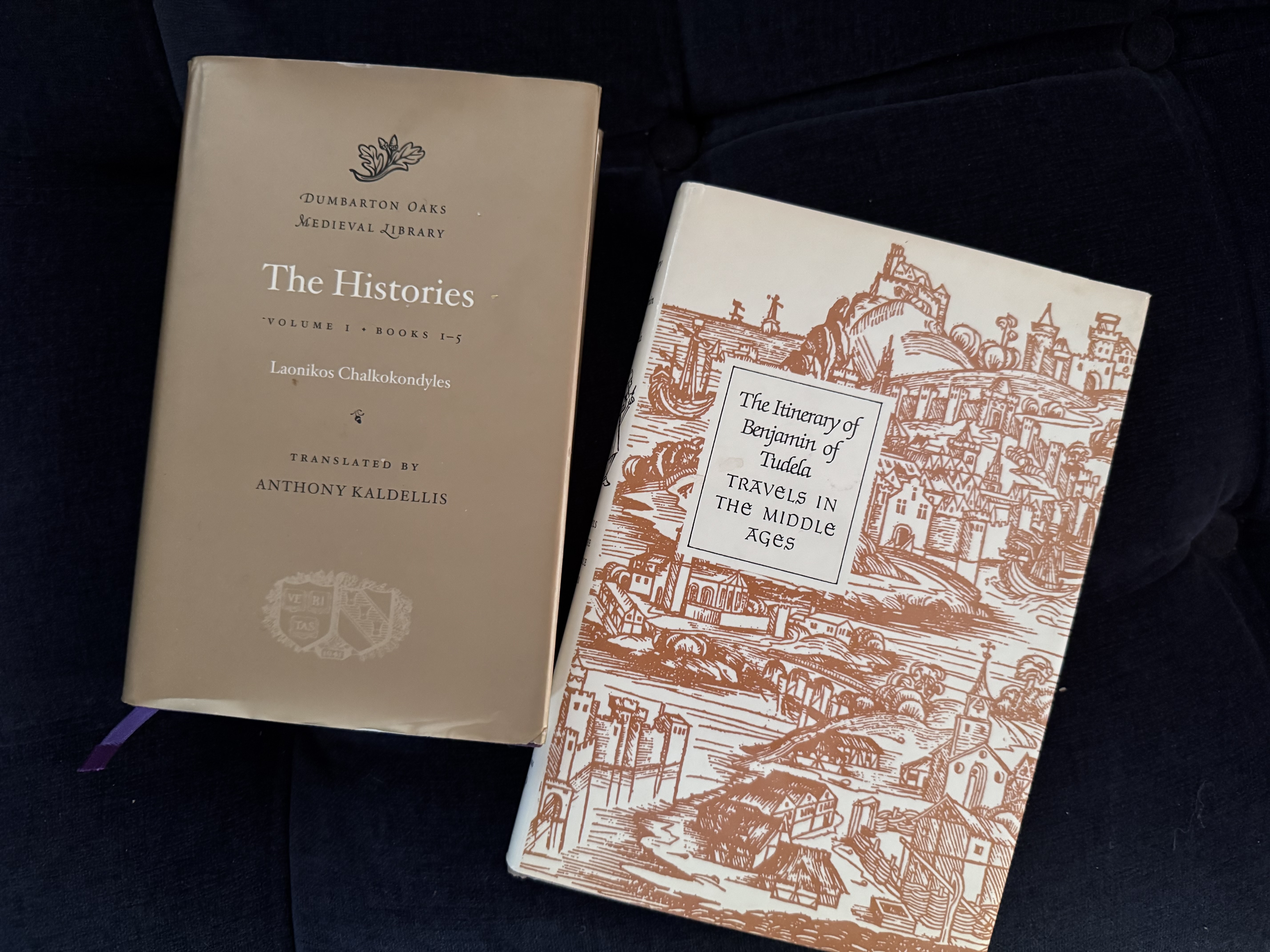
So the two non-fiction works that I’m currently obsessed with are those photographed above. Laonikos Chalkokondyles (b. 1430 CE) wrote a history of the victory of the Turks over the Greeks from the Greek perspective in the style of Herodotus and with shockingly little religious narrative focalization. He treats the rise of Islam as history coming full circle from the Greek victories over the Persians. He has all the gorgeous digressions and narrative style of Herodotus and feels like an old friend come again. Kaldellis makes slightly different translation choices as I might have, but he’s very clear about why he does so and the logic is sound and about the expectations and frame of reference of his most likely readers, i.e. those more familiar with Byzantine studies than I! The facing text in the Dumbarton Oaks series means there is no issue or true confusion. I find it striking though how accustomed I am to the Loeb Greek font so that this slightly different font feels ‘wrong’ on my eyes. I do enjoy the larger size of the physical volumes in this series and the I Tatti series. I’m reading this in a linear fashion and trying not to skip ahead to the book 3 ethnographic treatment of the Islamic Law and Mohammad as law-giver.
The other book is by a Jewish traveller making his way across the Mediterraean and Middle East in 1165-1173 CE. It is very easy to pick up and set down and dip in and out of. I find this perfect for the night stand. Last night and the inspiration for this little writing exercise, I read sections on Tyre, the Samaratians, and Jerusalem. Both Laonikos and Benjamin engage with an reflect back to their experience of the ‘classical’, the long shadow of antiquity in their world. A world dominated by Christianity but to which they both positioned themselves as outsiders, non-participants in the dominant world view, but commentators on that world.
In Tyre Benjamin tells us you can take a boat out onto the water and look down at the ruins of the ancient city. You can see all the places now submerged just as they once were. In Jerusalem he talks about Muslim and Christian constructions: the holy sepluchre, the dome on the rock. But he’s much more interested in the remnants of the temple and what he identifies as Solomon’s palace. Likewise in Caesarea he emphasizes the connection to Augustus and the magnificence of the structures. He tries to make sense of why based on the laws of Moses the Samaritans worshipped on Mount Gezirim.
Both authors make sense of their contemporary realities through a deep awareness of the Classical. They expect their readers to be equally alive to, familiar with this past. I wonder if this is in part because of their rejection of the Christian framework for making sense of the world. Antiquity offered an alternative share point of reference to a diverse audience.
Ok I can now do other things. I’ve written words and reminded myself of my whole intellectual self. On to my day job.

 Liv Mariah Yarrow