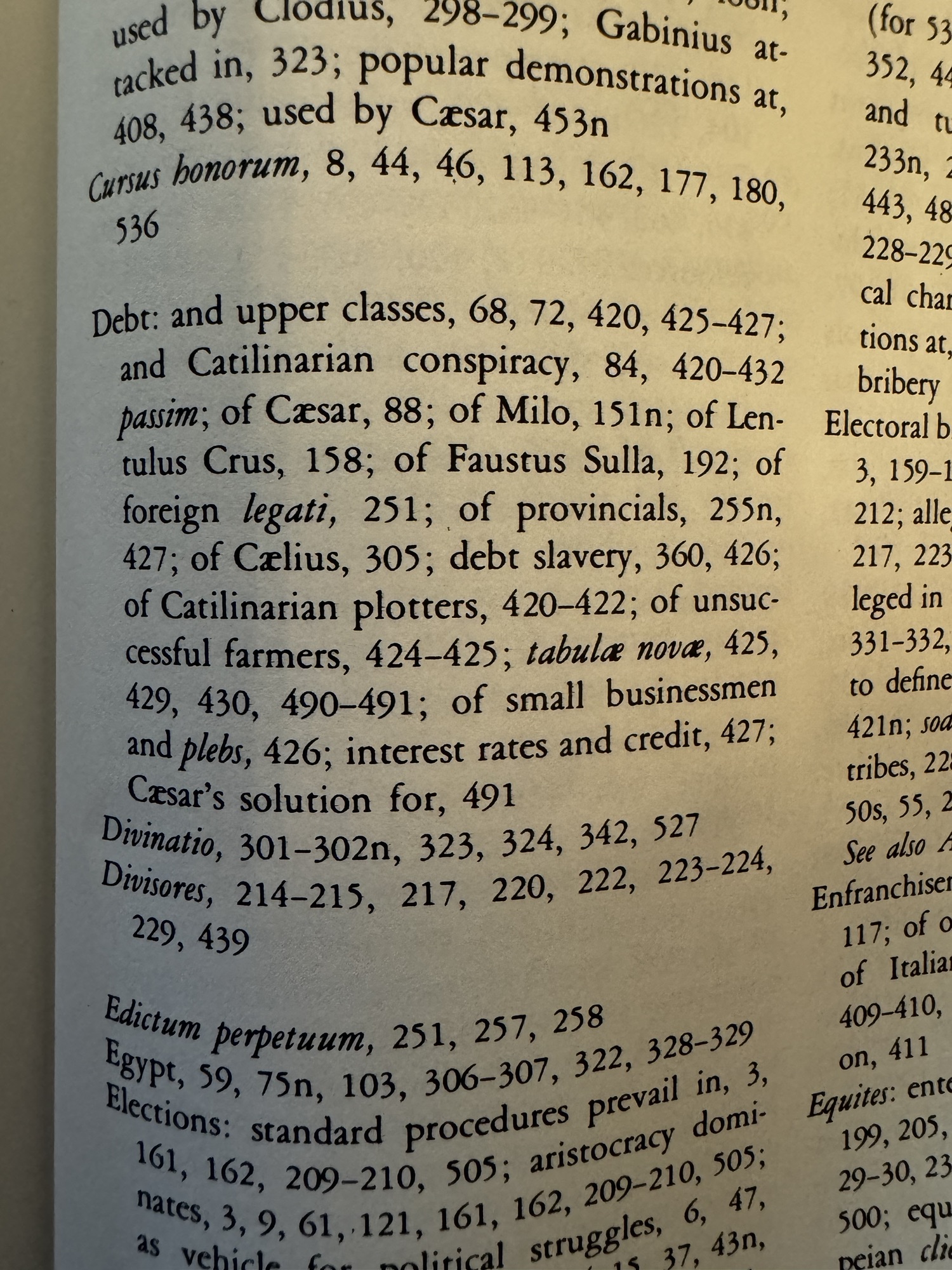
So the conference for which I’ve been preparing is to mark the 50th anniversary of Gruen’s Last Generation of Roman Republic. Thus in preperation I need to re familiarize my self with his thoughts on Debt. The fantastic thing about 50 year old indices is that they are USEFUL. This is in stark contrast with many today that are at once created by text searching and also assume that you can probably just search the electronic version of the book yourself.
P. 68 – Reviews power of Crassus uses as examples his role in Catilinarian conspiracy and Clodius and Cicero both wanting his support after.
Gruen:
Crassus lent out cash, not for material profit, but to place men under an obligation. A good number of Roman senators were in his debt.
Footnote gives evidence: paying off Caesar’s debts in 61 BCE (Plut. Crass. 7.6, Caes 11.1). Less paying off and more a case of underwriting the debt:
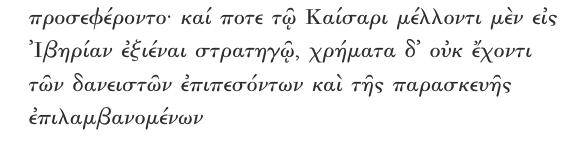
Plutarch in the loeb (translation adapted):
once when Caesar was on the point of setting out for Spain as praetor, and had no money, and his creditors descended upon him and began to attach his outfit,Crassus did not leave him in the lurch, but stood surety himself for eight hundred and thirty talents.
Also it is NEARLY 830 talents not exactly that amount in the Greek. So how much are we talking.
Imagine the weight of 8 full grown male rhinos and a one young skinny cow. That’s how much Crassus got hold over Caesar by way of other creditors. Or, if that is too silly for you enough to pay a legion for over 8 years. It makes me wonder if Crassus gave up the triumph to stand for the consulship because he’d not made enough in Spain to cover the debts and he needed a new province to get out from under Crassus’ thumb… Rabid speculation. Don’t quote me. I’d have to think a great deal more about this.
A helpful comment on the original post helped me correct the above.
I’m not sure I agree with the sentence:
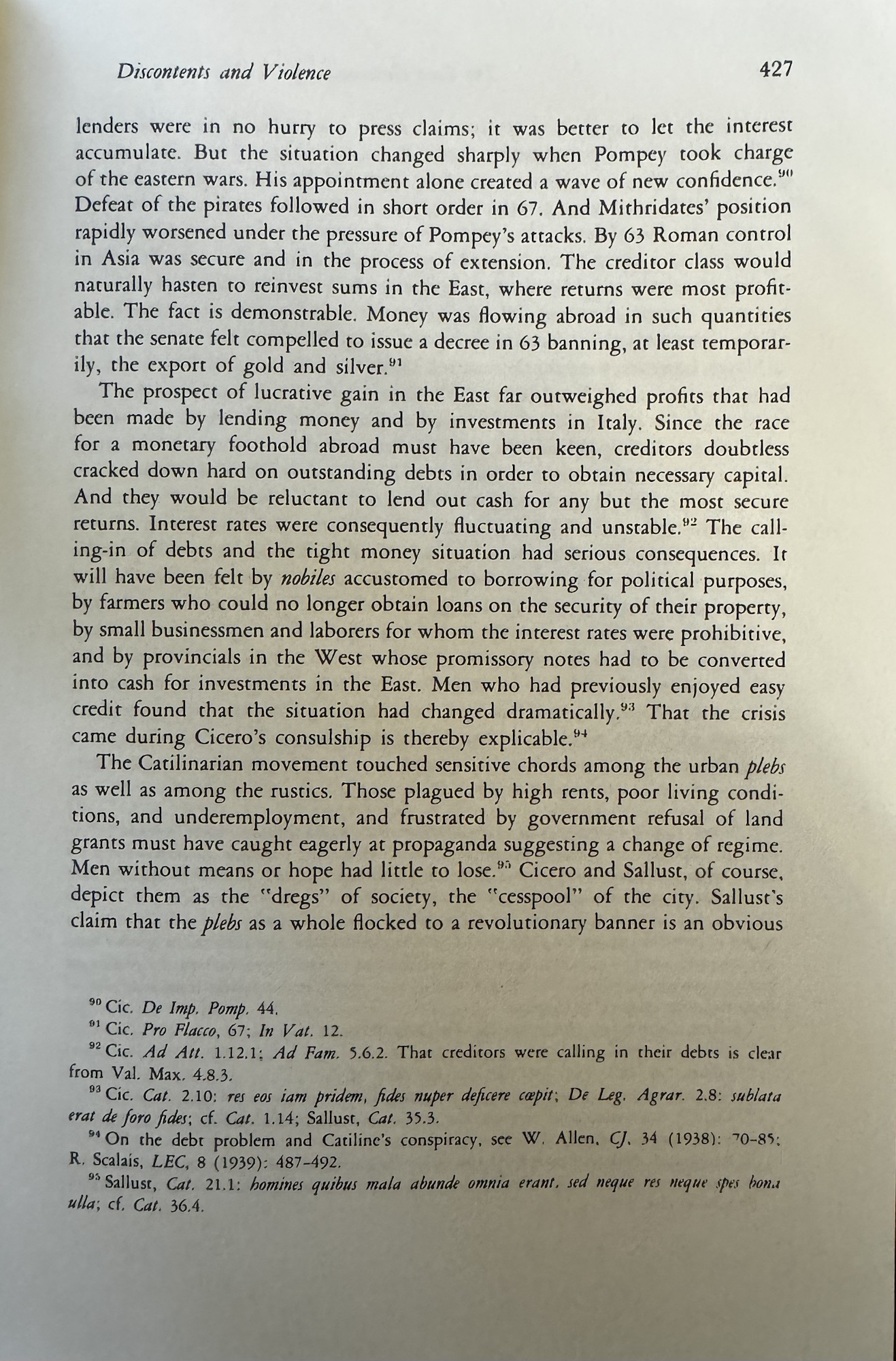
Money was flowing abroad in such large quantities that the senate felt compelled to issue a decree in 63 banning, at least the export of gold and silver.
Here’s the primary evidence:
Cic. Flac. 67
Cic. Vat. 12
In the Pro Flacco the key question is the sending of tribute to the temple in Jerusalem and stopping it is good, in the In Vatinum Cicero leaves the Jewish element out of his rhetoric because he’s seeking to vilify Vatinus not the Jewish people. The senate bans the export of resources to Jerusalem from Italy in 63 BCE because Pompey is actively besieging the city in that year! One does not fund the enemy.
Interest rates were consequently fluctuating and unstable.
Cic. Att. 1.12.1
S-B doesn’t think Teucris is Antony himself but rather a female agent based on the use of illa. The question is whether Cicero will defend Antony at his trial and if this loan is a quid pro quo arrangement. Antony may be holding out on dispensing the loan because of Cicero’s hesitations on the defense. Cicero wants a good interest rate. 12% per annum (= 1% per month) is an acceptable business rate as we’ve seen from this being the cap in Cicero’s edict. Cicero wants mates’ rates and Antony doesn’t want to deliver without re assurances of them actually being mates! Again I’m not sure this can be used as evidence as Gruen does here. I read the difficulty with the loan being a personal matter not a state of the economy matter.
Cic. Att. 1.13.5, 61 BCE
This follow up letter shows that Cicero wants the money to buy his house and that the loan is for some number less than 3.35 million denarii or that’s like 5 to 5.5 rhinos worth of silver. nothing to sneeze at.
To me the key part of this passage is that making expensive purchases with the help of friends was a matter of personal dignity. The loan facilitates the outward necessary performance.
Cic. Fam. 5.6.2, 62 BCE
Cicero is bragging here about the amazing interest he’s getting on mate rates on account of his being a friend to the creditors by suppressing Catiline’s conspiracy and the possibility of debt cancellation. 6% per annum is not the going rate it is the special rate for Cicero. Not unlike Crassus lending at no interest for political purposes (Plut. Cras. 3).
Val. Max. 4.8.3
Cic. Att. 2.24.4
S-B thinks this is the same individual as in A.1.12. Seems plausible and would make connection to Val. Max. individual more likely. For this incident opposing Caesar’s agrarian legislation cf. Plut. Caes. 14.
This Q. Considius may also be the fair minded juror mentioned by Cic. Verr. 2.1.18 and Cic. Cluent. 107.
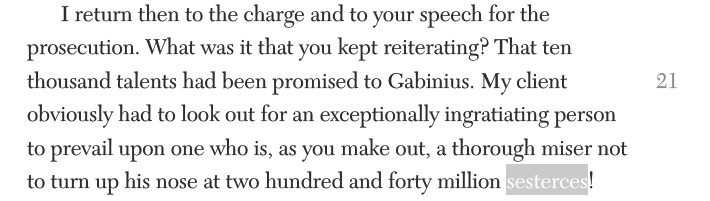
Cic. Rab. 21 provides nice evidence for the talent of account being 6000 denarii.
Pro. Cael.
Cic. QFr. 2.15 54 BCE
Why did this interest rate jump? Because they were borrowing so much and thus creating risk? Was it just for them or everyone?















 Liv Mariah Yarrow
Where exactly is the Loeb wrong? This text is even quoted by LSJ as an example of providing surety, not simply paying off a debt.
And the number is precise isn’t it?
Is there perhaps some confusion here between ἐγγύς and ἔγγυος?
Thank you! You had me look again and re translate!