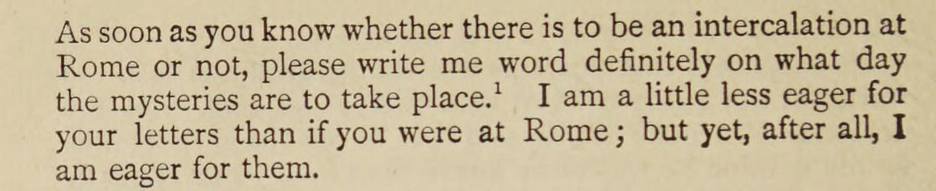
Romae intercalatum sit necne, velim ad me scribas certum quo die mysteria futura sint.
A.5.21
This is a late postscript in a letter to Atticus in Epirus from Cicero at Laodicaea on the 13 of February 50 BCE.
Neither Schuckburgh or S-B suggest what the Mysteries could be and presume the answer is unknowable. Of course the Romans had voluntary initiation rituals already at this date associated with any number of gods (Dionysiac, Isis, etc…). But none of this really seems really in keeping with Cicero’s own attitudes which tend to be skeptical leaning into out right condemnation
My first instinct is that what Cicero wants to know is if there is any chance he can attend THE Mysteries, i.e. the most famous and prestigious, Eleusinian Mysteries outside Athens.
Cicero and Atticus were both initiates and fell these were the only type of ‘mysteries’ including nocturnal rites and secrecy that should be permitted.
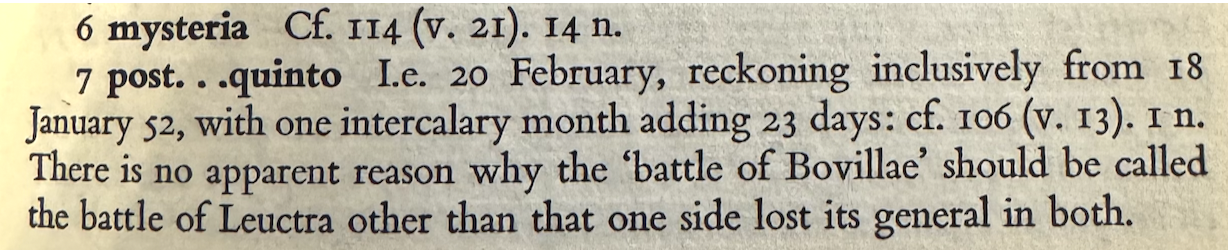
These Mysteries were held on the 14-23 of the Attic Month of Boedromion. While ostensibly this fell in the season we associate with Sept/Oct, how it lined up the Roman calendar is wholly unclear to me as both Athens and Rome did their own v different intercalations.
I’m guessing Cicero wants to know if he can catch the mysteries on his way back to Rome if he leave Laodicaea on the July 30. Not for his own initiation, but probably to ensure his son and he and Atticus’ nephew were able to initiated. The postscript isn’t about his political commitments but instead falls in the domestic affairs section and part of the goal of his governorship was some experience and acculturation of the boys who were approaching the age of manhood.
Speculation, but I think a better one than those I’ve read.
—
It is also possible that Cicero was interested in the rites on Samothrace or Lemnos both of which could have been included on his route home, if he had wished:
Cicero was aware both of a long tradition of Magistrates stopping at Athens enroute from provinces and that the timing of the mysteries themselves were non negotiables. The above passage was written in 55 BCE. The words are attributed to Licinius Crassus (cos. 95) and is referring to an incident c. 110 BCE.
cf. Kuhn, Annika B.. “Ritual change during the reign of Demetrius Poliorcetes.” In Ritual and communication in the Graeco-Roman world, Edited by Stavrianopoulou, Eftychia. Kernos. Supplément; 16, 265-281. Liège: Centre International d’Étude de la Religion Grecque Antique, 2006. Interprets demands for ritual change as expression of authoritarian power.
MY whole logic seems to fall apart when we get to a letter from just a week later:
end of A.6.1
But everything else about the passage is focused on Athens and specifically Eleusis… What makes the Mysteries Roman? Did they conduct special initiations for Romans? I just don’t know enough… S-B doesn’t indicate any problem with the manuscript and this particular word for all some of the surrounding text is disputed. Could Cicero have asked for the ROMAN date of the Mysteries…?
faciesque me in quem diem Romana incidant mysteria certiorem et quo modo hiemaris.
Look I know changing the Latin to fit one’s wishes is a bad precedent. But if an Romana could be shifted to modify diem all would be fine. If we fast forward to 44 BCE when Cicero really should have taken this vacation he was thinking about to avoid Antony, we see again Cicero asking about the dates of the Mysteries and here no one would assume it meant anything other than those at Eleusis:
And we known that Cicero was aiming to stop in Athens on the way home and to try to see Atticus there:
End of A.6.2. Dated first week of May.A.6.3. June. Cilicia.Loeb Link





 Liv Mariah Yarrow