
This post (in conjunction withearlier posts) shows that there was a demonstrable shift away from aes grave c. 240 in the votive deposits at Vicarello. Prior to 240 BCE aes grave and struck bronzes exist in near equal numbers, but after 240 BCE aes grave drops off and struck material strongly persists.

Signed here means anything with a name a symbol or a monogram. So unsigned mean anonymous issues–these far and away out number the later signed bronzes. The preference for the sextans is interesting, but it is not nearly as pronounced as the denominational preferences we saw for the cast coins from deposit.
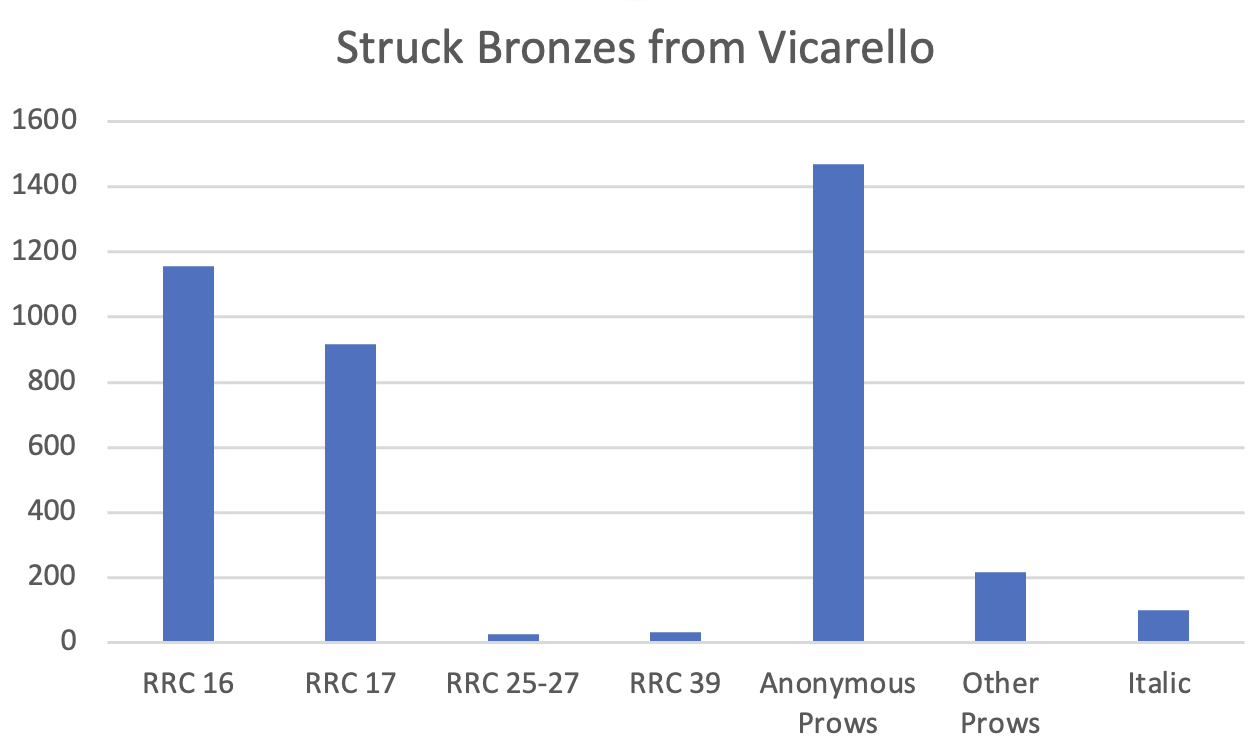
From RRC 39 there are only 3 sextans, but 31 semuncia!

Tiano, Suesano and Caleno issues together with Naples coins correlate with the large presence of RRC 16 (earlier post) and RRC 14 (earlier post), all together I’d suggest that the site was most active during the 1st Punic war. RRC 17 has been shown by Molinari and Jaia 2020 to be of a similar time to RRC 25-27. It’s greater presence here shows that in this next period (post 240 but prior to 2nd Punic war), the deposit was still active but the preference was strongly shifting to struck coinage. Dedications pick up in the second Punic war but not quite to levels of 1st Punic wars.
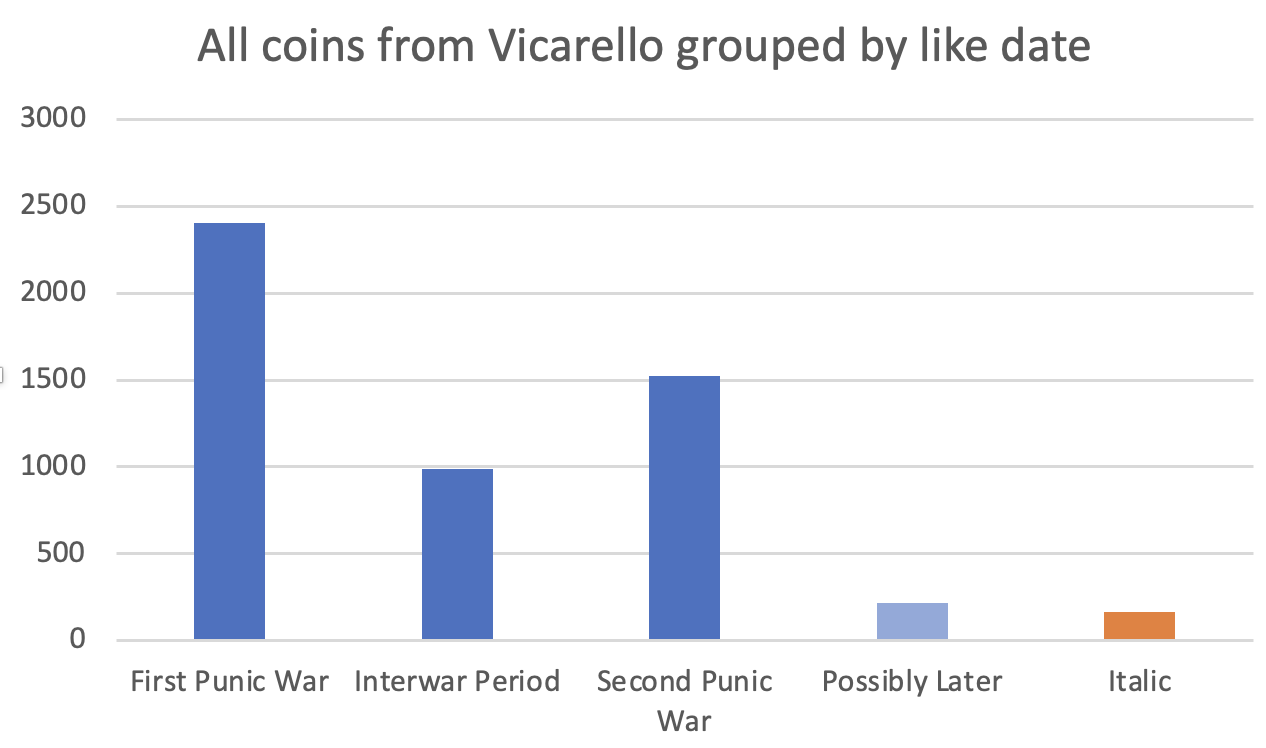
Of course the interwar period dip might reflect dip in coin production rather than a dip in sanctuary activity. Coins made during the First Punic War remain in circulation and available to deposit in the later periods. Many of those in light blue may actually be from 2nd Punic War and many of those in orange are likely to be from the 1st Punic War.
I’ve put RRC 21 in the interwar period again following Molinari and Jaia 2020 who based this finding on the La Bruna and Spoletium finds.

 Liv Mariah Yarrow