Educational Philosophies

I’m teaching 320 students this coming semester in two mega sections.  This is double last semester.  I’m loving the way large classes are challenging my pedagogic approach and make the time I invest in teaching prep feel much more meaningful and important.

For other professional reasons I’m going to need  to produce a new Educational Philosophy this semester.  The problem is the one I first drafted back in 2007 (I think), has been so well received that it has never in the last nine years or so seemed worth my effort to substantially update it.  I never meant it to be static, programmatic statement, but it has become such.  I need to update my teaching portfolio.  I’ve leaned on this ‘original’ too long.

Original Educational Philosophy

My classes are prepped, the students divided into teams (8 students per team, 20 teams per class), the internal websites are up and running.  It’s time to give some attention to the mentoring program I’m running this year, think about applicants to our PhD program, figure out when I’m going to have time to tackle this educational philosophy task and my teaching portfolio in general, and then get back to writing that presentation for Boulder the first weekend in March.  (I shouldn’t have started thinking about my longer to do list. Arg…)

Anyway.  Why is all of this here? Well, this blog is about keeping me on target and loosening up my writing when I get stuck.  Academic writing is going really well these days, only limited by my other time commitments.  This damn ‘philosophy’ has been being avoided and kicked down the road.  So I’m going to start brain storming about it here.

A list of random things that should be in my new E.P.:

  • How I approach technology
  • Why I believe in ‘extra credit’
  • How I address issues of diversity and privilege (my last one is all meritocracy/stars in my eyes/warm fuzzies on this stuff)
  • How teaching intersects with my research
  • Why I like large sections
  • What my teaching challenges are and how I may address them
  • My obsession with transparent pedagogy, communicating WHY I do what I do.

Okay.  That gives me some stuff to kick around in my brain and ideas for individual posts.

Don’t worry we’ll be back to coins and Rome soon, but my life demands I work on some other stuff as well.
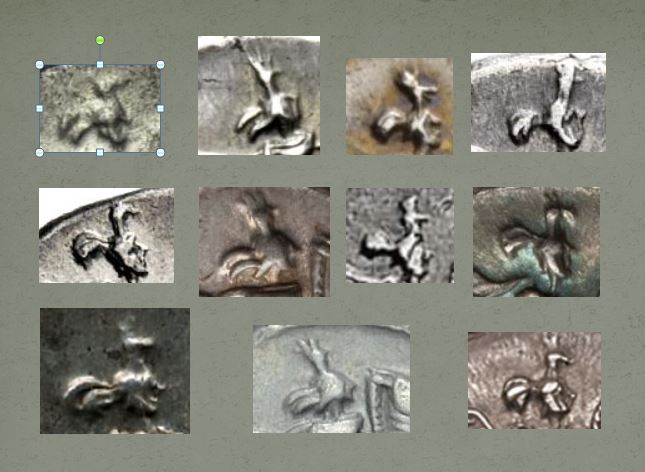
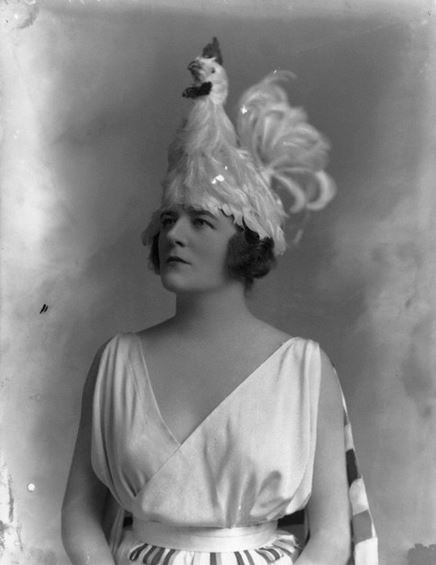


Chicken head, oh Chicken head

what are you really?!

Capture

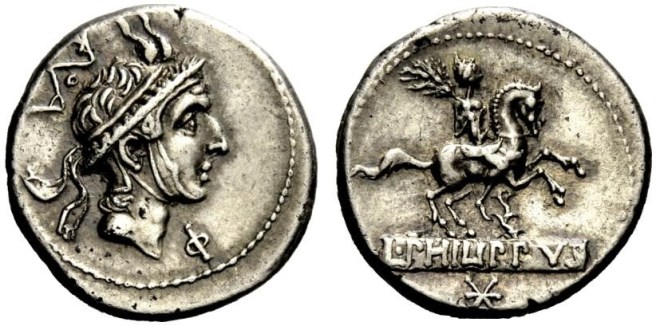
When I’m trying to get a sense of what an engraver actually intended to represent, I collect little snippets of coin images to help focus my eye.  After a while I start seeing things; I swear this looks more like a chicken hat than anything else.

Capture.JPG

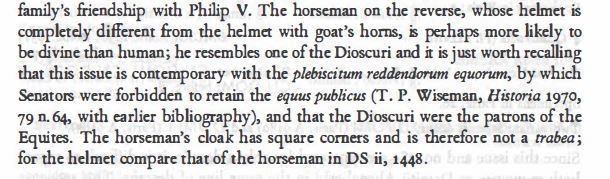
Anyway in all seriousness, the high helmet with streaming hair on this rider is the only real identifying attribute.  Crawford says the following:

Capture.JPG

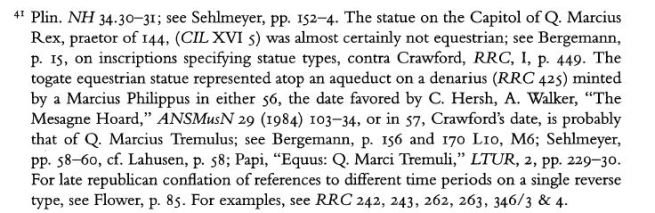
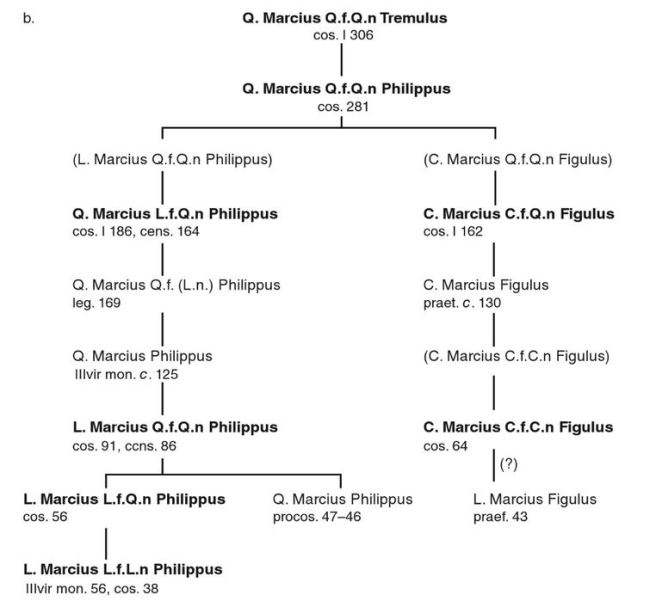
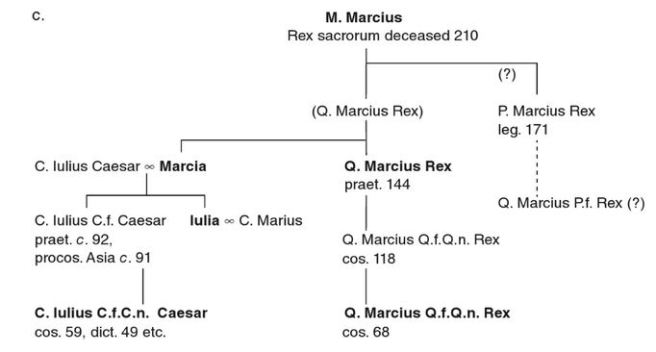
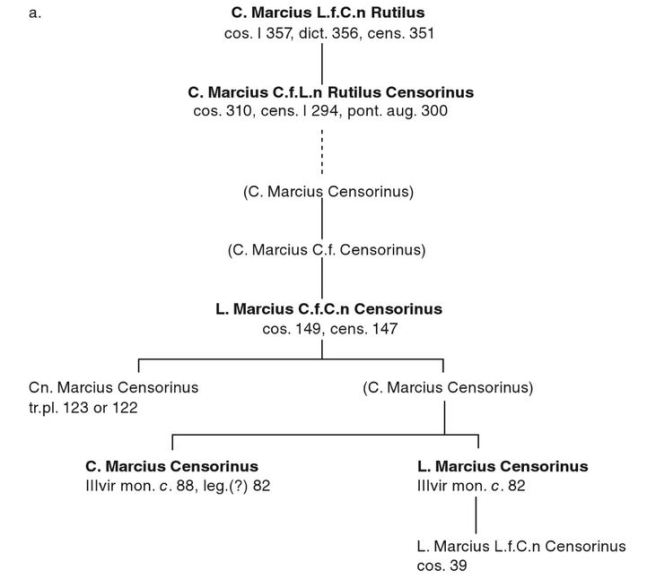
Do you know what DS ii, 1448 stands for? If so, PLEASE leave me a note in the comments.  There’s been some recent discussion of the type, but not really about identifying the rider.  I don’t think it’s Tremulus’ equestrian statue… but the Marcii Philippi’s interest in equestrian themes is striking.

Links to CRRO type (RRC 259/1)

Update 2/15/2016:

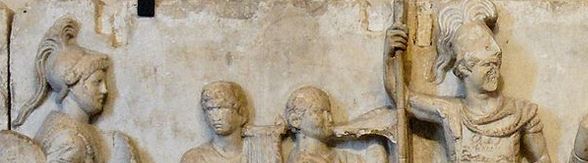
Discovering Daremberg and Saglio has helped clarify things for me. It seems Crawford was drawing a comparison to this type of imperial iconography:

Capture5

This cannot be right.  Given the lack of flowing plumage.  I may not have been too far off with my impression of feathers…  I think this earlier portion of DS, s.v. galea is better parallel.

They call this curieux, but then go on to compare it to the helmet of Mars on this coin type (RRC 400/1b):

Capture
links to acsearch entry


This helmet type has been linked to the concept of virtus in Republican Rome by Myles McDonnell (see esp. chapter 4; note also his connections between virtus at the equestrian representations!).

We can also draw into the conversation here the iconography of helmets on the so-called altar of Domitius Ahenobarbus:

Capture4

Capture

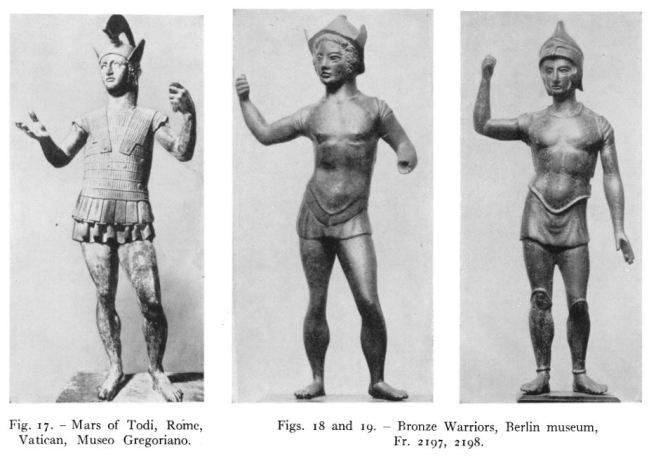
On the iconography of the three-plumed helmet, consider the two Etruscan figurines on the left:

Capture.JPG
Links to JSTOR article

On the Equestrian Statue of Tremulus

Capture
Links to acsearch.info entry

Here’s some useful bibliography, from a new-ish commentary on the Philippics:

This slideshow requires JavaScript.

I’m sharing it particularly because it supports my strong suspicion that this is indeed also Tremulus on this later type (RRC 425/1; cf. RRC 293/1 illustrated above):

 Update 2/15/2016:

Myles McDonnell makes the point very clearly in a footnote (p. 157):

Capture


A Call for a wider Roman Citizenship?

links to acsearch.info entry

So this is the sort of thing some people say about this coin :

This slideshow requires JavaScript.

(google book link)

And this as well:

Capture
links to preview page with discussion

I’m skeptical.  I think Marcius Ancus is there more as the founder of Ostia than as an advocate for integration.  Cf. my earlier discussion of the bronzes in this series, here and here.

CRRO entries on RRC 346.


A Short History of Roman Interactions with Kings by M. Tullius Cicero

From his Pro Sestio (Latin here):

57 King Ptolemaeus, who, if he had not as yet been himself styled an ally by the senate, was at all events the brother of that king, who, while his cause was identical with his, had long since received that honour from the senate; and was of the same family, sprung from the same ancestors as his brother, and had the same claims from the antiquity of his alliance; who, lastly, was a king, and if not yet an ally, still most certainly not an enemy; was enjoying the kingdom which had belonged to his father and his grandfather in peace and quiet, relying on the sovereign power of the Roman people in a condition of royal ease and tranquillity. While he was never thinking of any such thing, never suspecting any such thing, a motion was made and put to the vote of the same troop of labourers and artisans that he while sitting on his throne, with his purple and sceptre and all the other ensigns of royal authority, should be placed at the mercy of a public crier;—a motion was made, I say that the Roman people, which has been in the habit of restoring their kingdoms even to those kings whom they have subdued in war, should order that a king who was a friend of the nation, who was not even said to have done them any injury, who had never had any claim preferred against him or any demand for the restitution of anything, should have all his property confiscated and sold with his own person and liberty.

58 That year was a year of many cruel, of many shameful, of many turbulent proceedings, but I know not whether I ought not deservedly to call this the nearest in iniquity to that crime which their wickedness committed against me. Our ancestors determined that that celebrated Antiochus called the Great, after he had been subdued in a long and arduous struggle by land and seas, should be king over the districts within Mount Taurus. They gave Asia, of which they deprived him, to Attalus, that he should be king over that district. With Tigranes, king of the Armenians, we waged a serious war of very long duration; he having, I may almost say, challenged us, by inflicting wanton injuries on our allies. He was not truly a vigorous enemy on his own power and on his own account, but he also defended with all his resources and protected in his territory, that most active enemy of this empire, Mithridates, after he had been driven from Pontus; and after he had been defeated by Lucullus that most excellent man and most consummate general, he still remained in his former mind, and kept up a hostile feeling against us with the remainder of his army. And yet this man did Cnaeus Pompeius—after he had seen him in his camp as a suppliant and in an abject condition—raise up and placed on his head again the royal crown which he himself had taken off, and, having imposed certain conditions on him, ordered to continue king. And he thought it no less glorious for himself and for this empire, that the king should be known to he restored by him, than if he had kept him in bonds.

59 Therefore, Tigranes—who was himself an enemy of the Roman people, and who received our most active enemy in his territories, who struggled against us, who fought pitched battles with us, and who compelled us to combat almost for our very existence and supremacy—is a king to this day, and has obtained by his entreaties the name of a friend and ally, which he had previously forfeited by his hostile and warlike conduct.

That unhappy king of Cyprus—who was always our ally, always our friend, concerning whom no single unfavourable suspicion was ever reported to the senate or to our commanders in those parts—has now, as they say, while alive and beholding the light, been seized and sold with all his means of support, and all his royal apparel. Here is a good reason for other kings thinking their own fortunes stable, when by this example, handed down to recollection from that fatal year, they see that one tribune and six hundred journeymen have power to despoil them of all their fortunes, and strip them of their whole kingdom!

In sum, a kingdom for every king, a chicken it every pot, and whoa, oh whoa how much worse we are than our fore-bearers.  Damn Demagogues.


My 300th Post: So Many Types of Laurel

Pliny NH 15.40: the Delphic laurel is a uniform greener colour, and has very large berries of a reddish green; and that this laurel is used to make wreaths for the winners at Delphi, as it is for generals going in triumph at Rome. …  Another addition is the royal laurel, which has begun to be called the Augusta laurel, a very large tree with a very large leaf and berries without any rough taste. Some say that the royal laurel and the Augusta are not the same, and make out the royal to be a special kind, with longer and broader leaves. The same persons … much to my surprise give the name of triumphal laurel to one that has no berries, and say that this is the one used by persons celebrating a triumph—unless the use of it began with his late Majesty Augustus, as we shall show, as sprung from the laurel which was sent down to him from heaven, which was a very low growing tree with a short, crinkled leaf, and very rarely met with.

I thought I might save my 300th for something extra cool but this is just another note to self. 

Delphic Laurel = Triumphal Laurel, no problem just an agonistic type of symbolism

Royal Laurel = Augusta Laurel, so… that which is fit for kings is reserved for emperors?!

And the Divine Augustan Triumphal Laurel is something else entirely…

A Racial Distinction in Livy? Or something else?

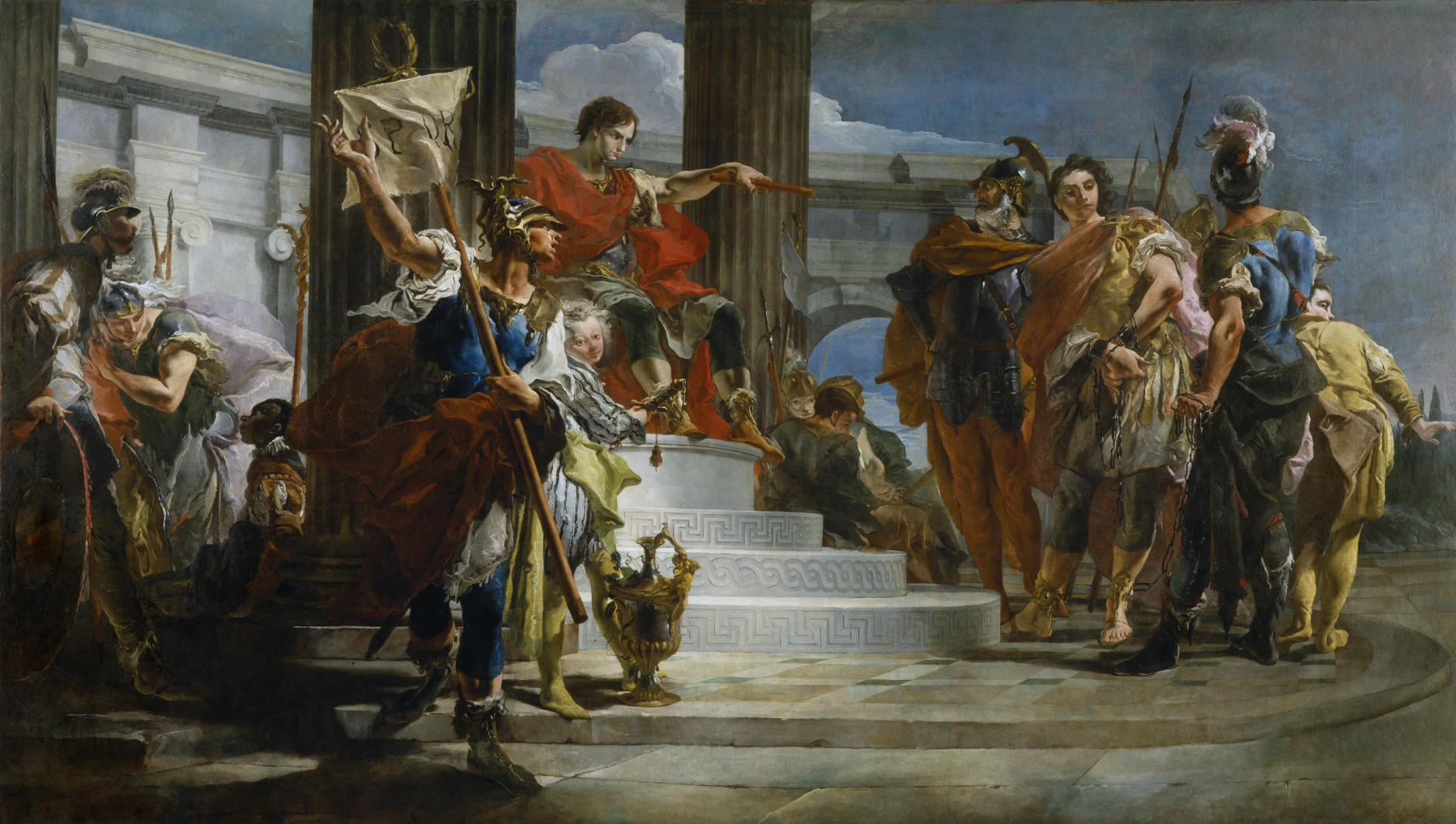
Hasdrubal had secured the war-chest before the battle, and after sending on the elephants in advance and collecting all the fugitives that he could, he directed his march along the Tagus towards the Pyrenees. Scipio took possession of the enemy’s camp, and gave up all the plunder, with the exception of the prisoners, to his troops. On counting the prisoners he found that they amounted to 10,000 infantry and 2000 cavalry. The Spanish prisoners were all released and sent to their homes; the Africans were ordered to be sold by the quaestor. All the Spaniards, those who had previously surrendered and those who had been made prisoners the day before, now crowded round him, and with one accord saluted him as “King.” He ordered silence to be proclaimed, and then told them that the title he valued most was the one his soldiers had given him, the title of “Imperator.” “The name of king,” he said, “so great elsewhere, is insupportable to Roman ears. If a kingly mind is in your eyes the noblest thing in human nature, you may attribute it to me in thought, but you must avoid the use of the word.” Even the barbarians appreciated the greatness of a man who stood so high that he could look down on a title the splendour of which dazzled other men’s eyes. Presents were then distributed amongst the Spanish princes and chieftains, and Scipio invited Indibilis to choose 300 horses out of the large number captured. Whilst the quaestor was putting up the Africans to sale, he found amongst them a remarkably handsome youth, and hearing that he was of royal blood, he sent him to Scipio. Scipio questioned him as to who he was, what country he belonged to, and why at his tender age he was in camp. He told him that he was a Numidian, and his people called him Massiva. Left an orphan by his father, he had been brought up by his maternal grandfather Gala, king of the Numidians. His uncle Masinissa had come with his cavalry to assist the Carthaginians, and he had accompanied him into Spain. Masinissa had always forbidden him to take part in the fighting because he was so young, but that day he had, unknown to his uncle, secured arms and a horse and gone into action, but his horse fell and threw him, and so he had been made prisoner. Scipio ordered the Numidian to be kept under guard, and when he had transacted all the necessary business he left the tribunal and resumed to his tent. Here he sent for his prisoner and asked him whether he would like to return to Masinissa. The boy replied amid tears of joy that he should only be too glad to do so. Scipio then presented him with a gold ring, a tunic with a wide purple border, a Spanish cloak with a gold clasp, and a beautifully caparisoned horse. He then ordered an escort of cavalry to accompany him as far as he wanted to go, and dismissed him. Livy 27.19

This portion of Livy corresponds to Polybius 10.40.  There are a number of differences and I’ve been writing a little elsewhere about how they both treat Scipio’s response to being hailed as King.  Here I’m worrying about this portion:

ex his Hispanos sine pretio omnes domum dimisit, Afros uendere quaestorem iussit.

On first reading my impression was that Livy was concerned to make clear two different standards of treatment one for the Spanish and one for the Africans.  The former being granted clemency, the latter the horror of slavery.  If this was the actual historical event, there might be practical reasons for the distinction.  The local population could be  expected to return to their homes and show appropriate gratitude for this beneficence, while those whose homes were across the sea would likely remain a logistical nuance if freed.   Also it might be tactically a way to divide the loyalties of those in the Carthaginian army by creating distinct outcomes for different populations.  There need not be a racial distinction inherent in this act or its narration.   It’s primary historiographical function is to set up the narration of Scipio’s interaction with Massiva.  Among the African slaves one stands out. He’s over royal blood.  Notice the thematic connection with Scipio’s own rejection of royal honors.  Livy interrupts himself to give a direct commentary saying Scipio is to be admired all the more for  rejecting “a title the splendour of which dazzled other men’s eyes” (miraculo…stuperent).  Now Massiva is recognized because his very bears witness to his royal origins (forma insigni cum audisset regii generis esse). He’s disobeyed his elders and acted wrecklessly by joining battle.  This royal youth shows none of the regalem animum of Scipio himself even though he has the look and lineage.  Recall how Scipio was too young for the command when he was sent out to Spain and the emphasis placed on his obedience to Rome.  Scipio shows this royal youth Roman clemency, restores him with many gifts to his family.  Notably among the gifts is a horse to replace the one that the youth lost, one he had stolen and then was got killed, leading to his own capture.

Massiva and the African prisoners are one hundred percent absent from Polybius.  Did Livy make this up out of sail cloth?!  Perhaps not.  Scipio Africanus is often the subject of anecdotes.  This may have been a well worn traditional story (the prince found among the paupers, diamond in the rough…) and may have been long attached to Scipio.  Livy’s artistry is fixing it here in the narrative in contrast to the Scipio’s acclamation and rejection of kingship.  Romans aren’t kings, they make kings.

Even if Livy isn’t playing with race in this episode, the later reception of this story certainly reflect European preoccupations with Race, especially its depiction in paintings…

Fasces as Royal Symbol

For, whereas the previous decemvirs had observed the rule of only one having the “fasces” at a time and making this emblem of royalty go to each in turn, now all the Ten suddenly appeared, each with his twelve lictors. The Forum was filled with one hundred and twenty lictors, and they bore the axes tied up in the “fasces.” The decemvirs explained it by saying that as they were invested with absolute power of life and death, there was no reason for the axes being removed. They presented the appearance of ten kings, and manifold fears were entertained not only by the lowest classes but even by the foremost of the senators. They felt that a pretext for commencing bloodshed was being sought for, so that if any one uttered, either in the senate or amongst the people, a single word which reminded them of liberty, the rods and axes would instantly be made ready for him, to intimidate the rest.  (Livy 3.36)

I’m always intrigued by the symbolism of the fasces and thus just wanted to file way this reference for future.  Older posts on fasces.

Minerva, not Mars

Capture1

Capture
All images in this post link to acsearch.info entries

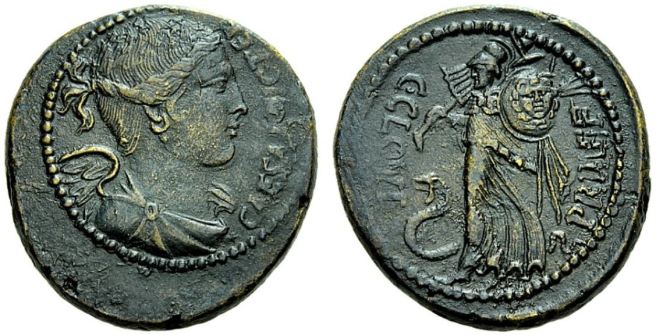
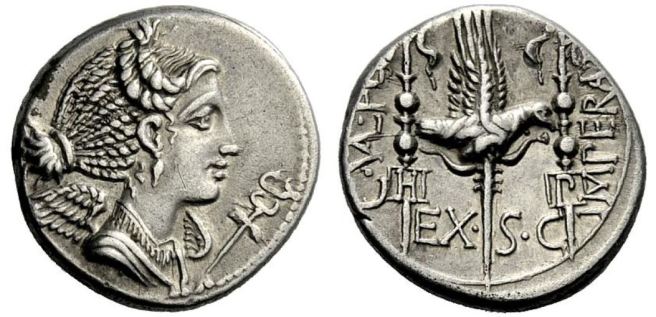
I just wanted to put these two types next to each other (RRC 306/1 and 476/1).  They are a great example of the long memory of earlier types at the Roman mint.  I check myself.  Perhaps a long memory more generally as RRC 476/1 is thought not to be struck at Rome.  I wonder is Massilia might not be a likely place for its design and possible striking.  I was made to wonder this because of the clear relationship between RRC 306/1 and RRC 365/1, both struck by Flacci, but the latter at Massilia, and of course Caesar’s pre occupation with events in the Hispania and So. Gaul during his third Dictatorship (46 BCE, 45 BCE).  The desirability of Minerva instead of Mars in 46-45BCE is surely that the former is viewed as the more rational of war gods, and thus perhaps more attractive during the midst of the civil war.  (I’m also struck by the lack of hoards from So. Italy or points east for 306/1…  It is found North of the Appenines, in Spain, and Britain.  Worth further thought perhaps. CRRO is a glorious thing!)

Capture2