What would the Romans call it?

This is a follow up to an old post

Festus says: 

Rodus, vel  raudus significat rem rudem et inperfectam;  nam saxum quoque raudus appellant poetae, ut Accius in Melanippo: “Constit[u]it, cognovit, sensit,  conlocat sese in locum celsum; hinc manibus rapere  roudus saxeum grande[m] et grave[m]”; et in Chrysippo: “Neque quisquam a telis vacuus, sed uti cuique  obviam fuerat, ferrum alius †saxio rudem†.” Vulgus  quidem in usu habuit, non modo pro aere inperfec to, ut Lucilius, cum ait: “plumbi pa<u>xillum rodus li nique matexam”; sed etiam signato, quia in manci pando, cum dicitur: “rudusculo libram ferito”, asse  tangitur libra. Cincius de verbis priscis sic ait:  “Quemadmodum omnis fere materia non deforma ta rudis appellatur, sicut vestimentum rude,  non perpolitum; sic aes infectum rudusculum. Apud  aedem Apollinis aes conflatum iacuit, id ad rudus appellabant. In aestimatione censoria  aes infectum rudus appellatur. Rudiari ab eodem  dicuntur, qui saga nova poliunt. Hominem inperi tum rudem dicimus.” Rudentes restes nauticae, et asini, cum voces mittunt.       

Working translation:

Rodus, or raudus, signifies an unfinished and imperfect thing; for the poets also call a rock raudus, as Accius in Melanippus:

“He stood, perceived, and recognised; betook And placed himself in a high place; thence seized In hands a huge and heavy unhewn rock.” [this quote is a modified Loeb trans.]

and in Chrysippus:

“Nor was anyone without a weapon, but they came together, some with iron, others with unhewn rock.”

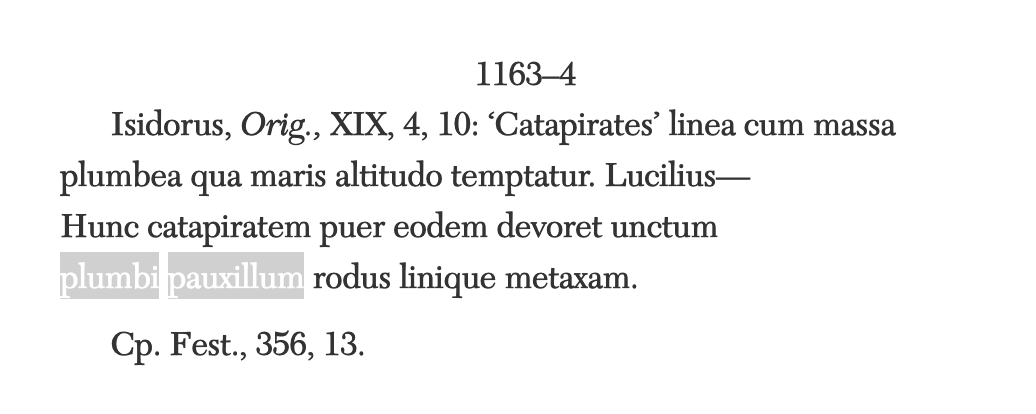
The common people indeed had it in use not only as Lucilius says, for unrefined bronze, as when he says:

“a little lump of lead and a [fine?] cord [of flax? silk?]” [see below: Isodore also quotes this line with more context]

but also symbolically, in the disposal of property [manumission?!], when it is said: “Let the scale be struck with rudusculo,” as an as touches the scale. [cf. Varro, LL 5.163!]

Cincius says of the ancient words:

“In the same way that almost every material that is not deformed is called rudis, just as a garment is rude, as in not refined; so is unwrought bronze called rudusculum. Near the temple of Apollo was situated fused[?] bronze, which was called rudus. In census appraisals unwrought bronze is called rudus. Rudiari are called thus because they adorn new cloaks. We call an ignorant person, rudem.” [I’ve no idea what the penultimate sentence about rudiari means; I want it to be about rudiarii, i.e. manumitted gladiators, but I just can’t make it work to have that meaning.]

Rudentes [can mean either] the naval ropes, [or] the donkeys when they bellow.

Tangential update 1-19-23:

Quote from:

CRAWFORD, Michael H. Thesauri, hoards and votive deposits In: Sanctuaires et sources: Les sources documentaires et leurs limites dans la description des lieux de culte [online]. Naples: Publications du Centre Jean Bérard, 2003 (generated 19 janvier 2023). Available on the Internet: <http://books.openedition.org/pcjb/878&gt;. ISBN: 9782918887218. DOI: https://doi.org/10.4000/books.pcjb.878.

He translated asses as money but I think given how many actual asses one finds in these things perhaps we should leave it be in the original language.
Day 7 of 234: Still more on RRC 486/1

Days 5-6 were the weekend. And, now that I have a family, I have a better appreciation of the need to stop oneself from working every possible moment.

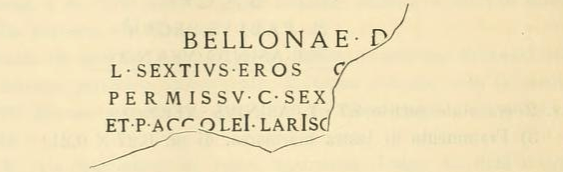
Grueber 1910 (see last post) cited Borasi 1898 and it is indeed it not only has a very nice sketch/transcription of the stone, but also a discussion of the earlier speculations on the coin including background to the historical dating of it and a little on what was known then on the cult of Bellona in the region. Perhaps fuel for deeper digging

Borasi and others keep mentioning a hybrid type with Augustus and RRC 486/1 and the legend “imp. Caes. Augus, tr. pot. iix.” as reported by Borghesi. I wondered if any of these hybrids have turned up more recently. I’ve not tracked one down yet, but I did come across TWO fun Spanish hybrid types using the obverse of RRC 407/2 and the reverse of RIC 1 404 (or 405). Kind of wild they use different dies but from the same types.

Specimen link
specimen link
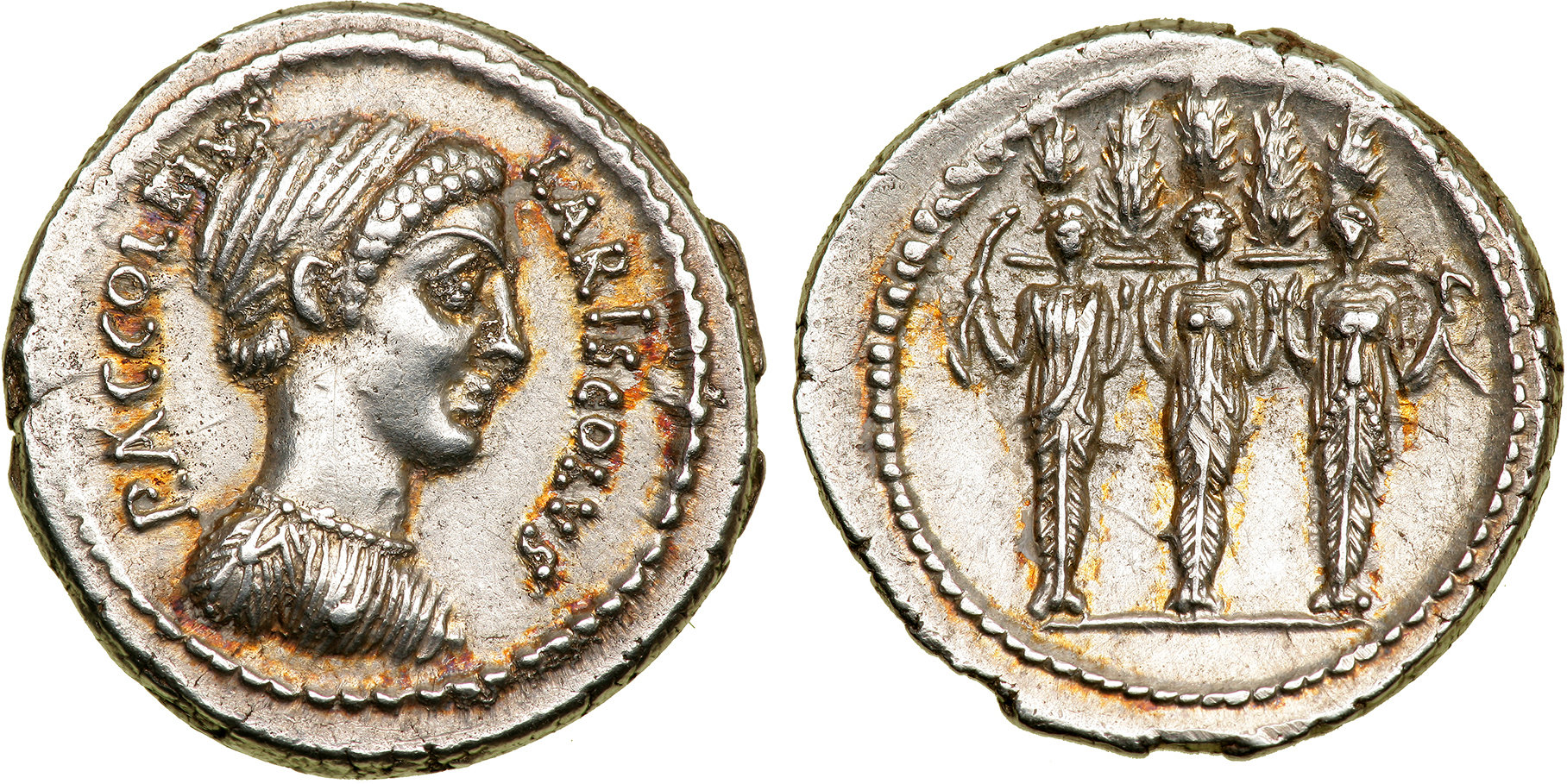
Just a nice specimen of RRC 486/1

I don’t think these goddesses are Oak Nymphs or Oak-Grove Lares (Querquetulanae) anymore than they were Larch trees, but its always good to review the evidence, before dismissing it.

Varro LL 5.49

Not my most satisfying warm up writing, but good enough… on to the lists.


Today

  • Spend EVEN MORE time with Dionysius
  • More Italy visit logistics
  • More Rutgers coordination as needed
  • More Princeton coordination as needed
  • Dr. Liz letter

Not Today (but maybe tomorrow, or the day after)

  • Teaching requests for Fall 2023
  • Circle back to department about any Jan planning meetings
  • Book flights
  • Set time table for any collaborative RRDP work/publication prep that needs to happen this semester: Chicago pub, INC pub, collaboration with RACOM, etc…
  • Circle back to Capito project
  • Consider ask for funding from Dean’s office
  • Begin Med school rec letter
  • record mini myth
  • find out what is on that v old harddrive and back up to cloud
  • follow up with Lafayette
  • Write up Teaching Eval
  • Follow up old student/tree sunset
  • Rosen Fellowship refs
  • Finalize AAH logistics
  • Cancel at least one more digital membership
  • renew Coinarchives

Ripped from the Stage?

A. Postumius A. f. Sp. n. Albinus. Denarius serratus 81, AR 4.05 g. Draped bust of Diana r., with bow and quiver over shoulder; above head, bucranium. Rev. Togate figure standing r. over rock, holding aspergillum over bull; between them, lighted altar. Babelon Postumia 7. Sydenham 745. Crawford 372/1. NAC 54 (2010) lot 919.

Peter Wiseman has put much scholarly energy into expounding how stage performances have influences our received narrative histories [for instance this book].  Not everyone believes this, but it is certainly a good starting point to introduce some skepticism into one’s reading of ancient histories.  I’m editing the section of the book on the coin above and have amongst my marginalia a note to find out whether it has been suggested that Plutarch’s narrative (from Juba) is ultimately derived from a stage production (Roman Questions 4):

Why do they, as might be expected, nail up stags’ horns in all the other shrines of Diana, but in the shrine on the Aventine nail up horns of cattle?  Is it because they remember the ancient occurrence?For the tale is told that among the Sabines in the herds of Antro Curiatius was born a heifer excelling all the others in appearance and size. When a certain soothsayer told him that the city of the man who should sacrifice that heifer to Diana on the Aventine was destined to become the mightiest city and to rule all Italy,  the man came to Rome with intent to sacrifice his heifer. But a slave of his secretly told the prophecy to the king Servius, who told Cornelius the priest, and Cornelius gave instructions to Antro to bathe in the Tiber before the sacrifice; for this, said he, was the custom of those whose sacrifice was to be acceptable. Accordingly Antro went away and bathed, but Servius sacrificed the heifer to Diana before Antro could return, and nailed the horns to the shrine. This tale both Juba and Varro have recorded, except that Varro has not noted the name of Antro; and he says that the Sabine was cozened, not by Cornelius the priest, but by the keeper of the temple.

It seems ripe for staging with far more characters and drama than another version.  Also notice how much of the action happens off stage and the drama is the dialogue between characters, except the final sacrifice.  It’s the trope of the cunning slave that really gets me me thinking in the direction of ancient theater.  But all my searches have turned up nothing.  I really wanted to put a footnote in and don’t really want to work up and defend the idea further myself.  So I think its out of the book for now.  Not the coin.  Just the theater angle.

I did come across an intriguing suggestion from C. J. Smith (Roman Clan 2006: 39):

A peculiar story in Plutarch, but taken from Juba and Varro, is suggestive of the kind of myth-making in the late Republic; it is connected with the foundation of the temple of Diana, founded by Servius Tullius, and has a Sabine duped by a Cornelius over the sacrifice of a heifer; evidence from coins may suggest that the same story was told of a Postumius. n.98

n. 98 – Plut. QR 4 = Mor. 264CD; Juba FGrH 275 F12. Cf. Livy 1.45.3 with Ogilvie (1965) 183–4; Val. Max. 7.3.1; Vir. ill. 7.10–14; Zonar. 7.9. There was a prophecy that the outstanding heifer in Antro Curiatius’ herd would, when sacrificed in the temple of Diana on the Aventine, bestow on the city of the one who sacrificed it dominion over Italy, but Cornelius the priest told Curiatius to bathe before sacricifing, and then Servius sacrificed the animal and hung its horns (cornua, hence Cornelius) in the temple. For a coin with a bust of Diana on the obverse and a scene of sacrifice on the reverse, see RRC 372; the moneyer was A. Postumius Albinus, who was related to the annalist. Livy gives the story without the names, and it seems that only Juba had got the story in full, since Varro’s version is slightly different again.

My basic line in the book is there is good evidence for an affinity between the gens Postumia and Diana from multiple moneyers.

Unrelated gossip: I heard it on the Classics grapevine that T.P. Wiseman was the model for Albus Dumbledore as J.K. Rowlings, Professor at Exeter.  Fun thought, even if not true.

I will always associate Harry Potter with Numismatics as on 8 July 1999, the release date of the third book, I was attending the Institute For Classical Studies, University of London, Summer Schools in Numismatics, led by Meadows and Williams with Crawford and Burnett and co making guest appearances.  One of my fellow students was a Glaswegian. I confessed to liking what was at the time a children’s book that had made the nightly news, not world phenomenon.  He in turn bragged that he wording the cafe where Rowlings wrote the first two novels.  Can’t remember his name.  I loved children’s literature before Rowlings and enjoy it even more that her success means publishers give other authors longer word counts and cross market to adults more readily.

Now, If only I had a longer word count for my book!