
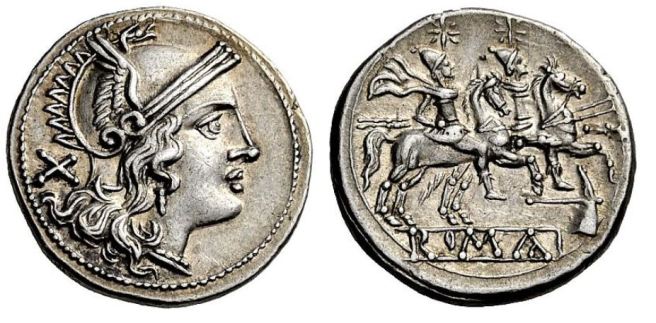
164 out of 410 days: a Dolabella in Sicily during the 2nd Punic War?

Capture.JPG

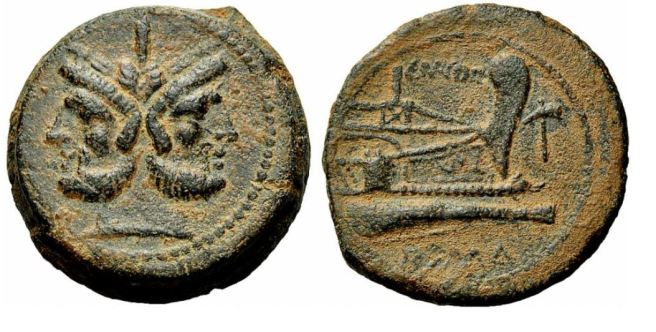
For the type illustrated (RRC 73/1) above Crawford does not speculate in RRC as to the moneyer indicated by the pick-axe = dolabra = dolabella.  The use of this symbol as a plausible indication of the moneyer’s cognomen is demonstrated by these coins of Cn. Cornelius Dolabella (RRC 81, redated and relocated by Russo to 130-128 BC in Spain):
Capture.JPG

The likely moneyer of the earlier coin seems to me to be lurking in plain sight in Zonaras’ epitome of Cassius Dio:

After Marcellus had left Sicily, Hannibal sent a force of cavalry there, and the Carthaginians despatched another. They won several battles and acquired some cities; and if the praetor Cornelius Dolabella had not come against them, they would have subjugated all Sicily. 

This connection or lack of connection may go back to Münzer in RE.  Here is Broughton on the subject:

Image

Image

Here is the Livy in question:

M. Cornelius was commissioned to select the city and territory for them, where he thought best, and 400 jugera in the same district were also decreed as a gift to Belligenes through whose instrumentality Moericus had been induced to change sides. After Marcellus’ departure from Sicily a Carthaginian fleet landed a force of 8000 infantry and 3000 Numidian horse. The cities of Murgentia and Ergetium revolted to them, and their example was followed by Hybla and Macella and some other less important places. Muttines and his Numidians were also roaming all through the island and laying waste the fields of Rome’s allies with fire. To add to these troubles the Roman army bitterly resented not being withdrawn from the province with their commander and also not being allowed to winter in the towns. Consequently they were very remiss in their military duties; in fact it was only the absence of a leader that prevented them from breaking out into open mutiny. In spite of these difficulties the praetor M. Cornelius succeeded by remonstrances and reassurances in calming the temper of his men, and then reduced all the revolted cities to submission. In pursuance of the senate’s orders he selected Murgentia, one of those cities, for the settlement of Moericus and his Spaniards.

Of course, that then would open the sticky issue of how long this Cornelius (Dolabella?) was in Sicily and the chronology of the early denarii.  This passage about the settlement of the Spaniards in Morgantina is critical because we date the start of the denarius to 211 based on deposits found in the excavation of that site below the destruction level.  Dating the issue is problematic.  It appears in four hoards but all closing in the 70s or later.  Crawford justifies his dating thus:

The Sicilian origin of the four issues is adequately attested by their close stylistic link with the issue with corn-ear, their early date both by this link and by their heavy weight-standard [i.e. 4.5 g.]  (RRC vol 1. p. 17)

Badian did not include Zonaras’  Dolabella in his study of the Dolabellae of the Republic. He mentions in passing the consul of 283, but begins properly with the consul of 159, briefly speculating that his father would be the Cn. Cornelius Dolabella who was made Rex Sacrorum in 208 and died in 180 (Livy 27.36.5).  The rex sacrorum could be the same as Zonaras’  Dolabella.  If he were in his early 40s in 211BC in Sicily, he would have then died in his early 70s.

One strike against Livy’s Cornelius being a Dollabella is the praenomen Marcus which is otherwise unattested in this branch of the family.  So if Zonaras or Livy is likely to be wrong it is easy to see why Zonaras has previously been dismissed, being so late and so abbreviated. That said, Dio has access to sources other than Livy. An abbreviated praenomen can be miss-transcribed.  And with the coin as extra weight, I’m tempted to lean away from Livy towards Zonaras on this point.

We, of course, are then right to ask what happened to the M. Cornelius Cethegus credited with suppressing the Sicilian revolts after Marcellus’ departure?  We’d have to leave him in the province that was assigned to him that year in the first place, Apulia (Livy 25.41).

As an aside, I am interested to note that one Wikipedia entry on the gens Cornelii lists this Dolabella with no citation, whereas another excludes him.

EETIA?

UPDATE 2/4/22: see now, Sánchez 2021 (related blog post).


This is the coin type that occupied me much of last Thursday.  The interest comes from it being a potentially non-Italian instance of an oath-taking scene.  Such scenes appear during the Hannibalic War on both Roman coinage and that of certain Campanian cities which sided with the Punic forces.

And was resurrected by the Romans probably about 137 BC:

But was then famously the iconography was taken over by the Italian allies during the Social War in the 80s BC when they broke with Rome.

The swearing of an oath on a pig to seal a treaty is well attested as part of Italic culture, perhaps most famously at the Caudine Forks incident.  The legend of the type had previously been read on less clear specimens as FETIA and thought to refer to the fetiales, the priests associated with religious declarations of war and solemnizing the peace.  All these ‘oath scene’ coins have been associated with the fetiales in the past.  That’s somewhat problematic as such an oath could be sworn by the generals without such priests (again, see Cicero on the Caudine Forks oath).

Anyway, the new specimen above clearly reads EETI- and all the other reverse die specimens I’ve seen could be read the same way.  EETIA must be Latin as the letter combination is unattested in Greek.  It’s none too common in Latin.  If the word begins EETI- one thinks of the various legendary kings and heros named Eëtion.   They are associated with the Greek mainland or Asia Minor.  Leypold said he bought his specimen in Amisus and because small bronzes don’t tend to travel far its usually attributed to that location or the general region.   No other specimens find spots are known.   The lack of a diadem or garland on the obverse head has lead to the assumption it was a portrait of a Roman commander.  Speculation then commences about possible Roman commanders active in Asia Minor.  The Roman certainly experimented with coinage in the region.

As we puzzle out the legend we might recall that “Accian” Vowels, i.e. the reduplication of vowels to indicate their long vowel length, do appear on Republican coins.  [This type of vowel is discussed by Lucilius.]

And, even on provincial issues from Macedonia:

For the type of the last see BM catalogue.

One other clue might be visable on this rather awful specimen:

On this specimen one can see what I think might be a Q under the obverse head.   Q or PRO Q is a relativelycommon addition special issues and military coinage of this period.  We’ve seen two examples already above.  Here are two more from the Crawford sequence:

I grabbed this last example because of the placement under the bust.  If there wasn’t the assumption that it was from Asia Minor, I would have speculated Italic or at least Western Mediterranean origins.  The type is closer to the Campanian imagery of two figures holding a pig above the ground than any of the Roman or Marsic scenes.

But finally, given that there only seems to be one obverse die and maybe about four reverse dies amongst all the specimens, not to mention the scarcity of the type, this must be a very low volume production.  Why put all this energy into its manufacture?!  Who benefited?  Is it purely an ideological statement?  If so, towards whom is it aimed?