I’m looking for the inventory number of a piece in the Glyptotek I need to footnote in this article I’m trying to send off. Hence, I’m trying to find just the right word to get the Danish National Database of Museum holdings to spit out the right information. Given that the database only functions in Danish (not one of my languages!), I keep getting distracted by my interesting, but incorrect search results. Thus, this flurry of posts.
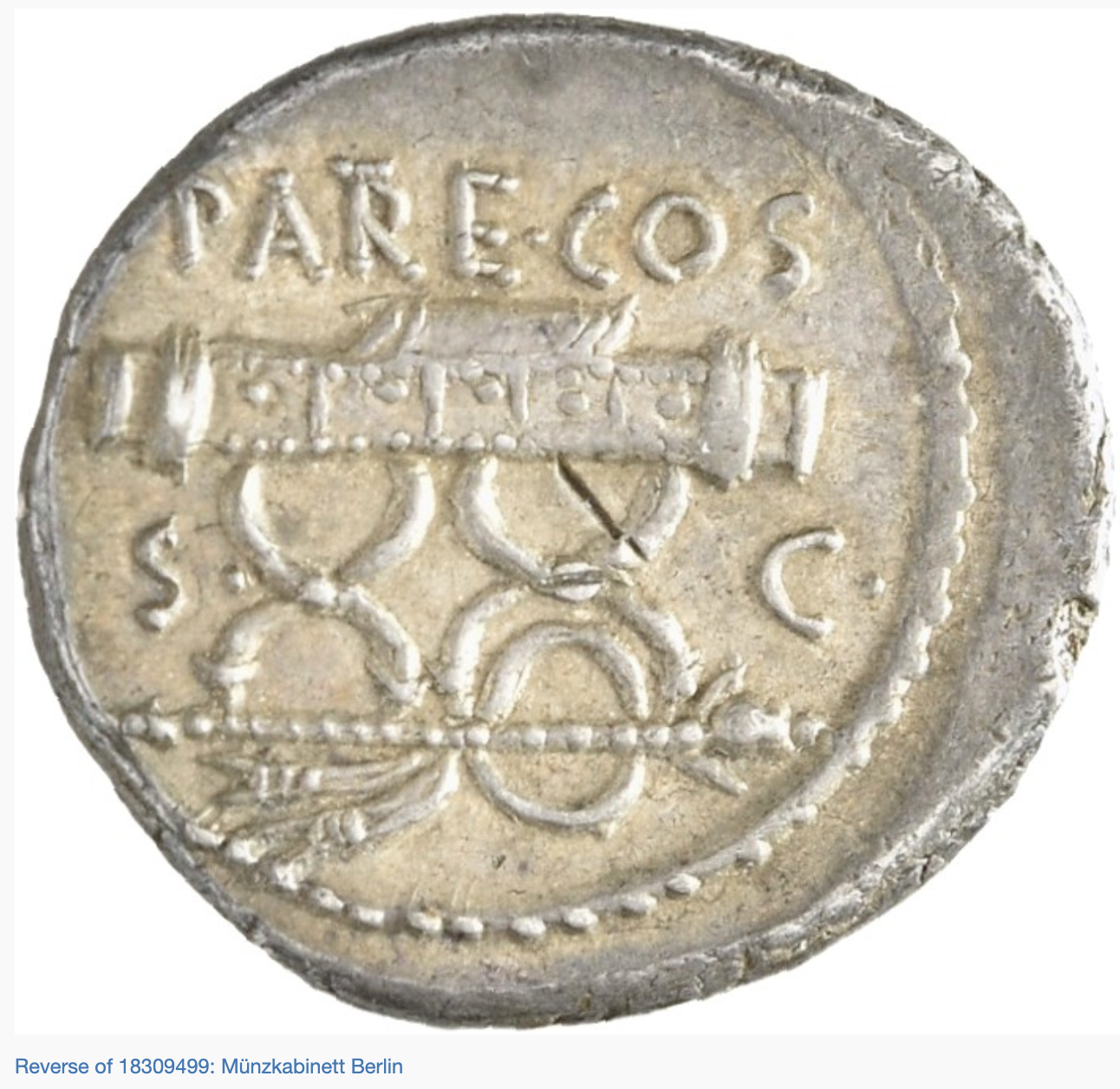
Anyway, I wanted to keep a record of this image from the high empire because of how it juxtaposes the scepter with the chair and crown. I also want to think more about the barbarians as leg supports and how this may have evolved out of the ‘creative’ feet on some of the curule chairs in republican iconography. I’m thinking the lion feet on the chair of the P. Fourius Crassipes on his issue as curule aedile (RRC 356/1).
This seems to be the earliest coin (c.53BCE, RRC 435/1) in which the symbols of Hellenistic kingship, the diadem and the scepter, are used in such a way as to suggest their rejection in favor of the traditional symbols of Roman power in this case the curule chair. For this coin, the context is the threat of Pompey assuming sole control of the Roman state.
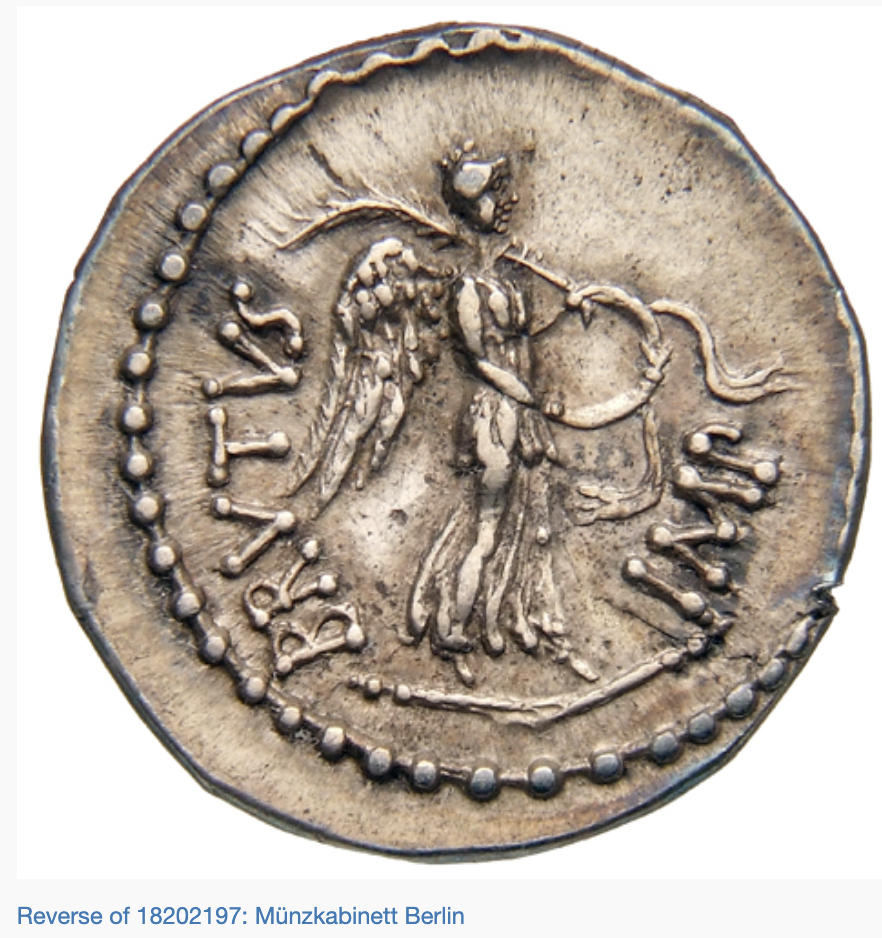
We see a similar iconographic strategy on a coin of Brutus after the murder of Julius Caesar (RRC 507/2):
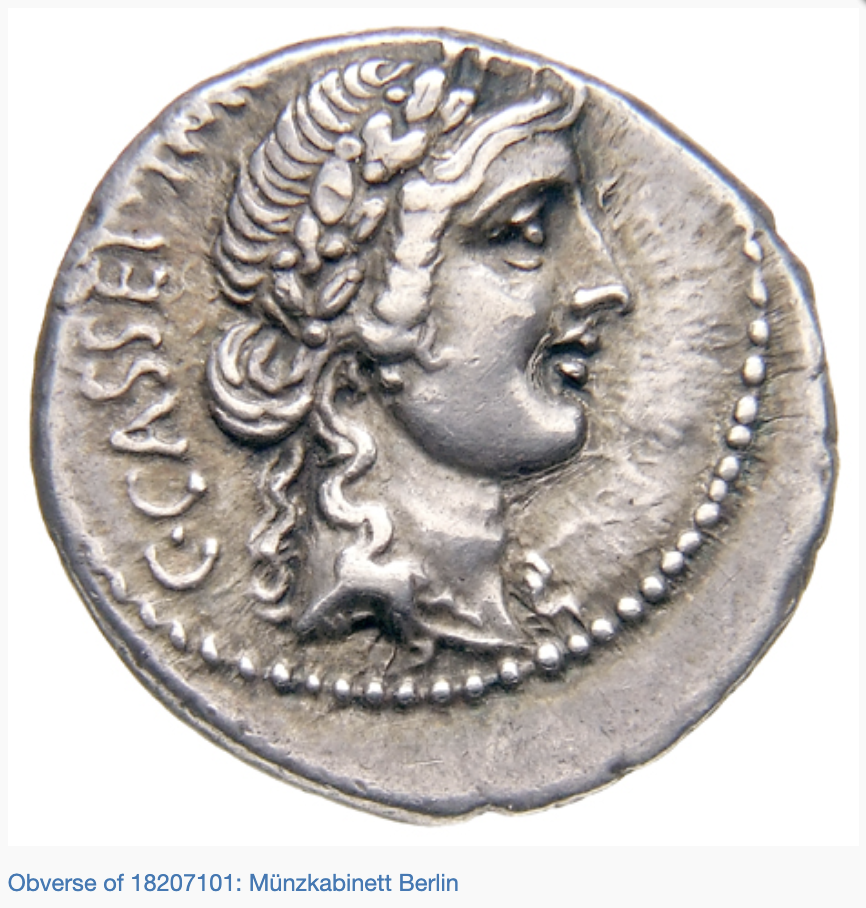
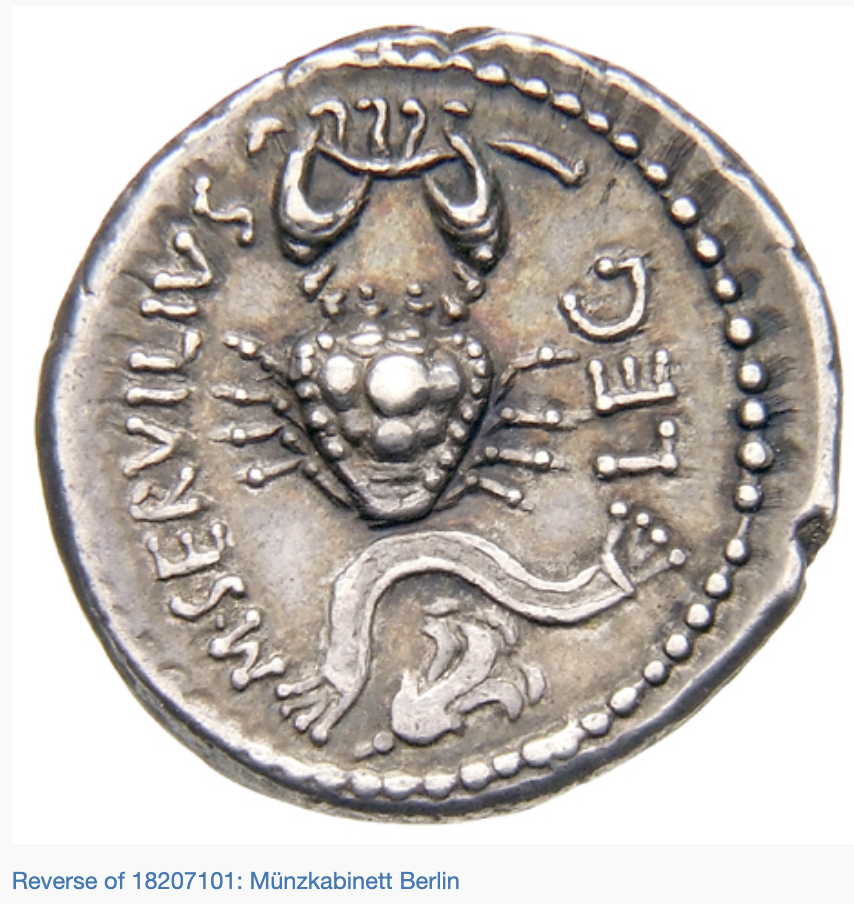
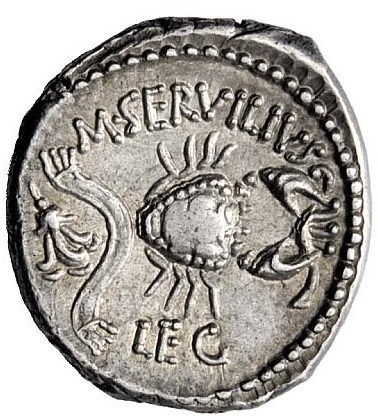
The question in my mind is should a similar interpretation also apply to this type (RRC 505/3):
Today the type is invariably photographed with the orientation shown above, but Crawford had his plates printed at the 90 degree rotation of the reverse:
Crawford is silent on the symbolism of diadem saying only: “Part of one issue of Cassius records his capture of Rhodes after a battle at Myndus, opposite the island of Cos; the rose of Rhodes and crab of Cos both figure, together with an aplustre as a symbol of victory” (p. 741). I must say, the aplustre doesn’t seem very victorious to me as it is clutched in the claws of the crab. Or perhaps its just Cos offering the naval victory to Cassius…
I also think I prefer symbolically the crab and aplustre read as over and above the more diminished Rhodian rose and the diadem, just as the curule chair symbolically sits over the diadem and sceptre in the first type above.
“Cassius, having taken Rhodes, behaved himself there with no clemency; though at his first entry, when some had called him lord and king, he answered that he was neither king nor lord, but the destroyer and punisher of a king and lord.”
I’m not sure this is specifically the allusion the die engraver was aiming at but it is certainly a reflection of the same rhetorical impulse.
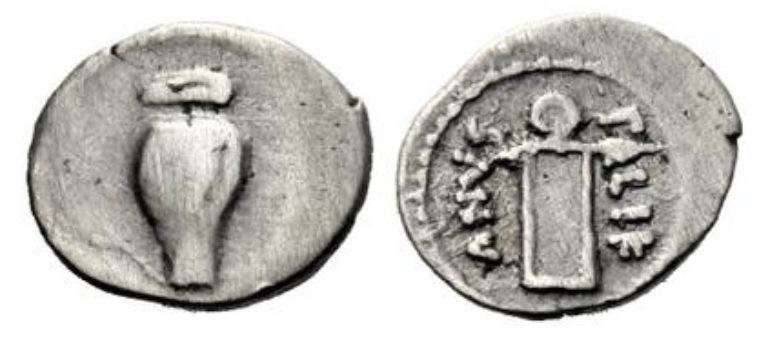
This little coin, a silver sestertius of 45 BC or there about, has me worried about the chronological limits of my book project. Yes, stopping in 49BC to leave the discussion of Caesar and the Civil Wars to another book does make good sense. However, a good number of post-49BC coins are intimately thematically related to earlier coins in the series. The issue of Palikanus taken as a whole is a good illustration of the “republican” characteristics of some of these later issues.
The above coin was thought to show a money pot or olla and a banker’s tessarae. This at least was Wiseman’s suggestion, based on the banking interests of the moneyer’s family.
Wiseman, T. P. (1971) New Men in the Roman Senate, 139BC-AD14. Oxford p. 85-6.
His idea is largely endorsed by Crawford and even to an extent by Zehnacker.
Zehnacker, H. (1972) ‘La Numismatique de la République romaine: bilan et perspectives’, ANRW I.I (Berlin), 266-96, at 284: “En tout cas, l’appartenance au monde de la finance expliquerait trés bien le mélange caractéristique chez les monetales de noms illustres—des cadets de famille qui ont préféré l’argentaux honneurs—et de noms quasi inconnus—de parvenus”
Based on the themes of the rest of the series as a whole, I think L. R. Taylor’s original suggestion of voting urn and ballot is far more likely (VDRR p. 226). The series celebrates:
Libertas and the Tribune’s Bench on the Rostra:
Honor and a Curule Chair flanked by Grain:
Then on the quinarius, Felicitas and Victory:
Given that all the other elements in the series celebrate civic virtues, even popular virtues, interpreting the smallest denomination in the series as a banking advert seems a bit of a stretch. A voting theme would harmonize much better.
All that said, there was a temple of Ops (wealth) in Roman. If its not voting being represented, I’d go with another divine personification before assuming a reference to a family banking business.
Also the use of the genitive on all these is types is striking.
Perhaps I’ll just need to include a flash forward to work a few of this series in.
—
Update 24 January 2014: So I was re-reading Witschonke 2012 on the possible uses of control marks at the Roman mint. Really the very best thing on the subject. Speculative in places by necessity, but logical and solid reasoning throughout. It depends on the important work of Stannard (Metallurgy in numismatics vol. 3 1993: 45-68 pl 1-2) on the evidence for mint practices revealed by gauging, namely that the mint worked in batches. What if money pot and tessarae (if that’s what they are) aren’t banking icongraphy but in fact minting iconography? A claim to the rigorous control of the issue. A celebration of Juno Moneta. Something like this coin of c. 46BC:





 Liv Mariah Yarrow