Sayings of and about Sulla

This paragraph of Appian (BC 1.101) reads very much like an excerpt from a collection of ‘wittisms’ or ‘memorable sayings’

So terrible was he and so uncontrollable in anger that he slew in the middle of the forum Q. Lucretius Ofella, the one who had besieged and captured Præneste and the consul Marius, and had won the final victory for him. He did this because, in spite of the new law, Lucretius persisted, though Sulla opposed and forbade, in being a candidate for the consulship while he was still in the equestrian order and before he had been quæstor and prætor, presuming on the greatness of his services, according to the former custom, and captivating the populace. Then Sulla assembled the people and said to them, “Know, citizens, and learn from me, that I caused the death of Lucretius because he disobeyed me.” And then he told the following story: “A husbandman was bitten by fleas while ploughing. He stopped his ploughing twice in order to clear them out of his shirt. When they bit him. again he burned his shirt, so that he might not be so often interrupted in his work. And I tell you, who have felt my hand twice, to take warning lest the third time fire be brought in requisition.” With these words he terrified them and thereafter ruled as he pleased. He had a triumph on account of the Mithridatic war, during which some of the scoffers called his government ” the royalty disavowed” because only the name of king was concealed. Others took the contrary view, judging from his acts, and called it “the tyranny confessed.”

The flea parable is particularly interesting in the tradition of parables.  The triumphal jokes should be read in light of the tradition of Roman ribald songs as part of the ritual, particularly ones that poke fun of the commander.  Cf. comments about Caesar and Nicomedes at the former’s triumph.

Numa in 88 BCE?

Capture.JPG

RRC 346 features both Numa and Ancus Marcius.  Most of the plausible explanations for the series and its types relate to Ancus, Rome’s 4th king.  Numa is typically explained as Ancus’  grandfather and thus the source of his elevated status and authority.  BUT… I just came across this passage in Appian (Mith. 22) and it got me thinking:

When the consuls cast lots, the government of Asia and the Mithridatic war fell to [Lucius] Cornelius Sulla. As they had no money to defray his expenses they voted to sell the treasures that king Numa Pompilius had set apart for sacrifices to the gods; so great was their want of means at that time and so great their ambition for the commonwealth. A part of these treasures, sold hastily, brought 90,000 pounds’ weight of gold and this was all they had to spend on so great a war. Moreover Sulla was detained a long time by the civil wars, as I have stated in my history of the same.

Sacrificial Implements on Cast Coinage

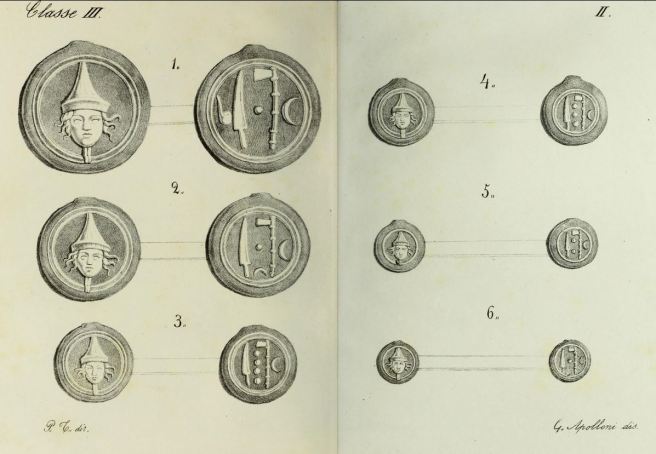
This anonymous Etruscan series (based on an as of c. 177g) seems to demonstrate a continuity of symbolism between 3rd century inland Etruria and 1st century Rome regarding symbols of the priesthood.  HN Italy 68a-e, Haeberlin pp 273-5, Vicari 219-23.

capture

[Why can’t I find a digitized copy of Haeberlin’s Aes Grave?  He died in 1925.  Even allowing the full 80 years post the  author’s death (German pre 1965 law), this would still have put it out of copyright more than a decade ago!]

A Coin about Coins

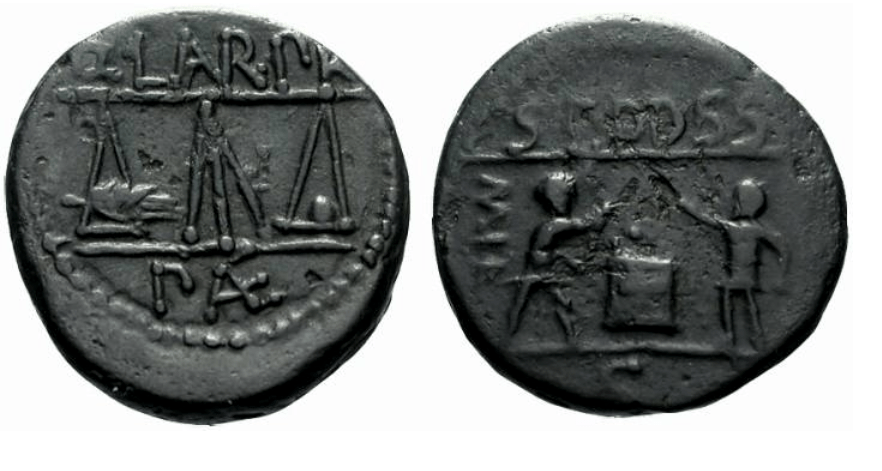
“Paestum. Semis early first century, æ 4.28 g. Q· LAR·PR Scales weighting ear of corn; in exergue, Pæ. Rev. SPDDS·S Two workmen in the act of coining; in field l., MIL. In exergue, S. SNG Copenhagen 1372. M. Crawford, Studies Price, Paestum and Rome. The Form and Function of a Subsidiary Coinage, 25/1. Historia Numorum 1238.” [specimen in trade]

Crawford interprets the legend as ” Q. Laur(entius ?) praetor sua pecunia dono dedit Senatus sententia milia (or miliens): “The praetor Q. Laur. out of his own money and by consent of the Senate (of Paestum) gave as a present (to his fellow citizens) thousands (of this coin)”. To what end is suggested by the obverse; to buy a measure of subsidised wheat.”

Image and links fixed 3.6.26.

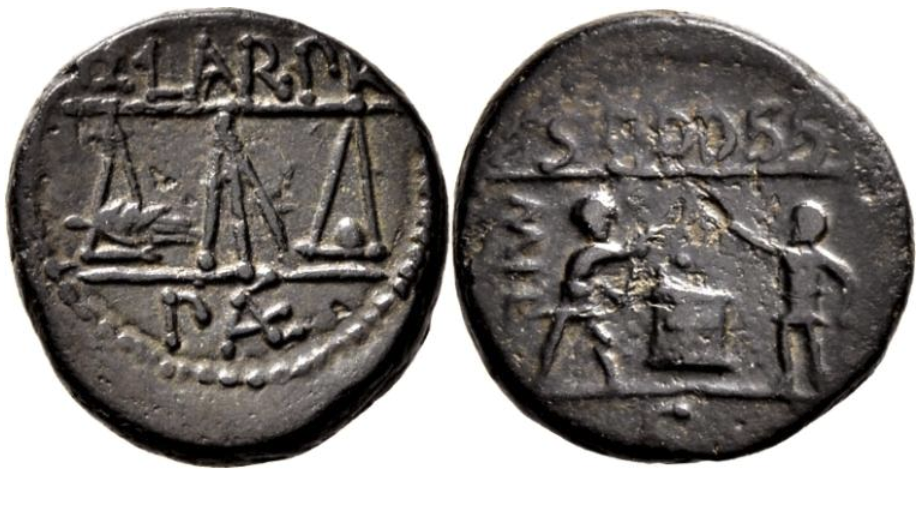
Same specimen different photo from a different sale.

Roma and the Wolf and Twins

Capture - Copy.JPG

Early posts on RRC 287/1.

(Is it just me or is there only one baby under that wolf?!  Not that it’s the finest execution but usually there is more of an attempt to indicate both twins.)

Update 6-30-17:

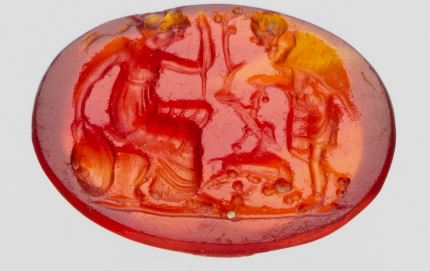
http://arachne.uni-koeln.de/item/reproduktion/3308096

http://arachne.uni-koeln.de/item/objekt/207558

http://arachne.uni-koeln.de/item/reproduktion/3308097

http://arachne.uni-koeln.de/item/objekt/207559