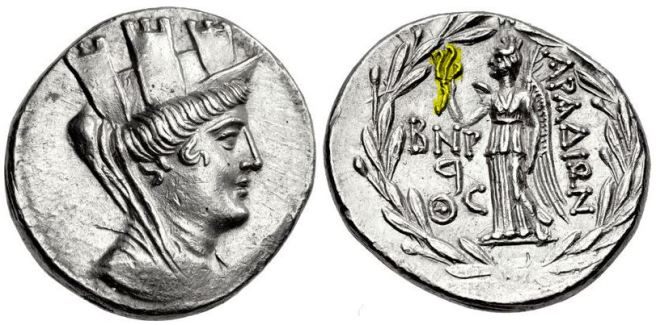
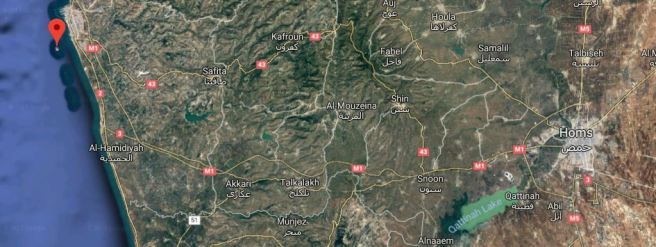
This tetradrachm is dated CY 152 (108/7 BC). Notice that Victory on the reverse is holding an aplustre (= stern decoration). A rather fitting emblem for an island mint (modern Arwad):

adventures in my head

This tetradrachm is dated CY 152 (108/7 BC). Notice that Victory on the reverse is holding an aplustre (= stern decoration). A rather fitting emblem for an island mint (modern Arwad):
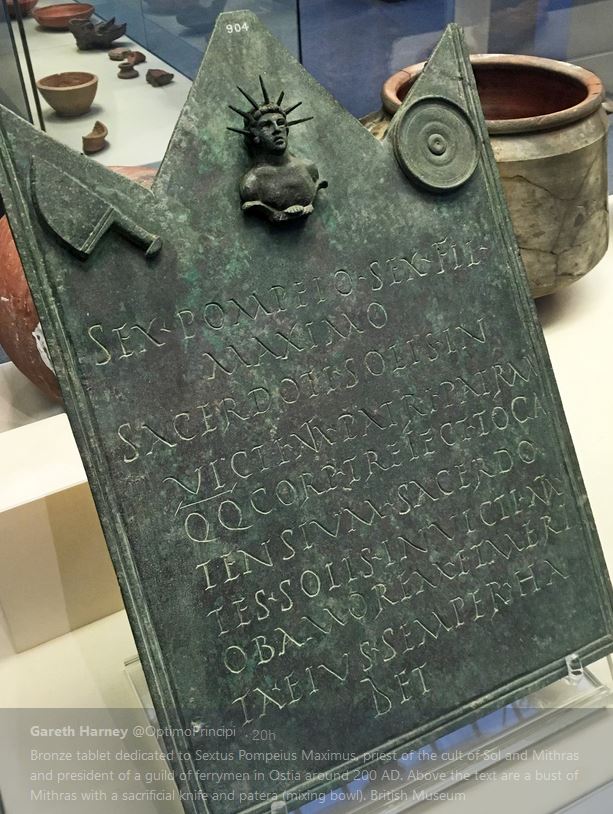
Right. Must stop seeing stuff and get back to emails and journal article revisions… But right before that here is yet another example that should have been mentioned in my article on RRC 242 and RRC 243 on the Minucii to bolster my argument for the iconography of the priesthood being a patera and knife and particularly the shape of said knife.

I got thinking about RRC 423/1 because of the preceding post. I wanted to recall other images of Romans facing Romans. As I was browsing the CRRO entry (linked in last sentence), I noticed a few specimens with crossed swords. Crawford notice this as well: “On one reverse die the soldiers are crossing swords (Bologna, Cat. 367)”.
Besides the one in trade illustrated above, I spotted one in Paris and one in the BM 2002,0102.4306 (why oh why do they not yet have stable URLs?!).
Didn’t bother to check whether they are all the same die. I wonder if this crossed sword interpretation might help us think about what the design means. I have often thought it might represent an oath scene or some sort…
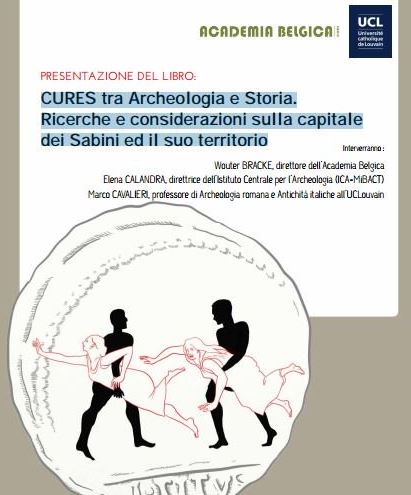
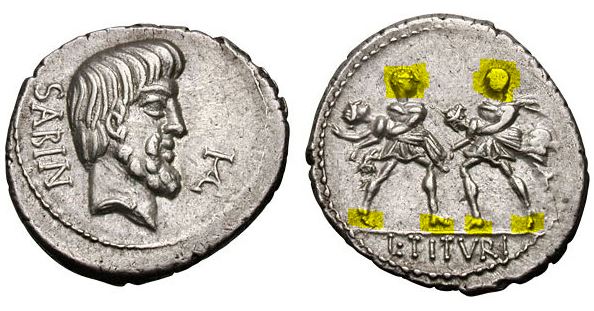
This book cover came across my twitter feed today. It riffs on RRC 344/1 and its depiction of the Rape of the Sabine Women. The reverse design re-imagined with more modern assumptions of bodies made me look at the bodies of the original more closely. I realized that because of the direction of the women’s arms I’d always read the type as the their being carried off stage left. This isn’t the case. The two men face each other and make eye contact. There feet and legs suggest they are run towards each other not off in the same direction. The scene is the “we got them, now what?” moment of the seizure and rape. I want to think more about this…
Ὁ δὲ Βροῦτος αὐτῷ πάλιν παραστὰς, “Ἴθι, ὦ ἀγαθὲ,” ἔφη, “τοῖς λήροις τούτων χαίρειν φράσας…”
and Brutus was standing with him again saying, “Go my good friend, be done with the non-sense of these people…” (Nic. Aug. 87; Toher trans.)
I read the above and started to fret a little over the vocative ὦ ἀγαθὲ. It felt unfamiliar and maybe an odd translation. Nope. Totally standard translation according to the LSJ:
ὦ ἀγαθέ, my good friend, as a term of gentle remonstrance, Pl.Prt.311a, etc.
Huh, I thought, maybe this is a philosophical thing? Ya sure you betcha! One use in Isaeus. But then lots of Plato and always with Socrates teasing and guiding the other interlocutors to the ‘right’ conclusion away from some ‘preposterous’ one (Republic, Phaedrus, Crito).
Where else does it show up? Well in the mock philosophic dialogue of Athenaeus!
[Bye-the-bye, it’s also all over early Christian writers and has some antecedents in the NT, probably a philosophical influence but not really my area, so I leave it be]
So what I like about this all is that Nicolaus the Peripatetic is bring his vocabulary of Philosophic dialogue into his life of Augustus. BUT, of course, we know that Brutus is deceiving Caesar at this moment! So is Nicolaus constructing ὦ ἀγαθέ as a bit of sophistry? Is Plato playing with sophistic rhetoric when he uses it in his Socratic dialogues?
Interestingly, Appian uses ὦ ἀγαθέ in moralizing discussions between friends deliberating correct action:
στενῆςδὲτῆςἐξόδουπάμπανοὔσηςὁΒλάτιοςἔφητῷΔασίῳ, τοὺςἄλλουςλαθών·
“οὐσώσεις, ὦἀγαθέ, τὴνπατρίδα;”ὃδὲκαὶτοῦτ’εὐθὺςἐκβοήσαςἐμήνυεν. …As they were going out by a very narrow passage Blatius said to Dasius in a low tone, “Are you not willing to save your country, good sir?” The latter immediately repeated the words in a loud voice… (App. Hann. 45, White trans.)
ἐπανερομένουδὲτοῦΚασσίου· “τίδ’, ἂνἡμᾶςκαλῶσινὡςστρατηγούς, τίποιήσομεν, ὦἀγαθὲΒροῦτε”; “ἀμυνῶτῇπατρίδι,”ἔφη, “μέχριθανάτου.”
Then Cassius asked him further, “What if we are summoned there as praetors, what shall we do then, my good Brutus?” “I will defend my country to the death,” he replied. (App. BC 2.113, White trans)
These instances are so similar that they feel like Appian must have a common model for both. His usage feels much more platonic, that Nicolaus’ sophistic tongue and cheek usage.

I’m thinking about Eunus (a.k.a. King Antiochus of Sicily) today and that led me back to this unique coin. Unique coins are a problem. And this one has a friend. Another unique coin. Another problem. They are listed as Enna 15, 16 by Campana.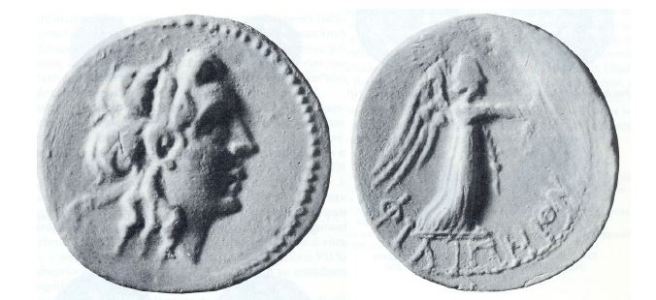
I don’t want to repeat Morton 2009. Other than to emphasize this opinion:
“Andrew Burnett and Keith Rutter, on the other hand, regard both coins as fakes. (Personal Comment, July 2008).”
All I have to add is what I think the likely inspiration of both coins may be. RRC 335/1 or 2 (late 90s Crawford, 91 BCE Mattingly).

This same reverse was resurrected in 59 BCE by RRC 421/1.
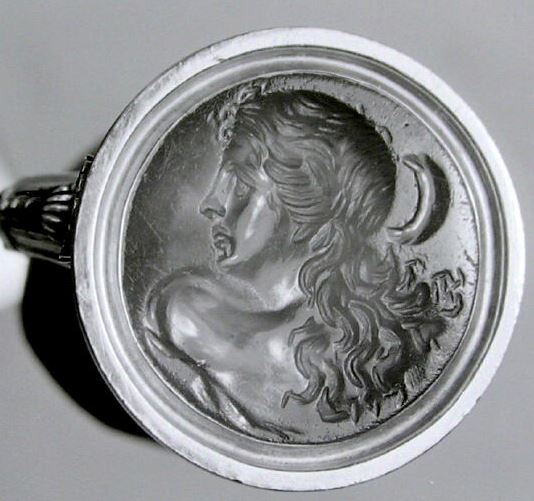
40004850, Marlborough, 415, Selene. Three-quarter back view of head and shoulders, with dress. Crescent in the field., Unknown, Boardman, J., Scarisbrick, D., Wagner C., Zwierlein-Diehl, E: The Marlborough Gems (2009), Story-Maskelyne, M.H.: The Marlborough Gems (1870), no. 415, Cornelian

In the past, I have been so interested in why Crawford’s 1971 interpretation of RRC 290/1 was wrong that until today I think I missed all that was right and interesting about his argument after one throws out the iconography portions.
I think he’s really on to something to link the traditions around the two Doliola especially as reported by Plutarch to the Dioscuri and their amphorae in Italic and Spartan imagery. This is a very smart and convincing hypothesis.
Here’s a basic run down:


More examples of the iconographic link between amphorae and Dioscuri:
15BCE, RIC 1 394:
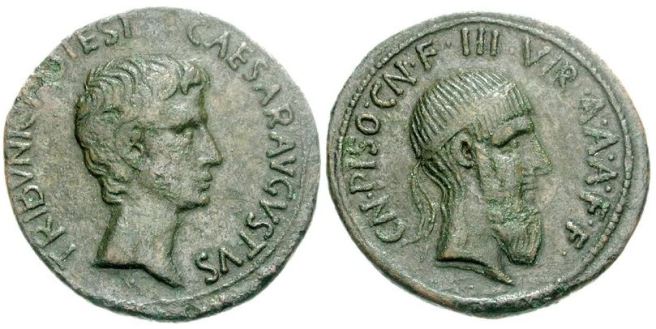
(very rare)
48 BCE, RRC 446/1:

Just a hunch but I doubt it was very politic to have chosen a Pompeian type, even if familial, for resurrection on the coinage under Augustus…
For the Calpurnius Pisones legendary ancestor Calpus, son of Numa, see Hor. Ars P. 292; Laus. Pis. 3, 14; Plut. Numa 21,2.
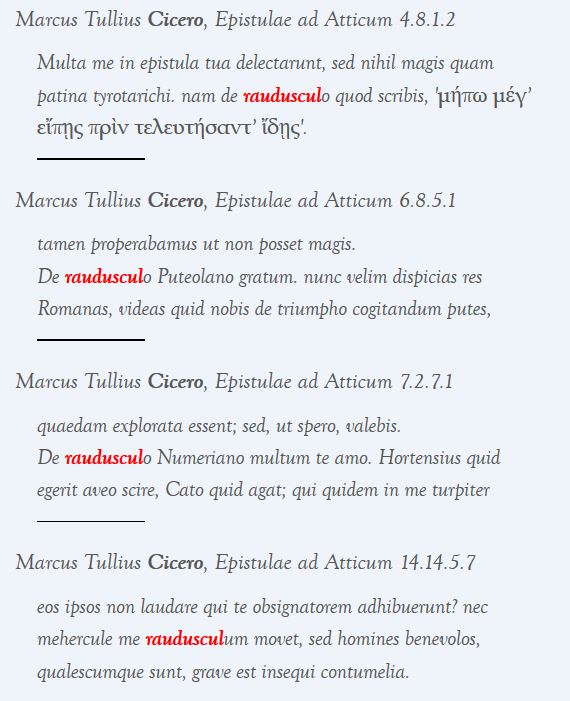
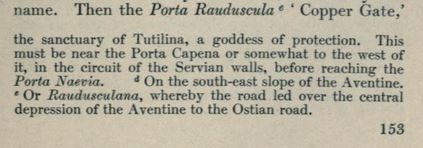
I got interested in rauduscul* because of its appearance in Varro, LL:
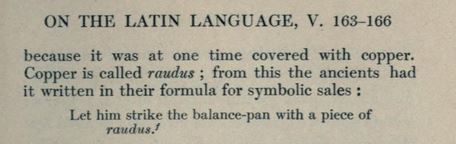
I’d be quite keen to know who Varro is quoting in this context and if the sale in question might be a manumission…
Anyway, all the uses by Cicero are exceptionally casual and dismissive, not at all in same level of solemnity that Varro seems to be describing.
 Liv Mariah Yarrow