Evidence on the Settlers of Neapolis

Just trying to keep my sources straight and working through Lomas’ footnotes.

Basic Strabo and Livy Passages (for once my own translations; follow links for other people’s translations):

Cumis erant oriundi; Cumani Chalcide Euboica originem trahunt. Classe, qua advecti ab domo fuerant, multum in ora maris eius quod accolunt potuere, primo [in] insulas Aenariam et Pithecusas egressi, deinde in continentem ausi sedes transferre.

They originated in Cumae, and the Cumani came originally from Chalcis in Euboea. My means of the fleet, in which they had travelled from home, the possess great power over the shore of the sea where they reside, first they took the islands of Aenaria and Pithacusa, then they ventured to transfer their base to the mainland.

Μετὰ δὲ Δικαιάρχειάν ἐστι Νεάπολις Κυμαίων ὕστερον δὲ καὶ Χαλκιδεῖς ἐπῴκησαν καὶ Πιθηκουσσαίων τινὲς καὶ Ἀθηναίων, ὥστε καὶ Νεάπολις ἐκλήθη διὰ τοῦτο

After Dicaearchia is Neapolis of the Cumani, later colonized by the Chalcideans and some Pithacussans and Athenians, thus because of this it is called Neapolis.

Other passages:

Strabo 14.2.10 on the Rhodians:  “among the Opici they founded Parthenopê”… notice a whole bunch of other rather outrageous claims and then a mention of Timaeus (not as the source of this particularly, but of their involvement in island foundations, that Strabo dismisses.   Everyone loves to dismiss Timaeus!)

Pseudo-Scymnos:

Capture.JPG

ἄστρον τι κοινὸν τῆς ὅλης οἰκουμένης  cf. Erskine 1994

On Odysseus in Latium see my article on Fides…

Cf. Strabo 6.1.6 Chalcidians as founders of Rhegium as a sort of sacred spring exercise.

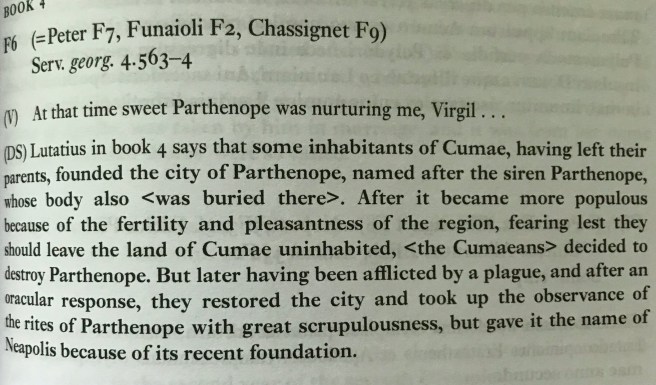
Velleius Paterculus 1.4.1-2: The Athenians established colonies at Chalcis and Eretria in Euboea, and the Lacedaemonians the colony of Magnesia in Asia. Not long afterwards, the Chalcidians, who, as I have already said, were of Attic origin, founded Cumae in Italy under the leadership of Hippocles and Megasthenes. According to some accounts the voyage of this fleet was guided by the flight of a dove which flew before it; according to others by the sound at night of a bronze instrument like that which is beaten at the rites of Ceres. At a considerably later period, a portion of the citizens of Cumae founded Naples.  The remarkable and unbroken loyalty to the Romans of both these cities makes them well worthy of their repute and of their charming situation. The Neapolitans, however, continued the careful observance of their ancestral customs; the Cumaeans, on the other hand, were changed in character by the proximity of their Oscan neighbours. The extent of their walls at the present day serves to reveal the greatness of these cities in the past.

Athenienses in Euboea Chalcida <et> Eretriam colonis occupauere, Lacedaemonii in Asia Magnesiam. Nec multo post Chalcidenses orti, ut praediximus, Atticis, Hippocle et Megasthene ducibus, Cumas in Italia condiderunt. Huius classis cursum esse directum alii columbae antecedentis uolatu ferunt, alii nocturno aeris sono, qualis Cerealibus sacris cieri solet.  Pars horum ciuium, magno post interuallo, Neapolim condidit. Vtriusque urbis eximia semper in Romanos fides facit eas nobilitate atque amoenitate sua dignissimas. Sed illis diligentior ritus patrii mansit custodia, Cumanos Osca mutauit uicinia. Vires autem ueteres earum urbium hodieque magnitudo ostentat moenium.   

On this last and the connection to Pseudo-Symnos above, see Malkin.
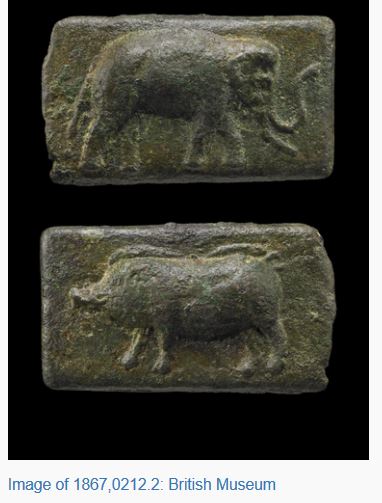
Types of the First Punic War?!

Brainwaves!

Capture.JPG

Most of the Carthaginian Elephants were captured by the Romans in Sicily (Polybius 1.19.11)

the whole island was said to be sacred to Demeter and Kore (Diod. 5.2.3; Cic. Verr. 2.4.106)

Pigs are symbolic of the worship of Demeter… (Ovid, Fasti 4.465-6 cf. RRC 342/3)

Sicilo-Punic Reverse Type from time of 1st Punic War:

Capture.JPG

RRC 4/1

Capture.png

This helps explain the common metallurgical profile of these bars and other bars with Naval imagery that are strongly associated with the 1st Punic War…..

Thoughts on RRC 402…

Kopij NAC 2016, 106-127

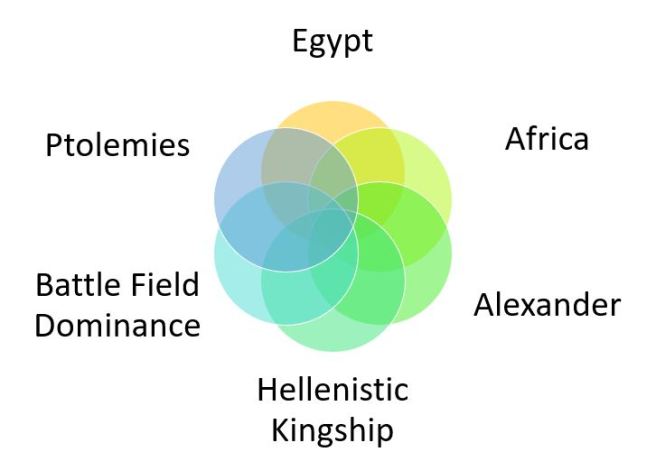
So just finished reading this article.  It is very important revisiting of ideas and evidence explored in Martiz 2001.   Kopij is the best lay out of all the evidence.  I do how ever read the development of the semantic range of meaning a little differently.  I would want a both/and style interpretation.  Symbols are best when they’re meanings are layered.  The elephant scalp can evoke any, some, or all of these connotations AND the connotations bleed into one another.

Capture.JPG

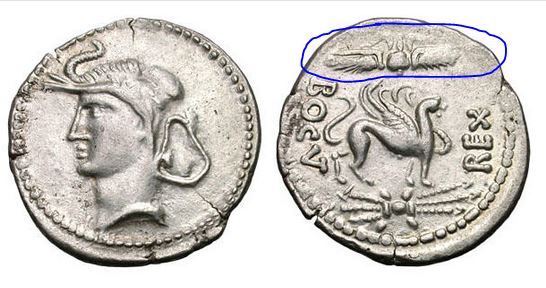
I certainly agree that Numidian and Maurentanian usage of the elephant scalp is drawing on Roman usage/expectation, but it is not completely without reference to Egypt = Africa and Hellenistic Kingship/Ptolemaic associations!  Consider the reverse of this coin of Bogud (successor of Bocchus I, father of Bocchus II):Capture.JPG

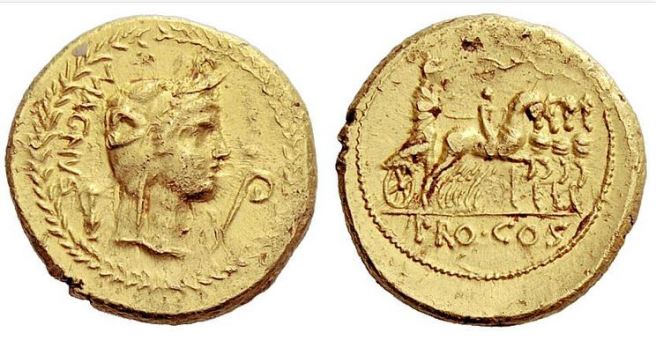
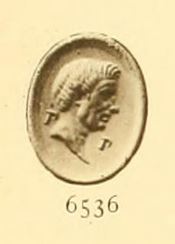
I’m 99.5% certain RRC 402 is a female personification.  The earring on the BM specimen is my main gender indicator (circled in blue).  One of the oddest part of Pompey’s coin feels to be the placement of the ear of the Elephant very very different than any other representation as far as I can tell.

Capture

ex RBW specimen for reference:

Capture.JPG

I like how Kopij puts the legend comparisons with RRC 446 and 447 front and center.  This isn’t a comparison I’ve really dwelt on and it seems key.  Also the gold = crisis point is well taken.

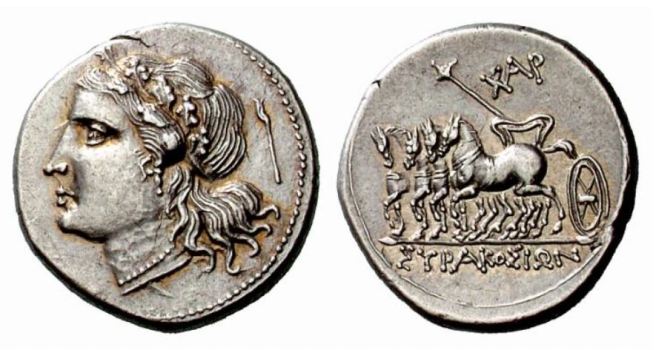
Issues I want to think more about and were not really discussed in the article are the imitation of Marian and Sullan triumphal imagery (RRC 326/1; RRC 367/4&5).  The trace rider and the shape of the car seem closer to Marian prototypes.  The Victory and the gold material closer to Sullan imagery.   The obverse head is small compared to the flan like the Sullan precedent.   I wish I could be sure what the triumphator was holding in the case of the Pompey and Marius types.  On the Sullan type its a caduceus and was made BEFORE Sulla got to Rome.   The laurel wreath border is odd and has its best parallels (to my mind) in the late 80s BCE (RRC 358/1; 376/1; 374/2; 361/1).

Stylistically I think it fits best in the 70s… but I give that assessment a low confidence rating.

Elephant Scalps Again

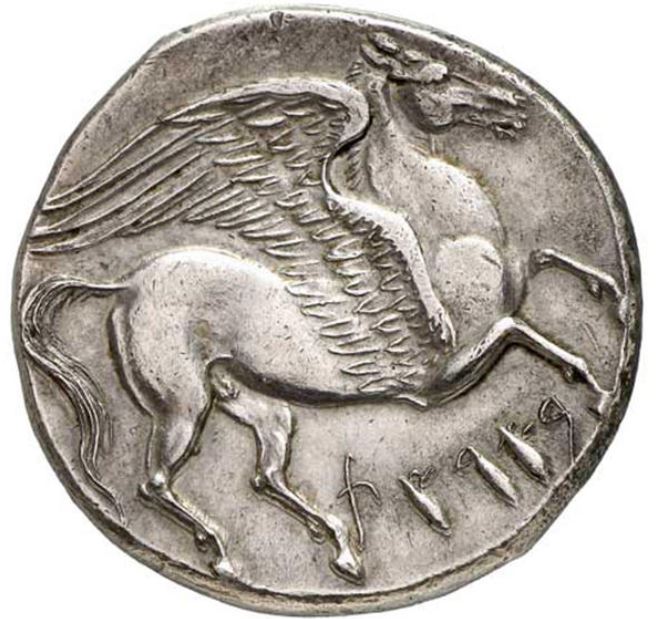
So I’m reading Kopij NAC 2016, 106-127 on RRC 402 at this moment and it was really bothering me I didn’t have an image to hand of this (unique) coin (I do hate unique coins).  Both he and Maritz 2001 cite SNG Copenhagen but don’t illustrate.  Much to my delight this website on Magna Grecia gave me the Jenkins SNR 50 reference which let me track an image down.  I now see why Panormos and Camarina are preferred IDs.  The reverse looks very much like the reverses of those two cities at the end of the fifth beginning of the fourth centuries BCE.

It is much like many glass paste representations and not much like other early coin types…  No particularly personal theories yet…

Capture1.JPGCapture.JPG

Update 5/9/2022:

Emory 2008.031.031