
Then [Fimbria] hired a slave, with money and the promise of freedom, to go to Sulla as a pretended deserter and assassinate him. As the slave was nearing his task he became frightened, and thus fell under suspicion, was arrested and confessed. Sulla’s soldiers who were stationed around Fimbria’s camp were filled with anger and contempt for him. They reviled him and nicknamed him Athenio – a man who was once a king of fugitive slaves in Sicily for a few days.
The symbolic importance of portrait gems
Ptolemy abandoned his alliance with Rome, out of fear for the outcome of the war, but furnished Lucullus with ships to convoy him as far as Cyprus, embraced him graciously at parting, and offered him a costly emerald set in gold. At first Lucullus declined to accept it, but when the king showed him that the engraving on it was a likeness of himself, he was afraid to reject it, lest he be thought to have sailed away at utter enmity with the king, and so have some plot laid against him on the voyage.
gems
The Ptolemy is I think Ptolemy IX Lathyros…
Death by Gold
Not sure how I didn’t make the mental connection prior to this but… the guy celebrated on this coin (RRC 401/1) is the same dude, Manius Aquillius, cos. 101, Mithridates’ killed by pouring gold down his throat!
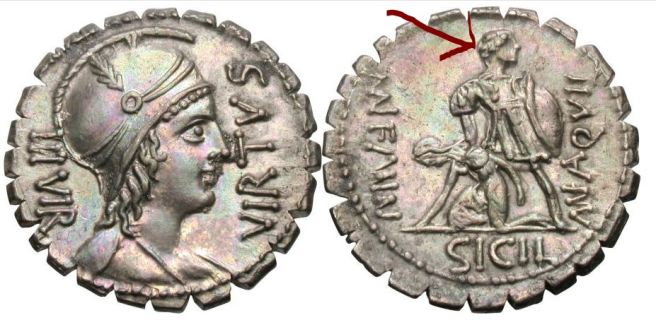
I find it remarkable that a father with such a checkered career was rehabilitated by his son as the epitome of virtus. Besides his death he was put on trial for his mismanagement of Sicily and he was given an ovation, not a triumph because he only fought against rebel slaves… (links to ancient sources)
How you die by this method is discussed in this Smithsonian article (the evidence that Crassus died this way is questionable).
Part of a speech from Posidonius preserved in Athenaeus from the Athenian usurper, Athenion:
‘King Mithradates is master of Bithynia and Upper Cappadocia; he is master of the whole continent of Asia as far as Pamphylia and Cilicia. And kings form his bodyguard, Armenian and Persian, and princes ruling over the tribes who dwell round the Maeotis and the whole of Pontus, making a circuit of three thousand six hundred miles. The Roman commander in Pamphylia, Quintus Oppius, has been delivered up and now follows in his train as a captive; Manius Aquilius, the ex-consul, who celebrated a triumph after his Sicilian campaign, bound hand and foot by a long chain to a Bastarnian seven and a half feet tall, is dragged along on foot by a man on horseback. Of all the other Roman citizens, some are prostrated before the images of the gods, while the rest have changed their dress to square cloaks and once more call themselves by the countries to which they originally belonged. And every community, greeting him with more than human honours, invokes the god-king; oracles from all quarters predict his supremacy over the civilized world. Wherefore he is dispatching great armies even to Thrace and Macedonia, and all parts of Europe have gone over to his side in a body. yes, ambassadors have come to him not only from Italic tribes, but even from the Carthaginians, demanding that they be allies to accomplish the destruction of Rome.’
A Whole Book on ONE COIN!
And they didn’t even let the author put a picture of it on the cover!?


Any way this is really just a note to myself that this exists and when I feeling flush I should acquire a copy. RRC 431/1. Google Preview Link.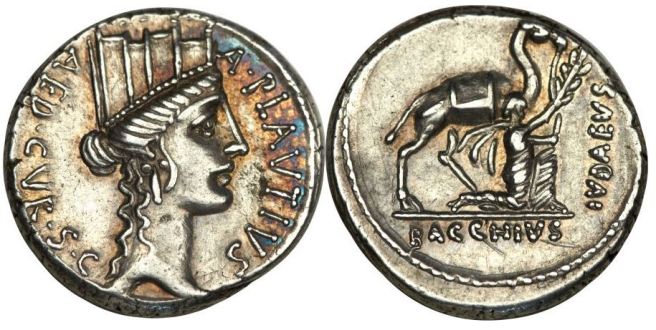
Summer Reading for an Interested Student
Dear [removed],
Thank you so much for following up!
I think you might enjoy the writing of Adrienne Mayor. She writes for a general audience and her books sell well, but she holds a research post at Stanford and her writing is widely respected and cited by academics. I found her book Amazons both fun and groundbreaking: it changed how I teach the material. Her first book, The First Fossil Hunters, is strongly recommended by one of my colleagues who studies ancient science. But, really you could read any or all of her books and be confident you were making a good choice.
A little older in James Davidson’s Courtesans and Fishcakes: The Consuming Passions of Classical Athens. It was written as his PhD, but became a best seller. I use sections of it in my 4000 level Sex and Gender course, but it is very readable and fun.
If you want to read more literature written in the ancient world rather than ABOUT the ancient world, Emily Wilson’s brand new translation of the Odyssey is BEAUTIFUL and really accessible. Likewise, you might look for Ann Carson’s translations of Sappho and various Greek plays. She’s a poet in her own right and they are stunning.
Also, my dear friend Josephine Quinn has just published a book In Search of the Phoenicians that everyone is raving about. It contextualizes the culture groups living around ancient Judea and says quiet a lot about the history of how Europeans and Americans came to think about their own relationships to the lands that are now the modern state of Israel.
Finally, if you’re really more interested in Rome, then look for books published by Mary Beard.
Once the fall semester starts …. [Removed]
All best,
Liv
Liv Mariah Yarrow
Associate Professor, Classics Department
Associate Professor, Classics Department
Addendum.
Rose Mary Sheldon’s Ambush and other books on ancient warfare
Eric Cline’s 1177 BC: The Year Civilization Collapsed
James Romm, Ghost on the Throne
Richard Miles, Carthage Must Be Destroyed
A.E. Stalling’s translation of Hesiod’s Works and Days
Sarah Rudens’ translation of Apuleius’ Golden Ass
Social War Coin Iconography

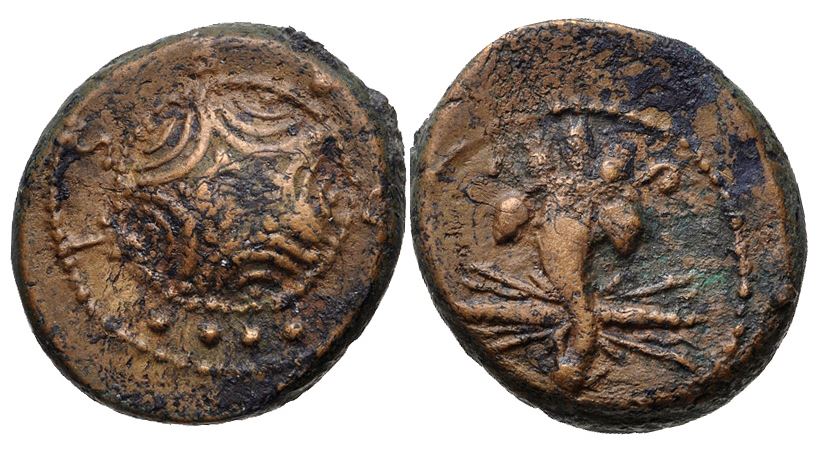
This is BM 1867,0101.1099.
I believe Pobjoy’s write up on this coin and most of the social war coins. 
The BM catalogue calls the scepter tied with a fillet the mast. This is just wrong. That is not what masts on ships on coins or gems look like.
addendum, later same day: This is the same description given in HN Italy 416–mast and sail–still wrong, but at least I know where BM is getting it, must check but probably also in Campana…
Filleted Scepter is clearly right reading BUT this is problematic to me because of it being iconographically unprecedented until later. That scepter tied with a fillet is a hallmark of the famous fleet coinage of Antony and also appears on the coins of Sextus Pompeius.
Also the hand shake with the prow in the background is an iconography of the civil war period (RRC 469, 470/1a).
Now all these parallels could have a common Hellenistic precursor, but if they do, I don’t know what it is (and that bothers me). I think it unlikely the later Roman Civil War types would copy Social War types.
It just makes me a little worried about the issue and its legitimacy, but there are a number of specimens which a good deal of variation…..
Just a lovely specimen I came across 19 Dec 2023. It shows super clearly that the reverse is Dionysus and the creature next to him… Panther? Bull? I forget what Pobjoy concluded… I think the former.

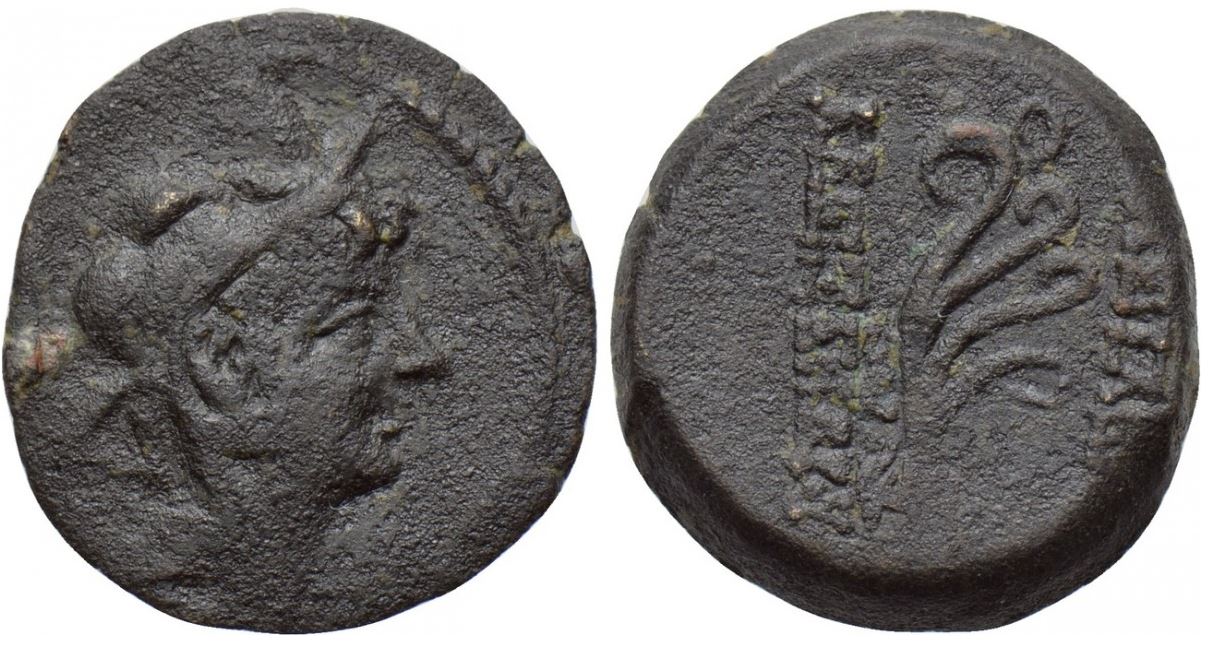
Elephant Headdress, Antioch, 120s BCE
Hmm. Capuan Iconography and Dating
So I assume along with the great and the good that the Mars Eagle types was introduced to support the introduction of denarius and thus it dates to 211 BCE and after. Right? right. 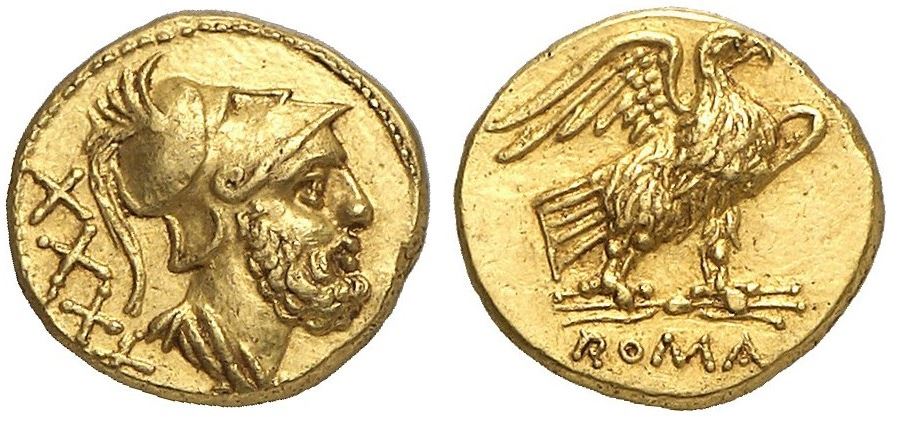
Ok. Fine. But doesn’t it seem likely that the Roman eagle inspired the eagle on the Capua As (HN Italy 503, BM 1937,0606.19 illustrated below) and Didrachm (HN Italy 480):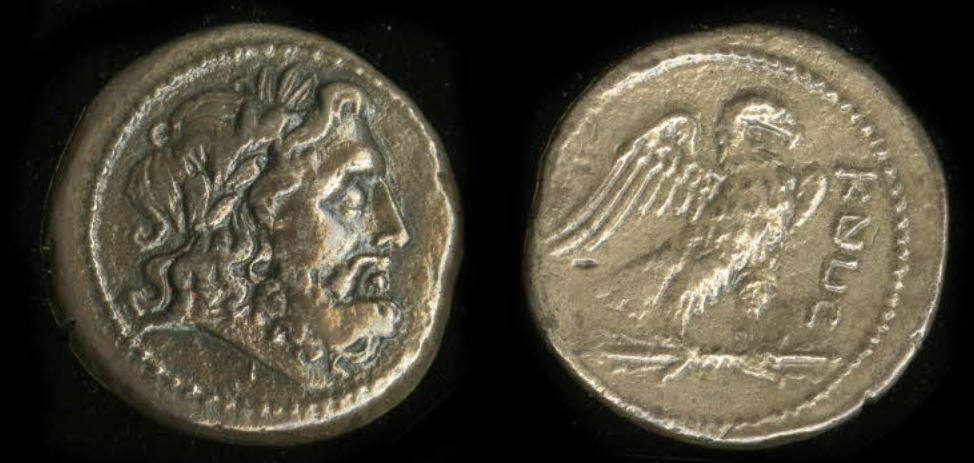
I know I know. Iconography is a terrible way to date coins but it does strike me as a little funny.
Not a Shield, but a Patera
Frugi’s coin is clearly a patera and part of the priestly implements (RRC 418):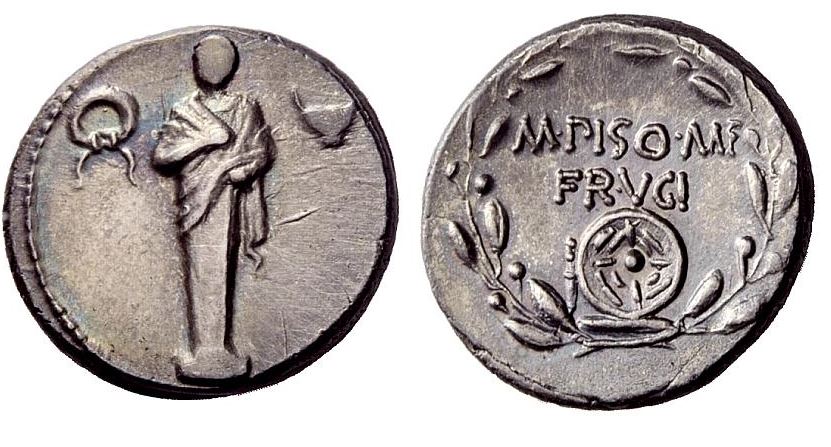
Now lets look at an under appreciated coin from much earlier RRC 271
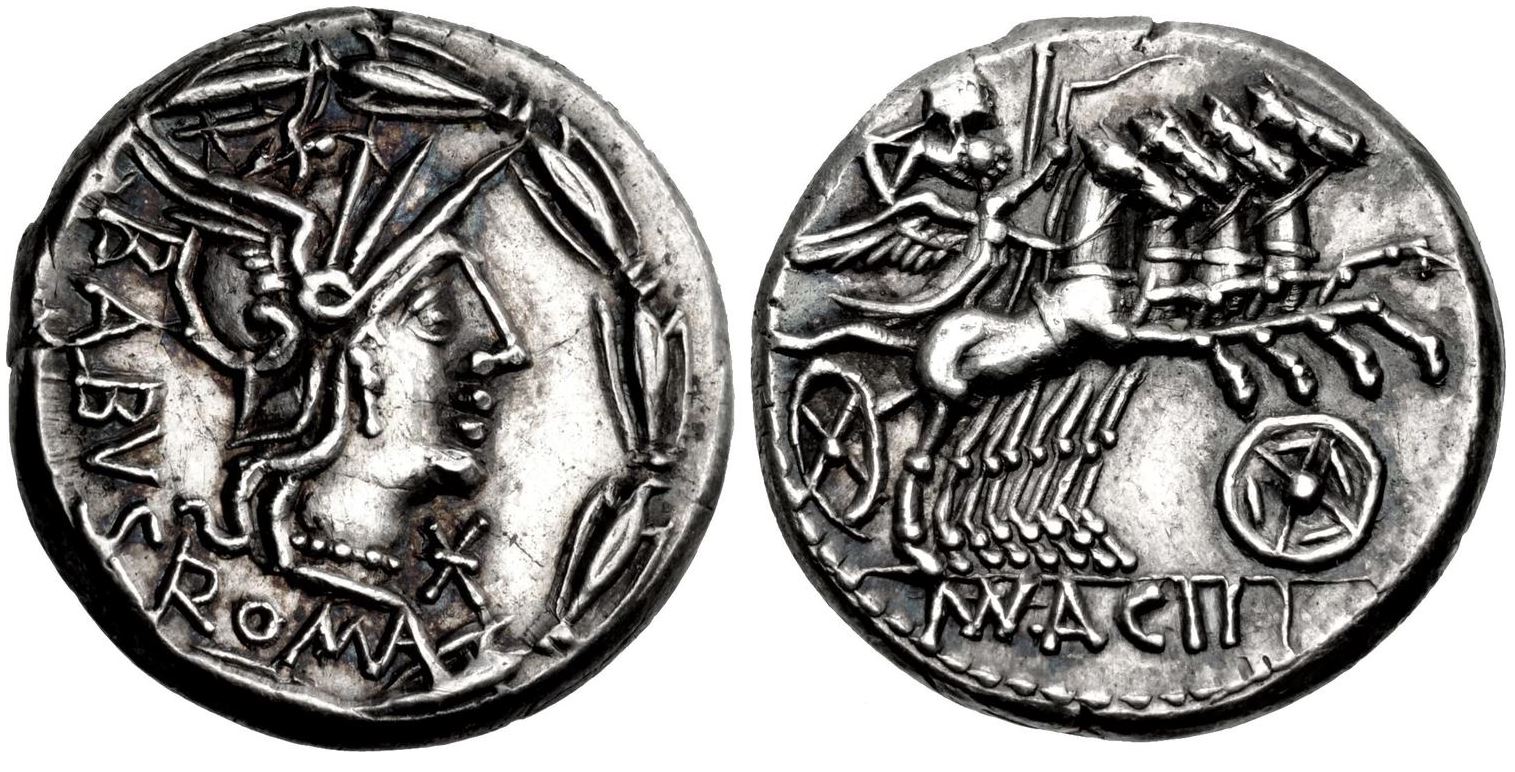
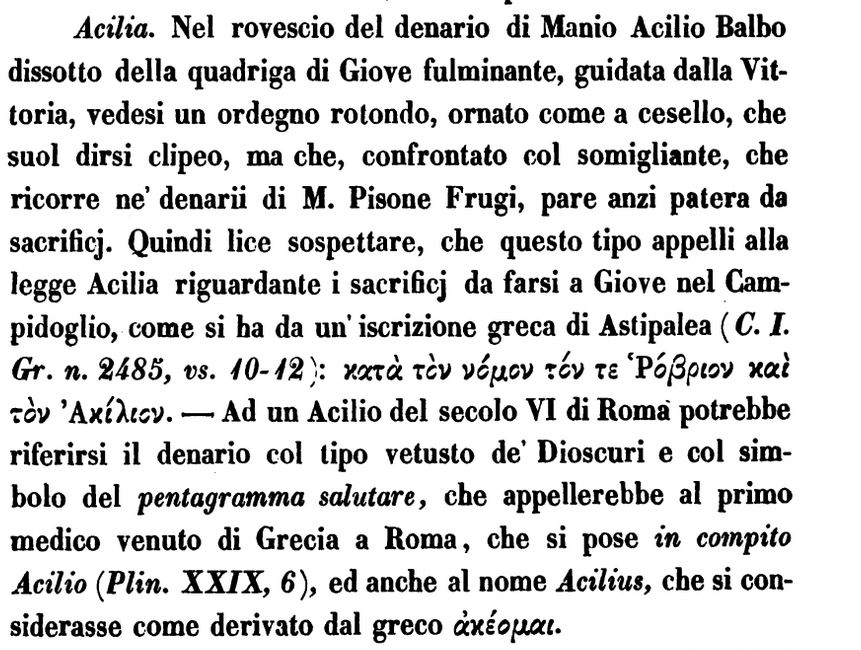
Same rendering. Same object. EVEN the same type of wreath! We now much put Cavedoni‘s idea that it might be connected to the lex Acilia back on the table which Crawford threw out. (I find myself relieved that he also makes the Piso Frugi parallel!)
Imitating the Roman Mint at Paestum
Crawford, Paestum 16/1, HN Italy 1223
Clearly based on RRC 264 (or 369, its restoration!) and RRC 265 (or 371, its restoration!)
 Liv Mariah Yarrow