
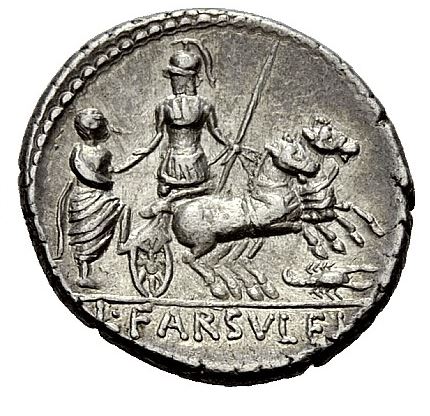
Crawford, Paestum 16/1, HN Italy 1223
Clearly based on RRC 264 (or 369, its restoration!) and RRC 265 (or 371, its restoration!)
adventures in my head

Crawford, Paestum 16/1, HN Italy 1223
Clearly based on RRC 264 (or 369, its restoration!) and RRC 265 (or 371, its restoration!)

Livy slips into the timeless ethnographic present to explain to his readers how Gallic (Celtic) bodies, barbarian bodies aren’t like their own…
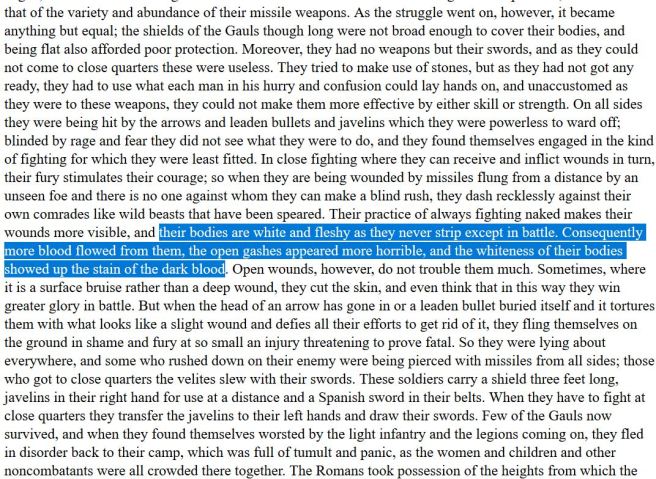
I cannot think of one off-hand, but I’d love to hear ideas. This ANS specimen got me thinking:


And that led me to the thoughts of Carroccio in SNR 85 (2006) 220:

Curiouser and Curiouser.
Update 7/11/2018:
Hispani specimen:

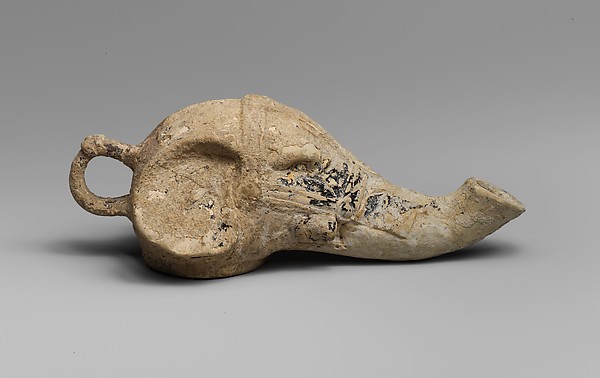
AND then these odd coins from Melita (Malta) with a Punic inscription which I think are likely related in some fashion. The Melita coin is typically put 211-175 BCE (I think because of weight standard, but I’m unclear on this):

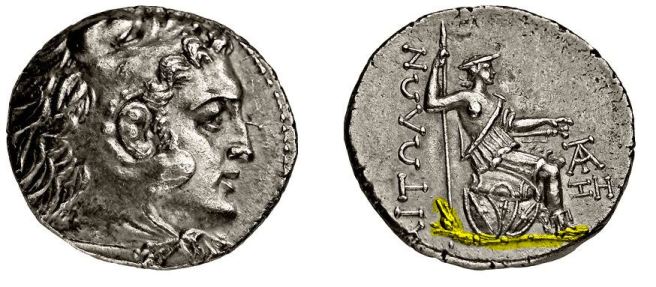
Too often I think of displaying images appropriated from one’s enemies as Roman. Here’s a nice corrective image:
From the Pro Plancio 33:
“He has at times,” says he, “said some very harsh things.” Perhaps he may have spoken rather freely. “But that speaking freely, as you term it,” says he, “is not to be borne.” Are then those men to be borne who complain that they cannot bear the freedom of a Roman knight? Where are our old customs? Where is our equality of privileges? Where is that ancient liberty, which, having been overwhelmed by civil disasters, ought by this time to be raising its head and to be at last recovered and assuming a more erect attitude again? Need I recount the abuse directed by the Roman knights against even the noblest men, or that of the harsh, ferocious, unbridled expressions of the farmers against Quintus Scaevola, a man superior to all others in genius, justice, and integrity?
Granius, the crier, replied to the consul Publius Nasica in the middle of the forum, when he, after a suspension of all judicial proceedings had been proclaimed, as he was returning home, had asked Granius “why he was sad; was it because all the auctions were postponed?” “Rather,” said he, “because they have sent back the ambassadors.” The same man made this answer to a tribune of the people, Marcus Drusus, a most influential man, but one who was causing great disturbances in the republic. When Drusus had saluted him, as is the fashion, and had said, “How do you do, O Granius?” he replied, “I should rather ask, O Drusus, what are you doing?” And he often reproved with impunity the designs of Lucius Crassus and Marcus Antonius, with still harsher witticisms. At present the state is to such a degree oppressed by your arrogance, that the freedom of laughing in which a crier used to be indulged, is more than is now allowed to a Roman knight in making lamentations.
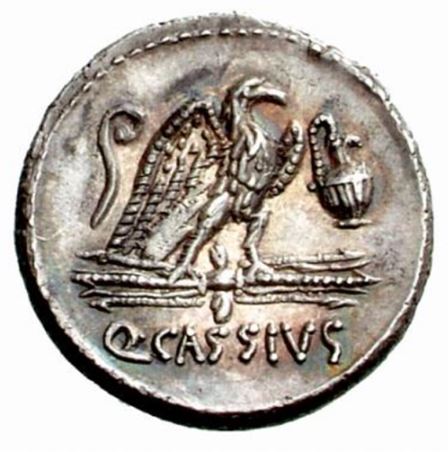
Crawford is misleading in his type description of 428/1 when he says the jug and lituus are connected to the consulship like the eagle. The eagle is better read as imperium, specifically imperium deriving from the Roman people. Broughton believes Cassius was himself an Augur and I tend to agree. (Cic. Att. 9.9.3) The letter well illustrated the power and importance of the position and close connection between religion and constitutional law.
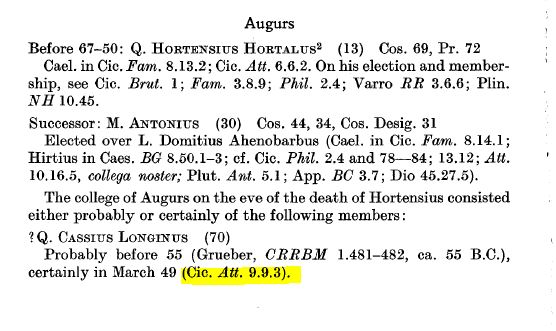
It is of great importance to Caesar that there should not be an interregnum: and that he secures, if the consuls are “created” by the praetor. However, it is on record in our augural books that, so far from consuls being legally capable of being created by a praetor, the praetors themselves cannot be so created, and that there is no precedent for it: that it is illegal in case of the consuls, because it is not legal for the greater imperium to be proposed to the people by the less; in case of the praetors, because their names are submitted to the people as colleagues of the consuls, to whom belongs the greater imperium. Before long he will be demanding that my vote in the college should be given, and he won’t be content with Galba, Scaevola, Cassius, and Antonius…

RRC 428 feels pretty well explained by Crawford. The one point I can’t wrap my head around is what the curule chair is doing on the coin. As far as I can make out, one only gets the chair with imperium. Vestals get lictors, but those are the special religious kind (lictores curiati) which had no fasces and no axes. The other logical explanation would be the chair of L. Cassius Longinus Ravilla (cos. 127) who re-tried the three delinquent Virgins. BUT, he was appointed to hold the quaestio by the people at the instigation of a tribune of the plebs (so Ascon. 46C), so he shouldn’t have had any imperium and certainly not a curule chair!

RRC 430/1, 55 BCE, moneyer is younger son of consul and triumvir.
At first I thought perhaps it might reflect Syrian campaign of his father, but coins are rarely anticipatory. Better to go with Venus Victrix and a reference to Pompey’s far Eastern conquests.

 Liv Mariah Yarrow