
adventures in my head


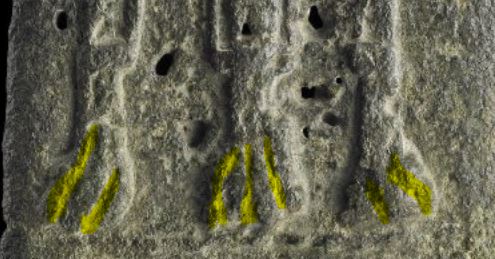
BM 2010,5006.525 cf. 524 (Bulls) and 526 (Shield) all watercolors from the collection of Charles Townley. All public domain images now. Also I think because of the quality of the depiction of the edges of the specimens in these drawing it should be possible to determine into which collection these specimens passed. As far as I can tell from an initial comparison, these are not held in the major CRRO museums or illustrated in Thompsen 1957 or Vecchi 1978. (RRC 5/1, RRC 7/1, and RRC 12/1)
Letter from James Byres to Townley, 9th December 1778:
‘…the most uncommon purchase I have made is of four of the earliest Etruscan Ase, which I have long thought of mentioning to you, as I believe they are unique, at last I never heard of any but three that could at all compare with them. One of the Treasury of St. Genevieve at Paris and two, but much inferior belonging to the Marquis Oliviero del Abate, at Pesaro. They are of an oblong form, about six inches and a quarter long by about three inches and half broad, of different thicknesses, weighing from four to upwards of five pounds each. On one of them is on each side a Bull, good work. on another, on one side are two Dolphins and two Tridents. On the other side. Two Cocks, the other two. have shields represented on each side of them. all very good work. The great Ase at Paris. I’m told, weighs about three pounds. those of the Marquis Olivero are octagon and only weight about two pounds each, which makes me think that mine are of a prior date. they were found last Autumn in Tuscany, in the Foundry where they had been cast, for along with them I got some broken pieces of Ase and several unform’d lamps of Brass.They have occasion’d a good deal of Speculation amongst the curious. I have had proposals made me from Paris. Germany and from the Cardinal Zelada. To part with them, but choose they should be placed in England, and if not in the British Museum, in the hands of some person who knows their value; I esteem them at one hundred pounds. I have a few other Ase, which altho’ known, are rare, which I would throw in with them…’ (TY7/686)
The five new (to me) data points from Vecchi (previous post), confirm the general trend and shift the mean average deviation from 88 to 84.
I was looking at the plates in Vecchi and Thurlow 1979 and realized the two illustrated specimens do no match the BM OR Copenhagen specimen. This does mean that Vecchi is associated with 3 out of the four specimens, but basically we have 1 specimen coming light in the 1948/49 and 3 appearing c. 1978/79. I cannot believe that a forgery would delay release of 3 specimens by 30 years and then ‘flood’ the market. Forgery just doesn’t make a lick of sense. No where oh were are these other two bars? I don’t think they made into a museum. I suspect the BM and two Vecchi bars are part of a cache or hoard recovered in the mid 70s. I’d give my eye teeth to know where the heck it was recovered from…
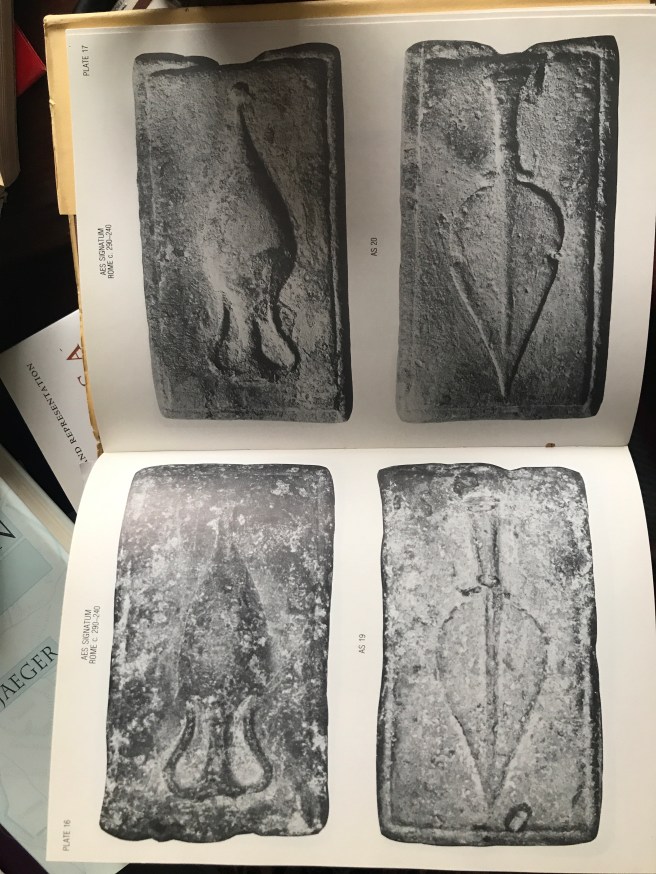
Copenhagen (see previous post for BM):
***
Other interesting points of Vecchi and Thurlow 1979 on Aes Signatum:
WHERE ARE THEY NOW?!
I’ve just ordered Vecchi’s 2013 book from Charles Davis. I want it NOW.
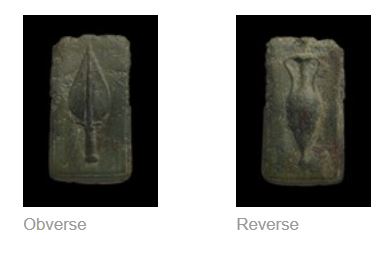
This is BM 1978,0721.2 [RRC 12/2], acquired from Italo Vecchi LTD in 1978. There is a another specimen of the same type in Copenhagen, KP 2060.2 (see Thompsen 1957 p. 57 fig. 30 for illustration), aquired with other aes signatum (no, no currency bars) from P. and P. Santamaria, P.zza di Spagna in Rome in 1948/49.
Burnett writes via email that one of the points of concern was the shape of the amphora.
This got me thinking about amphora shapes on Italic coinage, which lead me to these types from Metapontum and Taras.


Which of course lead me back to some of my earlier thinking on doliola. Basically, two amphora are cult objects associated with the Dioscuri, especially as worshipped at Sparta, of which this is a particularly awesome illustration:
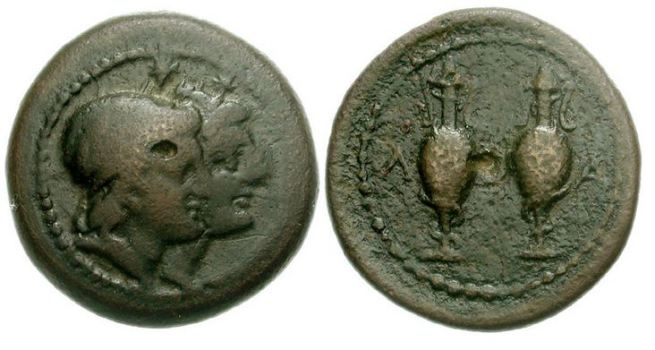
Now the question I have is can one doliolum/amphora still be a symbol of the Dioscuri or more accurately Dioscurus, or Castor, rather than Castores. Remember in Rome the temple of Castor is called just that, Castor singular, although it honors the divine twins.
I think probably one amphora can do the trick (RRC 411/1, c. 58 BCE):
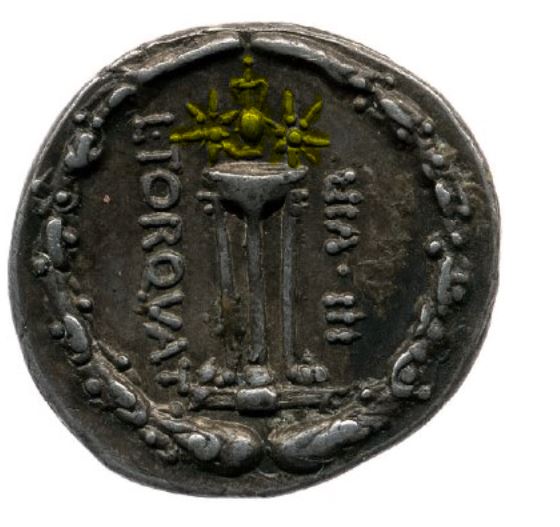
HN Italy 1101 is also suggestive (ANS specimen, another in trade):
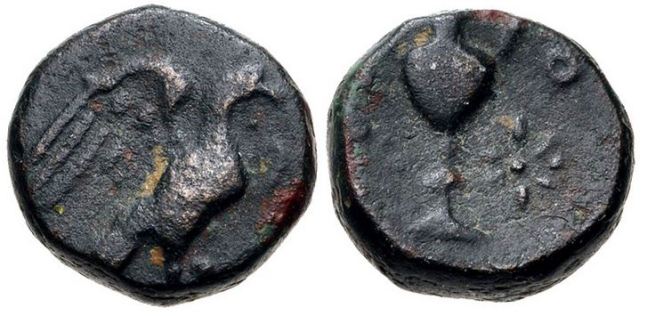
Also HN Italy 657, an obol from Canusium, (SNG ANS 693, another in trade with star); this type is paralleled by a rarer obol from Rubi with the name Da[zos], HN Italy 810 (no star):
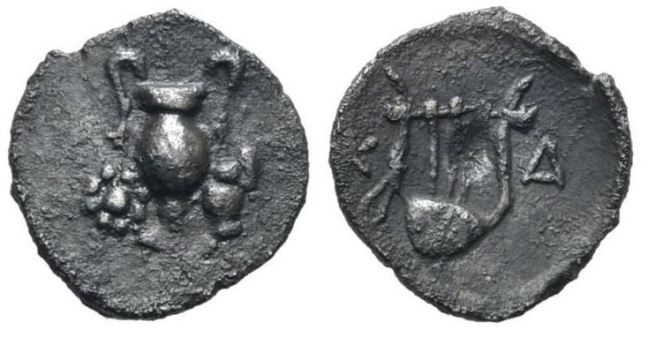
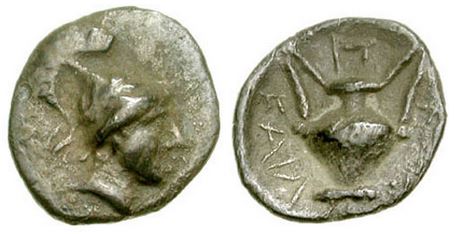
The icing on the cake is an obol from Caelia (HN Italy 759, cf. ANS specimens) that has a dioscurus on the obverse and an amphora on the reverse (a similar representation of a dioscurus is found on HN Italy 785-787, Hyria/Orra):
What about the spearhead? All I have on that is that the spear is also a primary attribute of the Dioscuri (and the Penates), albeit rarely seen separate form the figural representations of the pair.
There is also an old suggestion that the star/amphora motif on the coins of Corcyra is connected to the Dioscuri (I’m guessing inspired by Thuc. 3.75.4). I’m agnostic. Likewise there is a star and amphora on some coins of Chios and there was also an epiphany of the Dioscuri celebrated on the island, but I’m not sure I really want to explain the numismatic iconography that way. Amphoras are by no means exclusively associated with the divine twins…
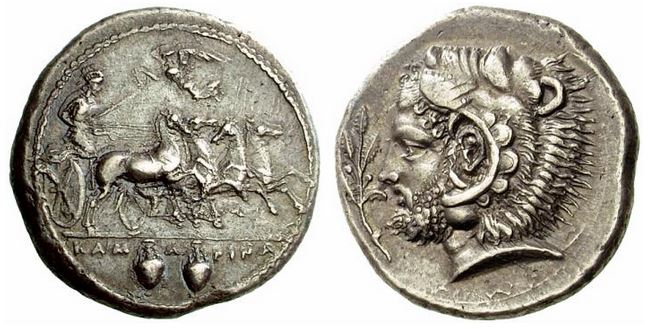
Cf. This late fifth century coin of Camarina (cf. ANS specimen), as well as these: 1, 2).
This post was a pre writing piece that culminated in my 2021 article. The full text and final images and charts can be downloaded here.
Crawford hates the term aes signatum, but the more I work with them the more I seem to default to this name. It seems so much more succinct that Roman Currency Bars.
Black are specimens known to Haeberlin and discussed as aes signatum by Rudi Thompson 1957.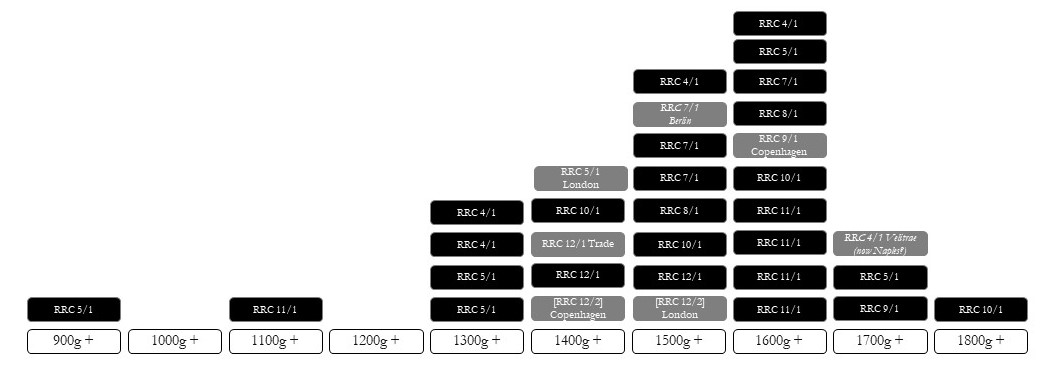
Berlin RRC 7/1 is a half specimen but appears nearly exactly half, so given here as it’s putative whole weight. Velitrae RRC 4/1 is reconstructed from Townsley’s observations and converting to metric.
I follow Ghey, Leins & Crawford 2010 in giving amphora/spear-head the putative RRC number 12/2.
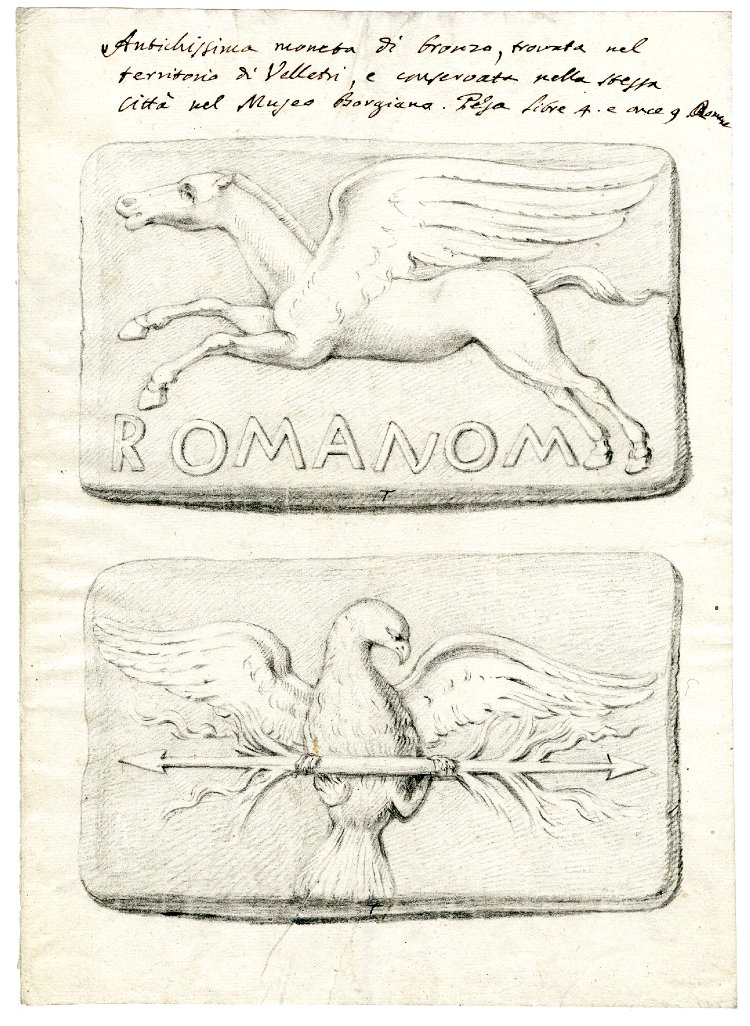
This is BM 2010,5006.527 (acquired 1814 from the collection of Charles Townley)!
For a historical discussion and contextualization of the Velitrae finds (a
small deposit found at the church of S. Maria della Neve 1784 including both RRC 4/1 and 8/1), see Andreas Muran’s piece.
The BM records the inscription “Annotated in pen and ink at top: “Antichissima moneta di bronzo, trovata nel territorio d’Velletri, e conservata nella stessa citta nel Museo Borgiano. Pesa Libre [?] once 9 [?]” To my eye it clearly reads 4 pounds 9 ounces.
The actual Roman currency bar (bronze ingot) is I think likely to be in Naples as it is said the Borgia coin collection was sold to King of Naples, Joachim Murat.
I believe this drawing to be the original from which Eckhel’s plate 9 was created.
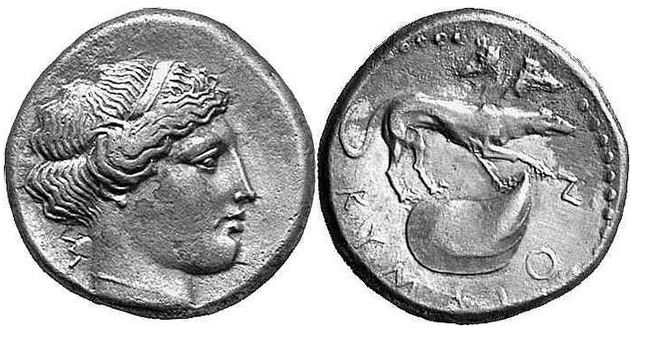
Rutter 76. SNG ANS 237.
“Kyme, which the Chalcidians first settled and then the Aiolians, where a Kerberion is shown, an underground oracle.” Ps. Skymnos 238-240.
Update 11/21/22:
Now see
Withycombe, Lily. “The temple dedicated to Jupiter Feretrius on the Capitoline Hill.” In Ruin or renewal ? : places and the transformation of memory in the city of Rome, Edited by García Morcillo, Marta, Richardson, James H. and Santangelo, Federico., 157-182. Roma: Quasar, 2016. [ILL requested]
—
Linda Zollschan (2012) makes the case that Volteius’ Jupiter temple coin (RRC 385/1, 75 BCE) does NOT represent the Capitoline Temple, but the temple of Feretrius which is also on RRC 439/1 (50 BCE).
I have some unresolved questions, but I’m intrigued by the theory.
Zollschan doesn’t directly address Livy’s assertion that the Capitoline Games honor Jupiter Optimus Maximus (5.50), but favors association of the games with Feretrius on the basis of Tertullian, on spectacles preserving a fragment of Piso.
She doesn’t resolve the apparent reduplication of effort if BOTH the college of the Capitolini and the Fetiales having a role in putting on these ludi. (Not that this matters for the coin image identification.)
Also on the Volteius coin there are clearly three cella doors. The temple of Jupiter Optimus Maximus, also has cellas for Minerva and Juno, not so Feretrius’ shrine as far as we know. It is this that makes me lean away from her hypothesis re: the coin.
Scan of Relevant Pages on Coin Discussion
L. Zollschan (2012) ‘The Longevity of the Fetial College’, in O. Tellegen-Couperus, Law and Religion in the Roman Republic, Leiden-Boston, pp. 119-144.
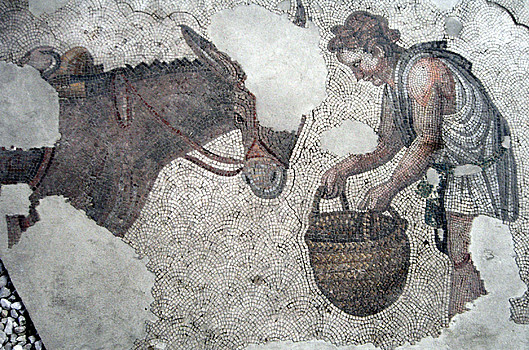
The everyday objects of the Papius series are still my obsession. In fact working on my page on these pairs has led to fewer blog posts. (My beloved calls Papius my ‘hobby’.) Just recording this basket for feeding beasts of burden (horses/donkeys/etc). Image links to the UK Rome Society’s new Imago database.
 Liv Mariah Yarrow