Mount Argaeus


intaglio
adventures in my head
I’m grateful to David Hill, ANS librarian and archivist, for his help accessing the Hersh papers and his kind permission to share these photographs. I am presently preparing a finding aid for the papers and this post was inspired by that work.
RRC 24/1 = Vecchi 64 is a rare large denomination of Aes Grave. There is no image in CRRO. Vecchi knows of only five specimens and lists the weights and last known location of all five. Only one is in a public collection, and that is in the Vatican.
Amongst Charles Hersh’s papers in the ANS archives, there are the following photos and details of a specimen previously unknown in publications.


The whereabouts of the specimen today are unknown. If you recognize the coin and have a better photograph, I’d be glad to know of it.
Update. With the help of Bill Dazell, I’ve learned that upon the owner’s death some 533 coins went to the ANS, but not this one it seems…
—
Update 11/4/2022:
a published specimen, just for reference.

This talk is unlikely to be ever published in precisely this general form. I continue to work on Kings on Coins and will likely publish some of this material in some form as the ideas mature. The talk was not recorded so in lieu of that I share here a script and screen shots of my slides. They are rough and I did at points diverse from the script but it largely reflects the event.

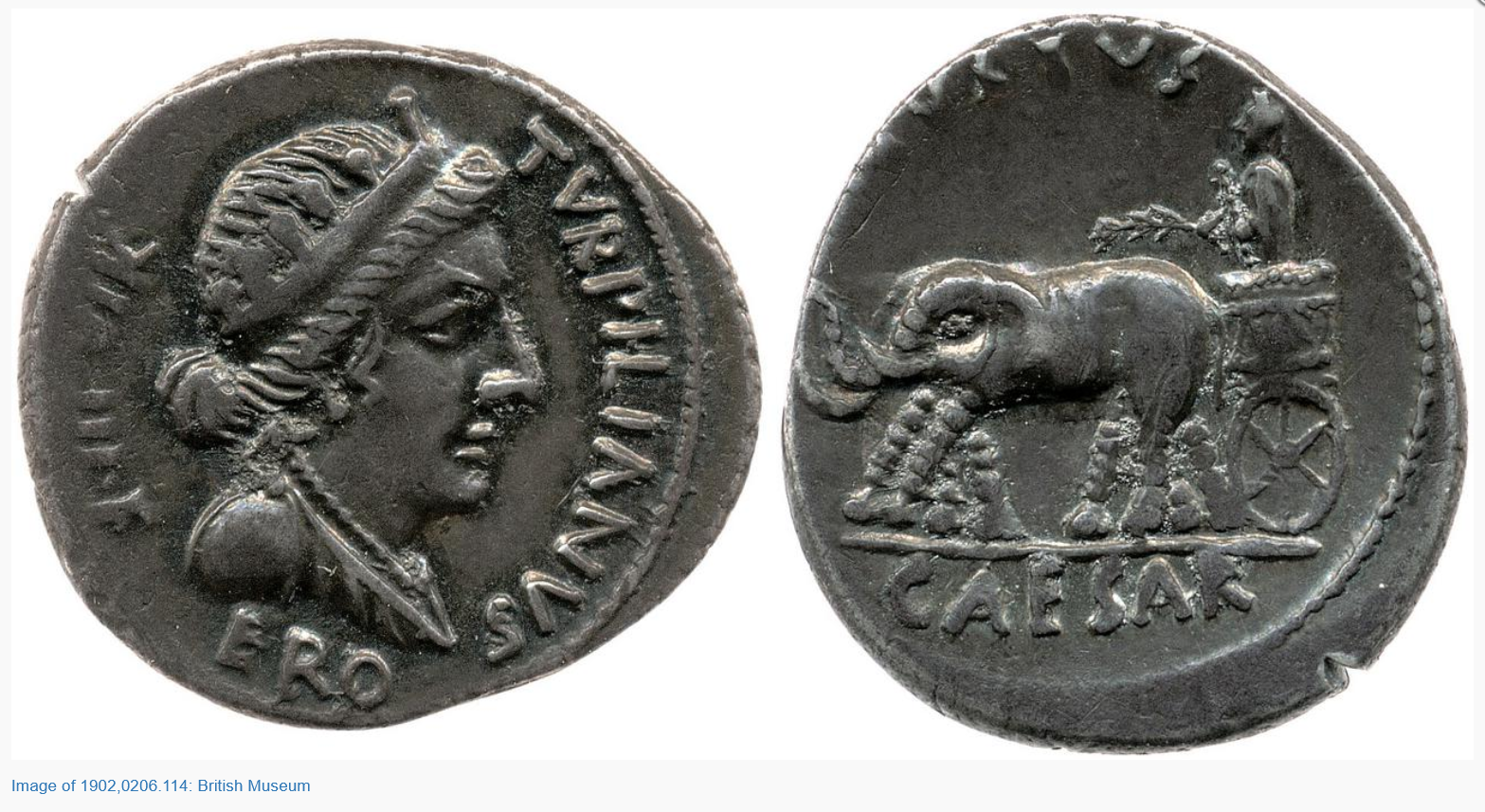
I was reading Crawford and he said that there was no convincing proposal of which A. Postumius Cos the portrait meant to honor. I grant there are seven men who held the consulship with this name (DPRR link to search results).
BUT I’m strongly inclined to think the man who made the coin is honoring his v own adoptive father the consul of 99.
The ancestry is deduced from Cicero’s letters, reading Cic. Att. 5.21.9 with Cic. Att. XII 22.2. Shackleton Bailey in his commentary endorses this reading and others have followed.
If correct this would also throw out Crawford’s speculation that his adoptive father was the moneyer of RRC 372.
The consul of 99 was killed in a mutiny in 89 in the social war, but even ancestors with greater failures had been celebrated on the coins…. Cf. this early post.
Update the next day: A colleague points out via twitter that it would be a very early adoption in an old family. A valid concern, I wonder if any one has done a typical age at adoption study for the Roman elite? How deep is the data to do such a study? This question generated some twitter convo of its own.
The same colleague points out that the consul of 99 also was ‘trounced’ (great word!) by Jugurtha.

Here’s a clearer photo of the bottom specimen.

The easiest explanation is that the forger used dies created by hubbing a legitimate specimen, but I also would love a weight for the top coin or even better a specific gravity….

I made the above map using data from Lockyear’s CHRR and Google Earth Projects. You can view the map in Google Earth.
Again thanks to seeing specimens side by side in a print catalogue I find myself asking questions.

The styles are so different.
No serrations and small head with stephane (407/2) and large head, no stephane, serrated (407/1).
Were they produced at the same mint at the same time?!
The above map was my first stab at seeing if they might have had different distributions in antiquity. One explanation is that the serrated issue was just taking too long to produce and at one point in the production process the serrations were abandoned. But… I’m still suspicious.

I’m more convinced we need to throw out the Fitzwilliam die axis data after graphing 407/1 (no serrations, small head). See below. Here there is not a single 12 oclock die axis reported by another collection.

What do I make of this? The fact that both have a strong 6 oclock die access might be a point in favor of their actually being produced at the same mint, but we all know the Roman mint wasn’t so keen on controlling die axes. To do this properly I’d have to also do all the specimens in the Schaefer archive.
I don’t have a theory yet but it is odd…
P.S. While you’re here note that the date for these two types is likely c. 64 BCE (So Hollstein endorsing Hersh and Walker based on Mesange hoard), not 68 BCE as in Crawford.
RRC 407/1
Update 1/17/19:
A colleague reminds me of this rare type published by P. Debernardi, “Some Unlisted Varieties and Rare Dies in Roman Republican Coinage”, NC 2010 and that this type suggests all were produced at the same mint. There are two obverse dies of small head, crown, serrated.


Another specimen of the same variant


Seeing these coins juxtaposed next to each other in a catalogue organized alphabetically by gens, makes the overlapping reverse iconography so obvious. It never occurred to me the curule chair as the reverse type might be familial or familial inspired. Perhaps not but must be considered.
The gens Furia has 62 members listed in the prosopographical database; of which five have the cognomen Crassipes. Brocchus from the coin is the only known Brocchus. Other gens use this later cognomen as well, but we have no epigraphic record of any Furius Brocchus (as far as I can tell relying on Clauss-Slaby database) .
Brocchus is cognomen based on a physical attribute like so many of them, meaning bucktoothed (very old blog post from near the start of my blogging). Valerius Maximus (6.1.13) did know of one Gnaeus Furius Brocchus, perhaps this man’s father or son?, who was was accused of adultery and when caught it is said in the act, turned over to be raped by the slaves of the wronged husband/father (?).
RRC 414/1
Good morning and (may it be a) happy New Year (for us all). I’m not on holiday as I had expected and am trying to ease myself into work and remember what I love about it. When I need to do that I often look at pictures to see what I see. I decided to look at aes grave in recent trade and this specimen caught my eye.

What specifically caught my eye was the apparent indentations surrounding the lower (in this image) part of of the fulmen (thunderbolt). It’s a curious hollow such as I don’t seem to remember seeing. It seems it must be a feature of the casting process, but how? its sits directly above where we commonly find the spue on this type.

As I’ve said elsewhere (here? certainly in my forthcoming metrology chapter…), cast coins have innies and outies just like bellybuttons. This is how the bronze flowed through the mould via these channels. When the coin is taken out of the mould in most cases either a little of the coin is removed (innie) or a little of the spue remains (outie). Among other things this means that the spues tell us very clearly the alignment of the two halves of the mould were aligned. Given this it seems really silly that we almost always photograph the fulmen in a vertical rather than horizontal position. The creators of these coins meant the fulmen to be on the same axis as the dolphin. Interestingly, when museums record the so-called die access for these specimens in their databases, the belief that the fulmen should be either horizontal or vertical effects how the axis is recorded. Some call it 12, some three, but in all cases the same alignment is being described. (I downloaded the CRRO data and when viewed as a spreadsheet this leaps right off the screen. More on this data set below.)
This spue pattern is so consistent on this type that when it is absent or significantly misplaced, I start to get suspicious. See the below specimen. Notice that the break (innie) is on the top and that there is no exit channel opposite. Notice also have the specimen has a strong join rim all the way around which is highly unusual for specimen of this type. The fulmen is also rendered in a radically different style (the center of the five spikes on each end is distinctively thinner and ends in an arrow in most cases). The fashion for imitations in the 19th century was very strong indeed and their manufacture is a personal point of interest. I have a hunch or inkling (not yet a theory or hypothesis) that engraved illustrations from early numismatic literature often influenced how imitators carved their molds.

My interest in spues isn’t really about authentication of specimens though. Authentication comes through well documented archaeological provenance (but we can talk about that at length). It started because the significant size of the spue, be it positive or negative, can significantly skew the weight of the individual specimen, especially in the very small denominations (unciae, semunciae). The Roman seem to have been remarkably tolerant of weight variations for coins from these earliest series right through to their batch control of the denarius in the late republic (cf. Stannard on gouging). This tolerance is at variance with an understanding of the face value reflecting an intrinsic value of the coin. And I find this apparent double think with Roman’s relationship to money absolutely fascinating. They seem to care about the purity of silver and the heft of a piece of bronze, but only up to a point. Specimens of different weights clearly circulated together. We don’t have evidence of clipping or shaving. Face value seems for all practical purposes far more significant than fabric.
The other thing I really like about spues is that they are a very obvious artifact of manufacture and thus offer us some clues about the creation process and I think they hint at aspects of the likely metallurgical composition of the bronze.
One fact that I can’t get out of my brain is the high lead content (~20-30%) of the Roman currency bars tested by the BM in the 1980s (see Burnett, Craddock, and Meeks). I am on record as being intrigued by the possible parallel metallurgical ratios seen in the Egadi rams (from only preliminary testing). I’m also on record as suggesting that those five pound bars are best associated with the 1st Punic War: This makes them later than RRC 14, 18, and 19. Lead makes the bronze more brittle once cool, but more viscous in the casting process. Specimens invariably show both an entrance and exit channel for the molten bronze (the spues). The Roman valued the ability of the bronze to flow both in and out of the moulds filling the whole cavity. They tolerated the brittleness that left the innies and outies on each specimen as they broke the coins free of the moulds. Heck, maybe the brittleness was even a feature rather than a flaw for this particular operation. Of course, I’m just speculating RRC 14, etc… have a lead content similar to the currency bars. I’ve not YET been able to test any specimens, but that is high up on my wish list.
In private conversation with someone who has spent many many more years than I looking at cast coinage, I’ve heard it speculated that the moulds might have been single use and clay because of how one does not find mould links like one finds die links for struck coinage. The question of materials used for the mould is fascinating. I don’t even know if it is possible to cast this type of bronze in clay. I also wonder if they were made out of clay why we couldn’t find stamp links. This is the age of petite estampilles on fine blackware, so the advantage of a reusable stamp would have been obvious those creating clay moulds. Tufa would be too soft, surely (?!). Travertine? But so often that has a texture of its own. I have questions. FAR too many questions.
Where does that leave me with this first specimen and the funny cavity… Worried. There is no exit spue opposite the cavity, only a smooth edge with a distinctive join. Also that’s a heck of a lot of negative space between the edge of the mold and the central arrow of the fulmen. Definitely funny. Could it be the last specimen in a line of specimens being cast in sequence? I guess. Maybe… But would that work if you were pouring molten bronze into the top channel how would you be confident that the bottom mould filled properly? wouldn’t you need an air hole at least? I’ve got stuff to learn.

What to make of this?
…
At this point I decided to get a little more serious about these questions so I reviewed all the RRC 14/3 specimens in CRRO and took notes on the spues visible in the available photographs and also any unusual features.
When I’m confident in what I’m seeing on the specimen only 16% have one spue, rather than two, or to be more literal, I found four specimens out of 25 where I am am certain the specimen only has one spue.
Amsterdam DNB 1946-0009 and RE-05012
The last causes even more concern as the alignment of the spues is atypical. On the dolphin side instead of aligning with tail or head, the spue is at about four o’clock.
The other fun point of note is the Badian collection specimen (Rutgers) has the dots above the dolphin rather than below and seems likely to be an imitation.

Unfortunately most imitations are not this easy to spot. (And, of course it is even just possible this is an engraving error at the mint).
Ideally the analysis would be restricted to specimens from well documented hoards and excavations, and yet that reduces the pool to an unmeaningful sample size.
I will keep thinking….

I’m grateful to Prof. Irene Soto Marín for access to Kelsey coins during the digitization process.
Who is the female figure on the reverse of the coins with legend PONTIF MAXIM?
The above reverse design with a seated female figure holding a scepter and an branch and a legend referring to the emperor in the role of Pontifex Maximus repeats on the coins of Augustus, Tiberius, and then revived under Vitellius, and Vespasian. The Vitellius aureus differs only slightly, with a shorter legend and a patera instead of a branch. RIC identifies the Vitellius reverse as Vesta and that was my first throught for the others, but Vesta is always (?) veiled. So perhaps we’d be safer reading this as a personification? Perhaps Pietas?

This is not the Papius specimen or control-mark I’m supposed to be thinking about this very moment, but I don’t want to lose this thought:
The cataloger for MZ 194 describes the reverse control mark as crossed shields and a helmet and thus as attributes of the Salii, armed priests who dance for Mars. This seems plausible but not certain. I’d like to see more crossed shields. I’m also interested if this is the cataloger’s original proposal or if it has been proposed else where. Other possibly Salii related images on the Blog.
RRC 384/1