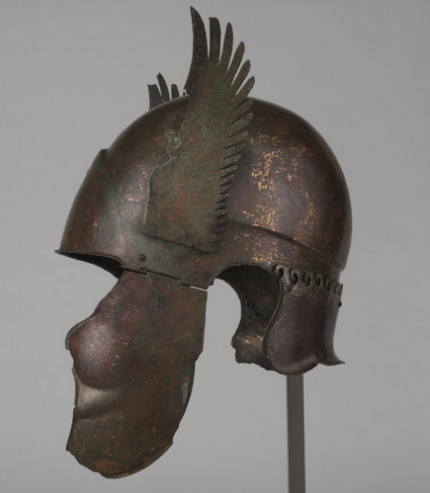
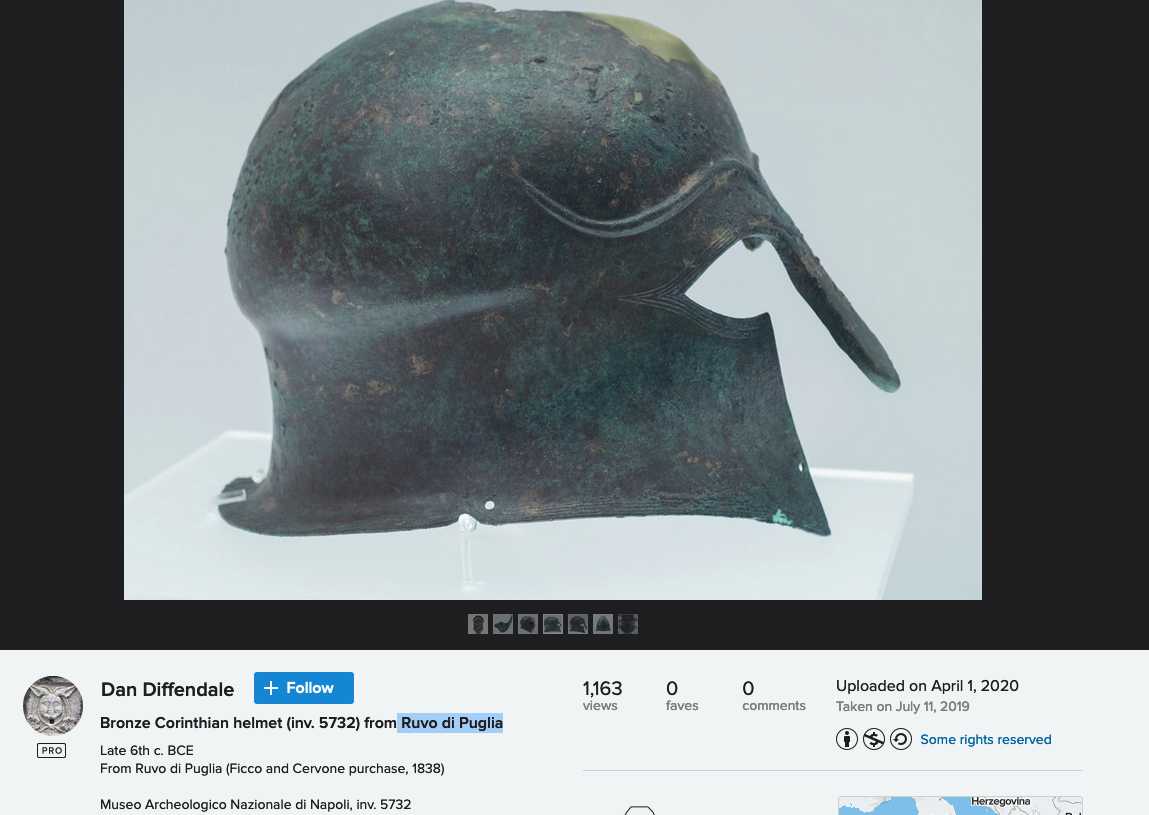
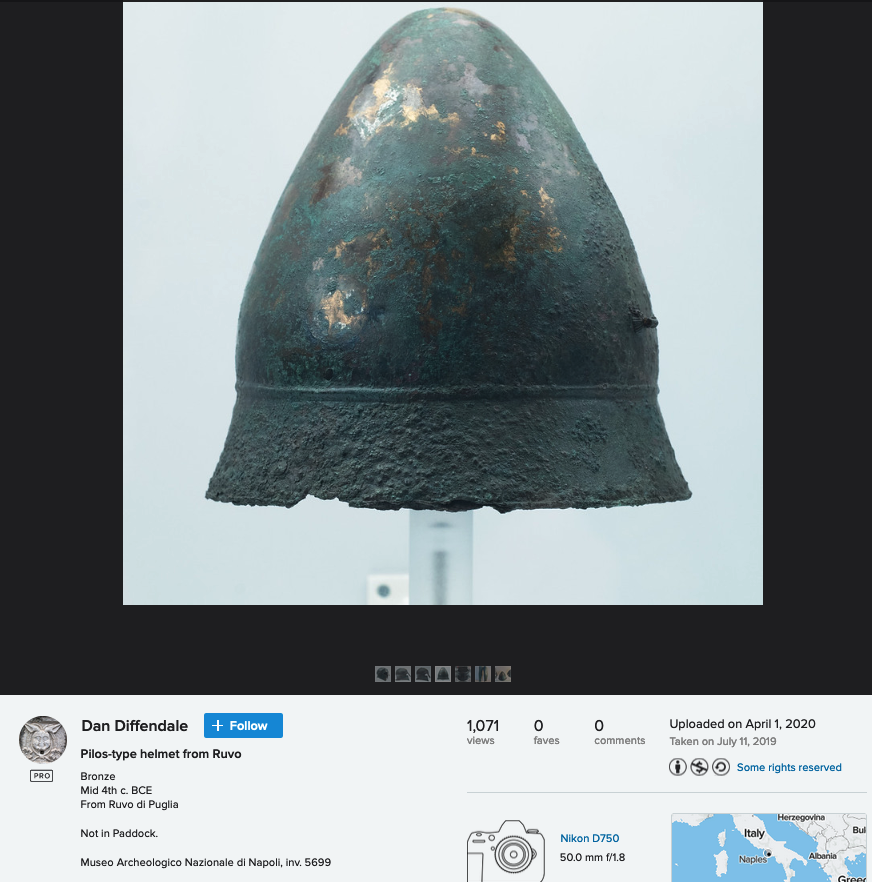
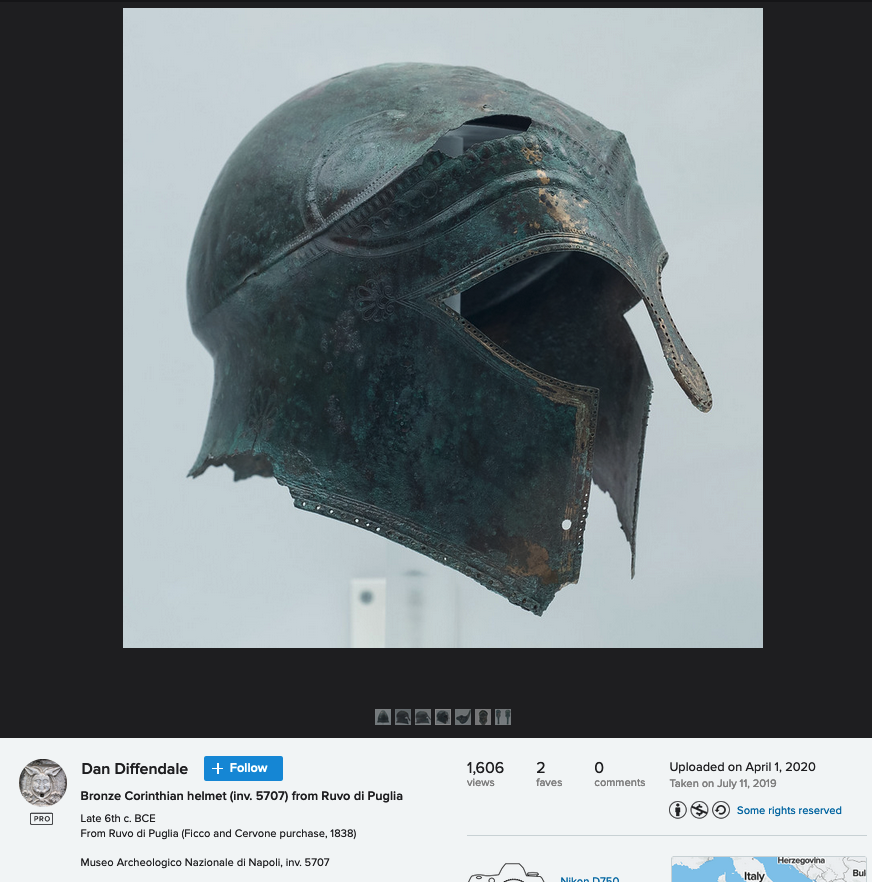
Before entering the Bnf it was owned by Honoré d’Albert de Luynes and is said to have been discovered in Ruvo. I wanted to know more about Ruvo and the helmet, but a quick search revealed MORE helmets said to be from the same place.
The BM has a great number of objects from Ruvo approximately 288 of which 217 came from Sir William Temple, but Alessandro Castellani liked to attribute objects to this find spot as well.
Dan Diffendale gives us images of three in Naples again purchases not excavation finds.
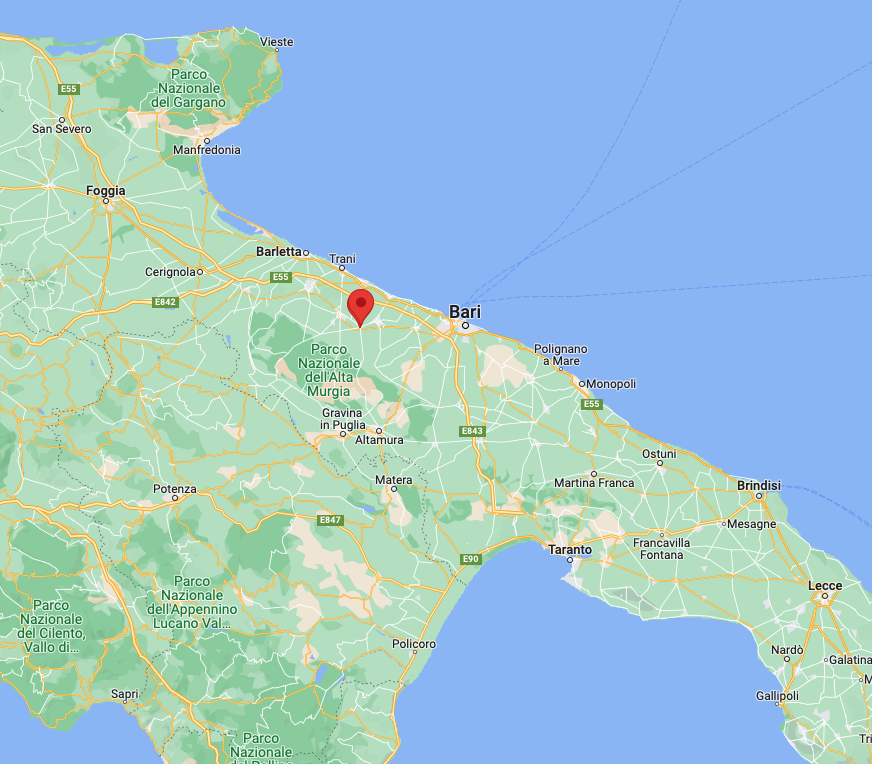
Where is Ruvo? Just a little north of Bari and south of Cannae.
Here’s an article on the attempts to ascertain what remains to be preserved at the site:
Giannotta, Maria Teresa, Lara De Giorgi, Giovanni Leucci, Raffaele Persico, Loredana Matera, and Ada Riccardi. “Preventive archaeology: the emblematic case of Ruvo di Puglia, Italy.” In 2015 8th International Workshop on Advanced Ground Penetrating Radar (IWAGPR), pp. 1-4. IEEE, 2015.
As an aside the Louvre didn’t buy any helmets from Ruvo but they did buy two cuirasses and other stuff; Berlin has 4 bronzes again no helmets.
Montanaro, Andrea. Ruvo di Puglia e il suo territorio: le necropoli. I corredi funerari tra la documentazione del XIX secolo e gli scavi moderni. Rome: L’Erma di Bretschneider, 2007. Too bad I can’t find a copy for under 600 dollars…ffffft.
Cf. Bottini, Angelo and Setari, Elisabetta. La necropoli italica di Braida di Vaglio in Basilicata: materiali dallo scavo del 1994 (Accademia Nazionale dei Lincei, Monumenti Antichi, volume 7 (issue 60)). Rome, 2003.
Both Crawford nor Haeberlin seem to derive their knowledge of this hoard primarily from the odd account by prof. Michele Stefano de Rossi who is obsessed with the possibility of eruption of the Alban hills in the historical period (to my knowledge this is non-sensical).
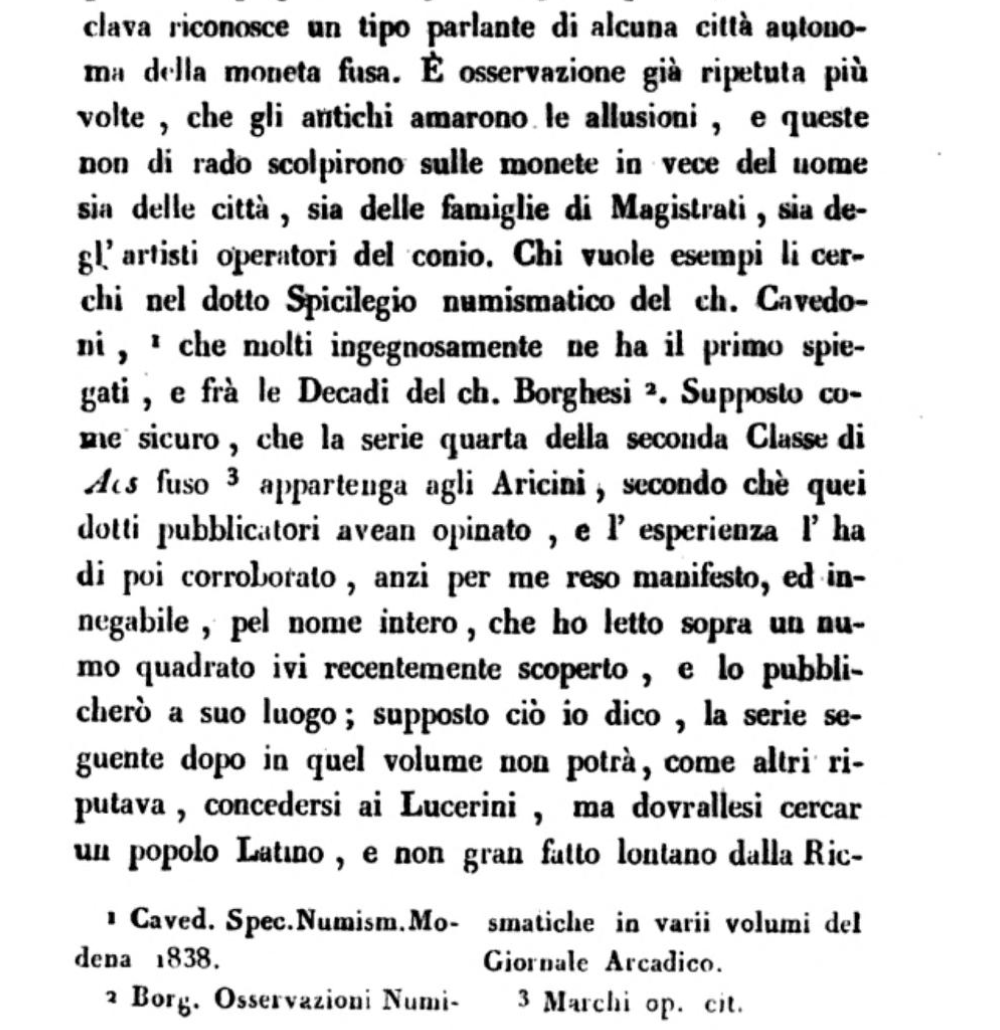
In 1848 the late P. Marchi purchased for the Kircherian Museum a hoard of primitive coins and aes rude found near Ariccia, which was then said to have been found under the peperino or inside a boulder of this rock. But since this fact was not published at the time and the news for me depended on verbal traditions nor, as far as I knew, there was any connection between the treasure and the pottery from Lazio, I had not yet hurried to ascertain the true circumstances of the find, without, however, losing sight of the fact that it could become a very important day. …
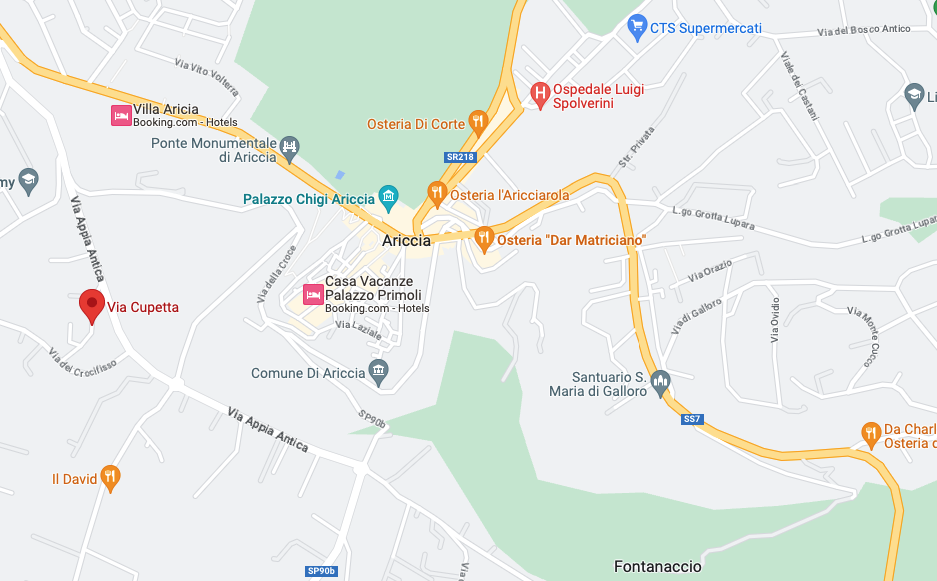
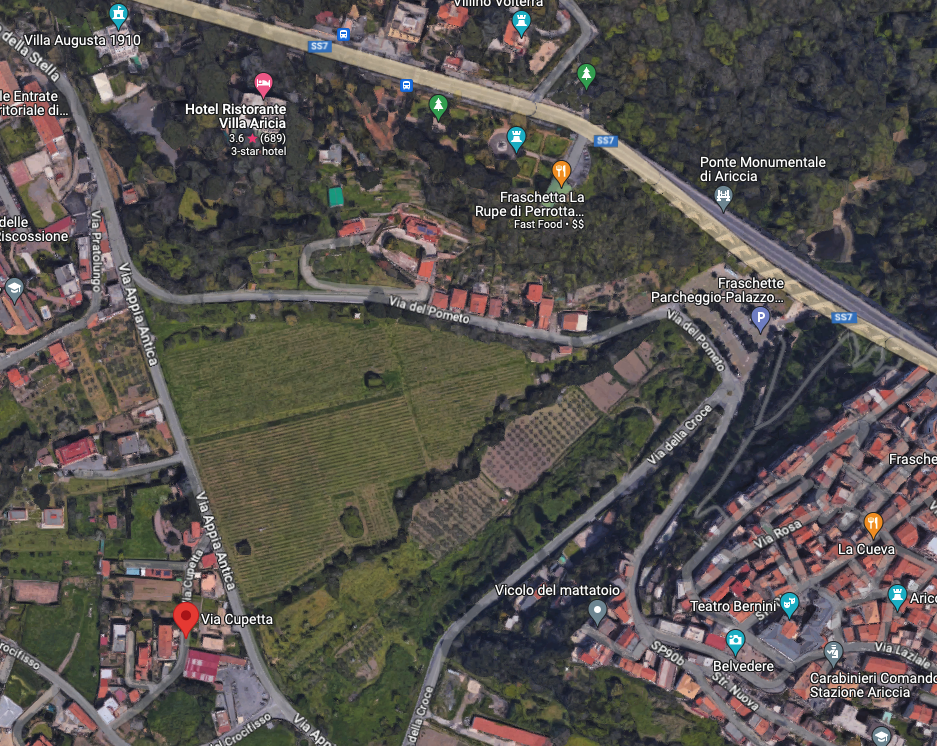
For the discovery of 1848 I found that a dispute arose between the municipality of Àriccia and the prince Chigi, the owner of the land. This led to numerous correspondence and appraisals and studies; which form a copious collection of documents in the provincial archives of the region. From these documents I learned not only the precise place and the method of the discovery — the enlargement of the via della Cupella* below Ariccia — but also the names of the workers and of the others; who intervened at work, from whom I was able to learn very precious details of the discovery. Without going into the difficult and thorny account of the investigations I made, the result of these was as follows.
To widen the said road located at the bottom of the slope of the hill towards the arid valley not far from the modern large bridge,** the rock was cut on the side of the mound and there among the earth below the layer of peperino was piled up the monetary treasure, made up of several currency bars, many semisses, some quadrantes and many aes rude. Fortunately the aes rude, less studied from the point of view of form, has not been too carefully cleared of the earth; and although 26 years have passed, being kept under crystal, it still retains the traces visible to the naked eye, but better with the lens, demonstrating that those metals were excavated among the volcanic ash of the Alban hills, not among the vegetable earth.
* – no road of this name exists today, but if it should read Cupetta, this might represent the approximate find spot. Big if.
** – Ponte Monumentale di Ariccia?
I was then able to persuade myself from the research done on the spot; that at a very small distance from the point where the treasure lay, that is about thirty paces towards the base or from the valley and within the same layer of clayey yellow ash, a few years before the discovery of which reason, a large amount of the usual coarse and blackish Latin pottery was found , the containers were broken and scattered. So I am certain that the pottery and the coins lay in the same layer. However if some scholar here does not want to rely too much on my investigations into the close relationship between the hoard and the crockery; he may suspend his judgment and await the end of the present reasoning. Having said that, here is the description of the treasure kindly communicated to me by ch. P. Tongiorgi successor of P. Marchi in the direction of the Kircherlano museum. I found another report identical to the one I am producing in the aforementioned series of documents in the archives of the province.
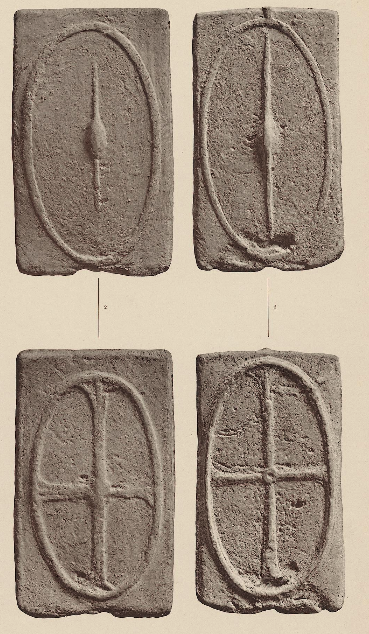
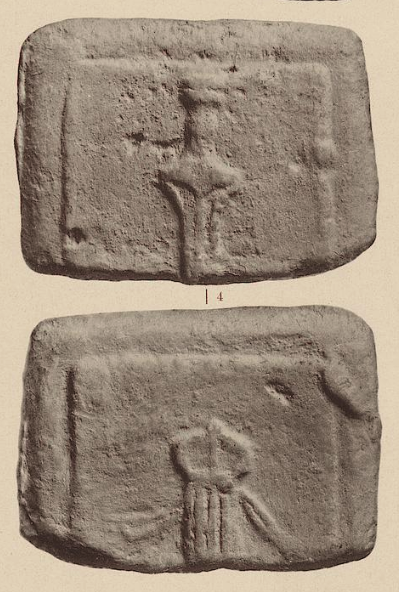
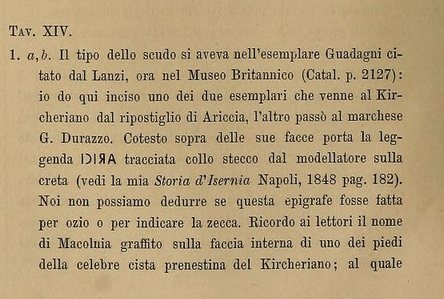
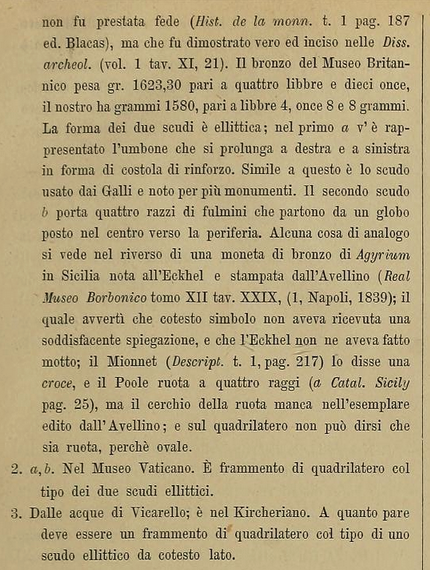
Quincussus (Five Pound Bar) with imprint of an elliptical shield, cut in one face in the greatest length and width by a kind of cross open in the center, enlarged in the four extremities in the form of a cone; cut it on the other side by a boss resembling a spindle which extends to the entire length of the shield. (This quincusse is in the cabinet of ancient medals of the MbL of Paris. [not in GALLICA. – others say it is in Kichner = Rome Coin Cabinet])
Another similar quicussus released from the casting process less perfectly than the previous one with a metal defect, so that at the top of the shield the air and the light pass from one side to the other
3. Fragment of quincussus with the imprint of the parazonium (short sword) on one side and the respective scabbard on the other. If one keep the grip with part of the parazonium on one face and the end of the scabbard is on the other. It is square, and represents three-fifths of the whole.
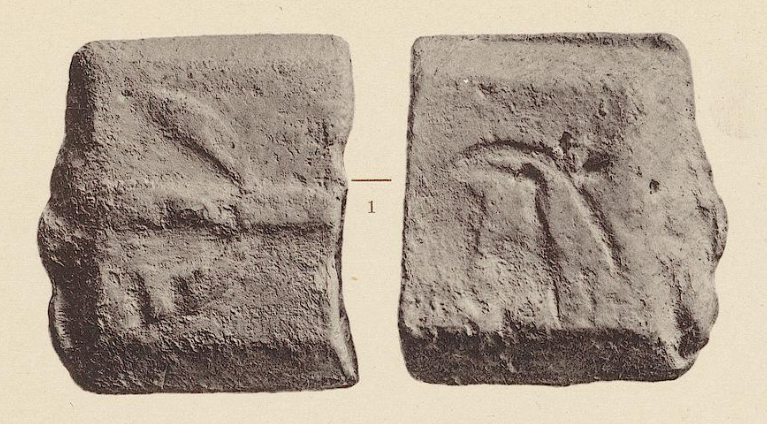
4. Another fragment of a rectangular currency bar, with two dolphins on one side and a leafless twig on the other. It is truncated at both extremities of its length, but it lacks little inside.
5. Another small fragment which on one side looks like the tripod of a candelabrum and on the other without imprint. The magnitude is less than the third of the whole. [RRC 6/1 or RRC 10/1?]
6. As with two-faced clean shaven obverse, head of Mercury left on the reverse. It should be noted that at the moment of the discovery the little treasure had at least three similar ones. [RRC 14/1]
7. Semis with an ox’s head to right and ship’s prow, also to the right. [Paestum type?]
8. Three similar trientes with dolphin and four globes on right, thunderbolt and four globes on right. [RRC 14/3]
9. Two similar quadrantes with open hand and three globes to the right, two shuttles or barley grains with globes [RRC 14/4]
10. Thirty-nine pieces of different proportions and unformed bronze, which it seems should be taken for aes rude as found in the deposit with the currency bars [aes signatum] (There is no doubt that these bronze pieces are true aes rude. The inferred study was compiled at the time of its discovery during the aforementioned question regarding the property.)
I will not talk about the combination in this hoard of the various kinds of money with the aes rude, nor about anything else of archaeological interest found in that coin group. Here it is enough for me to have verified the relationships of the coins with volcanic ash and of the coins with Lazio vases, and given the description of the numismatic series to which they pertain …
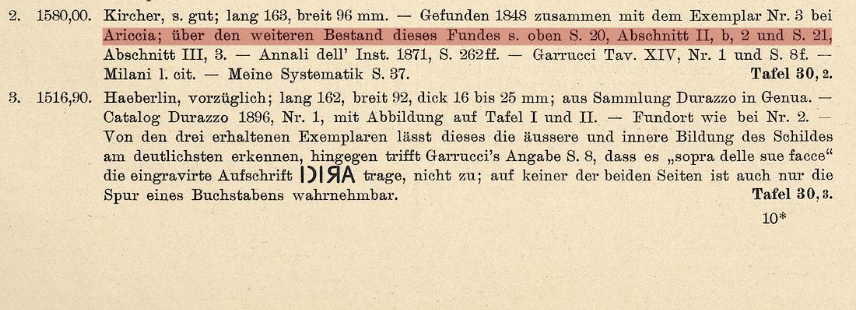
NOTICE nowhere in any of this is a mention of this bar which Haeberlin says is also from Ariccia (see previous post).
Haeberlin says he can see no trace of the writing on his bar which should be the same as that found at Ariccia with the hoard BUT …
Within a year of the discovery Garrucci was already claiming that it had such an inscription:
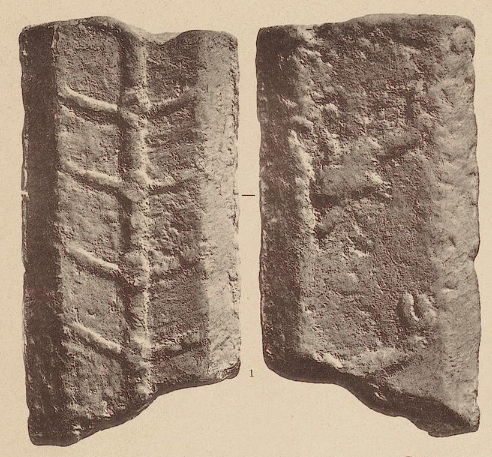
This is the first “Roman” Currency bar in Crawford’s sequence. There is no known whole bar. “B” is in Berlin according to Crawford in RRC and comes from the Ariccia 1848 Hoard according to Haeberlin, BUT but in CHRR Crawford says all bars except one shield from the Ariccia Hoard are in Rome…
“A” is from the S. Marinella 1927 Hoard. This image comes from Catalli’s 1989 re publication of the hoard (need a copy? Happy to send you a hi res pdf).
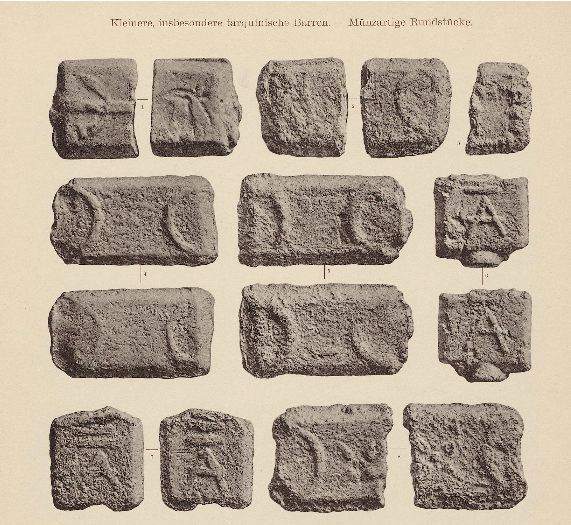
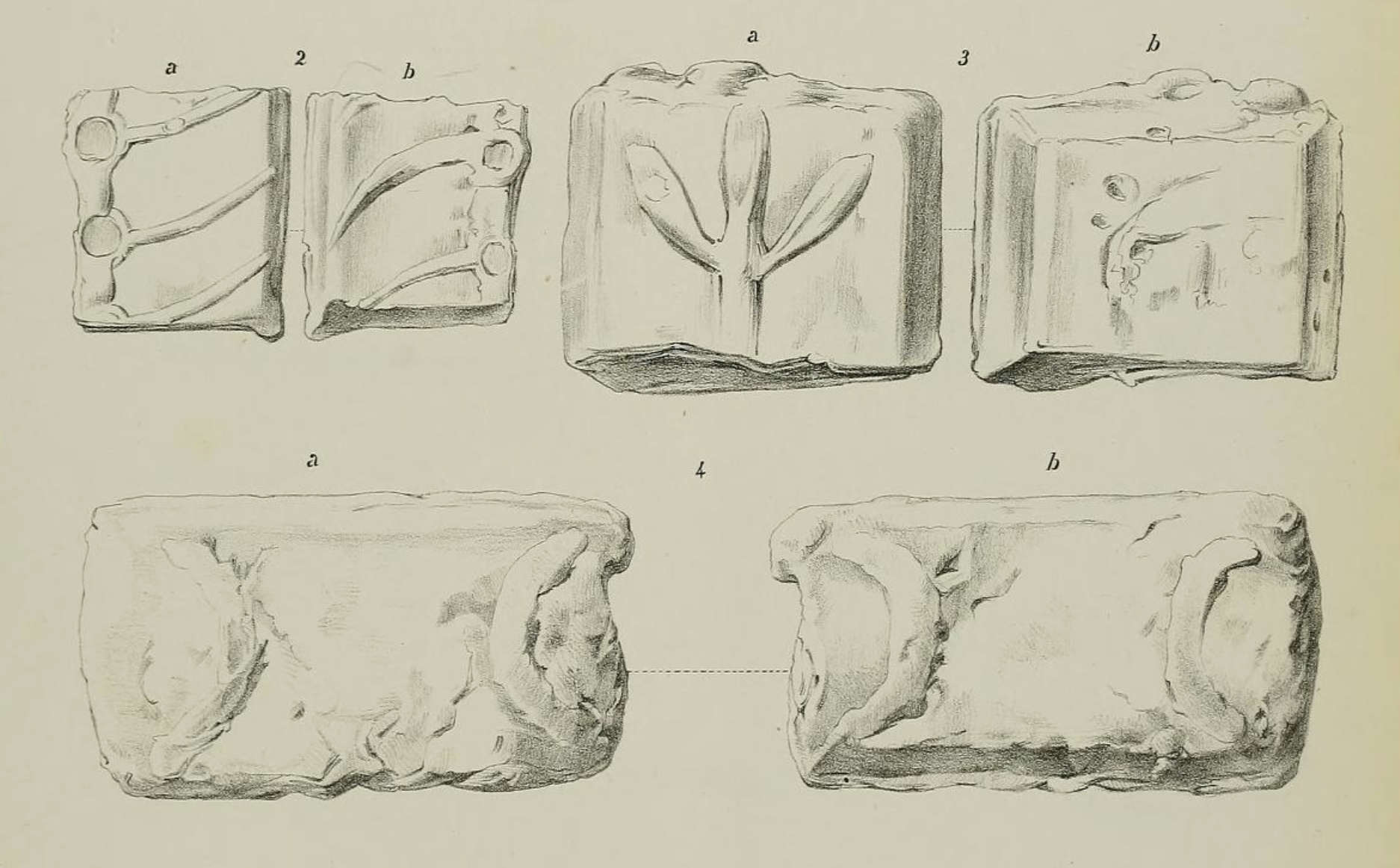
What makes RRC 3/1 different is it’s dimensions. It is far closer in proportion to the so called Tarquinia Bars than any of the other Roman ones. This is obvious by a quick glance at Haeberlin’s plate
Here’s a side by side to give you a sense of HOW DIFFERENT RRC 3/1 is from the other Roman Currency Bars
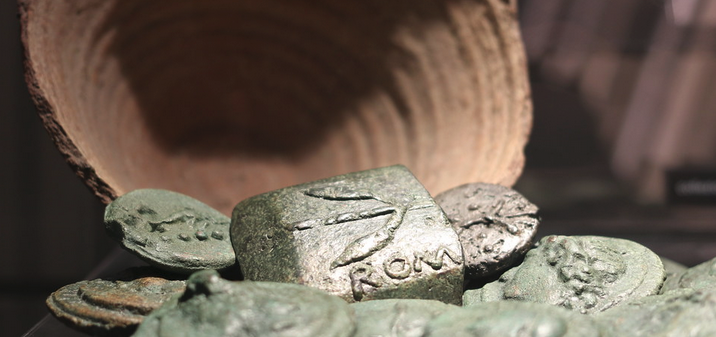
Snapshots taken from the hoard display in Rome show how massive the bevels are on the edge of the piece.
The other Roman currency bars are much flatter and wider and taller.
It has been accepted by Crawford and the Zagreb cataloguers that the Mazin Hoard contained a specimen of RRC 3/1b, i.e. the subtype without inscription:
I find myself agnostic about whether we should ascribe this bar fragment to Rome. Obviously the hoard contained other fragments of other Roman bars as well, but this looks like other ramo secco…
I wonder if the Berlin specimen could be metallurgically tested… Would it look like Roman material? The Tarquinian material? or the Ramo Secco? Each has a distinctive metallurgical profile.
All of this reminds me of:
Potts, C. (2019). Made in Etruria: Recontextualizing the Ramo Secco. American Journal of Numismatics (1989-), 31, 1–20. https://www.jstor.org/stable/27095026
Who argues that the symbol on the ramo secco is a LIVING plant. Most certainly on the S. Marinella Hoard specimen I see livng leaves on the stem…
No. 3 on Plate 35 of Garrucci 1885 clearly matches the photo of the Ariccia specimen in Haeberlin, he says it is in Kircheriano in his own day so that highly suggests it is now in the Rome, and not Berlin, and I won’t get to test it any time soon. The plate is also a nice illustration of similarities to Tarquinian specimens.
The below passage reminded me of the above coin and the decoding of the legend to be about the foundation of the ludi Apollinares by public subscription:
stips collata dei thesauro
The next thing to be discussed was the gift to Apollo, to whom Camillus said that he had solemnly promised a tenth part of the spoils. The pontiffs ruled that the people must discharge this obligation, but it was not easy to devise a method for compelling them to return the booty, that out of it the due proportion might be set apart for the sacred object. They finally resorted to what seemed the least oppressive plan, namely, that whosoever wished to acquit himself and his household of obligation on the score of the vow, should appraise his own share of the spoils, and pay in a tenth part of its value to the public treasury, to the end that it might be converted into an offering of gold befitting the grandeur of the temple and the power of the god and corresponding to the majesty of the Roman People. This contribution still further alienated the affections of the commons from Camillus.
Livy 5.23; c. 396 BCE
This passage could be read as confirmation that there was really a temple of Apollo in 431 BCE at Rome, rather than crediting the physical remains to to the ‘re’ foundation in 353 BCE. OR, it could be read as Livy pushing the type of collection from the people on behalf of Apollo back into the legendary past to flesh out his account of Camillus. I lean towards the latter but obviously unknowable.
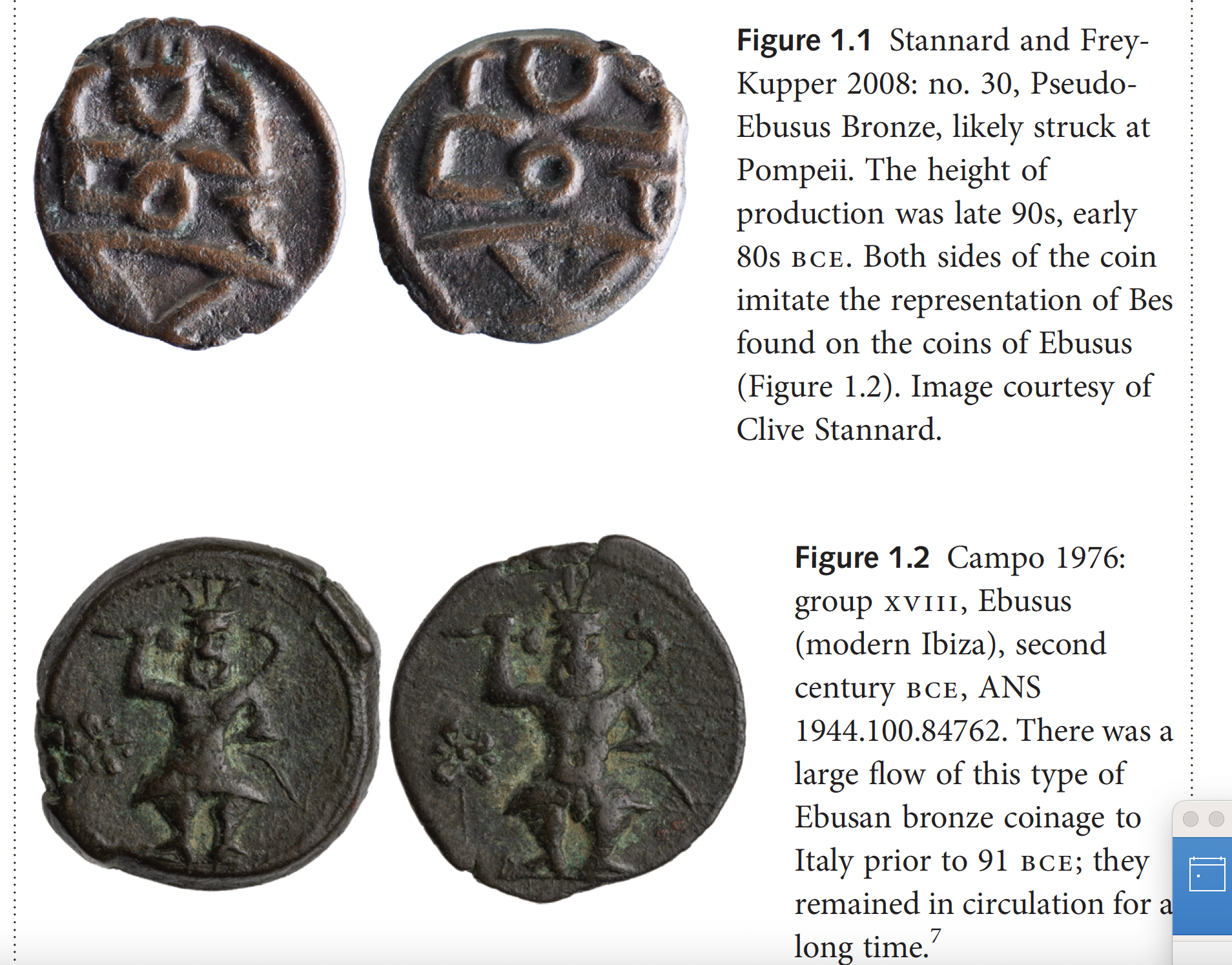
I started my coin book with images of Bes and how they came to Italy by way of Ebusus. (I also wrote a blog post over 10 years ago about these when I was just starting to think about the book project.)
But I’ve always found Bes a little odd. Why is this Egyptian god so popular in the Western Mediterranean? I’m sure someone has written on it.
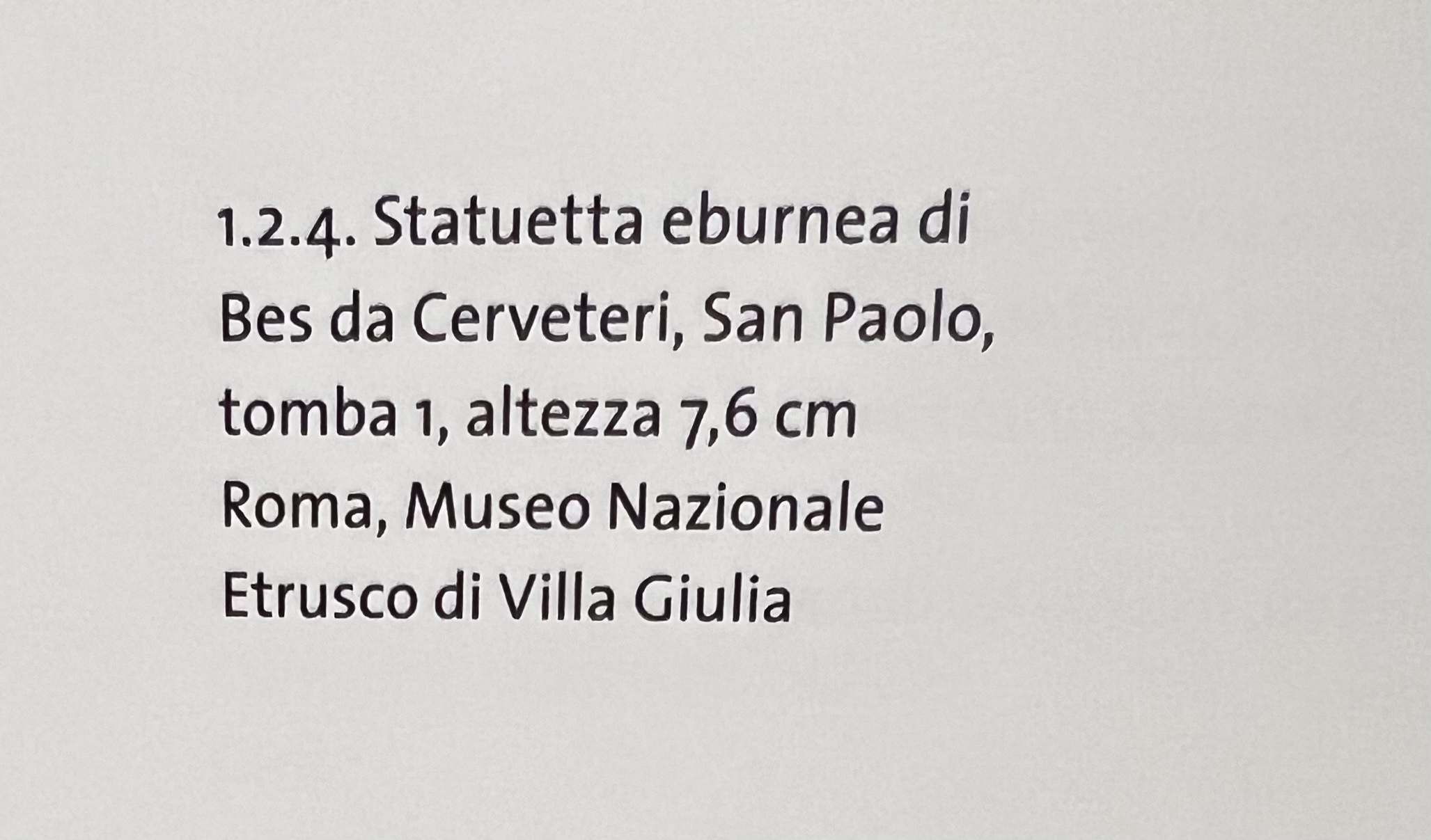
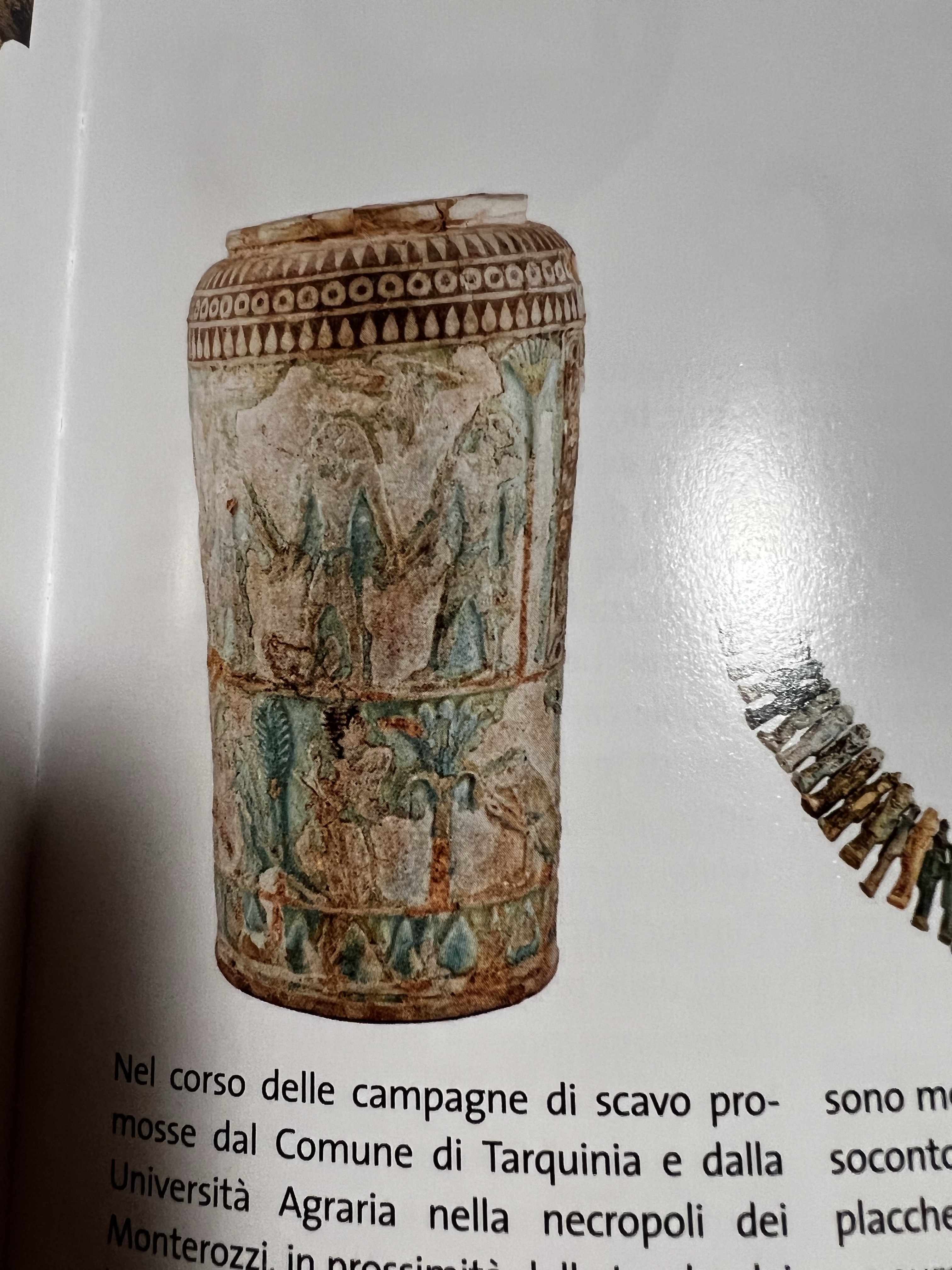
Anyway I was looking at Etruscan tomb finds from Ceveteri last night and say this image and of course realized how long Bes had been in Italy before he ever appeared on coins. There is a deep history not just with this god but with other Egyptian exports as well.
I like this passage as it shows the performance of hierarchies with emperor explicitly in the role of pater familias and the young emperor praised for acting old. I’d translated parsimonia as restrained as parsimony can have more negative connotations in English here than I think the Latin intends.
Stuff to keep in mind: domestic servants are enslaved as are huntsmen, grooms, and entertainers. Maybe some formerly enslaved but the jobs are associated with enslavement. Also Historia Augusta is as friend put it closer to fan fiction than history, which makes it extra useful for seeing tropes and moralizing expectations.
Emperor is appropriately more generous with those higher on the social ladder, his friends, the citizens of Rome (as well illustrated on the coins):
It is exactly this type of discrepancy that drives me nuts with numismatic typologies–there has to be a way our digital tools can help us correct and improve this sort of thing.
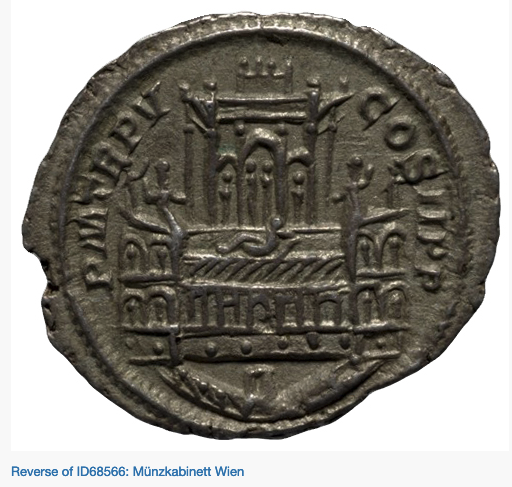
Later same day. This discrepancy on what architecture is being shown on the coin really bugged me.
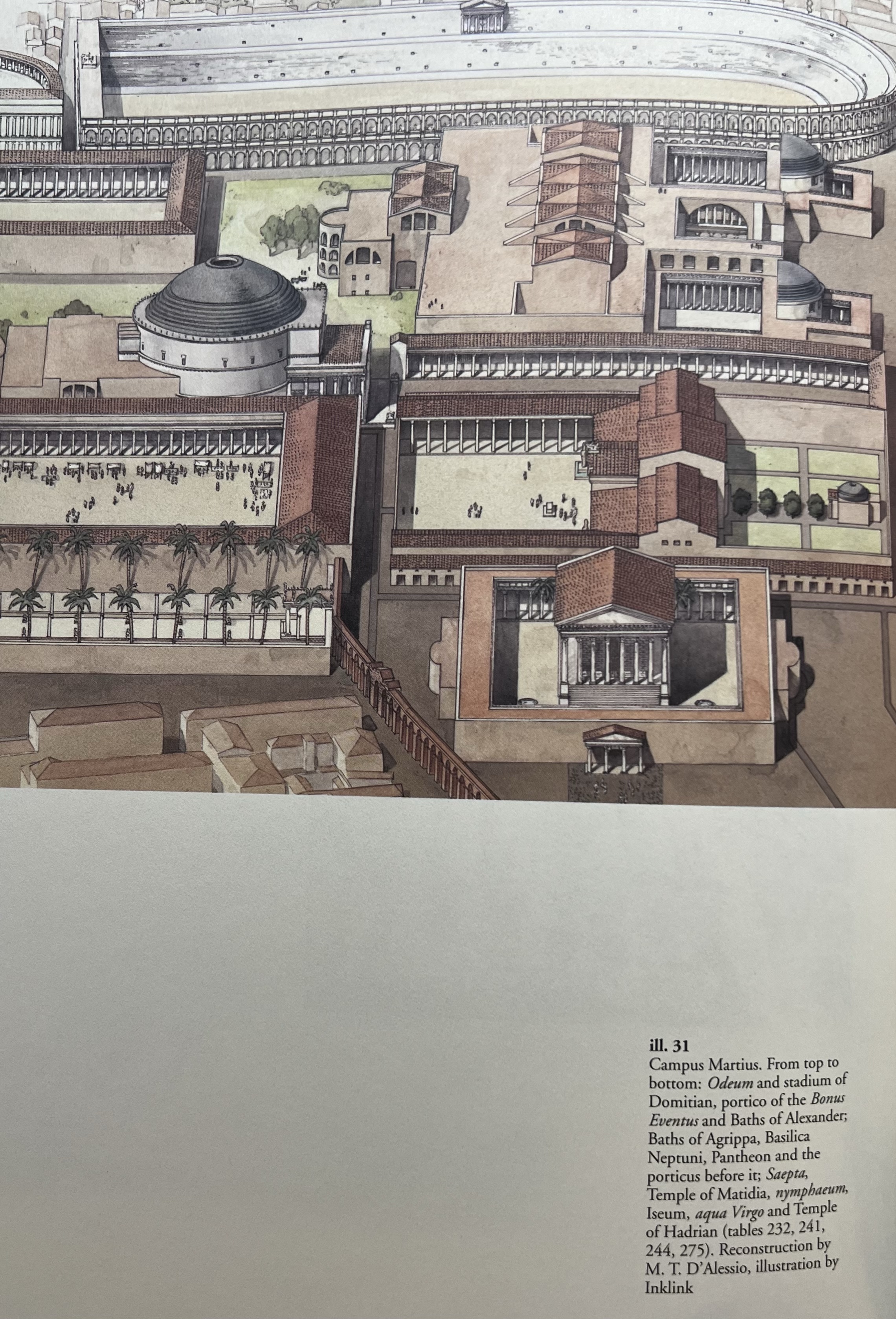
Nothing about the plan or reconstruction of the baths reminds me of what we see on the coin.
It is the big roofed building behind the Pantheon below Domitian’s stadium (= Piazza Navona), what was before Sev Alex got to it had been the baths of Nero. This causes confusion for the association of artifacts with Nero or Alex. And there are some impressive ones!
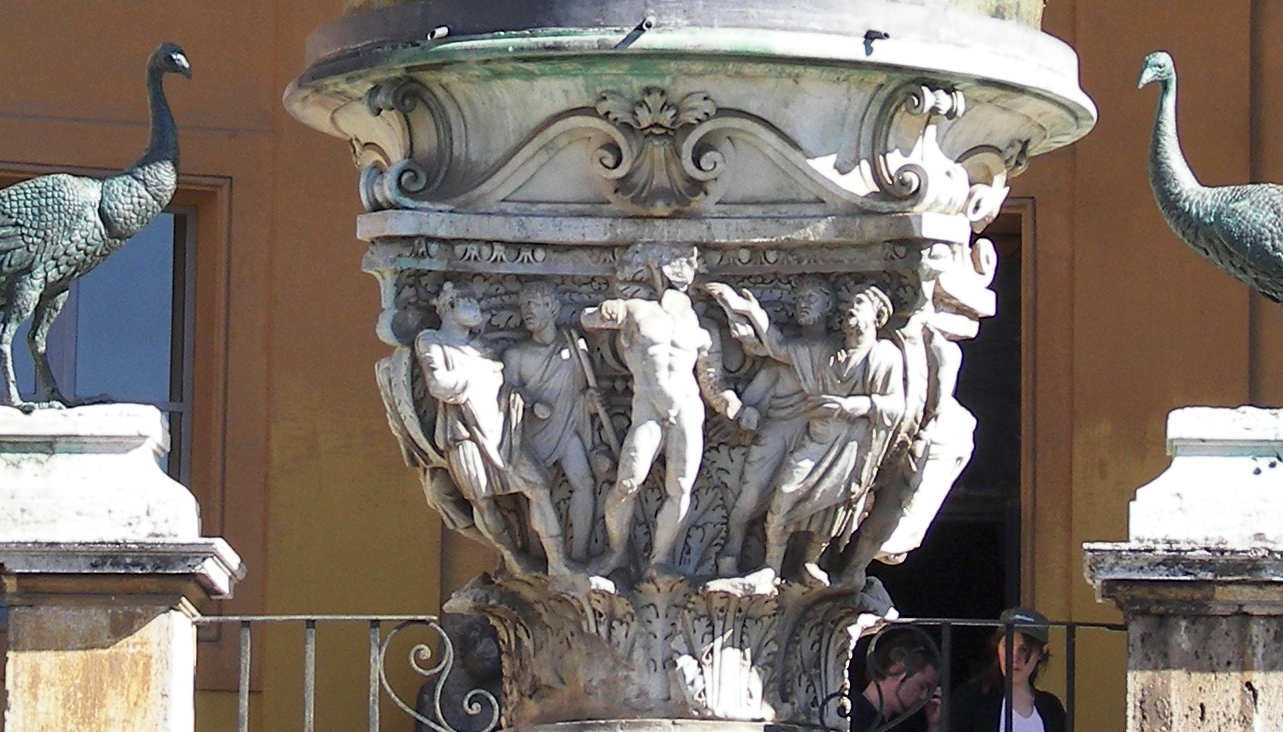
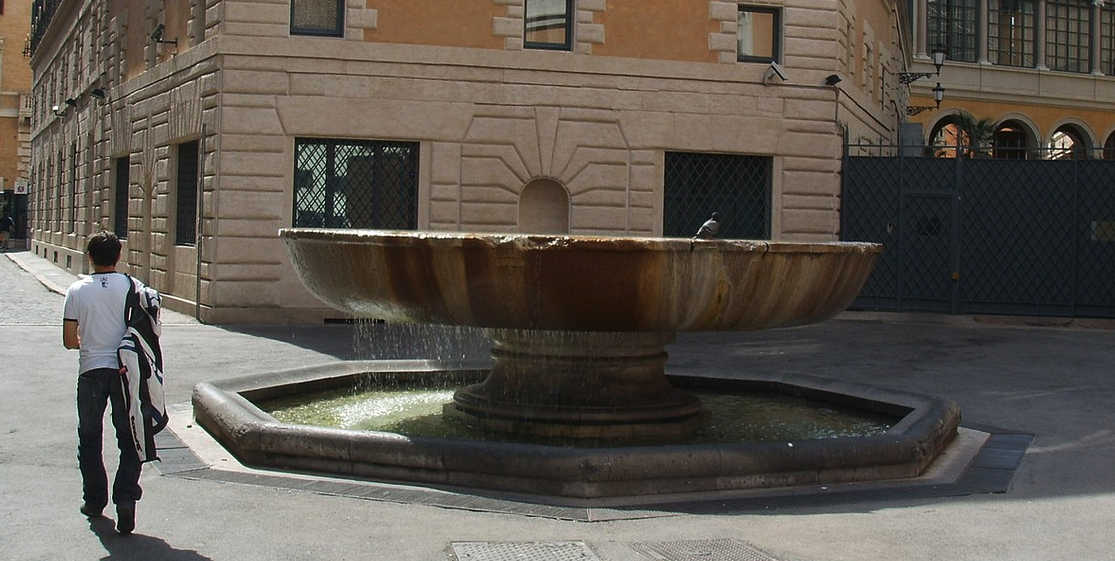
Like this giant capital now in the Vatican holding up a giant bronze pine cone.And the Giant wash basin turned Fontana del Senato
What about the Nymphaeum? Long story short. ALL The coins show the Nymphaeum and we have a pretty good idea how to match the coin image onto the surviving archaeology which is significant.
(This Elkins, of course, knew, see p. 104-105 of his 2015 book for details of numismatic introduction of this misguided Baths theory)
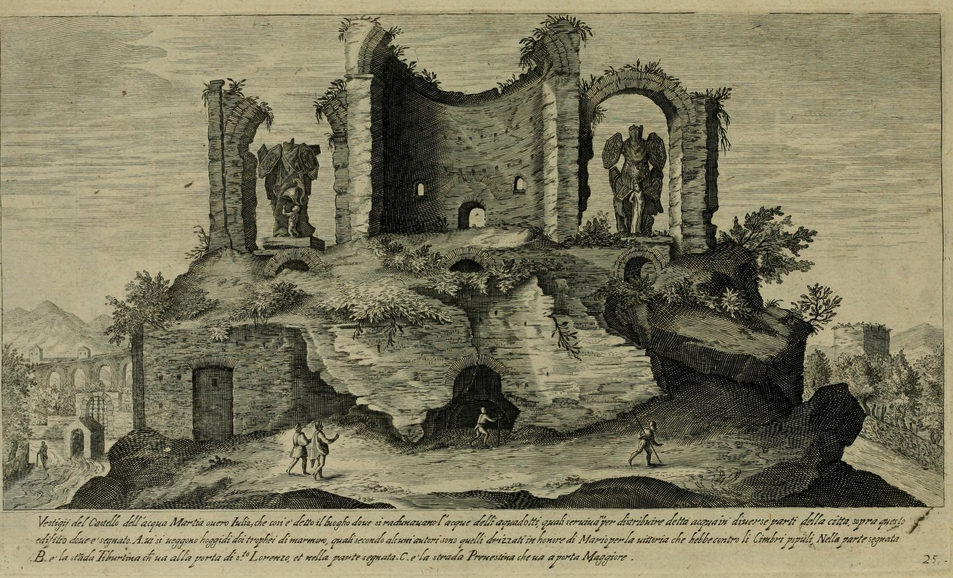
My favorite part?! The Coins show statues that still and if you’ve been to Rome you’ve probably seen. Look at the arches:
Historic view by Sadeler (Source; very distracting only open if you have time!!)
Those trophies now known to be repurposed from a Domitianic monument are still standing at the top of the ramp up to the Capitoline after being moved there!
On this blog I’ve been linking to Iris, esp. for Italic coins, but it seems as if Arch might be a better choice for searching going forward as it pulls in more types from various different databases including Iris. Anyway. Flagging my intent to change practice and sharing the link as it has other useful information on where to find various coin types online.
I’m interested in Phrygian helmets before they become associated with personifications of Roma. An earlier blog post talked about a Ptolemaic use, but this one is Italic and v early Hellenistic and thus even better precedence.
Note the griffin on the side and knot of Herakles, tying a diadem or fillet at the front; like my colleague Eduardo who brought this to my attention I too am a fan of the curls!! And want to think about this type of addition along wiht other things like horned helmets and animal helmets and helmets with faces. Notably I don’t see any space for wings or plumes but maybe that is just the photo angle.
“Salva res est dum cantat senex”, quare parasiti Apollonis in scaena dictitent, causam Verrius in lib. V, quorum prima est p littera, reddidit, quod C. Sulpicio, C. Fulvio cos., M. Calpurnio Pisone praetore urb. faciente ludos, subito ad arma exierint, nuntiatio adventus hostium, victoresque in theatrum redierint solliciti, ne intermissi religionem adferrent, instaurati qui essent: inventum esse ibi C. Pomponium, libertinum mimum magno natu, qui ad tibicinem saltaret. Itaque gaudio non interruptae religionis editam vocem nunc quoque celebrari. At in hoc libro refert Sinni Capitonis verba, quibus eos ludos Apollinares Claudio et Fulvio cos. factos dicit ex libris Sibyllinis et vaticinio Marci vatis institutos, nec nominatur ullus Pomponius. Ridiculeque de ipsa appellatione parasitorum Apollinis hic causam reddit, cum in eo praeterisset. Ait enim ita appellari, quod C. Volumnius, qui ad tibicinem saltarit, secundarum partium fuerit, qui fere omnibus mimis parasitus inducatur. Quam inconstantiam Verrii nostri non sine rubore rettuli.
This passage seem to correspond to a tradition of an interruption at the games as mentioned by Macrobius above. It also seems to engage in a debate about the role of Pomponii in the festival. Servius also knows this story!
avdax qvos rvmpere pallas sacra vetat ne interruptione sacrificii— ‘rumpere’ enim pro ‘interrumpere’ posuit—piaculum committeretur: unde etiam Helenus “nequa inter sanctos ignes in ho- nore deorum hostilis facies occurrat et omina turbet”. denique cum ludi circenses Apollini celebrarentur et Hannibal nuntiatus esset circa portam Collinam urbi ingruere, omnes raptis armis concurrerunt. reversi postea cum piaculum formidarent, invenerunt saltantem in circo senem quendam. qui cum interrogatus dixisset se non interrupisse saltationem, dictum est hoc proverbium ‘salva res est, saltat senex’. ‘audacem’ autem dicit ubique Vergilius, quotiens vult ostendere virtutem sine fortuna: unde etiam Turnum audacem vocat.
APOLLINARES LUDI, games in honor of Apollo; the people witnessed the spectacle crowned with laurels, and each paid according to his means.
Varro LL 6.18 (Loeb adapted)
The Nones of July are called the Caprotine Nones, because on this day, in Latium, the women offer sacrifice to Juno Caprotina, which they do under a caprificus ‘wild fig-tree’; they use a branch from the fig-tree. Why this was done, a historically themed play presented to them at the Games of Apollo enlightened the people.
Nonae Caprotinae, quod eo die in Latio Iunoni Caprotinae mulieres sacrificant et sub caprifico faciunt; e caprifico adhibent virgam. Cur hoc, togata praetexta data eis Apollinaribus Ludis docuit populum.
See Cirilo de Melo trans and commentary for reasons for necessary adaptation. Cf. Mac. Sat. 1.11.36-39 for summary of events that likely represent the plot of the play. Also cf. also Plut. Rom. 29.4 and Cam. 33.3. – I’d like one day to write an article about the loyal slave gets freedom trope in togata praetexta (historical plays) at a foot note to Richlin’s work on Plautus.
Diphilus tragoedus, cum Apollinaribus ludis inter actum ad eum versum venisset in quo haec sententia continetur ‘miseria nostra magnus es,’ derectis in Pompeium Magnum manibus pronuntiavit, revocatusque aliquotiens a populo sine ulla cunctatione nimiae illum et intolerabilis potentiae reum gestu perseveranter egit. eadem petulantia usus est in ea quoque parte ‘virtutem istam veniet tempus cum graviter gemes.’
Cicero gives “nostra miseria tu es magnus” and as S-B notes in commentary, Pompey was not in the theatre but in Capua.
Plin NH 19.23 (Loeb)
Tenting were used to make shade in the theatres, something first instituted by Quintus Catulus when dedicating the Capitol. Next Lentulus Spinther is recorded to have been the first to stretch awnings of linen in the theatre, at the games of Apollo. Soon afterwards Caesar when dictator stretched awnings over the whole of the Roman Forum, as well as the Sacred Way from his mansion, and the slope right up to the Capitol, a display recorded to have been thought more wonderful even than the show of gladiators which he gave.
In theatris tenta umbram fecere, quod primus omnium invenit Q. Catulus cum Capitolium dedicaret. carbasina deinde vela primus in theatro duxisse traditur Lentulus Spinther Apollinaribus ludis. mox Caesar dictator totum forum Romanum intexit viamque sacram ab domo sua et clivum usque in Capitolium, quod munere ipso gladiatorio mirabilius visum tradunt.
Cic. Phil. 1.36 (regarding pro Brutus anti Antony sentiment in 44; cf. Phil 2.31, 10.8)
And then there was the applause at the Apollinarian games, or rather the people’s testimony and expression of their feelings. Did you find that insufficient?
Apollinarium ludorum plausus vel testimonia potius et iudicia populi Romani parum magna vobis videbantur?
On political demonstrations also Cic. Vat. 115-127. Not explicitly Games of Apollo but most think refers to events at them.
Cic. Att. 16.4.1
I went to Nesis on the 8th. Brutus was there. How distressed he was about the ‘Nones of July’—quite extraordinarily upset! So he said he would write instructing them to announce the Hunt which takes place on the day following the Games of Apollo for the ‘14th Quintilis.’
Dio 48.20
However, when Sextus learned of this, he waited until Agrippa was busy with the Ludi Apollinares; for he was praetor at the time, and was not only giving himself airs in various other ways on the strength of his being an intimate friend of Caesar, but also in particular gave a two-days’ celebration of the Circensian games and prided himself upon his production of the game called “Troy,” which was performed by the boys of the nobility. Now while he was thus occupied, Sextus crossed over into Italy and remained there…
Dio 47.18-19
And they compelled everybody to celebrate his birthday by wearing laurel and by merry-making, passing a law that those who neglected these observances should be accursed in the sight of Jupiter and of Caesar himself, and, in the case of senators or senators’ sons, that they should forfeit a million sesterces. Now it happened that the Ludi Apollinares fell on the same day, and they therefore voted that his birthday feast should be celebrated on the previous day, on the ground that there was an oracle of the Sibyl which forbade the holding of a festival on Apollo’s day to any god except Apollo. Besides granting him these honours, they made the day on which he had been murdered, a day on which there had always been a regular meeting of the senate, an unlucky day.
Dio 43.48, 45 BCE
The administration of the finances, after being diverted at this time for the reasons I have mentioned, was no longer invariably assigned to the quaestors, but was finally assigned to ex-praetors. Two of the city prefects then managed the public treasuries, and one of them celebrated the Ludi Apollinares at Caesar’s cost.
Dio 48.33, 40 BCE (perhaps 41?)
In the year preceding this, men belonging to the order of knights had slaughtered wild beasts at the games in the Circus on the occasion of the Ludi Apollinares, and an intercalary day had been inserted, contrary to the rule, in order that the first day of the succeeding year should not coincide with the market held every nine days—a clash which had always been strictly guarded against from very early times.
Dio 47.20
And yet Cassius was praetor urbanus and had not yet celebrated the Ludi Apollinares. But, although absent, he performed that duty most brilliantly through his colleague Antony; he did not himself sail away from Italy at once, however, but lingered with Brutus in Campania and watched the course of events. And in their capacity as praetors they kept sending letters to the people at Rome…
Something seems to have gone wrong here and Cassius and Brutus should be reversed in this passage to match other testimony
Plin. NH 35.100
Boy in the Temple of Apollo, a picture of which the beauty has perished owing to the lack of skill of a painter commissioned by Marcus Junius as praetor to clean it in readiness for the festival of the Games of Apollo.
Cic. Brut. 78
Now by this time a richer and more brilliant habit of speaking had arisen; for when Gallus as praetor conducted the games in honour of Apollo, Ennius at that festival presented the tragedy of Thyestes, and died in the year of the consuls Quintus Marcius and Gnaeus Servilius.
Serv. Virg. Aen. 6.70
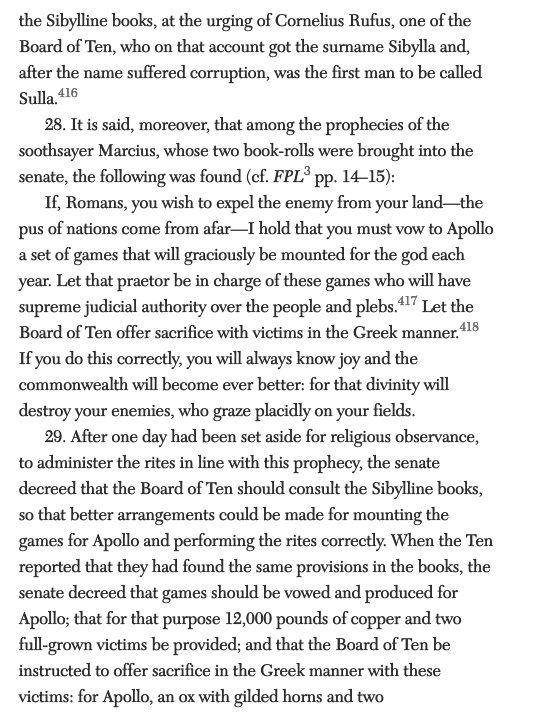
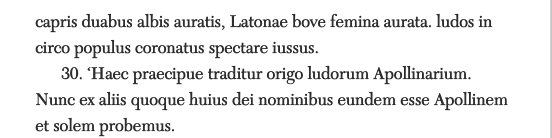
festosqve dies de nomine phoebi ludos Apollinares dicit, qui secundum quosdam bello Punico secundo instituti sunt, secundum alios tempore Syllano ex responso Marciorum fratrum, quorum extabant, ut Sibyllina, responsa.
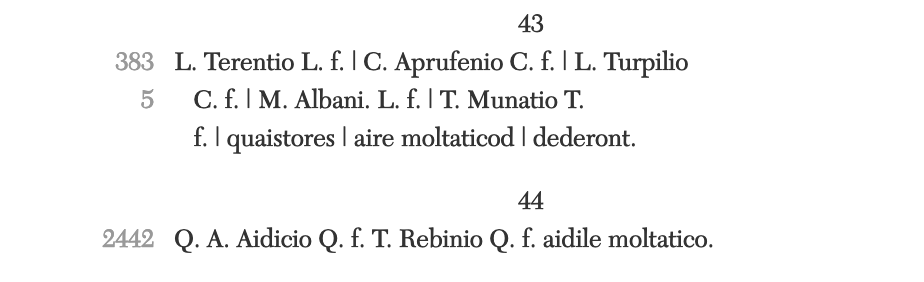
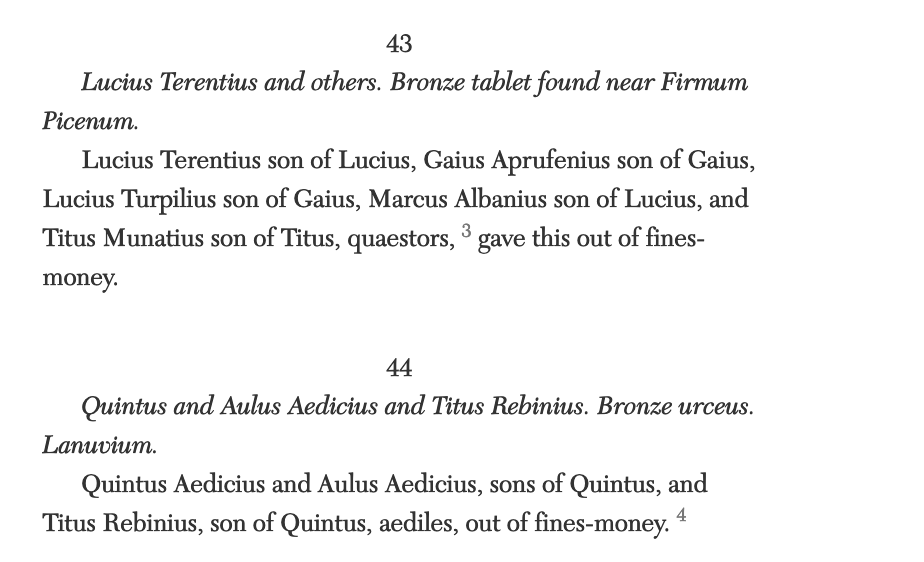
“[lost names, as] Curule Aediles authorized the dedication of this from the money collected from fines”
This was found in the podium underneath that for Apollo Sosianus during excavations c. 1937-1940.
There terminology is familiar from other inscriptions (from Loeb):
This inscription is typically dated to between 170-131 BCE on letter forms and vocabulary. You all know I love the verb probare and term probum. We see it from the 1st Punic War onwards as a term of how magistrates authorize stuff, coin issues, rams of ships, dedications, etc…
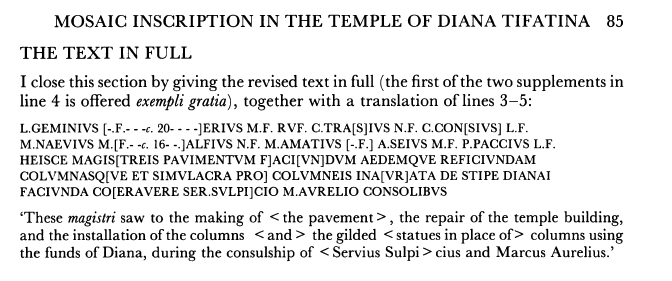
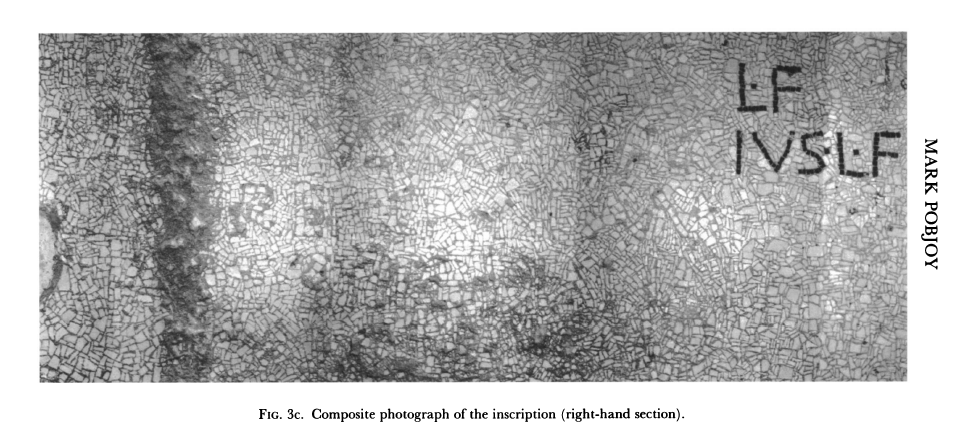
The other reason I love this inscription is that it reminds me of the one in Temple of Diana Tifatina. She’s also a recurrent character on this blog. There is a black and which dedicatory inscription on the floor of that temple that has been the subject of intensive reconstruction and is dated by Pobjoy to 108 BCE.
Pobjoy, Mark. “A New Reading of the Mosaic Inscription in the Temple of Diana Tifatina.” Papers of the British School at Rome 65 (1997): 59–88. (Link)
The inscription from Rome was clearly done with much greater care and attention, but the later one from Campania helps us imagine more of the effect and how popular this type of inscription was, perhaps because of its very enduring visibility.
Which reminded me of another from Nemi c. 30-1 BCE that I was worried was unpublished as all I’d seen was the 1885 photos but thank goodness it turns out it is: EDR147036
It has been suggested that the mosaic in the Temple of Apollo might be connected with works in the area c. 179 BCE conducted by the Censors (Livy 40.51). cf.
Ciancio Rossetto, Paola. “Tempio di Apollo: nuove indagini sulla fase repubblicana.” Atti della Pontificia Accademia Romana di Archeologia. Serie III, Rendiconti 70 (1997-1998): 177-195.



























 Liv Mariah Yarrow