Wider Contexts

Images and links updated 3.6.2026. I apologize for having no idea 13 years on where that top image is from.

Image

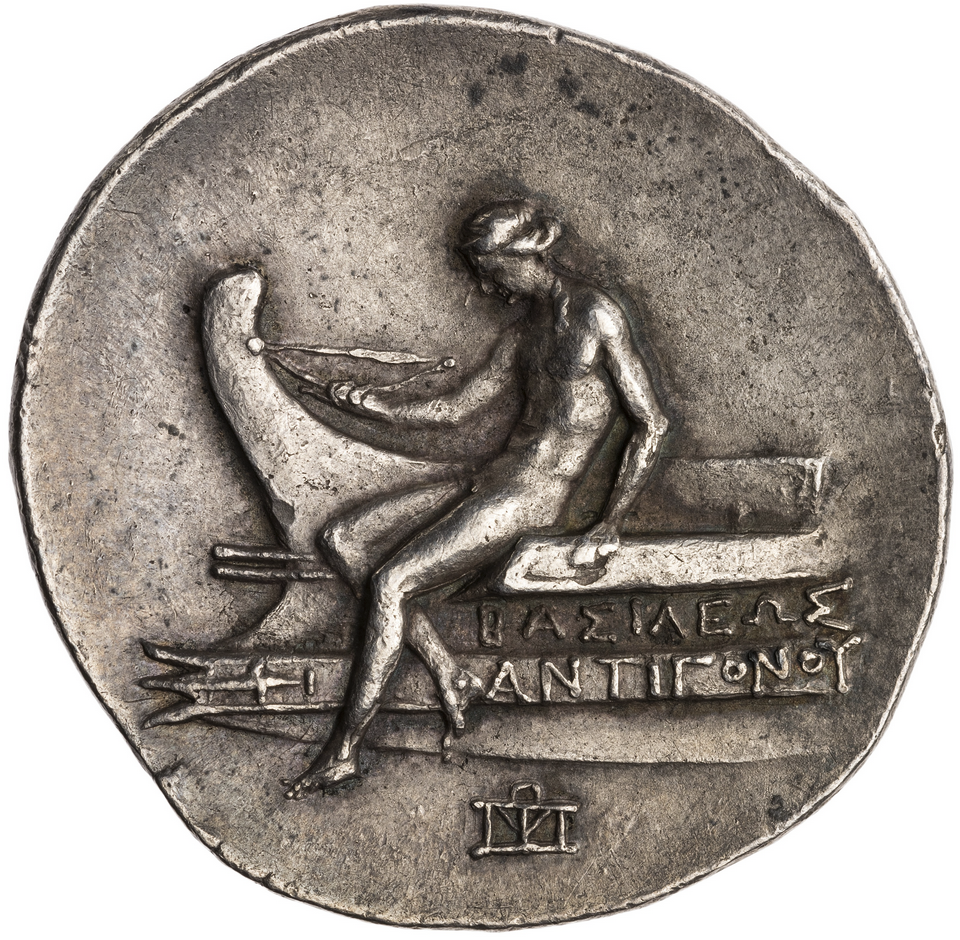
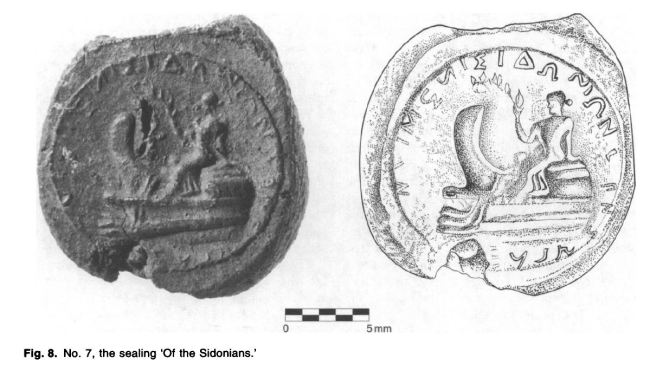
I came across this image of a bulla in my reading today and was immediately struck by the visual similarities with the Doson coin I posted about earlier.  How common is this image?  Not that common really.  Besides Doson, Magnetes of Thessaly has a similar type with Artemis:

Specimen in trade

And it is also a standard type of Histiaea in Euboia:


Specimen in trade

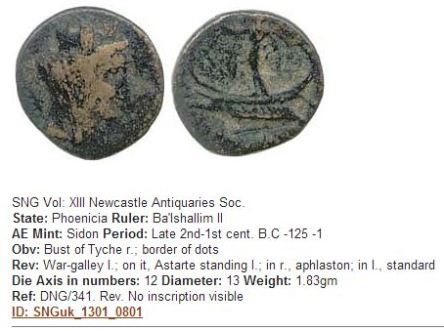
But that seems to be about it.  The publishers of the seal focus on the coins of Sidon, such as this:

Image

This isn’t really that close in design or style even if they show a figure on a ship. There might be a lost Sidonian type with a figure seated on just prow, but I suspect the inspiration for the design came from trade connections with the North.

updated:

RPC Sidonian coins with a prow.

exemplary images

N.B. RPC tends to call ships galleys for Sidon.

44 out of 410 Days: Neighborhood Delights

I sent the wire transfer for the deposit on the Istanbul place.  SDA said to me first thing this morning ‘there’s no one I’d rather have adventures with’.  It will be a grand adventure, but Ditmas Park is pretty fabulous too.

This morning I cramped up between 1.5 and 2.5 miles and had to walk, so I did an extra loop at the end of my route around a long block.  At the end of that very last loop a school crossing guard, who I swear I’ve never seen before, stopped me and with a big smile said “You made it round really fast! I was watching.”   I love the eye contact and smiles along the way, but that comment takes the cake.

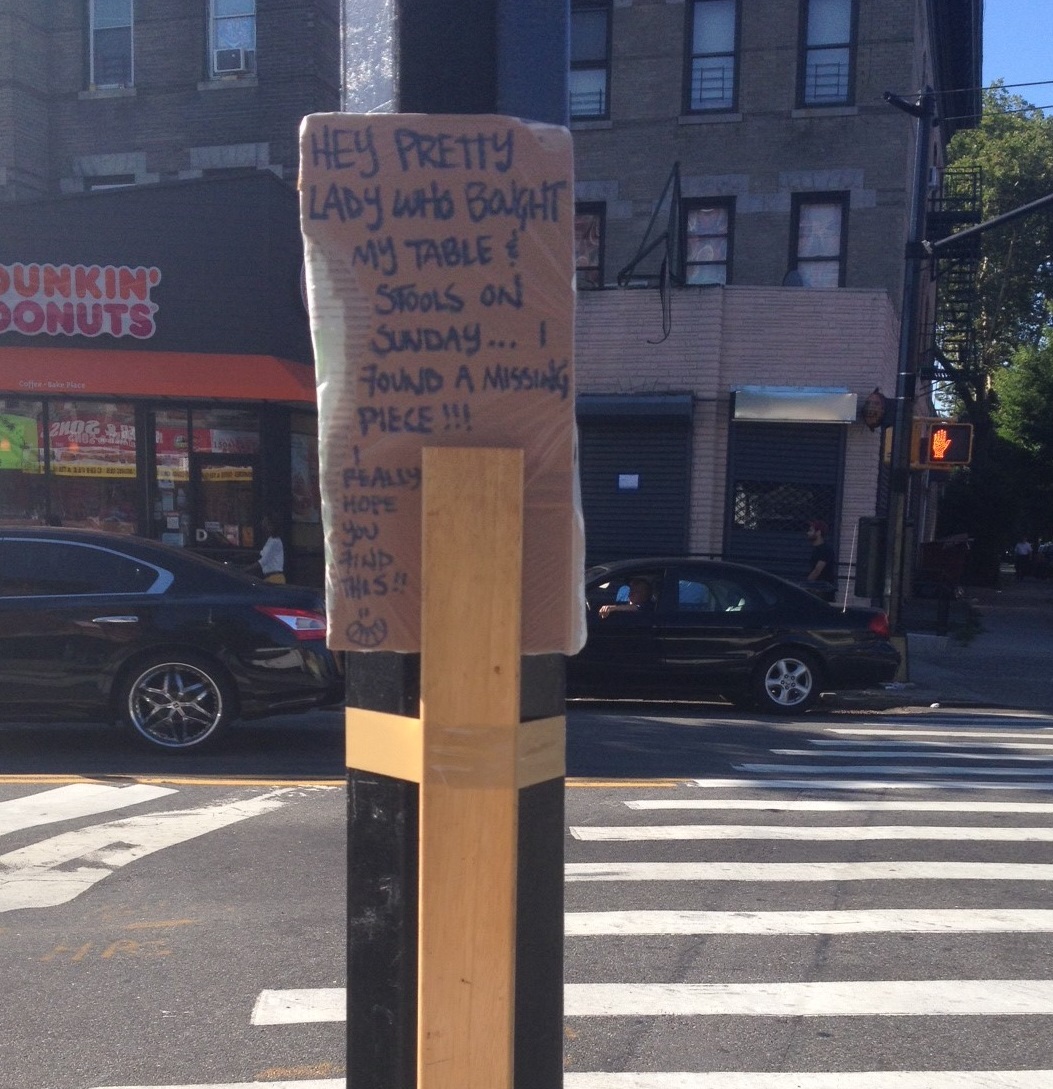
And, the other day I noticed this fabulous mystery item:

Image

What is it? It’s a single work boot with a very large rock in it that has been bound in an exceptionally complicated pattern and placed just inside the perimeter of a church yard. Art?  Binding Spell?  Symbolic Catharsis?  Joke? All of the above?  You choose.  No, I did not touch it.  No, I’ve not gone back to check on it.

And then this:

Image

The sign reads “Hey Pretty Lady who bought my table and stools on Sunday… I found a missing piece!!! I really hope you find this!!”  And yes, that is a piece of wood taped to a lamp post.  The toothy smile drawn on the sign is really the best part.

I’m going to miss this place.

Type vs Specimen

I’ve stared at this particular specimen of this particular type so much that when I came across an image of a different specimen in a book this morning part of me wanted to say oh that’s not the right image.  This can happen with famous or just easily accessible specimens of types.  The historian or student can start to think the one illustrative example IS the type.  This leads to some unfortunate readings.

Silver coin.

One of my favorite Roman historians have used the above image to argue that the Italic Bull is raping the Roman Wolf. [No, no I’m not going to give you a page reference for this.  I don’t really want to be bitchy about it.I got frustrated by my own cageyness when I came back to find the reference….]Capture.JPGI’ve even read it on student exams.  But other specimens make clear that only significant penetration on this type is an old fashioned goring with the horns:


Capture.JPG

The lesson is that unless one has seen as many specimens of a type as possible its really very dangerous to start generalizing.  A lazy die cutting can turn into a whole (sexualized!?) reading.

There are ten Flamininus specimens according to C. Botrè, “Lo statere d’oro di Tito Quinzio Flaminino: una coniazione straordinaria,” RIN 96 (1994/1995): four in museums: Athens, Berlin [??], London and Paris; and six in private hands including: WAW, 109 = Hunt I, 111, the Ley collection piece = Triton III; 30 November 1999, 815; LEU 81, 187NAC 39 (16.05.2007), 85.  His face may be fatter or thinner, rougher or smoother, hair wilder or sedate based on the specimen.  The controversy over how this image fits into Hellenistic portraiture traditions and/or Roman aesthetic conventions is not going to be resolved soon, but any discussion should be based on the examination of all possible specimens.

43 out of 410 Days: I’m liking my numbers

So first, I averaged 8.28 minutes per mile for 3 miles.  Yes, I did I fist pump at the end.  And, Yes, that’s even stopping at traffic lights.  In six weeks that’s a 50% increase in speed and my recovery time felt good too.   The other more important number was 750 words.  I put it in easily and then some.  It felt good to writing in linear fashion knowing that if I didn’t have exactly the right word for a concept I could fix it later.   I also was able to start seeing the huge number of cross references the book is going to contain.  Something I already new from my image lists and notes on what chapters they needed to be mentioned, but I really I found myself writing about a type that might end up being mentioned in every chapter.  I am opening chapter 6 on Imperators (Marius, Sulla, Pompey and co) with a contrast between M. Aemilius Scaurus cos. 115 and his son of the same name.  The former has no coins and his deeds are not commemorated on coins, even thought Cicero tells us he ruled the world with a nod of his head, by contrast his son as just an aedile brags about his own accomplishments!  The type is illustrated above.  Notice the big REX ARETAS legend on the obverse.  This is Scaurus claiming to have brought the king of the Nabataeans to his knees during his side excursion while under Pompey’s command in 62.   According to Josephus his ill advised trip to Petra left his army suffering famine and resulted in Aretas simply bribing him with some 300 silver talents to go back from whence he came. Not a very glorious deed all in all. This morning I was struck by the contrast between Aretas III’s self presentation and Scaurus’ desire to show Aretas as an outlandish foreigner (Camel, trousers, long scruffy hair):

Obverse Image

This of course plays on some Roman stereotypes and may have even created a new typology.  Compare this type of three years later (55 BC):

Reverse Image

[Who exactly Bacchius Judeaus is is a problem for another day.  Maybe Dionysius of Tripolis? Or maybe the High Priest himself?]

And yet this same monarch went farther than any other Nabataean ruler to craft a self image in line with Hellenistic standards:
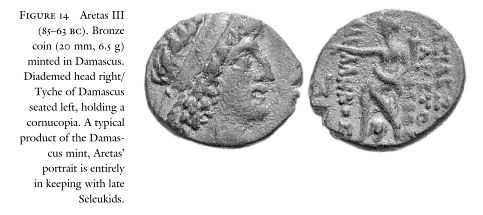
Capture

It’s not just the diadem or the tyche its the actual inscription labeling himself as a Philhellene! His successor kept Hellenistic imagery and even used a Greek regnal year, but he returns to Nabataean Aramaic to name himself and identity.  I wonder how they’ve resolved his successor’s regnal years. Is it circular? did they decide he must have taken the throne shortly after Scaurus’ campaign and thus year 26 must equal 35 BC?  Or is there an outside confirmation of this and thus we know Aretas III lost his throne shortly after Scaurus’ campaign.  I must find out…

But that’s a little off topic for the book. So back to where else does this type fit in:

First it an issue by two aediles, not regular moneyers.  Why?  Does it have to do with their games?  Scaurus lived long in the mind of Romans for the extravagance of these ludi.  Or, is it because aediles might also over see the grain supply?   Then there is sheer volume of this issue.  It would need to be part of a discussion of estimating mint outputs and possibility of correlating that with state expenditures.  And then there is the reverse with the capture of Privernum.  The should get a mention in the conquest of Italy section but the moneyer’s family connection is fanciful at best so that goes nicely with my discussion of familial legends.  Oh and it’s one of the rock solid coin types for dating as we have independent testimony regarding the issuers aedileship, meaning lots of other types are dated by relation to this one.  It’s like a book in one damn coin.

Okay.  Now that I’ve got that out of my system I’m going to go write 750 words or more for the actual book.
42 out of 410 days: Thoroughness

I picked up a set of sermons on my way out of church yesterday.  Muncie has been preaching a series on authentic living this summer.  He does a very good job of bringing nuance to the two sides, positive and negative, of PRIDE, amongst a number of other useful insights.  [Reading sermons on the subway does not, by the way, attract nearly as much attention as Roman History.]

Many vices and virtues can be equally two-faced.  Thoroughness can be a paralyzing standard for an academic endeavor and yet most necessary for the validity of the results. Chasing obscure bibliography, the fear of finding one key piece of scholarship post production, endless combing of catalogues and databases can result in rock solid peer-review worthy work, but also grind the process to a snail’s pace.  Searching a database can be easier than actually articulating words what one thinks.   I indulged in so much collection of bibliographical references over this weekend that the Inter-Library Loan Librarians must be cursing me this morning.  A disgusting number of requests were filed. In due course they will need to be incorporated into the book, or not, as the case may be, but waiting on their arrival or spending more time on the bibliography will not actually move the book forward or make the final product stronger at this point.  I’m usually a ‘measure twice, cut one’ type of writer.  Why compose a sentence until one can write the footnote that guarantees the accuracy of the statement?   This makes writing slow, nervous work.  The author of another book in the series wrote to me that he was trying to draft chapters: “very very fast (aiming at 750 words per day), in order to get something down on paper which I could edit”.  Ah editing.  Being open to self critical revision.  That is certainly a virtue I could due to cultivate.   So we’re going  to try something like that this week: just writing from the notes on file and the ideas in my head.   If this blog has proved noting else, its that I don’t suffer from a lack of words.

Oath Scenes Again.

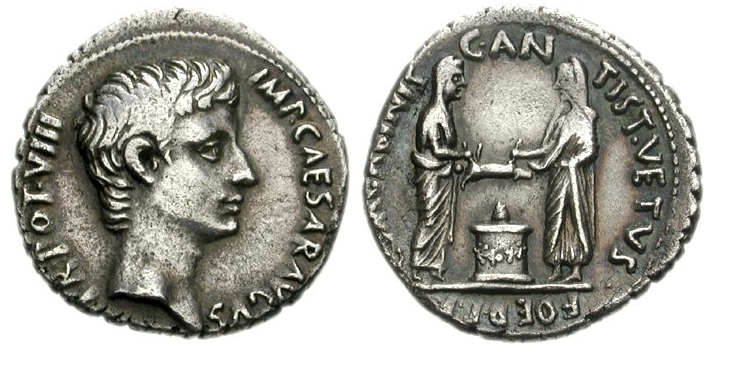
RIC I 364 (link to image on flickr)

Link to relevant types in OCRE

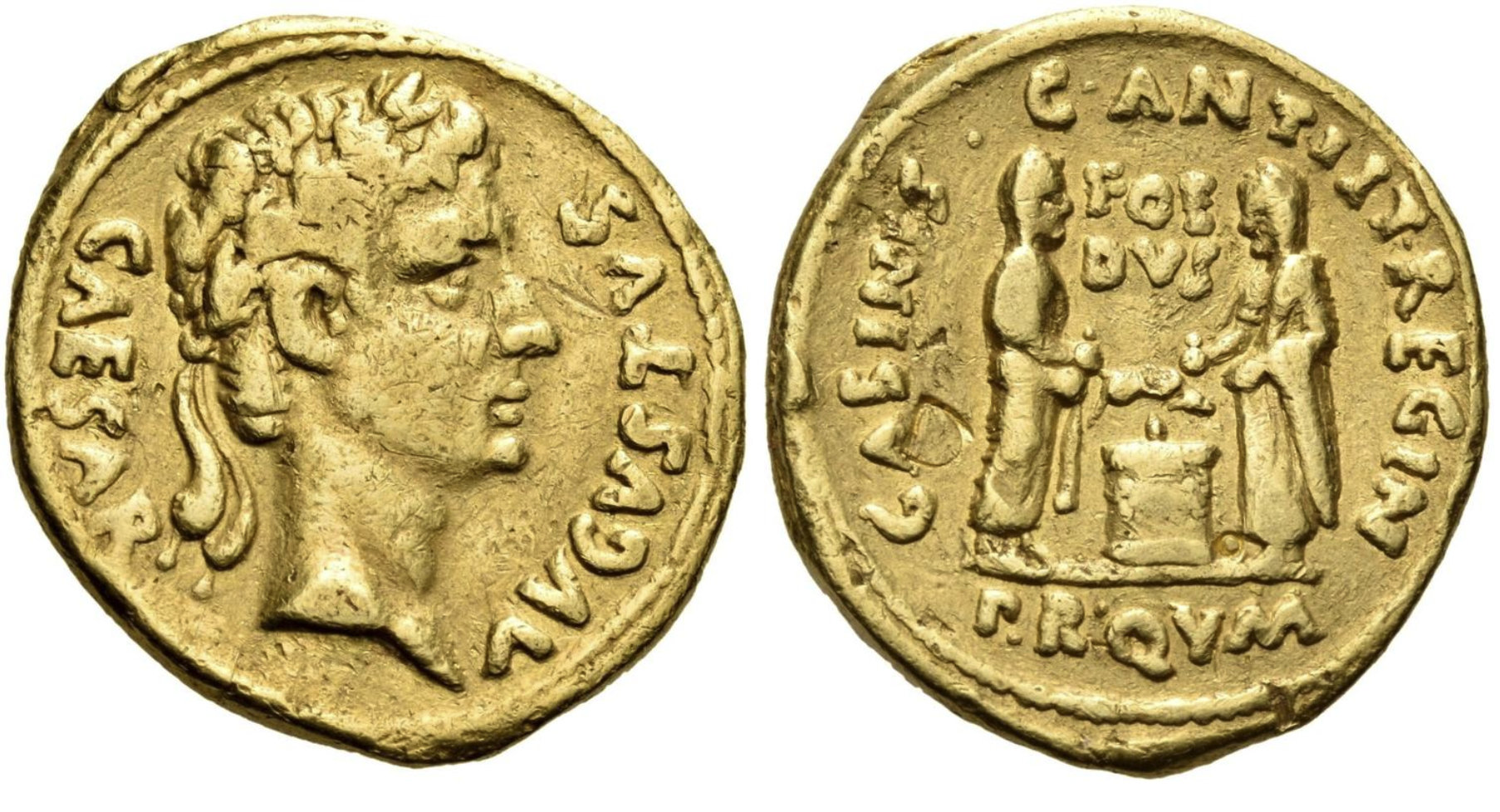
I seem to be spending too much time with imperial coins for someone writing a book on the Republic. I came across this coin in this article. It has its weak points, many of which are pointed out by this more recent piece. It too is not as complete in its treatment of the evidence as I’d like. The type above seems very likely to provide the prototype for the EETIA? type I’ve been obsessing over. Most obvious is the bare-headed obverse with the prominent ear. Second is the ‘civilian’ dress of the pig holders on the reverse, as well as the suspension of the pig. Obviously its not a perfect match. These pig holders have their heads covered as is appropriate for a Roman making a sacrifice and the altar is depicted and their outer arms are not outstretched. And,yes, the pig is upside down! The legend even tells us what we’re seeing, the Foedus Gabinum. Unfortunately, nothing about the legend, however, helps us puzzle out what is on the EETIA? coin. The type is repeated a couple years later in gold by a member of the same gens:

specimen in trade

This time Augustus is laureate. Farney gives the only really substantial discussion of these moneyers’ choice. For the background of the foedus and the role of the Antistius see Dionysius of Harlicarnassus’ account. He says the treaty still existed in his day written on the cow (not pig!) hide that was the sacrificial victim at its consecration. All in all, it is a story that paints the Tarquinii in a really awful light, with the Gabini being incorporated into the Roman power structure as a calculated and unexpected gesture of magnanimity designed to ensure their loyalty, even after being the victims of a terrible deception in which they were tricked into stoning one of their most loyal leading citizens… The story as Dionysius tells it is hardly appropriate for numismatic commemoration. R. E. A. Palmer, ‘A new fragment of Livy throws light on the Roman Postumii and Latin Gabii’, Athenaeum 78 (1990), 5-18 thought there was a different foedus in the forth century but his reading of the new fragment is rebuffed by Gabrielli. Perhaps there is new light on what the coins might mean in this newer article, but its still behind the pay wall even with my university’s subscription, so I won’t know today.

Other thematically relevant bibliography may include: Bensmann, Alexa. – Die « republikanische » Seite der augusteischen Münzprägungen : Bemerkungen zur Bildsprache der « IIIviri aere argento auro flando feriundo ». Numismatisches Nachrichtenblatt: 2008 57 (9) : 346-349 ill.

Images and some links fixed 3.6.26.

A Divine Explanation

I just ordered up via ILL a piece of German scholarship which from the abstract seems to redate some early Roman coins (aes grave with a prow and the quadrigati) and connected them with the events of 241BC. I’ll reserve judgement on that until I see the article. However, it also reminded of this portion of Ovid’s Fasti, calendar of the Roman year in poetic form:

I spoke these words to the god [sc. Janus] who holds the key.

‘Indeed I’ve learned much: but why is there a ship’s figure

On one side of the copper As, a twin shape on the other?’

‘You might have recognised me in the double-image’,

He said, ‘if length of days had not worn the coin away.

The reason for the ship is that the god of the sickle

Wandering the globe, by ship, reached the Tuscan river.

I remember how Saturn was welcomed in this land:

Driven by Jupiter from the celestial regions.

From that day the people kept the title, Saturnian,

And the land was Latium, from the god’s hiding (latente) there.

But a pious posterity stamped a ship on the coin,

To commemorate the new god’s arrival.

I myself inhabited the ground on the left

Passed by sandy Tiber’s gentle waves.

Here, where Rome is now, uncut forest thrived,

And all this was pasture for scattered cattle.

My citadel was the hill the people of this age

Call by my name, dubbing it the Janiculum.

Asses did stay in circulation for a very very long time and were minted very sporadically during the late Republic. Ovid’s Augustan age testimony provides evidence that worn base metal coins had become the norm but that the types were generally known. The prow however did not hold a particular meaning for a contemporary viewer. Ovid has the god explain that the prow commemorates Saturn’s arrival. This would have seemed plausible because Saturn was the god of the treasury, even if it is unlikely to have been the original inspiration. Crawford suggests the visual inspiration comes from this beautiful type of Antigonos Doson, c.227 BC (See RRC p. 42 esp. n. 5):

ANS link

Naval imagery first appears on Roman coins, unsurprisingly, when they become more adept as a military power. And it has even been argued that naval imagery on aes signatum commemorated the very battle in which the bronze itself was captured in the form of rams, armor, and other spoils from the Carthaginian enemies. However awareness of symbolism slips away as particular images stop resonating with contemporary audience, hence Ovid’s deduced explanation.

Images and links updated 3.6.26.

40 and 41 out of 410 days: The Dangers of Reading Roman History on the Subway

I took Rosenstein with me on my way to apply for the Turkish Visas yesterday. This drew more attention than reading porn in public.   Apparently in the age of private Kindle reading selections having a real book with a few pictures in it is an open invitation to conversation.  On my way there a nice man decided he must give me a section of the NY Times with an article about Egyptian Cats at Brooklyn Museum.  He was nervous to break the code of subway silence but couldn’t repress his desire to engage about culture.  He explained he tried to take an art history course or similar every summer.  I said I wished more people did that.  He responded fervently that the world would be a better, more humane place if they did.

On the way back, it was standing room only and I was smashed in next to a police officer, Officer O’Reilly his badge said.   He wanted to know if I was an avid reader and how he should go about becoming a reader himself.   He was bored with video games and the like.  He wanted substance.  I asked him what subjects interested him, history? science? Definitely science.  What kind of shows did he watch on television?  Did he need plot resolution?  a narrative arc?  mystery?  intensity?  I settled on recommending The Immortal Life of Henrietta Lacks.  One wasn’t good enough.  So I moved on to describing the writing style of Erik Larson.  Apparently my narration of the Devil in the White City was so gripping that a nearby junky (I know making such assumptions is less than PC, but if he wasn’t a junky, he certainly had adopted a similar aesthetic for his self-presentation.) interrupted and demand to know if I was describing the book in my hand.  I said, no, another book.  He needed all the details straight away.

I love New York.  I adore public transportation.

The visa application process was nerve wrecking I had to fill out by hand my CV including publications.  Four to eight weeks for any answers.  On the bright side, I met a nice girl going on Fulbright to paint Seljuk carpets with whom we might connect in Istanbul.  This morning I identified a coin set into jewelry for a friend of a friend.  A fun little test.  Now onto coins. SDA is away and as today is 10% of my sabbatical complete I hope to make it a good one…

And I almost forgot, my beloved is on the radio on our favorite show, Splendid Table.  Start listening at minute 36.30, if you want to skip to the good part.

39 out of 410 days: Progress not Perfection

The weather was cool.  This helped.   It helped many things.  I averaged under a 10 minute mile for 3.4 miles.  I’ve never ran that fast anywhere but a tread mill.  That is something.  

I spoke to the Turkish consulate. 6-8 weeks for the visa. Yikes.  Tomorrow will not be a coinfest, but a bureaucratic love-in.  SDA wants me to renew my driver’s license too.  

Today while trying to learn about coins and the Decii, I instead ended up back deep in the literature on the oath scene coins.  No bad thing really.  A false start on writing a narrative but a start.  I worked until after 8 pm and then made whole wheat pasta from scratch.  Just sayin’.  A pretty nice day all in all.  Oh and banking.  I spent a chunk of the morning on the phone with my bank.  I hate talking to humans.  Good thing they were nice ones.

Where in the world is Decius Mus?

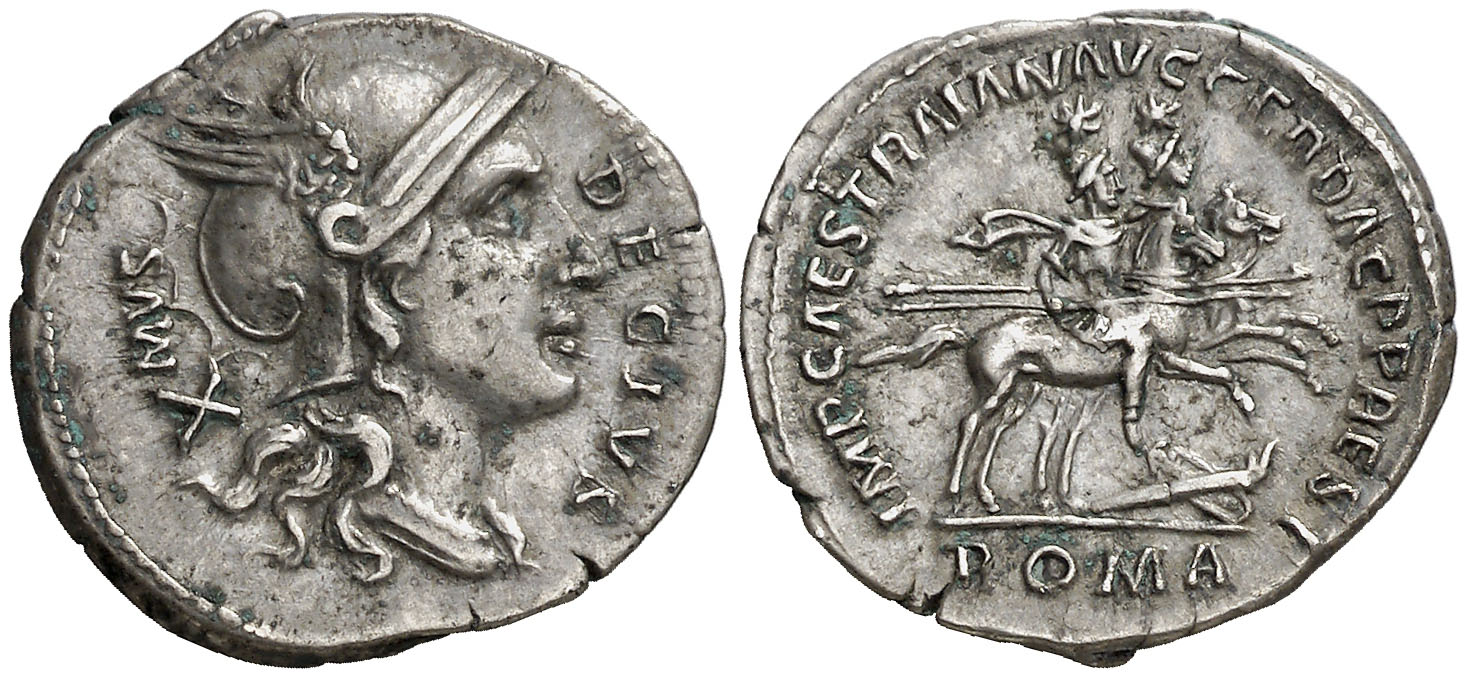
Trade specimen, RIC Trajan 766

To get inspiration for writing the book today I opened up Rosenstein’s latest, very readable, introduction to the Imperial Republic. He starts at Sentinium and how P. Decius Mus’ self-sacrifice provided a turning point in Rome’s conquest of Italy.  He and his father and his son, all bearing the same name, became a standard exempla of dedication unto death to the fatherland; Cicero mentions them thirty times in his extant works (cf. Van der Blom, p. 101).  And yet unlike so many exempla with wide communal resonance, they appear no where on the republican series that we can see.  Noteworthy by their absence.  Crawford thinks the line died out and without ancestors numismatic commemoration was unlikely.  Interestingly the lack of commemoration was so keenly felt that the Emperor Trajan made up a type to ‘restore’ in his name (see image above).  The image he chose to augment with Decius’ name is this type:

Specimen in Trade, RRC 128/1

The carnyx and shield clearly link the otherwise completely standard type with Celtic victories.  And, the Decii did engage with the Celts as well as the Samnites, but it is unlikely that Trajan has any ‘inside’ knowledge 300 years later about who made the original type.  Instead it is filling a void in the numismatic record.  The Decii deserved a coin type so the must have had one.  Did Trajan do the same for other republican heroes?   There are some modern copies for Cocles.  I’ve not see an authentic specimen yet, but two are listed in RIC so perhaps they do exist:


Capture

Images and their links updated 18 Dec 2024. Text and information left the same.