284 out of 410 days: Rostra

On themes discussed in this post, see now instead my 2021 Article.


Egadi-ram
Egadi Ram 1. Click for link to RPM Nautical Foundation information page.

I was re-reading Tusa and Royal’s ‘landscape of the naval battle at the Egadi Islands (241BC)’ JRA 2012 and it struck me how right Eric Kondratieff was to draw a parallel between the iconography of this currency bar and rostra:

Paris specimen of RRC 12/1

He made the argument for two rostra instead of two tridents on the basis of the Athlit Ram, a much more distant iconographic parallel, but that was before the Egadi Rams all came to light!  All of the Egadi Rams found thus far have a similar design on their driving center (see Tusa and Royal link above for the anatomy of the rams), but 1 provides the best visual parallel.  Given Egadi 1 has no specific provenience, it is harder to contextualize.  Tusa and Royal cautiously say:

“The clear differences in iconography, inscriptions and overall shape, combined with its unknown provenience, make an association of the Egadi 1 ram with the events of the First Punic War somewhat problematic.” (p. 45 n. 92)

And earlier they noted:

“Egadi 1 has the shortest driving center of the Egadi rams, being nearly identical in length to Egadi 5, yet has the longest tailpiece and the highest mid-length height and width. The reduction from the head to constricted waist is slightly greater than from the inlet. Given the ram’s significant increase in height from its constricted waist, it possesses the third tallest and second widest head. Its large head combined with a short driving center gives this ram a stubbier design than the others.” (p. 14)

Could it be earlier? Could it be later?  I’d speculate as to the former, but this is only a kneejerk instinct regarding the a likely general design trend from compact and short to long and thin.  Such speculation is likely unwarranted.  I could even argue against it via the ‘stubby’ appearance of the rostrum depicted on The Tomb of Cartilius Poplicola which dates to the 1st century BC (images are already up on my early post on prow stems).

William Murray, Age of Titans (2012), p. 52 gives a great illustration of a three-bladed waterline rams, just more confirmation of the rostra as the correct identification of the coin type.

Miscellaneous Post Scripts.

Another pre Egadi post Athlit publication that will be of interest to anyone interested in rams and rostra: http://luna.cas.usf.edu/~murray/actian-ram/WM-Murray-Recovering-Rams.pdf

Also on Duillus and innovations and the coinage, see Morello’s summary of his Italian publication with useful diagrams by Andrew McCabe: http://andrewmccabe.ancients.info/Corvus.html

Update 3 April 2014.

See now also my post about the rostrum on the coins of Ariminum.

277 out of 410 days: agri quaestorii and Rome’s first issue of cast bronze coins?

reverse
RRC 14/1. 358.81g. ANS 1969.83.385. Gift of E.R. Miles.

In CMRR, Crawford first uses the evidence of the Nemi finds to place the RRC 14 finds ‘no earlier than about 280’.  He then goes on: “One may speculate that the need to administer the agri quaestorii acquired in 290 (Lib. Col. 253, 17L; 349, 17 L) played a part in the decision to produce the first issue of cast bronze coinage.” (p.40-41).

To wrap my head around the plausibility of this I turned to Roselaar’s Public Land in the Roman Republic (2010).  She gives a good definition and survey of ager quaestorius (p. 121-127).  On 290 BC she says:

Image

Even if we go ahead and concede the land around Cures was sold shortly after 290, I have a hard time following the logic of how the sale of land is made easier by the creation of coinage.

The other issue muddying the waters regards agrarian issues in this period is the parallel and in precise testimony that M’. Curius Dentatus distributed land. Viris Illustribus has a good mash-up of various accounts.  First after conquering the Samnites he says in a contio  ” I took so much land that it would have become a desert, if I had not taken so many men. I took so many men that they would have starved, if I had not taken so much land.” (33.2)  Then, he gives 14 iugera of land the people (which we do not learn) and only takes so much for himself saying, “there was no one for whom this amount was not sufficient”. (33.5-6)  The latter echoes a pithy saying of his found in Plutarch, but where we are offered no context for it. Valerius Maximus says only seven iugera were given out, but also makes a moral out of the general taking no more than the rest.  Pliny has the very same nugget:

The words, too, that were uttered by Manius Curius after his triumphs and the addition of an immense extent of territory to the Roman sway, are well known: “The man must be looked upon,” said he, “as a dangerous citizen, for whom seven jugera of land are not enough;” such being the amount of land that had been allotted to the people after the expulsion of the kings.

Then at the end of the mini bio in Viris Illustribus (link above) we’re told he’s given 500 iugera by the public for his services (33.10).

And, just to add to the mix we should remember that his campaigns in the Po is said to have led to the founding of the colony of Sena which would have also included land distributions (Polybius 2.19).  The Periochae of Livy don’t have a land distribution, but do have the colonial foundation.

Cato the Elder, and Cicero after him, loved Dentatus as the epitome of the rustic Roman, military man and farmer, happy to conquer everyone in sight and still eat a simple stew from a wooden bowl. [Cincinnatus, anyone!?] The literary sources care FAR more about the bon mot than the distribution.  I don’t think we can nail down a context for it.

Thus, I think this is just a fun rabbit hole with very little promise for finding a context for the aes grave.

That’s not to say Dentatus is completely useless to us when we’re thinking about early contexts for making coins:

6. in the four hundred and eighty-first year from the founding of the City, Manius Curius Dentatus, who held the censorship with Lucius Papirius Cursor, contracted to have the waters of what is now called Old Anio brought into the City, with the proceeds of the booty captured from Pyrrhus. This was in the second consulship of Spurius Carvilius and Lucius Papirius. Then two years later the question of completing the aqueduct was discussed in the Senate on the motion of the praetor. At the close of the discussion, Curius, who had let the original contract, and Fulvius Flaccus were appointed by decree of the Senate as a board of two to bring in the water. Within five days of the time he had been appointed, one of the two commissioners, Curius, died; thus the credit of achieving the work rested with Flaccus. The intake of Old Anio is above Tibur at the twentieth milestone outside the* Gate, where it gives a part of its water to supply the Tiburtines. Owing to the exigence of elevation, its conduit has a length of •43,000 paces. Of this, the channel runs underground for •42,779 paces, while there are above ground. substructures for •221 paces.

I’d not like to connect this aqueduct to any one issue but like the construction of Via Appia, big infrastructure projects and the establishment of colonies are easier if the state has an easy means of making payments.

Map of the course of the Aqua Anio Vetus

269 out of 410 days: Do you believe the pig story?

Update:  This old blog post eventually led to a journal article.

“#NotAllElephants (Are Pyrrhic): Finding a Plausible Context for RRC 9/1” Ancient Numismatics 2 (2021), pp. 9-42. DOI: 10.19272/202114401001Unformated text and images with indication of page number in print text.

There comes a day in every young numismatist’s life when he or she asks the question is the pig story true?   Did the anyone, let alone the Romans, ever use pigs in battle against elephants?  Would it work?   And if it worked wouldn’t everyone have used it?  Fighting elephants was certainly the opposite of fun.

First off, let’s throw out the idea of Roman flaming pigs (regardless of what the video games offer you as options).  That is bad scholarship at least when it comes to the Roman account.  Here’s some of that bad scholarship (p. 87ff) and another one (p. 202). Don’t believe everything you read it books, even books with footnotes.  Lamentably, or admirably, Wikipedia is actually far better at reviewing the sources, than apparently some university presses.  Here’s the War Pig entry.

So why do numismatists think that pigs and elephants should date the above currency bar to the Pyrrhic War? Because of these two sentences in Aelian (on the nature of animals, 1.38):

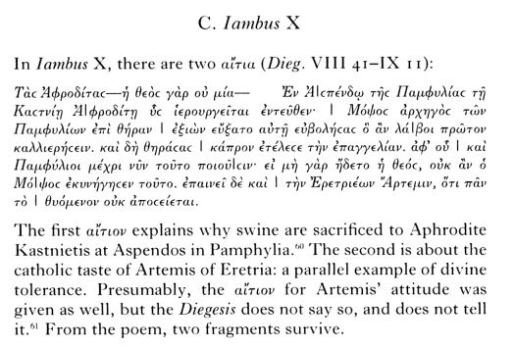
 Ὀρρωδεῖ ὁ ἐλέφας κεράστην κριὸν καὶ χοίρου βοήν. οὕτω τοι, φασί, καὶ Ῥωμαῖοι τοὺς σὺν Πύρρῳ τῷ Ἠπειρώτῃ ἐτρέψαντο ἐλέφαντας, καὶ ἡ νίκη σὺν τοῖς Ῥωμαίοις λαμπρῶς ἐγένετο.

Ariete cornuto et suis grunnitu abhorret elephas. Sic Romanos Pyrrhi Epirotarum regis elephantos in fugam vertisse dicunt, victoriamque amplam ex eo bello retulisse.

The elephant fears the horned ram and the grunting of a pig. Thus, the Romans are said to have routed the elephants of Pyrrhus, king of the Epirotes and brought about brilliant victory for themselves.

I put up the Latin as that’s more readily available online for those who want to check out context. My translation is based on the Greek (not that it makes a huge difference).

This is not great historical evidence. And everyone gets so hung up on the pigs that they ignore the mention of rams completely. Aelian followed Pliny and other writers for most of his little anecdotes.  Pliny has squealing pigs and elephants, but no Pyrrhus. Let’s put this in context: Pliny is also our earliest source for elephants being afraid of mice.  And common on, did you really need a Mythbusters episode to debunk that?

The whole thing sounds like some marvelous tale.  And in fact it’s found in the some of the Alexander Romances:

Image

The ‘secret’ of the elephant’s fear of a pig is attributed to Porus, the Indian King.

There is a better attested version of the elephant and pig story in Hellenistic history, but no Romans in sight.  Again, our sources are late and known for being magpies of wonderful tales:

 At the siege of Megara, Antigonus brought his elephants into the attack; but the Megarians daubed some swine with pitch, set fire to it, and let them loose among the elephants. The pigs grunted and shrieked under the torture of the fire, and sprang forwards as hard as they could among the elephants, who broke their ranks in confusion and fright, and ran off in different directions. From this time onwards, Antigonus ordered the Indians, when they trained up their elephants, to bring up swine among them; so that the elephants might thus become accustomed to the sight of them, and to their noise.

Aelian knew this story too (Latin trans.).

If it weren’t for the currency bar I’d throw the whole story out.  Dionysius offers some perfectly plausible accounts of the Roman tactics against elephants in the Pyrrhic War:

Outside the line they stationed the light-armed troops and the waggons, three hundred in number, which they had got ready for the battle against the elephants. These waggons had upright beams on which were mounted movable traverse poles that could be swung round as quick as thought in any direction one might wish, and on the ends of the poles there were either tridents or swordlike spikes or scythes all of iron; or again they had cranes that hurled down heavy grappling-irons. 7 Many of the poles had attached to them and projecting in front of the waggons fire-bearing grapnels wrapped in tow that had been liberally daubed with pitch, which men standing on the waggons were to set afire as soon as they came near the elephants and then rain blows with them upon the trunks and faces of the beasts. Furthermore, standing on the waggons, which were four-wheeled, were many also of the light-armed troops — bowmen, hurlers of stones and slingers who threw iron caltrops; and on the ground beside the waggons there were still more men.

When Pyrrhus and those with him had ascended along with the elephants, and the Romans became aware of it, they wounded an elephant cub, which caused great confusion and flight among the Greeks. The Romans killed two elephants, and hemming eight others in a place that had no outlet, took them alive when the Indian mahouts surrendered them; and they wrought great slaughter among the soldiers.

Elephants left a big impression on the Roman mind.  Of this there is no doubt.  But if pigs worked so well why not use it as a tactic elsewhere?

I find myself asking myself about the provenance of the BM specimen (acquired 1867 from the Sambon Collection).  Are there other specimens of this type of currency bar?  Are there more of them? Any with a decent archaeological provenance?  Is it all just to good to be true?

268 out of 410 days: South Italian Digital Archive

I was worrying about the conflicting testimony in Livy and Diodorus over Cleonymus of Sparta’s Italian adventures.  Oakley has a good overview of the problem but there is more that can be said on the historiographical side. Barnes also has a take on the matter.

Amongst other things is a place called Thuriae, not Thurii mind you, that features in Livy’s narrative:

During the year a fleet of Greek ships under the command of the Lacedaemonian Cleonymus sailed to the shores of Italy and captured the city of Thuriae in the Sallentine country. The consul, Aemilius, was sent to meet this enemy, and in one battle he routed him and drove him to his ships. Thuriae was restored to its former inhabitants, and peace was established in the Sallentine territory.

[In case you’re wondering, the Sallentine territory or peninsula is the heel of Italy’s boot.]

This little mystery led to finding this 1932 publication that suggests it is the same as Turi, outside of Bari.

The interesting thing about this publication is how it ended up on the web.  The provincial administration of Brindisi seems to have decided in 2012 to scan and archive online pretty much every last regional publication.  Here’s the announcement.  There is as far as I can find no easy portal for searching through all the old newspapers and journals to find the relevant bits, but the archive is hiding lots of numismatic tidbits.   For instance, here’s the publication of the Salvatore Hoard.

The best I’ve found to mine its depths is to use Google site search.  Just go to the google homepage and enter a likely term in Italian, say ‘didramma’, and then ‘site:emeroteca.provincia.brindisi.it’.  Leave off the quotes.

Postscript.  I just don’t think the Cleonymus of Polyaenus’s Stratagems is the same character.  It’s just too early a date for the Romans to control Apollonia and Epidamnus.

267 out of 410 days: Mapping Mints and Other Things

Image

Mapping functionality is being increasingly incorporated into digital numismatic publications.  The flash maps of the provincial mints were pretty hot stuff when they first came out on the RPC IV website about 8 years ago.  They still look pretty good if you ask me.  The ANS has started putting maps into most of its sites, the most impressive being the map feature of CHRR online.  But sometimes you want more than one point plotted on a map and you want to choose yourself which points are plotted.  I was pretty happy with the functionality of AWMC: À-la-carte map.  I think my internet speed (DSL) made it a bit clunky or maybe it’s the new Turkish internet security initiatives slowing things down.  That said, still worth it.  My first simple test (featured above) was to put on a map the mints that produced coins that are hoarded with RRC 13/1. I couldn’t get Cumae on the map at this magnification and use full name labels.  It’s label and that of Neapolis overlapped.  It however does let you custom label points or just number each point to stop the overlap feature.   I then just used the snipping tool (like a screen shot) to grab the portion of the map I wanted.

I suspect this mapping program is going to figure heavily in my lesson plans in future semesters.

For modern locations, such as find spots, there are a number of websites, Multiplottr is simple enough. [Why, oh why, has it become cute to name websites leaving out the last ‘e’?!]  Here are the results from plotting, S. Giovanni Ionico, Torchiarolo, Oppido Lucano, Mesagne, Valesio, and ‘Campania’.  Not publication worthy but certainly good enough to think with.  Very fast and easy to edit.

Capture

Crimean History in the News

There is a lot in the news right now about the Crimean War.  Where was Sevastopol?  Of course, I know about Florence Nightingale.  The Charge of The Light Brigade sounds familiar…   The major newspapers are helping us catch up on our snoozing in high school history class.  (Assuming we went to the sort of high school that taught such things.)   The Economic Times wants you to remember the Indian connection. The New York Times reminds us its all about how you tell the story, starting out with a reference to Tolstoy and filled with prosaic quotes from modern residents.  The Telegraph showcases the pictures of Roger Fenton, only occasionally addressing the issue of “staging”.

Oddly there isn’t much about the Ottoman Empire or the first Annexation of the Crimea in these popular histories, newsified accounts.  So just to add another perspective, let’s round up a few commemorative medallions.

Image courtesy of CNG. Auction 88, Lot 2017. RUSSIA, Empire. Ekaterina II Velikaya (the Great), with Abdülhamid I. 1762-1796. Tin Medal (43mm, 16.75 g, 12h). Commemorating the Treaty of Malka-Kaynardzha (Küçük Kaynarca). Dated 1774.

The catalogue entry reads:

The Russo-Turkish War of 1768-1774 grew out of the internal strife in Poland, during which Russia was a supporter of King Stanislaus Augustus. During a pursuit of a Polish Bar Confederation (force of nobility) into Ottoman territory, a group of Cossacks in Russian service allegedly involved some subjects of the town in their rampage, inciting the Ottoman Empire into action against Russia. Ultimately, however, the latter’s dominance of the seas provided her numerous victories in the conflict. With the Treaty of Malka-Kaynardzha (Küçük Kaynarca), Russia received the unofficial governance of the Crimean Khanate, a large sum of war reparations, and two important seaports allowing direct access to the Black Sea.

The obverse legend translates as “two hands bring an end to the turmoil”.

4345 Catherine II Rossia 1783 Annexation of Crimea and Taman Medal Bronze
SHH 4345
Catherine II The Great / Map of Crimea, Sea of Azof and Taman
Annexation of Crimea and Taman Bronze 83 Россия 1783/1792 Diakov 196; Moneta 60, 162 (Follow link for image source.)

Here I have to rely on the ANS translation of the legends of a similar medal:

Obverse: [In Russian]: BY THE GRACE OF GOD CATHERINE II EMPRESS AND ALL-RUSSIAN AUTOCRAT – Shoulder-length portrait of Catherine II, crowned, laureated, and armored, r.
Reverse: [In Russian,on banderole]: THE RESULT OF PEACE/in ex: ANNEXED TO THE RUSSIAN/EMPIRE WITHOUT BLOODSHED/APRIL8/1783 – Maps of Kuban’ and Crimean steppe and peninsula with Asof and Black sea
Anyway.  The next time someone brings up the Crimean War as an analogy for the present situation, you might just ask if they don’t think the events of the 1770s and 1780s might not just be a bit more relevant.
What’s Greco-Roman about this?  Oh we could talk about alliance coinages or other such things, but really it’s here just because I like a bit of history.  If you are jonesing for something classically themed, I offer this British beauty:
Capture
The discussion offered by Fitzwilliam website is quite good (click image for link).  Link and image broke. New image from British Museum.
And if you need just a little more propaganda:
Capture
Obverse: THE HOLY ALLIANCE LA SAINTE ALLIANCE – British and French soldiers standing before drum cannons
Reverse: ENGLAND AND FRANCE UNITED TO DEFEND THE OPPRESSED AND AVENGE INSULTED EUROPE
My favorite detail of this last piece is that is from a design by Punch Magazine!
Postscript 13 March 2014: Here’s a newspaper piece which is alive to the legacy of the Ottoman presence in the region.  No surprise its from the English version of a Turkish paper.

Putting a Face with a Name

Image


The festschrift for Barclay Head is in the public domain and fully (beautifully) digitized!  What a fabulous portrait.  We should all do so well as to appear so dapper for history.

This provides us with an image of RRC 2/1 that’s wholly in the public domain:


Image


Both Crawford’s image (see last post for link) and this one are taken from casts.  I’m not sure they are the same cast.  Regardless the plate itself is a nice sharp image one can zoom in on. Click on the photo for the link.

Here’s the link to the specific discussion of the type in the festschrift.

I note that Gàbrici gives the weight as 10.15, whereas Crawford as 6.14g.

260 out of 410 days: Profile versus 3/4s Profile

Above: Detail from Athenian red-figure clay vase, about 475-425 BC. Paris Musée du Louvre G365 © Musée du Louvre [Image links to Beazley archive]

I’m not worrying about the image above, I just think it is a pretty picture and one that can help students enter the iconographic and narrative thought world in which man-faced bull coinage was stuck.  

I am worrying about the dating of RRC 2/1: Thurian-style Athena obverse, full man-faced bull, walking right in profile, star above.  An image of which can be found on Molinari’s website, here.  Scroll down to #355, clicking on it provides a better resolution.  There is only one known specimen.  I’ve talked about how problematic that can before, twice in fact it seems.

I was adding a note in my current chapter draft about HN Italy 753 being the prototype for the reverse of  this first ROMANO coin (so HN Italy says), and decided to have another scroll through Molinari’s collection of Neapolis man-faced bull images (MFB hereafter). The thing is that even though HN Italy 753 has an eight-rayed star above the MFB on some specimens, the MFB has a 3/4 profile head. A similar 3/4 profile head is found on all  the full-bodied MFBs on bronzes of Neapolis, as far as I can tell.  [Other images are available via Luigi Graziano’s project].

Whoever carved the dies for RRC 2/1 was more familiar with a MFB in profile, rather than in 3/4s profile.  That makes it seem rather unlikely to me that he was looking at a bronze of Neapolis, let alone was also someone engraving dies for the Neapolis mint.  

I suspect somewhere in Molinari’s great collection of images one could find a better possible parallel, say something like the Hyira silver coins.  Obviously no star and wrong placement of ethnic, but overall a better ‘model’.  Crawford sees a sea-horse/sea monster/pistrix or whatever you want to call it on Athena’s helmet.  That might be another point when comparison shopping.

Obviously dating based on iconographic models is problematic anyway.  We need a few good hoards.  But don’t we always.

***

Update 8/27/14:  My thinking on this has developed a bit. See this more recent post.

What aid did Ptolemy render to Pyrrhus?

Update 15 April 2025. I see people have been reading this post. Please note that the Mars Eagle Roman gold shows no evidence of Ptolemaic origins. See now Suspene, AVREVS.

Gold stater, Taras, c. 280 BC. ANS 1997.9.159. Vlasto 35. HN Italy 983.

There is a tight series of gold issues from Pyrrhus’ arrival in Tarentum (HN Italy 983-992).  They share common controlmarks and are signed by the same magistrates.   A variety of denominations are known: stater, 1/2 stater, 1/4, 1/3, 1/8, 1/10, 1/12, and 1/16.  A variety of dieties appear on the obverse, Zeus, Apollo, Athena, Heracles.  The reverses types include a biga, a dolphin rider,  a biga of dolphins, an owl, and on three denominations an eagle, such as that illustrated above.

This eagle bears much in common with an eagle to appear at the end of the century on Roman gold:

RRC 44/3. ANS 1967.153.4.

Here is a link to a variety of illustrated specimens of the Roman issue. When writing about this issue Meadows has made a very strong case that the iconography reflects Ptolemaic support.  I give only a little quote here (1998: 128):

Image

Could it mean the same thing at Tarentum?  I think it very likely indeed.  Hammond 1988 makes a strong case that the Ptolemy that sent military aid to Pyrrhus for his campaign in Italy was Philadelphus base on this portion of Justin:

11 Nor was Pyrrhus of Epirus neglected by him, a king who would be of great assistance to whichsoever side he attached himself, 12 and who, while he desired to spoil them one by one, sought the favour of all. 13 On going to assist the Tarentines, therefore, against the Romans, he desired of Antigonus the loan of vessels to transport his army into Italy; of Antiochus, who was better provided with wealth than with men, a sum of money; and of Ptolemaeus, some troops of Macedonian soldiers. 14 Ptolemaeus, who had no excuse for holding back for want of forces, supplied him with five thousand infantry, four thousand cavalry, and fifty elephants, but for not more than two years’ service. 15 In return for this favour, Pyrrhus, after marrying the daughter of Ptolemaeus, appointed him guardian of his kingdom in his absence; lest, on carrying the flower of his army into Italy, he should leave his dominions a prey to his enemies.

The relationship between Ptolemy II and Pyrrhus has been documented at more length by Adams 2008.

The numismatic evidence strengthens the claims of both Hammond and Adams AND suggests that it was far more than troops and elephants that Ptolemy II sent to Italy.

Update 4/6/2014: I was very happy to read this paragraph in  2013 paper supporting a Pyrrhic dating for the eagle type at Taras on the silver.[Image links to full paper.]

Capture HN Italy 933


Postscript 5 March 2014.  If one is worrying about the use of the ‘Ptolemaic’ eagle in Italy, then this type of Larinum (c. 210-175, HN Italy 626) should also be thrown into the mix.  Inspired by the Roman gold in all likelihood:

Reverse of Bronze triens, Larinum. ANS 1944.100.2090.

I’ve discussed coins of Larinum from this period before, here.  And of course there is RRC 23/1.

Update 11 March 2014: Just a note to self.  Consider also the coinage of Alba Fucens, Latin colony of 303 BC.  HN Italy identifies three types, all silver obols (241, 243, and 244) that have Athena in a Corinthian helmet and an eagle on a thunderbolt, dating to c. 280-275.  Crawford CMRR p. 47 sees the issue and those of Norba and Signia as likely struck to pay troops in the War against Pyrrhus.

Silver obol, Alba Fucens. ANS 1944.100.2059. SNG ANS.1.112.

The Stazio and Mertens’  literature is on order from ILL. The Italian Wikipedia has an article on the Monetaziono di Alba Fucens. There is an odd specimen in trade that I’d like to understand what’s going on with the mark behind the eagle better, looks like a fillet or maybe a striking artifact of some kind, image #1 and image #2.  Also see HN Italy p. 11 and 180 for a little discussion of how the eagle and fulmen have been interpreted as symbols of Alexander the Molossian.  I’d like to learn more about this coin type as well sometime.  It’s a small bronze (Athena, Attic Helmet/close winged eagle and MOΛOΣΣΩN).    

Update 5/26/14:

The scholar who seems to be most actively writing about Eagles on Coins in Italy is Carroccio.  Most of his relevant papers are online with obvious titles, but the note the issue also comes up in his 2008 piece on Moneta Apula… also online on academia.edu.