
Category: Uncategorized
That As of Ariminum
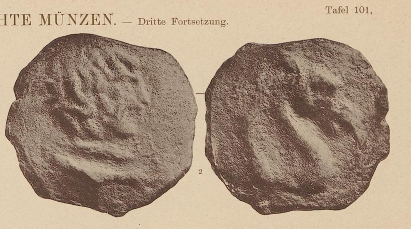
I only knew this specimen from drawing and now I find a photo of a cast in Haberlin’s ‘false friends’ plates! Pesaro, 340.2g.
Update 1.26.22:
Here’s the earliest record of this coin I have found thus far. Clearly same specimen. Were they actively forging these objects in 1767?!

Vulci (CHRR 10)
In 1842 the excavator, Fossati, wrote to Gennarelli a detailed description of his discovery of the Vulci hoard with its fragments of a bull-bull bar and a cock-rostra bar. This includes a description of its proximity to the bridge and the jar in which it was found. Thankfully for us Gennarelli published that letter.
Excellent photos of La Bruna (CHRR 16) bars acquired by Berlin as well as some superb etching of other aes grave can be found in Dressel 1894.
Machine translation:
“Since Your Lordship has courteously requested that I recount to you in writing the details of the discovery I made—at the site of Vulci—of a hoard of archaic bronze coinage, I hereby set forth the entire matter truthfully. I myself directed the excavations at Camposcala—an undertaking in which I was partnered with Candelori and Campanari—and I commenced operations within the necropolis of Vulci; this took place during the first month of the works, spanning from October to November 1828. To the east-southeast of the city—quite close to the Ponte alla Badia, an intact and archaic structure—I stumbled upon a find situated five palmi beneath the soil; from the excavation trench, I extracted a rough, medium-sized olla (earthen jar), standing in isolation from other objects and filled entirely with bronzes. These bronzes consisted partly of pieces weighing as much as dupondii or tripondii—shaped like rectangular prisms, some of which were fragmentary—and partly of fractional units of the as (the standard bronze weight), shaped like flattened ellipses, the majority of which were sextantes. Finally, constituting about one-sixth of the total hoard, there were cast bronze cubes—highly porous, bearing no markings or stamps, and heavily corroded by verdigris—ranging in weight across two or three modules, from the ounce up to the pound. Such was the abundance of ancient objects that I was bringing to light—especially during those initial stages—and so great was the burden of properly managing and supervising such a massive undertaking, that in the official report submitted to the Camerlengato regarding the aforementioned aes grave, I did not provide any greater level of minute detail than I was accustomed to doing when merely listing painted vases; I therefore furnished only a brief summary of the find. Once I had arranged for all the objects discovered during that first month to be transported to Rome and deposited at the Palazzo Candelori—a shipment comprising bronzes and painted Tyrrhenian vases sufficient to fill two four-horse wagon-loads—Cardinal Galeffi and his associates arranged for, and subsequently executed, the acquisition of the entire collection. …owners, for the price of 4,500 scudi.
The small yet intriguing hoard of which I speak was on public display for several weeks; its existence is attested in the archives of the Camerlengato by two inventory entries. This little treasure from Vulci clearly demonstrates that the form of the aes rude was variable and its weight indeterminate—its true value being established only upon the scales. Consequently, Forcellini’s definition proves inaccurate and requires correction: “The aes rude consisted of a copper plate weighing several pounds—oblong, unpolished, and rough—marked with as many bosses (globuli) as it weighed in pounds.” For the artifact cited by him—the Passeri monument—is not, strictly speaking, aes rude, but rather aes signatum.
However, when left to the discretion of private individuals, the aes rude inevitably gave rise to serious abuses, both regarding the accuracy of the standard and the purity of the metal. This led to the emergence of aes signatum—stamped currency—which, even more effectively than the formless ingots, came to take the place of livestock herds—that is to say, of the ancient form of pecunia (wealth). Hence, the wealthy were referred to as locupletes and pecuniosi—terms intended to denote the vastness of their landholdings and the multitude of their herds (i); indeed, in ancient times, fines were often levied in the form of such livestock. Following its sale to our government, the hoard was transferred to the Vatican Museum. It was at this time that Durcau de la Malle and I first became acquainted. He had already been engaged for some time in gathering data for a statistical survey of ancient Rome—a work that has since been published. While traveling together along the Via Aurelia and discussing the aforementioned hoard, I shared with him a conjecture of mine regarding its nature—a hypothesis I later reiterated and confirmed to him at his home in Paris. I now commit this same conjecture to the pages of this journal, confident that you, Sir, will see fit to publish it and submit it to scholarly discussion. First, I reiterate that the olla (earthen jar) contained nothing but bronze artifacts. The types—which I distinctly recall identifying as multiples of the as—consisted of a full-figure ox… …trident. Since, in our current investigation into the date of the deposit—and the nature of a portion of that deposit—we must prioritize the probable over the improbable, we are compelled to accept the hypothesis that the bronzes were placed inside the olla at a time so remote from our own that the aes [bronze currency] in that region was still cast rather than reduced in weight, angular in shape, and bearing only the simplest of designs. This era is precisely the one that immediately followed the initial phase, during which the Italic peoples utilized a similar form of currency, albeit one entirely devoid of any specific imagery or “type.” Such a rudimentary stage of artistic development is explicitly recounted by Pliny in the context of the Romans; yet, by virtue of the natural analogy governing the origins and evolution of human societies—an analogy that holds particularly true among neighboring lands sharing similar institutions—this observation may be extended, without fear of undue boldness, to the other Italic peoples as well. Furthermore, just as the subsequent transition—from the heavy, cast, and marked aes grave to the lighter, struck, and marked coinage—did not serve to exclude the preceding form (namely, the second phase) from commercial circulation, so too must we conclude—by necessary deduction—that this second category of currency did not, in turn, displace the very first category: that of a specific weight and regular shape, yet entirely devoid of any stamped imagery. Having thus discovered within the olla a collection of objects—assembled with equal care—comprising both cubical bronze ingots of various dimensions (devoid of imagery) and rectangular ingots bearing specific designs, we are led to the conclusion that this assemblage constitutes the very first tangible example of the Italic aes rude—the earliest form of currency fashioned from this metal. It appears that the cube was favored over other solid geometric forms because it was held sacred to Hermes, and because its dimensions and weight were more easily determined and standardized. As for the original placement of the olla itself, the most plausible hypothesis suggests that it served as an ancient votive deposit, entirely unrelated to any funerary context; nevertheless, one cannot entirely rule out the possibility that it was originally interred within a burial mound—for both in the vicinity of Vulci, and further afield in the Sabine territory near Sommavilla (where I myself have conducted successful excavations), it is by no means uncommon—particularly when the site in question… …slope), and the passage of time—along with the plow, which for so long has tormented the backs of these tombs—have meant that rains and winds have loosened and partially dissipated almost the entire upper structure of these hypogea; consequently, their floor level now lies merely a few spans beneath the surface of the ground. I must add, however—and I do so with candor—that throughout the many years I have spent conducting excavations and investigating Etruscan tombs, only once did I chance upon Roman aes unciale coins within an intact burial chamber: specifically, in a tomb situated to the left of—and in close proximity to—the celebrated Grotta del Cardinale (still adorned with frescoes to this day), located atop the ridge between Tarquinia and the sea. I remain deeply indebted to you, and I offer you my respectful salutations.
Milziade Fossati
Roman Names 101
I was asked if I could recommend an overview of how Roman names work. This is a type of lecture I give every semester sometimes multiple times, but I realized I don’t have a standard write-up of the framework to recommend. Writing up the basics in plain English seems like a good idea, as maybe I could then use that class time for something more interesting.
Greek naming conventions tended to involve a personal name (typically the same as one’s paternal grandfather) followed by an indication of who your father was and maybe where you lived to distinguish you from others with the same name. Greeks thought Romans were bizarre for having three names rather than one and sometimes had a hard time distinguishing which of the three names was the ‘right’ one to identify an individual.
Let’s run through some examples so unlike the Greeks we can know what is going on
Marcus Tullius Cicero
Marcus is the praenomen, or first name. This is typically the same as one’s father, or if one is a younger son, then the same as another male kin. If your older brother dies you might even take his praenomen to preserve its use in your generation. Branches of families rarely used more than two or three praenomina. This is the name your parents and close friends would call you in intimate situations. It is the closest thing a Roman has to a personal name. The Romans have very few common praenomina. Because of this they tend to be abbreviated. These abbreviations also preserve archaic letter forms in some cases: M.= Marcus, but M’. = a five stroke M = Manius, and C. = Gaius because Cs and Gs were historically the same letter. Many families uses the same few common praenomen, but a few families had special praenomen of their very own, the most famous being Appius (Ap.) among the Claudii.
Tullius is the nomen, or clan (gens) name. This is the biggest family unit. All the daughters of the men with in the same gens all had the same name, Tullia. Yes this was confusing and led to the use in the families of nicknames often reflecting birth order (e.g. Prima, Secunda, Tertia), or sometimes just terms of endearment (e.g. Tulliola). More on women and names below.
Cicero is the cognomen, or familial branch name. Not all Roman citizens have a cognomen. A famous example of a Roman citizen with only two names would be C. Marius. Cognomen often use terms to describe physical or personal characteristics. Cicero means chickpea. Balbus means stammerer. Caecus means blind. However, they are inherited on the paternal line and we can sometimes know when a cognomen was adopted by a specific historical individual and a new branch of the family begun using that name to mark the descendants of that individual, but usually we cannot. The main function of the cognomen is to distinguish family lines within a gens.
A lot of other information can appear in and around the Roman naming conventions:
M. Tullius f. M. n. M. Cor. Cicero Imperator
f. M. is the filiation of the individual. It expands in this instance to filius Marci, ‘son of Marcus’.
n. M. is a rarer inclusion but is used when an individual wished to indicate their paternal grandfather. Here it expand to nepos Marci, ‘grandson of Marcus’.
Cor. is the abbreviation of a tribus (tribe) and indicates the division in which one voted in certain assemblies. Enrollment in a tribe is inherited and established and confirmed in the census. Through out most of the historical period of the Roman Republic there were 35 tribes each with their own three letter abbreviation and originally correlating to geographical regions, but as families moved they did not change tribe.
Imperator is an title. All such titles go at the end of the name, not the beginning. When in the imperial period Imperator appears a the front of the name it is itself a praenomen, not a title.
Let’s look at a few other instances to observe other Roman naming features.
Publius Cornelius Scipio Africanus Aemilianus
Publius is the Praenomen, Cornelius the Nomen (gens), and Scipio the Cognomen. So far so good. But let’s remember that Publius was born the son of L. Aemilius Paullus conqueror of Macedon in 168 BCE. His biological father had him adopted by the son of Publius Cornelius Scipio Africanus, the dude who defeated Hannibal at Zama. Divorce was relatively common in Roman society so while marriage alliances between families could establish political alliances, giving a son in adoption created an even stronger (almost unbreakable) bond between families. Publius remained on intimate terms with his biological father and his birth family is preserved in his name by the inclusion of his original gens plus -an as another cognomen. This is why we sometimes call Caesar’s heir the former Octavius and future Augustus, Octavianus, even though he never used that name himself.
Africanus is sometimes called a agnomen, or honorific name. This type of cognomen can also be passed down to one’s sons after it is earned, typically through military victory and then triumph. But other agnomens exist like, Pius (the pious one), which is typically earned by extraordinary dedication to one’s father. Or Torquatus, referring to a famous instance of single combat in which the original individual who earned the name slew a Gaul and took the torque from his neck.
Thus far we’ve looked at elite male names. What about everyone else?
M. Tullius l. M. Tiro
This is the name after manumission of Cicero’s secretary. Tiro is his slave name. He retains this as a cognomen. He has no filiation (cf. Orlando Patterson and the idea that enslavement entail natal alienation). Instead, his ex-enslaver (dominus = master, lord), becomes his patronus (patron = father-like figure), and his status as a formerly enslaved person is worked into his name by the inclusion of patron’s praenomen. l. M. = libertus Marci, Marcus’ freedman. Notice he is given his ex enslaver’s praenomen and nomen (gens). Remember that familia in the Roman sense of family includes the enslaved.
The following passage shows how elite men liked to play with naming conventions when manumitting enslaved peoples using the name creation process to flatter each other and themselves:
I am glad about Eutychides, who, using your old praenomen and your new nomen, will be called Titus Caecilius, just as Dionysius, from a combination of your names and mine, is Marcus Pomponius. I am, by Hercules, exceedingly gratified that Eutychides has had cause to know your kindness to me, and that the sympathy he shewed me in the time of my sorrow was neither unnoticed at the time nor afterwards forgotten by me
Opening of Cicero’s Letter to Atticus 4.15
Cicero’s friend was born
Titus Pomponius
He earned Atticus as a cognomen through his fondness for Athens (including many acts of generosity to the city). BUT then his rich maternal uncle Quintus Metellus had no male children and thus wrote a will that Atticus could have the greater part of his estate if he accept a posthumous adoption thus taking a new name and responsibility for the family cult. (Cf. Caesar’s testamentary adoption of his great nephew Octavius.) He thus became
Q. Metellus Pomponianus Atticus
When Atticus manumitted Dionysius he flattered his friend by giving him the praenomen Marcus. When Atticus manumitted Eutychides he gave him his own old praenomen Titus. The purportedly ‘freed’ individuals had no say in this.
What about women you ask?!
When female enslavers manumit an enslaved person they have the fictive feminine praenomen Gaia.
M. Tullius l. Ↄ. Syrus
This is a plausible freedman’s name for a formerly enslaved man named Syrus manumitted by a woman named Tullia. One could refer to this woman formerly as:
Tullia f. M. Cornelii (Dolabellae)
Tullia daughter of Marcus, wife of Publius Cornelius Dolabella
Her husband freed a female slave named Aphrodita she would come
Cornelia l. P. Aphrodita
Did I miss something? Did I make a mistake? Let me know!
First Monday in August
Which means SYLLABUS PREP
I like course design, re-design, and implementation. This blog post is my attempt to pause and think before I dive into the minutia. It is a stepping back to remind myself of the big picture. A reflection on what the work ahead involves.
It’s still a pandemic and my students are still in crisis. Some of this is because of the changes and uncertainty the delta variant is raising. Some of this is how the long timeline of the pandemic has exacerbated pre-existing hardships. Just the pandemic itself has created a fatigue. We’re not starting from zero, but from minus 45.
The positive of the pandemic teaching experience is that I’ve learned to be more flexible, and am sure I can find even more ways to be flexible.
Most of the courses I’m teaching this fall have never been taught in a pandemic before. To do the work ahead I want to start by thinking closely about what I consider most essential for my students to learn, all the different ways they might learn those things, as well as reviewing and affirming my own ethical principles. This list of reminders to myself will likely grow…
- Invite students to articulate what they need
- Believe students
- The function of grades is to help communicate progress towards course completion
- Any passing grade indicates how well the student has met learning outcomes
- Incentivize engagement
- Provide clear structures
- Provide flexibility
- Provide alternative means of meeting course objectives
- Encourage students to apply pre-existing knowledge
- Empower students to find and evaluate information independently and share that information with peers
- Foster positive peer to peer interaction
- Make transparent WHY each task associated with the course is useful and/or meaningful
Stick(s?) in the Stern?
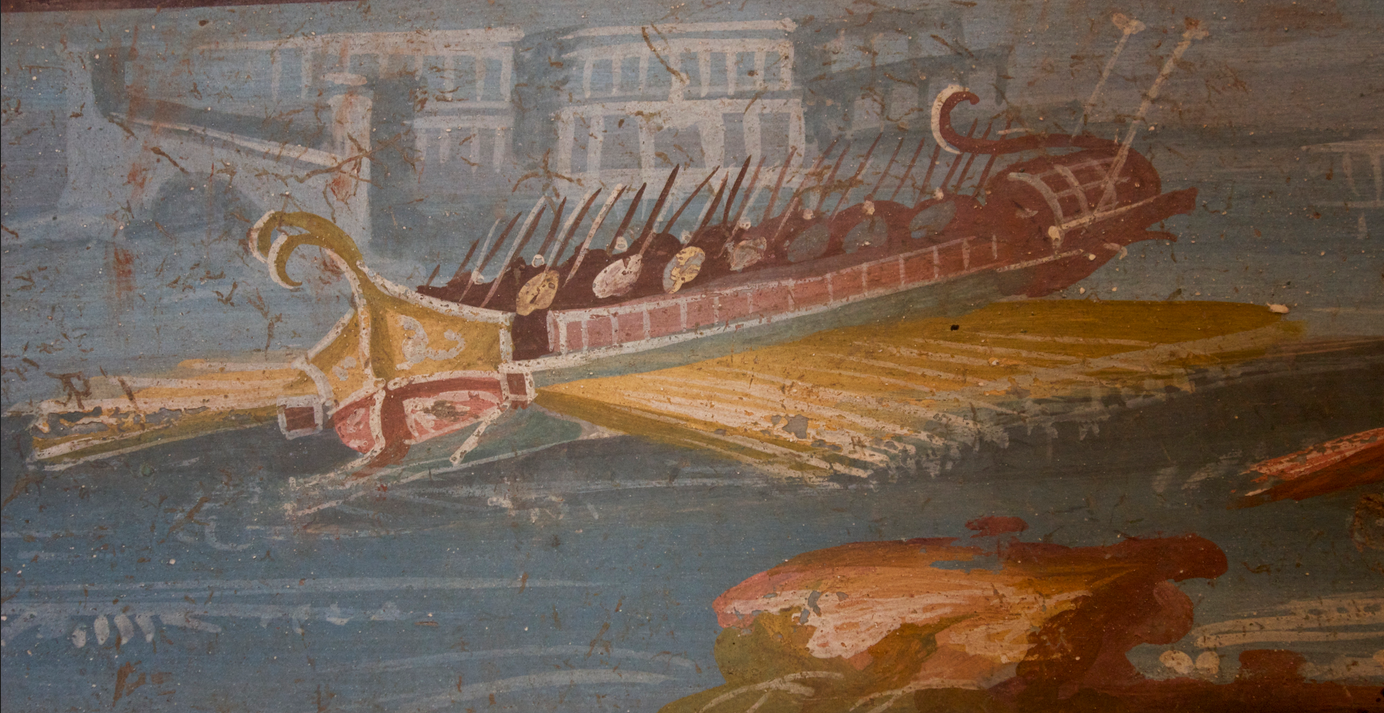
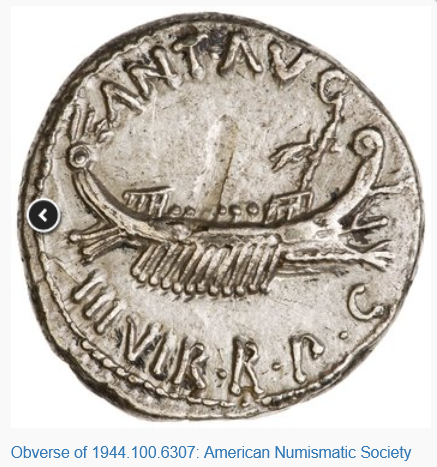
Notice the while ‘sticks’ coming out from the stern. These made me think of the filleted scepter on Antony’s coinage:
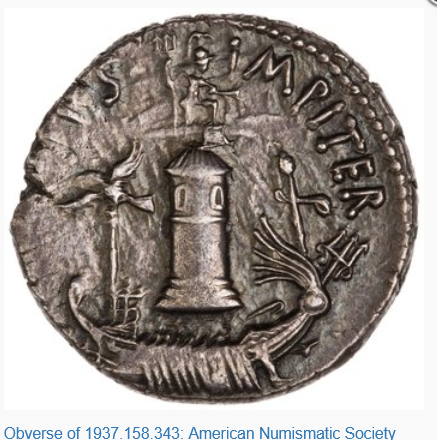
And, on the coinage of Sextus Pompeius
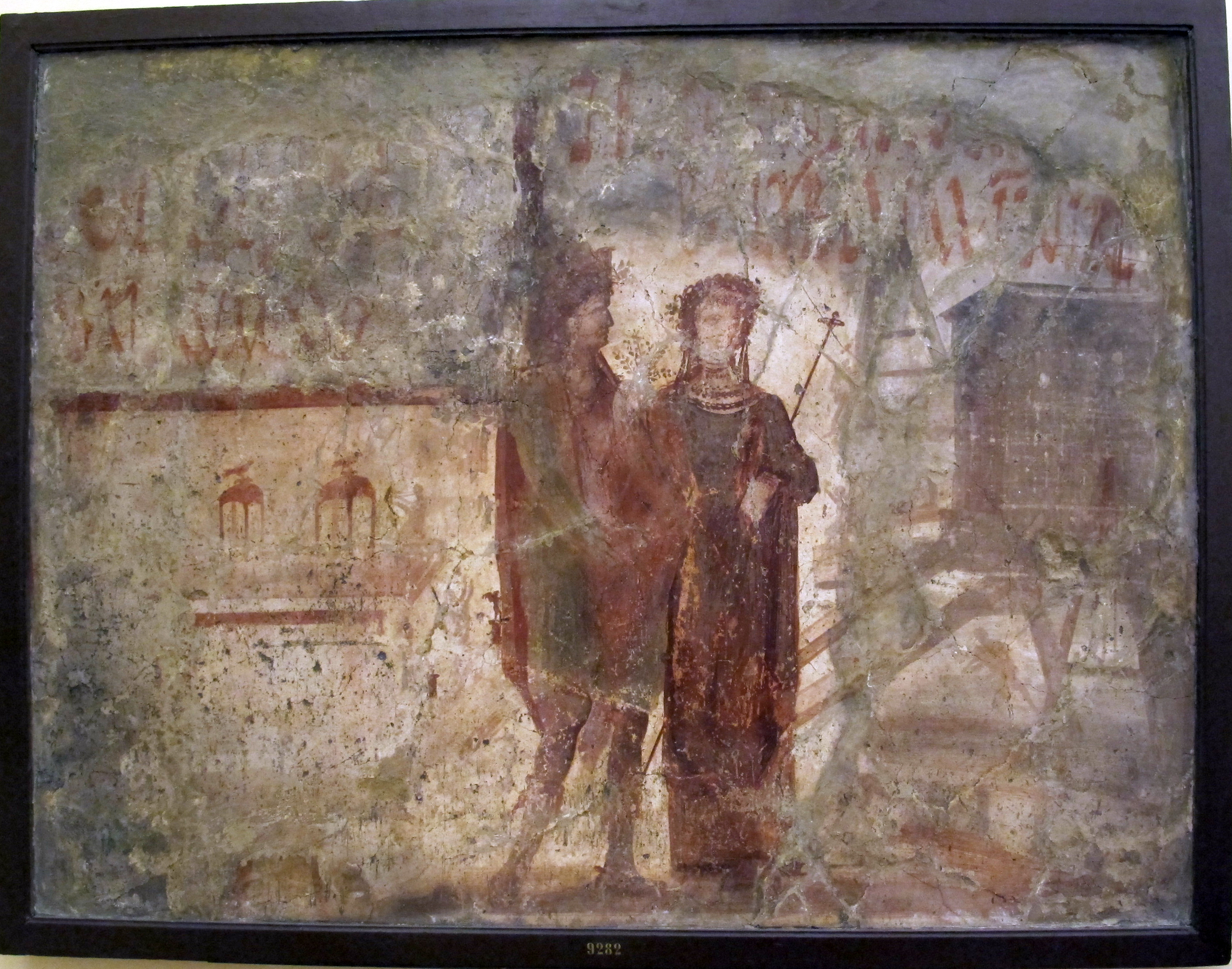
Faded construction scene

Just Five Coins?!
Next Sunday, August 1, 3 pm, I’m have an outdoor book event at a local bookstore and the audience will mostly have never thought much about either coins or Romans, a collection of local friends and family and perhaps any interested members of the community. Yes, it is open to the public. Yes, I’ll be signing books (reserve a copy for pick up on the day at a 10% discount). Yes, it will be live streamed (sign up here to get the link).
While I have a great deal of experience teaching coins, I usually have a captive audience of college students who know there is likely to be a test and I get a full hour plus and all the powerpoint slides I want. This is a completely different challenge. I need to keep it under 20 minutes. Ideally under 15. I have to pay to print large posters of any images I want to share (outside venue = no ppt) and I must assume the know nothing and I cannot be boring.
SOOOOooooo. My plan is to talk about five coins and try to hit all the most important points about Roman republican coinage with just those five coins.
Preliminary line up:
- Elephant and Pig
- a Quadrigatus
- a Bigatus
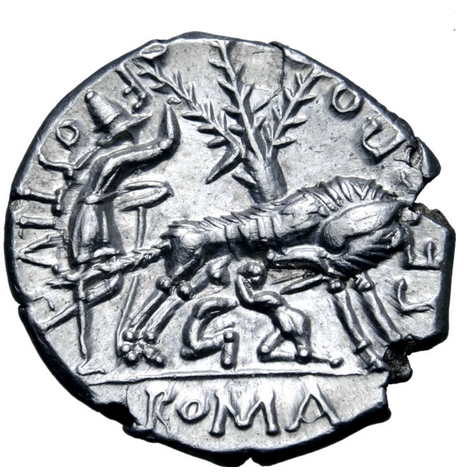
- Faustulus
- Brutus’ Libertas
Elephant and Pig
- Coins don’t have to be round and small
- The Italic monetary tradition is different than the Greek
- We make mistakes when we want to connect the pictures on coins to our most famous stories
Quadrigatus
- Romans struck coins to circulate with Greek coinages and thus imitating Greek conventions
- Heads (=obverse = anvil die) and Tails (=reverse = punch die) correlate to how coins were manufactured
- Roman coinage reflects Roman religion, and we don’t always know for certain the mean of the images
- Crisis –> Change
So-Called “Bigatus“
- conservative, stable designs is the norm for ancient coinages
- Denarius = 10 asses
- an innovative new denomination but one whose influence is still felt today
- Roma: goddess? personification?
- Dioscuri: Battle of Lake Regillus: Proof of Divine Favor
- Signed Issues: another Greek habit but one eventually to ‘take over’ of the Roman coin design tradition
Faustulus
- With Mediterranean-wide hegemony conservative coin design is no longer a necessity, even as the denomination itself remains stable
- New designs speak both to community identity in new ways, using an existing visual repertoire
- Diverse legend functions: Denomination marks, Moneyer’s name, labeling of the design, missing ROMA
Brutus‘ Libertas
- Still the denarius! Incredible stability and recognizably of the denomination
- Radical design shifts
- Use of shared past to comment on the shared present
- How the individual is also communal
- Foreshadowing…?!?!
Yeah that’s going to run longer than 15 minutes isn’t it….
Thoughts? suggestions?
NOW I need to get my image files and figure out where I’m getting them printed. Bonus result is I’ll have some pretty sweet posters for my office!
Tooting my own horn
I’m really pleased that the in-house journalist took our long convo and did such a great job of finding just the right framing and questions and extracts for this profile in the college magazine.

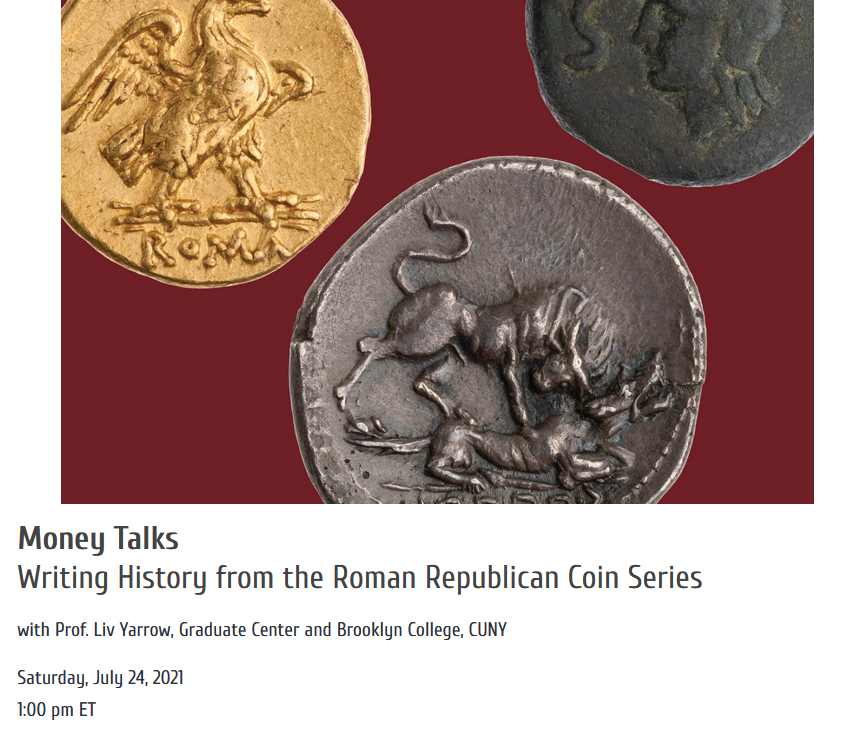
AND, if you want to hear me talk about lessons I learned from writing my book and how it ended up the way it did and where it might lead, THEN come Saturday, July 24, 1 pm

That ‘bingo machine’ again
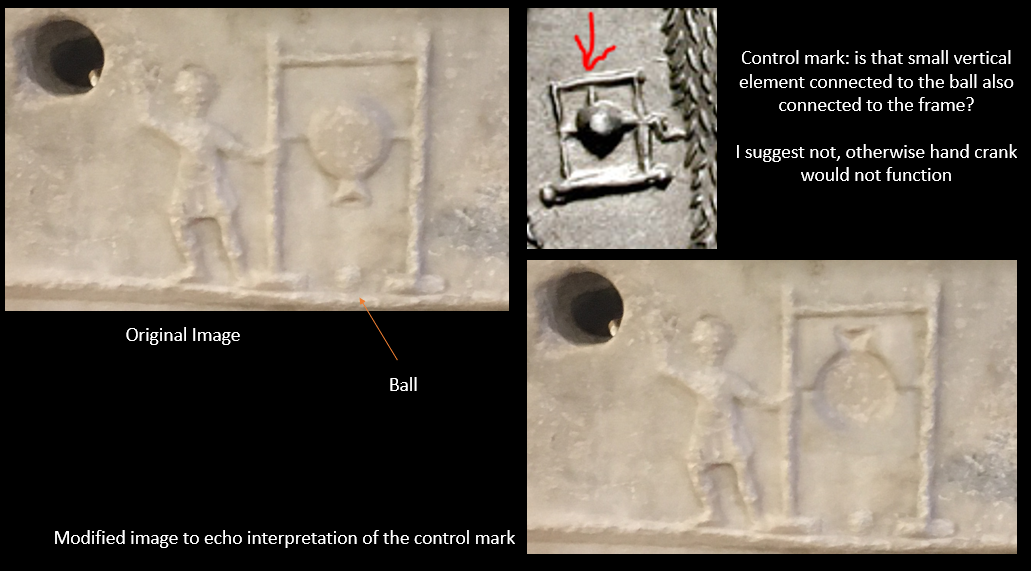
Schaefer pointed out the trouble with the bingo machine id for the obverse symbol 103 on the Fabatus series is the little symbol that (seems?) to connect the ball to the top bar.

I went looking for models of bingo balls that had a square frame around them (not a typical modern feature of mechanical bingo balls).
Here’s one I found being offered for sale with great pics but little historical detail/context.

If the little sticky out thing at the top is part of the ball not part of the frame and not connecting the two, then it might be the box that catches and releases the random ball. That’s a lot of ifs and by no means certain, but until we find an actual archaeological match for the symbol this is the best I’ve got so far.

Clare Rowan drew my attention to this depiction on a ball game machine in the Bode Museum Berlin:
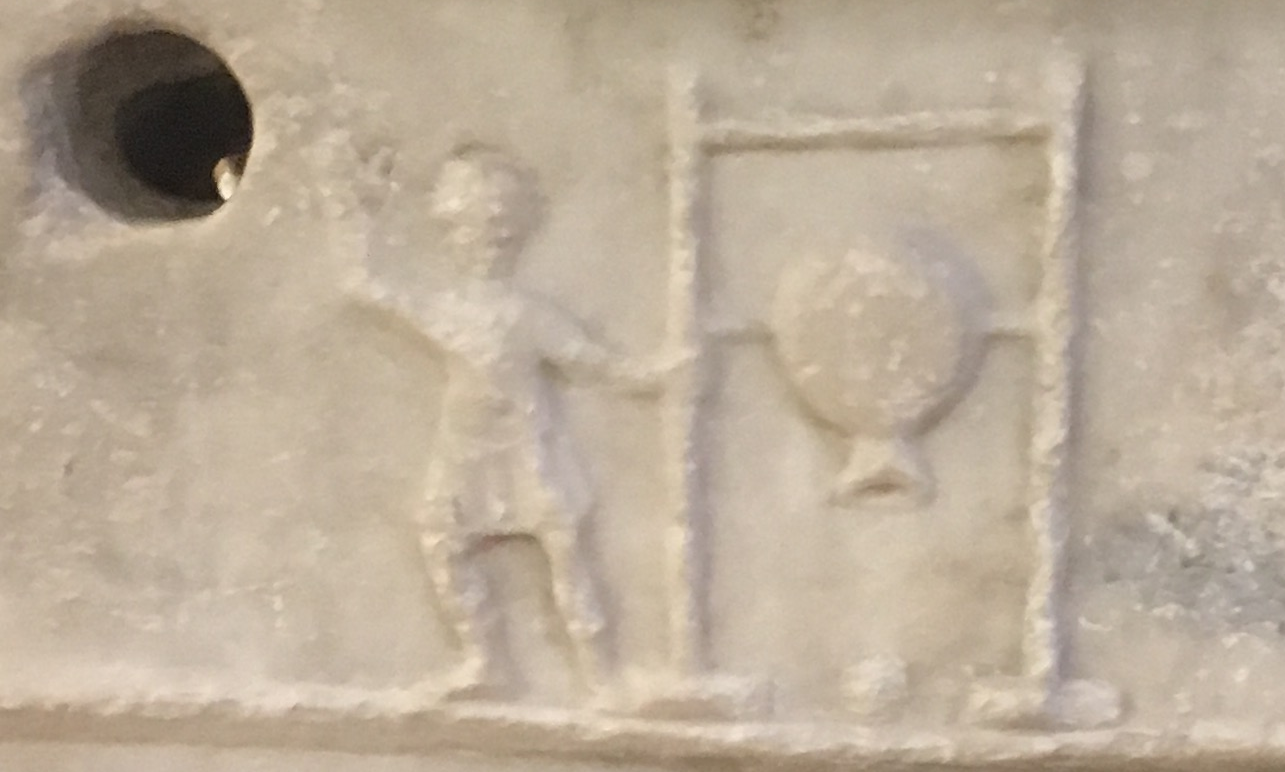
The rest of the reliefs on this machine are as she points out are all chariot related. See tweet thread for more images.
 Liv Mariah Yarrow
