A photographer and teacher friend of mine asked if I could share anything more about a coin that refers to a quote she often uses with students:
Of what use are lens and light to those who lack in mind and sight
It’s a great quote. Don’t you agree? Anyway. I’m a sucker for a coin question and need some joy of the hunt in my life this Sunday before classes start.
My friend had already tracked down another photographer’s blog post on the subject so my job was pretty easy. Please keep in mind that Thalers are pretty far out of my specialty. I’m just sharing what I found. Mostly higher res images and catalogue descriptions.

The following text has been lightly adapted and abbreviated with help of machine translation from the Kunker catalogue.
—
THE PRINCIPALITY OF BRUNSWICK-WOLFENBÜTTEL.
Struck under Julius (reigned 1568-1589)
Denomination is a Double Reichstaler. Weight of this specimen is 58.15 g.
Struck in 1587 by Mint master Diettrich Ockeler.
Obverse Legend: IVLIVS • D • G • D • BRVN • ET • LVN • N • R • M • A • D • I – 1587
Obverse Design: Armored hip image, half left, with battle axe in the right hand, below in the section
Reverse Legend: ALIIS • INS / ERVIEN / DO : CO / NSVM / OR, next to it helmet, right. triple helmeted, six-field coat of arms with central shield//* SI * DEVS * PRONOBIS * QVIS * CONTRANOS *, in the inner circle W • H • D • A – L • V • B • D • S • S • N • H • V • K – W •
Reverse Design: Wild man with tree trunk in his right hand stands half left, in his left light with skull, hourglass and glasses, in front of him the horse looking back left, above it • I • M • C • M •.
From the Catalogue notes: The curved sequence of letters on the back can be resolved into the following sentence: “Was Hilft Dem Auge Licht und Brille Der Sich Selbst Nicht Hört und Kieken Will”. “What help to the eye is light and glasses that does not want to hear and look at itself”. The letters placed horizontally above the horse mean “In Medio Cursu Metuo” (I have doubts in the middle of the race). Together with the legend “SI DEVS PRONOBIS QVIS CONTRANOS” (why against us when God is for us), they reflect the ruler’s personal attitude.
The same theme appears on other Thalers of the same time:
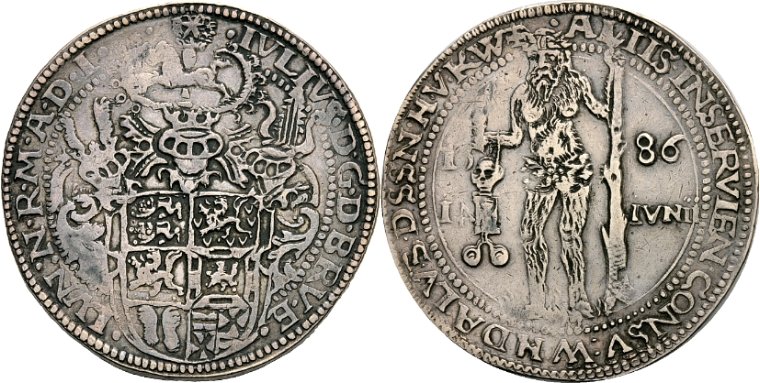
“Julius, 1568-1589 Reichstaler 1586, Goslar, Brillentaler with date June 14, 1586. 29.22 g. Coat of arms / Wild man with tree trunk and light, skull, hourglass and glasses between year and date 14 – IVNII.” [Machine translation]
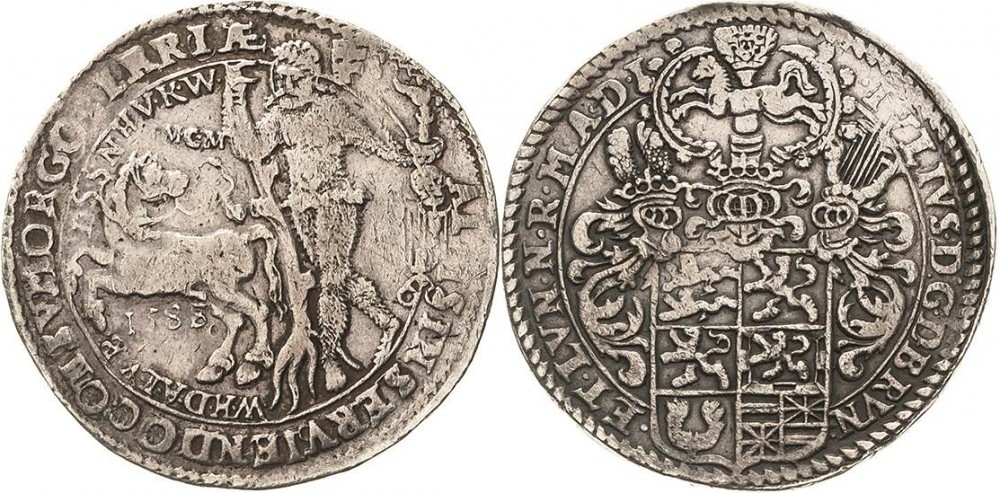
“Braunschweig-Wolfenbüttel Julius 1568-1589 1/2 Taler 1588, double cross Goslar half spectacle thaler. Triple helmeted six-field coat of arms / jumping horse, next to it wild man holding tree trunk as well as light, skull, hourglass and spectacles” [Machine translation]

“Mansfeld medals, counting coins and jetons Anton Koburger, mint master in Eisleben 1555-1577. Counting coin n.d. Crowned coat of arms with fleece order chain, inscription: VERBVM.DO.-MONET.INE. / On the right in the field an owl facing left, in its claws a pair of glasses and a small animal, in front of it a crowned double eagle and candlestick, inscription: W*H*M*LI*O*P*W*I*NI*S*WIL (“Was hilft mir Licht oder Pril, wenn ich nicht sehen will” = What good is light or lens to me if I don’t want to see).”

“Silver medal n.d. Owl with glasses and two candles / Inscription: What good are lights and glasses if you try hard not to see. 26 mm, 5.24 g” [Machine translation]
Text transcribed: was helffen lichter und brill wen man mit fleis nicht sehen will

“AR jeton (3.22g), ND [ca. 1553], Dugniolle 1934var, 28mm satirical silver jeton on the conflict between Michael Servet and Jean Calvin, 2 men arguing with splinters in their eyes with O – SCHALC TREC – VTH V BALCK around with LV6C in exergue // owl on perch holding a pair of glasses in front of a lit candle with WAT BBAT KERS OF BRIL DI NIT SIEN E WIL around”
The legend is beyond me. But when you pop the reverse into Google translate “detect language” it thinks it is Jamaican Patois. Which is both fun and very wrong. It is clearly Germanic and related in translation to the above coin legends. More as I know more.
It’s old Dutch. AND it even features in a Dutch Wikipedia entry on this and similar satirical tokens!
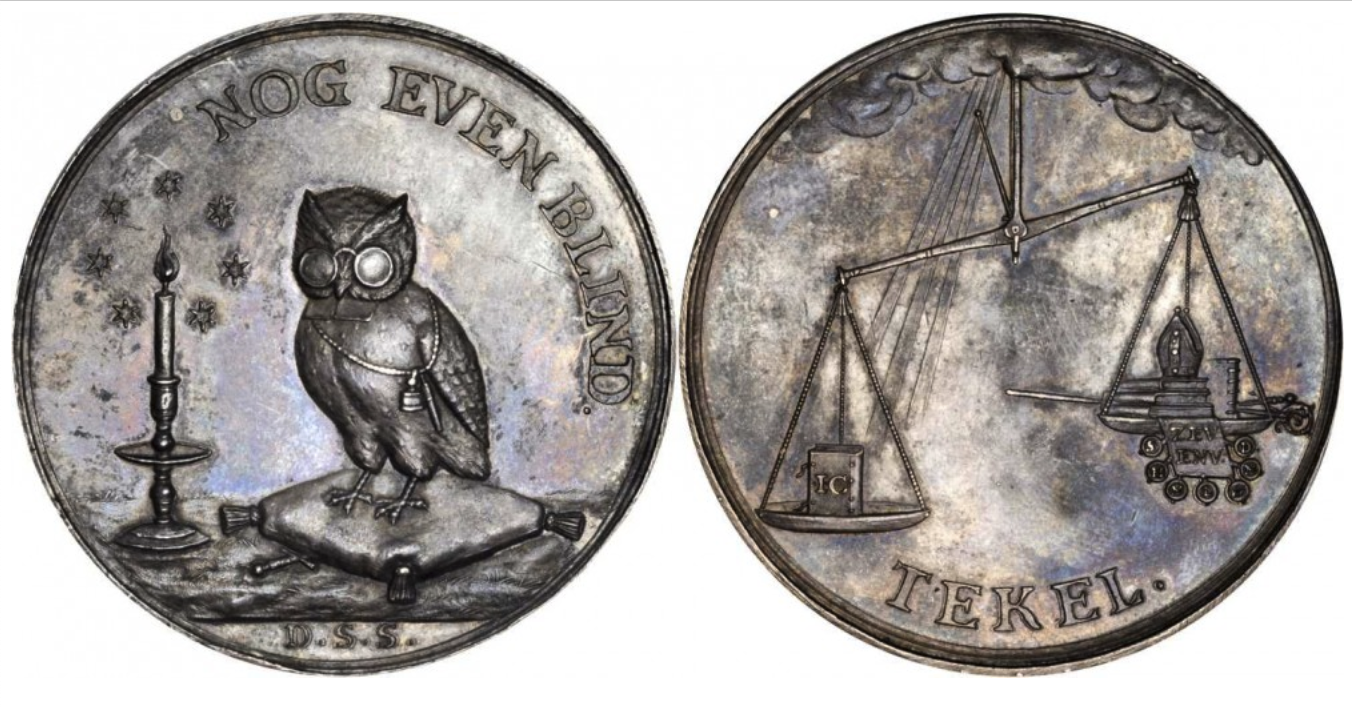
“Silver Satirical Medal Referring to the Committal of the Seven Bishops to the Tower, ND (1688).
47.82 mm; 47.34 gms. William and Mary (1688-94). Pickerton-pl XL #3; BM-pg. 709#1155. Owl wearing spectacles sitting on cushion, candle to left, legend above; Reverse: Scale suspended from heaven, emblems of the Papacy being outweighed by the New Testaments marked “I.C.””
The reverse TEKEL is a reference to Daniel 5:25, 27
“you are weighed in the balances, and are found wanting.”
“This medal was executed in Holland; the design and letters in the exergue on the obverse and on the seals have evaded all attempts at explanation. It may, perhaps, have no allusion to England, though it has been considered by De Vries to relate to the dispute between James and the Seven Bishops.”
The BM translates the obverse legend as “Yet still blind.”
I.C. stands for Jesus Christ.
The sentiment appears in a moralizing introduction to a Dutch Government report on Colonization in Africa from the late 18th century:
“Many a person is full of erroneous ideas, and this despite his imagination being so strong, that he will not allow himself to be taught better by another, even if he were given a light and glasses; the best thing for such a person is to gain insight through his own experience.” (machine translation)
J.C. Wolf, Reise nach Zeilan: nebst einem Berichte von der holländischen Regierung zu Jaffanapatnam (1782), p. xii-xiii.

The same sentiment more closely related to the coin appears in an 1897 journalistic publication. Again I quote using the help of machine translation.
Proverbs:
Hold fast to the beauty that fills you with joy,
that the divine have graciously given you;
but know that beauty is easily lost,
so hold it with careful hands.
And do not attach your loving heart to anything,
as if it would remain your own forever!
Ah, all too often the bitterest pain is the child of the tenderest love.
What one learnt early in childhood,
one still practices effortlessly in old age;
therefore plant nothing but virtue in the heart of one’s beloved youth.
It always takes two to argue: if you remain silent, the time is over!
What use are light and glasses to a fool when he lacks the will to see?
How often do the learned find the wrong in word and behavior!
God gives the nut, and to crack it you must make the effort yourself.
If you don’t want to run unnecessarily, you don’t have to run to the fair.

From the last page of an illustrated Sunday Magazine.
The common nature of the sentiment can be detected in the use of the metaphor in this portion of German 1904 Psychiatric treatise. The last two sentences machine translate to:
“This really annoys me! It is precisely in such a case that we are called upon to open the eyes of the parents etc. involved, and this is precisely where the light and the glasses are missing!”

The coin and legend is also discussed on page 130 of the following book.
W. Leschhorn, Braunschweigische Münzen und Medaillen: 1000 Jahre Münzkunst und Geldgeschichte in Stadt und Land Braunschweig (2010)