145 out of 410 days: Argos Panoptes?

Obverse of RRC 348/6. 2012.34.10

This as of L. Rubrius Dossenus (c. 87 BC) has, instead of the standard Janus, a janiform head combining Hercules and Mercury.  Alföldi connects this image, not to the palestra hermerakles imagery representing sound mind and sound body, but instead to a rather unusual vase image.  (See yesterday’s post for bibliographical citation).

Update 7/1/2020: Crawford judged Alföldi’s interpretation implausible in his 1984 Edinburgh catalogue. See McCabe for summary.

Image

The thing to notice is that the body of the figure is covered in eyes.  This is the standard means of depicting Argos Panoptes, the giant covered in uncountable eyes set to guard Io and killed by Hermes.  He is the mythological representation of the ever vigilant watcher.

A more recent monograph on the Polygnotos painter questions whether the standard identification of the figures (i.e. Hermes slaying Argos to free Io) on this most unusual vase are correct given how much it diverges from the standard representation:

Argos.jpg

Maybe this is not Hermes or Io, I grant their iconography isn’t typical, but Panoptes is surely intended on the vase given how his body is covered with eyes.  Perhaps we’re not seeing the right Argos Panoptes narrative here; the scholia on Euripides knew of other adventures in which he was a more positive protector, even if the vast majority of literary accounts are on Io.  There is even an early suggestion that Argos only had 4 eyes like a Janiform god:

Hesiod or Cercops of Miletus, Aegimius Frag 5 :
“And [Hera] set a watcher upon her [Io], great and strong Argos, who with four eyes looks every way. And the goddess stirred in him unwearying strength: sleep never fell upon his eyes; but he kept sure watch always.”

Is Alföldi’s suggestion plausible?  Maybe.  The vase certainly isn’t the standard representation but it is of Italic origin and we may be missing other key evidence.  That said, the vast majority of viewer would have been more familiar with the palestra imagery. Cf.  Cicero’s reference to wanting such a statue (ad Att. 1.10.3):

Image

We imagine this would be something like this:

Double-Headed herm Bust

Or like this one in the Boston MFA Collection:

That it is the two individual deities combined in one image which is intended on the coin seems to me to be more likely, given that the inclusion of the attributes of both in the design.  This is not that visible on the specimen, but is noted by Crawford and can be seen on this coin of Andrew McCabe:

Image

See how a club and caduceus jut out on either side below the chin and above the shoulder.

Why did Alföldi find the Argus explanation so attractive?  It allowed him to connect the coin to contemporary politics especially the vigilance of the Marians in anticipation of Sulla’s return.  (He dates the series to 86 BC.)

All that said it is also possible the Cicero/Palestra theory is a red herring.  Cicero might not have meant double herms but instead statues like this:

A little later aside (11/11/13): In that way that so often happens, I came across an odd coin with slightly similar imagery today.  Perhaps, I noticed it because I’d been looking at these janiform/bifrons heads yesterday.  I’m putting it up just so I have a note of it, should it ever prove relevant:

Another potential piece of comparative evidence (found 23/12/13):

Listed on Flickr as:

Janus-herm with addorsed head of Pan [or Zeus Ammon?] and Hercules, Marble, Roman, 1st c. CE; George Walter Vincent Smith Art Museum, 51.2002.10; Springfield, Massachusetts,  Gift from the Estate of Dr. Melvin N. Blake and Dr. Frank Purnell

Update 30/1/2014: Discussing Janiform head could also lead to an investigation of this sort of object:

Terracotta aryballos (oil-bottle) in the form of two heads, one male, one female. An imitation of an East Greek type.

3/22/14 update: Compare the coinage of Volaterrae with the image of Argos on the vase painting above. Note in particular the hat and the club:
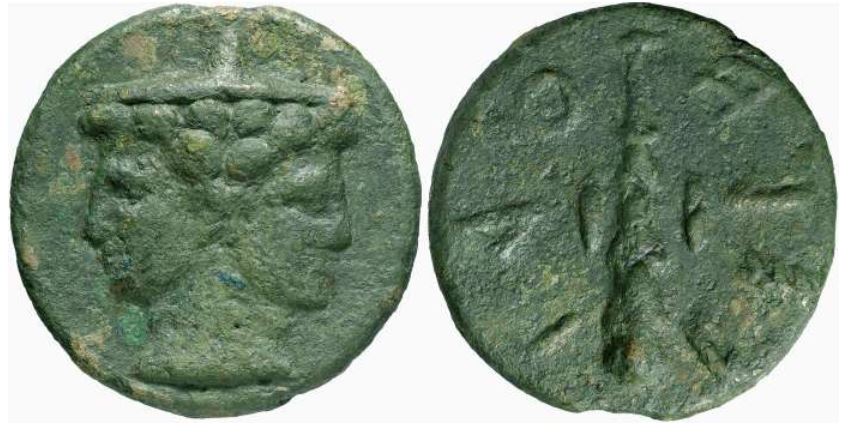
Etruria, Volaterrae, Dupondius circa 225-215, æ 259.55 g. Janiform head, wearing pointed cap. Rev. FELAQRI Club; on either side, mark of value II. H. pl. 83, 1. Syd. 305. TV 85. Ex CNG 29, The Thurlow collection, 1992, 69 and NAC 10, 1997, 287 sales.

Also of interest is the iconography of the Etruscan god, ‘Culsans’:
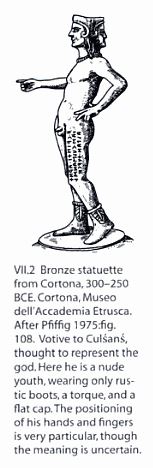
Capture
Capture

Note that the official museum catalogue website describes the headdress on this statue as a wild animal skin.
118 and 119 out of 410 days: Pyrrhus and Thetis

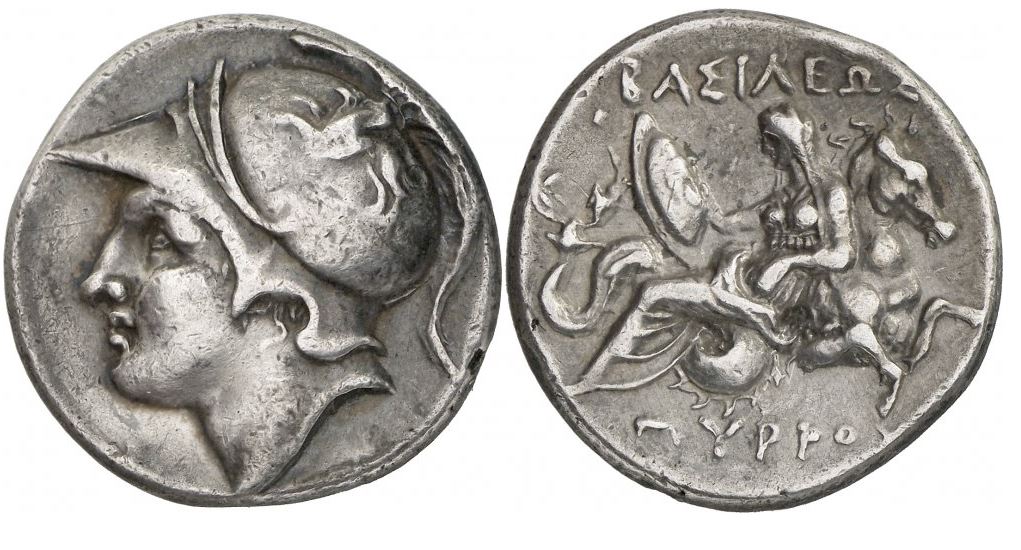
Yesterday late afternoon whilst reading about sources for the Pyrrhic Wars for this book review (It’s a really good book thus far! But slow going because I want to look everything up and enjoy the fun along with the author.) I became obsessed with the image of Thetis on the hippocamp. Below is a rather beautiful specimen in trade (cf. ANS Specimen):

capture.jpg

This is often attributed to the Locrian mint in Italy c. 279-274 B.C. The obverse is identified as Achilles (Pyrrhus’ ancestor) and the “portrait” is sometimes thought to be assimilated to Alexander or maybe even Pyrrhus himself. Perhaps the best thing to read on Pyrrhus’ use of the Trojan War narrative is Erskine, Troy Between Greece and Rome, p. 157-161. It’s basically a take down of the idea that Pausanias 1.12 can be taken as actual evidence that Pyrrhus used ‘anti-Trojan’ type propaganda against the Romans. The interesting thing is the relationship of Pyrrhus’ coin type to that of Larissa in Thessaly:

capture.jpg

There are also an number of illustrated specimens in the ANS collection. Note how on this specimen below the obverse head has the “whale spout” hair style so often associated with Alexander and also the AX monogram on the reverse shield standing for “Achilles”.

capture.jpg

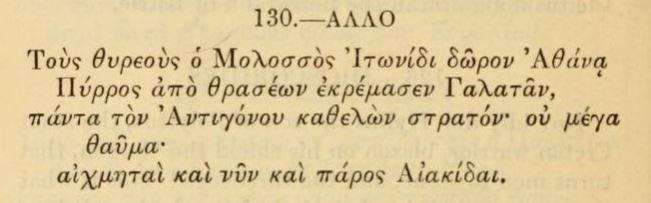
What does Pyrrhus have to do with Thessaly? Well it was his next stop after Italy. So Pausanias, and with references at Plutarch, and Diodorus, and the dedicatory inscription he set up is in the Greek Anthology attributed to Leonidas (6.130). Some discussion of his memorable dedication and his choice of sanctuary can be found in Graninger’s Cult and Koinon in Hellenistic Thessaly. The dedicatory inscription in fact emphasizes his decent from Achilles:

Image

Image

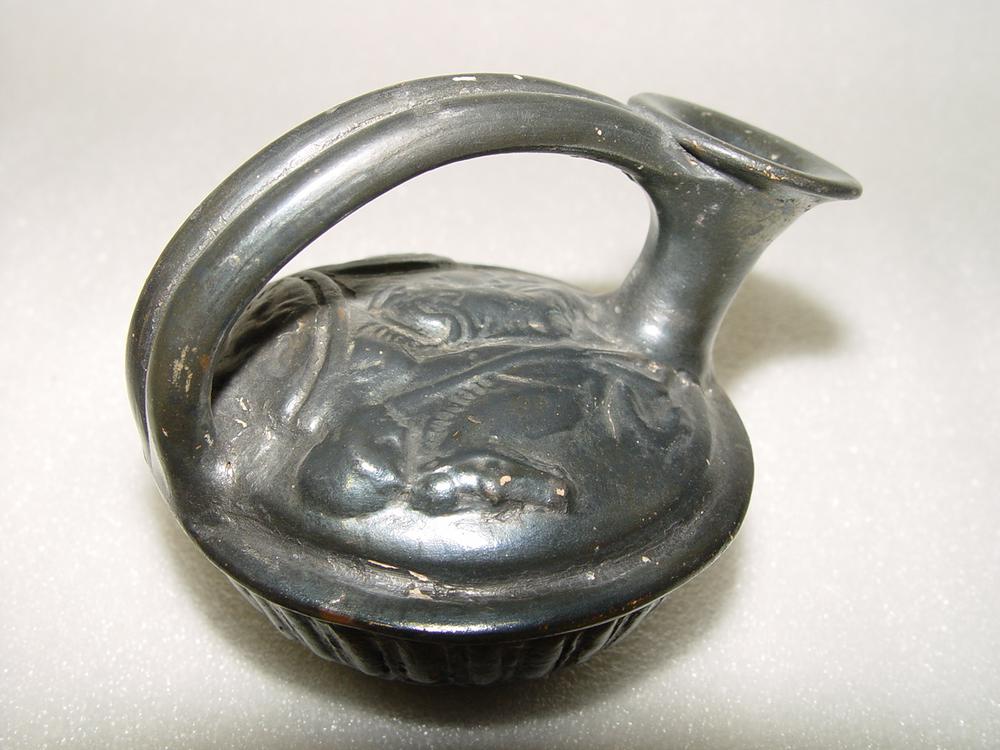
Of course, the image was generally popular, a popularity often ascribed to a lost statue group of Scopas thought to be referenced in Pliny. An Attic Red-Figure Bell Krater c. 350 BC in the BM show the basic image. And, the iconography is also known on Italic ceramics as well:

Black glazed pottery askos with a ribbed body and in relief on the top, Thetis or a Nereid on a hippocamp to the left with Achilles spear in right hand and in left a shield, the hippocamp has a fimbriated fish's tail.

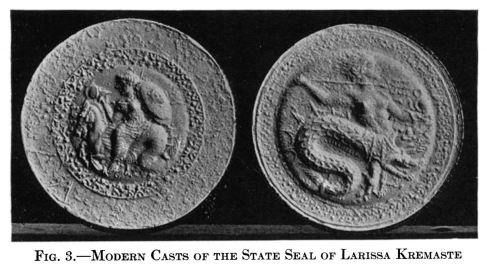
Just to make things more confused there are some little understood finds said to be from Thessaly near Larissa including this:

Image

There is a decent discussion here about this comparative evidence as it relates to Thessalian jewelry and gems.

I guess I’ll just have to mug up on the literature on Larissa and Thessalian numismatics starting with:

C. C. Lorber, Thessalian hoards and the coinage of Larissa, In: American journal of numismatics second series, vol. 20, 2008, p. 119-142, pl. 41-46.

Other literature of interest: Lücke, S. 1995. ‘Überlegungen zur Münzpropaganda des Pyrrhos’. In Brodersen, K., and Schubert, C. (eds.). 1995. Rom und der griechische Osten: Festschrift für Hatto H. Schmitt: 171–3. Stuttgart. As well as, Franke, P. R. 1989. ‘Pyrrhus’. CAH2 7.2: 456–85.

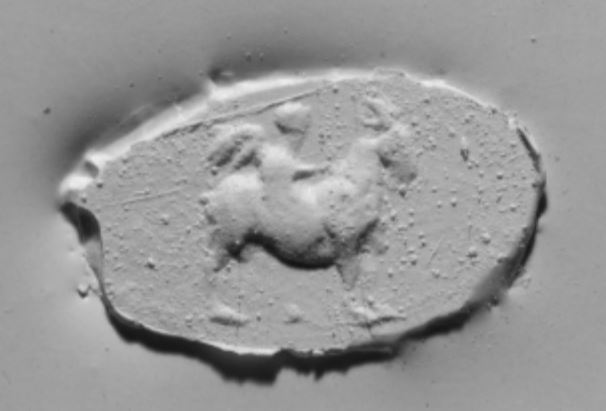
Italic Horserider Imagery

Capture.JPG

Note To Self: When considering the issue of L. Manlius Torquatus below (111 BC according to Mattingly), don’t forget that there are earlier Italic precedents for the reverse design, such as the AE quinrunx of Larinum above, dated by HN Italy to c. 210-175 BC.

You will want to order from ILL the relevant literature on Larinum (listed in HN Italy) and look for other similar Italic imagery.

Notice how the Torquatus coin even places all three elements of the legend in a similar location to that of the Larinum coin. His name for the ethnic, EXSC for the five pellets, and then, most strikingly, the Q for the V behind the riders head. [See three images down for a specimen of the quinrunx showing the V.]

The obverse of the above Larinum specimen looks more like a Minerva than an Ares in the Corinthian helmet. HN Italy queries lists as “Mars(?)”. Other specimens are more ambiguous or masculine:

But then see these long necked specimens (1) and (2)… The four specimens in the ANS seem very masculine indeed, especially the ‘fat necked’ SNGANS.1.131 and SNGANS.1.132.

Update 26/11/2013: Just adding this glass paste for comparison. It is dated by the Thorvaldsens Museum to the republican period.  This rider doesn’t have the same helmet but otherwise shares many design elements right down to the the shield details.

Rytter med spyd og skjold. Romersk republikansk paste

They also given this a republican date:

Kriger til hest. Romersk republikansk paste

Second update 27 February 2014: The coinage of Tarentum (Taras) also needs to brought into discussion (esp. HN Italy 1013):

Most of the rider imagery from Tarentum has the shield behind the rider, making this type stand out.  Even here, the horse is rendered differently from above imagery, but it is certainly in the same visual repertoire.

Also see this newer post for comparative evidence.

Update 19 Jan 2024:

Louvre Gy 3555 = Florence : Musée archéologique – N° inv. 14820.
Intaille – Sardonyx, ex Medici

Interesting Errors circa 1889

Capture

The website Forvm Ancient Coins has a Numiswiki for collaborative work.  I’m very impressed with their crowd sourcing transcription and editing of public domain books relevant to the discipline.  I stumbled upon this entry yesterday in the Dictionary of Roman Coins from 1889.   Two ‘errors’  are really intriguing.

1) The dating of the lex de limitibus.  This is the Mamilian law that proscribed the width of the strip of land dividing two properties and seems also to have governed the process by which disputes over these boundaries were adjudicated.  The date is controversial, as is the contents.   109 BC is the most common attribution, associating it with the same tribune who fought corruptions amongst the nobiles.   There are detractors though, most notably:  Morgan, L. 2007. The Moneyer C. Mamilius Limetanus. Ostraka 16.1: 195-201.  Leaving aside the modern debate, the date in this old general reference work is given as v.c. 589.  That’s A.U.C. 589 or 165 BC.  Somewhere, somehow, someone got the idea that the Lex Mamilia might have something to do with the Praetor Lentulus’ efforts to return Campanian land to ager publicus (public land) by paying off the holders.  There are two basic sources, Granius and Cicero, the former being the more substantive and narrative in quality.  This date doesn’t fit with any of the other prosopographical evidence or literary testimony.  It is most likely just flat wrong and a guess, but right now I’d give my eyeteeth to know where the idea came from.

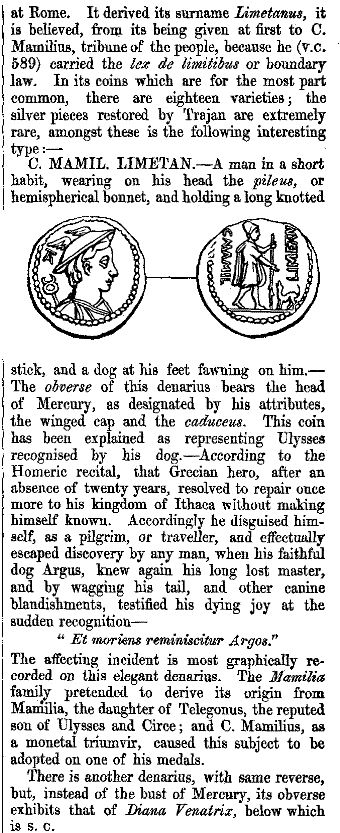
2) An alternative obverse type.  The final sentence of the entry claims that the reverse is known with a different obverse.  Again, given the popular nature of publication there is no reference to the location or provenance of the specimen.  BUT the description is pretty clear.  It means the obverse of this type:

RRC 383/1

This error is easier to understand.  Either there was a forgery that combined the two, or some catalog entry or illustration was inadvertently created or suggested the connection, or someone looking through a collection mismembered what they saw.  [Yes, I know that’s not a real word. It should be though.]

The one problem with the otherwise fabulous quest to digitize just about everything in the public domain is that it generalizes and disseminates that information that is 70 years old, making that canonical and widely accessed knowledge.   I think this blog is slowly becoming an open access advocacy site.

79 out of 410 days: Trial by Snake

This is the coin type at the heart of the chapter I need finish by the end of the month. I don’t expect to write too much about it here as I seem to like to keep my free writing and the formal writing separate. Yesterday was mostly looking at possible (and impossible!) epigraphic references to other members of the moneyer’s family, the gens Mamilia. Today I was chasing up the references from an old article that suggested the type is all about the moneyer showing support for the Italians. Not an idea I’m ready to support, but the references he cited were all fascinating. Here’s the best of the lot:

In the bodies of these people there was by nature a certain kind of poison, which was fatal to serpents, and the odour of which overpowered them with torpor: with them it was a custom to expose children immediately after their birth to the fiercest serpents, and in this manner to make proof of the fidelity of their wives, the serpents not being repelled by such children as were the offspring of adultery. This nation, however, was almost entirely extirpated by the slaughter made of them by the Nasamones, who now occupy their territory. This race, however, still survives in a few persons who are descendants of those who either took to flight or else were absent on the occasion of the battle. The Marsi, in Italy, are still in possession of the same power, for which, it is said, they are indebted to their origin from the son of Circe, from whom they acquired it as a natural quality. But the fact is, that all men possess in their bodies a poison which acts upon serpents, and the human saliva, it is said, makes them take to flight, as though they had been touched with boiling water. The same substance, it is said, destroys them the moment it enters their throat, and more particularly so, if it should happen to be the saliva of a man who is fasting

The other references also mention snake taming, but they’re not quite as fun (Pliny NH 25.11, Serv. Aen. 7.750, Sil., Ital. Pun. 8.495-510). I find it hard to believe that Mamilius is claiming kinship with the Marsi as fellow offspring of Circe via the coin, but who doesn’t like a good snake story?! It made me think of the ritual being shown on this coin:

Propertius 8.4 helps us understand the image:

Lanuvium, from of old, is guarded by an ancient serpent: the hour you spend on such a marvellous visit won’t be wasted; where the sacred way drops down through a dark abyss, where the hungry snake’s tribute penetrates (virgin, be wary of all such paths!), when he demands the annual offering of food, and twines, hissing, from the centre of the earth. Girls grow pale, sent down to such rites as these, when their hand is rashly entrusted to the serpent’s mouth. He seizes the tit-bits the virgins offer: the basket itself trembles in their hands. If they’ve remained chaste they return to their parents’ arms, and the farmers shout: ‘It will be a fertile year.’

This seems to be part of cult of Juno Sospita, or at very least it took place in close proximity with her sanctuary and it is her head on the obverse of the coin. Here’s some recent scholarship with references. The cult at Lanuvium is rightly contextualized by the accounts of the powers to charm snakes linked to Circe and her ilk (Medea, Angitia, etc) and the origins of various Italic peoples and associations with specific Italian topography.

***

The original wire transfer is still lost. I spent a horrible time on the phone with HSBC. Again. We’re investigating other services… I took a break to write this post largely because I need to tamp down my rage to get back to writing properly.

74 out of 410 days: Game Changing Scholarship

Image


Sometimes awesome publications just don’t get the attention they deserve. Sometimes a single inscription can completely change our reconstruction of an individual’s career and thus the shape of events and meaning of various symbolism.  Such seems the case with Díaz Ariño’s republication of the inscription first published by González, J. (1993), C. Memmius imperator, Habis 24, 281-286.  I’m sticking it up here largely just to give it attention.  RRC 427/1 doesn’t recall the moneyer’s uncle’s time in Macedonia, but instead his grandfather’s previously unknown Spanish campaigns.

There is also the great work being done by Saskia Roselaar mapping coin finds in Italy in time and space to reveal connections and patterns in those connections.  I love that she is making her work available as it develops.


68 out of 410 days: Boundary Rituals

I was reading this description of the pomerium.  And all of a sudden I couldn’t help but think about the ritual of beating the bounds still used in many English (and Irish?) parishes today.  Clicking on the picture above will give you a basic history with images. There is a good scholarly reflection on the revival/restoration of the historic practices here.  I like how this modern take accepts that each deployment of the ritual must be meaningful in the contemporary context and thus evolves overtime.

This was because I was hemming and hawing over how to talk about this coin of 81 BC, if at all:

Is it just about generalized ideas of bounty and stability in the aftermath of the Civil Wars?  Or is there some specific reference to Sulla’s extension of the pomerium or the establishment of his colonies throughout Italy?  Should we see the reverse as a peaceful genre scene or the illustration of a religious ritual?  The latter seems more likely given themes on the Roman Republican coin series generally, but on the other hand a more generalized symbolism would be more typical than the documentation of a very specific contemporary event or series of events.

I’m leaning toward a more general symbolism because the figure is clearly in a tunic, not a toga or other ritual garb.  And especially as it seems to be a direct echo of this earlier issue (100BC by Mattingly’s reckoning), with the exception of the addition of the driver:

Ryan 2009 has a good take on this issue, calling it a «aktualitätsbedingte Familienthematik » = “a family type of contemporary significance” linking it both to historical agrarian legislation by the family AND current events.

Victory Redux

I came across the answer to my question some weeks ago about the origins of the Victory inscribing a shield motif. There is a nice summary of the evolution in Hölscher (p. 61-2 with references to his earlier work on Victoria). He sees its origins in three different elements: 1) 4th century representations of Nike’s inscribing inscriptions like the one above from Heracleia Pontica or this one from Mallos:

2) The practice of dedicating inscribed shields to record victories at major sanctuaries. Here’s a relatively recent piece of scholarship with examples and references to relevant literature And 3) the adaption of the Venus of Capua who is looking at herself in the reflection of Mars’ shield:

He then much to my delight mentions lots of gem and glass paste examples that located the fusion of these three elements in the second century BC. All of which very nicely contextualizes its first appearance as a variation of the standard quinarius reverse design (RRC 333/1).

***

Part of me feels guilty for not knowing this already. Hölscher has been on my bookshelves for donkey’s years. I swear I’ve read this portion a number of times. My mind just didn’t make the connection while I was writing the earlier post. That had to wait until I read it again. Perhaps that’s why I”m so interested in re-reading (see today’s earlier post). To see information again for first time. For pleasure, for work. The repetition seems the only way to build the paths in my mind that lead to the connections that build the ideas that make the endeavor of learning seem worthwhile.

***

Update 4/21/2014:  Key bibliography also includes:

R. Kousser, “The Desirability of Roman Victory: Victoria on Imperial and Provincial Monuments.” in Representations of War in Ancient Rome, Cambridge University Press, 2006.

And

R. Kousser, Hellenistic and Roman Ideal Sculpture: The Allure of the Classical, Cambridge University Press, 2008.  BMCR review here.

66 out of 410 days: Hairy Goats and My Notes

Image

The last time I was in Oxford some 14 months ago, I think, I snapped this image with my camera phone in the Sackler Library.  I was so happy to find an example of the iconography of this coin in a published excavation report of site finds.  [Update 8/24/13:  The image above looks more like a sheep to me than a goat the longer I look at it here on the blog.  It’s the curly horns.  I think rest below are  really goats.] Something I stumbled upon on the new arrivals shelf.  An Italian publication I seem to recall.  What I can’t seem to find is any record at all of what the book was or from what site.


If I knew where it was I could say something about the context of the image, perhaps even a divinity associated with the area of the find.  Alas, what we have here is a failure of the information pack rat system.  What I’m very happy to say is that its a popular motif… you guessed it! … on SEAL rings.

A. Furtwängler, Beschreibung der geschnittenen Steine im Antiquarium, Königliche Museen Berlin (1896) Cat. no. 6811;  no. 7525; BM 1917,0501.513; Gold finger-ring with an engraved sard: Eros riding a goat.; BM 1923,0401.1121; Edinburgh Tassie 2258

Capture
Getty 83.AN.437.17

It is also popular on Lamps:

Mould-made pottery lamp decorated on the discus with a Cupid riding a goat. The nozzle has an air-slit, and is mainly missing. The handle is mainly missing. The lamp stands on a base-ring. Covered with a brown slip.

And the also this figurine from Cyprus:

Eros riding a goat

Crawford thinks its likely to be Dionysiac.  Perhaps.  Erotes are floating around with goats on many a Dionysiac sarcophagus, or Seasons sarcophagus.  But this might actually have more to do with the cult of Venus/Aphrodite:

Pausanias tells us that this is Aphrodite Pandemos, All Encompassing Aphrodite, usually translated Common or Vulgar Aphrodite:

Behind the portico built from the spoils of Corcyra is a temple of Aphrodite, the precinct being in the open, not far from the temple. The goddess in the temple they call Heavenly; she is of ivory and gold, the work of Pheidias, and she stands with one foot upon a tortoise. The precinct of the other Aphrodite is surrounded by a wall, and within the precinct has been made a basement, upon which sits a bronze image of Aphrodite upon a bronze he-goat. It is a work of Scopas, and the Aphrodite is named Common. The meaning of the tortoise and of the he-goat I leave to those who care to guess.  

What kind of connotations would “Pandemos” in the mids 80 BC? If that is, in fact, the reference. Certainly populist ones…

Update 8/23/13: Here’s a great study about what Pandemos might mean in a different community.  Those working on Cyprus have connected the Eros on Goat terracottas with the cult of Aphrodite/Astarte.  Muller took a different approach and associated this the ‘sport of Eros’ i.e. the motif of erotes playing with the attributes of other gods and other activities.  Thus he sees the coin as referring to the infancy of Zeus.  This is usually dismissed because the goat is male and Zeus’s goat was a nanny-goat.

Liberty Dime Excursus

This, this is a distraction, but an enjoyable one.   I was asked in the comments what I thought about this product of the US mint from 1916 to 1945, specifically the reverse.

The image of fasces with and without axes has a LONG tradition in the official sanctioned art of the United States certainly going back to portraits of Washington.  Houdon portrays Washington as a sort of second Cinncinnatus:

Houdon's Washington with Roman fasces

and the representation became highly influential, see esp. Ward’s Washington:

File:George Washington Statue at Federal Hall.JPG

These are without axes.  The Civil War memorials tend to juxtapose axed and axeless fasces in near proximity.   Lincoln in his temple rests his hand on axeless fasces, but the tripods flanking the steps sit atop axed fasces:

Here in Brooklyn, Grand Army Plaza’s inner columns have fasces with axes, the outer without:

GAP columns 7-22

I read the dime as a ‘Liberty must be Defended’ ideology inspired by the memorialization of the War between the states and the new experiences of the Great War.

Many of the drafters of the constitution thought of the US as a (even the) new Republic. We’ve been left with a very Roman legacy.  Each generation, in its own way, must come to terms with what that symbolic language means in a new age.

Update 8/24/13:  The more I think about the more I want to emphasize the olive branch in relation to the fasces, this seems to me as very similar to the caduceus as a symbol of peace juxtaposed against the fasces on republican coins. Peace and Law and Order beget Liberty?  Augustus rather dramatically connected the idea of Liberty and Peace on this issue:


The obverse legend resolves: “Imperator Caesar, Son of a God, Consul for the Fourth Time, Defender of Liberty”.