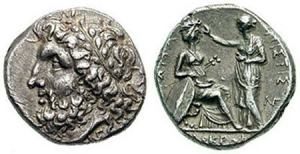
Being rather demoralized by the stalling of the edits and then further derailed by a networking lunch (a most pleasurable experience with much inspiration about future study abroad, err… ‘international education’ as one says today), I couldn’t really think about coins, but didn’t want to break my promise to put a coin from the book here every day. So I looked in my coin file and this one popped to the surface. It looked familiar so I did a key word search and sure enough just over a year ago I talked about it at a nice invited lecture at Leeds University. I said: “Near, orat the end of, the war with Pyrrhus, the Locrians, a community in the very toe of Italy, created a coin which has the very earliest depiction of the personification of Roma on it. She bears a scepter, rest her right arm on a shield, and sits upon a curule chair. She is being crowned by the personification of Pistis, the Greek equivalent of fides. Both figures are labeled with legends so the audience cannot mistake the unusual scene. Even this type of labeling on coins is virtually unknown at this date. Legends usually named whose coin it was ‘the coin of King Philip’ or the ‘the coin of the Athenians’. Our literary sources on the Pyrrhic War are spotty but according to the epitomes of Cassius Dio, the Locrians changed sides a few times and suffered the consequences of those choices—a pattern of events that repeated itself in Hannibalic War. I take this ‘celebration’ of Roman good faith as an expression of a rather desperate hope that they might benefit from this particular Roman virtue.” I then connected it with a few literary texts. Anyway. It’s something. Back to the damn edits.
So the internet went out in the middle of my edits and I found myself crawling the walls waiting to get to JSTOR to read all about Tzetzes and Stesichorus. I paced in the living room and ate some cheese. Not very productive. A version of Crawford’s words came back to me: “What can I productively do the next time the internet goes down for 15 minutes”. I opened a damned book. Radical I know. Paper. I looked up ‘coins’ in Stewart’s Statues in Roman Society. [I do like the pretty pictures…] He describes how the Romans distort representations of temples to emphasize the interior cult figure. The columns spread out and statue grows and the whole image is a symbol of the sanctuary and cult practice. He then goes on to say the “earliest clear numismatic representation of this kind of temple is on a denarius of M. Volteius in 78 BC. It shows the first temple of Jupiter Capitolinus. Before long the cult statue was displayed within the building.” He then goes on to talk about coins in 36 BC. I opened RRC and started scratching my head. Sure there is a temple on the coin (above), but I’m not sure what that it relates to cult statues, except perhaps in how the columns are widened to make visit the three cella doors thus making clear that this temple is the temple in which the Capitoline Triad are honored. And, it might represent the first temple of Jupiter Capitolinus, but I’m equally not sure we can know that to be true. At the time the coin was made the temple had been destroyed and not yet rebuilt. It represents the idea of the temple more than the temple itself. I almost wonder if Stewart didn’t mean to refer to this coin:
This seems to be the first of the type he’s describing and is illustrated on the same plate in RRC. All that said, this image and the earlier appear to come out of nowhere in the RRC (Like so much of the iconography). I haven’t yet checked on Hellenistic precedents, but I am intrigued that early architectural images seem to be on bronze (RRC 346/3 and RRRC 348/6). There are suggestions of architecture on earlier specimens (RRC 291/1), but not with the same prominence. And then there is the question if we should think of monuments as architectural (RRC 242/1 and 243/1). ….
So much more to say, but that colleague finally texted and I have an academic ‘date’ in Manhattan in an hour. Gotta motor.
Much later addendum (11/11/13): Today, again, I became obsessed with architecture on coins. No great revelations other than examples prior to the 1st century BC and scholarly discussion there of is thin on the ground. Here’s some types that might be relevant to future discussion. (Or not, but I enjoyed finding them!)
The coinage of Sidon in the late 5th century shows the city defenses. Most specimens show three towers it seems, this beauty has five:
This might be early temples on 4th century coinages under Persian influence:
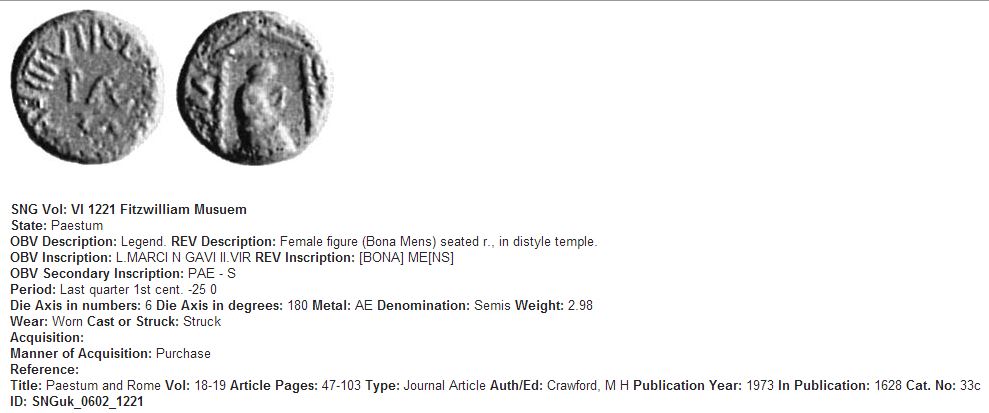
Otherwise, other pre Imperial non Roman temples are all probably influenced by Roman precedents. Such as this coin of Paestum (HN Italy 1252):
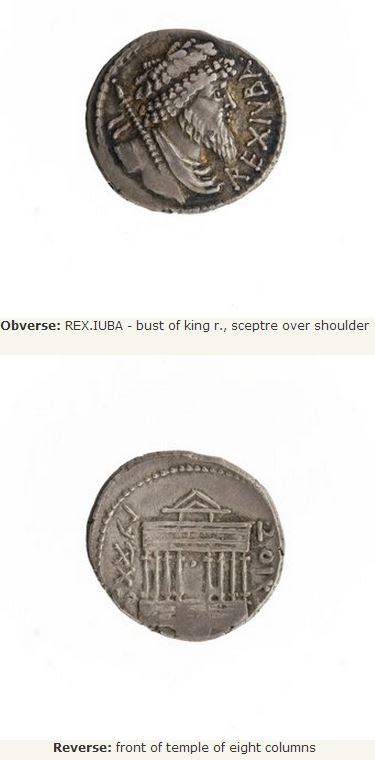
Or the coins of Juba I of Mauretania:
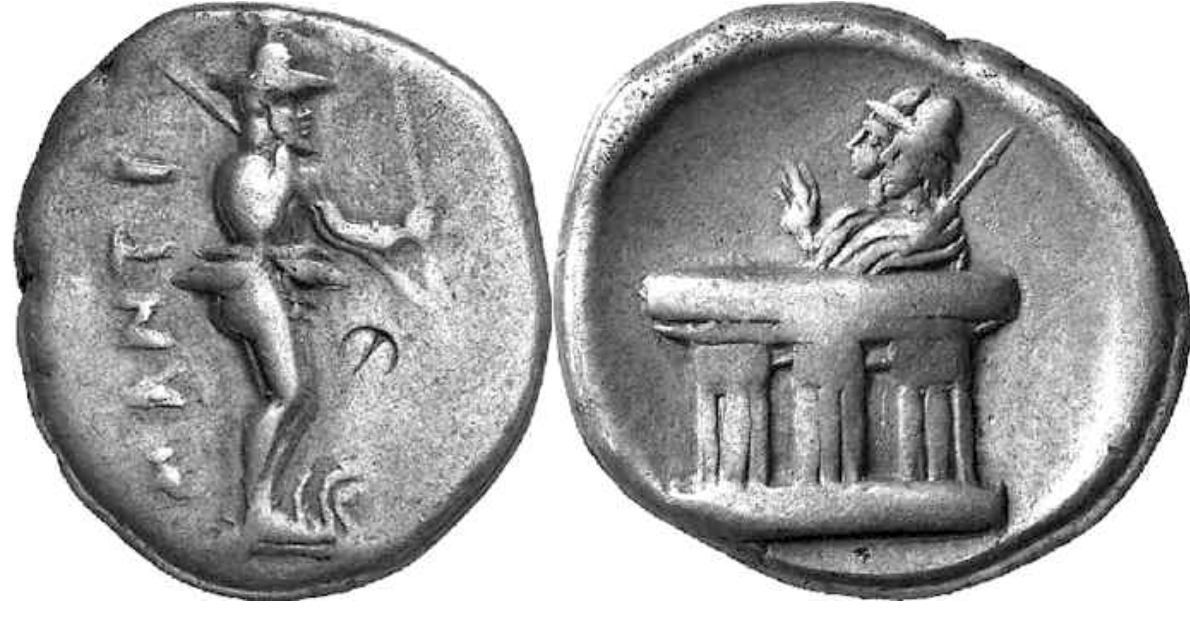
A little update 3/21/2014: I came back to this post just to add the coin below, but I was surprised I hadn’t already mentioned here the work of Elkins. He’s the scholar who has the most to say about the development of architectural types on coins and will become the standard reference. And, that said here’s a fun early type:
Mantinea, Drachm (Silver, 5.69 g 2), c. 370-360s. Bearded warrior, nude from the waist down, wearing traveling hat, cuirass and special shoes, dancing a ‘war’ dance to right, holding upright spear in his right hand and another transversely over his left shoulder with his left. Rev. Jugate busts of the Dioscouri to left on top of a low altar ornamented with triglyphs and metopes. BMC 6. MG 238. SNG Cop 246. Traité III 957, pl. CCVI, 34. On obv. see see. L. Lacroix, Les Monnaies de Mantinée et les traditions arcadiennes, Bull. Ac. R. Belg. 1967, pp. 303-311.
So when I think of the island of Ibiza I think of club music and drunk pasty white and sunburned 18-30s. Not a great image. Not my next holiday destination. But I have just a few minutes and I wanted to keep my coin-a-day promise. I panicked because edits had eaten up the day and switching gears before my 5.30 appointment wasn’t looking feasible. So I said to self, “SELF! you LOVE coins! It can be any coin! What’s the most fun coin you can think off…” And then it hit me, the Pseudo Ebusan Coins from the around the Bay of Naples. Could I find a picture?! Nope. Reminds me that tracking a good one down for the book will take some doing. Anyway, you can read all about them in real scholarship. The gist of it is that the Island of Ebusus (Modern Ibiza) made some scrappy bronze coins with a funky Egyptian diety on them named, Bes. I take no responsibility for the potential misinformation after that last link. I just put it there in case you needed a visual for the squat full-frontal pot bellied guy with his tongue stuck out. Anyway, some very clear numismatists who did not get all stuck on the image on the coins but rather looked at distribution patterns of finds and other things have shown that imitations of this small denomination were made in Pompeii or thereabouts. Why is that cool? Basically it shows a demand for small change that wasn’t being met by state production and is shows that the prototypes for what would spend in the market place weren’t Roman even in an Italy dominated by Rome. That has some rich rich potential. Okay I’m off…
I was feeling pretty good about this first day. I’ve read a little (about gems), I’ve written a little, I’ve chipped away at the to-do list on the mirror. I’ve kept the procrastination under reasonable control (who doesn’t need to know a little more about burning wild parsnips?!). I even have exciting new evidence that I’ve not yet worked into my argument (expect to hear more about Pliny’s preface to his Natural Histories soon). Still there are no coins. If this BOOK is too be written I must have something to say about the coins each and every day until the BOOK is done.
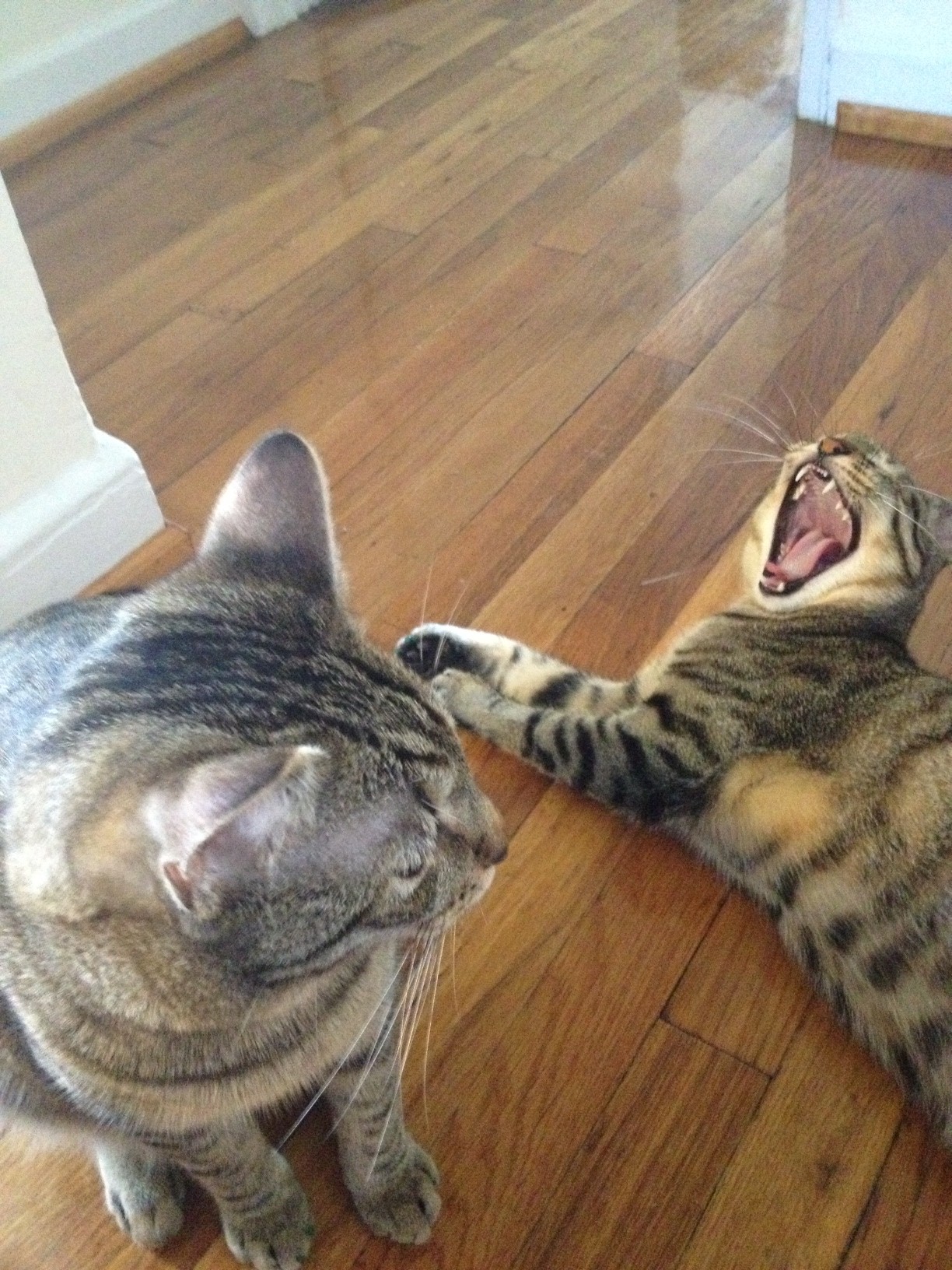
I picked this coin because it represents the Dioscuri, AKA Castor and Pollux. This also happens to be what my partner named our cats. So these are the other Dioscuri in my life:
There are lots of Dioscuri all over Roman republican coinage, especially on the most commonly produced denomination, the denarius. So when one thinks Dioscuri on coins its usually this image that comes to people’s minds:
Notice how in both representations the Dioscuri are wearing conical caps–their most distinctive attribute. This latter image is so common that its boring. Boring coins aren’t bad. In fact boring coins are really helpful because if we get too focused on the images and what the images might mean we miss all sorts of other questions. How many were made? Where were they found? When were they made? What were they used for? How were they made? The pictures are really seductive. They promise to give us answers if we can just crack their visual code, but visual codes are slippery. Slippery in the same way as language, especially poetry. Meanings get layered. They shift in the mind of the creator. They shift in the minds of audience, ancient and modern. They shift out of convenience, political expedience. They shift with cultural contexts: class, gender, political enfranchisement, age, ethnic self-identification, etc… And they layer the means up: both/and NOT either/or. There are huge tracts on semiotics and media studies and art history and more that could all be brought to bear on any numismatic image. But even if we mapped the intersections and disconnections between the dioscuri of the first coin and dioscuri of the second coin we’d be missing most what the coins can tell us. We’d be reading the coins through the history, not the history through the coins. Why is the first one cast? What type of base metal is it made out of? How does it fit into a denomination system? Why is the denominational system of the earlier period more complex that that of later periods? How is value indicated? Could the two coins be exchanges one for the other? If they are made out of different materials via different techniques and share very little markings in common, why do we want to put them under the same broad label of Republican coinage?



 Liv Mariah Yarrow