I’m grateful to Prof. Irene Soto Marín for access to Kelsey coins during the digitization process.
Who is the female figure on the reverse of the coins with legend PONTIF MAXIM?
The above reverse design with a seated female figure holding a scepter and an branch and a legend referring to the emperor in the role of Pontifex Maximus repeats on the coins of Augustus, Tiberius, and then revived under Vitellius, and Vespasian. The Vitellius aureus differs only slightly, with a shorter legend and a patera instead of a branch. RIC identifies the Vitellius reverse as Vesta and that was my first throught for the others, but Vesta is always (?) veiled. So perhaps we’d be safer reading this as a personification? Perhaps Pietas?
This is not the Papius specimen or control-mark I’m supposed to be thinking about this very moment, but I don’t want to lose this thought:
The cataloger for MZ 194 describes the reverse control mark as crossed shields and a helmet and thus as attributes of the Salii, armed priests who dance for Mars. This seems plausible but not certain. I’d like to see more crossed shields. I’m also interested if this is the cataloger’s original proposal or if it has been proposed else where. Other possibly Salii related images on the Blog.
This is a lovely specimen in the Kelsey Museum (T2009-0053; Thx Prof. Soto Marín!), but it looks funny. How am I 98.88% confident it is a 19th century imitation? Largely through comparison with images collected by Schaefer. This was made easier by the fact that Satrienus numbered his dies and thus told me exactly which dies I should be checking. A selection is given below.
My working hypothesis is that the imitation was made from casting a (relatively) well preserved specimen and then cleaning up that mold before using it for making imitations. Hubbing is also possible, but less likely.
Obverse:
The set of the eye is wrong, esp. the upper lid
There is too little detail in the hair
Lack of spiral on the helmet
Reverse:
The shape of the upper portion of the rear far leg is wrong
The fourth teat has been removed
There is too much fur on the underside of the raised front leg
There is too much fur in spikes beneath the tail
The hair at the neck has a different pattern
Fabric:
Funny Patina
Flan is much larger than most used for this series, allowing more detail than typical
Combination of soapy indistinct features suggesting wear and then very legible feature elsewhere (contrast letters and border dots).
Should the Kelsey de-accession this piece? Absolutely not.
It remains a key historical artifact; it just requires we ask different questions.. It came into the collection in a well documented fashion in the late 19th century (more on that history of the collection another time). Given that it is (near) replica of a likely genuine specimen it gives us evidence of that specimen’s existence. It also can teach us about the historical trade, manufacture, and marketing of fakes. I’m particularly interested in the metallurgy that produced this patina and whether it is distinctive enough to confirm other imitations where die comparison is inconclusive.
In this case I suspect the earnest buyer who was selecting specimens for the university while in Florence in the 1880s was an easy mark, as non-expert, with a very particular goal: selecting specimens to educate the young men of Ann Arbor.
And, in its own way it is beautiful, in fact too beautiful.
We all know emperors on Roman coins are laureate. Why? What does it mean?
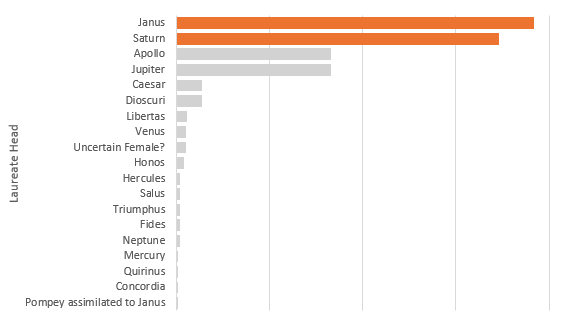
I’m trying to consider the republican evidence
These are all the individual types counted. A bad graph. It makes no difference of change over time and does not take into account differences between silver and the much more conservative bronze. Also Crawford’s numerous sub types can inflate representation.
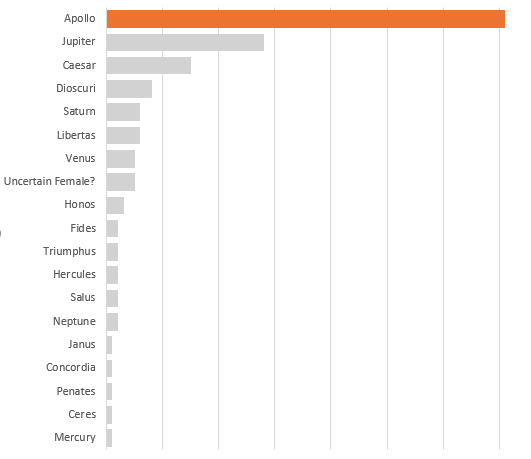
In this next Graph I removed all bronze and planned to restrict coin types to those at 146 BCE, but there are no silver or gold issues with laureate heads between 170 BCE and 119 BCE.
But I still want better data visualization. This doesn’t say anything very meaningful.
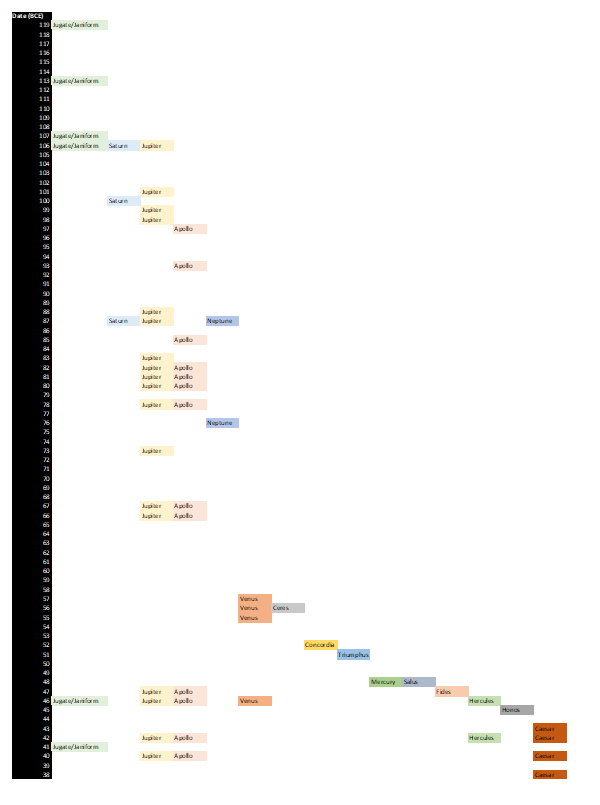
This next graph below is hard to read at this scale. But it does a better job of showing change over time. Traditional senior male gods are laureate through out the period and going back to the very start of the republic. Neptune gets to be laureate when he appears, unsurprising giving his divine status. Things only get interesting with the introduction of the laureate Venus in the mid 50s to represent Pompey’s Venus Victrix. After this minor gods or divine personification are made laureate on specific issues for reasons we may not fully understand. Caesar is only laureate after death and we should probably take it as a Roman symbol of his divine status. None of the many other living Romans who put their own portraits on the coins are depicted laureate, nor are their ancestors.
Anyway. Not earth shattering but there it is. Post Actium the future Augustus shows up on the coins laureate… I sure someone has written about that. Just wanted to see how the run up shook out.
This tweet thread on RRC 205 generated good conversation and supplementary images. I’m archiving on the blog to ensure I can find it when I next go looking.
This is a close up of the AS of Sulla's ancestor (c.151 BCE) showing a goddess in the prow stem. While one specimen doesn't define a type this one is extra clear … 1/ https://t.co/JTvZdQTU1cpic.twitter.com/ndv75UMBbL
— Liv Mariah Yarrow, (pronounced "leave") (@profyarrow) November 9, 2021
Perhaps to me the most interesting is this fitting said to be from the area of Actium in the British Museum. It measures Height: 47.50 centimetres Length: 58.42 centimetres Width: 44.45 centimetres.
The other key observation on twitter is that there are more decorated prow stems on the Roman Republican Bronzes than have been noted in the major catalogues, a point well made by Michael Davis ( @Michael24441229)
I’ve been very focused in the pre 49 BCE period. This is likely to change as my research evolves over the next few years, but I realize that I am so much less familiar with coins after that date. Even ones I ‘know’ I’ve just spent less time thinking about.
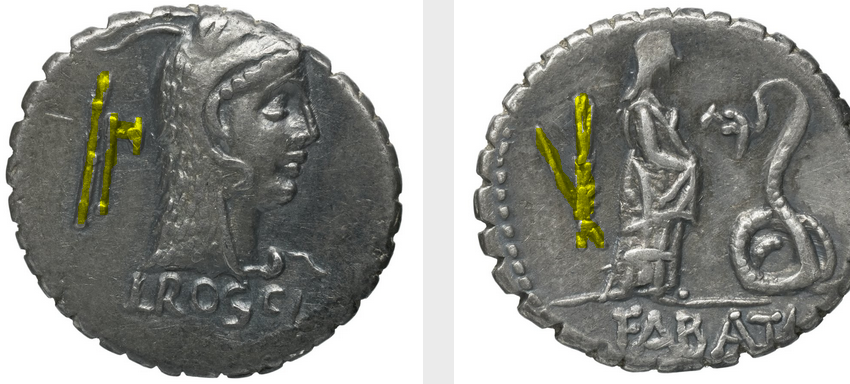
This might be completely obvious but prior to today I saw a hodge-podge of symbols on this reverse rather than a programmatic message. My blind spot was the axe. If I thought about it at all I thought it was a priestly axe as those show up on other Caesarean coins. It doesn’t look much like those priestly ones though. Instead, I now read it as the axe that has been removed from the fasces. It seems so obvious that I assume others have seen this before.
Caesar in his role as perpetual dictator has brought peace and harmony (caduceus and clasped hands) to the world (orb)–or at least an end to conflict, if I was being snarky. Civil order has been restored (fasces) and thus military authority (axe) is no longer necessary.
The reading of the clasped hands on this specific coin is discussed Cornwall 2017, 65 no. 53.
A selection of fasces with axes for comparison (see earlier post)
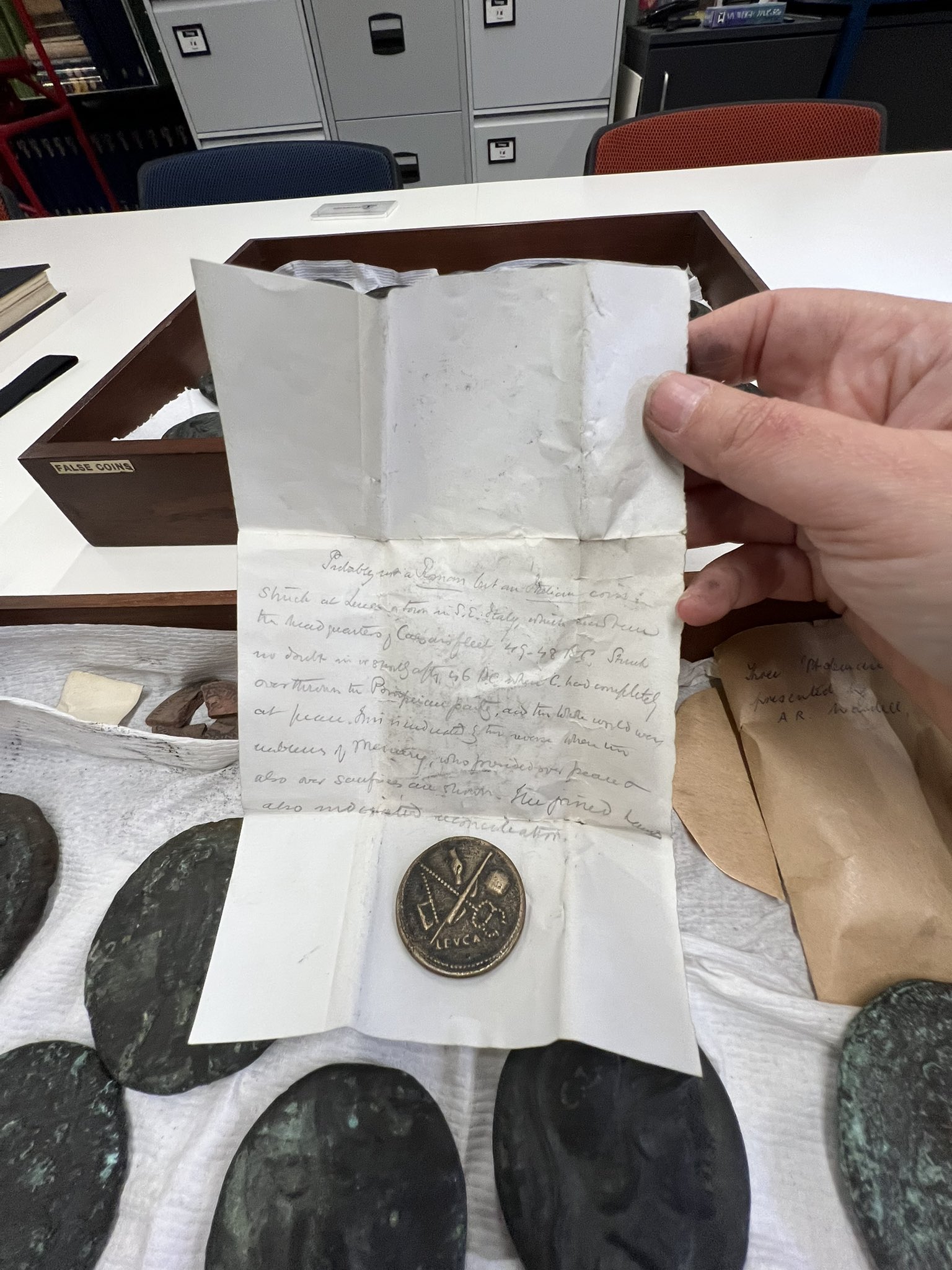
Of course I’ve been thinking about it more since discovering this Cavino specimen in Glasgow, which takes its inspiration from the denarius but associates the imagery with the events of 56 BCE and the conference at Luca:
and now I have an addition for any future edition of my book. This should have been cited in footnote 24 of chapter 4 (see pages 168 and 233).
Keaveney is a blistering invective against Wiseman’s interpretations of RRC 385/2. While it is not particularly collegial in tone, he raised some valid points and the two pieces of scholarship must be read in tandem.
BUT if I’ve read it correctly after all the criticism of Wiseman’s reading of Sullan evidence. He seems to accept there were games of Heracles and that this coin likely celebrated them. He suggests at the very end that maybe the games were not down graded because of Sulla but continued much like his ludi Victoriae. I still have no strong opinion.
I would note that Keaveney’s use of RRC 205/5 (n. 14 and corresponding text) shows a lack of awareness of Hercules as a standard god for any quadrans.
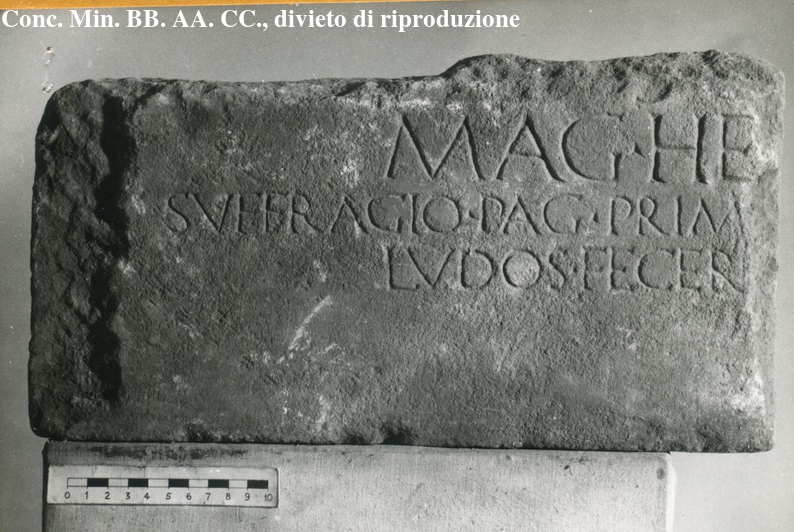
Besides the coin the certain evidence for the games includes two inscriptions
I’ve been saying I’ll publish this paper for ages. Maybe I will but no time soon based on the length of my to do list. So I’m going to add it to my blog here just so that it is available. Perhaps it will generate comment.
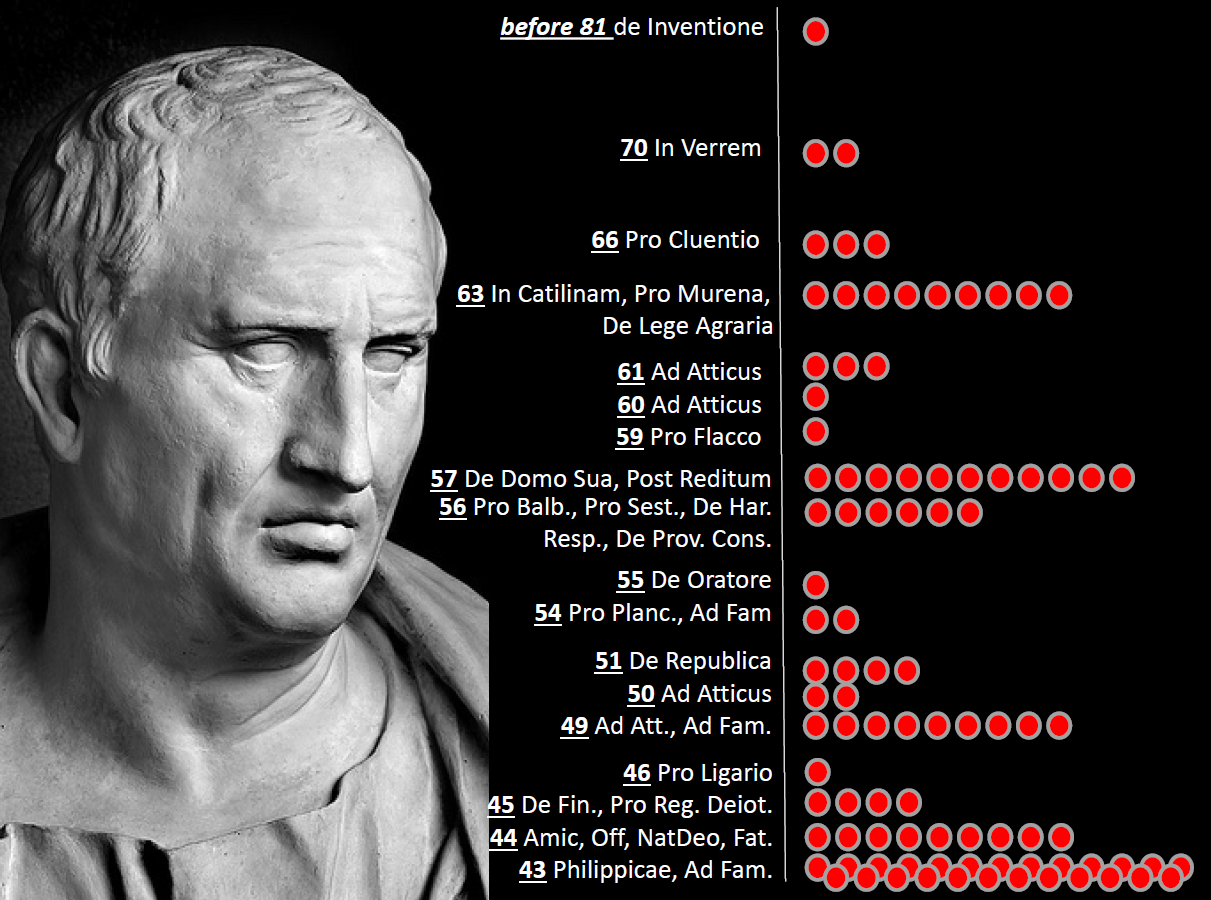
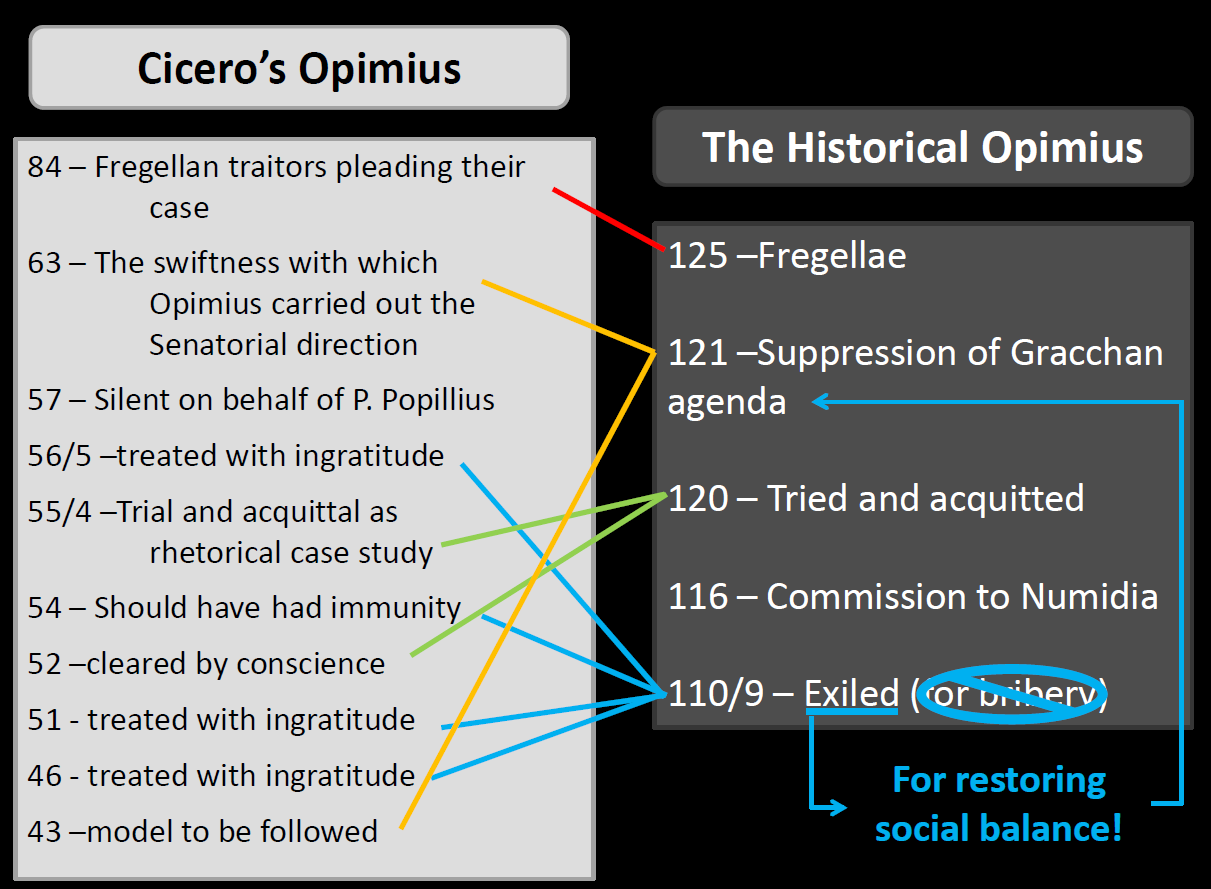
Favorite slide from the presentation of this paper. Each dot represents the use of the vocabulary of concord(ia) in a Ciceronian text.My second most favorite slide from the same talk. It shows how Cicero’s use of Opimius as an exemplum changes over time in reaction to contemporary events.






 Liv Mariah Yarrow