I have far less to say here because Woytek and Zawadzka have said so much:
Woytek, Bernhard E., and Anna Zawadzka. “Ockham’s Razor. A Structural Analysis of the Denarii of Coelius Caldus (” RRC 437″).” The Numismatic Chronicle (1966-) 176 (2016): 135-153.
Where to find in the Schaefer Archive:
437/1: Binder 8, pages 165, 172, 173 (no clippings?).
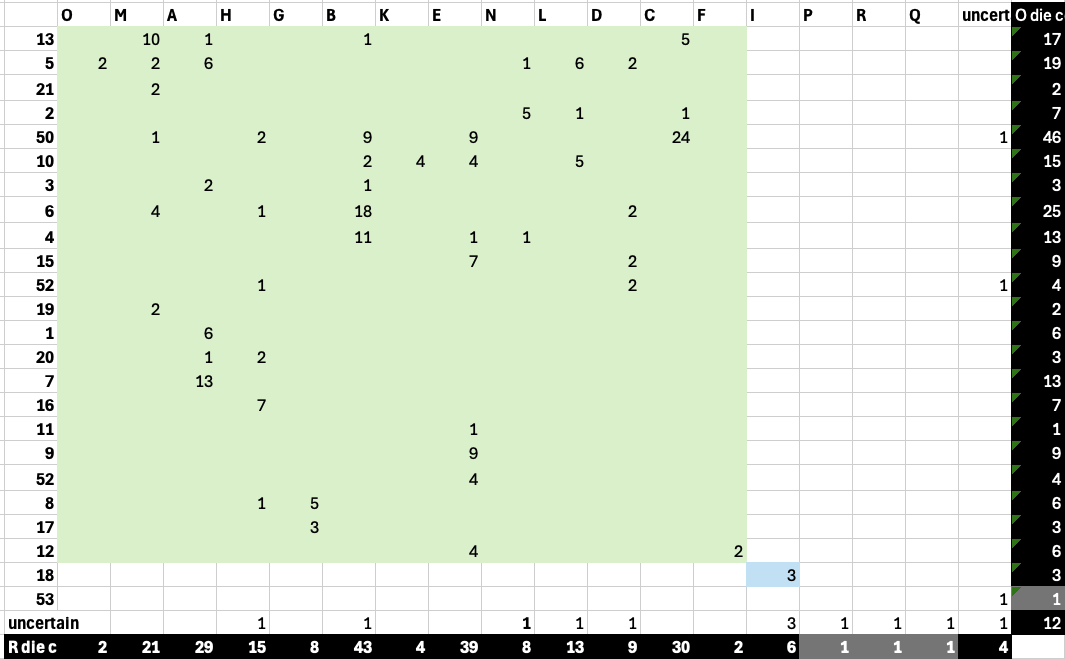
Ok. So Bigger than either of the last two issues. Here we have 23 known Obverse dies and 33 known Reverse dies. But plenty of singletons among both so not all the dies by a long shot. Crawford estimated O=33, R=37.
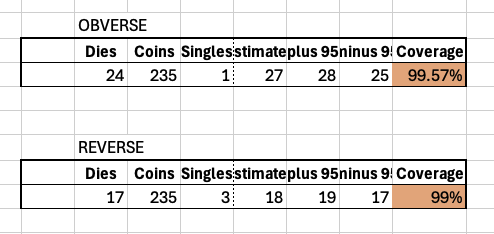
Esty’s formulae
Nicely the die links aren’t messy. There is one big cluster as you can see but always we can predict a sequence. Of course if we find more dies it might get messier, but generally speaking this is the mint working in a much more systematic way than it with the previous issue.
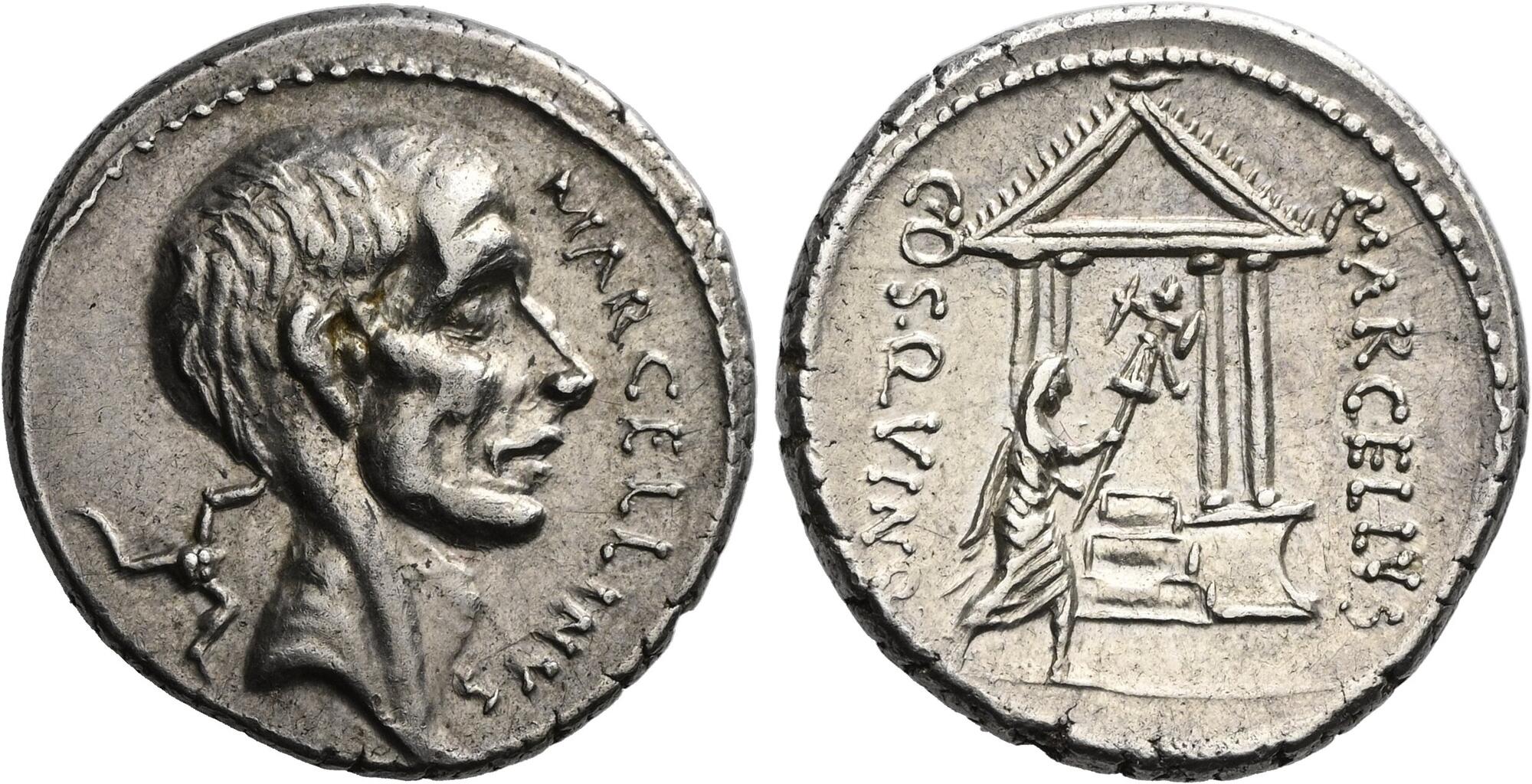
437/2: Binder 8, pages 178, 184, plus clippings in 400-499 batch. Note: Schaefer did not separate out types 3 and 4 and their subtypes but rather leaves them as part of 2.
Ok this really surprised me. I assumed mint workers working on the same issue for the same moneyer would use the same striking management approach. But oh no! They couldn’t be more different.
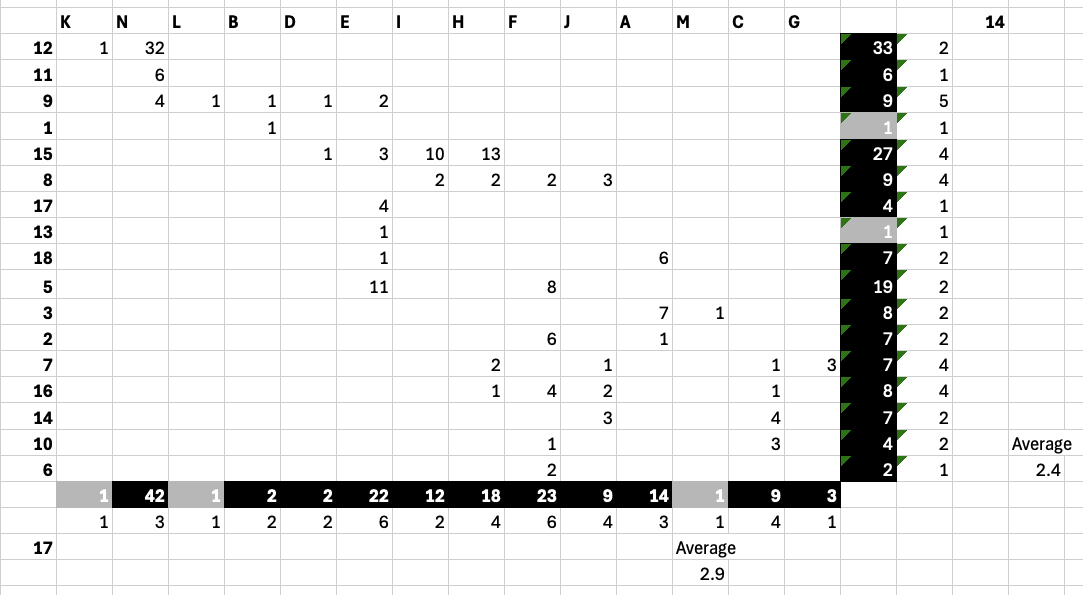
We have 17 reverse dies (the altar) and 24 ‘obverse’ dies, and except for one ‘pair’ when we have both dies identified every die is linked to every other die in some way. The other thing that feels weird or at least challenges my previous thinking is that Crawford over estimates the number of dies.
On average each obverse die links to about 2 reverse dies and each reverse die links to about 4 reverse dies. Could the altar side really be the anvil (obverse) die?
The only singletons are among the non-paired dies and could (should) be rechecked.
I’ve re arranged these rows and columns many times but not yet come up with anything that looks like a clear sequence.
Generally speaking this issue looks like it is about twice the size of RRC 436/1.
Thinking of the security of the dating of this type I’m looking at the hoards and it appearance as the ‘newest’ coin in the Casaleone Hoard has me wondering if it could (should?) move earlier in the sequence. The next newest coins are all from 54 BCE. The Brandosa Hoard (closing 49 BCE) could help with this judgement if one could compare the degree of wear.
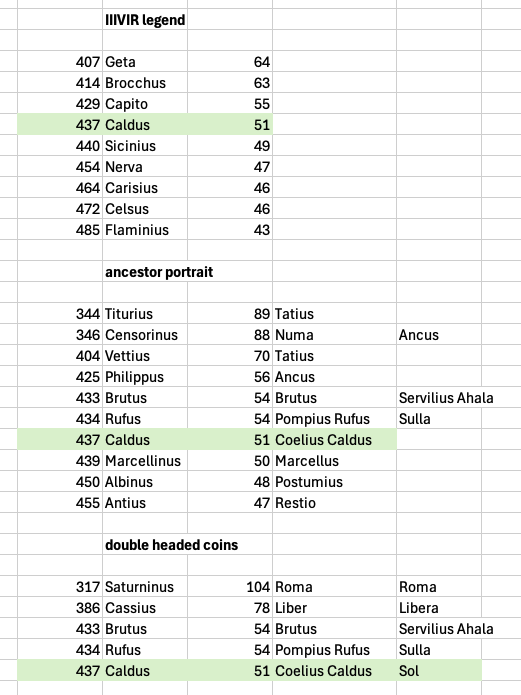
These lists need to be checked for completeness, but basically I wanted to think about features of Caldus’ coinage that connect stylistically with other choices moneyer’s make:
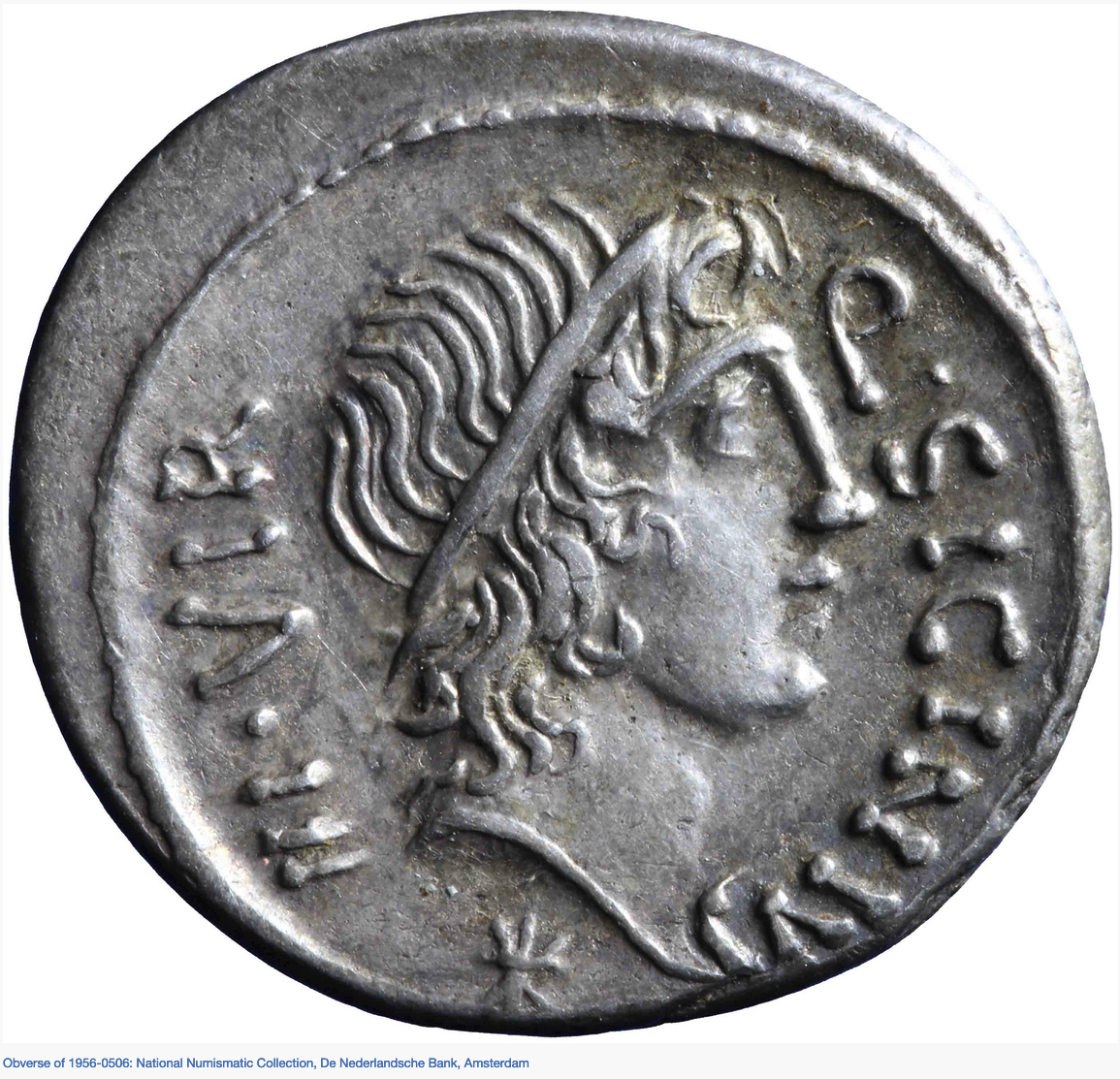
I see Caldus’ choices regarding IIIVIR and ancestor portraits and double headed coins as consistent with relative chronology that pulls him closer to Brutus, Rufus, and Capito’s choices. Rather than Marcellinus’ and Sicinius’ choices. This isn’t proof just part of my assessment of plausibility. Perhap Caldus could move back to 53?
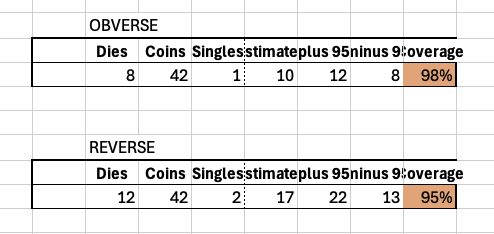
This is a very small issue we’re probably missing a couple of dies but not many. 8 obverses and 12 reverses are known.
It is the most recent coin in the La Grajuela Hoard. Again, the next newest coins are all from 54 BCE. Perhaps this is just a function of volume of striking. I wonder how much the consulship of his father has influenced the dating of the type?
This issue is likely much smaller than Crawford guessed. The Schaefer Archive only documents 17 obverses and 14 reverses.
At the most generous Etsy formula suggests at most we might be missing 4 obverse dies and 2 reverse dies. This is a much small issue than Crawford estimated.
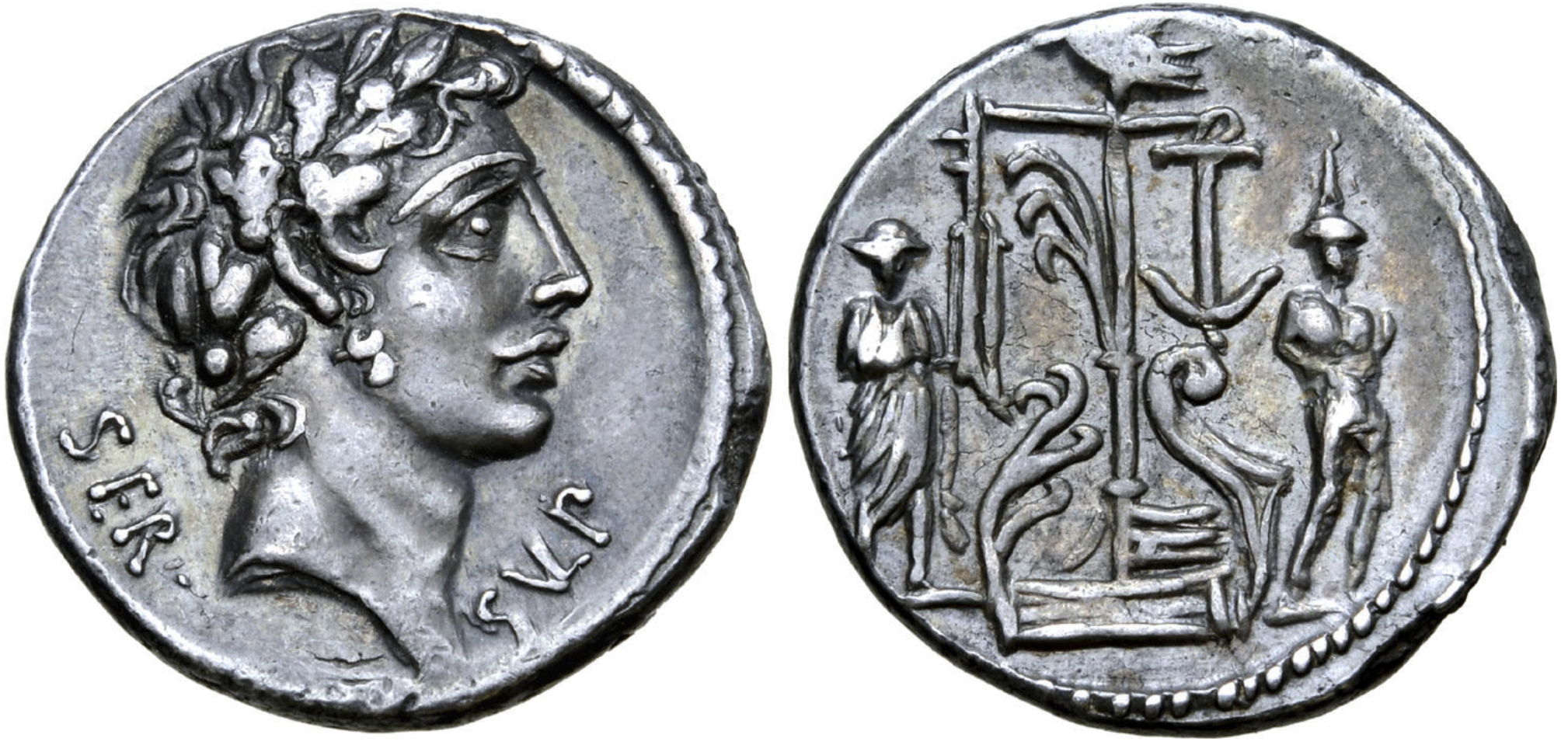
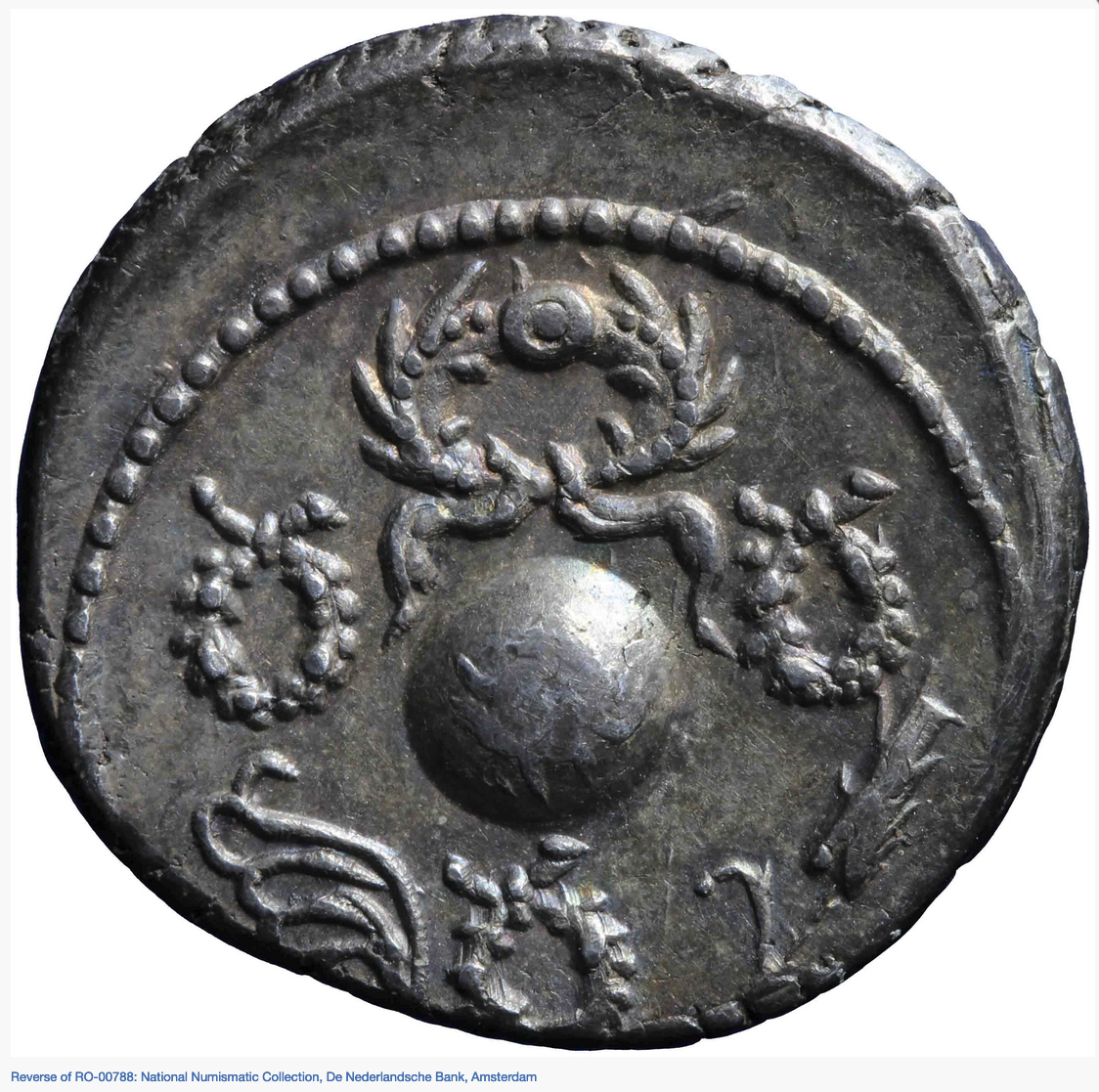
As you may notice one of these crowns is not like the others. [One of these crowns is doing its own thing… 🎶] I was certain that I’d written about this earlier on the blog. But not here. I know I wrote about it in a lost paper on Faustus I deliver versions of at Cambridge, Princeton, and the NYC Coin Club early in my career (all before 2008), but try as I might the typescripts and word docs of that paper have been lost in fried hard drives and failure to back up my work in those early years. One reason I love my blog (and dropbox). I should have another search at some point. I wonder if a printout might be in my physical files at BC…
Anyway. I chose a specimen from trade so can see all the details that often fail to show up on other more worn specimens. Notice among other things the globe has lines on it. I talk about this and other globe symbolism in a publication from 2010. These lines were first drawn to my attention by Rick Witchonke a moment of looking at his collection with him I always hold dear.
Today, my eye is concerned with the big wreath or crown. Notice it has a double band. A center ornament and prominent fillets. At first I was worried the fillet might be close to a diadem and thus worrying for regal ambitions, but diadems are distinguished from fillets by having more than one tassle at the end and sometimes a decorative band above the tassle (earlier blog post with imagery for comparision).
Crawford identifies this larger crown as the corona aurea.
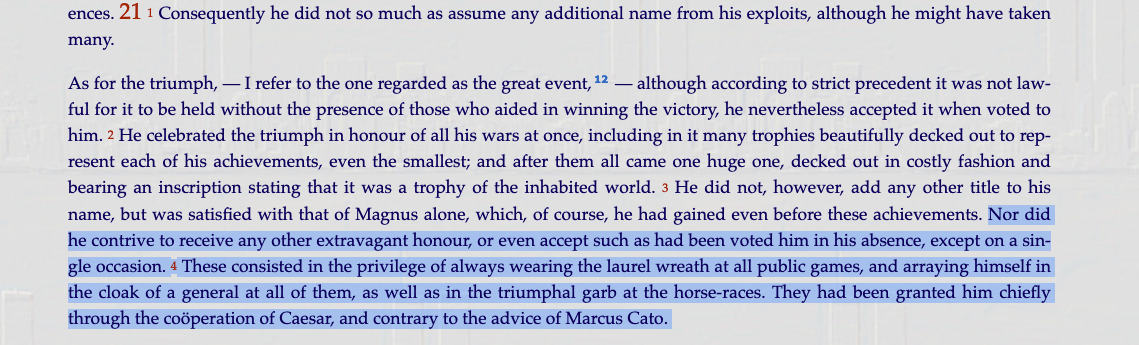
So, I have questions. This doesn’t seem like a popular move to have accepted this honor. Was it acceptable to put it on a coin? Can you have the crown and not wear it. Also isn’t this gold crown and the rest of this theater costume the sames as the triumphal costume? Why would this crown have a different iconography? Did Pompey not know the precedent set by Marius that wearing this stuff out of context makes you suspect?
So perhaps what Crawford meant was that Cicero offers proof that Pompey actually used these honors at least into 60 BCE:
Cic. Att. 1.18
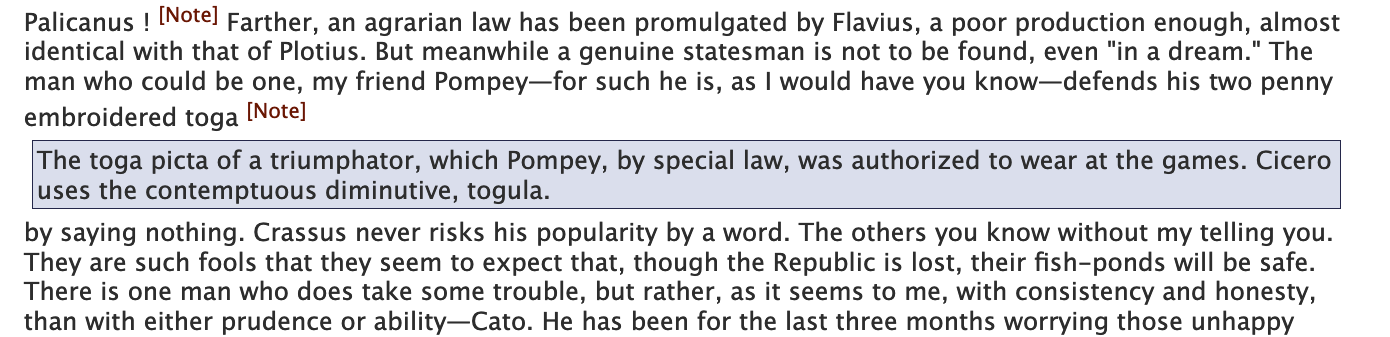
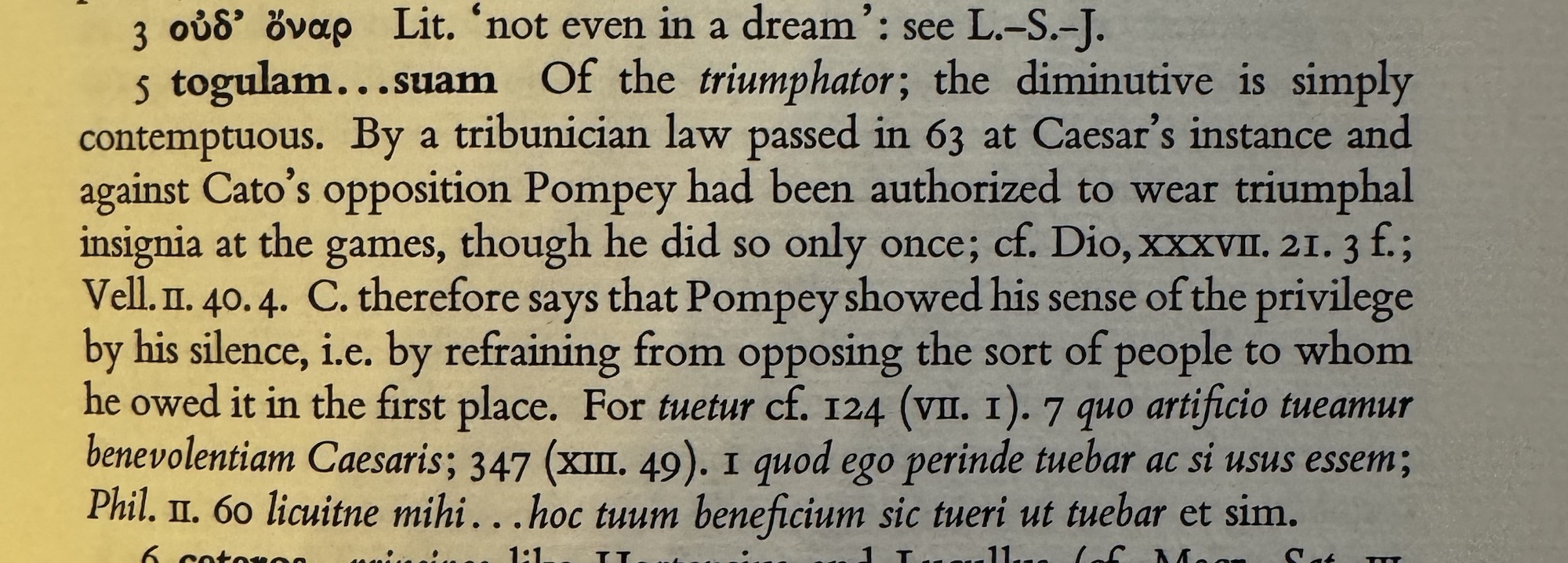
qui poterat, familiaris noster (sic est enim, volo te hoc scire) Pompeius, togulam illam pictam silentio tuetur suam
SB translation:
Shuckburgh translation with note:
SB knows his rendering of tuetur is controversial so he offers in his commentary a better justification than is typical of his free translation style.
I believe Cicero over Vellius and Dio. Pompey clearly enjoyed his symbolic honors and indulged in them.
The funny part we should not over look is that his honors were different based on where he was showing off. Laurel wreath at an ordinary ludi, but at the circus races the triumphal crown. How is this different? The circus was a place where triumphal garb was worn by the leaders of the ludi, especially in the Ludi Romani and the Ludi Apollinares (See earlier post). I have two different posts on laurel wreath crowns that may be relevant (post 1, post 2). We also have this assertion about 292 BCE in Livy:
10.47.3 This year, for the first time, those who had been crowned for their deeds in war were allowed to wear their decorations at the Ludi Romani, and then, too, for the first time, palms were given to the victors after a custom borrowed from Greece.
We only have one depiction of the triumphal costume as a costume and that from 18 BCE. Notice the center medallion in the wreath.
We have four triumphators on the reverse of republican coins: Marius (RRC 326/1), Anonymous (RRC 358/1), Sulla (RRC 367) and Pompey (RRC 402/1). They all could be wearing laurel crowns but in no case is it distinct enough to really see. What is clear is the variety of things being held types of different branches (probably palm and laurel), caduceus, possibly a scepter… These traditions of representation and probably ritual could evolve.
On some die variations though. Pompey’s big crown looks a great deal like triumphal crown of 18 BCE.
Why emphasize this one crown more than the triumphs? Aren’t the triumphs a bigger honor? Maybe it is as SB suggested that the one voted on by the people spoke to Pompey’s popularity more than his senatorial support.
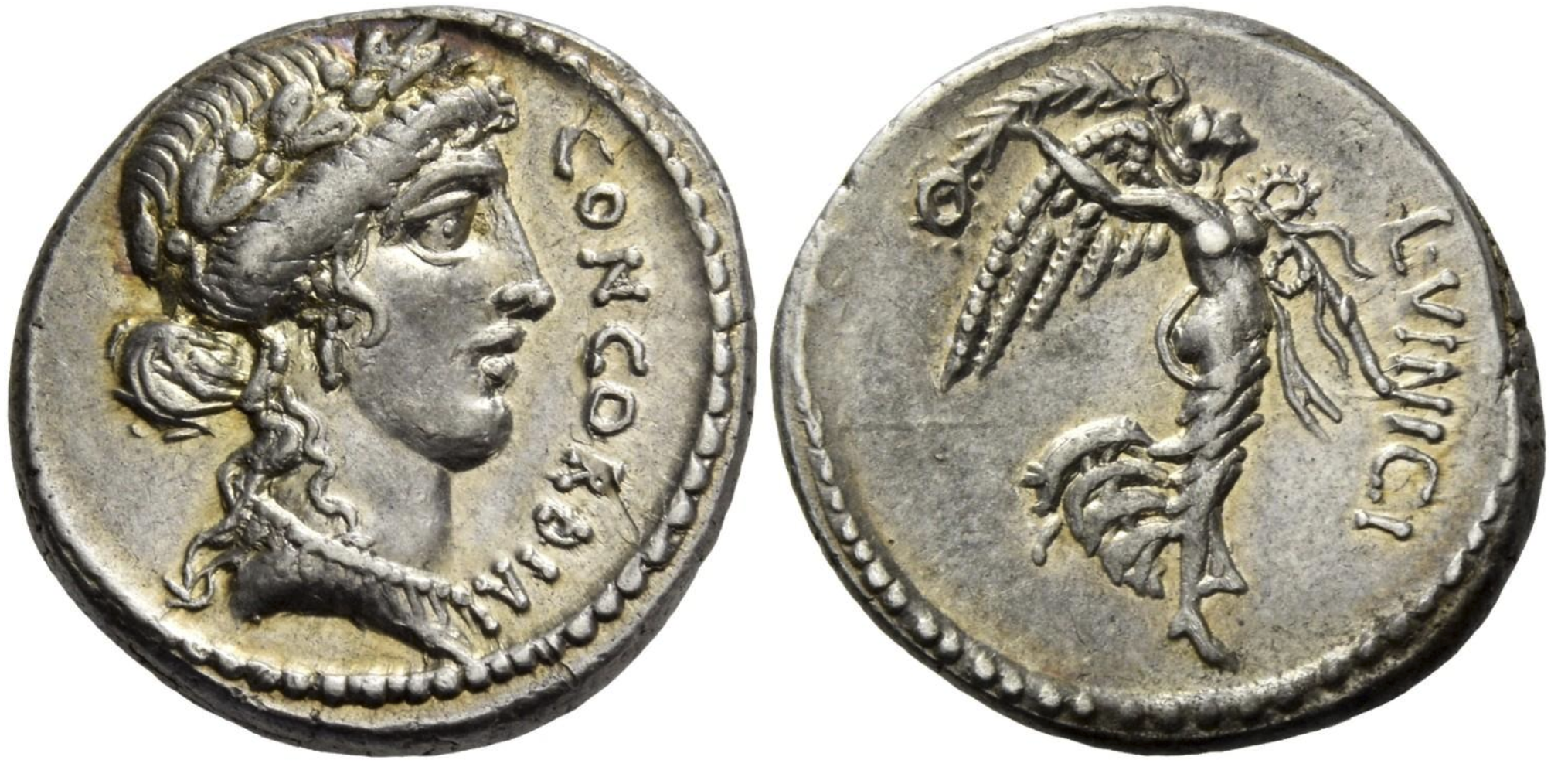
Wowza. I’ve been writing for a long time and am still no where close to getting to my original question, how sure are we that the four wreaths on Vinicius’ coin are for Pompey…
I decided to spend some time looking very carefully at the dies. There are 12 of both obverse and reverse.
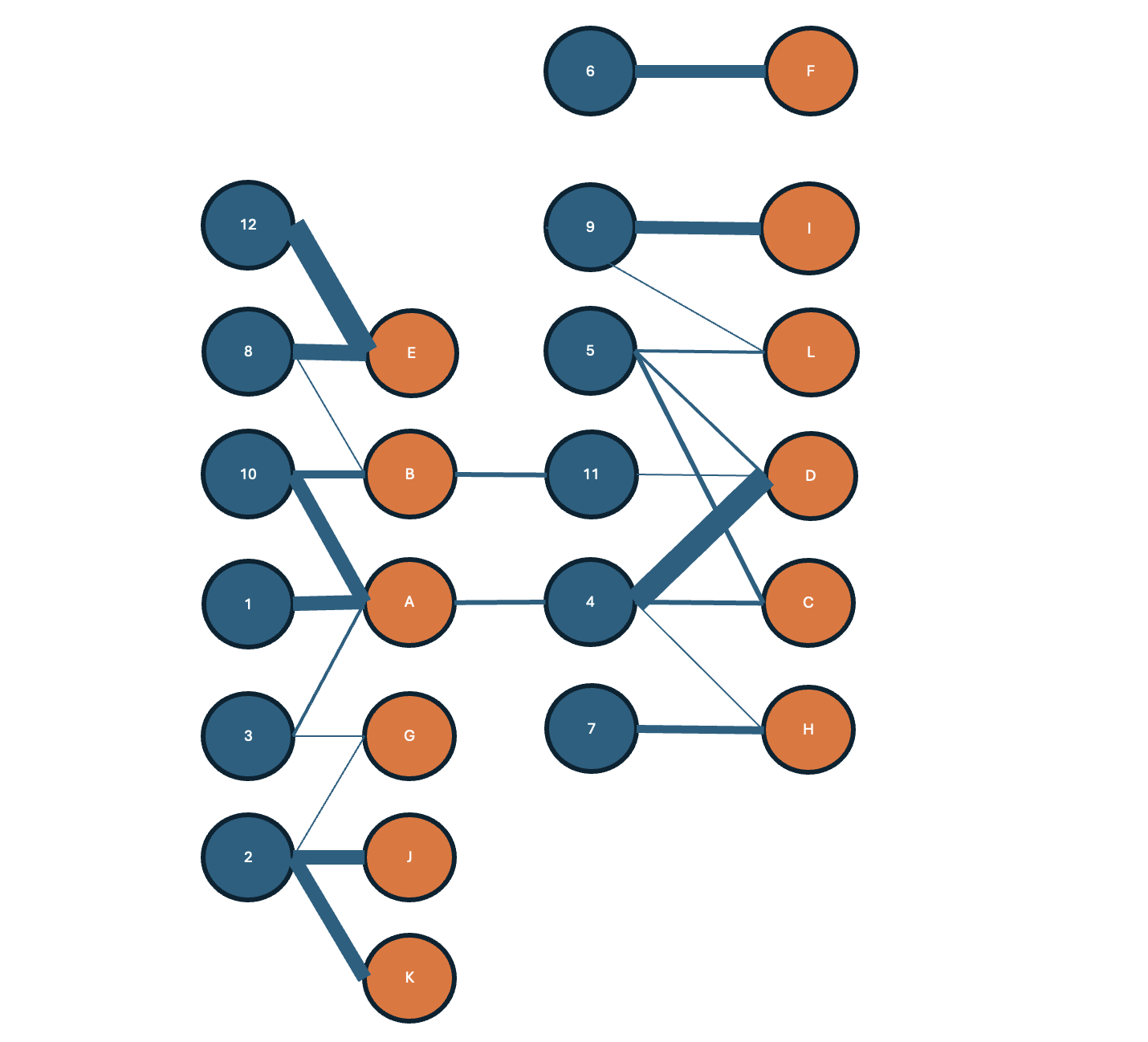
I wasted time drawing this. Unlike many RR issues their doesn’t seem to be much ‘pairing’ of dies, even if they do still seem to use an equal number of obverse and reverse dies. In the process of looking at all the specimens collected by Schaefer, I’ve decided it is super hard to tell if any one wreath is supposed to be different than the other three. At first I thought that the one closest to the stomach of Victory might have extra prominent fillets but the one above that near her breast also have fillets at least on some dies. I could almost confince myself that the one hanging off the palm branch end was the most significant but not really.
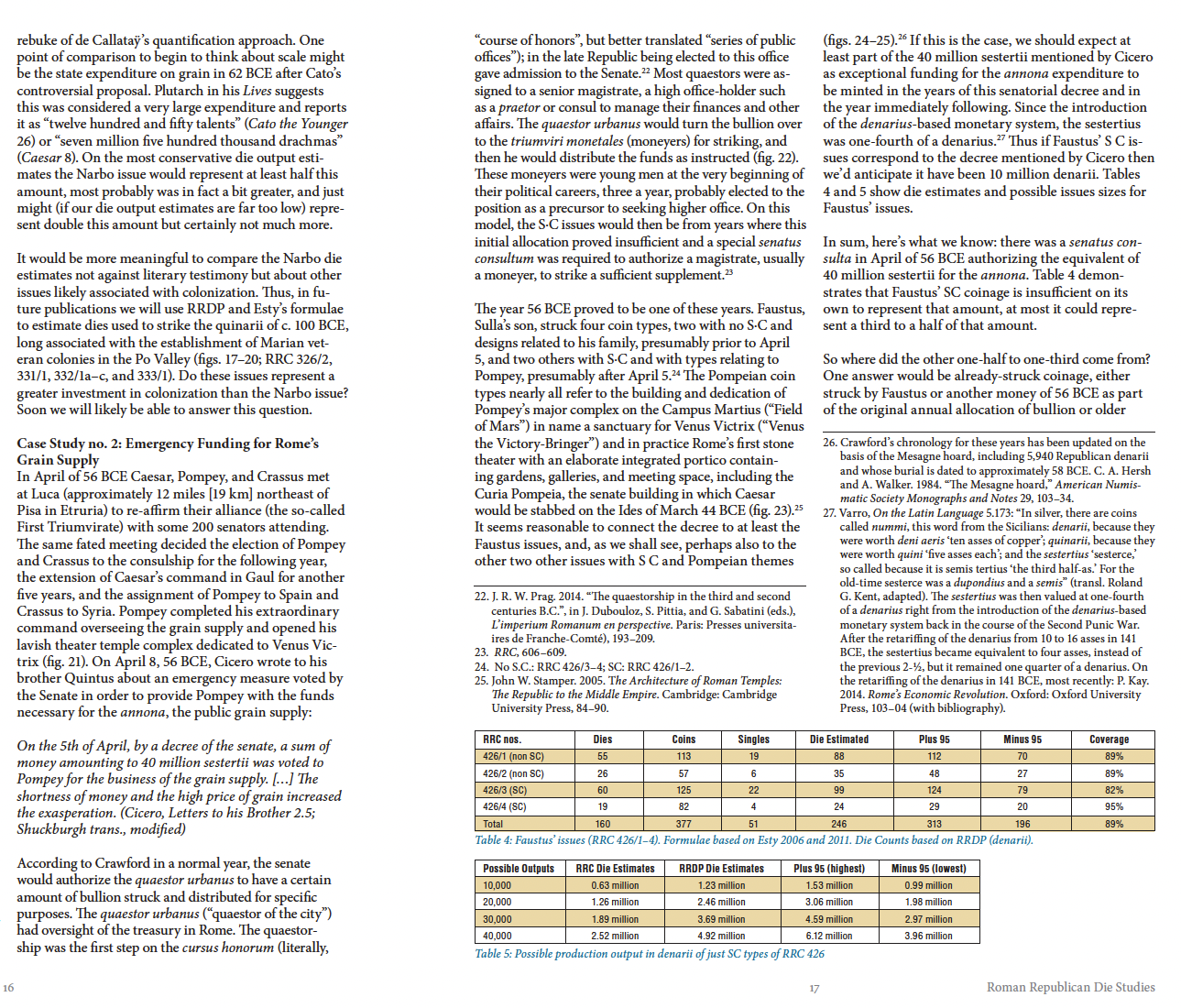
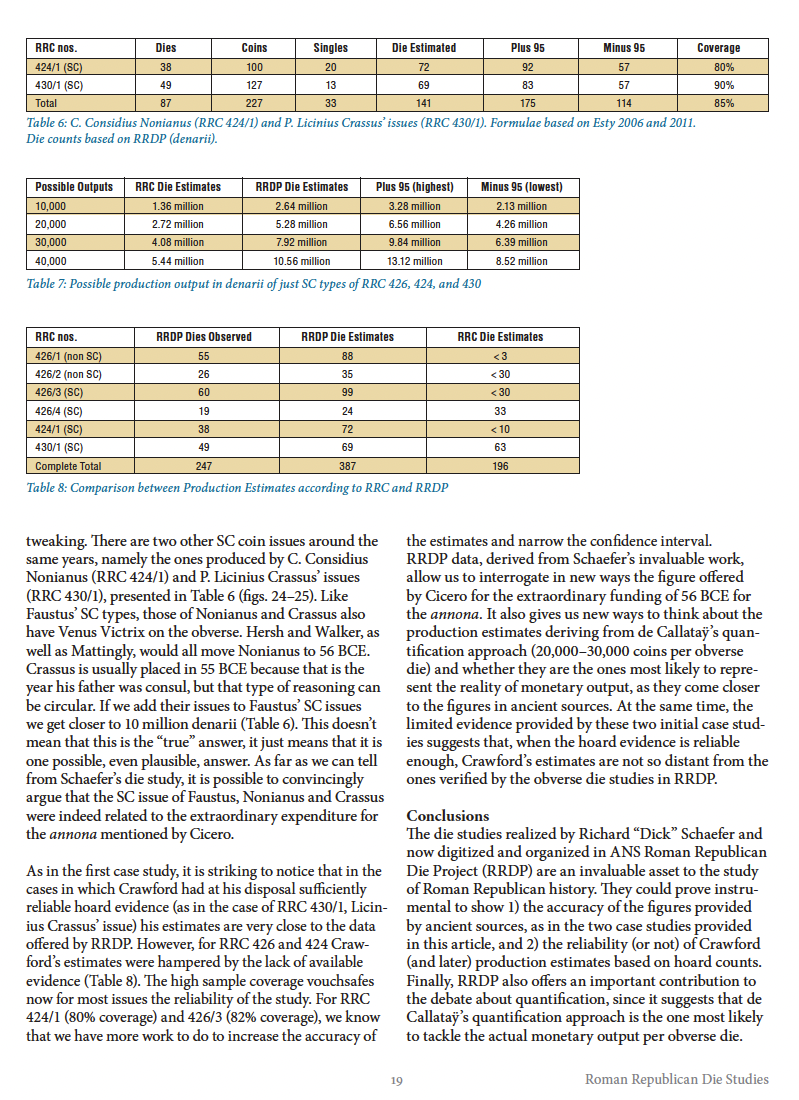
This issue is slightly larger than Messala’s from yesterday’s post. It represents something more than 120,000 denarii and certainly much less than 450,000 denarii. For context, this would plausibly be about the same amount of monetary value as Cicero owed Caesar in the next year 800k in sestertii (4 sestertii per denarius). [Charts on die counts and pair counts at end of this post.]
I worry this is a case of best prosopographical and iconographic fit…Vinicius is Tribune of the Plebs in 51 BCE so his coinage MUST be earlier seems to be part of the logic. But cast your mind back to my musing from about two months ago on how Vibius after being a Caesarean tribune in 51 BCE stays in the city and serves as money AFTER his tribunate.
Is it that there is no room for Vinicius in the Caesarian colleges?
49 – Sicinius, Mn. Acilius (not Nerius who is urban Quaestor), missing moneyer
48 – Pansa, Albinus, (joint issue), Saserna
47 – Plancus, Nerva, Restio
46 – Cordius, Carisius, Paetus
45 – Celsus, Palikanus, Asiculus
44 – FOUR AAAFF
That is pretty damn tight. Why would I want to run the thought experiment? Largely because in April of 46 Julius Caesar celebrated his own quadruple triumph. Four wreaths… And and even concordia could be a celebration of the end of civil war…
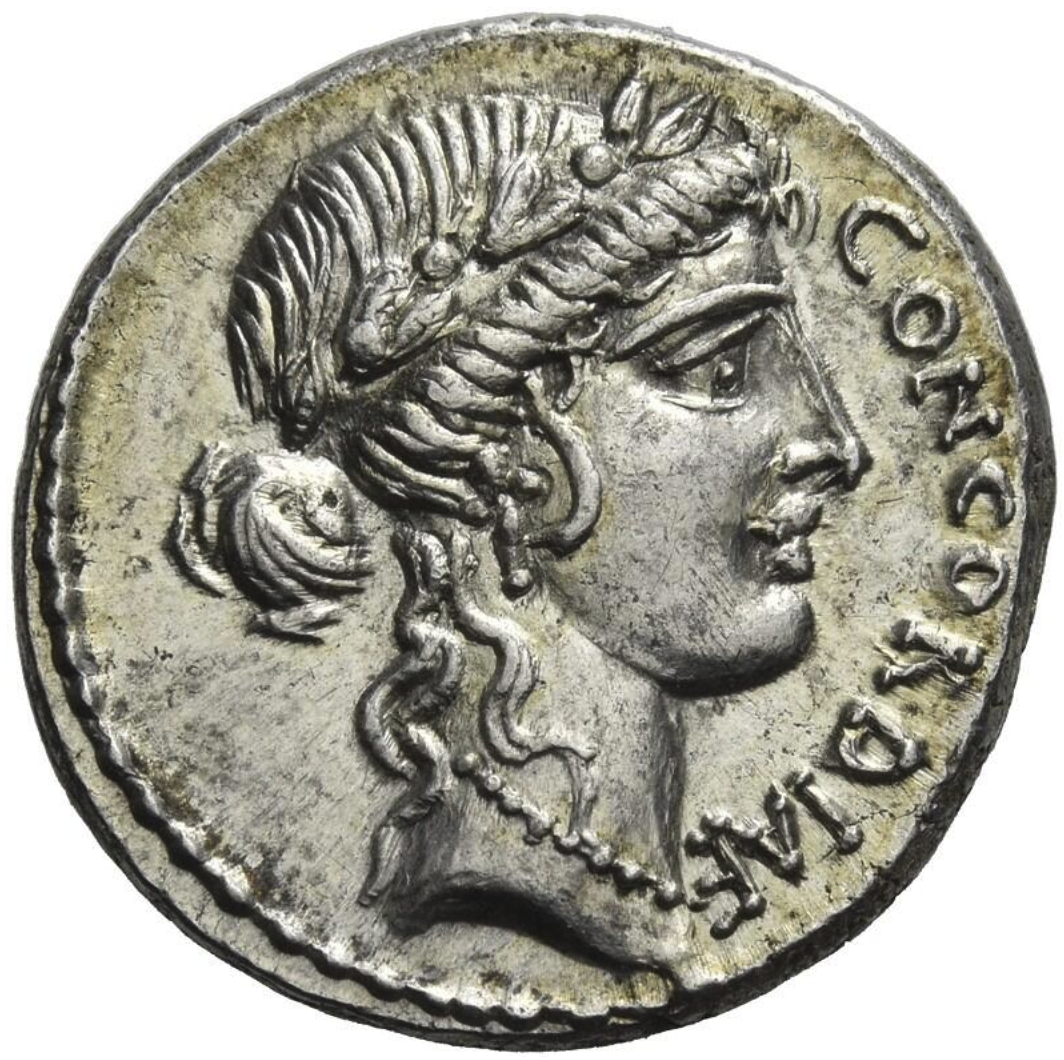
But we have one more clue. The case of the obverse legend. It is never in the nominative as is typical of labels instead it is in the DATIVE. To-For Concord. The depiction of the goddess is indistinguishable without the words from Venus Victrix.
Right. I found it hard to walk away from my thinking about the 50s yesterday but that is a good thing. It helps the work start easier today. It is the above quote (see last post for citation) that really got me spinning.
If there is any one who could tell you about mint production in these years it should be me and my research partner Lucia Carbone on RRDP. Thanks to the Schaefer Archive we’ve got bucket loads of die data and we have Lockyear’s correspondence analysis of hoards to let us think more about dating.
Part of me wants to pivot fast from Cicero and dive into this work now. I think that is a very bad idea.
So what are my first reactions.
Crawford was hesitant to assign many moneyers to the years 53, 52, 51, and 50.
55 and 54 have pretty ample coinages just at a glance, regardless if you accept Hollstein’s modifications of dating–putting RRC 434 (Pompeius Rufus) back to 55 and moving RRC 429 (Fonteius Capito) up to 54. The last really massive issue was RRC 425 (Philippus), well over 400 dies if not 500. Hersh Walker put that in 57, Mattingly in 58, and Hollstein affirms Crawford 56 dating. When I say 55 and 54 had ample coinages we’re talking multiple moneyers with issues using over 100 dies. Generally speaking with RRDP we’ve found Crawford’s die estimate low but reasonable relative measures. You can safely use them to compare the size of one issue to another but not for absolute quantification.
Likewise, Crawford isn’t always on point (nor is anyone else yet) with absolute dates, but we need a good reason to change his relative chronology. The main reason people have rearranged the dates of these coins in the 50s is the so-called Mesagne Hoard, but I have good reason to worry about at least some aspects of the reporting of this hoard. I am not ready to get into that either.
So what am I more confident about.
RRC 435 (Messala – one of my all time favorite coins) MUST be in 53 BCE so that gives us something concrete. Why? It says PATRE COS. My father is consul. That didn’t happen until July 53 BCE and ended on Jan 1 52 BCE. Unfortunately it is a tiny issue. And in this case Crawford over estimated the number of dies he’d failed to see. Probably because the issue was over represented in collections due to its historical interest — this is speculation! Don’t quote me on it.
Schaefer’s Archive data transcribed:
Die Pair
Binder
Clippings
Total
1:A
6
8
14
2:B
10
5
15
3:F
6
4
10
4:D
2
0
2
4:G
3
1
4
5:E
5
0
5
6:B
0
1
1
6:C
4
4
8
7:H
3
0
3
OBVERSE DIE
COUNT
REVERSE DIE
COUNT
1
14
A
14
2
15
B
15
3
10
C
8
4
6
D
2
5
5
E
5
6
9
F
10
7
3
G
4
H
3
Notice that only one reverse die is shared by two obverse ties. And that in the other case of one obverse die having two reverse dies that is the only die link for each of those reverses. This fits the general pattern of the Roman mint in the late republic to typically pair obverse and reverse dies but to occasionally replace them as needed. Also notice that we have NO singletons. Even Reverse D is known from 2 examples and No obverse is known from less than 3 specimens. Another dies or two might turn up but this is generally speaking excellent coverage. If we want to quantify we can say it is almost certainly an issue larger than 80k and well under 300k = small and of no great importance to the coin supply.
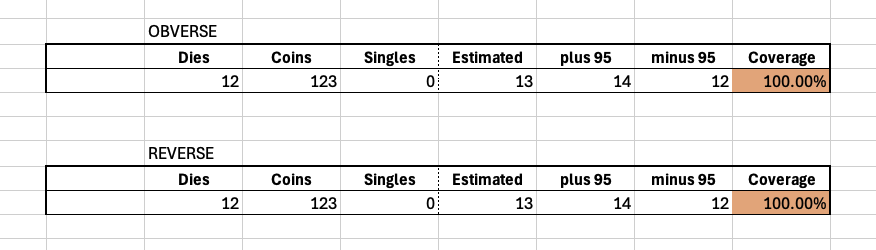
Esty Formulae applied
Weirdly it is an SC issue. This means, we think, that it was issued in addition to any authorization to coin money in the regular course of the year (What I think SC means and why). What does it mean to have striking authorized by SC but presumably no other senatorial authorization for the year? I’m interested in these authorizations of funding and the connection for the coinage also because in 51 BCE Cicero seems to be waiting for his own funding authorization (A.5.4: 12 May 51).
Here for once SB’s commentary is helpful, detailed, and logical:
Since the discovery of the so-called Mesagne Hoard, RRC 423, has been moved later in the relative sequence of the Roman republican series. Hollstein suggested 54, Hersh/Walker and Mattingly agree on 53. If this true it looks like a normal monetary issue that would have preceded the small Messalla issue–ball park 100 dies. Not huge but not nothing and certainly a relatively reasonable amount for an annual striking. Could the supposed coin shortage just be an illusion of our poor previous knowledge of the relative and absolute chronologies?
So RRC 435 does show up in hoards. The earliest being dated to 49 BCE and from the outskirts of Rome–CHRR BRA or 352 originally published here:
Pavini Rosati, Franco. “Rispostigli di denari repubblicani del Museo Nazionale Romano.” Annali dell’Instituto Italiano di Numismatica 4 (1957): 79-108. [ILL requested]
Because I’m a glutton for punishment I went through and recorded the types in the hoard with our updated dates post Crawford and then graphed them.
One hoard is never a perfect proxy for anything but this hoard is fairly large documents most years if not all types going back to the 140s. I thought it might be ‘good to think with’. The masses of striking during the Social Wars and unrest of the Cinnan regime and Sullan dominate are in full evidence. As more coins have been down dated from the 60s to the 50s it looks like there was a drop off in production during the late 70s and early 60s. Something like our presumed drop off in the 90s after the production bump during the rise of Marius and his military exploits. Here’s the same data graphed by year so you can better see the ebbs and flows:
Boccardi, Simone, Valentina Caffieri, and Sara Guiati. “Roma, Museo Nazionale Romano. Il ripostiglio da Rio Marina (1901), III-I sec. aC.” BOLLETTINO DI NUMISMATICA. MONOGRAFIE 60 (2021): 27-139. [Free to download via Google Scholar, I have on file] This article looks at hoards closing at c. 70 BCE and the same drop offs are visible in all the graphs. Backendorf, Dirk. Römische Münzschätze des zweiten und ersten Jahrhunderts v. Chr. vom italienischen Festland. Mann, 1998. Has similar graphs at the back of his big book.
What is new if anything is the idea that the Romans responded again from the late 60s onwards in increasing coin production and we cannot necessarily attribute a drop off in striking in 52,51, and 50 to to a monetary or cash flow crisis. Like all people the Romans has as much of an emotional relationship to economics as they did a logical one. Generalities about the state of things in literary texts must be balanced against physical evidence where ever possible.
To be continued but I’m going to stop for a bit. Get dinner cooking and then comeback to see if I have another post in me.
An after thought. The Brandosa hoard makes me question whether RRC 444 was really struck with a mint moving with Pompey as Crawford suggests.
And, no surprise, Woytek in Arma et Nummi p. 94-95 came to basically the same conclusion for much the same reason. 49 BCE is the right year but RRC 444 and RRC 440 were both made at Rome BEFORE the Pompeian faction abandoned the city.
Ok. This isn’t a real post. It is just a convenient link for me to use when I want to cite myself on this topic. I may add to it as and when my thinking changes.
FROM: Yarrow, Liv Mariah. The Roman Republic to 49 BCE: Using Coins as Sources. Cambridge University Press, 2021.
Before the book came out I said much the same thing in an article Lucia Carbone and I wrote:
I was taught to investigate all primary evidence and formulate my own ideas before turning to the secondary literature. Then if I find something agrees with me I know my thinking is likely sound or at least based on similar logical deductions. If I find what I disagree with, I must then use those contrary conclusions to challenge my own thinking.
I’m finding this article challenging. Even though I and the author are reading mostly the same evidence…
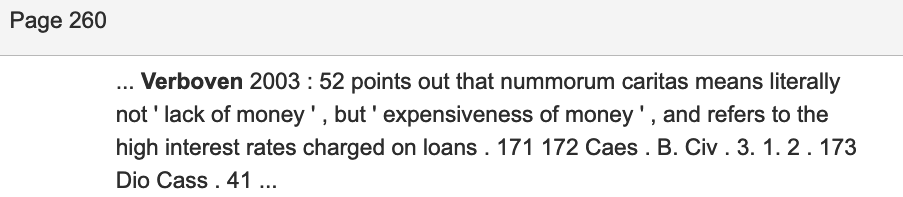
Verboven, Koenraad. “54-44 BCE. Financial or monetary crisis?.” In Credito e Moneta nel Mondo Romano, pp. 49-68. Edipuglia, 2003.
I thought best to see how others have received it. I’ve been going through the citations of the paper in later scholarship via Google scholar. Usually it is cited without comment or actual engagement. Sometimes listed in bibliographies without being even mentioned in the paper or footnotes. Those are of no use to me. It is just name dropping. (I do this too in my writing but it is v uninteresting). Below I collect a list of little snippets of deeper engagement but where it is only for a small point.
The first to peak any real interest from me was:
Collins, Andrew, and John Walsh. “Debt deflationary crisis in the late Roman Republic.” Ancient Society (2015): 125-170.
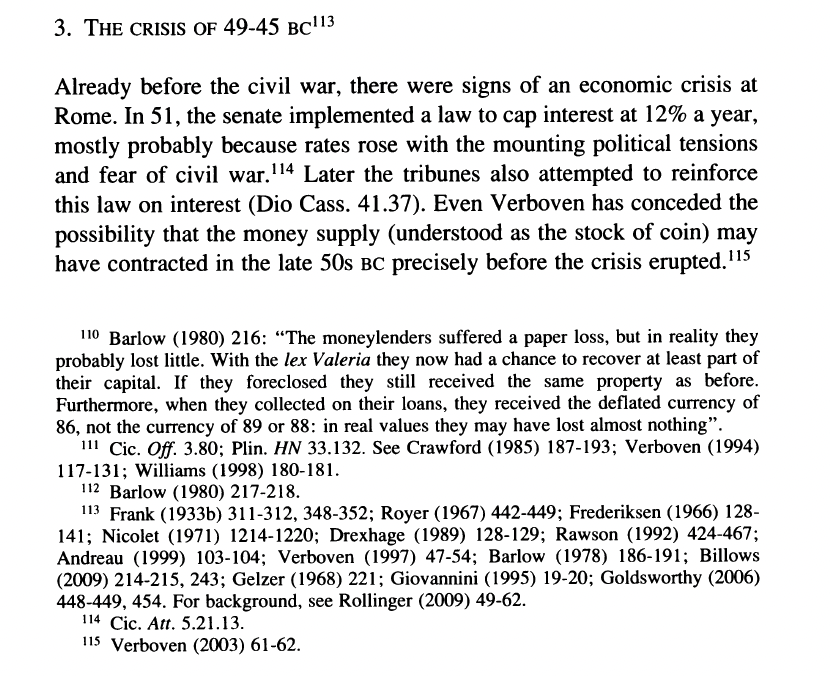
Negotiable debt instruments as a form of credit money makes lots of sense to me based on what I read in my Roman sources. What I notice however is that Collins and Walsh start their crisis in 49, NOT 54. I think my problem is that i don’t really believe the crisis started in 54 but rather that conditions were ripen for the crisis in the 5 years before 49. And my interest in 51-50 is just at the tail end before the crisis itself.
So now we come to the kicker: Does Cic. Att. 5.2.13 say what it is presumed here and by others to say? That interest rates were capped because they were sky-rocketing in relation to political tensions. This is not how I naturally read the episode or senatorial motivations. Let’s look at it together.
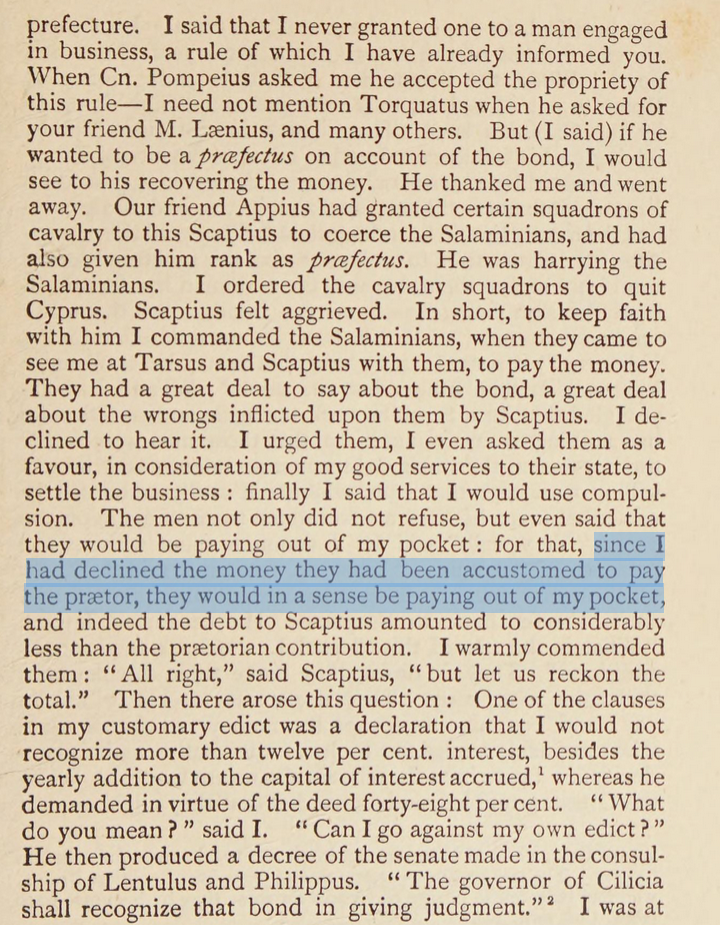
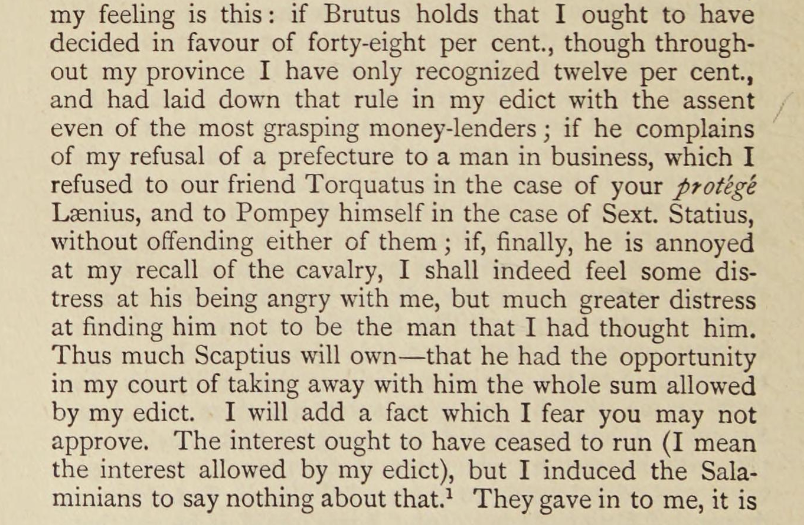
The Salmatians are ready to pay with 12% interest (in our terms which is APR, but 1% MPR in ancient reckoning). Scaptius, Brutus’ agent, objects and want 48% APR (4% MPR – quaternas in the Latin). Cicero says he wrote his edict to not allow such interest gouging in his province and his province alone. Scaptius counters with a SC from 56 BCE that says that the debt should be upheld by the governor as written. Cicero discovers there were two SCs from 56 BCE. The SC Scaptius envokes allowed a 4% interest, but wasn’t legal because of a lex Gabinia.
What is this lex Gabinia? Either it was passed in 67 (a plebicite) or 58 (consular lex). It is only known from this letter and A.6.2.7. It seems to have made invalid loans raised at Rome by provincial communities (whether this effected provincials more generally is unclear). The loan could be declared invalid and the parties fined. The first SC tried to give an exception, but Cicero judges that it insufficent:
at postea venit in mentem faeneratoribus nihil se iuvare illud senatus consultum, quod ex syngrapha ius dici lex Gabinia vetaret.
The second SC description is lost in the corrupt text. I find SB’s reconstruction plausible. That it allowed the loan but didn’t differentiate from other loans.
Cicero continues that Atticus must make Brutus see all of this. To support his judgement he invokes a recent decision of the Senate:
praesertim cum senatus consultum modo factum sit (puto, postquam tu es profectus) in creditorum causa ut centesimae perpetuo faenore ducerentur.
“especially as a senatorial decree has just been passed—I think since you left town—in the matter of money-lenders, that twelve per cent. simple interest was to be the rate.” (Shuckburgh)
“especially as the Senate recently passed a decree for creditors, after you left Rome, I think, fixing 1 percent simple interest as the legal rate.” (SB)
We are clearly missing some context though. If this was going to directly effect either Atticus or Cicero’s own finances he wouldn’t be so flippant in his summary of Lucceius’ judgement. Lucceius is likely Pompey’s agent in Cilicia and the one tasked with extracting payments from his debtors:
Cicero seems to be laughing at the idea that this measure could be compared to a general debt cancellation. He also seems to find the idea that payment delays were such a terrible blow to the state.
In all the other references to loans this SC does not come up again. Like the lex Gabinia it shows senatorial interest in the economy, but we just don’t know to whom it applied. We also see that from SCs of 56 BCE about the Salmatians that the Senate is delightfully fickle in these judgements and happy to make exceptions.
Dio 41.37 is often invoked as a continuation of what Cicero reports as an aside in A.5.21:
Caesar takes action because the tribunes couldn’t get a lower interest rate to work. This isn’t an enforcing of an old law, this is a new tribunician action. μετριάζω means to regulate or moderate not to enforce. The problem according to Dio is that creditors would rather forfeit securities than pay and the creditors were demanding physical coin and not accepting securities. 49 was a cash hungry year. That is not the case in 51 or even early 50.
García Morcillo, Marta. “Mentality, motivation, and economic decision‐making in Ancient Rome: Cicero and Tullia’s shrine.” The Economic History Review 73, no. 3 (2020): 623-643.
Silver, M., 2011. Finding the Roman Empire’s disappeared deposit bankers. Historia: Zeitschrift für Alte Geschichte, pp.301-327. [but no page 9! in this article]
Woytek, Bernhard E. “Monetary innovation in ancient Rome: the Republic and its legacy.” In Explaining monetary and financial innovation: A historical analysis, pp. 197-226. Cham: Springer International Publishing, 2014.
Still to be checked; ILL requested:
Harris, William V. “Credit-money in the Roman economy.” Klio 101, no. 1 (2019): 158-189.
Romano Sicilian issues, including Apollo/two ears of grain, C Alio Bala, and more … Binder 14, page 226; Janus/monogram in wreath, p. 225; bearded god head left/standing warrior, bacchus on pig/mercury, possible overstrike on Copia coinage, p. 224, Janus/ACILI, p. 218, 219
Ok. I have finished my careful reread of Cicero’s letters between May 51 and November 50. This takes him from the outskirts of Rome to the far side of Cilicia and back again. He’s waiting for a triumph so he’s hanging out in December onwards outside the city but still in closer distance. He’s still corresponding but for all intensive he’s back in the swing of local politics, which are hot, very hot. We’re getting close to the Rubicon and the casting of die. Part of me wants to keep reading but a great deal more of me needs now to look away. Like turning off the news when the world all becomes to much. How I love the republic. How a hate its failures.
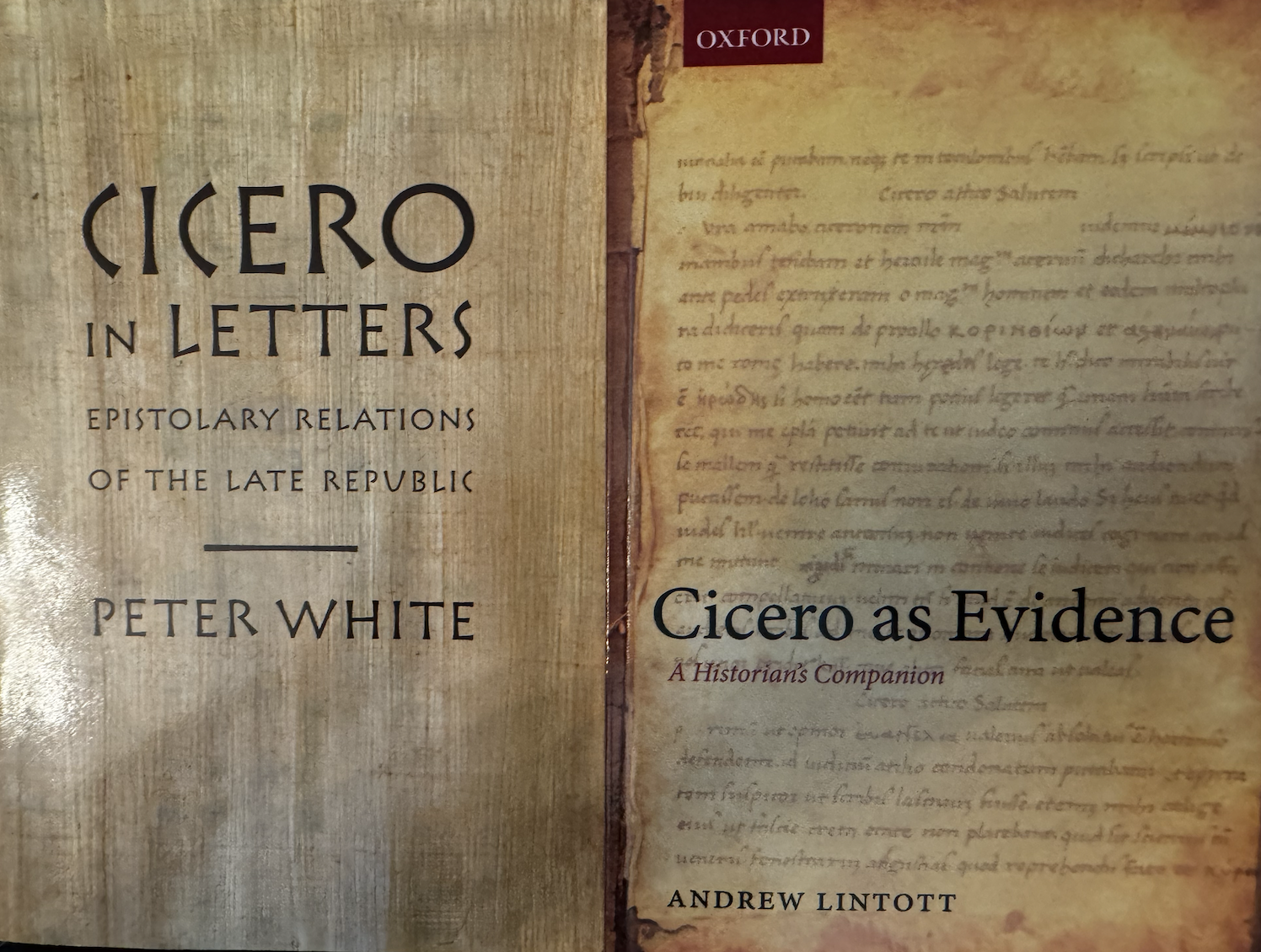
Now the task is to take my notes and start to decide what I think and to what degree is is similar to my previous thoughts. I’ve very intentionally not opened my past powerpoints for fear of trying shove my new work into stale thinking. My impression without a full review of my notes is that I found less than I thought I would. My other great impression is how greatly curated these letters are. We’re missing so many, not just those for Atticus, but so many others even from Cicero himself. This is not a complete corpus. Editorial hands have shaped our view. I need to remind myself what we know about this editing process, but not quite yet. I’ve pulled a couple things from the bookshelf to get me started and as a reminder to check for newer bibliography (everyone who has cited White; and those who cited Lintott).
I feel the editorial hand not just in what is missing and how often the existing letters even refer to that missing material! BUT also in how the selection of certain letters seems to direct our attention to certain virtues of Cicero and those around him or to tailor our view of certain characters. Appius is a pompous ass. So is Cato. Cicero is inflexibly moral (lawful good in D&D speak). Caelius is a clever juvenile. Tiro is well loved and care for. There is human complexity but a great deal of black and white. I feel led to certain conclusions. Brutus is missing. Pompey is missing. Caesar is missing. They all corresponded, but we’re not allowed to see them in this time frame. The letters to Atticus are the most beautiful and literary, full of quotes and grand standing, as if meant to read to a packed house. Even the letter of reference are exemplary rather than ordinary. As if the best of the lot has been creamed off and sent. Something for every occasion.
So let’s look at what I have. A partly complete Google earth map. (It keeps crashing; I need to learn a better tool for this type of work).
I want to be able to toggle on and off my various coded points. What journey stops are exact (orangy yellow). Where am I approximating his location (light yellow). How can I reflect time on a static map (right now only in written labels). And then more importantly what sites are of primary financial interest (blue debt; green other business). Nevertheless stepping back from all the minutiae even in this crappy version of the data we see that while Cicero traversed a very small part of our world he did manage a significant swath of his own Roman world and across a surprising contained latitude.
So next to categorize the data. I think of this something like how social scientists code qualitative data. Not exactly the same process, but not too far off either.
Money is the big category. Let’s brainstorm now labels stuff is likely to fit on based on my memory
Debts, between Romans
Cicero owes Caesar 820k and wants it paid off, Oppius and Atticus act as agents
Cicero owes Atticus as a result of his desire to be seen as not taking public funds, expects to borrow to pay back Atticus
Messalla owes Attilius (Cicero’s client?), but because of his legal problems Cicero tells Philotimus not to collect
P. Valerius cannot pay Atticus back, is being materially supported by Deiotaurus
One Egnatius may not repay Cicero
Appius refuses to repay Caelius, goes in for prosecuting him instead
Someone has paid Camillus for something they owe Cicero, but he doesn’t know what
Debts, communities owing Romans
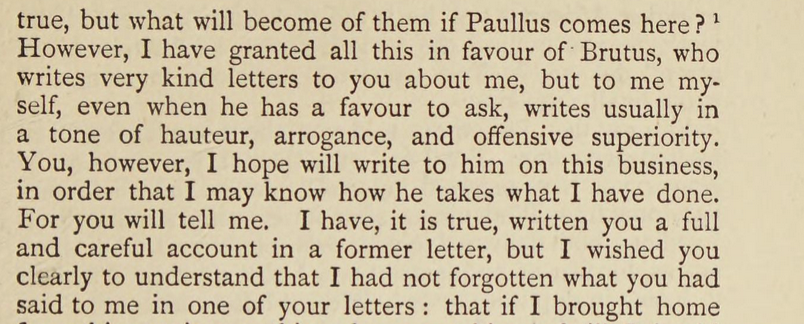
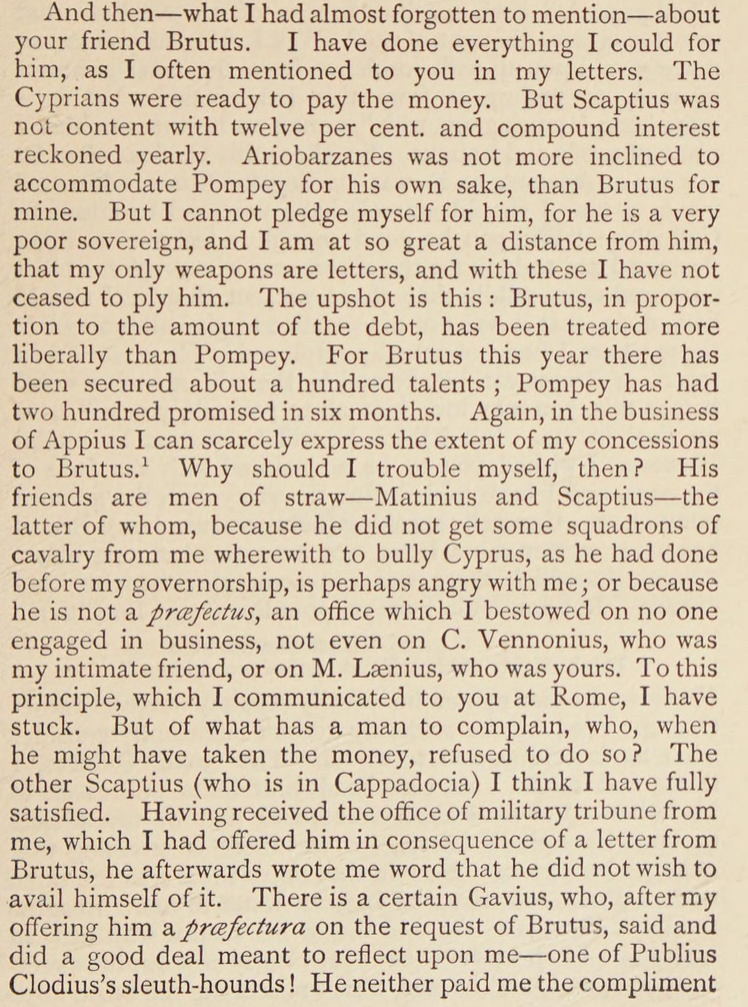
Ariobarzanes is endebted to both Brutus and Pompey, who gets paid first?! OR AT ALL. Pompey is getting paid 33 attic talents ever 13 days and that doesn’t even cover monthly interest. Pompey is owed more than double what Brutus is owed, yet in the year of Cicero’s governorship Pompey got only 200 talents and Brutus a 100 talents.
Salamis is endebted to Brutus, his agents are a huge problem and used to using Roman governmental authority to extract payment. Is the debt 106 talents or 200 talents? Is the interest rate 12% or 48%?
Mylasa, Alabanda, Heraclea, Bargylia, Caunus all endebted to Cluvius the banker of Puteoli, but Pompey underwrites these debts. An agent named Euthydemus is involved. Cicero asks Asian gov. Thermus to check it out.
Nicaea owes the young Pinnius for whom Cicero is serving as a guardian 8Mill; Cicero wants Nerva the governor to help collect.
Sardis is possibly endebted to Anneius (he has legal wows there).
Adiatorix (based in Pessinus) is endebted to Caelius, chances of repayment slight
If Roman officials don’t devolve costs on provinces AND local magistrates don’t exploit thier own communities, they can pay their debts AND taxes. A.6.2.
Taxation
Tax exemptions for Roman property owners in the provinces? The case of Feridius.
Publicani consult (advise) with governor on wording of edicts ahead of arrival in province.
Communities complain that burdensome tax collection means they don’t have extra cash to spend on honors for Romans.
Cicero considers himself a patron of company collection pasturing duties in Ephesus. Asks fellow governor to help his clients. P. Terentius Hispo. Ditto P. Rupilius collecting in Bithynia, letter to Quaestor.
Publicani are FAST letter careers
Appia imposed special taxes to honor Appius. Cicero halted this extra taxation.
Curio proposes a tax on servile attendants? 100 S per head.
If Roman officials don’t devolve costs on provinces AND local magistrates don’t exploit thier own communities, they can pay their debts AND taxes. Mention of present quinquennium and past quinquennium. Presumably taxation period of 5 years. F.2.13 echoing A.6.2. Back taxes paid without complaint.
Other Business investments – These may be debt/moneylending related but it is often not explicit in the text.
Atticus has financial interests in Ephesus and gets help from Asian governor
T. Claudius Nero has business interests, both in Nysa and with a certain Pausanias of Alabanda and Servilius Strabo, gets help from governors
Discussion of property sales and rivalries in business back in Italy, nothing relevant.
Obligations that cost but aren’t expressed as purely financial
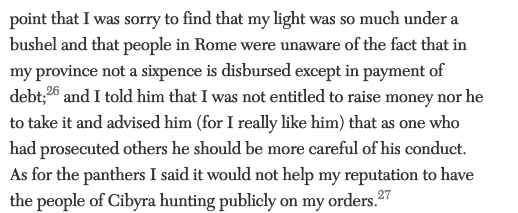
The panthers for Caelius and Octavius, who will pay for the hunt?
Purchase of Milo’s estate to save it
Gifting a Philosopher a house in Athens
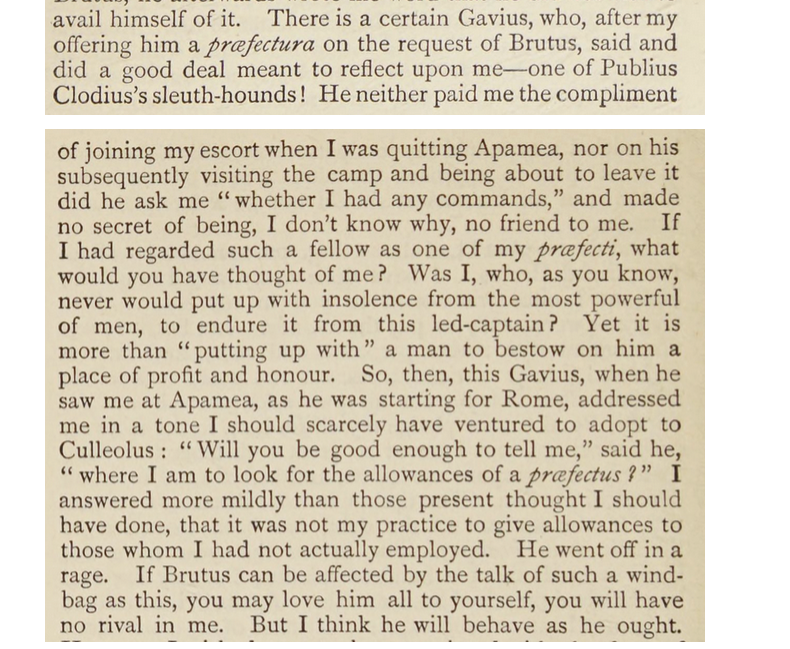
Giving the role of praefectus to be excused from jury duty
Letter carrying
Publicani (not necessarily trustworthy but fast)
Pomptinus was leaving Ephesus but for Appius’ sake turned back and delivered a message to Cicero in Laodicaea.
Personal slaves and freedmen dedicated to the task
Caring for vulnerable minors
Honors for Romans from locals
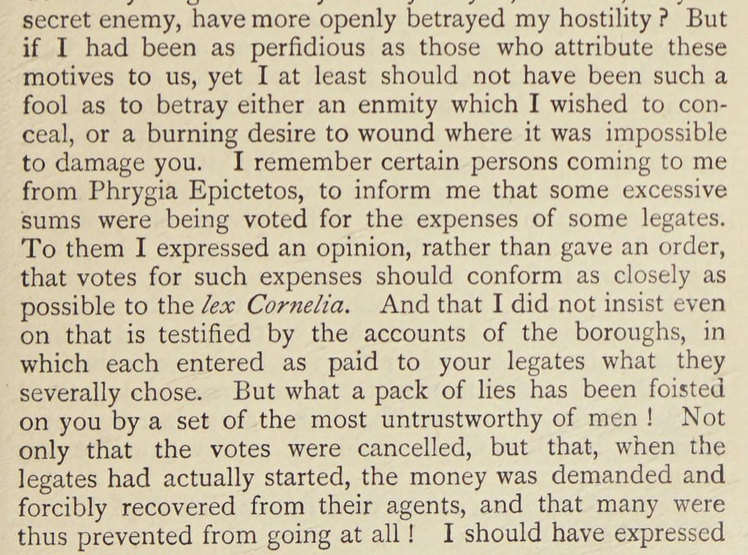
lex Cornelia tried to regulate
Benefactions to local communities from powerful Romans. (mostly Athens)
Sourcing a musical instrument
sourcing pottery
Cicero treated Cato’s clients well and expects something in return
Cicero honored Cassius’ recommendation of Fadius and now wants political support in return
hunting for self liberating slaves
Letters with information about state of politics
Devolution of expenses on Local communities
Cicero did accept: boats, four beds and a roof, Stuff L. Tullius took under lex Julia.
Refused payment to not provide winter quarters, saved Cyprians 200 talents
Gavius wanted to take allowances Cicero says no, title, no pay
Cicero won’t order hunt because of cost to locals
Government Funding
SC authorizes treasury to release funds
Funds available in Laodicaea
Lictors can serve as official letter carriers
Must leave financial records in two cities (Tarsus, Laodicea, Apamea all candidates, S-B thinks the latter two based on F.2.17, I see A.6.7 seeing a deposit at Tarsus).
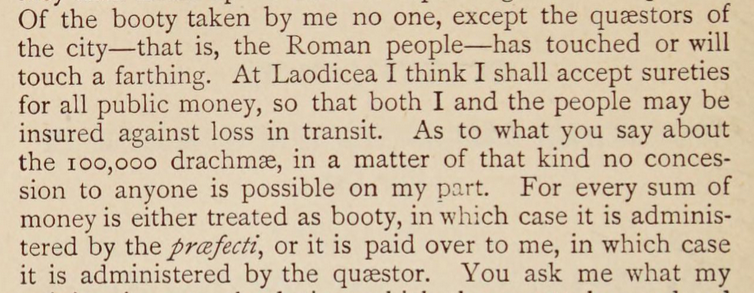
Plunder will be deposited with City Quaestors
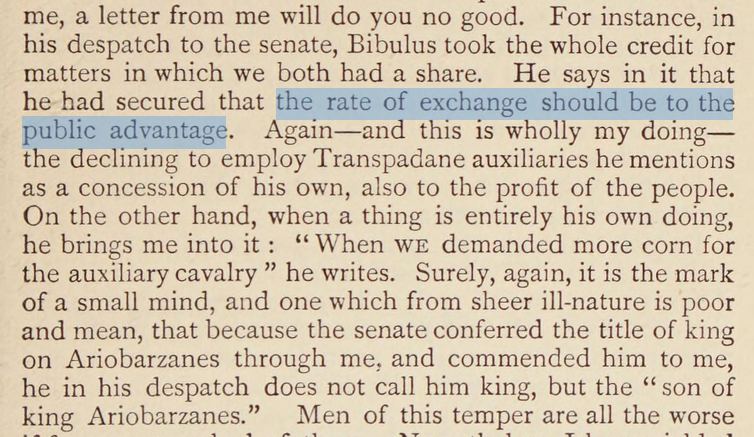
rate of exchange negotiated to public advantage
Fronting Money (kinda sorta like Banking)
Depositing Money (kinda sorta like Banking)
Offering to Underwrite a Line of Credit
Sense of Financial Entitlement
Agents managing Finances on Behalf of Others
Inheritances
three discreet wills mentioned over four letters none that interesting drop from project
These categories overlap and that’s ok, even critical to my major point. My list will evolve as I sort my notes but that is ok too. Memory is fallable! Below I’m sorting the same information from my earlier post by my newly determined categories.
A work in progress. To be continued.
Debts, between Romans
Cicero owes Caesar 800k Sest, possibly with 20k interest (A.5.1, A.5.5, A.5.6: May 51, A.5.9: June 15, 51). Cicero is fretting about whether this is resolved (27 June 51, Athens, A.5.10),
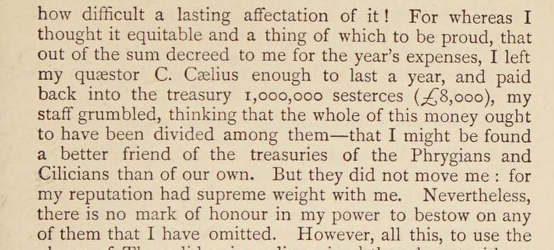
Cicero makes explicit the connection between not exploiting provincials and his own debt. The money he borrowed from Atticus will have to be repaid by yet another loan. (A 5.15. 3 August 51. Laodicia.; cf. A.5.13. where the drawing of a line of credit at Ephesus is mentioned.)
Cicero has told his agent Philotimus not to collect on Messalla’s debt to Attilius (because of the Messalla’s recent conviction). A.5.19. 20 September 51.
and from the same mention of a debt owed (presumably to Cicero) by an Egnatius that may or may not be paid. Perhaps a man from Teanum Sidicinum.
F.8.12. Begun mid August but not posted until after 23 Sept. From Caelius.
The Latin is confused but it seems Appius as censor is looking to take action against Caelius and in doing so trying to show favor to Pompey. SB assumes Caelius has already gone over to Caesar at the is point.
Appius retaliated by charging Caelius under the lex Scantinia (immoral sex acts with the freeborn, maybe). Who charged him with the same in return. Tells Cicero he should take up his cause against Appius.
Debts, communities, foreigners owing Romans
Someone in Cicero’s province owes Sittius money, Caelius wants Cicero to help him collect. SB thinks this is really Caelius’ own money. (F.8.2. June 51; F.8.4. August 1, 51). Caelius has sent men to collect this debt; the same who will be transporting panthers! (F.8.9. 2 September 51). F.8.11. April. From Caelius. Mentions Sittius (related to the panther business).
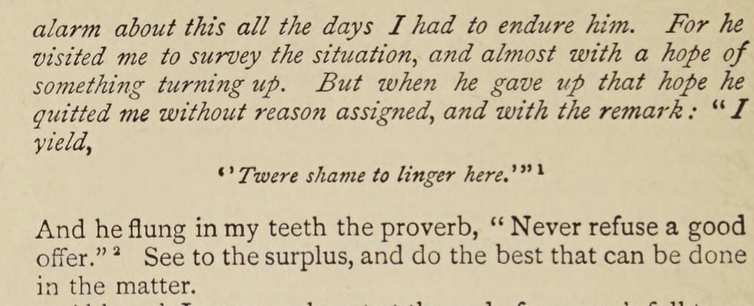
Ends letter by saying that he will settle up Brutus’ business (clearly a favor asked by Atticus) and do so better than Brutus could himself BUT his pupillum he cannot defend (against delinquency charges), because he is so poor and without resources. [A.5.18.51 September. Cybistra.] Cicero alludes to having cheered Brutus even as he denied extracting money from king Ariobarzanes. (A.5.20. 19 December 51, Pindenissum). Fullest summary of Brutus’ investments,A.5.21. February 13. Laodicaea.
A.6.1. 20 February. Laodicaea. Apparently in a letter of 21st Sept. Atticus praised Cicero’s restraint with Appius and independence regarding Brutus. Long reflection on how Appius bled the province dry and how pleased Cicero is to reverse course and rescind his injustices.
Now follows the deep financial interests of Pompey and Brutus in Ariobarzanes:
Cicero’s efforts to separate government and business are bucking the common trend and ruffling feathers. He moves on to Salamis:
I find the idea that Paullus would favor Brutus because of family connections odd logic (S-B follows this logic too). The two brothers did not get along at all. Could it be another relationship between Paullus and Brutus? S-B worries that Paullus couldn’t get a province in light of Pompey’s law requiring a 5 year wait, but clearly Cicero thinks that law is not worth much given current political landscape and obviously he was correct just not in this way.
Invokes His own Republic as moral justification in the face of others’ anger at him sticking to his fiscal policies
F.013.56. Date uncertain. Again to Thermus. Recommends Cluvius the banker of Puteoli. Mylasa and Alabanda owe him money. An Agent named Euthydemus told Cicero at Ephesus that Mylasa would send envoys to Rome. A specific individual in Alabanda has mortgaged property and needs to pay or surrender the property to Cluvius’ agents. Heraclea and Bargylia are also in debt to him, but can offer liens instead of payment. Caunus says they deposited the money they owe him but Cluvius is claiming it as unpaid. Pompey underwrites these debts to Cluvius.
F.13.61. Date uncertain. To Nerva governor of Bithynia and Pontus. Requests help collecting on a debt of 8Mill owed by Nicaea to a young man Pinnius for whom Cicero is serving as a guardian.
F13.57. Spring. Laodicaea. To Thermus (governor of Asia). Needs his military expert M. Anneius back and because of this needs Thermus to sort out Anneius legal woes with Sardis.
A.6.2. First week of May. Laodicaea. Responds to a letter Atticus sent via Brutus’ letter carrier.
F.2.18. June. Cilicia. To Caelius. Hungry for news. Reports Caelius’ men have left to try to collect on a debt. Down plays any hope of a triumph.
A.6.3. June. Cilicia.
Taxation
Caelius recommends an equites M. Feridius to Cicero who hopes to secure an exemption from taxation on certain lands. The Latin is a little obscure here and the financial arrangements thus also. This may be at the expense of locals in favor of Roman investor interest? (F.8.9. 2 September 51)
Communities already suffering from a lack of resources–local communities petitioned linking this expense to already burdensome tax collection. Informs Pulcher that he was met by publicani on Samos! who convinced him to change the wording of his edict [in their favor] by adopting a phrase from Pulcher’s edict. F.3.8. 8 October 51.
F.13.65. Date uncertain. Also labelled as to Nerva, but the community that needs to be influenced appears to the Ephesus and thus perhaps this also went to Thermus? S-B is silent. My own hypothesis. Cicero describes himself as a patron of whole tax company and P. Terentius Hispo in particular. They’re supposed to be collection pasturing duties.
F.13.9. Date uncertain. To Crassipes quaestor in Bithynia. Urges him to help publicani, esp. P. Rupilius.
F.8.7. February? From Caelius. Refers to another letter sent via Cicero’s freedman (implies safe method) lets it be known this is written in a rush to give to publicani (unsafe communication).
F.3.7. After February 11. Laodicaea. To Appius. Letter is travelling via Brutus’ messengers and written in haste. Commissioners from Appia delivered to Cicero a letter from Appius complaining Cicero’s policy stopping additional taxes has stopped a building project. Cicero assures Appius more of the members of the community want the tax halted than want it extracted.
Letters carried by Publicani mentioned for speed of delivery. A.5.21. February 13. Laodicaea.
A.6.1. 20 February. Laodicaea:
A.6.2. First week of May. Laodicaea. Responds to a letter Atticus sent via Brutus’ letter carrier.
F.2.13. early May. Laodicaea. To Caelius. Mostly trying to convince Caelius he does like Appius just as he likes Brutus and Pompey.
Inheritances
Cicero writes the exiled Memmius (pr. 58) seeking have him grant Patro(n), an Epicurean, Epicurus’ (ruined?) house in Athens, which Patron seems to claim was his by Phaedrus’ will, but Memmius owns through a decree of the Aeropagites. Cicero claims Atticus wants this to happen. (F.13.1. July 51. Athens.)
A.6.9. Athens. 15 October.
F.14.5. 16 October. Athens. To Terentia. Much concern about letter exchange and travel arrangements also political news
A.7.1. 16 October. Athens.
A.7.2. Brundisium. 25 November.
Other business investments
Atticus has financial interests in Asia (specifically Ephesus?), but the local governor Thermus has it in hand. Cicero only makes more introductions to Atticus’ people. (A.5.13. after 22 July. Ephesus.). Alludes to his helping Atticus’ business dealings via Thermus in Ephesus. (A.5.20. 19 December 51, Pindenissum). Again the same pressuring of Thermus (A.5.21)
Caelius alludes to Cicero having a negative view of Sempronius Rufus in relation to a business deal involving also Vestorius of Puetoli. Tuccius who is persecuted by Rufus seems to have been a close business associate of Vestorius: wares of both merchants have been found together in shipwrecks. See D’Arms 1980: 48-55 for full reconstruction of the relationship using A. 14.12 and A. 6.2.10 and epigraphic evidence. F.8.8. October. Rome.
F.13.64. Date uncertain. Labelled as to Nerva in manuscripts but seems more likely to have been to Thermus, so S-B and I concur. Recommends T. Claudius Nero’s business interests, both in Nysa and with a certain Pausanias of Alabanda and Servilius Strabo.
F.9.25. After February 11. Laodicaea. To Paetus. Spells out M. Fadius’ trouble: his brother Quintus has listed for sale a property jointly owned at Herculaneum. Marcus doesn’t want it sold. Cicero is soliciting help to settle outside of court. Marcus’ problems may stem from Mato and Pollio. (Cf. F13.59)
A.6.1. 20 February. Laodicaea. We don’t know why Philotimus was in the Chersonese or what the payment is for:
Later in same letter mentions of Lucceius putting a Tusculum property for sale and Lentulus Spinther putting everything but his Tusculum property on the market
Obligations that cost but aren’t expressed as purely financial
Caelius Rufus mentions the cost of employing someone to write down decrees, gossip, news, etc.. that he is sending to Cicero. (F.8.1, May 51) He wants to be paid in panthers for this new services (F.8.2, June 51; F.8.4, 1 August 51;) Caelius wants Cicero to send more than 10 panthers (the number secured by Curio via Patiscus and now gifted along with 10 more to Caelius). The feeding and transport of said panthers can be handled by the same men Caelius has sent to collect on Sittianam syngrapham! He’s willing to send more men if needed. For debt collection or panthers is ambiguous. Perhaps intentionally. They are one and the same. (F.8.9, 2 September 51). Almost as a postscript, Caelius mentions his entanglement with Curio who is opposing everything Caesar does. The entanglement is the gift of African animals, and thus Caelius presses Cicero to deliver panthers. He’s sent a Greek and a freedmen with the message but also to retrieve the animals and pressure Cicero. F.8.8. October. M. Octavius (curule aedile with Caelius; Appius’ father in law) wants panthers. Atticus suggested unlikely. Cicero says NO. No extra public expense. A.5.21. February 13. Laodicaea. F.2.11. April 4. Laodicaea. To Caelius. Cicero tries to assure Caelius that he’s working on the panthers BUT not using public funds/powers. Cicero must satisfy both his own reputation and also Caelius’ expectations. Patiscus is Caelius’ agent on the ground.
De pantheris per eos qui venari solent agitur mandatu meo diligenter.
Cicero is purchasing Milo’s estate after his exile to help preserve key assets and ensure his wife, Fausta’s, dowry is restored to her. (A.5.8, June 1, 51).
Cicero writes the exiled Memmius (pr. 58) seeking have him grant Patro(n), an Epicurean, Epicurus’ (ruined?) house in Athens, which Patron seems to claim was his by Phaedrus’ will, but Memmius owns through a decree of the Aeropagites. Cicero claims Atticus wants this to happen. (F.13.1. July 51. Athens.)
Let’s Atticus offer anyone the role of praefectus on his staff to get them out of jury duty (!).A.5.11. 6 July 51. Athens
This letter is being sent via a trusted mutual but Cicero explains most letters will be delivered via the private companies charged with land tax and customs collections. (A 5.15. 3 August. Laodicia; cf. conditions of writing in A.5.16, c. 14 August)
Has entrusted Deiotarus with son and nephew for campaign season. A.5.17. August. On the Road to Pilomelium? or Perhaps Iconium? Mentions his debt to Deiotarus for looking out for the boys. (A.5.20. 19 December 51, Pindenissum)
Cicero defends to Pulcher his decision to absolve local communities of sending representatives to Rome (to praise Pulcher). He frames it as an unnecessary financial burden on communities already suffering from a lack of resources– F.3.8. 8 October. Cilician plain.
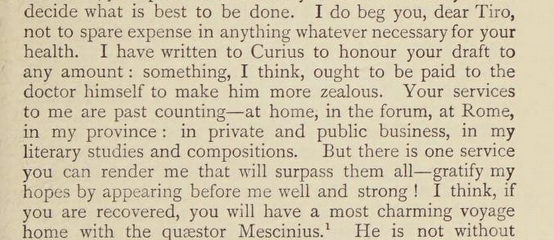
Cicero promises to be on the look out for the right musical instrument for Phemio (presumed to be an enslaved musician in Atticus’ household, cf. A.6.16.7).
Requests Cato vote in favor of honors in the Senate to celebrate his successful military campaigns, part of the argument is base on services rendered to Cyprus and Commagene, Cato’s client states. F.15.4. January?
F.15.13. January? To Paullus. Cicero alludes to his endebtedness for past political support of Paullus, asks for him to support him on not staying in the province and a positive vote in senate on honors for Cicero.
F15.14. January? To Cassius. Network of mutual obligation is contructed through Cassius’ recommendation of Fadius and their shared connection to Brutus. Cicero mostly wants political support in return.
Cicero reports on other matters including his failure to recover two self liberating slaves: one case was mentioned in A.5.15 as a goal.A.6.1. 20 February. Laodicaea. The musical instrument for Phemius has been acquired at great cost as has some special pottery from Rhosus
A.6.1. 20 February. Laodicaea
F.3.10. early May. Laodicaea. To Appius. Trying to convince him he has his back and that he loves Pompey and Brutus. Pomptinus was leaving Ephesus but for Appius’ sake turned back and delivered a message to Cicero in Laodicaea.
Cicero emphasizes how he has fulfilled past obligations:
More about loyalty to Pompey Appius’ daughter’s father in law. On account of his restoration. Also his letting him support Milo without repercussions. Ethnic prejudices… How could you believe a Phrygian or Lycaonian legate over me.
A.6.6. Side. 11 August.
Payment for services
Caelius Rufus mentions the cost of employing someone to write down decrees, gossip, news, etc.. that he is sending to Cicero. (F.8.1, May 51)
Devolution of expenses on local communities
Cicero brags neither he nor his staff have taken anything from local communites (27 June 51 BCE, A.5.10, Athens; A.5.17 August 51). Long reflection on how Appius bled the province dry and how pleased Cicero is to reverse course and rescind his injustices. A.6.1. 20 February. Laodicaea.
Has boats from Rhodes and Mitylene as well as others for his own use, but also brags about no exploitation. {A.5.11. 6 July 51. Athens}
In order NOT to devolve expenses on local communities Cicero has put himself in debt to Atticus (A 5.15. 3 August 51. Laodicia.; cf. A.5.13).
General complaints about how the province has been drained of resources. Cicero now accepts four beds and a roof but not even hay or firewood. However he is often in a tent he says. A.5.16 c. 14 August. Between Synnada and Pilomelium.
M. Octavius (curule aedile with Caelius; Appius’ father in law) wants panthers. Atticus suggested unlikely. Cicero says NO. No extra public expense. A.5.21. February 13. Laodicaea. Cf. Other Panther discussions, but here we finally get explanation of why it is a problem. A.6.1. 20 February. Laodicaea.:
Also from A.5.21:
A.6.3. June. Cilicia.
Government funding
Cicero needs an SC to pass to authorize a grant from Treasury to fund his provincial governorship, says Bibulus needs the same. (A.5.4: 12 May 51)
Cicero writes to Pulcher the out-going governor about their various travel and logistics:
perpaucos dies, dum pecunia accipitur quae mihii ex publica permutatione debetur, commorabor.
This sentence helps us see that even public funds do not necessarily need to be sent from Rome to fund provincial activities. Cicero can simply access the funds upon arrival. In combination with the previous quote, we see that Cicero had arranged to pick up cash for himself in Ephesus, and for his official duties in Laodicea. (F.3.15. 28 July 51. Tralles.)
F.2.19. Cilicia. After June 21st Lictors can serve as official letter carriers!
Must leave accounts in two cities Tarsus and Laodicea. A.6.7. End of June. Tarsus.
F.2.17. Tarsus 18 July. To Sallustius proq. Syria. Accounts will not be sent may be deposited at Apamea. Plunder will go to the city quaestors.
A.7.1. 16 October. Athens.
Depositing Money
Salamis debt /// temple…
Caunus debt payment deposited Cluvius disputes
Drawing on a Line of Credit
This sentence seems to me the clearest example of individuals being able to draw on lines of credit internationally rather than travel with vast sums of coin or bullion: “Ego praeterea rationem Philogeni permutationis eius quam tecum feci edidi.” (A.5.13. after 22 July 51. Ephesus; cf. A.5.15 that discusses this as a debt.)
F.16.4. Leucas. 7 November. To Tiro ill at Patrae.
F.16.9. Brundisium. 26 November. To Tiro ill at Patrae.
Offering to Underwrite a Line of Credit
Sense of Financial Entitlement
Agents managing Finances on Behalf of Others
Cicero wants Atticus to be his agent to resolve matters with Caesar’s agent Oppius (A.5.1, A.5.5, A.5.6: May 51)
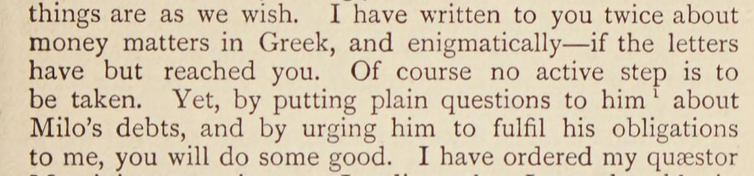
Milo is objecting to a freedman of Terentia, Philotimus, being a partner in the financial transaction. (A.5.8, June 1, 51), Caelius promises to ensure Philotimus doesn’t do anything wrong. (F.8.3, June 51). Cicero is fretting about Milo’s estate (27 June 51, Athens, A.5.10),
A.6.1. 20 February. Laodicaea. Possibly relevant:
A.6.4. Tarsus. Early June.
A.6.5. June 26. Tarsus.
More reference in A.6.7. end of June. Tarsus
A.6.8. Ephesus.1 October.
Bribery
Messalla (cos. 53) was guilty of bribery and that the jury should not have acquitted him, such as to make Hortensius regret defending him and winning. (F.8.2. June 51)
3 million sestertii were transferred from Pulcher (previous governor)’s estate to Servilius to try to secure a failed prosecution for extortion, the former’s own son testified to this. F.8.8. October. Caelius.
F.3.2. June. Cilicia. To Appius. Addresses him as if he were censor. Congratulates him on acquittal.
Judicial Role in Finances
Expresses anxiety about settling contracts in his province given pressures he’s already facing from locals and Romans even where he is not governor (A.5.13. after 22 July. Ephesus.)
Caelius recommends an equites M. Feridius to Cicero who hopes to secure an exemption from taxation on certain lands. The Latin is a little obscure here and the financial arrangements thus also. This may be at the expense of locals in favor of Roman investor interest? (F.8.9. 2 September.)
F.13.53. Date uncertain. to Thermus governor of Asia as for special treatment of L. Genucilius Curvus about property rights and in determination of the venue for any legal proceedings.
F.13.55. Date uncertain. Again to Thermus. Requests help for his legate M. Anneius in his ongoing legal suit with Sardis.
F.13.64. Date uncertain. Labelled as to Nerva in manuscripts but seems more likely to have been to Thermus, so S-B and I concur. Recommends T. Claudius Nero’s business interests, both in Nysa and with a certain Pausanias of Alabanda and Servilius Strabo.
A.6.1. 20 February. Laodicaea
Discussion of parts of Cicero’s edict including right to over turn bad faith contracts and allow locals to be tried under their own laws. He divided the edict in three parts, but first and foremost all the stuff about money to be paid to taxcollectors, debts, interest, etc…
Servilius was governor of Cilicia 78-74.
“I spent but two days at Laodicea, four at Apamea, three at Synnada, and the same at Philomelium. Having held largely attended assizes in these towns, I freed a great number of cities from very vexatious tributes, excessive interest, and fraudulent debt.” F.15.4. January? To Cato.
F.13.54. Spring. Laodicaea. To Thermus (governor of Asia). Recommends a Marcilius son of his interpreter. Specifically to help him stop the prosecution of his mother in law. Not certain the prosecution is related to finances… but seems likely.
F13.57. Spring. Laodicaea. To Thermus (governor of Asia). Needs his military expert M. Anneius back and because of this needs Thermus to sort out Anneius legal woes with Sardis.
F.3.2. June. Cilicia. To Appius. Addresses him as if he were censor. Congratulates him on acquittal.
Plunder
The amount for which captives are sold remains a question. Watt wants the number to be 12,000,000, S-B prefers 120,000. The main question to my mind is to what degree are these captives being ransomed to other loved ones, versus being sold as chattel slaves. The British museum quotes 2,000 sestertii for an unskilled or moderately skilled person. So did he sell 60 people or did he sell closer to 6000 people? If S-B is right. Cicero did not deserve that triumph if Watt is correct the triumph is more warranted. A.5.20. 19 December. Pindenissum.
F.2.17. Tarsus 18 July. To Sallustius proq. Syria. Accounts will not be sent may be deposited at Apamea. Plunder will go to the city quaestors.
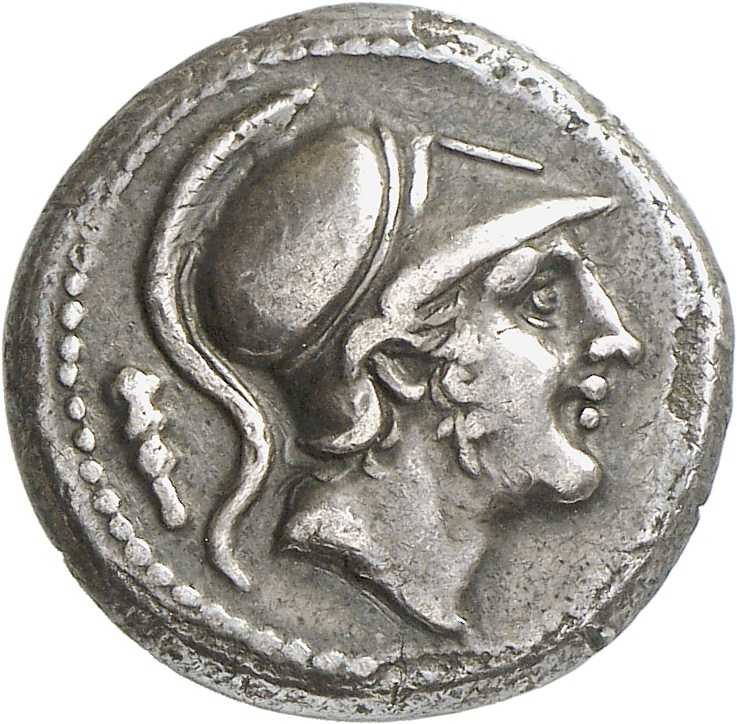
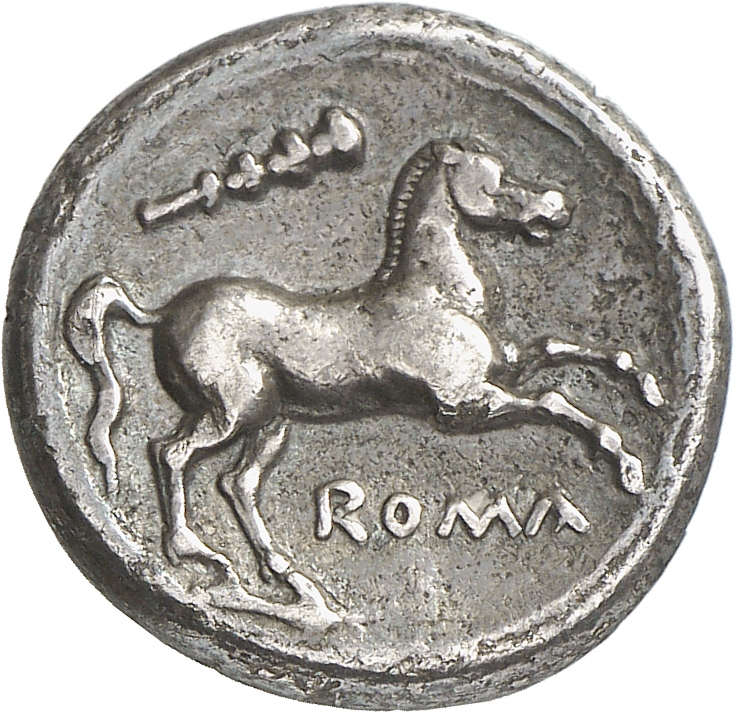
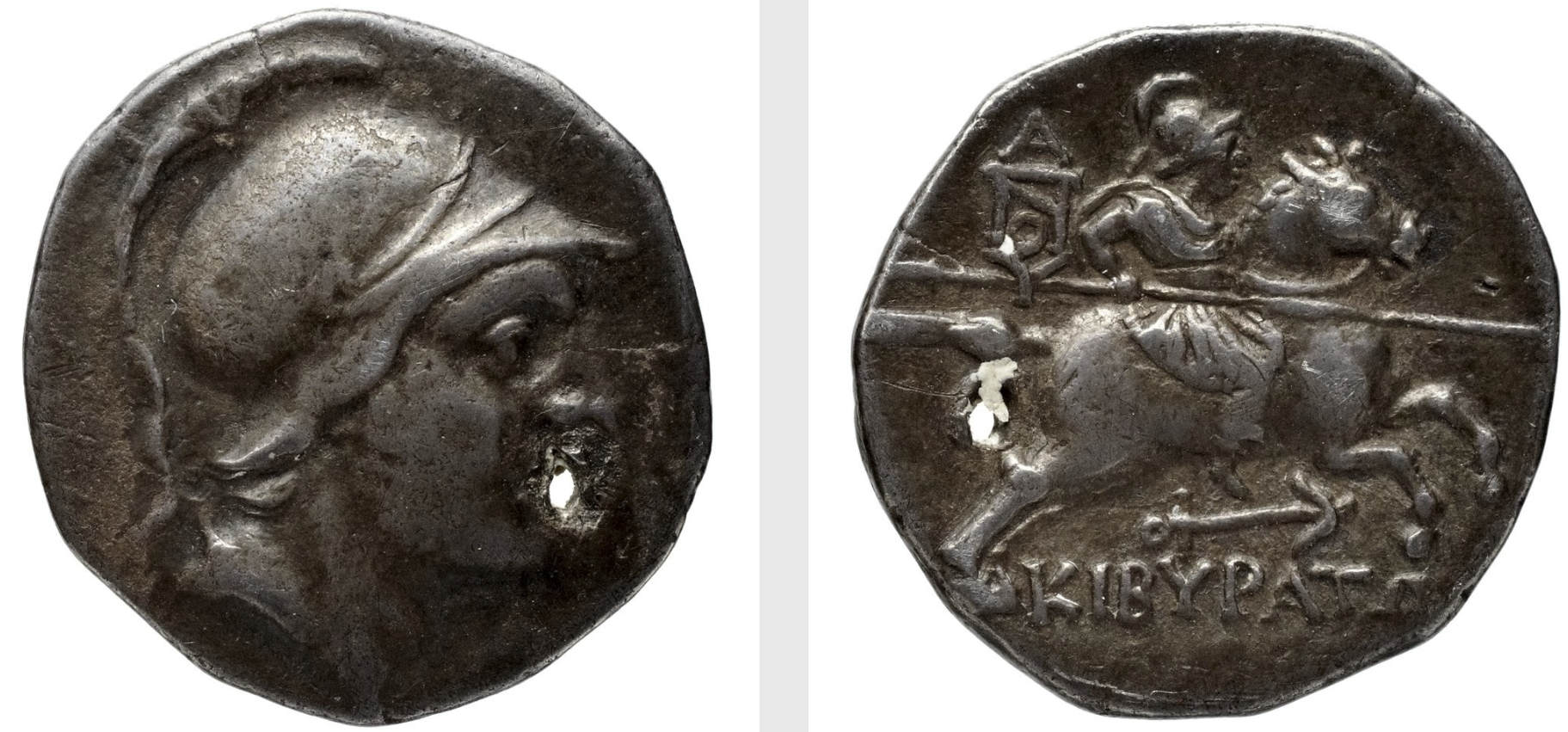
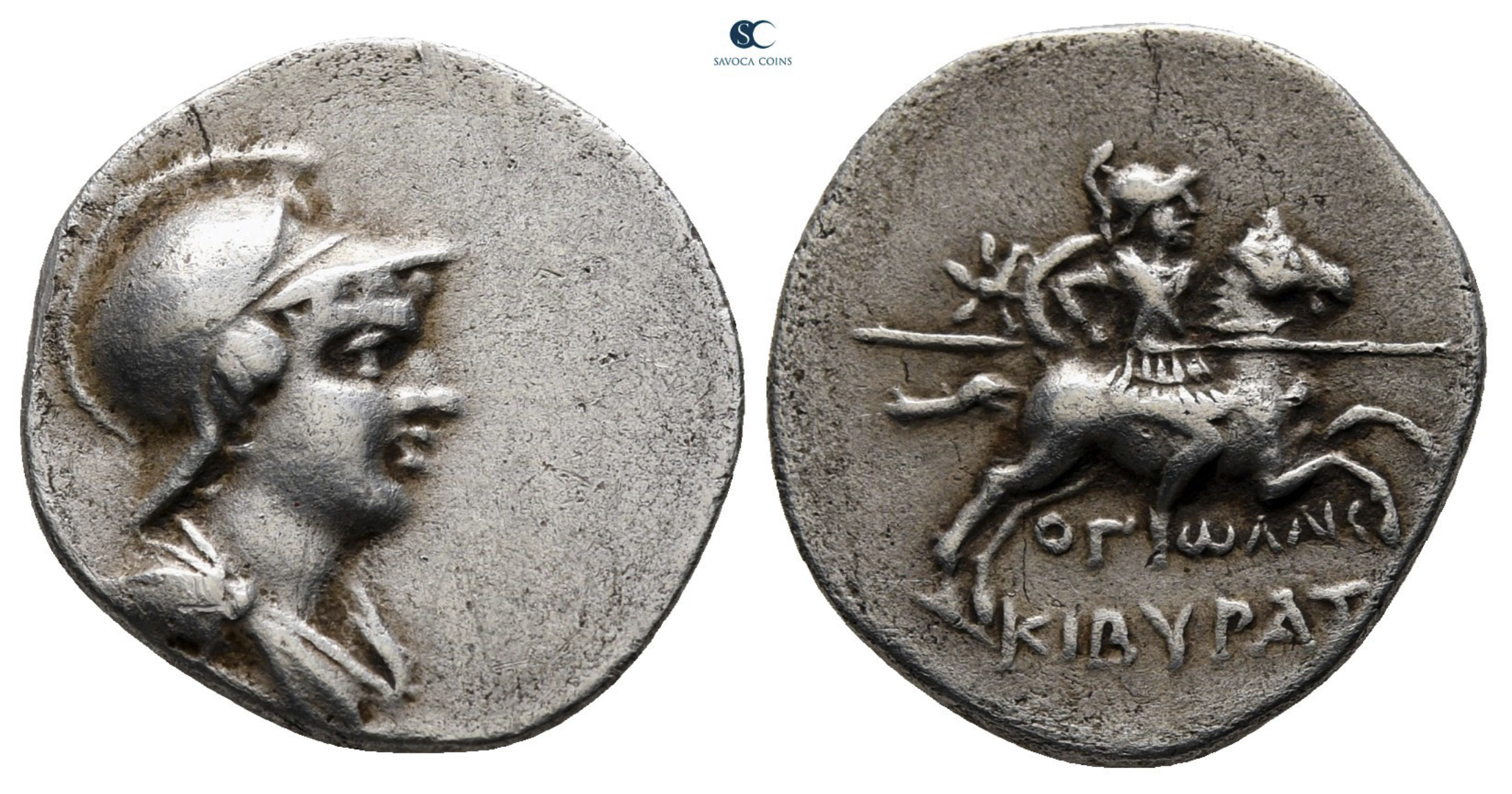
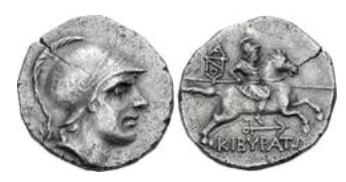
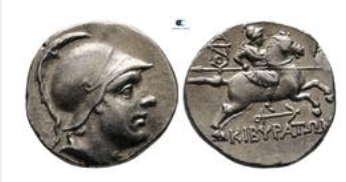
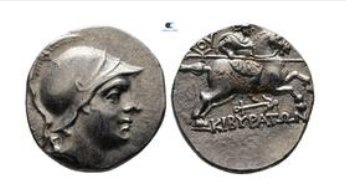
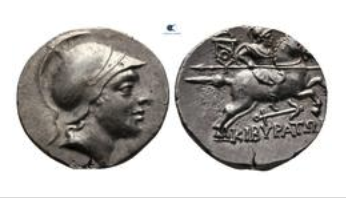
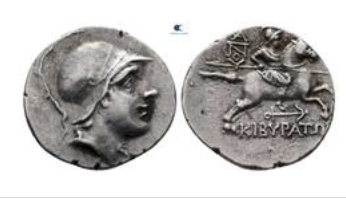
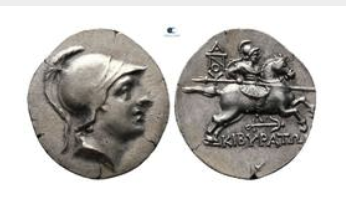
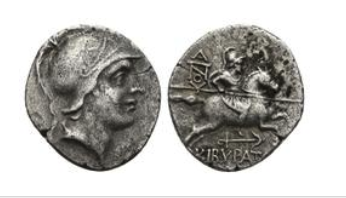
The silver coins of Kibyra (or Cibyra) are typically attributed from the establishment of Roman control of Asia Minor, c. mid 160s, to the Sullan exit from the region, c. mid 80s BCE. There is a tetradrachm and a drachm.
I’m pretty far from my expertise here, but a friend asked a question and that got me thinking. A dangerous habit that is. Thinking I mean. Very distracting. It looks like most people still use just SNG or BMC numbers to refer to the various types. I can’t find a complete study of the coinage on ANS donum. Do you know one? I’d love to know of it.
The part that gets me is how much the youthful helmeted male head on the obverse reminds me of youthful (beardless) Mars on the Roman series. This is a topic I love on the blog (RRC 27/1, Berlin Specimen shown here).
But the other thing is that like so much Hellenistic coinage the Cibyra coinag is signed with a great variety of symbols and monograms. I wasn’t going to blog this coinage until I spotted this monogram. Because Antonius is rendered Antony that was my very first though. Of course, that is not the likely resolution. The N is topped in all likelihood with a Greek “Pi”.
There is supposed to be a Kibyra coin with this monogram in the Ashmolean SNG but it is not on line yet. None of the BM coins are photographed yet. None are listed in IKMK. The ANS has not photographed any of their silver specimens of this mint. Paris has only one specimen:
And yet 22 specimens with this anchor and monogram have appeared on the market starting in October 2022 nearly all (excepting 2) from a single auction house. Images below.
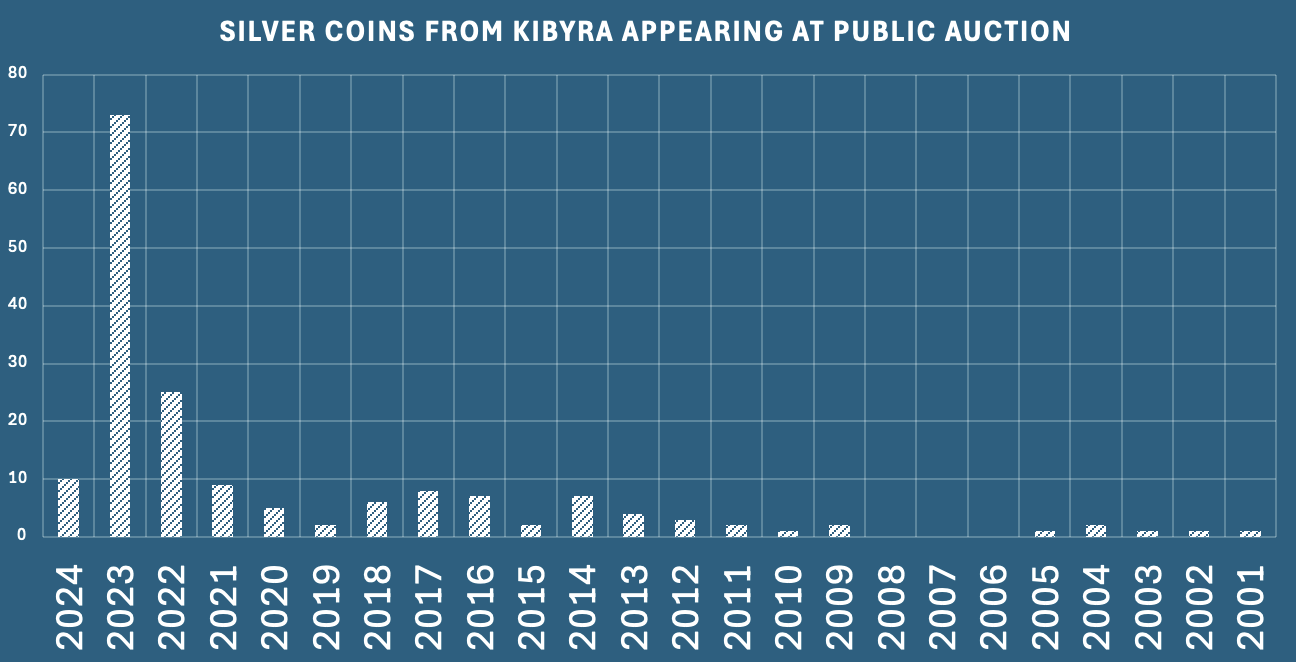
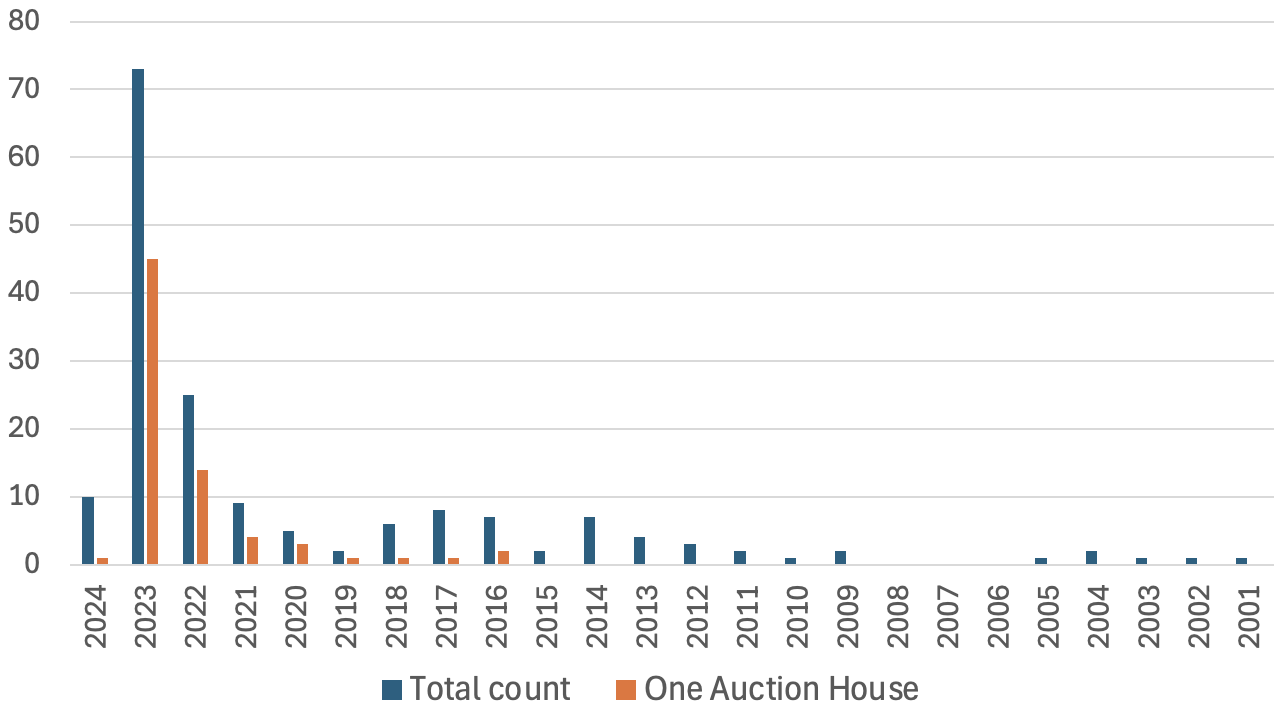
Since 2001, some 172 AR coins of Kibyra have appeared at public auction, yet before 2022, none with this monogram. There is an average of 7 coins per year over the whole time . But if we restrict the average to 2021 and before, the average is only 3 per year.
Just one auction house has sold 72 of these coins, and there sales seem to be driving the market trend.
The anchor/monogram coins are not the only types to proliferate in the recent sales there are also many with IO. However there are also specimens with very clear full names of local individuals:
This now dispersed hoard was of immeasurable historic value for reconstructing the history this city, the region, and its relationship with Rome. That possibility is now lost. Ogollis named on the above coin is a name known to have been a father of the Dynast Moagetes. The name appears in a treaty with Rome from 188 and renewed in 174. This hoard intact and with deposition data could have provided us a full chronology of this mint and let us better understand the influence of the Romans and the economic power of this city and its dynasts.
A quick glance over these coins will show you that there are many die links:
I’ve long thought that Pompey is the true predecessor to Augustus. Caesar’s model got him stabbed. Had Pompey held Rome and pushed Caesar off, the Empire could have started and continued with different dynasty but much the same framework without the horrid triumviral period. Perhaps a fun alt history novel but actually relevant for seeing why the empire ended up running as it did. The seeds were all in existence long before Caesar left Gaul.
Cic. F.3.2, June 50 BCE To Appius
Pompey in the the above passage is already PRINCEPS and Brutus is already FIRST among the IUVENTUTIS. There is almost an identical passage in F.3.10 written to Appius the previous April.
The above passage follows on from one of the best articulations of the problem and political character with all maiestas charges, i.e. the idea that someone can be put on trial for weakening the state for basically any reason. This was the primary charge used to suppress dissent against the imperial house under the Empire.
This post is likely to grow as this idea develops. I’ve been meaning to collect passages of this sort. I also mean to collect references to Sulla in the letters, but that can wait until I’m back on my book 3 project as there is a chapter on Sulla in the works.




















































 Liv Mariah Yarrow