So this iconography is almost always identified as being Rhea Silvia (Ilia) and Mars and being an allusion to the foundation of Rome. Classic examples are the mosaic from Ostia and or the coins of Antoninus Pius. And yet this same iconography is on gems identified as Ares and Aphrodite…(another example) Do the Rhea Silvia representations derive from an earlier prototype or is this just a error in cataloguing the gems? My knee-jerk reaction is the latter, but one needs to keep an open mind.
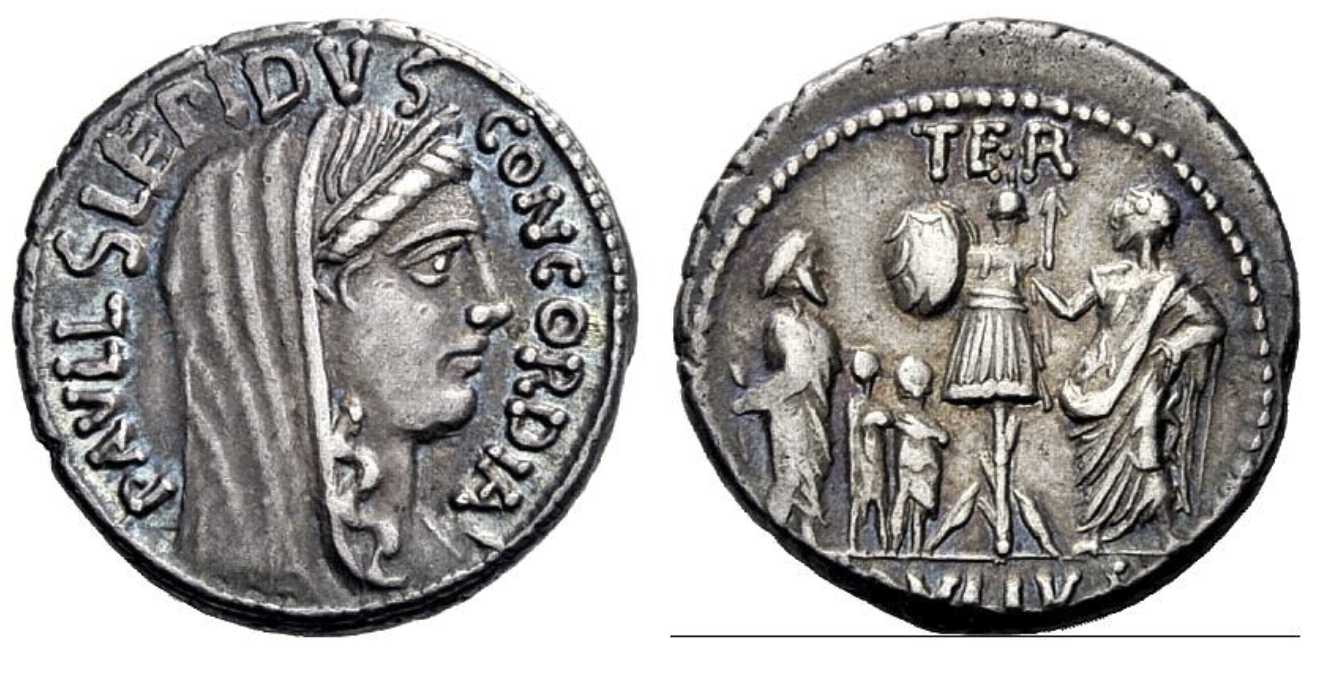
The reverse is without a doubt modeled on RRC 308/1. And, in this series the moneyer connects each member of the triumvirate with their divine ancestry (Lepidus = Mars, Antony = Hercules). Thus by extension, this design in this context must represent Aeneas and Anchises and be alluding to the young Caesar’s connection to Venus via his adoption.
Does this mean Herennius certainly meant to represent Aeneas, and not one of the Catanaean brothers? No, not certainly. It is, however, another nail in the coffin of that identification. (See earlier post linked above for more “nails”.)
I’m intrigued that Regulus did not used Julius Caesar’s own Aeneas type (RRC 458/1). I’d argue that this rendering may have been chosen because it emphasizes filial piety, over divine piety, and thus is more appropriate for the young Caesar in 42BCE.
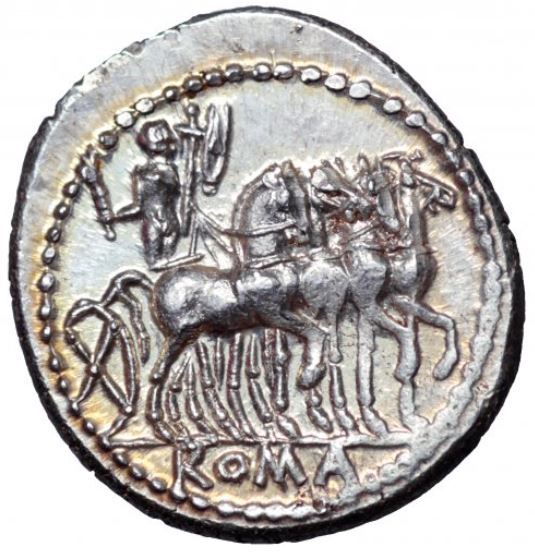
I’ve found this type (RRC 255/1) rather confusing for some time. It shows Hercules in a slow quadriga (associated with a triumphal procession) holding a trophy (a sign of martial victory) and a club (how we know which god is being represented). I just came across this entry in Pliny’s NH 34.16 and it seems to help connect some mental dots:
That the art of statuary was familiar to Italian Italy also and of long standing there is indicated by the statue of Hercules in the Cattle Market said to have been dedicated by Evander, which is called ‘Hercules Triumphant,’ and on the occasion of triumphal processions is arrayed in triumphal vestments;
To be clear, I don’t think the coin represents the statue, just that the statue helps suggest why this divinity might be represented in this type of chariot.
See Burnett 1986: 72 and passim for the assertion that Hercules at Rome is a god of victory.
This is a particularly ugly specimen that’s poorly photographed, but what caught my eye was the evidence of failure of the reverse die: notice the large crack and crater in relief above the exergue line and to the left of the twin. Cracked dies are useful for two purposes: (1) they suggest something of the intensity of the minting operation, that production was valued over aesthetic considerations; and (2) they can help with the sequencing of a die study.
Notice also that some one has gouged the front of the coin, likely to check for plating.
This is a little problem specimen I got obsessed with. I need to move on so I’m just throwing up some material here in case I want to return to the problem later.
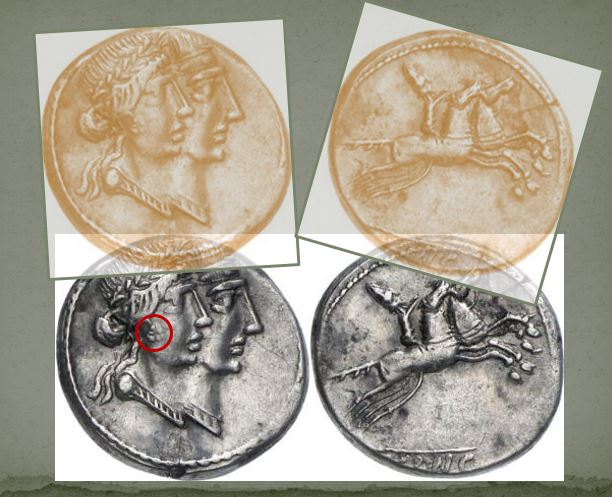
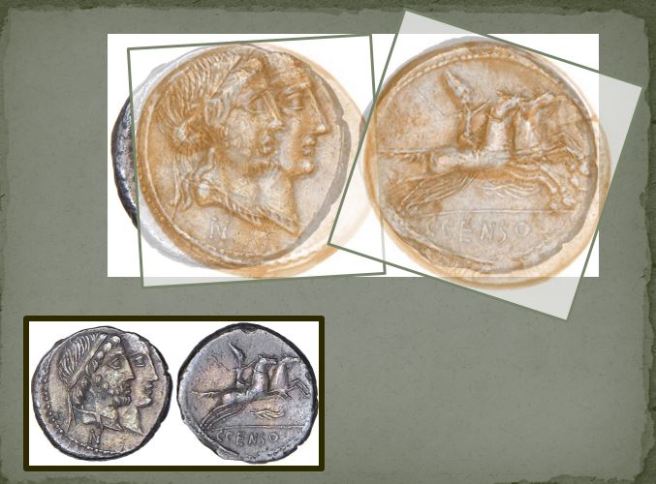
My little obsession was to see if I couldn’t prove this hypothesis via a die link. My two big clues for the obverse was the large amount of space below the busts and the edge of the flan and the little lump of what I think is beard on the cheek of the woman. Circled in red in this pic:
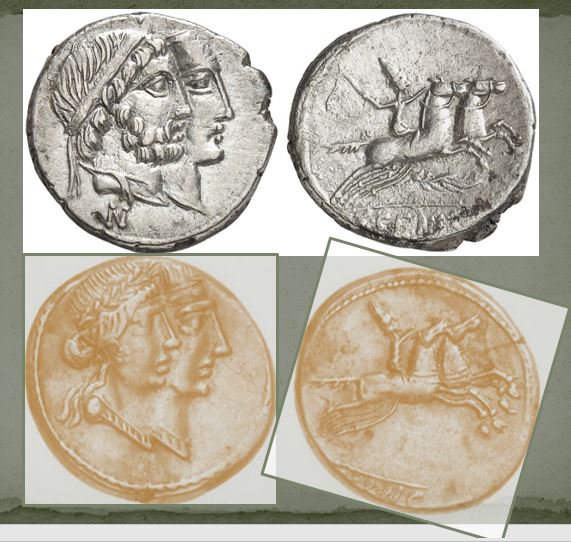
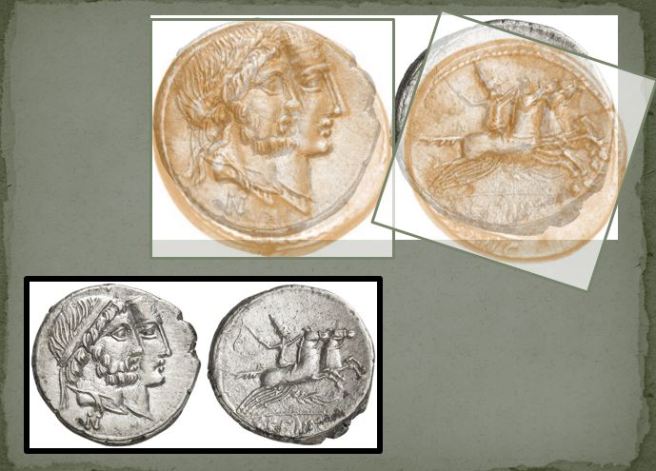
I thought I might have spotted a die link even through the distortion created by hubbing and recarving. So I created the transparency to aid my visual comparison.
I’m not a hundred percent convinced after comparing it with two die linked specimens of the original type (specimen 1, specimen 2) which might have been die linked with the hubbing prototype of this imitation. But, I think it’s still a likely hypothesis. And I need to move on with bigger questions for now.
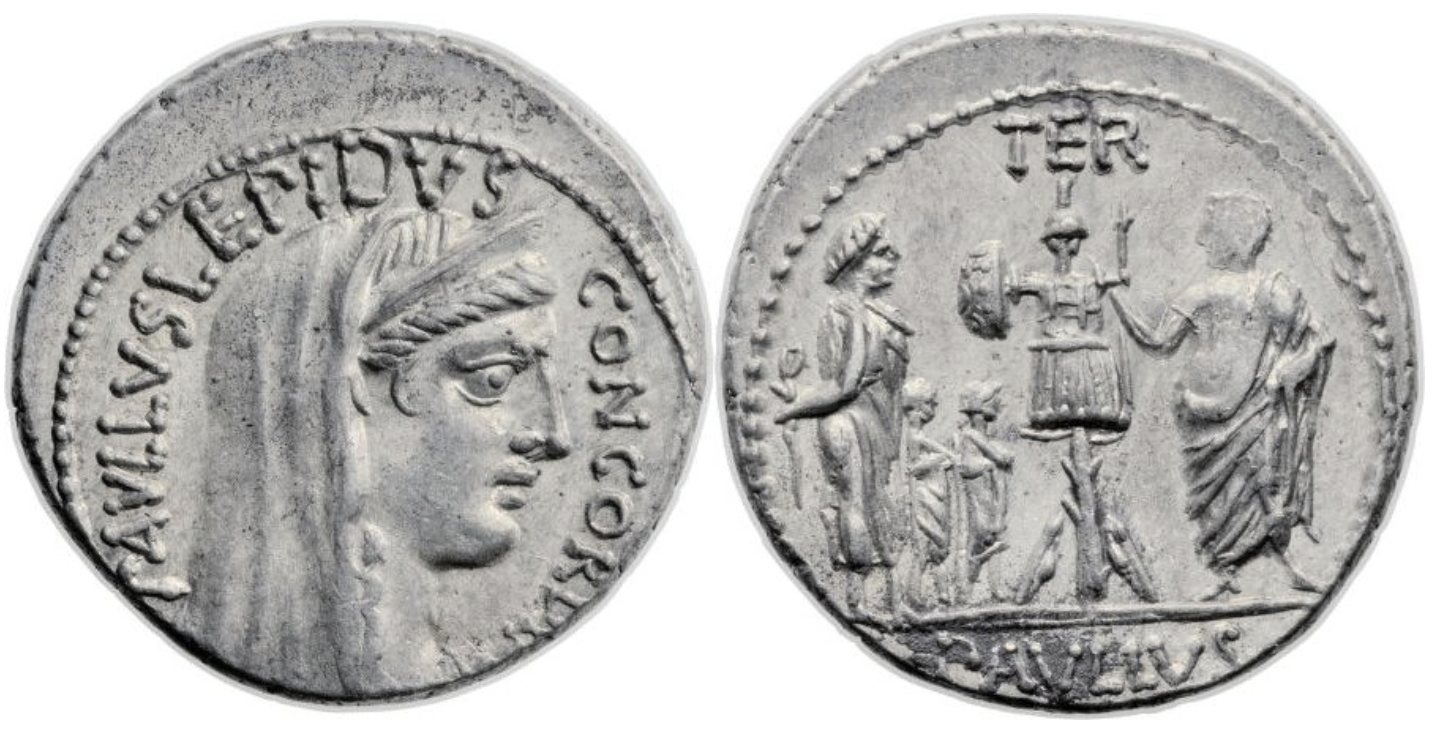
On almost all dies for this type the legend reads PONTF MAX up the right hand side and and TVTOR REG down the lefthand side. (The NTF, and arguably also an I, are in ligature.) On this specimen the die cutter and turned this arrangement around. (A variation not noted by Crawford or the sales catalogue.)
The whole of legend describes the Roman figure (M. Aemeilius Lepidus, cos. 187), he is both chief priest and guardian of the king (Ptolemy V = the left figure). However, in the normal layout the legend also serves to clarify and label the image. We see the intentionality of the original legend lay out in this error. Here an uninitiated viewer might mistake the boy-king for the chief priest! Rather than understand that he is the king ruling by the grace of Rome.
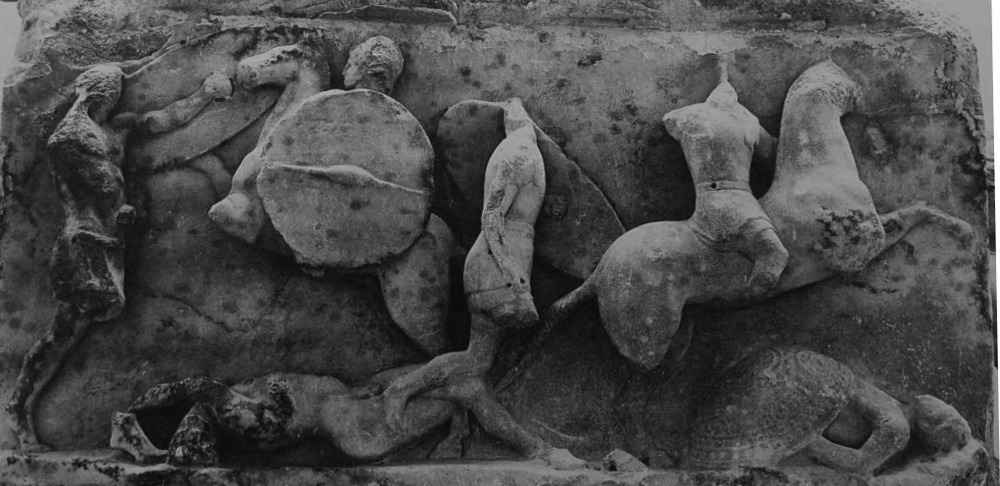
I was looking for a specimen or three which clearly represent the far left hand figure on the reverse of this type. (An illustration for my talk in Boulder, CO in March — all about coins, so probably more blog posts to come!) But here I noticed that at least on this die the trophy has been carved specifically to represent Macedonian armor. This is made most clear in the tell tale scalloping pattern on the shield. Numismatists will recognize the pattern from Macedonian coins, both before and after the Roman conquest. It’s use to represent Macedonian armor is known from both Roman monuments like that of Paulus at Delphi. Notice the pattern on the shield of the fallen Macedonian and contrast it with that of the Roman rider.
Here’s another case of a clear specimen making the type more comprehensible. Notice the two objects on either side of the base of the trophy. Those aren’t wooden supports (never a feature of the trunk of a trophy)! They are in fact two more Macedonian shields leaning up against the post.
Update 5/17/21: “one [is] a small thureos, the other a small buckler, not Macedonian peltai.” – Thanks Paul Johnstono!
This is the same iconographic strategy as that used in RRC 281/1.
Update 10-5-22:
A nice use of a Macedonian Shield on a Campana plaque (relief):
It’s New Year’s Day night. We’ve re arranged the books in our home and are eating chocolate cake and looking at pictures from Turkey and thinking about how good life is. Here are few things from that trip I forgot about.
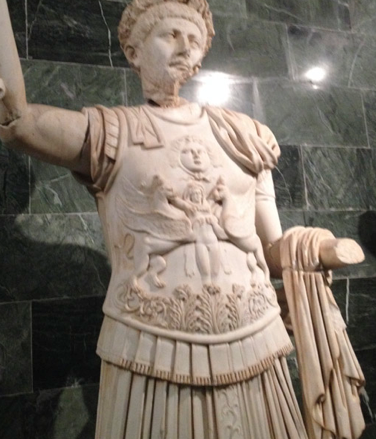
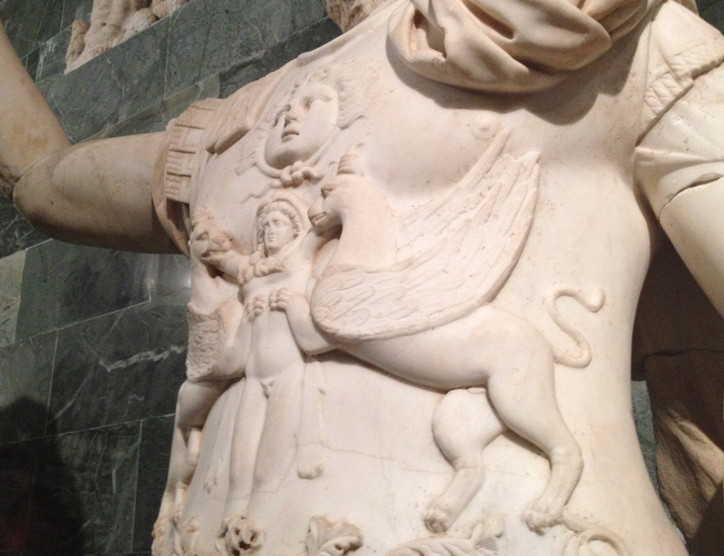
This is a statue of Trajan from the theatre at Perge now in the Antalya museum. Notice that it changes the typical representation of the Griffins into an apotheosis of Herakles/Hercules! This is a remarkably atypical rendering of apotheosis. Is it a commentary on Trajan’s own divinity?
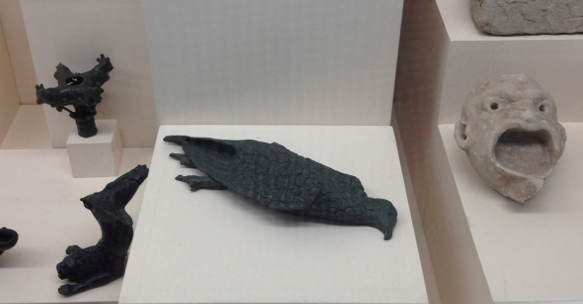
From the same museum, here are some unusual bronzes:
I’ve no idea in what context there would have been a desire to represent a dead bird (eagle?!).
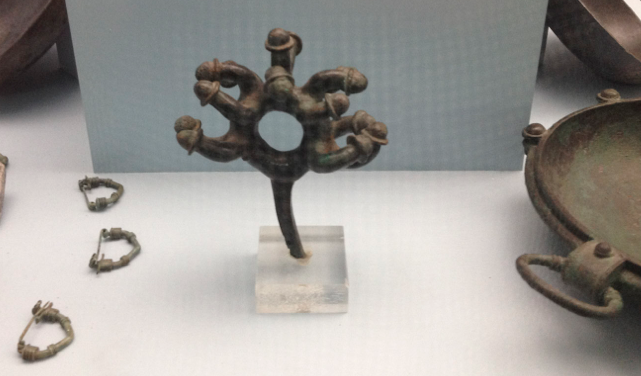
This (below) seems to be an apotropaic object with multiple phalluses. Not terribly unusual of a theme, but also not as common in Asia Minor as elsewhere is my impression:










 Liv Mariah Yarrow