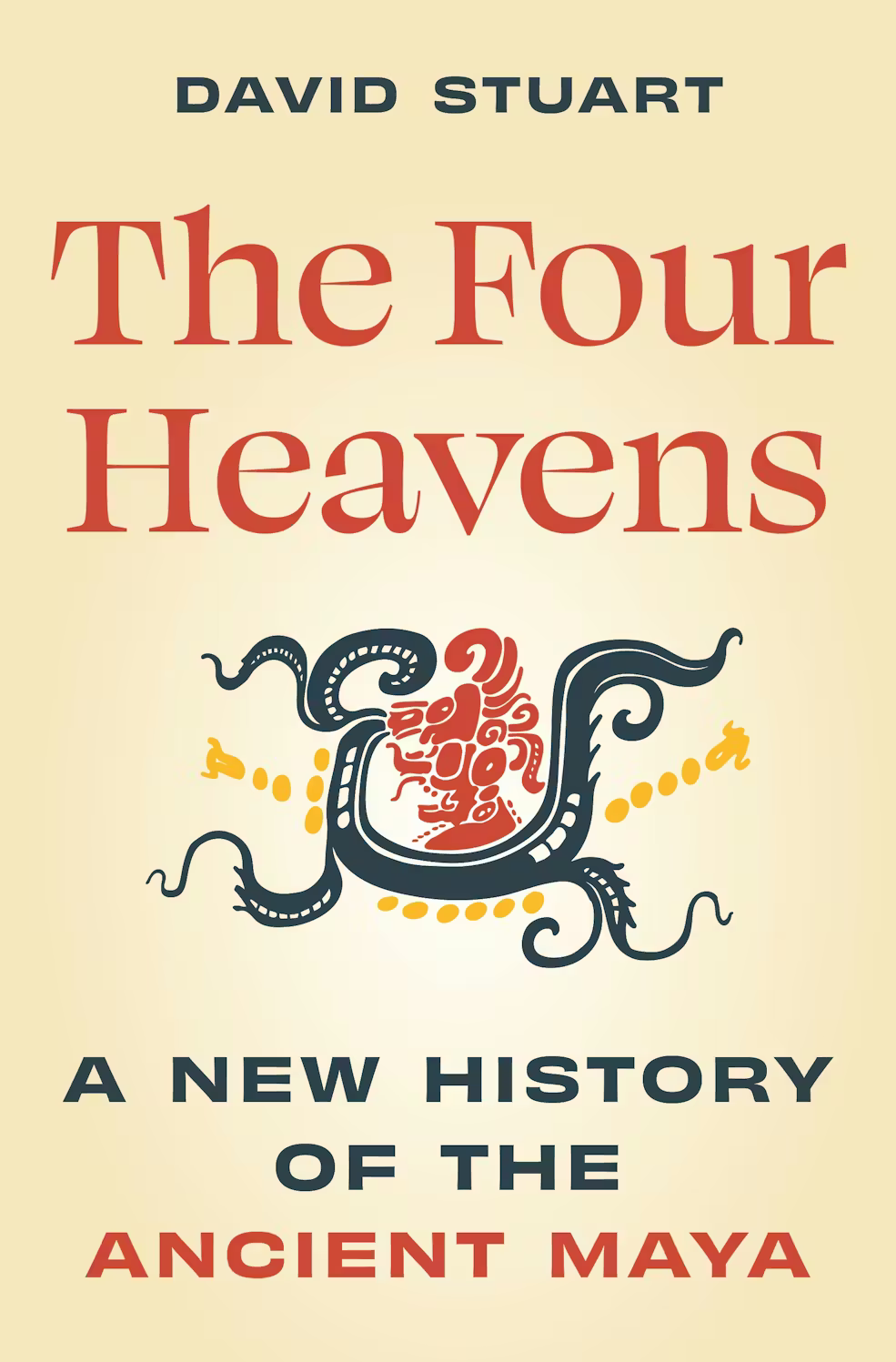
“Maya history was seemingly lost forever when the first Europeans encountered the great ruins of ancient cities in what is today Mexico and Central America. Today, with the recent decipherment of their ancient writings, the story of the Maya can now be told from their perspective. Stuart traces the rapid emergence of permanent settlements in the rainforest, which gave rise to monumental architecture and a flourishing urbanism and ushered in the Classic period of Maya civilization beginning in the mid-second century CE. He reveals a world of majestic royal courts tightly bound together by marriages, shifting alliances, and warfare, much of it driven by the ambitions of two major dynasties, the Kanuls and Mutuls. Stuart describes how the long-standing rivalry between these two great houses shaped the fates of the surrounding kingdoms and may have set the stage for “the Great Rupture” of the ninth century, when the royal courts buckled under the weight of internal strife, social unrest, and environmental crisis, transforming Maya civilization yet again.”
I’m obsessed with this book. I downloaded the audiobook on lark when a colleague who works on Ancient China shared a picture of his own copy on FB. I did not expect it to have such a drastic effect on my conception of my own field and its place in Ancient Studies writ-large. I think I am finally and utterly convinced that Global Ancient History is ‘a thing’ and that it valid and even necessary for those of us who specialize in one culture to understand and appreciate the methods and challenges and insights of others working on other ancient cultures. (Sorry to come late to this party…)
To be clear, I’ve not finished the book, but I need to write about it in media res to create some room in my brain for today’s work on my own materials. I also apologize to everyone I’ve texted and gabbed to about it the last few days. It seems to be the only thing I can talk to anyone, and I mean anyone. I realize part of this is the its new to me, so it must be new to you phenomenon. I trust and hope that at least some of my colleagues, friends, and family are better exposed to Meso-American Pre Colonial histories than me.
Why do I love this book?
It seamlessly, and in a compelling narrative style, integrates the story of the people themselves with…
- The history of scholarship, how we know what we know and the personalities and contexts that shaped their work for both good and bad. Here particularly I love how he acknowledges those whose work often goes uncredited, indigenous scholars and memory keepers, women. The shout out to Alice Kober was so unexpectedly perfect. Stuart allows us to vicariously enjoy the wonder and joy of first insights and first glimpses of ruins, while not losing sight of power dynamics, missteps, and misconceptions. The story is richer for the shades of gray, few heroes, few true villains. And without the shades of gray I don’t think I could have been so moved and horrified by Bishop Landa’s book burning. One of the greats crimes I know. Which brings us to…
- The history of epistemicide (the intentional erasure of knowledge as a colonial tactic – he doesn’t use epistemicide but what he describes is the very definition of the phenomenon. Stuart spells out clearly the advantages to the colonial powers of presenting the inhabitants of these lands as timeless, primitive peoples without any knowable past (or future)).
- The effects on looting and the art market on the state of our knowledge (I’d love a hair more here on how economic conditions motivate local communities to participate in this and how the collecting desires of museums and individuals feeds (and launders) this black market industry, but maybe it is coming in future chapters I’ve not yet read.)
- The distinguishing of linguistics and archaeology and art history from HISTORY while still fully integrating these into the story of the people over the sweep of time.
- The commitment of author and publisher to having the audiobook read by Timothy Andrés Pabon who fluently reads the Mayan names and sentences into the text, giving (at least an illusion) that we today can hear again some of these peoples.
- a consistent re iteration of the lineage and cultural connections between the living Mayan peoples today and those of antiquity. Far too often I’ve heard people question if people of the modern nation state of Greece are really the descendants of the ancient Greeks of the temples and texts. In all of this is a dismissive tradition of racism that centers northern European powers as the intellectual and imperial heirs of Mediterranean cultures be it Christianity or Rome or Athens. To say nothing of Aryan master race theories that give us today’s ancient alien conspiracy theorists. Again, I’d love it if Stuart came out and directly engaged with this but he is clearly rebutting it every step of the way.
- crystal-clear periodization and re iteration of key cultural features such that I feel like my mental map is growing and a sequence of events and their connection to real time emerging.
- the constant reminder that this may be a new history but that it is incomplete and that we can and will learn more as we move into our own future. That space to be wrong, that space to be curious, is something I so yearn for …
So now you’re wondering if I see any lessons or parallels. So many! Each new chapter gets me more excited.
Hellenistic and Roman Italy made incredible use of Terracotta in its first phase of Monumentalization where as the Maya seem to have first build large earthworks and then quickly massive stone complexes. Roman Italy leans into stone quite rapidly though. Both the Maya and Romans discover the incredible versatility of plaster for both 2D and 3D artistic architectural decoration.
The shift from communal religious identity in the arts of the pre-classical Maya to the dynastic arts of the classical reminds me intensely of the shift from republic to empire. Same, but different. The 9th century cultural change leading the Maya to new ways of life outside the control of dynastic structures bears some resemblance to the dissolution of Rome and how individual patterns of life seem to become more focused on the local without the central power figures.
I can immediately think of parallels for connections of ruler and gods, the animistic approach to the natural world and the divine, the listing of events and the measuring of time as a means of expressing control and power, the intense devotion to ancestors, the claiming of shared ancestors for political purposes, the use of visible public religious ceremony to re enforce social hierarchies, the use of competition as spectacle and avenue for social cohesion, the blurry boundary between history and legend, the monumental epigraphic habit, the labeling of figures in art, even the lists on cups, to say nothing of the importance of cultural exchange with their neighboring cultures (esp. to the south), and how their own traditions and prestige were borrowed by other seeking regional status in future generations.
Ok… enough for now. I need to focus on my own work. I cannot wait for my copy of the book to arrive for the illustrations. I anticipate the more I listen the more I may post about all of this.

 Liv Mariah Yarrow