
I mentioned in the “just email” post that I’ve trying to read a little in the morning over coffee something that stimulates my intellectual curiosity, but not directly connected to research. My theory is if I spend my days as a petty bureaucrat and event planner at least I will not forget I am a scholar and I may find it easier to hit my research goals in the moments in between.
Ehrman, Bart D. Lost Scriptures : Books That Did Not Make It into the New Testament. Oxford University Press, 2003. [full text PDF download from Internet Archive]
Why this? It was to hand. I picked up a copy at some charitable book store over the last few years. It comes in small chunks–so easy to pick up and put down. I like fragmentary texts. I like alternate perspective and less known voices from the ancient world. The narrative variations are fun.
I’m teaching Sex and Gender and thus gender is on my brain. Or maybe it is this moment where government entities seem obsessed with policing gender expression and trying to define and codify the gender binary. Or maybe I just think about gender and gender performance a great deal regardless.
This passage many of you will already know. It gets leaned on hard in many progressive communities of Christian faith, and interpreted with different emphases in conservative ones.
27 As many of you as were baptized into Christ have clothed yourselves with Christ. 28 There is no longer Jew or Greek, there is no longer slave or free, there is no longer male and female; for all of you are one in Christ Jesus. 29 And if you belong to Christ, then you are Abraham’s offspring, heirs according to the promise.
Galatians 3:27-29 (NRSVA translation)
If you’re not familiar with this letter of Paul the wikipedia entry isn’t half bad and gives a nice little outline of the letter to help you see the context of this quote.
So this canonical text is in my mind, for all I always struggle with Paul. I prefer Mark, then Acts, then Matthew and Luke, the rest of the canon is interesting, but I find less compelling… The dangers of being a Roman historian engaging with ancient texts as both ethical spiritual teaching and as a scholar. I have heterodox opinions.
Here are two passages that seem to speak to this idea in discussion in early Christian communities.
First the so called Gospel of the Egyptians known from Clement of Alexandria. Clement was particularly obsessed with a reported convo between Jesus and Salome. No, not the lady who asked for John the Baptist’s head. Just a common enough name to make one check twice.
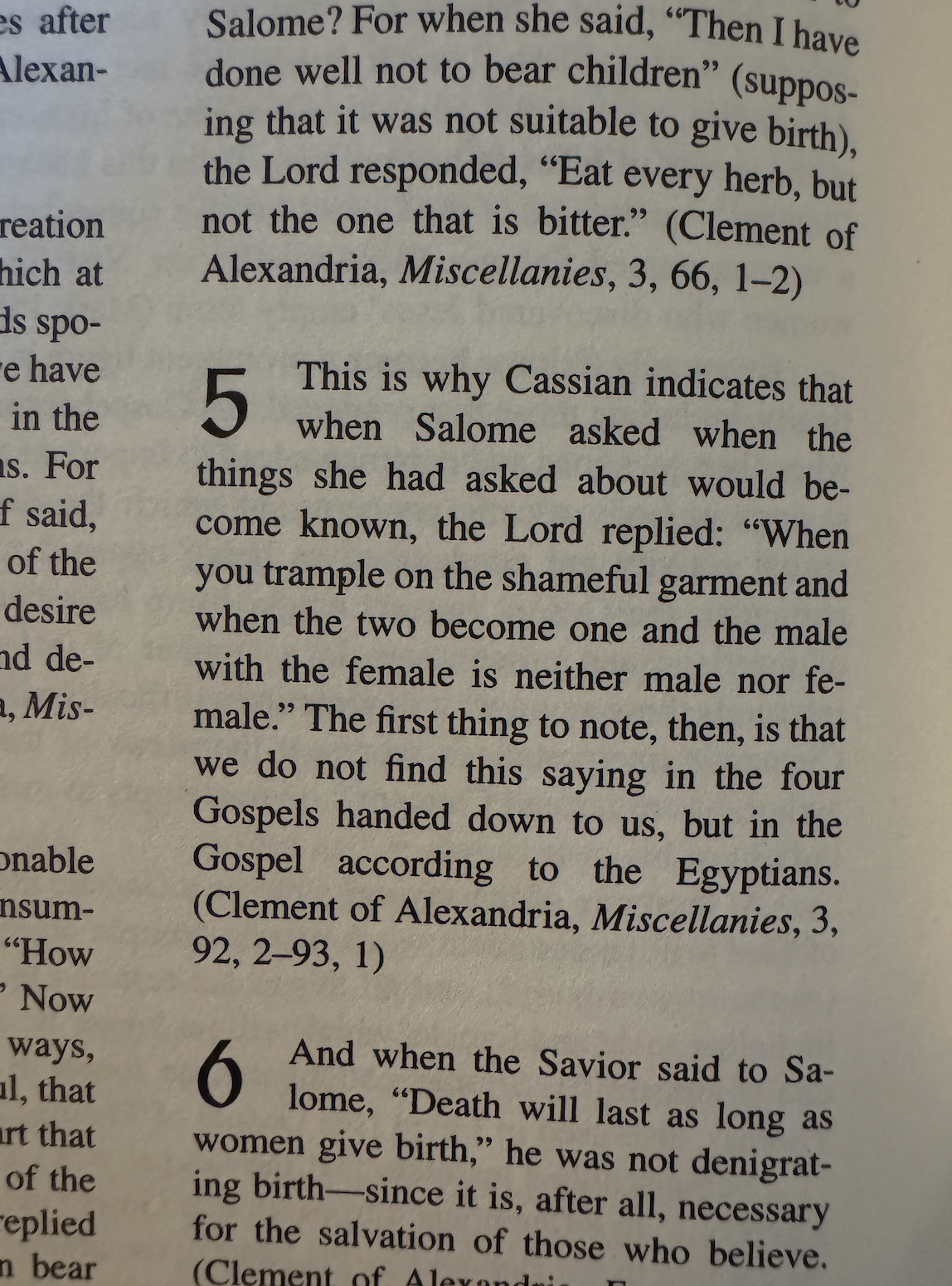
“Death will last as long as women give birth”
“Then I’ve done well not to give birth?” “Eat of every herb, except the bitter one.”
[when will secret knowledge, be revealed] “When you trample on the shameful garment and when the two become one and the male with the female is neither male nor female.”
Clement has his own reasons for cherry picking this text, but for me the verbal echoes of Paul are suggestive of a conversation on the nature of gender, one familiar from stories of Thecla and Perpetua from the early church. The two become one motif is popular in other apocrypha as well appearing in Coptic Gospel of Thomas. And I am curious how much we can read the motif generally about gender.

It seems to me a great deal of the interpretation depends on the sense of META (“with” in the above translation).
“The Male together with the Female is neither Male nor Female” suggests an end to gender distinction as an ideal state
“The Male in dealings with the Female, is neither Male nor Female” suggests the teachings is meant to say something of how the sexes interact.

The natural reading seems to be using META as a conjunction giving primacy to the Male position, but given that the rest of the quotes have to do with procreation, I wonder and I appreciate the ambiguity of the “with” in the translation. Which got me to think “what f– does that mean?!”.
The ideal of Maleness over Femaleness is the very last verse of the Coptic Gospel of Thomas, a collection of Jesus sayings from the Nag Hammadi library discovered in 1945.

The internet is a wonderful place. I don’t read Coptic but I did find this gem.
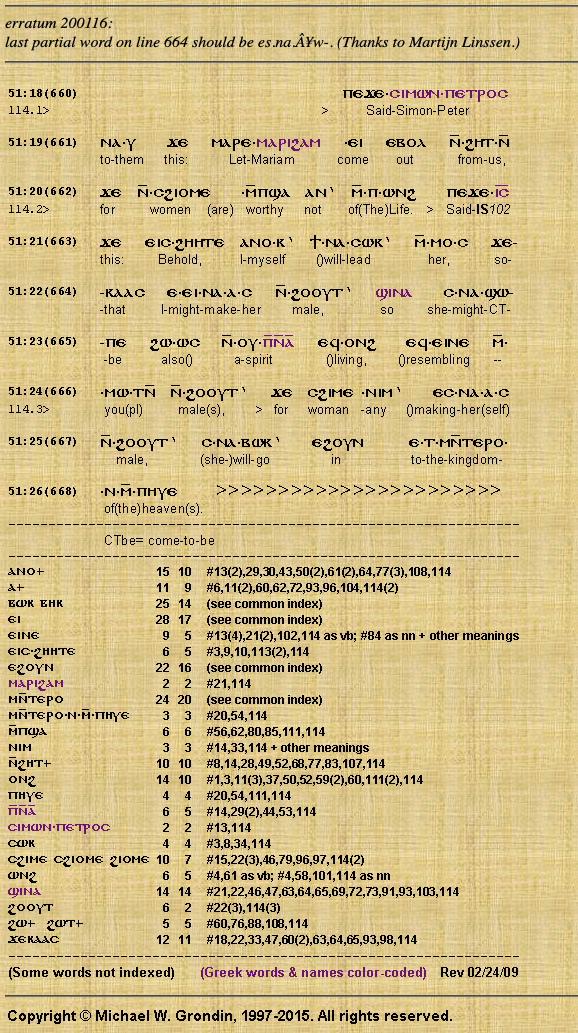
All of this is just to ensure I have this material to hand for my last seminar of the semester and also so I have a place to add more gems as I continue my morning readings.

 Liv Mariah Yarrow
This is gold. To me the key in the Gospel of the Egyptians is the “secret knowledge…” The antinomies all break down and get reconfigured in different ways in these mystical traditions – why shouldn’t Male/Female be one of the main ones to think with?
Who knows what the hell that means about gender…
A rabbi I knew at Cambridge recently published his PhD Cantab on a turn-of-the-century Hasidic thinker, who he says anticipates or sounds similar to Helene Cixous’ theories on gender! Go figure…
https://www.bloomsbury.com/us/philosophy-of-rabbi-shalom-ber-schneersohn-9781350341197/
Are you perhaps suggesting a link between Gnosticism and Alchemy via this logic? Gotta check out this book.
No, just in the most general terms…
The book is not a page turner, but I dipped into it to see how someone could make the argument that some of deconstruction’s most famous moves could be made by people living in a strict gender-normative environment…
Also, and this is really outside the academic lines, but I think that, as you allude to in your post, the way that modern religious thinkers approach these issues can intersect with ancient – it’s kind of a laboratory.
In the case of ancient Med. mysticism, specifically, it’s flat out alive in kabbalistic traditions that are still alive. Chasidic thought preserves those with all kinds of thinking about the female and the male structuring cosmic order in ways that can be inverted…Leigh’s book, the gender section, may be interesting to you from this perspective…He worked closely with Simon Goldhill.
Thanks! Super interesting.