
And there it was that he heard the causes of the Jews, and of their governors Hyrcanus and Aristobulus; who were at difference one with another: as also of the nation against them both; which did not desire to be under Kingly government. Because the form of government they received from their fore-fathers was that of subjection to the priests of that God whom they worshipped: and [they complained] that though these two were the posterity of priests, yet did they seek to change the government of their nation to another form; in order to enslave them. (Jospheus, J.A. 14.3.2)
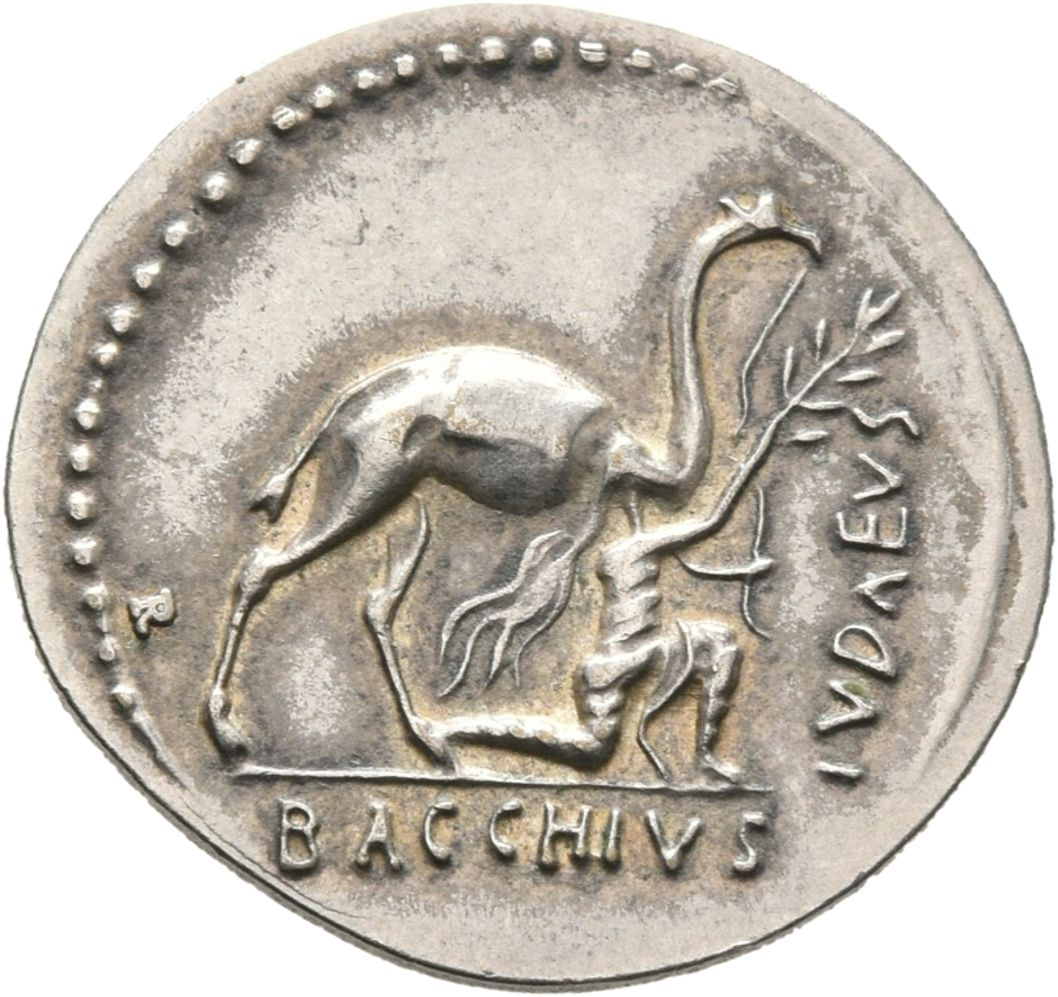
This coin has always caused problems of identification to known historical figures. What about unnamed figures? I speculate about the leadership of this third part of Judaea who wanted the Romans to restore a theocracy instead of support any candidate for king.
Listening to John Davies walk us through Book 14 and it is brilliant. Didn’t want to lose this thought.
UPDATE:
So when I want to illustrate a type and defer to museum specimens I go to CRRO and go to end of the specimens because I’ve found German collections often have the prettiest specimens and best photograph in most cases. Yesterday I was working fast at a conference and grabbed the shiniest image without really LOOKING at it. This was a colossal fail only saved by Andrea Pancotti who swiftly pointed out I’d grabbed a reproduction from Parmalat that some how ended up in CRRO/IKMK. I’m starting to see why the ANS doesn’t illustrate fantasies/imitations/ancient forgeries for fear of this type of accident.
Here’s the Boston MFA specimen of RRC 431/1.

The clearly marked Reproduction: “R”

 Liv Mariah Yarrow
But is the Mainz specimen really this 1970s forgery?
Here’s the museum link: https://numid.uni-mainz.de/object?id=ID565 Sorry for not including it in my original post. Tell me more about it being a forgery!
The letter R on the reverse stands for “reproduction.” In fact, the coin in question is part of a series issued in the 1980s by Parmalat as promotional giveaways for a line of confectionery products (cookies/snacks for children) called Mister Day: https://www.forumancientcoins.com/monetaromana/falsi/ParmalatMisterDay/dettaglio.html
The letter R on the reverse stands for “reproduction.” In fact, the coin in question is part of a series issued in the 1980s by Parmalat as promotional giveaways for a line of confectionery products (cookies/snacks for children) called Mister Day: https://www.forumancientcoins.com/monetaromana/falsi/ParmalatMisterDay/dettaglio.html
This is at once hilarious and sad. I’ll remove the image from the post but we best tell them.
Fascinating. What do people make of the camel? Students will love this, in my senior seminar. They are always looking for a way to get outside of the perspective of Josephus. Often they want either the “people’s” voice in rural Judea or the Syro-Greek voice that’s occluded from S Levantine cities…I see I need to read this: https://books.google.com/books?hl=en&lr=&id=KrbkEAAAQBAJ&oi=fnd&pg=PP1&dq=bacchius+iudaeus&ots=ThA85A4eaw&sig=z9OVsRdInFvsIZXWXRaApLIiDLs#v=onepage&q=bacchius%20iudaeus&f=false
It is very similar to this earlier type:
https://numismatics.org/crro/id/rrc-422.1
I (and i assume others) associate the two and the iconography evokes exotic eastern barbarians. While we don’t know who Bacchius was we do know Aretes and this is nothing like how he portrays himself.