Skip to the second half of this post if you just want notes on actual scholarly stuff. Most of this at the top is about the meta-experience of conferencing, but it does contain links to earlier posts on conference papers.
—
For reasons that are boring and practical and completely unexpected, I’m on a crappy bus without any wifi or electrical plugs winding my way home the long way. No this is not great for my mood. I’m writing to try to cheer myself up and of course as always to consolidate some of my learning and reflect on how to do better next time.
I want to refine my conferencing strategy to meet my relatively well-defined conference goals.
Goals.
Connect people.
Basically, I love ensuring I introduce those at different career stages to one another and myself being introduced to new people and hearing updates on their career and lives from those I’ve met before in these transient academic spaces. This was an especially good year for this, I got to connect both UGs and Grads with a wide range of colleagues at other institutions and at different career stages. The reward was myself feeling like I made great connections with early career Italian scholars all three of whom I think will be important to my work going forward. The other rewarding moments were hearing about how my funding list has been used by both institutions and individuals. I also learned a great deal about how MMUF works on private campuses.
I guess also in this category is where I would put being accessible myself to those who want to connect with me.
Learn about newly excavated evidence.
Later in this post I’ll allow myself to vent about the impossibility of attending everything of value at the SCS/AIA and how this is demoralizing and even toxic for the field. But since one has to choose what to attend in all the concurrent sessions, I put my attention primarily on hearing papers where I will see unpublished archaeological evidence with a primary focus on Italy, ideally pre Augustan Italy. My logic is that here I am most likely to learn something transformative for my own scholarship that I cannot learn from just reading on my own. You might have already deduced this from my earlier conference inspired posts (divination, Capitoline, phalloi, and natal alienation). But not all such papers I attend actually lead to a post. Likewise the evolution of Pompeii I.14 was fascinating from the shifting use of space (is indoor or outdoor space more needed in any given moment? time to dig a new cess pit!) to the impressions found of originally woven reed mats in herring bone pattern with borders. There was also the stunningly good paper by Krupali Krusche on the Temple of Vesta, comparing digital scans to archival drawings (22 columns are now certain! as is a wider opening with engaged columns). Some more notes can be found in the second half of this post.
Learning about new trends in scholarship and the field.
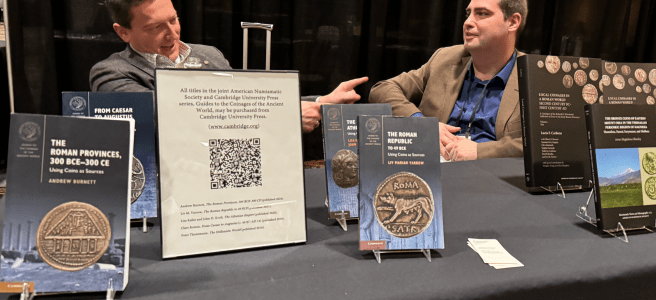
So this should happen in the panels but frankly the best that usually happens is just reading titles of sessions and papers I’d like to hear but conflict with something else I’m going to prioritize because of the previous goal. Instead, the main place I meet this goal is in the book exhibition hall. Yes, it is a great place to bump into people (esp. if the bar isn’t your thing), but really I like to work through the whole hall table by table and photograph each title of interest. You might remember my round up from last year. The photos act as notes as well as a pause before purchase. This year I wanted to attend so many sessions I didn’t give the hall the attention it deserved. I did get Tabolli on Veii at a steal and I’ll drop some images of other books below. There were good conversations with one exhibitor about pricing structures of digital products and another about image permissions.
[This bus is so hot I feel a little faint and my nose is rather offended. Only an hour to go, but my laptop battery won’t last…]
Seeing friends.
I think I’ve prioritized this too much in the past. I know this seems strange, but all of us at the conference have such a range of demands on our time, I am coming to see, especially after this year, that the social can be deeply unsatisfying. I long to have meaningful convos and catch ups and feel connected to my besties in the field and those more senior scholars I consider role models and mentors of a sort. Yet, the venue is only ever a taster or a tease. I’d have to give up all the goals above to meet this one well and even then how can I ask others to prioritize the personal over the professional. This is not a dig at anyone but only a mild wistfulness of those I missed completely and those to whom I did not give my fullest attention. I need a mild mental re calibration of personal expectations. I don’t want to conflate my goal of connecting people with my personal desires for re-connection. And, I need I think more opportunities to see those I care about throughout the year. Luckily this spring holds many such travel commitments.
Serendipity.
I want to be open to unexpected and the spontaneous. This is always my goal in life generally, but especially I do not wish to be rigid in the conference space. This year serendipity connected me with the Low Income and First Gen advocacy group (you can sign up for their mailing list here, website to come). It also led me to reflect on my commitment to reproductive healthcare access and a desire to forthcoming WCC initiatives. These conversations helped me articulate for myself that I want to contribute in fixed one-off gifts of time and talents, but that I’m not in a position to take on standing roles with job descriptions. It helped me feel better about turning down a leadership position.
Strategic Tweaks.
Session attendance planning.
This year I did better about planning my session attendance than in past years and the app helped. BUT I was still doing it partly on the fly and at the conference. In an ideal world I’d do all that planning before arriving, or given that isn’t always possible perhaps next year I should fly in a day early or just arrive much earlier on day one to give myself time to read it all and plan and discern about that plan in light of above goals. I think doing this will help me pace myself and anticipate the rest and personal care necessary in order to keep going for the duration of the conference.
Tend to the body.
The schedule of the AIA/SCS is beyond grueling. The program requires the you chose to forego key professional activities to eat and sleep. Parts of the program start as early as 7 am and official programming goes as late as 10 pm. There is no officially empty slots for any meals. There is not even the crappy coffee and dry pastries as one might expect at other conferences. There is no culture of providing food at drinks parties. And there is a culture of many such back to back receptions, some with v generous open bars, others where a bottle of water is eight dollars. Can we learn nothing from our Italian and Greek colleagues who would never dream of giving you a glass of wine without at minimum salty nibbles?! Even today, airlines still give you a micro packet of wee crackers with your non-alcoholic beverage. Most of us struggle to sleep in a strange bed or to fall asleep without at least a little decompression time. I learned (again) the hard way that I cannot run on empty indefinitely. Two major changes for next year I think. I’m not to be trusted to chose self care when I have a list of professional opportunities in front of me.
1) I will need to be blocking out meal times and pre gaming a strategy of where the food will be sourced. The hotel is often not an option given crazy lines and up-charges. At minimum I need a case of bars and a case of seltzer for my room and maybe even something caffeinated.
2) Discern clearly which goal is being met by various evening ‘receptions’ or even just bar time. Serendipity is great but it is low on the list and one can predict where one might be most likely to have a meaningful interaction.
Packing.
It isn’t over packing to have a variety of outfits and shoes. I found myself refreshing before evening events by showering and changing. It really helped. I want to intentionally pack double in future years. I also want two bags. The backpack is perfect for day time with the laptop and all, but come evening a smaller shoulder bag to make up for a lack of pockets is highly necessary. Both bags will help with having water, bars, and crochet to ready hand. Being able to switch between heels and flats was also great.
[I made it off the bus and into the bosom of family.]
More notes (and photos).
It’s the morning after and I’ve got 20 minutes now before I have to strategize the spring schedule with my dean.
SCU.
Catherine Steel delivered a masterful re evaluation of the senatus consultum ultimum which I may never again refer to as ‘so called’. Caesar gives us the ultimus shorthand in BCiv 1.5.3, but the decree from 121 BCE onwards is recognizable by the use of the phrase: “ne quid res publica detrimenti capiat“. I’m sure she’s going to publish this and when that happens I’ll try to come back and add notes. I also have photos of many of her slides on file. Key questions that emerged were: what does detrimenti imply and is the concern primarily about property damage? Is this decree descriptive of crises rather than proscriptive of specific actions? Why is it used as compared to other crisis actions like the appointment of a dictator? How do we understand 77 BCE use and how does it related to the ambiguous citizenship status of individual in greater Italy in this this period? What differentiates this type of SC from other SCs and what is the evolution of the quasi legal status of SCs any way?
This section had glorious discussion. And I blushed as Cynthia Bannon described Zach Herz, Carlos Noreña and I as a power trio as we praise Steel and engaged in the convo. Yes this is just (no so humble) bragging. But I like to remember these little asides.
Glandes.
Elizabeth Heintges blew me away with her paper on sling bullets. Surely once published this paper will become the definitive citation on the subject. This is another perennial interest on this blog. She used new finds from Spain and a review of literary evidence and the historical corpus of such material to review the communicative functions of such objects and the words upon them. One distinction is bullets that are etched upon after casting (graffiti) vs. those cast with a message. She convinced me that bullets may have been much different that arrows or javelins with messages attached. It also got me thinking a great deal of reuse of such objects. Would a labeled object be less likely to be reused or at least melted and re cast before being slung back? She also drew my attention to the fact that different size bullets existed some quite large as much as 70gms!
Looking for an image she showed led me to this great digital resource on Trajan’s column and images of all scenes in incredible detail. But my republican loyalty makes me love the relief with slingers from Ascoli Piceno more.

Note that the stacks of ammunition in this relief are probably for the ballista also shown in the same scene not sling bullets. The extra bullets are in the slingers cloak 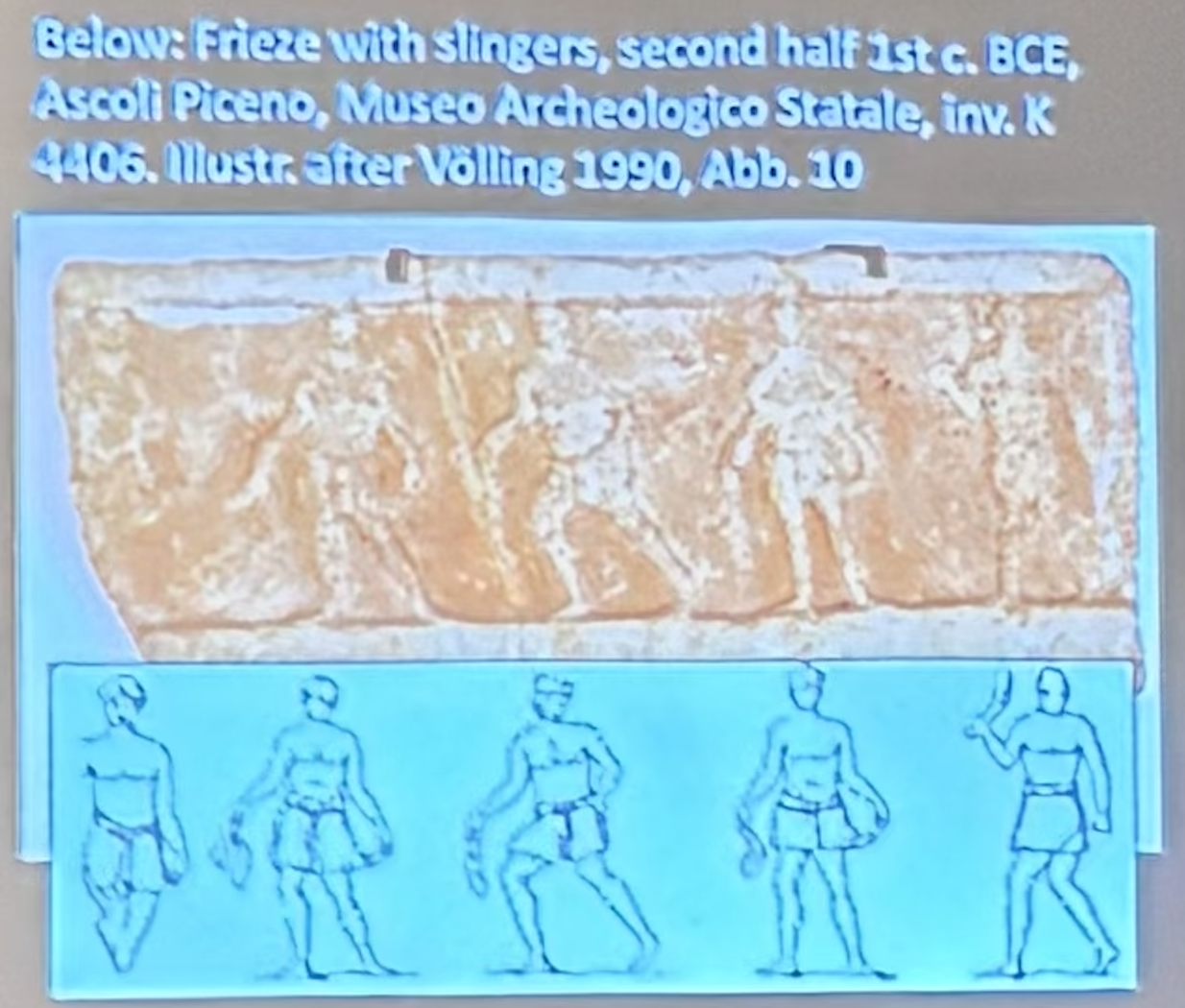
Do you have a better image of this? I’d love it. I’m also struck by the relative nudity of these slingers vs. that on the column relief
Feronia.
My interest in Feronia has been evident on the blog before.
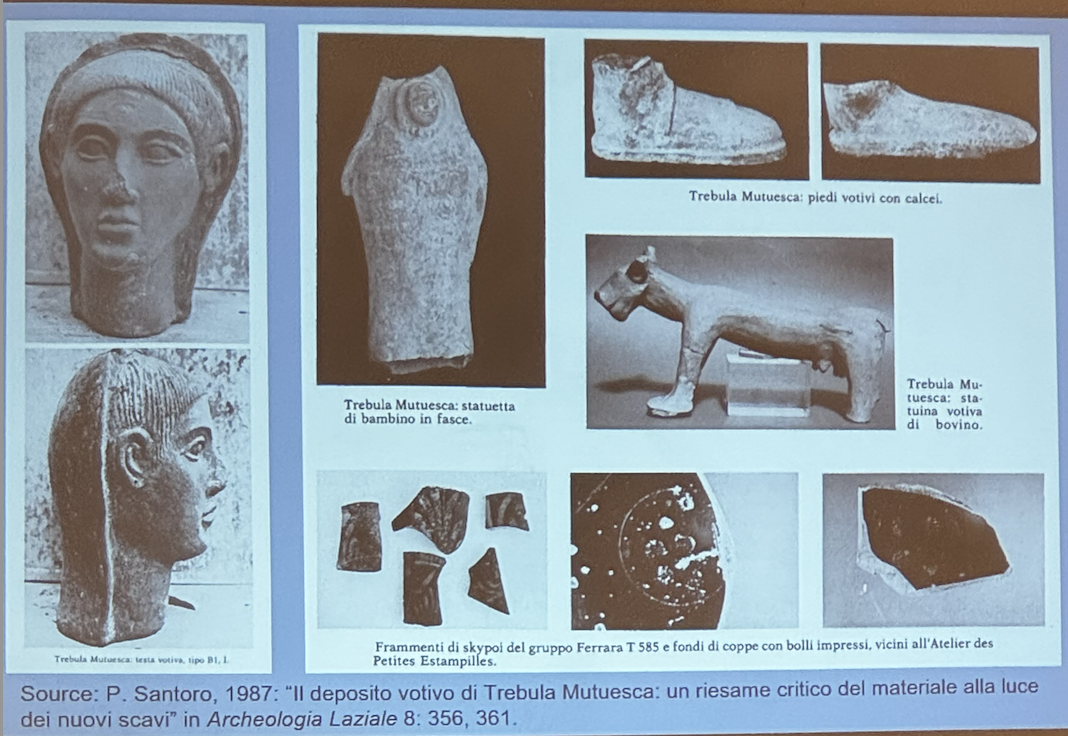
Notice the petite estampille on the black glaze 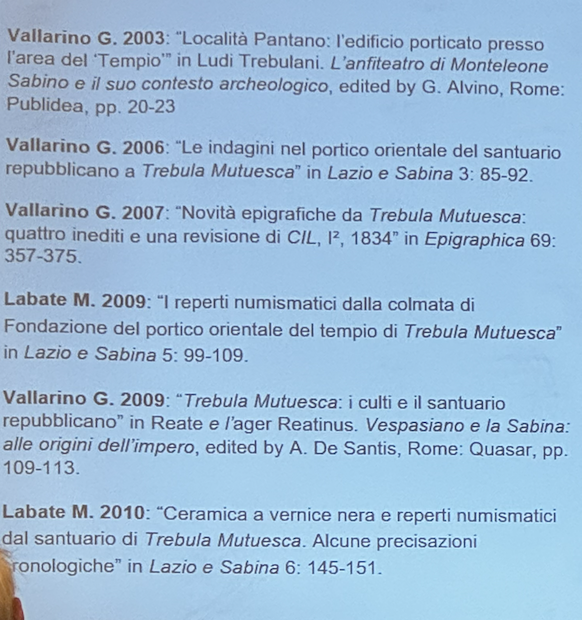
just bibliography to check 
the column is from the colonade (see other slide) 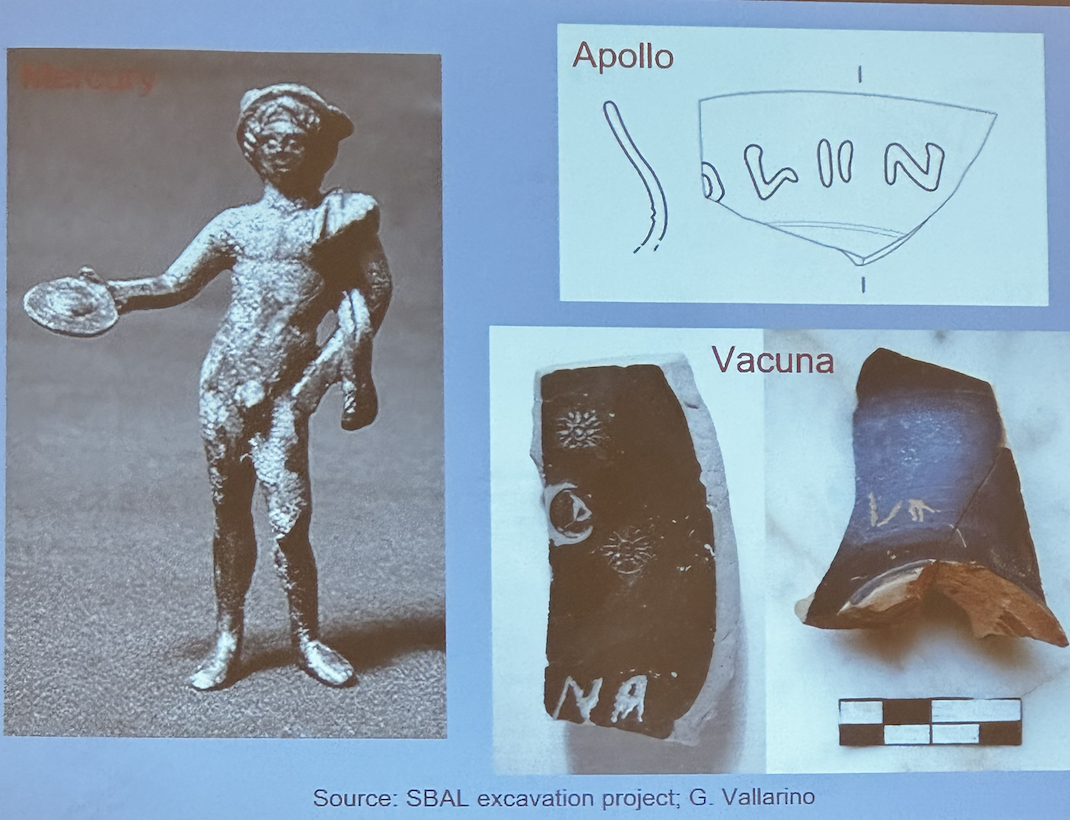
Again notice the stamps on the black glaze, the speaker was emphasizing here that other gods besides Feronia were honored here 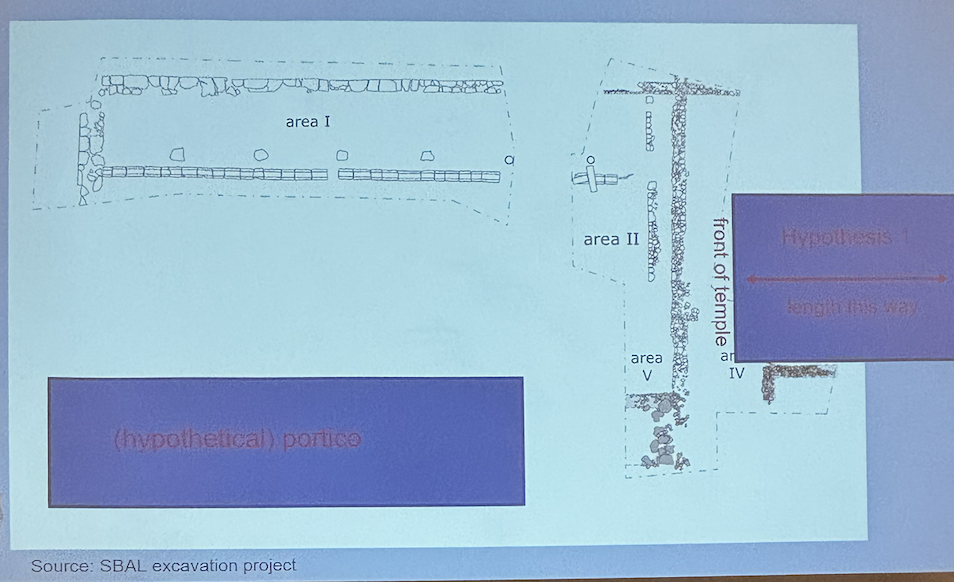
Another hypothesis perhaps stronger is that the temple orientation should be rotated 90 degrees 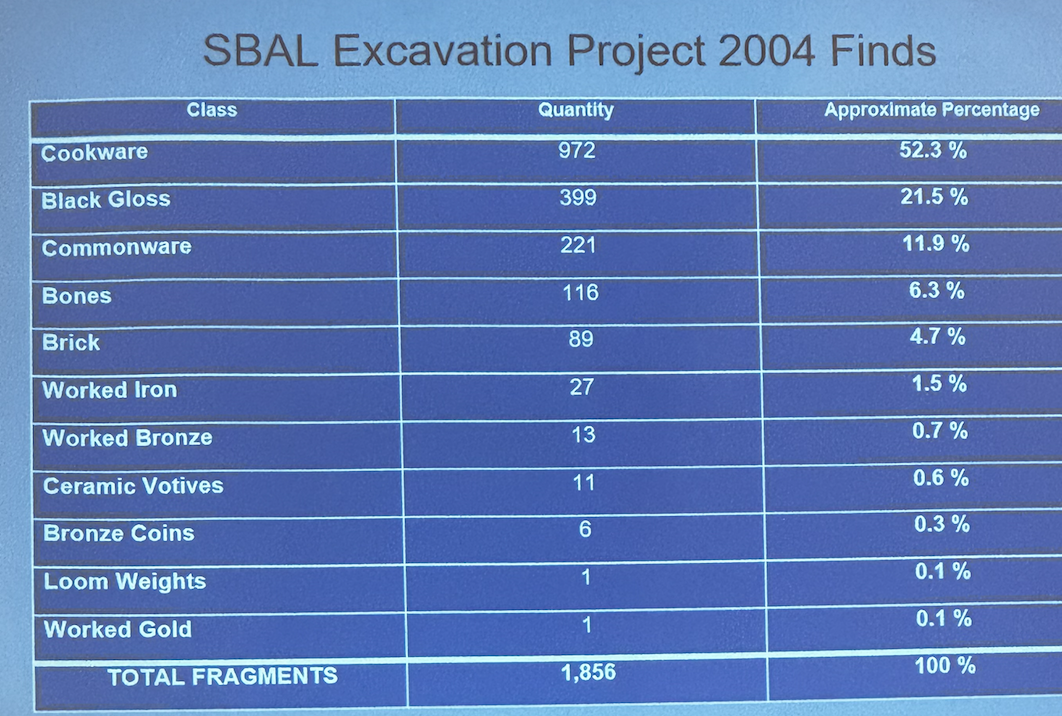
I’d v much like to find the details of coin finds and compare to find locations of black glaze
Enslavement.
The panel on Slavery was fabulous. Chance Bonar’s paper started to think about how enslavers construed and constrained and feared the religious knowledge of the enslaved, and how the enslaved utilized this knowledge. Perhaps most striking to me what how different his examples were from those that immediately come to my mind. These are mine: Eunus using religion to unify Sicilian uprisings, enslaved used for the most brutal jobs in animal sacrifice, the baccanalia SC, the worship of the enslavers genii and iunones, the enslaved deaconesses of Pliny’s letters, general concern over foriegn cults. He instead talked about Cato’s agricultural treatises and ambushes of former enslavers by the self liberated at festivals. Lots of potential.
Javal Colman and Dan-el Padilla Peralta challenged assumptions of any growing concern for humane treatement of the enslaved in the later empire (antonine onwards). Instead of seeing legislation as concerned with humanity of enslaved rather the texts can be read as controlling mismanagement of property and how such mismanagement potentially threatens the rights of ‘good’ enslavers to be able to control their own property. Handout on file.
Grateful to Joe Howley for asking a question on Diodorus that led to Muntz crediting my work and the importance of questions of Roman imperialism to ancient perceptions of the consequences of mass enslavement. I got to credit Tristan Husby for helping my thinking on this evolve from 2006 to 2021. (Both my books talk about the theme).
Update: Post inspired by another paper at this panel
Book Fair.
Note image captions.
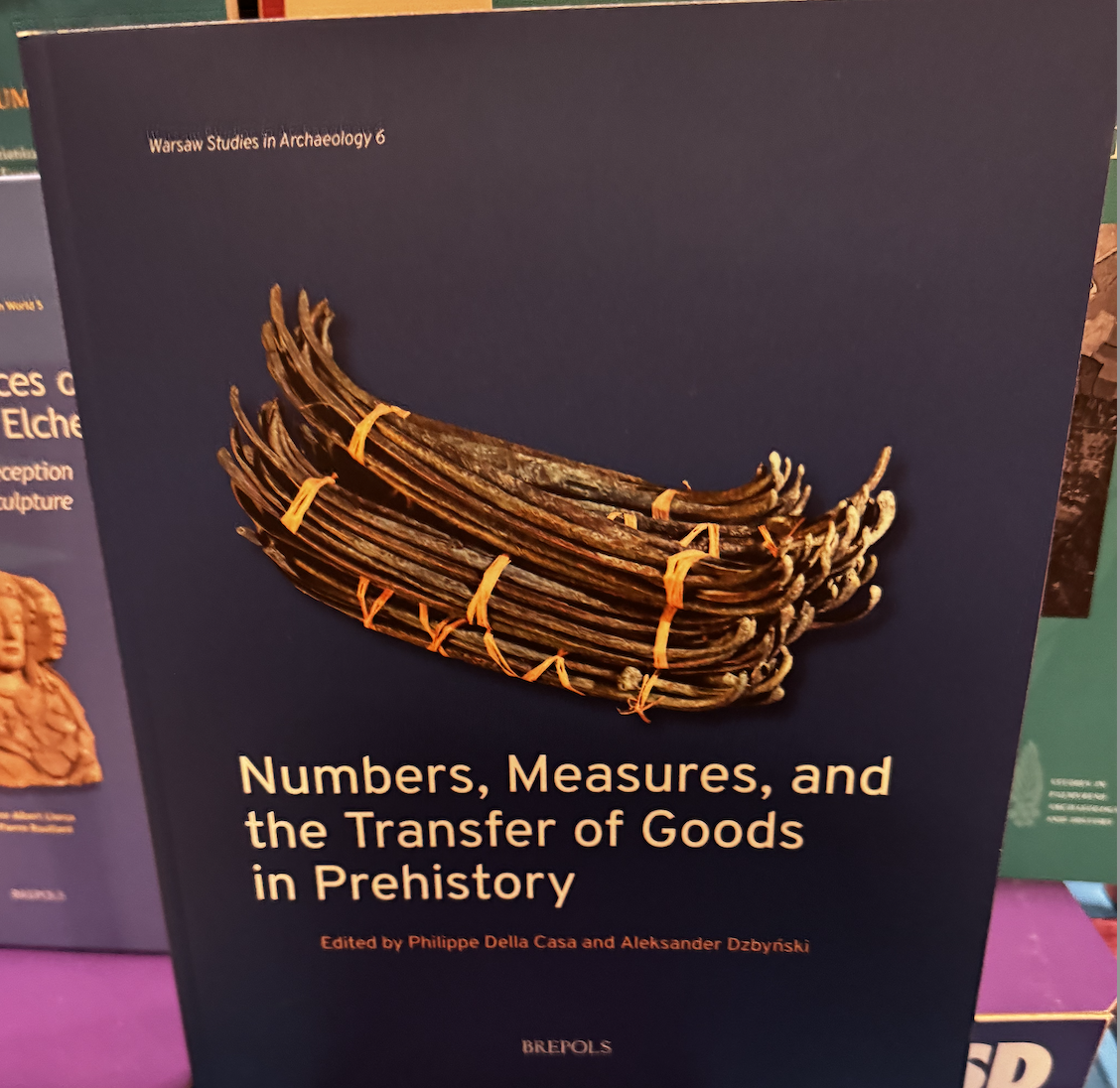
This seems relevant to my work on aes rude and the transition to aes grave 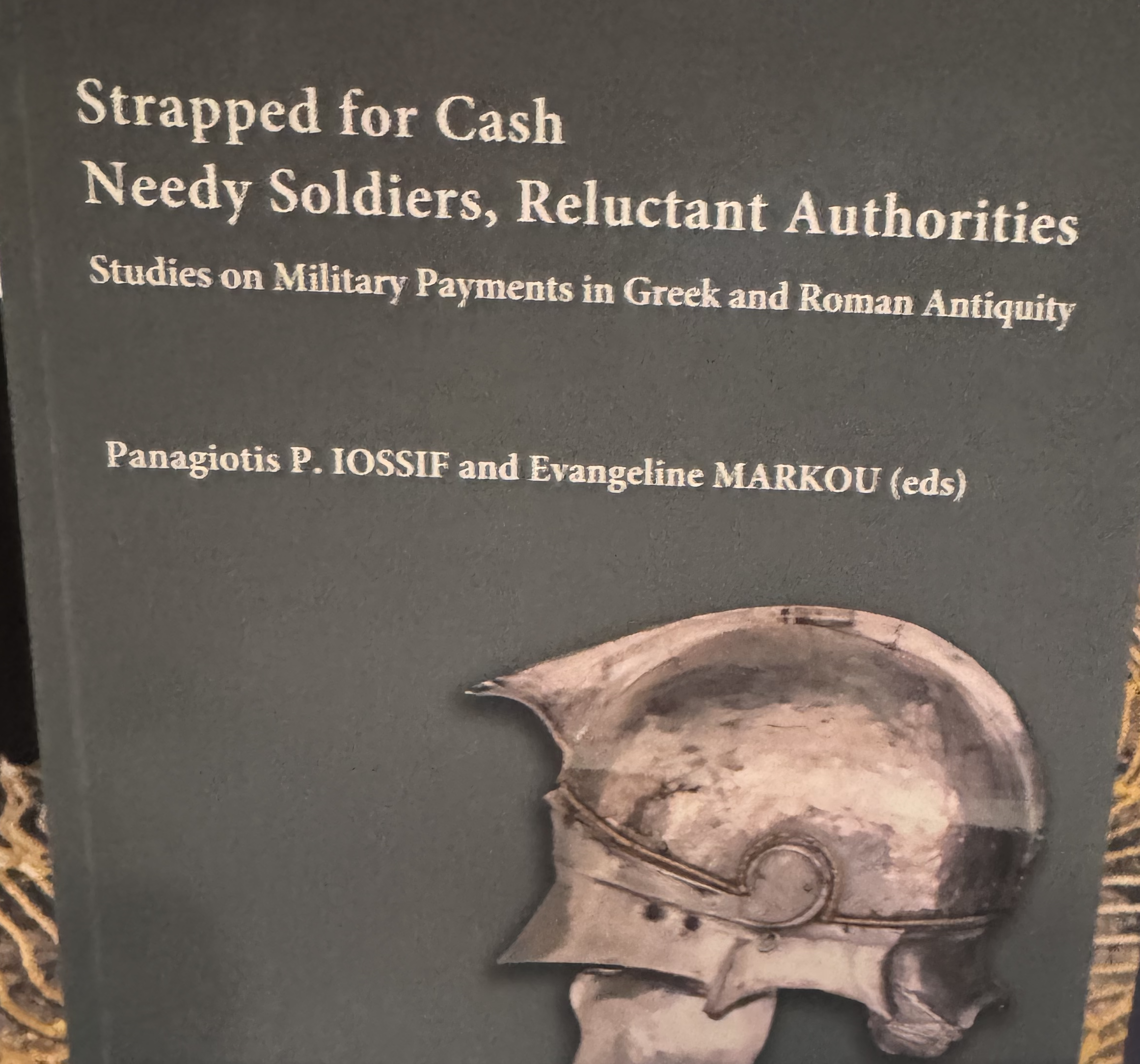
I wonder if Michael Taylor has reviewed this 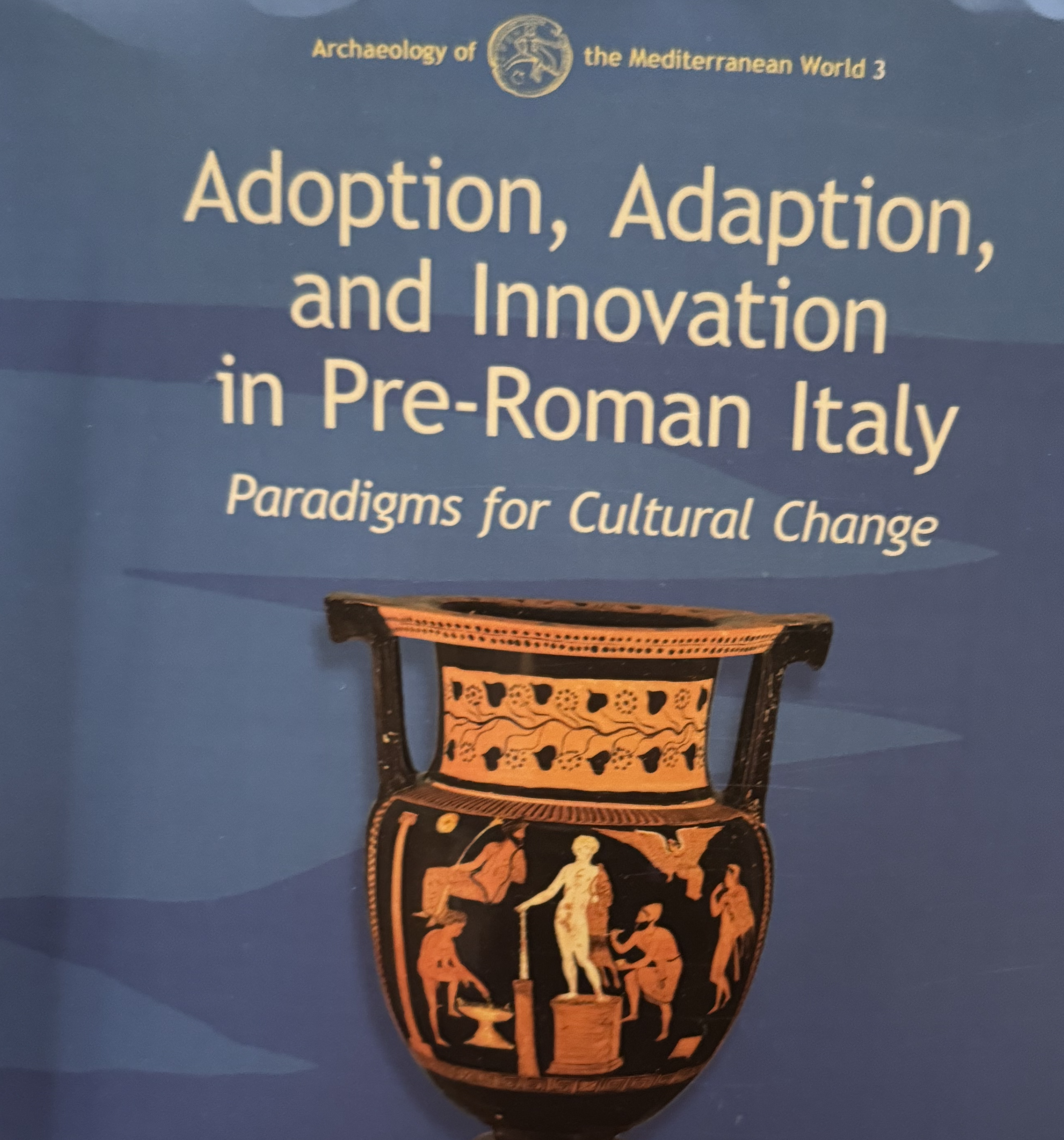
must find ToC 
Perhaps useful enough to buy? 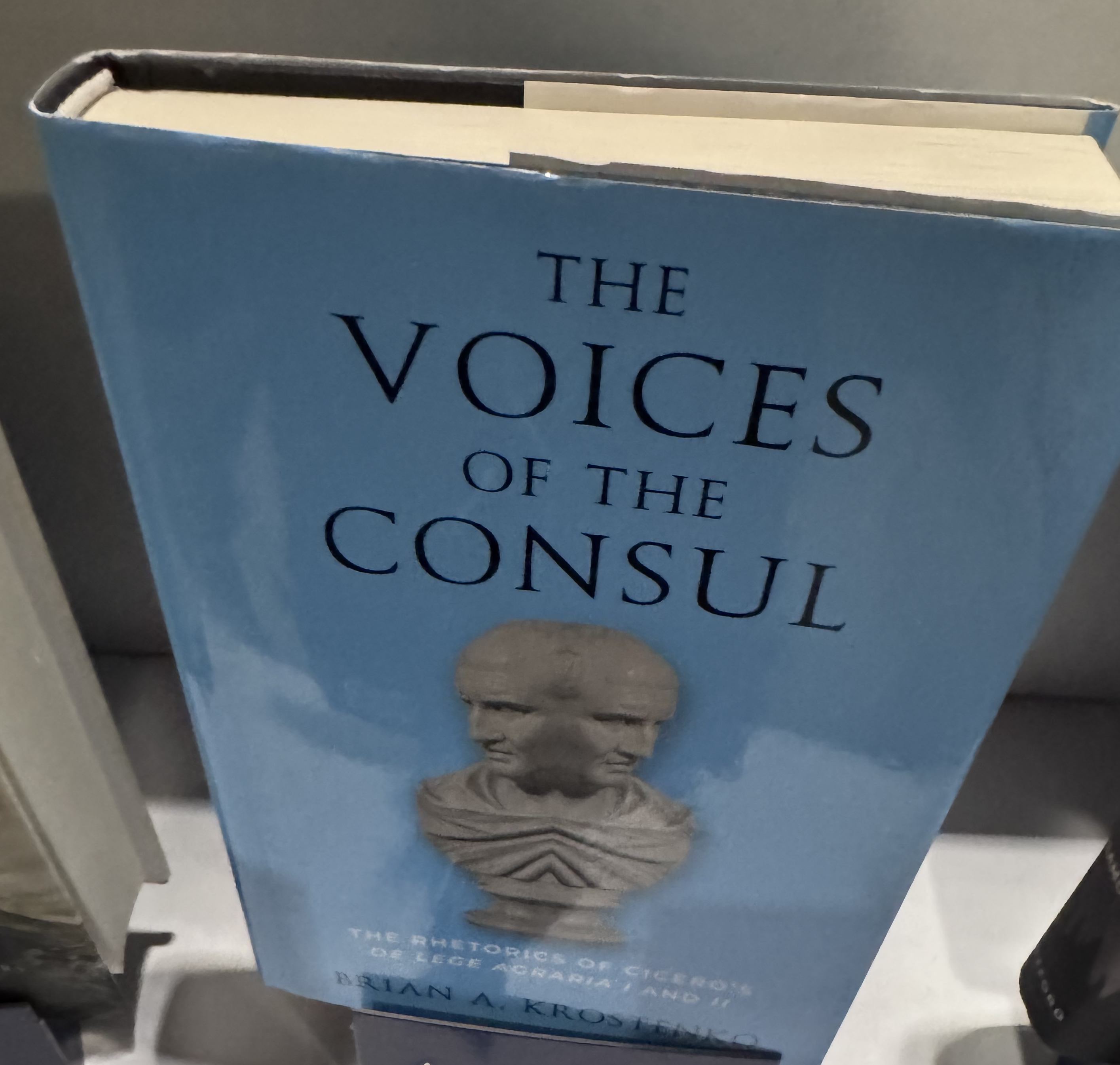
Specifically on the lex agraria speeches 
Archival Archaeology is growning — given my work with Archival Numismatics through the Hersh archive I want to think more about how others are approaching this work 


Useful for my interests in access to the field 
Just pleased to see my book at the fair!

 Liv Mariah Yarrow