Both Crawford nor Haeberlin seem to derive their knowledge of this hoard primarily from the odd account by prof. Michele Stefano de Rossi who is obsessed with the possibility of eruption of the Alban hills in the historical period (to my knowledge this is non-sensical).
Machine translation with some human intervention
From Annali 1871, p. 262
In 1848 the late P. Marchi purchased for the Kircherian Museum a hoard of primitive coins and aes rude found near Ariccia, which was then said to have been found under the peperino or inside a boulder of this rock. But since this fact was not published at the time and the news for me depended on verbal traditions nor, as far as I knew, there was any connection between the treasure and the pottery from Lazio, I had not yet hurried to ascertain the true circumstances of the find, without, however, losing sight of the fact that it could become a very important day. …
—
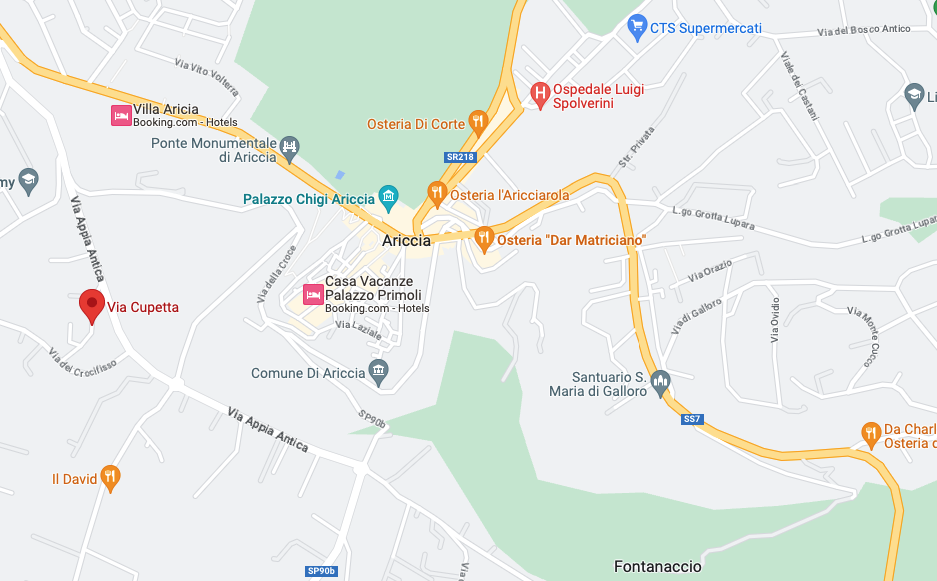
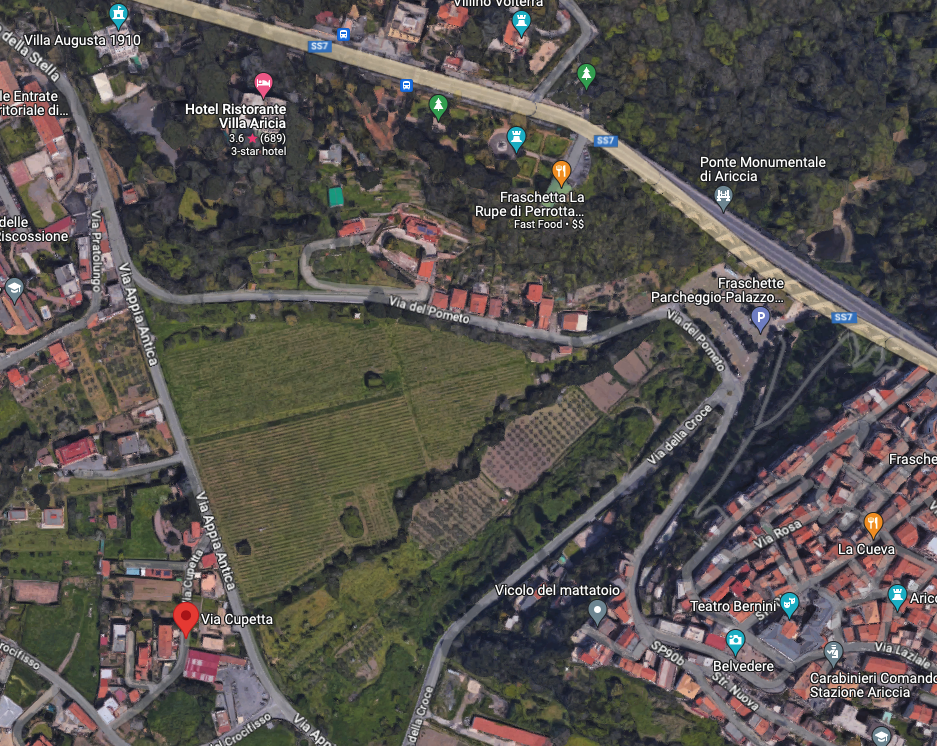
For the discovery of 1848 I found that a dispute arose between the municipality of Àriccia and the prince Chigi, the owner of the land. This led to numerous correspondence and appraisals and studies; which form a copious collection of documents in the provincial archives of the region. From these documents I learned not only the precise place and the method of the discovery — the enlargement of the via della Cupella* below Ariccia — but also the names of the workers and of the others; who intervened at work, from whom I was able to learn very precious details of the discovery. Without going into the difficult and thorny account of the investigations I made, the result of these was as follows.
To widen the said road located at the bottom of the slope of the hill towards the arid valley not far from the modern large bridge,** the rock was cut on the side of the mound and there among the earth below the layer of peperino was piled up the monetary treasure, made up of several currency bars, many semisses, some quadrantes and many aes rude. Fortunately the aes rude, less studied from the point of view of form, has not been too carefully cleared of the earth; and although 26 years have passed, being kept under crystal, it still retains the traces visible to the naked eye, but better with the lens, demonstrating that those metals were excavated among the volcanic ash of the Alban hills, not among the vegetable earth.
* – no road of this name exists today, but if it should read Cupetta, this might represent the approximate find spot. Big if.
** – Ponte Monumentale di Ariccia?
I was then able to persuade myself from the research done on the spot; that at a very small distance from the point where the treasure lay, that is about thirty paces towards the base or from the valley and within the same layer of clayey yellow ash, a few years before the discovery of which reason, a large amount of the usual coarse and blackish Latin pottery was found , the containers were broken and scattered. So I am certain that the pottery and the coins lay in the same layer. However if some scholar here does not want to rely too much on my investigations into the close relationship between the hoard and the crockery; he may suspend his judgment and await the end of the present reasoning. Having said that, here is the description of the treasure kindly communicated to me by ch. P. Tongiorgi successor of P. Marchi in the direction of the Kircherlano museum. I found another report identical to the one I am producing in the aforementioned series of documents in the archives of the province.
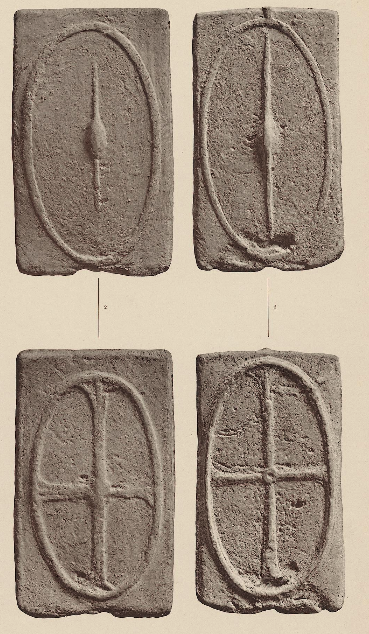
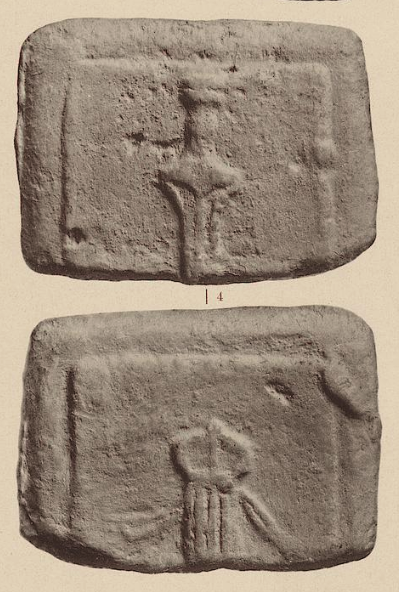
- Quincussus (Five Pound Bar) with imprint of an elliptical shield, cut in one face in the greatest length and width by a kind of cross open in the center, enlarged in the four extremities in the form of a cone; cut it on the other side by a boss resembling a spindle which extends to the entire length of the shield. (This quincusse is in the cabinet of ancient medals of the MbL of Paris. [not in GALLICA. – others say it is in Kichner = Rome Coin Cabinet])
- Another similar quicussus released from the casting process less perfectly than the previous one with a metal defect, so that at the top of the shield the air and the light pass from one side to the other
3. Fragment of quincussus with the imprint of the parazonium (short sword) on one side and the respective scabbard on the other. If one keep the grip with part of the parazonium on one face and the end of the scabbard is on the other. It is square, and represents three-fifths of the whole.
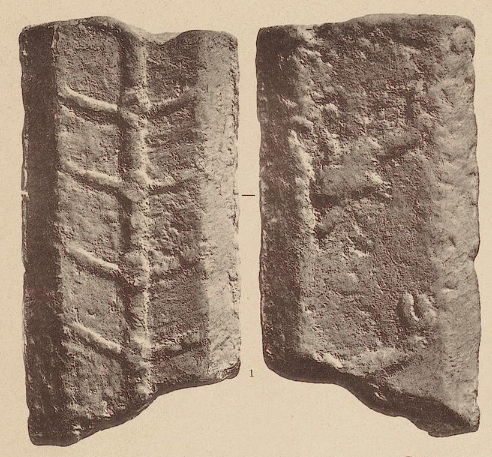
4. Another fragment of a rectangular currency bar, with two dolphins on one side and a leafless twig on the other. It is truncated at both extremities of its length, but it lacks little inside.
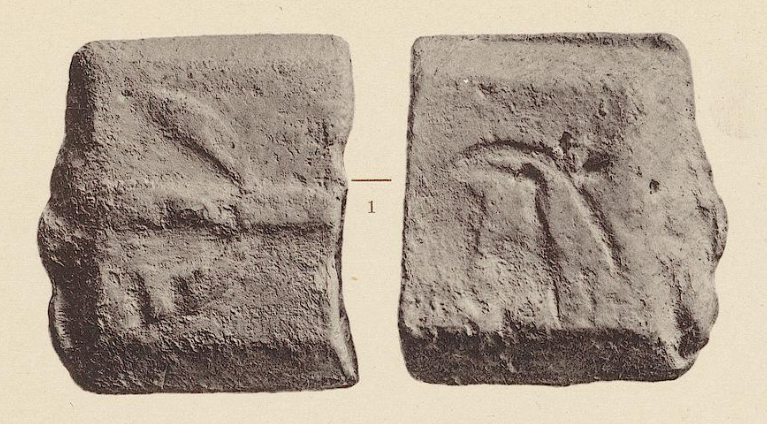
5. Another small fragment which on one side looks like the tripod of a candelabrum and on the other without imprint. The magnitude is less than the third of the whole. [RRC 6/1 or RRC 10/1?]
6. As with two-faced clean shaven obverse, head of Mercury left on the reverse. It should be noted that at the moment of the discovery the little treasure had at least three similar ones. [RRC 14/1]
7. Semis with an ox’s head to right and ship’s prow, also to the right. [Paestum type?]
8. Three similar trientes with dolphin and four globes on right, thunderbolt and four globes on right. [RRC 14/3]
9. Two similar quadrantes with open hand and three globes to the right, two shuttles or barley grains with globes [RRC 14/4]
10. Thirty-nine pieces of different proportions and unformed bronze, which it seems should be taken for aes rude as found in the deposit with the currency bars [aes signatum] (There is no doubt that these bronze pieces are true aes rude. The inferred study was compiled at the time of its discovery during the aforementioned question regarding the property.)
I will not talk about the combination in this hoard of the various kinds of money with the aes rude, nor about anything else of archaeological interest found in that coin group. Here it is enough for me to have verified the relationships of the coins with volcanic ash and of the coins with Lazio vases, and given the description of the numismatic series to which they pertain …
NOTICE nowhere in any of this is a mention of this bar which Haeberlin says is also from Ariccia (see previous post).
Haeberlin says he can see no trace of the writing on his bar which should be the same as that found at Ariccia with the hoard BUT …
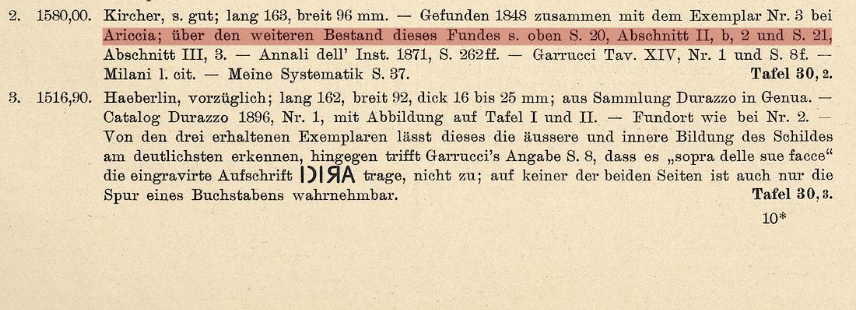
Within a year of the discovery Garrucci was already claiming that it had such an inscription:
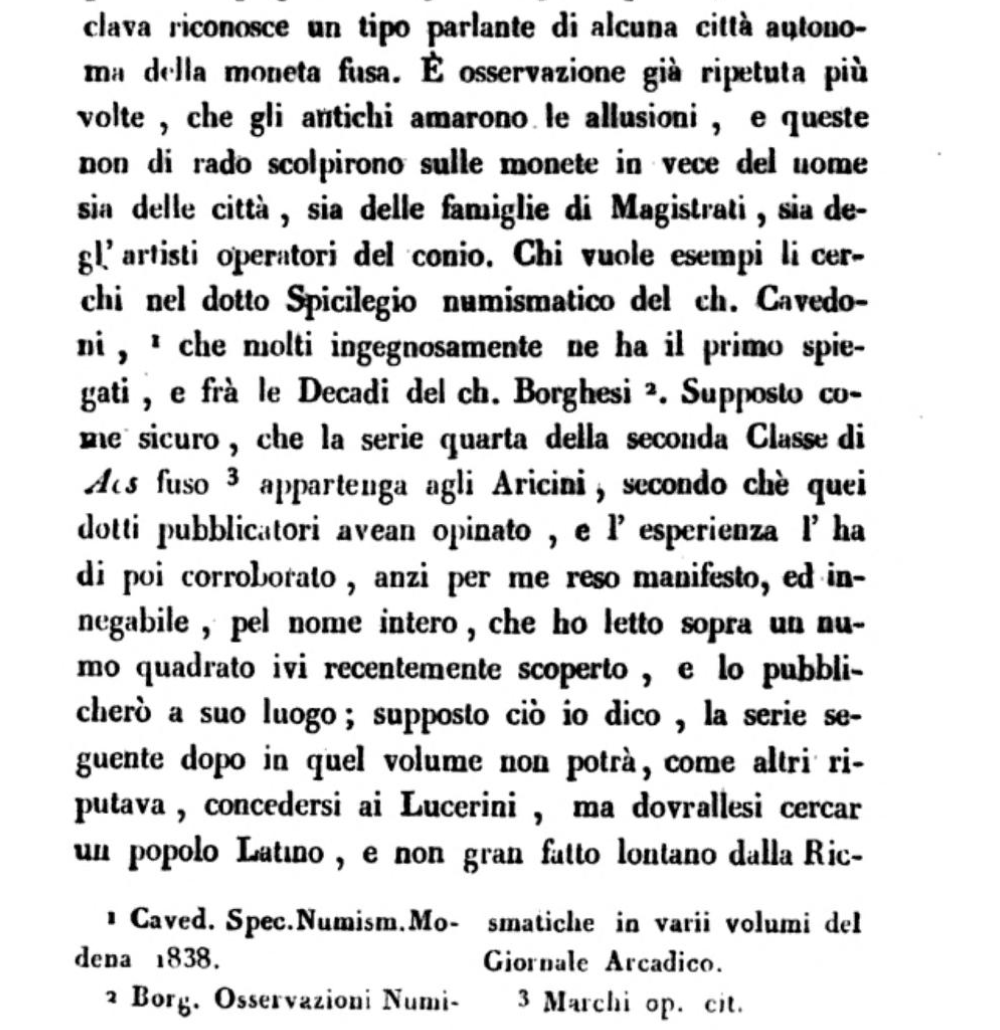
A claim he doubles down in for his later treatment:
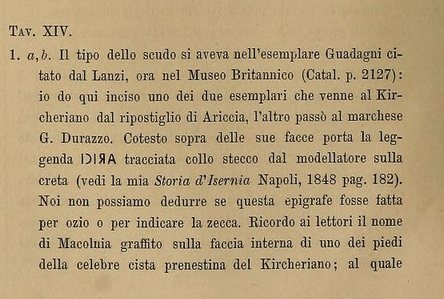
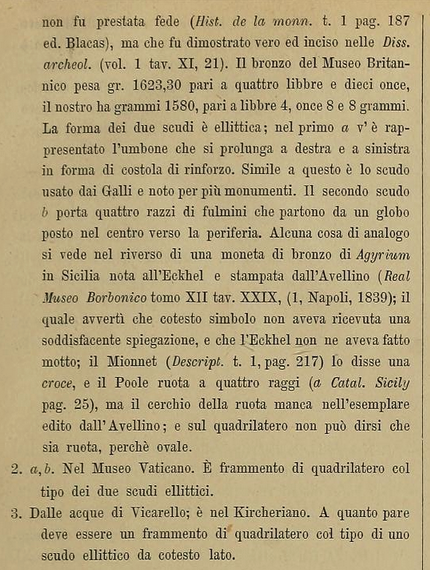
Crawford CHRR suggests that Haeberlin’s bar is in Berlin. If true maybe the possible inscription could be revisited with better imaging technology.
Pizzamiglio 1857 says clearly that the discovery was part of the efforts to create the bridge foundation.


 Liv Mariah Yarrow