10 of 234 days: UPenn Nemi connection

The Cesano 1940 (lake?) Nemi coin catalogue has not yet arrived from ILL, but it’s less than 24 hours so I must be more patient, maybe I’ll get to blog about that in a day or two.

Important article on Collection history at UPenn (PDF also on file)

My poking around brought to my attention that the UPenn Museum also was a major purchaser of artifacts from the late 19th century excavations at the sanctuary of Diana
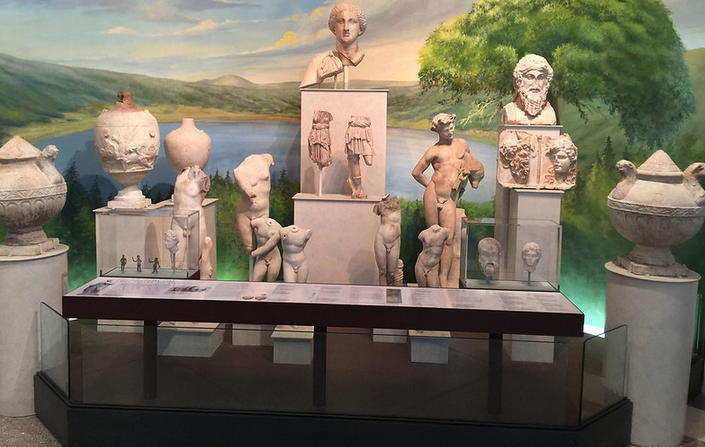
From Flickr

Their online catalogue suggests just shy of 50 objects. The main agent in the acquisition of Nemi material for UPenn seems to have been Mrs. Lucy Wharton (Joseph) Drexel in 1897. That she acquired? (paid for?) along with the ‘fine art’ this weight leads me to believe its is just possible she (or the university agent) might have also brought back coins, even ugly ones.

Catalogue entry (a shame the exact dimensions including mass aren’t recorded)

UPenn also has a pretty decent coin collection, more than 20k specimens when all periods are included, of which the vast majority are Roman. While I cannot say I looked at all their coins, it seemed pretty clear from entries that provenance before 1929 was typically not recorded. My suspicion is that if they got Nemi sanctuary coins they didn’t record them as such. Archival paperwork on the Nemi acquisitions in the museum might answer those questions, but even better would be to fine the Savile photos that Crawford mentions (see earlier post.)

A collection of photos donated by Lord Savile to the British Museum illustrates a number of pieces not otherwise attested, which have been included in the list below, and there may well have been more.

He also says:

A number of pieces were published by E. J. Haeberlin in his Aes Grave as forming part of his own collection and a number of others as having been part of the stock of the dealer X. Pasinati in 1895.

Given the excellent quality of Haeberlin’s images; it should be possible to establish where at least some of these coins from the Pasinati’s stock ended up. I’m making a right pest of myself at the BM as C&M doesn’t seem to have the photos and I am now banging round the other departments asking questions and favors.


Transitioning between projects is so hard. It’s weird. I was so eager to be done with Dionysius and to give my full attention to the coins, but yet finding the most productive steps is harder than anticipated. The habit of worrying about whether my work is good enough and whether I can actually do it is also hard to break. What if I collect all this data and it is all meaningless? I’m a wee bit under the weather (yes, the covid test is negative, and yes I’ll test again before going to NYC this weekend), and that has my mood down I suspect. We’re finally in double digits on the enumeration and yes without a doubt real progress has been made. The running discipline is good to help reassure myself of that.

Today

  • First steps on Aes Grave project – collect relevant bibliography
  • More Italy visit logistics
  • More AAH logistics
  • Book flights
  • More BM communications
  • Schaefer follow up
  • follow up with Lafayette

Not Today (but maybe tomorrow, or the day after)

  • Teaching requests for Fall 2023
  • Circle back to department about any Jan planning meetings
  • Set time table for any collaborative RRDP work/publication prep that needs to happen this semester: Chicago pub, INC pub, collaboration with RACOM, etc…
  • Circle back to Capito project
  • Consider ask for funding from Dean’s office
  • Begin Med school rec letter
  • record mini myth
  • find out what is on that v old harddrive and back up to cloud
  • Write up Teaching Eval
  • Rosen Fellowship refs – Jan 16
  • Cancel at least one more digital membership
  • renew Coinarchives
  • Review grad student apps by Jan 19

Ripped from the Stage?

A. Postumius A. f. Sp. n. Albinus. Denarius serratus 81, AR 4.05 g. Draped bust of Diana r., with bow and quiver over shoulder; above head, bucranium. Rev. Togate figure standing r. over rock, holding aspergillum over bull; between them, lighted altar. Babelon Postumia 7. Sydenham 745. Crawford 372/1. NAC 54 (2010) lot 919.

Peter Wiseman has put much scholarly energy into expounding how stage performances have influences our received narrative histories [for instance this book].  Not everyone believes this, but it is certainly a good starting point to introduce some skepticism into one’s reading of ancient histories.  I’m editing the section of the book on the coin above and have amongst my marginalia a note to find out whether it has been suggested that Plutarch’s narrative (from Juba) is ultimately derived from a stage production (Roman Questions 4):

Why do they, as might be expected, nail up stags’ horns in all the other shrines of Diana, but in the shrine on the Aventine nail up horns of cattle?  Is it because they remember the ancient occurrence?For the tale is told that among the Sabines in the herds of Antro Curiatius was born a heifer excelling all the others in appearance and size. When a certain soothsayer told him that the city of the man who should sacrifice that heifer to Diana on the Aventine was destined to become the mightiest city and to rule all Italy,  the man came to Rome with intent to sacrifice his heifer. But a slave of his secretly told the prophecy to the king Servius, who told Cornelius the priest, and Cornelius gave instructions to Antro to bathe in the Tiber before the sacrifice; for this, said he, was the custom of those whose sacrifice was to be acceptable. Accordingly Antro went away and bathed, but Servius sacrificed the heifer to Diana before Antro could return, and nailed the horns to the shrine. This tale both Juba and Varro have recorded, except that Varro has not noted the name of Antro; and he says that the Sabine was cozened, not by Cornelius the priest, but by the keeper of the temple.

It seems ripe for staging with far more characters and drama than another version.  Also notice how much of the action happens off stage and the drama is the dialogue between characters, except the final sacrifice.  It’s the trope of the cunning slave that really gets me me thinking in the direction of ancient theater.  But all my searches have turned up nothing.  I really wanted to put a footnote in and don’t really want to work up and defend the idea further myself.  So I think its out of the book for now.  Not the coin.  Just the theater angle.

I did come across an intriguing suggestion from C. J. Smith (Roman Clan 2006: 39):

A peculiar story in Plutarch, but taken from Juba and Varro, is suggestive of the kind of myth-making in the late Republic; it is connected with the foundation of the temple of Diana, founded by Servius Tullius, and has a Sabine duped by a Cornelius over the sacrifice of a heifer; evidence from coins may suggest that the same story was told of a Postumius. n.98

n. 98 – Plut. QR 4 = Mor. 264CD; Juba FGrH 275 F12. Cf. Livy 1.45.3 with Ogilvie (1965) 183–4; Val. Max. 7.3.1; Vir. ill. 7.10–14; Zonar. 7.9. There was a prophecy that the outstanding heifer in Antro Curiatius’ herd would, when sacrificed in the temple of Diana on the Aventine, bestow on the city of the one who sacrificed it dominion over Italy, but Cornelius the priest told Curiatius to bathe before sacricifing, and then Servius sacrificed the animal and hung its horns (cornua, hence Cornelius) in the temple. For a coin with a bust of Diana on the obverse and a scene of sacrifice on the reverse, see RRC 372; the moneyer was A. Postumius Albinus, who was related to the annalist. Livy gives the story without the names, and it seems that only Juba had got the story in full, since Varro’s version is slightly different again.

My basic line in the book is there is good evidence for an affinity between the gens Postumia and Diana from multiple moneyers.

Unrelated gossip: I heard it on the Classics grapevine that T.P. Wiseman was the model for Albus Dumbledore as J.K. Rowlings, Professor at Exeter.  Fun thought, even if not true.

I will always associate Harry Potter with Numismatics as on 8 July 1999, the release date of the third book, I was attending the Institute For Classical Studies, University of London, Summer Schools in Numismatics, led by Meadows and Williams with Crawford and Burnett and co making guest appearances.  One of my fellow students was a Glaswegian. I confessed to liking what was at the time a children’s book that had made the nightly news, not world phenomenon.  He in turn bragged that he wording the cafe where Rowlings wrote the first two novels.  Can’t remember his name.  I loved children’s literature before Rowlings and enjoy it even more that her success means publishers give other authors longer word counts and cross market to adults more readily.

Now, If only I had a longer word count for my book!